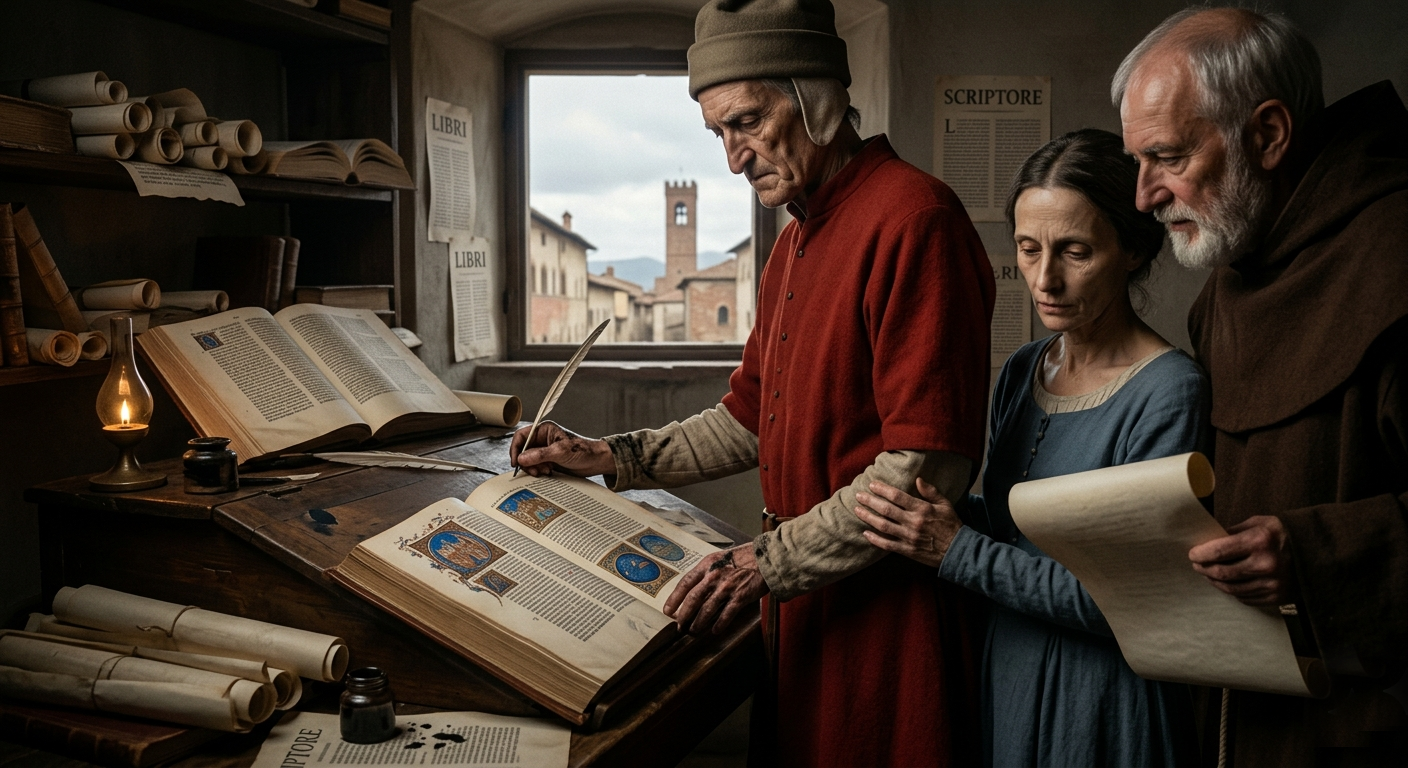
The Completion of the Divine Comedy and the Death of Dante Alighieri in September 1321
In the summer and early autumn of 1321, in the city of Ravenna in northeastern Italy, an ageing poet put the final touches to one of the greatest works in the history of human literature. Dante Alighieri, born in Florence around May 1265, had spent more than a decade composing the Divine Comedy — a visionary epic poem in three parts tracing his allegorical journey through Hell, Purgatory, and Paradise. He had begun the work during the bitterest years of his exile from Florence, had carried it with him through decades of wandering from court to court across northern Italy, and had completed the final canticle, the Paradiso, in Ravenna under the protection of Guido Novello da Polenta, the city’s ruling lord. The poem was finished. And within weeks of completing it, Dante was dead.
In August 1321, Dante had undertaken a diplomatic mission to Venice on behalf of Guido Novello da Polenta, travelling across the marshy lowlands of the Po Delta. On his return journey, he contracted what contemporaries described as quartan malaria — a form of the disease characterised by recurring fevers that struck every four days. The illness proved fatal. Dante returned to Ravenna in a deteriorating condition and died on the night of September 13 to 14, 1321, aged approximately fifty-six years old. He was attended at his deathbed by his three children — Pietro, Jacopo, and Antonia — and by friends and admirers he had gathered in Ravenna during his final years. His funeral oration was delivered by Guido Novello da Polenta himself, and Dante was buried with full honours at the Church of San Pier Maggiore in Ravenna, later called the Basilica di San Francesco. He died as an exile, never having returned to the city of Florence that had cast him out two decades before.
The coincidence of the completion of the Divine Comedy and the death of its author gives the end of Dante’s life a quality of almost mythological closure. The poem he had laboured over for so many years was his answer to exile, to grief, to political betrayal, to the death of the woman he loved, and to the moral disorder of the world he inhabited. Its last line — the Love which moves the sun and the other stars — is one of the most celebrated closing lines in all of literature. Dante was gone before the full weight of what he had made was widely understood. Within a generation, Giovanni Boccaccio would write a biography of him and lecture on his poem in the church of Santo Stefano di Badia in Florence. Within a century, the Divine Comedy was one of the most copied and commented-upon texts in the Italian literary world. Today, more than seven hundred years after Dante’s death in Ravenna on that September night in 1321, his poem remains alive in every language into which it has been translated, and his name is spoken alongside those of Homer, Virgil, and Shakespeare as one of the defining voices of Western literature.
Florence in the Thirteenth Century: The City That Made and Then Destroyed Dante
Florence in the second half of the thirteenth century was one of the most dynamic and violent cities in Europe — a wealthy mercantile republic whose cloth and banking industries had made it a financial capital of continental significance, but whose internal politics were characterised by the kind of factional ferocity that makes modern political conflict look genteel. The city was divided, as most northern and central Italian communes were, between the Guelph and Ghibelline factions: the Guelphs, who broadly supported the papacy’s political authority over Italian affairs, and the Ghibellines, who supported the Holy Roman Emperor’s claims to sovereignty over the Italian peninsula. These were not merely abstract political positions; they organised the social life, the business relationships, and the physical geography of Italian cities, with families literally killing one another in the streets over allegiances that their grandparents had first adopted.
Dante Alighieri was born into this world, most likely around May 1265, in Florence. His full baptismal name was Durante di Alighiero degli Alighieri — Durante being the formal name from which the shortened form Dante derived — though no document from his own lifetime refers to him as Durante. A document prepared for his son Jacopo identifies him as Durante, often called Dante. The Alighieri family were of lesser nobility, Guelph in their political allegiances, and of modest financial means. Dante’s mother died when he was approximately seven years old. His father, Alighiero di Bellincione, a notary and moneylender, remarried and had further children before dying when Dante was in his mid-teens. These early losses — his mother when he was barely old enough to understand death, his father before he reached adulthood — left Dante in the care of guardians and shaped the emotional landscape of a man who would spend much of his life writing about loss, exile, and the search for a love that could survive mortality.
The Guelphs of Florence had themselves fractured by the late thirteenth century into two competing factions: the White Guelphs, led by the Cerchi family and broadly opposed to excessive papal interference in Florentine civic life, and the Black Guelphs, led by Corso Donati and closely aligned with Pope Boniface VIII. Dante was firmly and vocally a White Guelph. He had enrolled in the Guild of Physicians and Apothecaries — the guild that also encompassed philosophers and which was required for participation in public life — and had built a modest but genuine political career in the city’s republican institutions. In June 1300, Dante was elected as one of Florence’s six Priors, the highest executive office in the city’s republican government. The position lasted only two months, but it placed him at the centre of a political crisis that would define the rest of his life.
Exile and the Birth of the Divine Comedy: How Political Betrayal Became Literary Immortality
In 1300 and 1301, the political situation in Florence was deteriorating with alarming speed. Pope Boniface VIII, determined to bring Florence under Black Guelph control, orchestrated a sequence of events that destroyed the White Guelph government and sent its leading figures into exile. In the autumn of 1301, Dante was part of a Florentine delegation dispatched to Rome to negotiate with the Pope regarding the city’s political future. It was a mission with an element of political entrapment: while Dante and his colleagues were in Rome, Pope Boniface detained Dante specifically, keeping him in the city while the other delegates were permitted to return. During his enforced absence, Charles of Valois — the brother of King Philip IV of France, acting in concert with Boniface — entered Florence with Black Guelph forces, who in the following six days destroyed much of the city, killed their opponents, and installed a new Black Guelph government. Cante dei Gabrielli da Gubbio was appointed as the new Lord-Mayor.
Dante, trapped in Rome and then Siena, received word that his assets had been seized by the new Florentine government and that he was considered to have absconded — to have fled the city as a criminal. In January 1302, the Black Guelph government formally condemned him and other White Guelphs to exile for two years and demanded payment of a large fine. The charges against Dante were largely fictitious: corruption, financial wrongdoing, and extortion, accusations fabricated by political enemies who had seized power and needed legal cover for the punishment of their opponents. Dante refused to pay the fine, partly because he believed himself innocent and partly because all his assets in Florence had already been confiscated. In March 1302, his sentence was escalated to perpetual exile: if he ever returned to Florence, he would be burned at the stake. He never returned. For the remaining nineteen years of his life, Dante was an exile, eating what he himself would call in the Paradiso the bitter bread of others and climbing up and down the heavy stairs of strangers’ houses.
The experience of exile was, paradoxically, the condition that made the Divine Comedy possible. Free from the day-to-day obligations of Florentine politics, immersed in philosophy and classical literature during his wandering years, burning with a combination of grief, anger, and spiritual longing that only his best poetry could contain, Dante began composing the vast poem that would become his life’s work. He began it, scholars believe, sometime around 1308, though the exact date is uncertain. By approximately 1314, the first canticle — the Inferno — was complete and beginning to circulate in manuscript copies. The Purgatorio followed in subsequent years. In 1319, Dante moved from Verona, where he had spent periods under the patronage of Cangrande della Scala, to Ravenna, where Guido Novello da Polenta offered him shelter and support. It was in Ravenna that he completed the Paradiso and, with it, the entire Divine Comedy, in approximately 1320 or early 1321, months before his death.
Beatrice Portinari: The Woman Who Became a Symbol of Divine Grace and Saved Dante’s Soul
No account of the Divine Comedy can separate the poem from the woman whose image pervades it. Beatrice Portinari was the daughter of Folco Portinari, a wealthy Florentine banker and founder of the hospital Santa Maria Nuova in Florence. According to Dante’s own account, in his autobiographical prose work La Vita Nuova, he first saw Beatrice when he was nine years old and she was eight, at a May Day celebration in Florence, and was seized immediately by a feeling of overwhelming love. She was wearing a crimson dress. He did not speak to her. Nine years later, he encountered her again on a street in Florence, wearing white, accompanied by two older women, and she greeted him — and that greeting, Dante wrote, made him feel as if he had glimpsed the outermost limit of blessedness. His love for her was entirely unconsummated — there is no evidence that they ever had any personal relationship beyond these public encounters — and it belonged entirely to the tradition of courtly love, in which a male poet exalted an idealised woman from a distance as a source of spiritual elevation.
Beatrice Portinari married a Florentine banker named Simone dei Bardi, almost certainly in an arranged marriage of the kind standard in medieval Florentine society. She died on June 8, 1290, at approximately twenty-four years of age, most likely of illness, though the specific cause is not recorded. Her death shattered Dante. He wrote about it with a grief that, in La Vita Nuova, achieves a pitch of lyrical intensity without precedent in Italian literature. He immersed himself in philosophical study in an attempt to console himself, reading Boethius’s Consolation of Philosophy and Cicero’s De Amicitia among other works, and threw himself into Florentine politics. But Beatrice never left his imagination. Over the following decade, as he rose through the city’s political institutions and built his career as one of the most respected poets of the dolce stil novo — the Sweet New Style, a movement of Tuscan poets that included Guido Cavalcanti, Lapo Gianni, and Cino da Pistoia — Beatrice remained the fixed point around which his inner life organised itself.
In the Divine Comedy, Beatrice is transformed from a historical Florentine woman into something far larger: a figure of divine revelation, theology, grace, and faith who descends from Paradise to commission Virgil as Dante’s guide and who herself guides Dante through the entire Paradiso. She represents the capacity of human love, when properly understood, to draw the soul toward God. Dante’s choice to place Beatrice in this theological role — making the specific woman he loved in life the instrument of his fictional salvation — is one of the most audacious and most moving decisions in the history of literature. It transforms a personal grief into a universal spiritual statement: that the earthly loves we carry through life are not obstacles to the divine but pathways toward it. When Dante finally sees Beatrice in the Paradiso, after years of separation and spiritual journey, the reunion is one of the most emotionally and theologically charged moments in the entire poem.
The Structure of the Divine Comedy: One Hundred Cantos, Three Realms, and the Architecture of the Medieval Universe
The Divine Comedy is a poem of extraordinary structural ambition and mathematical precision. It is composed of 14,233 lines divided into three canticles — Inferno, Purgatorio, and Paradiso — each consisting of 33 cantos, with one additional introductory canto in the Inferno that brings the total to 100. The number one hundred, symbolic of perfection and completeness in medieval numerological thought, is thus achieved through a structure built on the sacred number three — the number of the Christian Trinity — and its multiples. The verse form throughout is the terza rima, an interlocking rhyme scheme of three-line stanzas in which the middle line of each tercet rhymes with the first and third lines of the next: ABA BCB CDC DED, continuing to the end of each canto. Dante is generally credited with inventing or perfecting this verse form, and its combination of forward momentum and retrospective connection — the rhyme that looks back before moving forward — has been read as formally encoding the poem’s spiritual logic: each step of the journey requires the previous step before it can proceed.
The poem begins, famously, in the middle of things: Nel mezzo del cammin di nostra vita — Midway upon the journey of our life — the opening of the first canto that places the narrator in a dark wood, lost, assailed by three symbolic beasts (a leopard, a lion, and a she-wolf representing various forms of sin), and unable to find the straight path. The poem is set during Holy Week in the spring of 1300 — the Jubilee Year and the year Dante served as Prior of Florence — beginning on the night before Good Friday and ending on the Wednesday after Easter. This specific temporal setting is itself significant: the poem’s chronology overlaps with the events of the Passion and Resurrection of Christ, embedding Dante’s personal spiritual journey within the central narrative of Christian salvation.
The structural principle organising each of the three realms is the contrapasso — the idea, drawn partly from Aristotle’s Nicomachean Ethics and partly from Christian moral theology, that each soul’s condition in the afterlife mirrors or inverts the nature of its earthly choices. In the Inferno, the fortune-tellers who tried to see the future must walk with their heads twisted backwards, unable to see what is ahead. Gluttons lie in filth, wallowing in the excess they made their earthly purpose. Paolo and Francesca, the adulterous lovers famous from Canto V, are blown eternally together in a whirlwind — united in death as they were in life, but without the peace that earthly love briefly offers. In the Purgatorio, souls undergo active purgation of the seven deadly sins — pride, envy, anger, sloth, avarice, gluttony, and lust — progressing upward through seven terraces of a mountain rising from the Southern Hemisphere, each terrace peeling away one layer of moral disorder until the soul is ready to ascend. In the Paradiso, souls are distributed through nine concentric celestial spheres organised according to the medieval Ptolemaic cosmology — the Moon, Mercury, Venus, the Sun, Mars, Jupiter, Saturn, the Fixed Stars, and the Primum Mobile — before the pilgrim Dante ascends beyond all spheres to the Empyrean, the realm of pure divine light and love, where God himself is encountered in a final vision.
The poem is organised numerically in ways that multiply and reflect one another. The three cantiche each end with the same word: stelle, meaning stars. The three realms follow a pattern of nine levels plus one transcendent level — nine circles of Hell plus Satan at the bottom, nine rings of Purgatory plus the Garden of Eden at the summit, nine celestial spheres plus the Empyrean. The guides who accompany Dante are three: the Roman poet Virgil, the poet’s beloved Beatrice, and the Cistercian theologian Bernard of Clairvaux, each representing a distinct mode of human approach to God. Virgil, the greatest poet of pagan antiquity, represents human reason: the farthest a soul can travel by unaided intellect. Because he died before the advent of Christ and cannot be saved in the Christian theological framework Dante operates within, Virgil cannot enter Paradise, and at the boundary between Purgatory and Paradise he departs, weeping. Beatrice, the idealised beloved, represents divine revelation and theological understanding. And Bernard, the mystic, represents contemplative devotion and the final dissolution of intellectual effort in pure love.
Inferno: Dante’s Map of Hell and the Most Famous Section of the Divine Comedy
The Inferno is by far the most widely read and celebrated of the three canticles, and it is one of the most extraordinary pieces of imaginative literature in any language. It begins where all stories of moral recovery must begin: at the bottom. Dante descends through nine circles of Hell, each organised according to the severity of the sin it punishes and each populated with historical, mythological, and contemporary figures whose specific placements in the moral hierarchy of damnation constitute a sweeping, often fiercely personal commentary on the politics, religion, and culture of Dante’s world. Popes, kings, emperors, philosophers, poets, lovers, traitors, fraudsters, murderers, heretics — all find their place in Dante’s infernal geography, assigned their stations according to a moral logic derived from Aristotle, Thomas Aquinas, and Dante’s own considerable capacity for indignation.
The nine circles of Hell are organised from the least to the most grievous sins. The outermost circle, Limbo, holds virtuous pagans and unbaptised infants who, through no fault of their own, never knew Christ — figures including Virgil himself, Homer, Socrates, Plato, Aristotle, Julius Caesar, and Saladin. Their condition is one of incompleteness rather than torment: they exist in a noble castle with green meadows, in a state of intellectual fulfilment but perpetual spiritual yearning. Deeper circles hold the lustful, the gluttons, the avaricious, the wrathful, and the sullen. The sixth circle punishes heretics, who lie in burning tombs. The seventh circle is divided into three rings for three categories of violence: against neighbours, against oneself (including suicides, whose souls are imprisoned in trees), and against God and nature. The eighth circle, Malebolge — meaning Evil Ditches — contains ten concentric ditches each devoted to a different category of fraud: seducers and panderers, flatterers lying in excrement, simonists (those who traded in spiritual offices) thrust head-first into holes, false prophets with their heads reversed, corrupt politicians boiled in pitch, hypocrites in leaden robes, thieves transformed into serpents, false counsellors wrapped in flame, sowers of discord with their bodies split open, and falsifiers afflicted by disease. The ninth and lowest circle punishes traitors, divided into four rounds based on the nature of their betrayal, culminating in the frozen lake of Cocytus at the centre of which Satan himself is imprisoned, chewing the three greatest traitors in history — Judas Iscariot, who betrayed Christ, and Brutus and Cassius, who betrayed Julius Caesar.
Among the most memorable individual encounters in the Inferno are the episode of Paolo and Francesca da Rimini in the circle of the lustful — two souls who died together in adultery and who tell Dante their story, sending him into a swoon of compassion — and the episode of Ugolino della Gherardesca in the lowest circle, who gnaws on the skull of Archbishop Ruggieri, the man who imprisoned him and his sons and grandsons in a tower and starved them to death. Dante’s political enemies are scattered throughout: Pope Boniface VIII, the architect of Dante’s exile, is expected in Hell though not yet there at the poem’s 1300 setting, and Dante places him in the Malebolge among the simonists. Filippo Argenti, a Black Guelph who may have had some role in the confiscation of Dante’s property, is depicted wallowing in the river Styx, and Dante watches with grim satisfaction as other sinners tear him apart. The Inferno is, among its many other things, a work of magnificent literary revenge.
Purgatorio and Paradiso: Redemption, Ascent, and the Vision of God
If the Inferno is the most widely read canticle, the Purgatorio is often regarded by scholars as the most humanly compelling — a realm not of punishment but of active transformation, in which souls who are fundamentally oriented toward God undergo the difficult, voluntary process of purging the disordered loves that prevented them from aligning fully with divine will. The souls of Purgatory are saved; their journey through the seven terraces of the mountain is not indefinite suffering but purposeful progress toward an end they are certain to achieve. This makes the Purgatorio uniquely hopeful in tone, and many of its most beautiful episodes are infused with a quality of gentle, tender humanity that the Inferno’s spectacular horrors cannot quite encompass. The encounter with the poet Casella in Ante-Purgatory, where Dante asks his old friend to sing one of Dante’s own poems and all the assembled souls stop to listen, transported by beauty, until Cato rebukes them for their idleness, is one of the most quietly touching scenes in the entire Comedy.
In the Purgatorio, Virgil guides Dante up the seven terraces corresponding to the seven capital vices: pride, envy, anger, sloth, avarice, gluttony, and lust. On each terrace, the vice is both depicted in its most negative form and countered by examples of its opposing virtue — carved in the very floor beneath the pilgrims’ feet, or spoken aloud, or presented in visionary form. The process of purgation in each terrace is accomplished by direct confrontation with the nature of one’s own moral disorder and by the voluntary embrace of its remedy. Near the summit of the mountain, Dante passes through a wall of fire to enter the Earthly Paradise — the Garden of Eden, restored to its prelapsarian condition — where Virgil takes his leave. The appearance of Beatrice, veiled and seated on a triumphal chariot, heralds the transition from the guidance of human reason to the guidance of divine revelation. In a scene of intense emotional complexity, Beatrice speaks harshly to Dante, accusing him of having wasted his gifts and strayed from the right path after her death. His confession and contrition purge the final trace of sin from his soul. He drinks from the river Lethe, which erases the memory of sin, and then from the river Eunoe, which restores the memory of good. He is ready for Paradise.
The Paradiso is the most theologically demanding and — in the view of many readers who have persisted to its heights — the most breathtakingly beautiful of the three canticles. Guided now by Beatrice, Dante ascends through nine celestial spheres, each inhabited by souls whose particular virtues correspond to the qualities associated with that sphere’s planet or stars in the medieval Ptolemaic cosmological system. In the sphere of the Sun he meets the great theologians and philosophers, including Thomas Aquinas and Bonaventure, who discourse on wisdom and the history of Christian thought. In the sphere of Mars he encounters crusaders and martyrs, including his great-great-grandfather Cacciaguida, a crusader who died fighting for the faith, and who speaks the most explicit prophecy of Dante’s exile in the entire poem: You will try the salt of others’ bread, and know the heavy way of going up and down another’s stair. The sphere of Jupiter contains the great just rulers of history. Saturn holds the contemplatives. The Sphere of the Fixed Stars offers a vision of the entire created universe spread below. The Primum Mobile — the first moving sphere, which imparts motion to all the others — holds the angelic orders. And beyond all spheres is the Empyrean, the realm outside space and time, where the blessed are gathered in the Mystic Rose and where Dante, guided finally by Bernard of Clairvaux, receives the ultimate vision: the direct contemplation of God as three circles of light containing all things within their circumference, a vision in which he glimpses the mystery of the Incarnation — how the human and the divine are united in Christ — before the poem ends with its famous closing image of the soul’s will and desire being turned, like a wheel, by the Love which moves the sun and the other stars.
Dante’s Other Works: La Vita Nuova, De Vulgari Eloquentia, the Convivio, and the Monarchia
The Divine Comedy was the culmination of a literary career that produced several other significant works, each of which illuminates a different facet of Dante’s extraordinary range. La Vita Nuova — The New Life — written in the early 1290s and published around 1295, is the earliest of his major works and the most personal. It is a collection of thirty-one lyric poems — sonnets, ballads, and canzoni — woven together with prose commentary that explains the circumstances of each poem’s composition and its place in the story of Dante’s love for Beatrice. The prose sections are written in Italian, a choice that was at the time unusual for a serious literary work: Italian was the vernacular, the everyday spoken language, while Latin was the language of scholarship, theology, law, and serious prose writing. La Vita Nuova is thus simultaneously a love story, a technical treatise on the writing of vernacular poetry, and a document of Dante’s spiritual experience. It ends with a vow to write of Beatrice something that has never been written of any woman before — a promise that the Divine Comedy fulfils.
During his years of exile, Dante produced several major works of political and philosophical significance. The Convivio — The Banquet — was a prose work begun around 1304 and left incomplete, intended to be a kind of philosophical encyclopedia in Italian addressed to the lay reader who could not access Latin scholarship. It consists of an introductory book and three extended commentaries on three of Dante’s own canzoni, using the poems as starting points for discussions of ethics, philosophy, and the nature of the soul. The De Vulgari Eloquentia — On Eloquence in the Vernacular — written in Latin around 1304 to 1305, was a theoretical argument for the dignity and potential of the Italian vernacular as a literary language, and for the development of a refined literary Italian capable of expressing the highest levels of thought and feeling. It too was left unfinished, but its arguments about language were enormously influential on subsequent Italian literary culture. Dante’s linguistic vision — that a unified, elevated Italian could serve as both a literary language and a vehicle for cultural and political unification of the fragmented Italian peninsula — proved prophetic in ways he could not have anticipated.
The Monarchia — On Monarchy — written probably around 1318, is Dante’s most sustained work of political theory, arguing in Latin for the necessity and justice of a universal monarchy under the authority of the Holy Roman Emperor, operating independently of and co-equal with the authority of the Pope in their respective spheres of temporal and spiritual governance. The work argued against the papacy’s claim to universal temporal sovereignty — the position of Pope Boniface VIII that had driven Dante into exile — and in favour of a secular imperial authority capable of maintaining peace and justice across Christendom. Predictably, the Monarchia was condemned as heretical by the Church after Dante’s death: in 1329, Cardinal Bertrand du Pouget, acting as the representative of Pope John XXII, had the book burned and attempted to have Dante’s bones exhumed and burned as well. The bones were protected by local Ravenna authorities, but the episode illustrates how politically dangerous Dante’s ideas remained even after his death.
Dante’s Patrons in Exile: Cangrande della Scala, Guido Novello da Polenta, and the Courts of Northern Italy
Dante’s nineteen years of exile were years of constant movement and dependence on the hospitality of northern Italian lords and rulers who recognised his genius and were willing to provide him with shelter, food, and intellectual companionship in exchange for the honour of his presence at their courts. This was not an unusual arrangement in medieval Italian political culture, where poets and scholars were valued as symbols of cultural prestige and where a court that attracted important intellectual figures gained reputation and legitimacy. But for Dante, proud, politically passionate, uncompromising in his opinions and his verse, the condition of being a permanent guest and supplicant was one of deep personal humiliation — the very salt of others’ bread that Cacciaguida described in the Paradiso.
The most significant of Dante’s patrons was Cangrande della Scala, the lord of Verona, to whom Dante dedicated the Paradiso. Cangrande was born in 1291 and became the ruler of Verona in 1308, building the city’s Scaligeri court into one of the most splendid and culturally vibrant in northern Italy. He was a powerful military figure — the head of the Ghibelline league in northern Italy — as well as a generous and sophisticated patron of arts and letters. Dante spent at least two extended periods at his court, benefiting from his protection and engaging in the intellectual discussions that the court attracted. A celebrated letter attributed to Dante, the Epistola a Cangrande, is addressed to Cangrande and provides an elaborate allegorical reading of the opening of the Paradiso, explaining the poem’s four levels of meaning: literal, allegorical, moral, and anagogical. The authenticity of this letter has been debated by scholars, but it remains one of the most important documents for understanding how Dante intended his poem to be read.
Dante’s final patron was Guido Novello da Polenta, the lord of Ravenna and a nephew of the remarkable Francesca da Rimini who appears in the Inferno’s fifth canto as the adulterous lover blown in the whirlwind. This biographical connection between Dante’s patron and one of the poem’s most celebrated characters adds a layer of personal and historical complexity to the last years of Dante’s life that later centuries found endlessly fascinating. Guido Novello was himself a poet and a man of genuine literary sensitivity, and he welcomed Dante warmly when the poet arrived in Ravenna in 1319. It was under his patronage that Dante completed the Paradiso, and it was Guido Novello who arranged and presided over Dante’s burial at Ravenna’s Church of San Pier Maggiore in September 1321, delivering the funeral oration himself. The debt of gratitude that Ravenna felt toward Dante endured: when Florence repeatedly requested the return of the poet’s remains in subsequent centuries, Ravenna refused, and Dante’s bones remain in Ravenna to this day.
The Italian Language and Dante’s Revolutionary Choice to Write in the Vernacular
One of the most consequential decisions Dante made in composing the Divine Comedy was not a matter of theology or structure but of language. He chose to write his great poem not in Latin — the universal language of the educated European Church and the language in which all serious philosophical, theological, and scientific discourse was conducted in the medieval period — but in the Tuscan vernacular, the spoken Italian of Florence and its surrounding region. This decision was at once a deliberate artistic choice, a political statement, and a cultural vision. In making it, Dante helped establish the Tuscan dialect as the foundation of what would become the standard Italian literary language, earning him the title by which he has been known for centuries: the Father of the Italian Language.
The reasons for the choice were both principled and practical. In his De Vulgari Eloquentia, Dante had already argued theoretically for the dignity of the vernacular as a literary language, contending that a refined Italian — drawing on the best elements of the various Italian dialects rather than merely reproducing any single regional speech — was capable of expressing the highest levels of thought and beauty. Writing the Divine Comedy in Tuscan Italian was the practical demonstration of this argument: by composing the most ambitious and philosophically serious literary work in Italy in the vernacular rather than in Latin, Dante proved by example that the vernacular was up to the task. He also, in the process, created a model of Italian literary excellence so authoritative that subsequent generations of Italian writers — including Petrarch and Boccaccio, who together with Dante form the triumvirate of the Italian literary tradition — oriented their own linguistic choices in relation to his.
The significance of writing in Italian extended beyond the literary. Latin was the language of the Church and of a clerical and scholarly elite. Writing in Italian meant writing for the merchant, the artisan, the soldier, the woman who had not received a Latin education — writing, in other words, for the entire literate population of Italy rather than a learned minority. Dante’s poem could be read aloud in public squares, in courts, in workshops, in the homes of the prosperous middle class that Florentine economic expansion had created. This democratisation of access to profound philosophical and theological content was unprecedented. That Dante was also, simultaneously, creating the most technically sophisticated poem in the language — the most precisely structured, the most philosophically dense, the most linguistically inventive — made the achievement doubly remarkable. He did not simplify; he elevated.
The Medieval Cosmology and Theology Behind the Divine Comedy: Aristotle, Aquinas, and the Christian Universe
The Divine Comedy is not merely a poem but a cosmological and theological system, and understanding it requires at least a basic grasp of the intellectual framework within which Dante was working. That framework was the synthesis of classical Greek philosophy and Christian theology that reached its most systematic expression in the Summa Theologica of Thomas Aquinas, the Dominican friar and philosopher who died in 1274, when Dante was about nine years old, and whose influence on the Divine Comedy has led scholars to call the poem a Summa in verse. Aquinas had achieved a brilliant and comprehensive reconciliation of Aristotle’s philosophy — particularly his logic, ethics, and natural philosophy — with the doctrines of Catholic Christianity, producing a theology that could engage with the full range of human intellectual enquiry while maintaining the primacy of revealed truth.
Dante’s cosmology in the Divine Comedy is Ptolemaic and Aristotelian: the Earth sits at the centre of a series of concentric spheres, each corresponding to one of the classical planets and the Fixed Stars, with the Primum Mobile — the outermost sphere — imparting motion to all the rest, and beyond it the Empyrean, the timeless, spaceless realm of pure divine presence. Hell is located beneath the surface of the northern hemisphere of the Earth, a vast inverted cone whose apex is at the centre of the Earth where Satan is imprisoned. Mount Purgatory rises from the southern hemisphere, diametrically opposite Jerusalem, formed from the earth displaced when Satan fell. Paradise encompasses the celestial spheres. This geography is not arbitrary decoration but a structural expression of Dante’s moral philosophy: Hell is below, the realm of disorder and love corrupted or refused; Paradise is above, the realm of love properly ordered and perfectly fulfilled; and Purgatory is the active space in between, where the soul labours upward from the one toward the other.
Dante’s relationship to Aristotle is complex and admirably critical. He places Aristotle in the Limbo of virtuous pagans — il maestro di color che sanno, the master of those who know — honouring him profoundly while registering the theological inadequacy of a philosophy that reached the limits of human reason without access to revealed truth. He draws on Aristotle’s ethics for the organisation of the Inferno, using the Aristotelian categories of incontinence, violence, and fraud as the broad framework for the descending circles of sin. He uses Aristotelian physics and metaphysics throughout the Paradiso, where Beatrice and Thomas Aquinas explain the nature of light, movement, free will, and the structure of the blessed. But he consistently places revealed theology above philosophical reason: Virgil, the representative of human philosophy and poetry at their highest, cannot enter Paradise because he lived before Christ. Human wisdom reaches only so far; beyond that boundary, only faith and grace can carry the soul.
Dante’s Legacy in Literature, Art, and Culture: From Boccaccio to T.S. Eliot and Beyond
The impact of the Divine Comedy on subsequent literature, art, music, and culture is so vast that any account of it must be selective. Giovanni Boccaccio, the author of the Decameron and one of the three foundational figures of Italian literature alongside Dante and Petrarch, was among the earliest and most fervent champions of Dante’s work. Boccaccio wrote the first major biography of Dante, the Trattatello in laude di Dante — A Treatise in Praise of Dante — between 1351 and 1355, in which he introduced the adjective Divina to describe the Comedy, giving the poem the name by which it has been known ever since. In 1373, responding to a petition from Florentine citizens, Boccaccio gave a celebrated series of public lectures on the Divine Comedy at the church of Santo Stefano di Badia in Florence — the first public commentary on the poem in the city that had exiled its author. By 1400, at least twelve substantial commentaries on the Divine Comedy had been written, a testament to the speed with which the poem had established itself as the central monument of Italian literary culture.
The influence of the Divine Comedy on Renaissance painters was enormous and enduring. Botticelli produced a series of illustrations for the poem in the 1480s and 1490s, commissioned by Lorenzo di Pierfrancesco de’ Medici and constituting one of the most sustained visual engagements with the work in art history. The Sistine Chapel frescoes by Michelangelo show elements that scholars have connected to Dantesque imagery, particularly in the Last Judgment. Raphael, Signorelli, and dozens of other Renaissance painters drew on the Divine Comedy for imagery, characterisation, and theological iconography. The nineteenth century produced a particularly rich vein of Dantesque art: Gustave Doré’s engravings for the Inferno, published in 1861, became the most widely reproduced visual interpretation of the poem and shaped how readers visualised Hell for generations. Auguste Rodin’s The Gates of Hell, the monumental sculptural project on which he worked from 1880 until his death in 1917, was directly inspired by the Inferno. William Blake’s illustrations for the Divine Comedy, commissioned in the last years of his life and left incomplete at his death in 1827, are among the most visionary works of Romantic-era art.
In literature, the influence of Dante on English-language writing alone runs from Chaucer and Milton through to the Romantic poets and the entire modernist movement. T.S. Eliot, who described Dante as the most universal poet of the modern world and placed him alongside only Shakespeare as dividing the literary world between them, drew pervasively on the Divine Comedy in The Waste Land (1922), and his essay Dante (1929) remains one of the most acute critical engagements with the poem in English. The opening of Eliot’s Four Quartets — In my beginning is my end — resonates with the Dantesque sense of the journey that must begin at the bottom before it can ascend. James Joyce drew on Dante’s structural thinking in Ulysses and Finnegans Wake. Samuel Beckett, Jorge Luis Borges, Primo Levi — all wrote in the shadow of Dante’s great poem. In Italian literature, the lineage from Dante through Petrarch and Boccaccio to Ariosto, Tasso, Leopardi, and beyond constitutes the spine of the entire literary tradition. When Italy adopted a standard national language in the nineteenth century at the time of unification, it was substantially Dante’s Tuscan that became the basis for that language — fulfilling, seven centuries later, the linguistic vision that Dante had articulated in the De Vulgari Eloquentia.
Florence’s Long Regret: The Empty Tomb, Ravenna’s Defiance, and Dante’s Contested Remains
Dante died in Ravenna having never returned to the city that condemned him to perpetual exile. Florence, which had threatened to burn him at the stake if he came home, came in time to understand what it had lost — and to want back what it could not have. The relationship between Florence and the remains of its greatest poet became one of the most protracted and unusual disputes over cultural heritage in European history, lasting from the fifteenth century to the present day, with the bones of Dante still resting in Ravenna and the tomb Florence built for him remaining empty.
Bernardo Bembo, the praetor of Venice, erected a tomb for Dante in Ravenna in 1483, honouring the poet’s burial site at the church near San Pier Maggiore. Florence made its first formal request for Dante’s bones around the same period, but Ravenna refused. In 1519, Pope Leo X — himself a Medici, from the ruling family of Florence — made an official request for the return of Dante’s remains to Florence, with Michelangelo offering to design a fitting tomb. Ravenna refused again. In 1781, a neoclassical mausoleum was built beside the Basilica di San Francesco to contain Dante’s sarcophagus, further cementing Ravenna’s custodianship. In the twentieth century, Florence finally built the tomb it had long promised: in the Basilica di Santa Croce, where many of Italy’s greatest figures are buried, there stands a monument to Dante with the inscription Onorate l’Altissimo Poeta — Honor the Most Exalted Poet, a quotation from the Inferno — but the tomb has no body in it. It is a cenotaph, a memorial without remains.
There is one further episode in the extraordinary afterlife of Dante’s bones. During the First World War, fearing that Ravenna might be bombed, the authorities concealed Dante’s sarcophagus in a false wall within the monastery garden adjacent to the mausoleum. The bones remained hidden throughout the war and for some time afterward. When they were recovered and formally reinterred, they were found to be in good condition and to match the historical record of Dante’s physical description. In 2008, the municipality of Florence formally apologised for its expulsion of Dante more than 700 years earlier — an apology that, while coming somewhat late, at least acknowledged the historical record with the candour that the city had long resisted. In 2021, a symbolic re-trial was held virtually in Florence to posthumously clear Dante’s name of the charges on which he had been convicted in 1302. It was a gesture of cultural reparation — inadequate, of course, to undo anything — but telling of the degree to which Dante remains a living presence in Italian culture, a figure whose personal fate still carries moral and civic weight.
Dante and the Political Vision of the Divine Comedy: Power, Corruption, and the Moral Order of the Universe
The Divine Comedy is not merely a spiritual autobiography or a theological treatise in verse; it is also one of the most comprehensive and vehement works of political commentary ever written. Dante was, before he was exiled, a politician — a man of genuine public engagement who had held the highest executive office in his city’s republican government — and the bitterness of his political experience infused the poem with a passionate, detailed, often savage engagement with the public affairs of his time. Popes, emperors, kings, city rulers, traitors, fraudsters, and corrupt officials fill the poem’s three realms, each placed by Dante with a precision that constitutes a running moral verdict on the political history of medieval Italy and of Christendom more broadly.
Dante’s central political conviction, elaborated most fully in the Monarchia and dramatised throughout the Divine Comedy, was that the papacy’s claim to universal temporal authority was both morally wrong and historically destructive. Pope Boniface VIII — the man most directly responsible for Dante’s exile — is condemned in the Inferno to the pit of the simonists, thrust head-first into a hole with flames burning on his feet, waiting to be pushed deeper when the next corrupt pope arrives. Pope Nicholas III is already there below him. The prophecy in the Inferno that Boniface’s successor Clement V — who moved the papacy to Avignon — will make his hellish predecessor’s position even worse is one of the poem’s most pointed political moments. The corruption of the Church by worldly power and financial greed is a theme that runs through all three canticles, from the corrupt clergy in Hell to the prophetic laments of Beatrice and others in the Paradiso for the state of the Church in Dante’s own time.
But Dante’s political vision was not merely a vehicle for personal revenge. It was grounded in a coherent philosophy of history and governance. He believed that God had ordained the Roman Empire as the temporal authority through which human civilisation was to be governed in preparation for salvation, and that the papacy’s interference in temporal affairs had disrupted the divinely ordained order that the Roman Empire’s successor — the Holy Roman Empire — was meant to maintain. His hope, repeatedly expressed in both the poem and the Monarchia, was for an emperor who would restore proper governance to a world torn apart by factional conflict. The election of Henry VII of Luxembourg as Holy Roman Emperor in 1308 had briefly rekindled this hope; Dante addressed a rapturous letter to him as the saviour of Italy. Henry VII’s death in 1313 extinguished it. But the vision persisted in the poem, in the words of Dante’s ancestor Cacciaguida and in the final cantos of the Paradiso, as an eschatological aspiration rather than an immediate political expectation.
Seven Centuries Later: Why Dante Alighieri and the Divine Comedy Still Matter
Dante Alighieri died in Ravenna on September 14, 1321, having completed, in the final months of his life, one of the greatest works of human imagination. He was fifty-six years old, an exile for nineteen years, and he had spent the last two decades of his life writing a poem that synthesised medieval theology, Aristotelian philosophy, classical poetry, personal grief, political rage, and visionary spirituality into a single sustained act of literary creation unlike anything that had existed before it. The Divine Comedy is simultaneously a map of the medieval universe and an autobiography of the human soul, a work of theological speculation and a work of intensely personal feeling, a political tract and a love poem, a theological summa and an aesthetic achievement of the first order.
The continuing vitality of the Divine Comedy across seven centuries is one of the most remarkable phenomena in the history of literature. The poem’s surface is anchored in a world remote from modern experience — a medieval cosmology, a scholastic theology, a Florentine political landscape of bewildering complexity — yet its deepest concerns are as immediate now as they were in 1321: the nature of justice and mercy, the relationship between love and knowledge, the possibility of spiritual transformation, the question of what constitutes a life well or badly lived. Dante’s decision to place himself, by name, at the centre of the poem — to make the poet’s journey through the afterlife the vehicle for all this theological and philosophical content — was a gesture of extraordinary personal courage and literary audacity. It means that the poem can never be purely abstract; it is always also the record of a particular human being’s attempt to understand the world and his place in it.
In 2021, the seven-hundredth anniversary of Dante’s death was commemorated across Italy and around the world with exhibitions, lectures, readings, new translations, and public events that drew unprecedented popular engagement with his work. Pope Francis issued an apostolic letter honouring Dante as a prophet of hope — a characterisation that captures something essential about the poem’s ultimate movement, from the dark wood of sin and confusion at its opening to the blinding light of divine love at its close. T.S. Eliot’s characterisation of Dante and Shakespeare as dividing the modern world between them — with no third — remains the most economical statement of Dante’s place in the literary canon. More than seven centuries after he died in Ravenna, having completed a poem he had laboured over for more than a decade of bitter exile, Dante Alighieri continues to guide readers through the moral and spiritual landscapes of existence, a voice from the fourteenth century that speaks, unmistakably, to the twenty-first.