On June 1, 2009, at approximately 11:14 p.m. local time in Brazil, air traffic controllers on both sides of the Atlantic lost contact with Air France Flight 447. The Airbus A330 was carrying 216 passengers and 12 crew members from Rio de Janeiro to Paris. There was no distress call. There were no witnesses. One of the safest aircraft types in commercial aviation had simply vanished over one of the most remote stretches of ocean on earth.
What followed was two years of agonizing uncertainty, one of the most expensive and technically challenging search operations in aviation history, and eventually a final investigation report that exposed a catastrophic failure not of technology alone, but of the relationship between human pilots and the increasingly automated systems that surrounded them. All 228 people on board died. The word “stall” sounded in their cockpit 75 times in the final minutes. None of the pilots, apparently, understood what it meant for what they needed to do next.
The Flight and the Aircraft: Background on Air France 447
Air France Flight 447 was a scheduled overnight transatlantic service operating between Rio de Janeiro Galeão International Airport and Paris Charles de Gaulle Airport. The route was approximately 5,000 nautical miles and typically took around eleven hours. The aircraft assigned to the flight was an Airbus A330-203 registered F-GZCP, nicknamed “Ville de Rio de Janeiro.” It had entered service on February 25, 2005, and was 4.3 years old at the time of the accident, well within its normal operational lifespan. The A330 had an excellent safety record. Since its commercial introduction in 1994, it had never been involved in a fatal accident as a commercial flight.
The flight crew for the journey consisted of three pilots, a standard arrangement for long-haul flights that require pilots to rotate rest periods during the crossing. Captain Marc Dubois was 58 years old, a veteran pilot with nearly 11,000 total flying hours and extensive experience on the A330 type. He was the most experienced member of the crew. First Officer David Robert was 37, a pilot who had trained at Air France and had since moved into an executive position within the airline, but was serving on this flight to maintain his type rating on the A330. First Officer Pierre-Cédric Bonin was 32, the youngest and least experienced of the three, with approximately 2,000 flying hours. He had been described as having come up through Air France’s in-house training program and was, informally, known within the airline as the “company baby.”
Nine cabin crew members and 216 passengers from 33 different countries completed the manifest. The flight departed Rio de Janeiro at 7:29 p.m. local Brazilian time on the evening of May 31, 2009, which was 22:29 UTC. It climbed to its cruising altitude of 35,000 feet, known in aviation parlance as Flight Level 350, and set course northward across the Atlantic.
The Known Problem That Was Never Fixed: Pitot Tubes and Ice
At the heart of the disaster was a component called the pitot tube. Pitot tubes are small L-shaped metal probes mounted on the exterior of an aircraft that measure airspeed by detecting the pressure differential between the air hitting the probe head-on and the ambient atmospheric pressure. This measurement is fundamental to flight: it tells pilots and autopilot systems how fast the aircraft is moving through the air, which in turn determines whether the wings are generating sufficient lift and whether the aircraft is flying within its safe operating envelope.
The A330 was equipped with three pitot tubes, manufactured by Thales, a French aerospace company. In certain atmospheric conditions, particularly when flying through areas of dense ice crystals rather than liquid water droplets, the internal channels of these probes could become temporarily blocked, producing false or contradictory airspeed readings. This was a known issue. Airbus had recommended in September 2007 that airlines replace the older Thales pitot tubes on their A320, A330, and A340 aircraft with a newer, improved model that was more resistant to ice crystal accumulation.
Air France had ordered the replacement probes. The first aircraft in their A330 fleet was retrofitted on May 30, 2009, the day before Flight 447 departed Rio de Janeiro. The replacement work on F-GZCP, the aircraft assigned to Flight 447, had not yet been carried out. The old probes were still in place. The maintenance schedule had planned the work for the following week.
Into the Storm: The Intertropical Convergence Zone
The Intertropical Convergence Zone, known by meteorologists as the ITCZ, is a band of intense atmospheric activity that runs roughly parallel to the equator. It forms where the trade wind systems of the northern and southern hemispheres meet, creating a region of warm, rising air, dense cumulonimbus cloud formations, powerful thunderstorms, heavy turbulence, and exactly the kind of atmospheric icing conditions that could block pitot tubes. The ITCZ was a regular feature of the Rio de Janeiro to Paris route, and Air France crews were trained and equipped to navigate around its most intense weather cells.
Captain Dubois handed over control of the cockpit at approximately 02:02 UTC on June 1 and went to the crew rest area to take his mandatory rest break, leaving Bonin as the pilot flying and Robert as the pilot not flying in the monitoring role. Dubois had mentioned to crew members that he had only managed about one hour of sleep before the flight. At 02:06 UTC, Bonin warned the cabin crew over the intercom that they were about to enter a zone of turbulence.
The aircraft encountered icing conditions and what the cockpit voice recorder described as sounds similar to hail or graupel striking the exterior of the aircraft. Ice crystals began accumulating inside all three pitot tubes simultaneously. At 02:10:05 UTC, the airspeed readings from the three probes became contradictory and unreliable. The fly-by-wire autopilot system, which requires consistent airspeed data to function, automatically disengaged. The autothrust systems cut off three seconds later. The aircraft transitioned from its normal “normal law” fly-by-wire mode, which includes extensive automated flight envelope protections, into the degraded “alternate law 2” mode, in which many of those protections were suspended and the aircraft became more sensitive to pilot inputs.
Bonin took manual control. The pitot tube blockage itself lasted less than one minute. The airspeed indication anomaly was a relatively minor technical event, one that the aircraft was designed to handle and that trained pilots were expected to manage.
Four Minutes and Twenty-Three Seconds: The Final Descent
What happened in the cockpit over the next four minutes and twenty-three seconds has been analyzed and debated by aviation experts, psychologists, human factors specialists, and pilots around the world ever since the flight recorders were finally recovered and read in 2011. The analysis represents one of the most instructive and disturbing case studies in the history of aviation human factors research.
As the autopilot disconnected and turbulence began to affect the aircraft, Bonin reacted with what the BEA described as an “abrupt” and “unnecessary and excessive” control input: he pulled back on his side-stick, raising the aircraft’s nose. This caused the A330 to climb steeply, from 35,000 feet to approximately 38,000 feet, while simultaneously exceeding the aircraft’s critical angle of attack, the angle at which the wings can no longer generate adequate lift. The aircraft entered an aerodynamic stall.
The stall warning system activated at 02:10:16 UTC, just eleven seconds after the autopilot disconnected. It sounded the alert “STALL” repeatedly. Over the course of the next several minutes, the stall warning would sound 75 times. At certain moments the warning fell silent, not because the stall had been corrected, but because the aircraft’s speed had dropped so low that the flight computer itself considered the airspeed data unreliable and temporarily suspended the warning, a design characteristic that deeply confused the situation. When the warning resumed, Bonin’s panic deepened rather than resolved.
The correct response to a high-altitude stall is to lower the nose, reducing the angle of attack, allowing airspeed to recover and lift to be restored. This response is counterintuitive for a pilot whose aircraft appears to be descending, and who instinctively wants to pull up. Bonin kept pulling the nose up throughout the entire event. Robert, the other pilot on the flight deck, attempted to take control on two occasions, but the Airbus side-stick design means that both pilots can make simultaneous inputs that cancel each other out, and neither pilot can directly see or feel what the other is doing with their stick. This created a situation in which the two pilots were effectively working at cross-purposes without either being fully aware of it.
Captain Dubois returned to the cockpit at 02:11:43 UTC, but he entered a situation so chaotic and confusing, with multiple alarms sounding simultaneously, contradictory instrument readings, and two co-pilots making opposing control inputs, that he could not orient himself to what was happening in time to intervene effectively.
At 02:13:39 UTC, just 49 seconds before impact, Robert said “Climb, climb, climb, climb.” Bonin responded, “But I’ve been max nose up for a while.” It was at this moment that Dubois began to understand that Bonin had been holding the nose up the entire time. Dubois shouted, “No, no, no, don’t climb.” Robert told Bonin to give up the controls. At 2,000 feet, the Ground Proximity Warning System began continuously sounding “PULL UP.” Bonin, apparently hearing this and reverting to instinct, pulled full nose-up deflection on the side-stick one final time. One of the pilots said “We’re going to crash.” Another said “It’s not possible.” At 02:14:28 UTC, Air France Flight 447 struck the surface of the Atlantic Ocean at 152 knots, descending at a rate of 10,912 feet per minute. The aircraft was fully intact at the moment of impact. There was no fire, no explosion. The crash was not survivable.
The Britannica account of what happened to Air France Flight 447 provides a thorough reconstruction of the final minutes and the investigation that followed, available at the Britannica entry on Air France Flight 447.
The Search: Two Years on the Ocean Floor
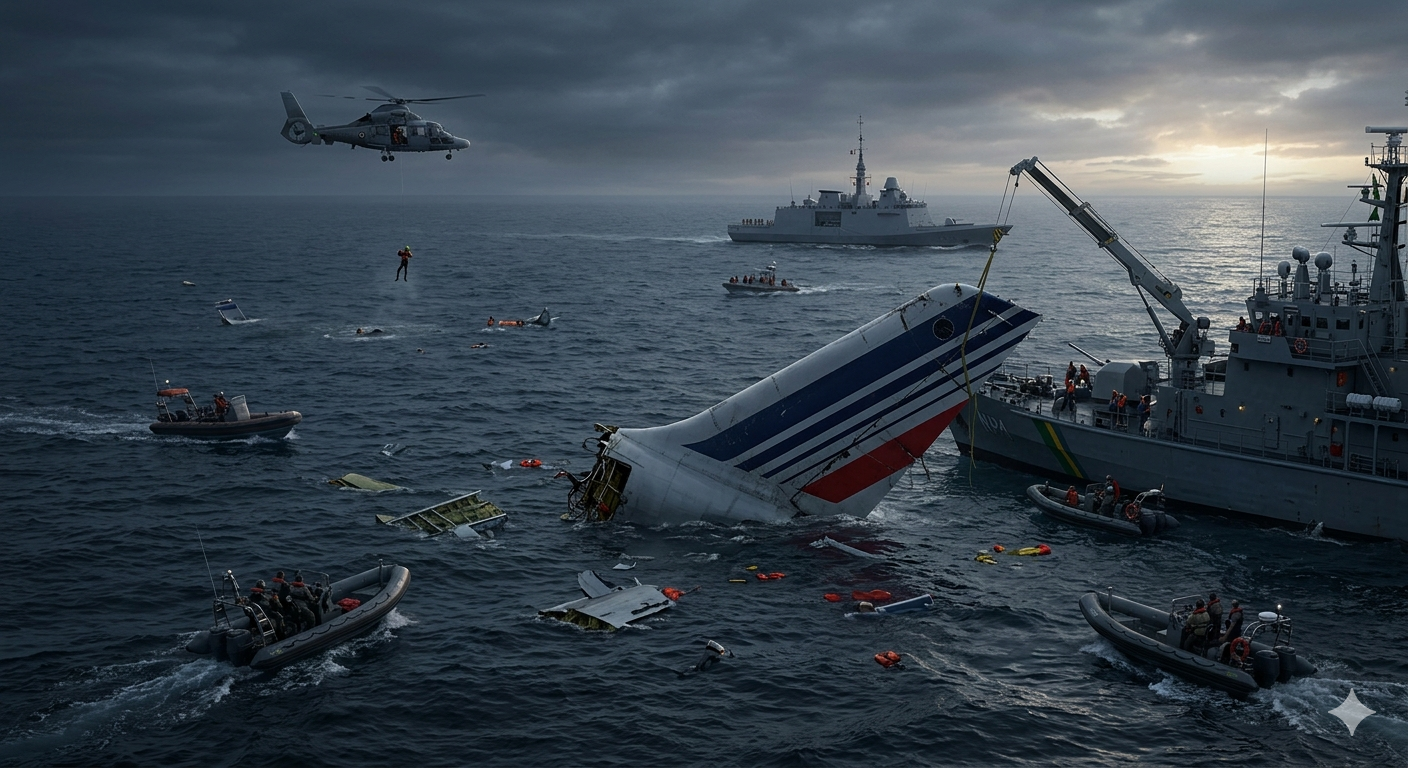
Brazilian aircraft spotted an apparent oil slick and light debris floating in the Atlantic on June 2, 2009. On June 6, two bodies were recovered, along with personal effects. On June 7, the aircraft’s vertical stabilizer, a large section of the tail, was found floating on the surface. By the end of June, search teams had recovered more than 600 pieces of debris and the bodies of 50 victims, including Captain Marc Dubois. The main wreckage and, critically, the two black boxes containing the flight data recorder and cockpit voice recorder, could not be located.
The search that followed was one of the most ambitious and expensive underwater operations in history. Four separate search phases were conducted between 2009 and 2011, using specialized sonar vessels, autonomous underwater vehicles, remotely operated submersibles, and the combined analytical expertise of oceanographers from France, Russia, Great Britain, and the United States. The ocean floor in the area of the crash reaches depths of approximately 3,900 to 4,700 meters, roughly 2.5 to 3 miles below the surface. The total search area eventually covered more than 6,300 square kilometers.
On April 2, 2011, during the fourth search phase, sonar imaging detected a large debris field on the ocean floor. On April 3, a submarine equipped with cameras reached the field and returned images that ended the uncertainty: the wreckage of Air France Flight 447 lay scattered across the abyssal plain, four kilometers beneath the Atlantic. The flight data recorder was recovered on April 26, 2011. The cockpit voice recorder was found on May 2, 2011. A further 104 bodies were recovered from the ocean floor during this phase. The remaining 74 victims were never found.
The BEA Final Report: What the Investigation Concluded
France’s Bureau of Enquiry and Analysis for Civil Aviation Safety, the BEA, released its final report at a press conference on July 5, 2012. The report was the product of nearly three years of investigation following the recovery of the flight recorders and drew on analysis of both the physical wreckage and the full data from the cockpit voice recorder and flight data recorder.
The BEA identified a chain of contributing factors rather than a single cause. The triggering event was the temporary obstruction of the pitot tubes by ice crystals, which produced inconsistent airspeed readings and caused the autopilot to disengage. The blockage lasted less than a minute. On its own, it was not a catastrophic failure and had been handled by crews on other aircraft without incident.
What made it catastrophic was the response. The BEA found that Bonin’s initial control inputs, pulling the nose up rather than maintaining level flight, induced the aerodynamic stall from which the aircraft never recovered. The crew never correctly identified the stall. The crew did not perform the appropriate recovery maneuver. The stall warning sounded 75 times and was never acknowledged or acted upon correctly.
The report identified inadequate pilot training as a central factor. Neither Bonin nor Robert had received any training in how to manage an unreliable airspeed indication at cruise altitude, or how to manually fly the aircraft under such conditions. Neither pilot had ever been trained on high-altitude stall recovery procedures. The BEA’s chief investigator, Alain Bouillard, specifically questioned what he called the “piloting culture” at Air France, and noted that if Captain Dubois had remained at the controls through the ITCZ rather than taking his rest break, his experience might have changed the outcome.
The BEA also noted the design of the Airbus side-stick controls as a contributing concern. Because the two pilots’ side-sticks are not mechanically linked, and because there is no tactile feedback between them, a pilot cannot feel what the other is doing. The report did not formally classify this as a cause of the accident, but aviation safety experts around the world identified it as a significant human factors issue.
The BEA’s findings in the final report on Air France Flight 447 are documented in full at the Wikipedia entry on Air France Flight 447.
Legal Consequences: Air France, Airbus, and the Manslaughter Investigations
Both Air France and Airbus were placed under formal investigation for manslaughter in France in 2011. The investigations examined whether the airline had failed to adequately train its pilots for scenarios involving equipment failure, and whether Airbus had failed to respond quickly enough to the known pitot tube icing problem.
In 2019, French prosecutors recommended dropping the manslaughter case against Airbus but proceeding against Air France, arguing that the airline had been aware of the pitot tube problem and had failed to train its pilots to handle the consequences of sensor failure adequately. Air France contested those recommendations. The case proceeded through the French judicial system. In November 2021, a French court acquitted both Air France and Airbus of manslaughter charges, ruling that while negligence existed, a direct causal link between the companies’ actions and the crash could not be established with sufficient certainty to support criminal conviction.
Safety Changes: What Air France 447 Changed About Aviation
The accident produced a cascade of safety improvements that have affected commercial aviation globally. Airbus and other manufacturers accelerated the replacement of older pitot tube designs with more ice-resistant models. New requirements were introduced for pilots to receive training specifically in unreliable airspeed scenarios at cruise altitude, a gap in training that the accident had dramatically exposed. High-altitude stall recovery training was added to recurrent pilot training requirements for Airbus operators and eventually across the industry more broadly.
The underwater locator beacons fitted to black boxes, which emit signals to help rescuers locate them on the ocean floor, had a battery life of 30 days at the time of the accident. This was significantly insufficient given that it took nearly two years to find the wreckage of Flight 447. Following the accident, regulations were changed to extend the minimum transmission duration for these beacons to 90 days.
The accident also intensified a broader debate about what aviation researchers call the “automation paradox”: the concern that highly automated flight systems, by handling the vast majority of routine flying tasks, gradually reduce pilots’ opportunities to practice and maintain manual flying skills. When automation unexpectedly fails or disengages, pilots may find themselves unprepared to take over. Air France 447 became the defining case study in that debate, and its lessons drove a global reassessment of how pilots are trained to manage the boundary between automated and manual control.
The National Transportation Safety Board’s resources on the broader issues of automation dependence in modern aviation, which the Air France 447 accident brought to international attention, are available through NPR’s reporting on the final BEA crash report findings.
The 228 people aboard Air France Flight 447 came from 33 countries and boarded what was statistically among the safest forms of transportation in human history. Their deaths, in four minutes over a dark and empty Atlantic, revealed not a failure of the aircraft but a failure of the system that surrounds it: the training that prepares pilots to fly it, the protocols that govern their coordination in the cockpit, and the design decisions that shape what pilots can and cannot perceive and do when everything that was supposed to work simply stops.