On the morning of April 3, 1882, in a rented house at 1318 Lafayette Street in St. Joseph, Missouri, Jesse Woodson James — the most wanted outlaw in America, the man whose name had been synonymous with bank robbery, train robbery, and frontier defiance for more than fifteen years — was shot in the back of the head by a 20-year-old member of his own gang. He was standing on a chair, adjusting a dusty picture frame on the wall of his own parlor, unarmed, his back turned to the two brothers he believed were his most loyal remaining associates. Robert Ford fired a single .44-caliber round into the base of Jesse James’s skull. The most dangerous man in the American West died on his living room floor at the age of 34 without drawing a weapon, without a chance to defend himself, killed not in a blazing gunfight but in what his admirers immediately and permanently condemned as a cold-blooded act of treachery.
The death of Jesse James was not merely the end of a criminal career. It was a cultural earthquake that reverberated across American society in ways that few deaths in the nation’s history have equaled. Jesse James had been more than an outlaw — he had been a myth, a legend, a projection of the grievances and fantasies of a society still wrestling with the aftermath of the Civil War, the transformation of the frontier, and the rising power of banks and railroads. His death created another myth: that of the noble outlaw betrayed, gunned down from behind by a coward motivated by money, his murderer condemned by the very people who had presumably wanted him caught. Robert Ford, who had expected to be celebrated as a hero, instead became ‘the dirty little coward who shot Mr. Howard’ in the words of the folk ballad that would be sung around campfires and in saloons for decades to come. Jesse James had achieved a kind of immortality that his killer would never escape.
Missouri’s Borderlands: The World That Made Jesse James
To understand Jesse James, it is essential to understand the specific world that produced him: the border country of western Missouri and eastern Kansas in the decade before and during the Civil War. This was a region torn apart by the deepest ideological and personal conflicts in American history, a landscape where neighbor killed neighbor over slavery, where federal authority and Confederate sympathy existed in violent proximity, and where the distinction between soldier, guerrilla, and outlaw was perpetually blurred. The James family lived in Clay County, in the heart of what was called ‘Little Dixie’ — a stretch of Missouri settled predominantly by families from the upper South, who had brought with them the culture, the economics, and the racial attitudes of the slaveholding states.
Jesse Woodson James was born on September 5, 1847, near Centerville (present-day Kearney) in Clay County, Missouri. His father, the Reverend Robert Sallee James, was a Baptist minister who helped found William Jewell College in Liberty, Missouri — a man of education and local standing who owned several enslaved people and was, by the standards of his community, a respected member of the propertied class. In 1850, Reverend James left for California to preach to Gold Rush miners and never returned, dying of cholera that same year. Jesse was three years old when his father died, leaving his mother Zerelda Elizabeth Cole James — a formidable, fiercely opinionated woman who would prove to be the most important single influence in his life — to raise her children largely alone. She would later marry twice more, the second time to a physician named Reuben Samuel, who became the boys’ stepfather and who would himself become a victim of the violent forces unleashed by his stepsons’ careers.
Jesse’s older brother Frank—Alexander Franklin James, born January 10, 1843 — set the template for Jesse’s path. The eruption of the Civil War in 1861 immediately thrust Missouri into a savage internal conflict. The state officially remained in the Union, but its population was deeply divided, and in the western counties the war took the form of irregular guerrilla warfare of exceptional brutality on both sides. Frank James joined the pro-Confederate guerrilla forces operating in Missouri, eventually riding with the most feared guerrilla leader of the border war: William Clarke Quantrill, whose Raiders conducted some of the most violent actions of the entire conflict. On August 21, 1863, Frank participated in Quantrill’s raid on Lawrence, Kansas — a center of abolitionist sentiment and Union support — in which approximately 200 unarmed men and boys were murdered and 180 buildings burned. This was not a military engagement; it was a massacre, and Frank James was part of it.
The Making of an Outlaw: Jesse James at War and the Centralia Massacre
Jesse James joined the Confederate guerrilla forces in the spring of 1864 at the age of sixteen, when Union militia came to the family farm looking for information about Frank’s guerrilla activities. The soldiers beat Jesse in a field, reportedly whipping his back until, in the words of one account, it looked ‘like geography.’ They also strung up Jesse’s stepfather Reuben Samuel repeatedly from a tree, nearly killing him before extracting information. The family was subsequently exiled from Clay County by Union authorities. Jesse, nursing his wounds and his fury, went to join his brother riding with William ‘Bloody Bill’ Anderson — a former lieutenant of Quantrill’s who had broken away to lead his own even more radical group, and who was renowned for carrying the scalps of his victims on his saddle and wearing a necklace of human ears into battle. Anderson represented the most extreme expression of Confederate guerrilla violence: the total abandonment of any distinction between military targets and civilian victims.
In August 1864, Jesse was shot in the chest during a summer raid — the first of two serious chest wounds he would receive during the guerrilla war. He was still recovering when, in September 1864, he rode with Anderson into the small Missouri town of Centralia for what would become one of the most notorious atrocities of the entire Civil War. The guerrillas looted the town, robbed a stagecoach, and then stopped a train carrying 24 unarmed Union soldiers returning home from duty. Anderson’s men stripped the soldiers of their uniforms for use as disguises and then shot them dead in the streets, killing all but one. When a Union infantry regiment under Major A.V.E. Johnson arrived in pursuit of the guerrillas later that same day, Anderson and his men set an ambush, lured the soldiers into a trap, and killed virtually all of them — more than 120 men — with Jesse James credited by Frank with personally killing Major Johnson. The soldiers’ bodies were mutilated: beheaded, disemboweled, and scalped. Jesse James would carry the violence of Centralia with him for the rest of his life, both as a demonstrated capacity for brutality and as the template for the guerrilla raid that would define his subsequent criminal career.
When the Civil War ended with Confederate surrender in April 1865, Jesse James was among a cohort of former Confederate guerrillas who found themselves unable and unwilling to accept the terms of reconstruction. Unlike Frank, who surrendered in Kentucky and was paroled, Jesse was shot in the chest a second time while attempting to surrender near Lexington, Missouri — fired upon, he claimed, by Union soldiers while he was riding under a flag of truce. He was nursed back to health in Kansas City by his cousin Zerelda ‘Zee’ Mimms, to whom he became deeply attached and would eventually marry. The second wounding reinforced his hatred of Union authority and his conviction that no genuine peace was possible between himself and the federal government. By 1866, Jesse James had made a decision — whether conscious or not — that the life of a frontier outlaw was the only life available to him.
The James-Younger Gang: Sixteen Years of Robbery Across the American Frontier
The James-Younger Gang — which combined the James brothers, Jesse and Frank, with their cousins Cole Younger, Jim Younger, John Younger, and Bob Younger, along with a rotating cast of additional members — became the most celebrated criminal organization in American history. Historians believe their outlaw career began with the robbery of the Clay County Savings Association in Liberty, Missouri, on February 13, 1866 — the first daylight peacetime bank robbery in American history. The gang stole approximately $60,000 in cash and bonds and killed a bystander named George Wymore on the street outside the bank. It was a template they would refine and repeat across seven states over the next decade: rapid planning, sudden violent assault, and immediate dispersal into the countryside before law enforcement could organize a response.
Over the following decade, the James-Younger Gang robbed banks in Iowa, Kentucky, Minnesota, Missouri, Texas, West Virginia, and Alabama, and added train robberies to their repertoire beginning in 1873 when they held up a Chicago, Rock Island and Pacific Railroad train near Adair, Iowa, by removing a section of rail. They robbed stagecoaches and their passengers. They committed murders in the course of these robberies, though the exact death toll attributable to Jesse personally versus other gang members has been a matter of historical dispute. Their crimes made them subjects of enormous national press coverage, and the coverage itself helped create the legend that would eventually outlast the reality. Dime novelists, magazine writers, and especially Kansas City newspaper editor John Newman Edwards — an unreconstructed Confederate who made it his journalistic mission to portray Jesse James as a noble Southern hero still fighting the Civil War by proxy — transformed the outlaw’s crimes into something approaching a political statement. Jesse James was not, in Edwards’s telling, a criminal but a rebel, a man fighting back against the Northern banks and railroads that were dispossessing Southern farmers and the working poor.
Jesse himself was not passive in the construction of his own legend. He corresponded with newspapers under pseudonyms, responding to allegations, denying specific crimes, and positioning himself as a principled man of the South who had been driven to outlawry by Union persecution. In one famous letter he wrote: ‘We are not thieves, we are bold robbers. I am proud of the name, for Alexander the Great was a bold robber, and Julius Caesar, and Napoleon Bonaparte.’ Whether Jesse genuinely believed the romantic self-portrait he was constructing or was simply clever enough to understand its value as protection — men who were seen as heroes by their communities were much harder for law enforcement to capture, since those communities sheltered and aided them — is impossible to know. What is certain is that the Robin Hood mythology of Jesse James, though largely fictional in its specifics (there is no credible evidence that he distributed significant sums to the poor), took root among a significant portion of the population and proved extraordinarily durable.
The Northfield Disaster and the Destruction of the Original Gang
The James-Younger Gang’s career of remarkable success came to a catastrophic end on September 7, 1876, in the small farming community of Northfield, Minnesota. The gang — including Jesse and Frank James, Cole Younger, Jim Younger, Bob Younger, Clell Miller, Samuel Wells (alias Charlie Pitts), and Bill Chadwell — targeted the First National Bank of Northfield in what they expected to be a straightforward robbery. What they encountered instead was one of the most ferocious civilian responses to a bank robbery in the history of the American West. The citizens of Northfield, upon realizing what was happening, opened fire from buildings, windows, and doorways with whatever weapons they had at hand. Inside the bank, the teller Joseph Lee Heywood refused to open the vault even when threatened with death and was murdered. Outside, Clell Miller and Bill Chadwell were shot dead in the streets. The entire gang was driven from the town in a hail of gunfire, having obtained virtually no money and having left two gang members dead.
The aftermath was worse. A massive manhunt lasting two weeks swept southern Minnesota. Bob Younger was wounded repeatedly, Cole and Jim Younger were also badly wounded, and the horse carrying their only map was shot and killed. The gang split up. Charlie Pitts and the three Younger brothers were cornered near Madelia, Minnesota, in a dense thicket; Pitts was killed in the ensuing gunfight, and Cole, Jim, and Bob Younger were captured and taken prisoner — wounded so severely that several observers were surprised they survived at all. They would be sentenced to life imprisonment in the Minnesota State Prison at Stillwater. Only Frank and Jesse James escaped, slipping through the dragnet and eventually making their way back east, eventually settling in Tennessee under assumed names — Jesse calling himself Thomas Howard. The James-Younger Gang, as it had existed for a decade, was effectively destroyed. It would be more than two years before Jesse James returned to criminal activity.
Governor Thomas T. Crittenden and the $10,000 Bounty That Sealed Jesse’s Fate
Jesse James’s return to criminal activity in 1879 was the beginning of the end. The new gang he assembled was fundamentally different from the original James-Younger outfit — it lacked the deep bonds forged in the Civil War guerrilla experience, the fierce loyalty among men who had fought and bled together, and the experienced leadership of Cole Younger and the other veterans. These were younger men motivated primarily by money and the glamour of riding with Jesse James, without the underlying commitment that had made the original gang cohesive. They also, crucially, lacked the same reluctance to betray one of their own to law enforcement. Jesse himself had grown increasingly paranoid, suspicious of betrayal at every turn, occasionally — as in his killing of Ed Miller in 1881 when he suspected Miller was an informant — acting on those suspicions with lethal results. The gang was consuming itself from within.
Thomas T. Crittenden had been elected Governor of Missouri in 1880 on a platform that included a direct commitment to ending the James brothers’ criminal career. In his inaugural address in January 1881, Crittenden declared: ‘Missouri cannot be the home and abiding place of lawlessness of any character.’ He meant this specifically with reference to the James gang, which had been a source of international embarrassment for Missouri and a genuine threat to the state’s commercial development. Railroad and express company executives were eager partners in this project: their trains were the gang’s primary targets, and they were willing to pay substantial amounts to eliminate the threat. At a meeting in Kansas City in July 1881, Crittenden persuaded representatives of the major railroad and express companies to sponsor a combined reward of $10,000 each for the capture and conviction — or delivery dead — of Frank and Jesse James. This was an extraordinary sum, equivalent to approximately $300,000 in modern terms, and it immediately attracted the attention of every desperate man in Missouri who knew or could claim to know Jesse James.
The reward drew the specific attention of the Ford brothers. Charles Ford had joined the new James gang in 1881 and participated in the Blue Cut train robbery near Glendale, Missouri, on September 7, 1881 — the last train robbery the gang would ever commit — which netted the six members approximately $3,000 in cash and jewelry from the passengers. Robert Ford, Charles’s younger brother, had been on the outer fringes of the gang’s social world, idolizing Jesse James from a distance, finally getting to meet him in 1880 when he was eighteen. By the winter of 1881-82, both Ford brothers had positioned themselves as trusted members of Jesse’s inner circle — precisely the position they needed to be in to collect the reward that Crittenden had put in place.
The Wood Hite Killing and the Secret Conspiracy Against Jesse James
The chain of events that led directly to Jesse James’s death began in January 1882, at the farmhouse of Martha Bolton — Robert Ford’s widowed sister — in Ray County, Missouri. Two members of the James gang, Wood Hite (Jesse’s cousin) and Dick Liddil, had taken refuge at Bolton’s farm while on the run from law enforcement. On the morning of January 5, a dispute between Hite and Liddil escalated into a shooting. Hite fired four shots, one of which struck Liddil in the leg. Liddil returned fire from the floor, hitting Hite in the arm. At this point, Robert Ford drew his own revolver and fired a single shot that struck Wood Hite in the head. Hite collapsed to the floor and died minutes later. Ford then wrapped the body in a blanket, placed it on a mule, and buried it in a shallow, unmarked grave in the woods.
The killing of Wood Hite placed Ford in an extremely dangerous position. He had just murdered Jesse James’s cousin — a man who was, in the eyes of any James loyalist, protected by the most dangerous outlaw in Missouri. Ford’s response was immediate and calculating: he went to law enforcement. He and Dick Liddil surrendered to Sheriff James Timberlake of Clay County at Bolton’s farmhouse. They were brought into a meeting with Governor Crittenden, who offered Ford exactly what he needed: a full pardon for the Hite killing, a pardon for any murder that might result from killing Jesse James, and the reward money. Ford agreed. The secret arrangement was made on January 13, 1882, when Robert Ford met personally with Governor Crittenden. From that point forward, Ford was not merely a member of the James gang — he was a government agent embedded within it, waiting for the right moment to act.
Jesse James was unaware of any of this. He was aware that Dick Liddil had surrendered to authorities — that news eventually reached him through the newspapers — and the fact that the Fords had not reported this to him planted the first seeds of suspicion. He noticed things: small inconsistencies in the Fords’ behavior, moments of awkwardness that his highly developed sense of self-preservation registered as threatening. Yet he did not act on these suspicions with his usual decisive violence. Historians have speculated about why. Perhaps he genuinely trusted the Fords more than his instincts were telling him. Perhaps the paranoia of his last years had produced so many false alarms that he had learned to doubt his own suspicions. Perhaps he was simply tired — tired of running, tired of planning robberies with unreliable men, tired of the weight of being Jesse James. By late March 1882, he had invited the Ford brothers to move into his home in St. Joseph with his family, apparently intending to use them as partners in a planned robbery of the Platte City Bank.
April 3, 1882: The Morning of the Killing in St. Joseph
Jesse James was living at 1318 Lafayette Street in St. Joseph, Missouri, under the alias Thomas Howard — a name he had used before, and one that gave him a thin cover of anonymity in a small city where, in truth, some neighbors almost certainly knew or suspected who he really was. He had moved there the previous November with his wife Zerelda, whom he had married on April 23, 1874, after a nine-year engagement, and their two children: Jesse Edwards James (born 1875) and Mary Susan James (born 1879). By all accounts, Jesse was devoted to his wife and children, and the domestic life at the Lafayette Street house had a quality of genuine normality amid its extraordinary concealment. Zee cooked meals and maintained the household. Jesse played with his children. He read the newspapers obsessively, scanning them for any mention of the gang or of law enforcement activity that might affect his safety.
The morning of April 3, 1882 was a Tuesday. Jesse, Charles Ford, and Robert Ford had breakfast together — Zee having cooked the meal — and the three men then moved into the parlor to discuss Jesse’s plans for the Platte City bank robbery. It was warm for early April, and Jesse had been moving in and out of the house attending to various tasks. At some point during the morning, reading the daily newspaper, Jesse saw an account of Dick Liddil’s confession to participating in the murder of Wood Hite. Liddil had surrendered to authorities weeks before, and his confession had now become public. Jesse had not been told about this by the Fords — who, of course, had themselves been present when Hite was killed and had been working with law enforcement ever since. This was the moment the Fords had feared: Jesse was putting the pieces together.
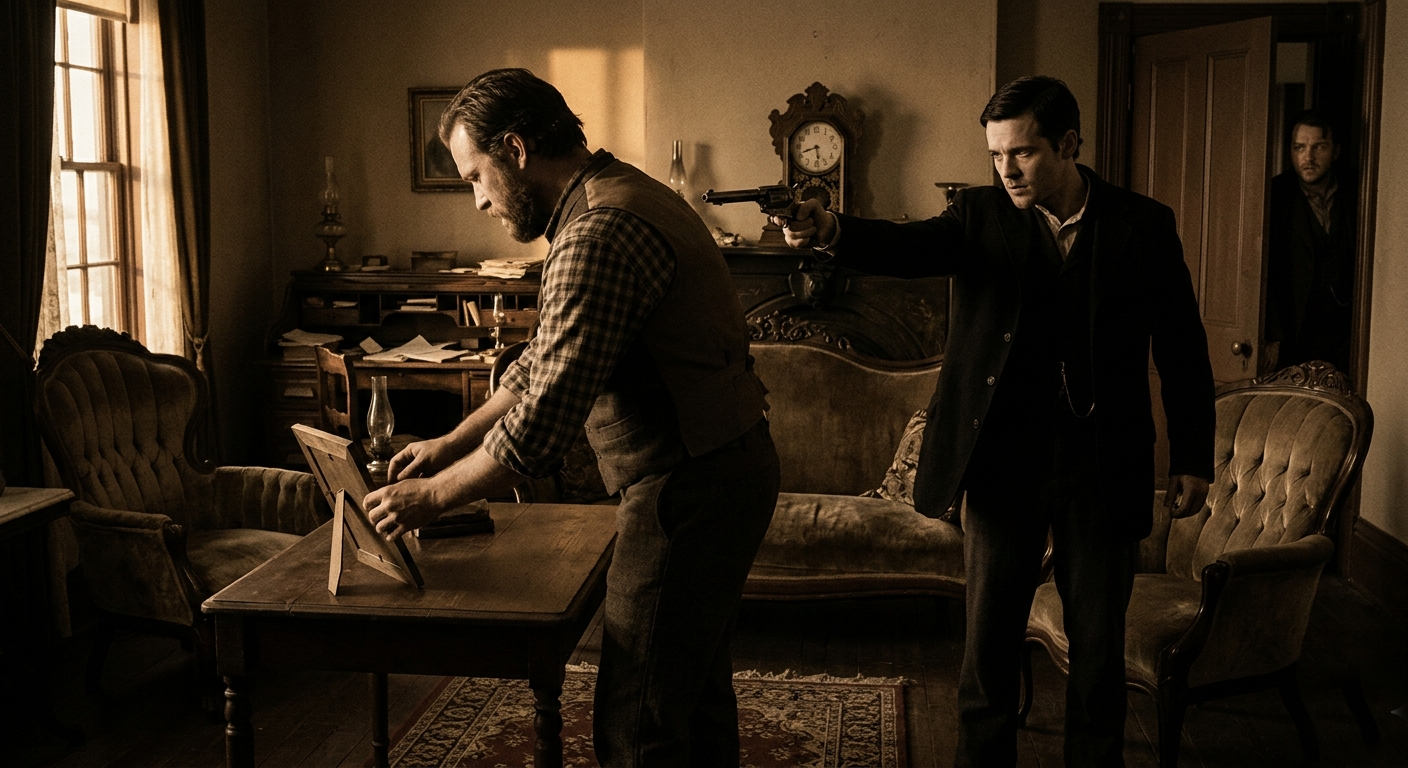
According to Robert Ford’s own later account, he could see in that moment that Jesse had realized something was wrong, that the newspaper story had confirmed his suspicions about betrayal. The atmosphere in the room became charged with unspoken threat. Both Ford brothers were armed; Jesse was also armed, having worn his revolvers habitually throughout his outlaw career. But then Jesse did something unexpected: instead of confronting the Fords directly, instead of drawing his weapons, he walked to the sofa and laid his revolvers down. He had been wearing his coat, which would have made his revolvers visible from the street; he removed the coat as well, setting it aside. And then he noticed that a framed picture above the fireplace mantel was dusty and crooked. Jesse stepped onto a chair to clean and straighten it.
In that moment — unarmed, his back turned, standing on a chair with his hands raised toward the picture frame — Robert Ford drew his Smith & Wesson Model 3 revolver and fired a single shot into the back of Jesse James’s head. The bullet entered at the base of the skull and lodged behind his right eye. Jesse James crumpled from the chair and fell to the floor. He was dead before he fully landed. Zee, who was in another room of the house, rushed in to find her husband lying on the floor with blood pooling around his head. She later said that Jesse was still breathing when she reached him, that she heard a last ‘death rattle’ as she knelt beside him, and then he was gone. He was 34 years old, and had been a fugitive for sixteen years.
The Aftermath: Pardons, Condemnation, and the Spectacle of Jesse James Dead
Robert Ford ran from the house and down the street, shouting — by some accounts hysterically — ‘I killed him! I shot Jesse James!’ He sent a telegram to Governor Crittenden almost immediately: ‘I have killed Jesse James.’ The brothers then walked to the police station and surrendered. They were arrested and charged with first-degree murder — the legal formality of charging the men who had done exactly what the governor had arranged to have done was a measure of how fraught the entire enterprise was politically. Within days, both Ford brothers were tried, convicted, and sentenced to hang. Governor Crittenden pardoned them both within hours of sentencing, as had been secretly promised. The pardons were legally straightforward but politically catastrophic: they made unmistakably public the fact that the governor of Missouri had arranged the assassination of a private citizen and promised immunity to the killer in advance.
The public reaction was extraordinary in its complexity. The newspapers that had been calling for Jesse James’s capture and the end of his criminal reign were now, in many cases, condemning the manner of his death. The image of a man shot from behind while adjusting a picture frame — unarmed, in his own home, killed by a member of his own gang who had taken his hospitality and betrayed him for money — struck a nerve that transcended partisan politics and sectional allegiance. Even people who had never romanticized Jesse James found something offensive about the circumstances of his death. In the South and among former Confederate sympathizers, the reaction was closer to outrage: Jesse James had been murdered by a coward at the instigation of a politician who had paid for the assassination. The folk song that immediately began circulating captured the popular sentiment with striking directness: ‘Well it was Robert Ford, that dirty little coward, I wonder now how he feels, for he ate of Jesse’s bread, and he slept in Jesse’s bed, and he laid poor Jesse in his grave.’
The body of Jesse James was put on public display in St. Joseph within hours of the killing — the pragmatic decision of authorities who recognized that positive identification of America’s most famous outlaw would require public viewing, since rumors that he had faked his death (a theory that circulated persistently for decades afterward) needed to be preemptively addressed. Thousands of people filed past the body. Photographs were taken. Jesse’s mother, Zerelda Samuel, arrived in St. Joseph and made a public identification of her son’s body, noting the wounds on his chest and body from the Civil War and his outlaw career that only she could recognize with certainty. His body was eventually transported to Kearney, Missouri, where he was buried in the yard of the family farm, his grave marked by a simple stone that Zerelda kept under close guard — she reportedly charged visitors a small fee to see it and sold pebbles from the grave as souvenirs, a entrepreneurial response to her grief that said a great deal about the commercial potential of the Jesse James legend even in its immediate aftermath.
The Fate of Robert Ford: From Coward to Corpse in Creede
Robert Newton Ford had expected celebrity and reward. What he received was something very different. He and his brother Charles briefly attempted to capitalize on their notoriety by taking to the theatrical stage in a production called ‘Outlaws of Missouri,’ in which they performed nightly re-enactments of the killing of Jesse James. The shows were greeted with a combination of jeers, catcalls, and occasional physical threats from audiences who found the spectacle of the ‘dirty little coward’ celebrating his act of betrayal more disgusting than entertaining. Ford told his version of the killing carefully, omitting the crucial detail that he had shot Jesse in the back; audiences either knew the truth or sensed it, and their response reflected the national verdict on Ford’s character. The theatrical venture quickly collapsed.
Charles Ford fared even worse emotionally. The younger Ford brother, by most accounts, was consumed by guilt and depression in the years following the killing. He had not pulled the trigger, but he had been complicit in the conspiracy and had watched his brother commit the act. On May 6, 1884, less than two years after the killing, Charles Ford died by suicide — the most direct acknowledgment that the killing of Jesse James had not brought either Ford brother the peace or reward they had anticipated. He was approximately 25 years old.
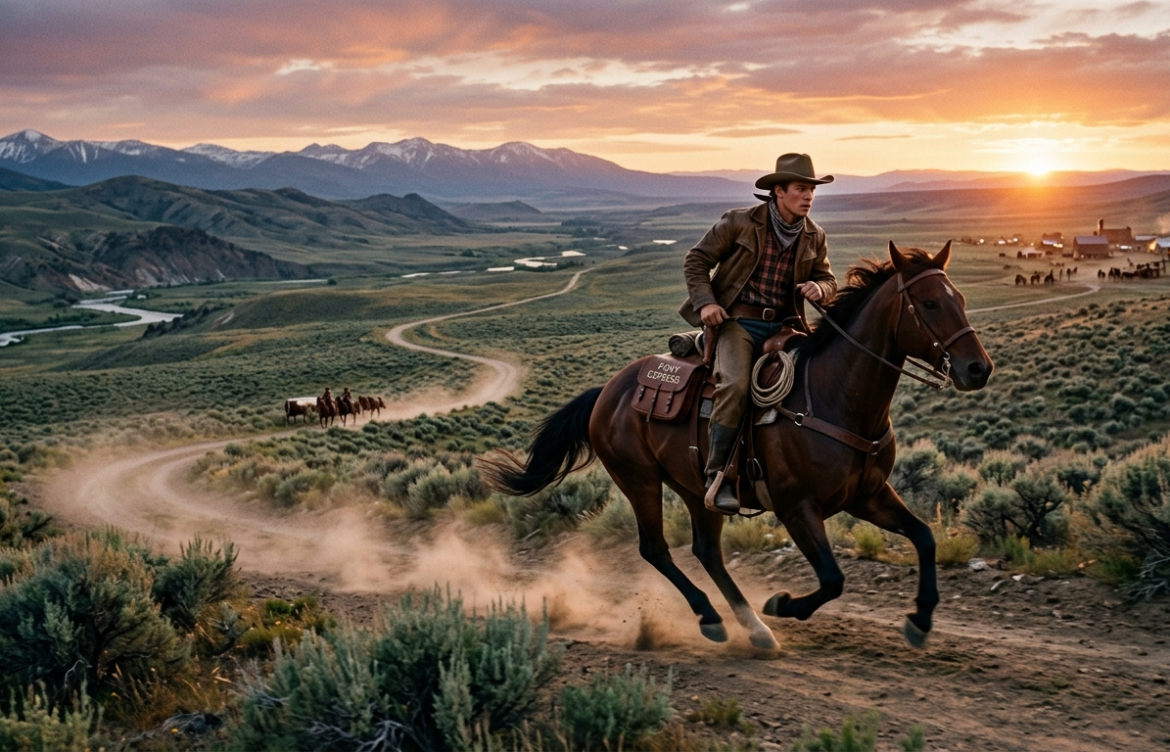
Robert Ford drifted west, operating saloons and dance halls in Las Vegas, New Mexico, Walsenburg, Colorado, and eventually Creede, Colorado — a silver mining boom town where Ford ran a tent saloon. He never escaped his reputation. Wherever he went, people knew who he was, and opinions about him ranged from open contempt to the grudging fascination of those who wanted to see the man who had killed Jesse James. On June 8, 1892, ten years after the killing that had defined his entire public identity, Ford was standing in his dance hall in Creede when a man named Edward Capehart O’Kelley walked in with a double-barreled shotgun. O’Kelley reportedly greeted Ford politely from behind; when Ford turned, O’Kelley fired both barrels at point-blank range, killing him instantly. Robert Newton Ford was 30 years old. O’Kelley was convicted of second-degree murder and sentenced to life imprisonment, but was released in 1902 after receiving 7,000 petition signatures from sympathizers who considered him a hero for having killed Jesse James’s killer — a chain of frontier vengeance that illustrated the extraordinary grip the Jesse James legend maintained on American popular sentiment. O’Kelley himself was shot and killed by a police officer in Oklahoma City in 1904.
Frank James: The Outlaw Who Lived and the World That Forgave Him
Jesse’s older brother Frank James, who had been the co-leader of the James-Younger Gang through its entire history, was not present at the Lafayette Street house on April 3, 1882. He had been living separately, and the news of his brother’s death reached him in hiding. On October 5, 1882 — six months after Jesse’s killing — Frank James walked into Governor Crittenden’s office in Jefferson City and surrendered, unbuckling his revolvers and handing them to the governor with the reported remark: ‘Governor Crittenden, I want to hand over to you that which no living man except myself has been permitted to touch since 1861, and to say that I am your prisoner.’ It was a theatrical moment that reflected both Frank’s intelligence and his instinct for the value of symbolic gestures.
Frank James was tried twice for specific crimes — once in Gallatin, Missouri, for the murder of a train passenger, and once in Huntsville, Alabama, for a train robbery — and acquitted both times by juries that were either genuinely unpersuaded of his guilt or unwilling to convict a man who had become, in death, a symbol of Southern resistance and lost Confederate honor. He was never convicted of any crime. He lived quietly in Missouri for decades after his acquittal, working at various times as a farmer, a shoe store clerk, a theater doorman, and eventually as a guide at the family farm in Kearney — now a tourist attraction — where his brother was buried. He died in February 1915 at the age of 72, in the same room at the Kearney farm where he had been born, having outlived Jesse by 33 years and having watched his brother’s legend grow to proportions that would have seemed fantastic on the morning of April 3, 1882.
Governor Crittenden’s Conspiracy and the Politics of Frontier Justice
The role of Governor Thomas T. Crittenden in arranging Jesse James’s assassination remains one of the most morally complex episodes in the political history of Missouri. Crittenden had not merely offered a reward for Jesse James’s capture or conviction — he had arranged a secret meeting with the Ford brothers, promised them immunity in advance for a murder that had not yet been committed, and thereby become the architect of what was, in legal and moral terms, a state-sanctioned assassination. The pardons he issued to the Fords within hours of their conviction made the arrangement public and exposed him to withering criticism from multiple directions simultaneously.
Critics from the Jesse James sympathizer community condemned Crittenden as a murderer who had bypassed the legal process to eliminate a man who, romanticized as he was, had rights under the law. Critics from the law-and-order community objected that the method — paying an informant to commit murder with a promise of immunity — was itself a violation of the principles it claimed to uphold. Crittenden defended himself by arguing that conventional law enforcement had failed to capture Jesse James for sixteen years and that extraordinary methods were required for an extraordinary situation. His argument had practical force: it was true that the Pinkerton National Detective Agency’s years of pursuit, including a disastrous 1875 raid on the Samuel farm in which a bomb thrown through the window killed Jesse’s eight-year-old half-brother Archie Samuel and blew off Zerelda Samuel’s right arm, had failed to bring Jesse to justice and had produced only public sympathy for the outlaw. But the means by which Crittenden achieved his end remained permanently controversial.
The Legacy of Jesse James: Outlaw, Folk Hero, and American Myth
Jesse James was buried initially in the yard of the Samuel family farm in Kearney, Missouri, and his grave quickly became a site of pilgrimage. His mother Zerelda, who had survived the loss of her son Archie and her own arm to the Pinkerton bomb, proved to be the most effective guardian and promoter of Jesse’s memory in the years immediately following his death. She received visitors at the farm, told stories about her son, and charged admission — reportedly charging a quarter to view the grave and selling pebbles from it as souvenirs. Her fierce and uncompromising defense of Jesse’s character and her lifelong insistence that the Ford brothers were cowardly traitors set the tone for the narrative that would develop around his memory.
In 1995, forensic scientist James Starrs exhumed Jesse James’s remains from their final resting place at Mount Olivet Cemetery in Kearney, Missouri — where they had been moved from the farm in 1902 — for DNA analysis. The results showed a 99.7 percent certainty that the remains were indeed those of Jesse James, definitively establishing that the man killed by Robert Ford on April 3, 1882 was the outlaw himself and putting to rest the persistent rumors that Jesse had faked his death. Several men over the years had claimed to be the ‘real’ Jesse James, living under yet another alias — the most notable being J. Frank Dalton, who made the claim in 1948 at the age of approximately 100. The DNA evidence settled the question definitively.
The cultural legacy of Jesse James has been immense and remarkably durable. The folk song ‘Jesse James,’ first widely recorded in 1924, framed the story precisely as Jesse’s sympathizers had always wanted it framed: as the murder of a noble outlaw by a treacherous, cowardly assassin motivated solely by money. Bruce Springsteen, The Kingston Trio, The Pogues, and dozens of other musicians have recorded versions of the song, ensuring that the folk narrative reaches new generations. The Jesse James story has been told in films more than fifty times, from silent-era productions to the 2007 critically acclaimed ‘The Assassination of Jesse James by the Coward Robert Ford,’ in which Brad Pitt played Jesse and Casey Affleck earned an Academy Award nomination for his portrayal of Robert Ford. The story has generated historical novels, academic histories, television documentaries, and tourist industries in Missouri that continue to thrive.
The endurance of the Jesse James legend reflects something genuine and persistent in American cultural life: an ambivalence about the relationship between law, order, commerce, and the individual. Jesse James was, by any objective measure, a violent criminal who killed people in the course of his robberies and contributed nothing of genuine value to the communities he preyed upon. The Robin Hood mythology attached to his name is largely fictional. Yet the conditions of post-Civil War Missouri — the displacement of former Confederate soldiers, the power of Northern-controlled banks and railroads over Southern farmers, the sense that Reconstruction represented a continuation of the war by other means — created a genuine grievance culture in which someone who targeted banks and railroads could be experienced as a kind of protest against legitimate oppression, even if the protest involved innocent victims and was primarily motivated by greed. Jesse James understood this dynamic intuitively and exploited it masterfully. He was as skilled at managing his public image as he was at planning a bank robbery.
Conclusion: A Shot Heard Through American History
On April 3, 1882, at a quarter to nine in the morning, Robert Ford fired a single bullet into the back of Jesse James’s head and ended the most celebrated outlaw career in American history. The act took less than a second. Its consequences lasted more than a century and are not yet exhausted. Jesse James died as he had lived: amid betrayal, violence, and the ambiguous moral accounting of a society that could never quite decide whether he was a criminal to be celebrated, condemned, or mourned. Robert Ford died as he had killed: from behind, by a man who considered him worthy of death. And the legend that was born in that parlor on Lafayette Street in St. Joseph has never entirely died — it has only changed its costume with the times, finding new audiences in each generation who recognize in Jesse James some version of the story they want to tell themselves about freedom, defiance, and the price of being the most dangerous man in the room.
Jesse James was 34 years old when he died. He had been an outlaw for sixteen years. He had robbed approximately a dozen banks and a dozen trains across seven states. He had killed an uncertain number of men — estimates range from as few as four to as many as sixteen directly attributable deaths, with more attributable to members of his gang during operations he led. He had been the subject of a decade and a half of national press coverage, two presidential administrations’ concern, and the investigative efforts of the Pinkerton agency and multiple state law enforcement agencies. He had made himself a myth in his own lifetime, and his death only deepened the myth. The bullet that Robert Ford fired on that April morning did not end the Jesse James story. It created the version of it that has lasted.