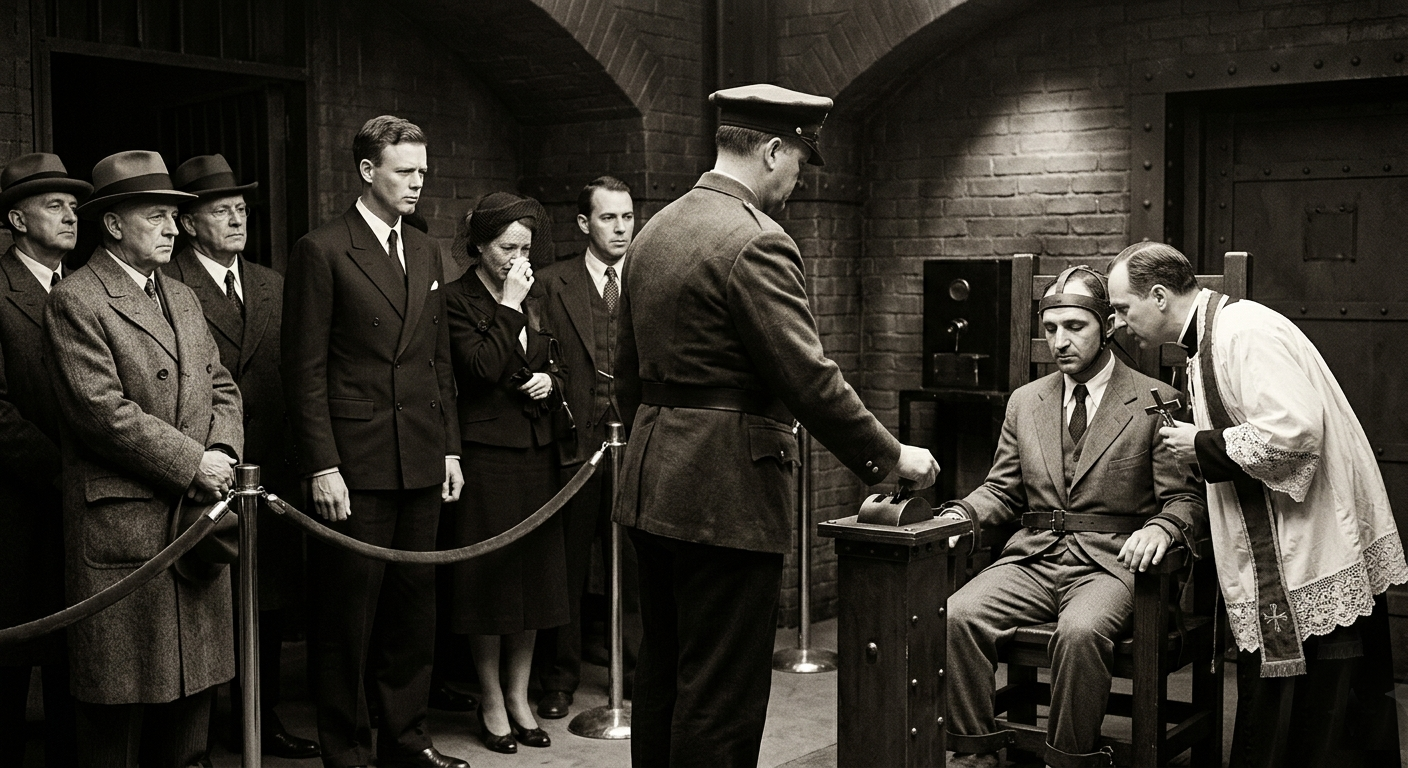
At 8:44 in the evening on April 3, 1936, two thousand volts of electricity surged through Bruno Richard Hauptmann in the execution chamber of the New Jersey State Prison in Trenton. The German-born carpenter and convicted kidnapper — described by the press as the ‘most hated man in the world’ — died in the electric chair, maintaining his innocence to the end. He had refused every offer of a deal, every inducement to confess, every arrangement that might have saved his life at the cost of admitting guilt. A Hearst newspaper had reportedly offered a substantial sum to his wife Anna if he would provide a confession; he declined. The New Jersey Board of Pardons had offered to commute his death sentence to life imprisonment in exchange for a confession; he refused that too. Bruno Hauptmann went to the electric chair, insisting that he had not kidnapped or murdered Charles Augustus Lindbergh Jr., the 20-month-old son of America’s most celebrated hero.
Whether Hauptmann was guilty, innocent, or somewhere in the complex middle ground of a partially complicit participant in a larger conspiracy remains one of the most debated questions in the history of American criminal justice. What is not debated is the scale of the case he was at the center of: the kidnapping on March 1, 1932, of the infant son of aviator Charles Lindbergh — the man who had made the first solo, nonstop transatlantic flight in 1927 and had become the most famous person in America — was immediately recognized as the most shocking crime the country had experienced in decades. H.L. Mencken, the acerbic journalist and cultural critic, called it ‘the biggest story since the Resurrection.’ The American press called it ‘the crime of the century.’ The trial of Bruno Hauptmann, beginning in January 1935 in the small New Jersey town of Flemington, was called ‘the trial of the century.’ Whether or not Bruno Hauptmann committed the crime for which he was executed, the case generated by the kidnapping and his prosecution changed American law, American journalism, and the American understanding of celebrity, justice, and the possibility of error in the machinery of capital punishment.
Charles Lindbergh: America’s Hero and the Fame That Made Him a Target
Charles Augustus Lindbergh was born on February 4, 1902, in Detroit, Michigan, and grew up in Little Falls, Minnesota. His father, Charles August Lindbergh Sr., was a Republican congressman from Minnesota. From his early childhood, the younger Lindbergh was fascinated by mechanical things, and by his early twenties he had become a barnstormer — one of the young aviators who traveled the country performing aerial stunts at county fairs and rural air shows, living on the edge of both poverty and death with something approaching cheerful indifference to the latter. He became an airmail pilot, flying the dangerous early postal routes, and then in 1927 he accepted the challenge that had already killed several more experienced pilots: a solo, nonstop flight across the Atlantic Ocean, from New York to Paris.
On May 20-21, 1927, Lindbergh flew his single-engine plane, the Spirit of St. Louis, from Roosevelt Field on Long Island, New York, to Le Bourget airfield outside Paris — a distance of approximately 3,600 miles in 33 hours and 30 minutes. He landed to a crowd of 150,000 people who rushed the airfield in one of the largest spontaneous public celebrations in European history. The reception he received when he returned to the United States was, if anything, even more overwhelming. An estimated 4 million people lined the streets of New York City for his ticker-tape parade — a number that exceeded the city’s entire population at the time, suggesting that people had come from across the region. Congress awarded him the Medal of Honor. President Calvin Coolidge received him personally. He was given the first Distinguished Flying Cross. He became, in a way that is difficult to convey to a later era, the most famous human being on earth.
The fame brought everything that status brings: adoration, scrutiny, commercial opportunity, and danger. Lindbergh married Anne Morrow in 1929 — the daughter of Dwight Morrow, the American ambassador to Mexico and a partner at J.P. Morgan — and their wedding and subsequent life together was relentlessly documented by a press and public that could not get enough of the golden couple. Their son, Charles Augustus Lindbergh Jr., was born on June 22, 1930, and immediately became public property in the sense that his photographs were in constant demand and his movements were of national interest. The Lindberghs, increasingly desperate for privacy, had built a new home they called Highfields on a 390-acre estate near Hopewell, New Jersey — remote enough, they hoped, to give them some measure of quiet family life away from the relentless attention that had become the permanent condition of their existence. It was at this house, on a cold Tuesday evening in March 1932, that the worst thing that could happen to them happened.
The Night of March 1, 1932: The Kidnapping of Charles Lindbergh Jr.
The evening of March 1, 1932 was cold and windy at the Lindbergh estate near Hopewell, New Jersey. Charles Augustus Lindbergh Jr. — twenty months old, known to his family as ‘Charlie’ — was suffering from a mild cold. His nurse, Betty Gow, had rubbed medication on his chest before putting him to bed at approximately 7:30 in the evening. The household that night included Charles and Anne Lindbergh, the butler Oliver Whately and his wife Elsie who cooked and cleaned, and Betty Gow. The house was not yet fully occupied — the Lindberghs had only recently begun staying there on weekends while their Englewood, New Jersey home was being winterized — and despite the family’s fame, its security arrangements were minimal. There were no guards, no regular police patrols, and the home’s location on a quiet rural road in Hunterdon County made it both secluded and accessible.
At approximately 10:00 p.m., Betty Gow went to check on the baby and found his crib empty. She immediately sought out Anne Lindbergh, and together they searched the house. Charles Lindbergh, when alerted, went directly to the nursery and found a ransom note on the windowsill. He looked out the window into the darkness, grabbed his rifle, and ran outside. The note was crudely written with distinctive grammatical errors and misspellings that suggested the writer was not a native English speaker: ‘Dear Sir, Have 50,000$ redy 25000$ in 20$ bills 15000$ in 10$ bills and 10000$ in 5$ bills. After 2-4 days will inform you were to deliver the Mony. We warn you for making anyding public or for notify the Polise the child is in gut care. Indication for all letters are singnature and 3 holes.’ On the lower right-hand corner of the note were two interlocking circles with a red oval in the center, punched with three holes — a distinctive signature that would appear on all subsequent ransom communications and would eventually become a key element in identifying the kidnapper.
Police were notified immediately, and by 10:30 that evening radio news bulletins were announcing the story to a stunned nation. A search of the grounds around the house found the remains of a homemade wooden ladder — three sections of crudely joined wood — lying in the orchard not far from the house. One of the ladder sections had broken, apparently during the kidnapper’s descent from the second-floor nursery window, creating a gap that might explain why the ladder was abandoned at the scene. Footprints in the muddy soil beneath the nursery window were too indistinct to provide usable impressions. No fingerprints of value were found anywhere on the ladder, in the nursery, or on the ransom note itself — a failure of basic crime scene preservation that would later be attributed partly to the chaotic conditions that descended on the property in the hours after the kidnapping, as police, neighbors, reporters, and officials converged in numbers that effectively contaminated every potential piece of physical evidence.
The investigation that followed was immediately complicated by the extraordinary nature of the case and the extraordinary character of Charles Lindbergh himself. New Jersey State Police Colonel H. Norman Schwarzkopf took formal charge of the investigation, but Lindbergh — accustomed to being in command, lionized by a public and a press that treated his wishes as essentially equivalent to government orders — positioned himself at the head of the operation and resisted, sometimes successfully, the efforts of law enforcement to run the investigation on standard professional lines. He accepted ransom intermediaries and communication channels that the police were not fully aware of or in control of. He made decisions about handling evidence and conducting the search that professional investigators considered counterproductive. His involvement, meant to help, repeatedly complicated the investigation in ways that would later become sources of criticism and controversy.
Cemetery John: John F. Condon and the Ransom Negotiations in the Bronx
The most consequential development in the kidnapping case came from an unexpected direction. On March 8, 1932, a seventy-two-year-old retired schoolteacher and coach from the Bronx named John F. Condon published a letter in the Bronx Home News offering to serve as an intermediary between Charles Lindbergh and the kidnappers, and offering to add $1,000 of his own money to the ransom. The letter was a piece of genuine but eccentric public-spiritedness from a man who had spent decades serving the Bronx community and who seems to have believed, with the confidence of an old schoolmaster, that he could personally resolve the crisis. The morning after the letter was published, a man purporting to represent the kidnapping gang contacted Condon and told him they would accept him as the go-between.
Condon—operating under the alias ‘Jafsie,’ derived from the phonetic pronunciation of his initials J.F.C.—was authorized by Lindbergh to conduct the negotiations, and over the following weeks, a remarkable and strange cat-and-mouse game unfolded across the cemeteries and back streets of the Bronx. Communications from the kidnapper arrived through various channels: notes left under stones at specified locations, messages delivered by taxi drivers who had been paid by unidentified strangers, and letters in the mail. On March 12, following directions from a note delivered by a taxi driver, Condon met for the first time with a man he came to call ‘Cemetery John’ or ‘Graveyard John’—because the meeting took place in the vicinity of Woodlawn Cemetery near 233rd Street and Jerome Avenue in the Bronx. The man spoke with a heavy German or Scandinavian accent, stayed in the shadows during the conversation, and gave his name as John. He claimed the baby was being held by a gang of three men and two women, that the child was unharmed, and that he was being kept on a boat. He asked Condon a question that became one of the most chilling details in the entire case: ‘Would I burn if the package were dead?’—meaning, would he face the electric chair if the kidnapped child were already dead? He quickly reassured Condon that the baby was alive.
As proof that he actually had the child, the kidnapper promised to return the baby’s sleeping suit. It arrived by mail shortly afterward — a gray wool garment that Betty Gow, the baby’s nurse, identified positively as the one Charlie had been wearing on the night of the kidnapping. The return of the sleeping suit intensified the pressure on Lindbergh to pay the ransom quickly, and the negotiations accelerated. A total of thirteen ransom notes were eventually received, and the ransom amount was ultimately raised to $70,000. The money was assembled by United States Treasury agents, who carefully recorded the serial numbers of every bill—a precaution that would prove decisive two and a half years later. Many of the bills were gold certificates rather than ordinary Federal Reserve notes, which would make them conspicuous after President Franklin Roosevelt’s April 1933 executive order requiring all gold certificates to be exchanged for Federal Reserve notes by May 1, 1933.
On the night of April 2, 1932, at St. Raymond’s Cemetery in the Bronx, John Condon handed $50,000 to Cemetery John while Charles Lindbergh waited in a car nearby, close enough to hear the shadowy man’s voice when he called out ‘Hey, Doctor!’ to get Condon’s attention. (The remaining $20,000 of the agreed $70,000 was withheld, contributing to later complications.) In return, Cemetery John gave Condon a note claiming that Charles Lindbergh Jr. was being held safely on a boat named ‘Nellie’ off the coast of Martha’s Vineyard, Massachusetts. The Lindberghs immediately began searching the New England coast. There was no boat named Nellie. There was no baby. The ransom had been paid for nothing.
The Body is Found: May 12, 1932, and the Murder That Changed American Law
On May 12, 1932 — forty-one days after the ransom was paid, seventy-two days after the kidnapping — a truck driver named William Allen stopped by the side of a road near Mount Rose, New Jersey, approximately four and a half miles from the Lindbergh estate, to relieve himself in the undergrowth. He found a small, partially buried body in a shallow depression in the earth, face down, partly decomposed by exposure to the elements over the preceding ten weeks. It was the body of Charles Lindbergh Jr. An autopsy established that the child had died from a blow to the head — most likely struck on the night of the kidnapping itself, either from a fall during the descent from the nursery window when the ladder broke, or from a deliberate act. Charles Lindbergh and Betty Gow both identified the remains, primarily through recognizable physical characteristics including a deformity of the left foot and the nurse’s own stitching on the sleeping garment found with the body.
The discovery confirmed what many investigators had suspected: the baby had been killed on or shortly after the night of March 1, 1932, and all the subsequent ransom negotiations had been conducted over a corpse. The brutal reality of this — that the Lindberghs had paid $50,000 for the return of a child who had been dead for months — intensified the public outrage and transformed the kidnapping from an already-horrifying crime into something that galvanized the entire country. Charles Lindbergh, who had already been scattering the ashes of his son from an airplane over the Atlantic Ocean that August, was destroyed by the news in a way that those who knew him said permanently changed his character. The loss of his son, and the circumstances of that loss, darkened Lindbergh in ways that would eventually contribute to some of the most controversial episodes of his later public life.
The political and legal consequence was immediate and sweeping. Congress had already been debating a federal kidnapping statute, and the national horror at the Lindbergh case provided the momentum that passage had previously lacked. On June 22, 1932 — which would have been Charles Lindbergh Jr.’s second birthday — Congress passed the Federal Kidnapping Act, commonly known at the time as the ‘Lindbergh Law.’ The act made it a federal offense to transport a kidnapping victim across state lines and authorized the FBI to investigate such cases. It provided for the death penalty in cases where the kidnapping victim was harmed. The Lindbergh Law transformed American law enforcement’s approach to kidnapping and gave the FBI — then a relatively new agency under the leadership of J. Edgar Hoover — a major new jurisdiction that significantly expanded its power and prestige.
The Two-Year Hunt: Tracking the Ransom Money Through New York City
For two and a half years after the ransom was paid and the baby’s body was found, the case went cold. The serial numbers of the ransom bills had been recorded and distributed to banks, retail establishments, and law enforcement agencies throughout the northeastern United States, and the bills began appearing sporadically — mostly in the Bronx and upper Manhattan neighborhoods of New York City, concentrated in the predominantly German-speaking community of Yorkville. But no suspect had been identified. John Condon’s composite description of Cemetery John — a man of medium height, approximately 35 to 40 years old, with a strong German or Scandinavian accent, a triangular face, and an athletic build — was too general to narrow the field significantly. The investigation had reached a standstill that seemed likely to become permanent.
The breakthrough came on September 15, 1934, at a gas station at 127th Street and Lexington Avenue in upper Manhattan. A filling station attendant received a $10 gold certificate from a customer who seemed nervous and suspicious. Being alert to the ongoing distribution of the ransom bill serial numbers — the Treasury Department had made the list widely available, and many alert citizens knew that the ransom had been paid partly in gold certificates — the attendant wrote the license plate number of the customer’s car on the margin of the bill. The bill was taken to the Corn Exchange Bank and Trust Company at 125th Street and Park Avenue, where an alert bank teller on September 18 recognized it as one of the ransom bills. Investigators were immediately notified.
The license plate traced to Bruno Richard Hauptmann of 1279 East 222nd Street in the Bronx — a German carpenter who had been in the country for approximately eleven years and who closely matched the physical description that Condon had provided for Cemetery John. Hauptmann was placed under surveillance by the New York City Police Department, the New Jersey State Police, and the FBI. On September 19, 1934, Hauptmann apparently realized he was being watched and attempted to flee — speeding and running through red lights — before being blocked by a truck on Park Avenue just north of Tremont Avenue in the Bronx. He was arrested on the street. A $20 gold certificate from the ransom was found on his person. When police searched his home at 1279 East 222nd Street, they found further evidence that would form the core of the prosecution’s case against him.
The Evidence Against Hauptmann: Ransom Money, Wood, and Handwriting
The evidence found in and around Bruno Hauptmann’s Bronx home was, by any standard, deeply incriminating — though its ultimate sufficiency to prove guilt beyond a reasonable doubt, and particularly the sufficiency to justify execution, would be debated for decades. Most significantly, investigators found more than $14,000 in ransom money — gold certificates whose serial numbers matched the list maintained by the Treasury Department — concealed in a suitcase in Hauptmann’s garage. The total amount of ransom money found with or traced to Hauptmann eventually exceeded $14,590, with additional evidence suggesting he had spent approximately $35,000 more on a relatively lavish lifestyle for a carpenter: he had quit his job within two days of the April 2, 1932 ransom payment and had never returned to work, living instead on his investments and apparently spending at a rate consistent with the $50,000 ransom.
Inside the house, detectives found John Condon’s telephone number and address written on the trim of a door in a closet — a discovery that directly linked Hauptmann to the ransom go-between. In his attic, investigators — led by New Jersey State Police Lieutenant Lewis Bornmann — discovered that a section of floorboard had been sawed off in a way that left a gap. When wood expert Arthur Koehler, a Forest Products Laboratory specialist who would later be recognized as a founding figure of forensic botany, examined the handmade kidnapping ladder, he concluded that one of its rails — ‘Rail 16’ — was made from wood that matched precisely the grain, tool marks, and nail holes in the attic board. The wood had not merely come from the same species of tree or the same commercial batch; the grain patterns, the tool marks from the mill, and even a nail hole that existed in the attic board aligned exactly with a corresponding hole in Rail 16. Koehler’s testimony, which was the result of years of meticulous forensic analysis, represented one of the most significant applications of scientific evidence in an American criminal trial to that date.
Eight leading handwriting experts testified at trial that Bruno Hauptmann had written the ransom notes. The distinctive grammatical features and spelling patterns of the notes — misspellings consistent with a German speaker’s phonetic rendering of English sounds, unusual constructions that appeared across all thirteen notes in the series — matched patterns found in Hauptmann’s own handwriting samples. Handwriting analysis as a forensic science had significant limitations in 1935, and subsequent examination of the handwriting evidence by later analysts has been more equivocal, but the testimony of multiple respected experts carried considerable weight with the jury. Additional evidence included a sketch of a ladder similar to the kidnapping ladder found in a notebook belonging to Hauptmann, and testimony from several witnesses who claimed to have seen Hauptmann or his car near the Lindbergh estate in the period before the kidnapping.
The ‘Fisch Story’ and Hauptmann’s Defense
Bruno Hauptmann’s explanation for the ransom money remained consistent from his arrest through his execution, and it has remained the central question in all subsequent debates about the case. He claimed that the money — along with other items — had been left with him for safekeeping by a man named Isidor Fisch, a German Jewish fur trader and business associate with whom Hauptmann had been involved in a joint stock market investment venture. Fisch, according to Hauptmann, had packed up his belongings into several bundles and a suitcase before returning to Germany in December 1933, asking Hauptmann to store them. Fisch died in Germany in March 1934 before returning to the United States. Hauptmann claimed he did not discover the money until months after Fisch’s death, when he found the suitcase in his closet and opened it to find a substantial sum in gold certificates. He kept the money, he said, because Fisch owed him money from their joint business ventures. He claimed he had no knowledge that the money was from the Lindbergh ransom.
Prosecutors immediately labeled this explanation ‘the Fisch Story’ and treated it with contempt, noting that Fisch was conveniently dead and unable to confirm or deny the account, and that the circumstances of Hauptmann’s subsequent behavior — quitting his job, living on his investments, never reporting the money to police — were inconsistent with the story of a man who had innocently come into possession of money left by a friend. Hauptmann’s defense attorney, Edward J. Reilly — a 52-year-old Brooklyn lawyer known as ‘the Bull of Brooklyn’ who reportedly drank heavily throughout the trial and who has been widely criticized by later analysts as having been ineffective in his representation of his client — argued that the prosecution’s evidence was entirely circumstantial, that no reliable witness had placed Hauptmann at the scene of the crime, and that the physical evidence had been contaminated, mishandled, or in some cases fabricated by investigators eager to close the most high-profile case in American history. The defense also suggested the involvement of Isidor Fisch’s associates and other members of a potential gang, pointing to Cemetery John’s own claims about a ‘gang of three men and two women.’
The Trial of the Century: Flemington, January-February 1935
The trial of Bruno Hauptmann opened on January 2, 1935, in the Hunterdon County Courthouse in Flemington, New Jersey — a small town wholly unprepared for the circus that descended upon it. Some 700 reporters from around the world converged on Flemington. Celebrities including Walter Winchell, Damon Runyon, Arthur Brisbane, Jack Benny, Edna Ferber, and Kathleen Norris attended as spectators. Vendors appeared selling miniature kidnapping ladders, locks of ‘the Lindbergh baby’s hair,’ and photographs of Charles Lindbergh. The town’s single hotel was overwhelmed. Judge Thomas Whitaker Trenchard, a seventy-one-year-old jurist of good reputation, presided over a proceeding that was itself something of a media spectacle, with radio broadcasts and newsreel cameras creating conditions that modern legal standards would have found incompatible with a fair trial. H.L. Mencken’s observation that it was ‘the biggest story since the Resurrection’ was hyperbolic but not entirely wrong in its assessment of the case’s penetration of the national consciousness.
Charles Lindbergh testified at the trial in a moment of extraordinary dramatic intensity. He stated from the witness stand that he recognized the voice of Bruno Hauptmann as the voice he had heard at St. Raymond’s Cemetery on the night of April 2, 1932, when Cemetery John called out ‘Hey, Doctor!’ to John Condon while Lindbergh waited in the car nearby. This was powerful testimony — the word of America’s greatest hero, identifying the defendant as the kidnapper of his son — but it was also deeply problematic from an evidentiary standpoint. Lindbergh had heard the voice for only a brief moment in a dark cemetery two years earlier, and voice identification under such circumstances is now regarded by cognitive scientists as one of the least reliable forms of eyewitness evidence. Anne Morrow Lindbergh also testified, a composed and heartbreaking figure in the courtroom. John Condon was called as a witness and identified Hauptmann as Cemetery John — identification he had actually been reluctant to make definitively during the initial investigation, having twice failed to identify Hauptmann’s photograph from a police lineup before his arrest.
Three weeks into the trial, Bruno Hauptmann took the witness stand. He was visibly nervous, and while he maintained his innocence under direct examination, he admitted under cross-examination by the aggressive New Jersey Attorney General David T. Wilentz that he had lied to police on several occasions during the initial questioning — a concession that severely damaged his credibility with the jury even if the specific lies were explained as responses to police intimidation rather than consciousness of guilt. Hauptmann had been beaten by police during his initial interrogation, a fact acknowledged at trial, and he claimed that several of his responses had been coerced rather than freely given. After eleven hours of deliberation, the jury returned its verdict on February 13, 1935: Bruno Richard Hauptmann was guilty of murder in the first degree. Judge Trenchard sentenced him to death by electrocution.
Appeals, Reprieves, and Governor Hoffman’s Doubts
The road from conviction to execution was longer than either side expected, marked by legal appeals and a remarkable gubernatorial intervention that kept the case in public view for more than a year after the verdict. The New Jersey Supreme Court upheld the conviction on October 9, 1935. Hauptmann’s appeal to the United States Supreme Court was denied on December 9, 1935, exhausting his direct judicial remedies. He was scheduled to be executed on January 17, 1936. On that very day, Governor Harold G. Hoffman of New Jersey granted a thirty-day reprieve — not to suggest that Hauptmann was innocent, Hoffman was careful to say, but because Hoffman had significant doubts about whether all parties involved in the kidnapping had been identified and prosecuted.
Hoffman’s intervention was extraordinary and controversial. He had secretly visited Hauptmann in his cell on October 16, 1935, accompanied by a stenographer. He had publicly stated his belief that the kidnapping was not a ‘one person job’ and that additional accomplices had never been brought to justice. He urged the New Jersey Court of Errors and Appeals to review the case. He directed State Police Colonel Schwarzkopf — who had been the lead investigator and who was Hoffman’s political enemy as well as a potential critic — to continue investigating for additional accomplices. Hoffman’s actions were denounced by the press, by prosecutors, and by supporters of the conviction as the politically motivated interference of a German-American governor who was either personally sympathetic to a German defendant or who was using the case for electoral purposes. They were defended by Hoffman and his supporters as the appropriate response of a conscientious executive to a case where the evidence of guilt, however suggestive, had not been free of doubt.
In early 1936, New Jersey detective Ellis H. Parker — a nationally prominent investigator known as ‘the Old Fox’ who had been conducting his own independent investigation and who was also a Hoffman ally — announced that he had obtained a signed confession from a former Trenton attorney named Paul Wendel, claiming that Wendel had been involved in the kidnapping. The Wendel confession created a sensation and contributed to Hoffman granting a second reprieve in March 1936. But the case against Wendel collapsed within days when Wendel retracted his confession and insisted it had been coerced by Parker’s associates, who had held him for weeks in a location outside New Jersey. The Wendel episode was ultimately a catastrophe for the cause of Hauptmann’s supporters: it produced not an alternative suspect but an embarrassing episode of apparent evidence fabrication that discredited the doubt-based critique of the prosecution.
On March 30, 1936, the New Jersey Board of Pardons denied Hauptmann’s petition for clemency — his final appeal. Hauptmann had declined his last concrete opportunity for survival: an offer, reported to have come with authorization from Governor Hoffman, to commute his death sentence to life in prison without parole if he would confess. He refused. He told those around him that he could not confess to a crime he had not committed. On the morning of April 3, 1936, he was visited by a Lutheran minister. He maintained his innocence in those final hours. That evening, at 8:44 p.m., he was strapped into the electric chair in the execution chamber of the New Jersey State Prison. Two thousand volts were administered. Bruno Richard Hauptmann, born November 26, 1899, in Kamenz, Saxony — carpenter, German Army veteran, convicted kidnapper and murderer — was dead.
Who Was Bruno Hauptmann? The Man Behind the Most Hated Name in America
The biographical details of Bruno Hauptmann’s life before the kidnapping present a picture that is both mundane and, in certain specific details, deeply relevant to the case. He was born on November 26, 1899, in Kamenz, a town near Dresden in the Kingdom of Saxony, Germany, the youngest of five children. Notably, neither Hauptmann himself, his family, nor his friends ever called him Bruno — he was known by his middle name, Richard. The prosecutors’ insistence on calling him ‘Bruno’ throughout the trial was a deliberate strategy, as Richard Hauptmann sounded less menacing and foreign than Bruno Hauptmann.
He served in the German Army during the final year of World War I, from 1917 to 1918. After the war he apparently drifted into criminal activity in the context of the severe economic dislocation of Weimar Germany. He was convicted of burglary in 1919 and arrested for possession of stolen goods in 1922, escaping before trial in the latter case. Significantly, one of his early burglaries had involved breaking into a house using a ladder to reach a second-floor window — a detail that would resonate loudly at his trial. He made two illegal attempts to enter the United States in 1923, both of which failed. On his third attempt in late 1923, he successfully stowed away on an ocean liner and arrived in New York City, where he was sheltered by the established German immigrant community and found work as a carpenter.
In 1925, Hauptmann married Anna Schoeffler, a German waitress. The marriage was, by all accounts, a genuinely loving one. They had a son, Manfred, born in November 1933. Anna Hauptmann would never accept her husband’s guilt, spending the remaining fifty-eight years of her life — she died in 1994 at the age of ninety-five — fighting to clear his name. Twice in the 1980s she sued the state of New Jersey for the wrongful execution of her husband; both suits were dismissed on procedural grounds. A remarkable aspect of the marriage was that Anna did not know her husband’s first name was Bruno until his arrest in 1934 — a detail that illustrated how thoroughly Hauptmann had suppressed his own identity and personal history during his years in America.
The Enduring Controversy: Guilty, Innocent, or Something More Complex?
The question of Bruno Hauptmann’s guilt or innocence has not been settled in the decades since his execution, and it is unlikely to be settled without DNA evidence that may or may not be recoverable from the case’s physical materials. The case for his guilt rests on an impressive accumulation of circumstantial evidence: the ransom money found in his garage in quantities that went far beyond what a simple act of safekeeping could explain, his financial behavior after April 1932 that was entirely consistent with having received a $50,000 payment, the wood evidence linking the ladder to his attic, the handwriting evidence linking him to the ransom notes, Condon’s telephone number on his closet wall, and his general profile — German carpenter with a criminal record including ladder-based burglary, living in the Bronx neighborhood where the ransom money had been spent — matching the known facts about Cemetery John.
The case for reasonable doubt rests on several serious concerns about the integrity of the investigation and the trial. The crime scene was catastrophically contaminated in the hours after the kidnapping, making reliable physical evidence collection essentially impossible. Lindbergh’s personal involvement in managing the investigation arguably compromised the independence and professionalism of law enforcement. The ladder board found in Hauptmann’s attic was discovered by Lieutenant Bornmann during a search conducted after thirty-seven FBI and New York City police officers had already searched the attic nineteen times — a fact that critics have pointed to as evidence of planting. Condon’s identification of Hauptmann was wavering and inconsistent before it became definitive after the arrest. Charles Lindbergh’s voice identification was made from the briefest possible exposure and across a gap of more than two years. The defense attorney Reilly was widely regarded as ineffective and possibly compromised. And the atmosphere of the trial — the celebrity circus, the vendetta-like press coverage, the public’s overwhelming desire for conviction — made a genuinely fair proceeding almost impossible.
Several books have argued Hauptmann’s innocence or raised serious doubts about his guilt. Anthony Scaduto’s 1974 Scapegoat argued that Hauptmann was framed. Ludovic Kennedy’s 1985 The Airman and the Carpenter made a more comprehensive case for the wrongfulness of both the investigation and the conviction. Robert Zorn’s 2012 Cemetery John proposed that Hauptmann was part of a gang that included two other men, one of whom — ‘Cemetery John’ — may not have been Hauptmann at all. Some researchers have suggested Lindbergh household members may have had involvement; others have proposed the involvement of Lindbergh himself, citing the extraordinary circumstances of the investigation and the absence of any direct eyewitness to the actual kidnapping. None of these theories has been proven. What they have collectively established is that the case was far more complex and far more contaminated than the confident verdict of February 1935 suggested.
The Legacy: The Lindbergh Law, the Media, and the Meaning of the Crime of the Century
The Lindbergh kidnapping and the execution of Bruno Hauptmann changed American life in several lasting ways. The Federal Kidnapping Act of 1932 — the Lindbergh Law — fundamentally altered the landscape of federal law enforcement, giving the FBI a powerful new jurisdiction and establishing the principle that kidnapping was not merely a local crime but a federal one when victims were transported across state lines. The law was subsequently amended to provide for the death penalty in kidnapping cases where victims were harmed, a provision that remained on the books until the Supreme Court’s evolving jurisprudence on capital punishment restricted its application. The American Bar Association has cited the Lindbergh trial as a landmark in the history of criminal procedure, particularly regarding the effects of media coverage on the fairness of criminal proceedings.
The trial itself prompted significant reform of press conduct at legal proceedings. The spectacle of Flemington — cameras in the courtroom, radio broadcasts, the carnival atmosphere of a media event that the defendant had to endure while fighting for his life — was so widely condemned, even by those who believed in Hauptmann’s guilt, that the American Bar Association adopted Canon 35 in 1937, prohibiting cameras and broadcast equipment from courtrooms. This prohibition remained largely in effect in most American jurisdictions for decades, eventually giving way to the gradual reintroduction of cameras in the 1970s and afterward. The Hauptmann trial also contributed to the development of more rigorous standards for forensic evidence, particularly the wood analysis conducted by Arthur Koehler, which established foundational precedents for the admission of physical evidence in criminal trials.
For Charles and Anne Lindbergh, the kidnapping and its aftermath cast a permanent shadow over everything that followed. Charles Lindbergh’s subsequent political activities — his opposition to American entry into World War II, his America First speeches, his public statements that were widely interpreted as sympathetic to Nazi Germany, and his eventual semi-exile from American public life — were shaped in ways both direct and indirect by the loss of his son and the shattering experience of having his grief, his family, and his judgment made the subjects of a global media circus. Anne Morrow Lindbergh, one of the most gifted writers of her generation, would publish her memoir of the kidnapping period in a 1940 book called The Wave of the Future. The couple eventually moved to Europe for years, seeking privacy that America could no longer provide.
Conclusion: April 3, 1936 and the Question That Would Not Die
Bruno Hauptmann went to the electric chair on the same date — April 3 — that the first Pony Express rider had left St. Joseph, Missouri, in 1860, and the same date that Jesse James had been shot by Robert Ford in 1882. The coincidence meant nothing, of course. But there is something appropriate in the way that the date falls in the early spring, in the ambiguous, transitional season when the worst of winter is over and the warmth of summer has not yet arrived — the season of beginnings that can tip either way.
What the execution of Bruno Hauptmann began, in a paradoxical sense, was the question of his innocence that has never been fully resolved. His wife Anna, who spent sixty-two years after his death fighting for his exoneration and who died in 1994 still insisting he had been wrongly executed, expressed the persistence of that question with eloquence in a phrase that has been attributed to Hauptmann himself: ‘They think when I die, the case will die. They think it will be like a book I close. But the book, it will never close.’ The book has not closed. The case remains one of the most argued and re-argued in American legal history. The crime of the century continues to generate new books, new investigations, new theories, and new doubt about whether the man executed for it was the man who committed it — or whether the machinery of justice, under the immense pressure of a grieving nation’s demand for a guilty verdict, had executed not a kidnapper and murderer but a convenient foreigner with suspicious finances and an implausible story about a dead friend and a suitcase full of money.
Whatever the ultimate truth about Bruno Hauptmann’s guilt or innocence — and the weight of the physical evidence, contested as it is, still inclines most careful students of the case toward a conclusion of at least significant involvement — the case stands as a permanent monument to the dangers of trying to achieve justice in a courtroom that has been transformed by celebrity, media, and national emotion into a theater. Charles Lindbergh Jr. deserved justice. Whether justice was done on April 3, 1936, remains, eight decades later, genuinely uncertain.