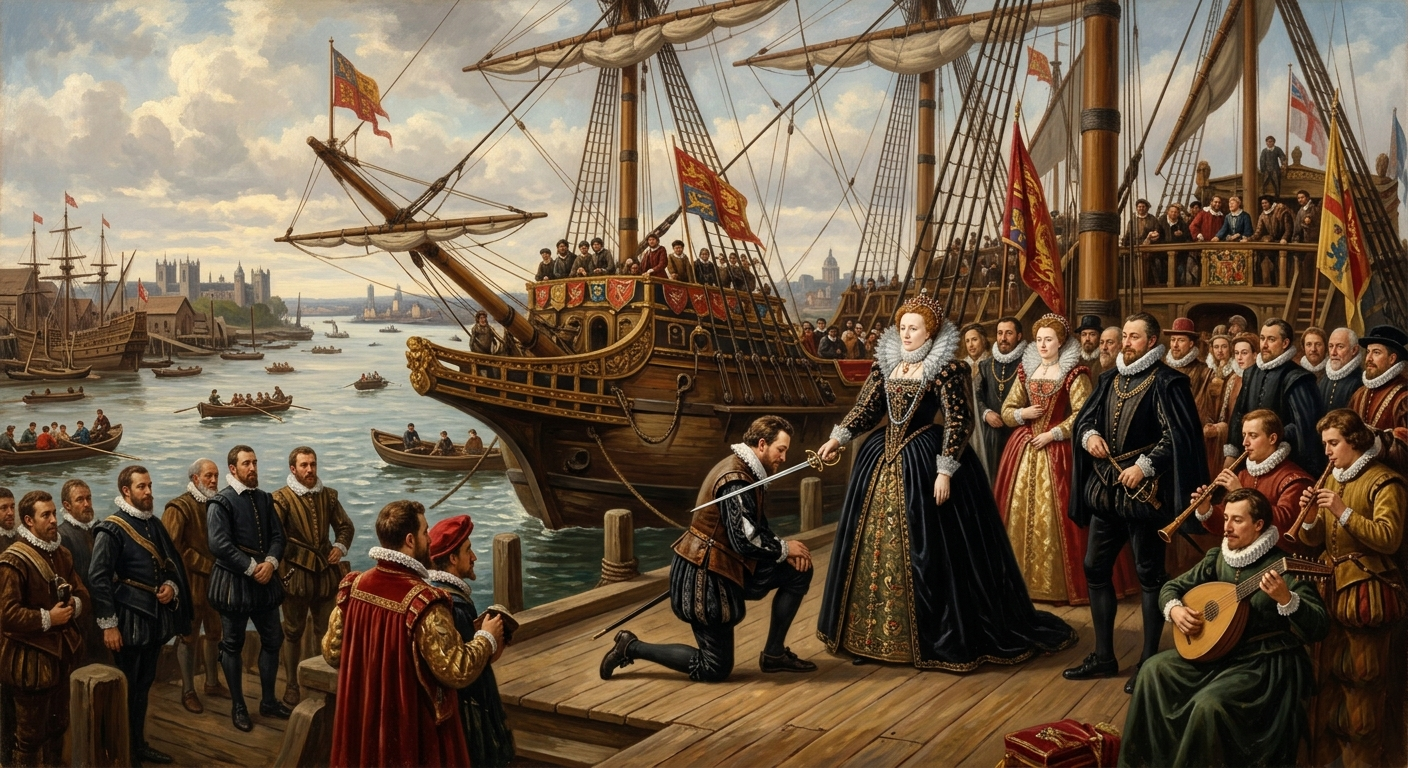
On April 4, 1581, Queen Elizabeth I stepped aboard a weather-beaten 120-ton galleon moored at the royal dockyard at Deptford on the River Thames and did something that sent a political shockwave across Europe. She bestowed a knighthood upon Francis Drake, sea captain, privateer, circumnavigator, and the man whom King Philip II of Spain had branded a pirate and upon whose head he had already placed a bounty. The ceremony took place on the deck of the Golden Hind, the very ship in which Drake had spent nearly three years sailing around the entire globe, raiding Spanish ports and capturing Spanish treasure ships in waters that Spain considered its exclusive domain. With that act of royal honour, Elizabeth transformed a daring voyage of plunder into an act of national glory, declared herself a rival of Spain on the world’s oceans, and elevated a Devon-born mariner of relatively humble origins into one of the most celebrated figures in the history of England.
The knighting of Francis Drake was one of the most consequential symbolic acts of the Elizabethan age. It was simultaneously a personal honor, a political provocation, and a statement of national ambition. Spain was already furious. The Spanish ambassador had formally demanded that Drake be executed as a pirate and that the treasure he had stolen from Spanish ships and settlements be returned. Elizabeth’s response to these demands was to board Drake’s ship, feast with him, and make him a knight. The message could not have been clearer: England would not be intimidated, would not return what its sailors had taken, and was prepared to claim a place on the world stage alongside the Iberian powers who had divided the globe between them by papal decree. April 4, 1581 was the day England announced itself as a maritime power to be reckoned with.
Elizabethan England and the World It Inhabited: Power, Religion, and the Spanish Shadow
To understand the full significance of Drake’s knighting, it is essential to understand the world of late sixteenth-century Europe and the peculiar, precarious position that England occupied within it. Elizabeth I had been queen since November 1558, having inherited a kingdom that was religiously divided, financially strained, and diplomatically isolated. Her father, Henry VIII, had broken with the Roman Catholic Church in the 1530s, establishing the Church of England and triggering a religious revolution whose effects were still convulsing English society forty years later. Her half-sister Mary I had briefly attempted to restore Catholicism during her reign from 1553 to 1558, burning nearly three hundred Protestants at the stake and earning herself the sobriquet ‘Bloody Mary.’ When Elizabeth came to the throne as a Protestant queen, she inherited a kingdom divided between a Protestant establishment and a substantial Catholic minority, and a Europe that was increasingly polarized along religious lines.
The dominant power in that Europe was Spain under Philip II, who had briefly been Elizabeth’s brother-in-law through his marriage to Mary I. Philip ruled not just Spain but the vast Spanish empire — the most extensive political entity the world had ever seen, stretching across the Americas from Mexico and the Caribbean to Peru and Chile, encompassing the Philippines in Asia, and including large portions of Italy, the Netherlands, and other European territories. The silver and gold that flowed from the mines of Peru and Mexico made Spain incomparably wealthy, funding armies and navies that made it the superpower of the age. The 1494 Treaty of Tordesillas, ratified by papal authority, had divided the non-European world between Spain and Portugal along a line in the Atlantic: everything to the west belonged to Spain, everything to the east to Portugal. England had signed no such treaty and recognized no such division, but for decades had lacked the naval power to challenge it directly.
Elizabeth’s England occupied an uncomfortable middle position in this world. Too Protestant to be allied with Catholic Spain, too cautious of Spanish military power to provoke open war, Elizabeth pursued a policy of studied ambiguity — encouraging privateering against Spanish shipping while maintaining the fiction of peaceful relations, supporting Protestant rebels in the Spanish Netherlands while denying official involvement, and cultivating potential alliance with France as a counterweight to Spanish dominance. The privateers — seafarers licensed to raid enemy shipping during wartime, and who operated in a legal grey zone during nominally peaceful periods — were essential instruments of this ambiguous policy. Men like Francis Drake could harry Spanish commerce while giving Elizabeth the ability to deny official responsibility if Spain complained too loudly.
Francis Drake: Birth, Early Life, and the Formation of England’s Most Feared Seaman
Francis Drake was born around 1540 at Crowndale Farm in Tavistock, in the county of Devon in southwest England, the eldest of twelve children born to Edmund Drake, a Protestant farmer who later became a preacher, and his wife Mary Mylwaye. His precise birth date was never recorded — a common circumstance for the children of modest families in Tudor England — but can be estimated from contemporary sources that indicate he was approximately twenty-two when he obtained his first command in 1566, placing his birth around 1544, and from a portrait miniature painted by Nicholas Hilliard in 1581 that identified him as being approximately forty-two years old. Devon, where Drake spent his early years, was one of the great maritime counties of England: a rugged coastal landscape that had sent sailors, merchants, and explorers to sea for generations, and whose trading ports looked naturally outward toward the Atlantic.
When Drake was still a child, his family’s fortunes were disrupted by the religious upheavals that characterized the mid-Tudor period. The details are disputed, but the family’s Protestant sympathies — strongly held in Edmund Drake’s case — led to some form of displacement from Devon. Drake was placed at an early age into the household of his relative William Hawkins, a prominent sea captain and merchant in Plymouth, whose family had already established themselves in the transatlantic trade. It was in Plymouth, in the Hawkins household, that Drake received the education that would define his life: not a classical education in Latin and theology but a maritime one, learning the arts of seamanship, navigation, and commerce from one of the most experienced seafaring families in England.
Through the Hawkins family connection, Drake became closely associated with John Hawkins, William’s son and one of the most significant figures in early English maritime history. In the 1560s, John Hawkins pioneered the English participation in the transatlantic slave trade — a brutal and morally indefensible enterprise that Drake participated in as a young man, sailing on Hawkins’s slaving voyages that captured West Africans and transported them to sell in the Spanish colonies of the Caribbean. The experience introduced Drake to the Atlantic world, to the dynamics of English competition with Spain, and to the violent possibilities of maritime raiding. In 1568, Drake participated in the disastrous Battle of San Juan de Ulua in Mexico, where a Spanish fleet attacked the English vessels in a harbor that was supposed to have guaranteed their safety under a truce. The treachery — as Drake experienced it — of the Spanish attack, which killed many English sailors and nearly captured Drake himself, planted in him a hatred of Spain that would be one of the defining motivations of his career for the rest of his life.
Between 1570 and 1572, Drake made two reconnaissance voyages to the Spanish Main — the Caribbean coast of South America and Central America — gathering intelligence about Spanish trade routes, harbor defenses, and the movements of treasure shipments. In 1572, he led his first independent privateering expedition, sailing with two small ships and seventy-three men to raid the Spanish port of Nombre de Dios on the Isthmus of Panama — where the silver from Peru was transported overland before being loaded onto ships for Spain. The raid on Nombre de Dios was only partially successful, but it announced Drake’s presence as a serious threat to Spanish commerce and demonstrated his extraordinary physical and tactical courage. On this same expedition, Drake and his small force ambushed a Spanish mule train carrying silver across the Isthmus, capturing an enormous quantity of treasure. Most significantly, during this voyage Drake climbed a tall tree on the Isthmus of Panama and became the first Englishman ever to see the Pacific Ocean, swearing, according to the account, that he would ‘sail an English ship in those seas.’
The Secret Commission: Elizabeth I, the Privy Council, and the Plan for the Pacific
The voyage that would culminate in Drake’s knighthood began with a secret meeting at Elizabeth’s palace in Greenwich in 1577. Francis Walsingham — Elizabeth’s brilliant and ruthless Principal Secretary, spymaster, and the architect of much of Elizabethan foreign policy — had been developing a plan for an English expedition into the Pacific. The Pacific was the heart of Spain’s empire in the Americas: it was the ocean over which the silver and gold of Peru and Mexico were transported, the sea through which the Manila Galleons made their annual voyages between the Philippines and Mexico carrying the wealth of Asia, and the body of water that Spain considered its exclusive domain. No English ship had ever sailed in the Pacific. The only route for a non-Spanish ship to enter it was through the Strait of Magellan at the southern tip of South America — a passage of legendary danger and difficulty that only one expedition before Drake’s had ever successfully navigated.
The plan that Walsingham developed, with Drake as the designated commander, was in essence a covert military operation against Spanish economic infrastructure. Drake would sail through the Strait of Magellan, raid the undefended Spanish ports and treasure ships on the Pacific coast of South America (which Spain had never bothered to fortify because no enemy was supposed to be able to reach them), seize as much treasure as possible, and return to England by whatever route was practicable. The expedition would be funded by a consortium of investors that included some of the most powerful people in England: Robert Dudley, Earl of Leicester (Elizabeth’s favourite and closest male companion); Sir Christopher Hatton, Vice-Chamberlain and one of Elizabeth’s most trusted councillors; Francis Walsingham himself; Sir John Hawkins; and the Queen herself, who invested 1,000 crowns in the venture. The involvement of these investors meant that the voyage was, in practical terms, a state-sponsored piracy operation, even though its official cover was a trading and discovery mission.
The secrecy surrounding the expedition was intense. The stated destination was changed repeatedly to conceal the voyage’s true purpose. One cover story described the fleet as heading to the Mediterranean on a trading mission. The real plan — to enter the Pacific and raid the Spanish empire from its unprotected western side — was known only to Elizabeth and her inner circle. Drake was given detailed instructions at a private meeting with the Queen at her Greenwich palace in 1577, during which the specific plan was finalized and Drake was given what amounted to a personal commission from the sovereign to carry it out. The existence of this royal commission would be both the making and the complication of Drake’s subsequent reputation: it made him a privateer rather than a pirate in English legal terms, but Spain refused to recognize any such distinction.
The Voyage of the Golden Hind: From Plymouth to the Pacific, 1577 to 1580
Francis Drake departed Plymouth on December 13, 1577, commanding a fleet of five ships: the Pelican (his flagship, 120 tons), the Elizabeth (80 tons, captained by John Winter), the Marigold (30 tons), the Swan (50 tons, used as a supply ship), and the Christopher or Benedict (15 tons, a small pinnace). The total complement was approximately 164 men. The fleet’s departure was deliberately low-key, with the cover story of its Mediterranean destination still circulating. The first attempt to leave had been made on November 15, but violent storms forced the fleet to take shelter in Falmouth before returning to Plymouth for repairs — an inauspicious beginning to what would become the most celebrated voyage in English history.
After crossing the Atlantic and making stops at the Canary Islands and the Cape Verde Islands — where Drake captured a Portuguese vessel and its pilot, Nuno da Silva, whose knowledge of the South Atlantic would prove invaluable — the fleet reached the coast of Brazil and began to work its way south toward the Strait of Magellan. During this phase of the voyage, Drake faced the most dangerous internal crisis of the expedition. Thomas Doughty, a gentleman who had been Drake’s friend and a co-organiser of the voyage, was accused of treachery — of plotting to undermine the expedition and of having leaked information about it to the Spanish. The precise nature of Doughty’s offence and whether Drake’s response was legally and morally justified remain contested by historians. What is not contested is Drake’s response: he convened a hastily assembled court on the coast of Patagonia, tried Doughty, found him guilty, and on July 2, 1578 had him beheaded. It was a brutal exercise of authority in a brutal environment, and it established Drake’s absolute command over the expedition beyond any further question.
It was in the Strait of Magellan, in August 1578, that Drake renamed his flagship. The Pelican became the Golden Hind — named in honour of Sir Christopher Hatton, one of the voyage’s principal investors, whose family coat of arms featured a golden hind (a female red deer). The renaming was both a tribute to Hatton’s patronage and a diplomatic gesture designed to ensure the continued support of a powerful councillor who had reason to be concerned about his investment. The Golden Hind navigated the Strait of Magellan in sixteen days — a remarkably swift passage through a notoriously treacherous waterway — and emerged into the Pacific Ocean in September 1578. What greeted the fleet immediately was catastrophe: violent storms of extraordinary force destroyed the Marigold, with all hands lost, and drove the Elizabeth so far south that her captain, John Winter, turned back and sailed for England, concluding that Drake and the Golden Hind must also have been lost. Drake was now alone in the Pacific with a single ship and fewer than eighty men.
The Pacific phase of the voyage was where Drake earned the treasure that would make him wealthy and famous. The Spanish ports and ships on the Pacific coast of South America were essentially undefended: Spain had never anticipated an enemy reaching the Pacific via the Strait of Magellan, and had invested nothing in Pacific coastal fortifications. Drake exploited this vulnerability with the methodical efficiency of a born raider. He attacked the harbor of Valparaiso in Chile, capturing a Spanish vessel loaded with gold and seizing stores of wine and provisions from the town. Moving north along the coast, he struck at Callao, the harbor of Lima — Peru’s capital and the richest port in South America — creating panic among the Spanish authorities who had never imagined an English ship in their waters.
The most spectacular capture of the entire voyage occurred on March 1, 1579, off the northern coast of Peru. Drake had received intelligence about a rich treasure ship that had departed Lima heading for Panama, carrying the accumulated silver and gold of the Peruvian mines. The ship was the Nuestra Senora de la Concepcion, known to the Spanish as the Cacafuego — a name that might be translated as ‘spitfire’ or ‘firedrake,’ though its literal Spanish meaning was considerably more vulgar. The Cacafuego’s captain had no expectation of encountering an enemy in Pacific waters and mistook the approaching Golden Hind for a Spanish vessel. By the time he realized his error, it was too late. Drake captured the Cacafuego and spent several days transferring her cargo to the Golden Hind: eighty pounds of gold, a gold crucifix set with emeralds, a great quantity of silver coins, thirteen chests of silver plate, twenty-six tons of silver bullion, and quantities of jewels. It was the richest single prize ever captured by an English privateer up to that time, and it transformed the expedition from a profitable raid into a legendary windfall.
Unable to return south through the Strait of Magellan — where Spanish ships were now patrolling in search of him — Drake sailed north along the coast of Central America and then continued to modern-day California and beyond, searching for the legendary Northwest Passage that navigators believed would provide a route across the top of North America back to the Atlantic. He sailed perhaps as far north as modern Vancouver Island, possibly the Oregon coast, before being driven south by the cold. In June 1579, he anchored in a bay just north of what is now San Francisco, where he remained for five weeks repairing the Golden Hind and recovering from the rigours of the voyage. He claimed the surrounding land for Queen Elizabeth I, naming it Nova Albion — New Britain — and took possession of it with considerable ceremony, erecting a brass plate that proclaimed English sovereignty. Nova Albion was the first English claim to territory on the North American continent, and it would have profound implications for the future of English and later American settlement.
Having failed to find the Northwest Passage, Drake resolved to complete the circumnavigation and return to England via the Pacific, Asia, and the Indian Ocean. In July 1579 the Golden Hind set off westward across the Pacific — a crossing of approximately 68 days that brought them to the Moluccas, the fabled Spice Islands of modern Indonesia. There Drake negotiated a commercial alliance with the Sultan of Ternate, loading the Golden Hind with six tons of cloves — spices so valuable in Elizabethan England that their weight in gold was not entirely metaphorical. Continuing south and west through the archipelago, the ship narrowly escaped disaster when it ran aground on a reef off the island of Celebes and was stuck fast for twenty hours before the wind shifted enough to float her free. From the East Indies, Drake sailed across the Indian Ocean, rounded the Cape of Good Hope at the southern tip of Africa, and made his way up the Atlantic. On September 26, 1580, the Golden Hind sailed into Plymouth harbour with Drake and 59 surviving crew members aboard, along with a cargo of extraordinary richness — gold, silver, jewels, spices — that had been accumulated over 1,020 days at sea and nearly 36,000 miles of ocean.
The Return to Plymouth: National Triumph, Diplomatic Crisis, and Elizabeth’s Calculation
The return of the Golden Hind to Plymouth created immediate excitement and a diplomatic crisis. Elizabeth was at first uncertain how to receive Drake—Spain’s ambassador, Bernardino de Mendoza, was already demanding his arrest, the return of the stolen treasure, and his punishment as a common pirate. The Spanish government had calculated the value of what Drake had taken at approximately 1.5 million pesos—an enormous sum that represented a significant portion of Spain’s annual revenue from the Americas. Philip II was furious, and with justification: Drake had attacked his ships and ports during a period of nominal peace, had humiliated the Spanish authorities throughout the Pacific, and had demonstrated that Spanish colonial infrastructure in the Pacific was alarmingly vulnerable.
Elizabeth responded to Spain’s demands with the skilled ambiguity that characterized her foreign policy at its most effective. She ordered that written accounts of Drake’s voyage should be classified as state secrets, and that the voyage’s participants should be sworn to silence under pain of death — an instruction designed primarily to prevent the full extent of Drake’s activities in the Pacific from becoming a public diplomatic record that Spain could use to press its case. The treasure that Drake had brought back was locked in the Tower of London while Elizabeth’s government deliberated on what, if anything, should be returned to Spain. In the end, virtually nothing was returned. The Queen’s share of the cargo alone — approximately £160,000 in Elizabethan money, equivalent to perhaps half a billion pounds today — exceeded England’s entire annual national debt. Drake’s investors received extraordinary returns: some accounts suggest that the investors in the voyage received a return of approximately 4,700 percent on their outlay.
For Elizabeth, the political calculation was complex. To punish Drake as Spain demanded would be to admit that his actions had been unauthorized and illegal — which would be embarrassing, given her own investment in the voyage and the involvement of senior members of her Privy Council. It would also be a sign of weakness that England could ill afford in its precarious position relative to the great European powers. To openly celebrate Drake and his actions, on the other hand, would be to effectively declare war on Spain — a step that England was not yet ready to take. Elizabeth chose a characteristically middle path: she would honour Drake in a way that was unmistakably public and provocative, while stopping short of any formal declaration of hostile intent. She would go aboard the Golden Hind and knight him — and she would make the ceremony as diplomatically significant as the act of knighting itself.
April 4, 1581: The Ceremony at Deptford and the Sword Handed to a French Ambassador
The knighting ceremony took place at the royal dockyard at Deptford, on the south bank of the Thames a few miles downstream from central London, on April 4, 1581. The date had been initially reported by some sources as April 1 — All Fools’ Day — which would have been an additional pointed joke at Spain’s expense, but most historians now accept April 4 as the correct date based on contemporary documents. The occasion was elaborate by any standard: a sumptuous banquet was held aboard the Golden Hind, attended by Elizabeth and a large party of courtiers, noblemen, and foreign dignitaries. The ship had been brought to Deptford specifically for the occasion — moored in the creek beside the dockyard in a position of ceremonial honor.
The ceremony contained a diplomatic detail of extraordinary subtlety that has fascinated historians ever since. When the moment came for Drake to be dubbed a knight, Elizabeth did not use her own sword. Instead, she handed the ceremonial sword to a French diplomat — identified in historical records as Monsieur de Marchaumont, a representative of Francis, Duke of Anjou, who was at that time the brother of the French king Henry III and was officially engaged in negotiations for a possible marriage to Elizabeth I herself. It was de Marchaumont who physically performed the dubbing, touching the sword to Drake’s shoulder while Elizabeth looked on.
The use of the French ambassador to perform the physical act of knighting was one of the most carefully calculated diplomatic gestures of Elizabeth’s reign. Historians have proposed two principal interpretations of this choice, which need not be mutually exclusive. The first is that Elizabeth wished to avoid the personal act of directly honouring a man whom Spain had formally demanded she execute — by having the French diplomat perform the dubbing, she could claim some measure of deniability regarding the ceremony’s full political force, though in practice this deniability was extremely thin given that she was present on the ship. The second, and perhaps more significant, interpretation is that the involvement of the French diplomatic representative was a deliberate signal to Spain: by having the representative of France’s royal family participate in honouring Drake, Elizabeth was suggesting that France, England, and their interests were aligned — that Spain faced a united Anglo-French front rather than being able to divide and conquer its European rivals separately. For Spain, the message was unmistakable: England had just been endorsed in its defiance of Spanish maritime power by a gesture that implicated the French crown.
After the knighting, Drake presented the Queen with extraordinary gifts: a jewel that had been taken as a prize off the Pacific coast of Mexico, made of enamelled gold and decorated with an African diamond and set with a ship of ebony. Elizabeth in turn presented Drake with a jewel and a portrait of herself — gestures of personal favour that reinforced the message of royal approval. The Golden Hind was then consecrated by Elizabeth as a monument of English maritime achievement. She ordered that the ship should be ‘drawn up in a little creek near Deptford upon the Thames to be preserved for all posterity’ — effectively converting the circumnavigation vessel into a national monument, comparable to a modern museum ship. The Golden Hind remained at Deptford for decades, becoming one of the most visited tourist attractions in Elizabethan London, before eventually falling into decay in the early seventeenth century.
The political fallout from the knighting was immediate and severe in Madrid. King Philip II of Spain declared his outrage at what he regarded as a deliberate insult: England had just publicly honoured a man who had raided his ports, seized his treasure ships, and terrorized his colonial administration from Chile to Mexico, in waters that Spain considered its own sovereign domain. Philip’s fury, and the diplomatic damage done to Anglo-Spanish relations by the knighting of Drake, would contribute directly to the escalating tensions of the 1580s — the covert English support for the Dutch revolt against Spanish rule, the growing undeclared war at sea, and ultimately the formal outbreak of the Anglo-Spanish War in 1585. The knighting of Drake on April 4, 1581 did not cause the Anglo-Spanish War, but it was one of the most significant milestones on the road to it.
Drake’s Heraldry, His Coat of Arms, and the Motto Sic Parvis Magna
Following his knighthood, Francis Drake confronted an immediate problem of social identity. A knight required a coat of arms — a heraldic device that expressed his lineage, his honour, and his place in the social hierarchy. Drake, who came from relatively humble origins, attempted to resolve this by adopting the coat of arms of an ancient Devon family called Drake of Ash, to whom he claimed a distant kinship. The right to use these arms was disputed in court by members of the Drake of Ash family, who objected to what they regarded as an unauthorized appropriation of their heraldic heritage by a man of inferior birth who had grown wealthy and famous through piracy. The dispute became a matter of some public embarrassment until Queen Elizabeth personally intervened and awarded Drake his own coat of arms — a royal grant that settled the matter definitively and provided Drake with a heraldic identity that was unambiguously his own.
The coat of arms that Elizabeth granted Drake became one of the most evocative symbols of the Elizabethan age. Its central elements referenced his voyages and his nature as a seafarer, and the motto — Sic Parvis Magna, meaning ‘Great achievements from small beginnings’ or ‘Greatness from small things’ — was a characteristically Elizabethan expression of the self-made man’s creed. Drake had indeed begun small: born on a Devon farm, raised in the household of relatives, educated not in the Latin schools but in the rigging and hold of merchant ships. The motto acknowledged that starting point and proclaimed that it had been transcended. By any measure, it was accurate. From a farm in Tavistock to a knighthood on the deck of the world’s most famous ship was a journey not many men of the sixteenth century could have made, and Drake had made it through a combination of exceptional skill, exceptional courage, and an exceptional willingness to operate at the violent edge of what was legally and diplomatically permissible.
Philip II, Spain, and the Price of English Defiance: The Path to the Spanish Armada
King Philip II of Spain’s reaction to Drake’s knighting was one of the most consequential responses to a diplomatic provocation in sixteenth-century European history. Philip had already placed a bounty on Drake’s head during the circumnavigation — the Spanish called Drake ‘El Draque,’ the Dragon, and feared him as a supernatural menace whose sudden appearances in waters that should have been safe from any enemy represented a kind of black magic of seamanship. The decision to knight Drake, and to involve a French diplomat in the ceremony, transformed Philip’s personal indignation into a formal political grievance. The knighting demonstrated conclusively that Elizabeth was not going to apologise for Drake’s actions, was not going to return the stolen treasure, and was not going to execute the man Spain regarded as a criminal.
Philip’s response to the escalating English provocations would build through the 1580s toward the great confrontation of 1588. In the meantime, Drake continued to operate as a instrument of English maritime aggression. In 1585, the Anglo-Spanish War formally began, and Drake immediately launched a major expedition that sacked the Spanish Caribbean ports of Santo Domingo and Cartagena and captured the Spanish fort of San Agustin in Florida — demonstrating once again that Spanish colonial infrastructure in the Americas was vulnerable to English attack. In 1587, Drake executed one of the most daring and strategically significant naval raids in English history: the attack on the Spanish port of Cadiz, in which his fleet destroyed or captured approximately thirty-seven Spanish vessels that were being prepared for the projected invasion of England. Drake described this operation as ‘singeing the King of Spain’s beard’ — a phrase that captured perfectly the combination of tactical brilliance and personal insolence that characterized his entire career. The Cadiz raid delayed the sailing of the Spanish Armada by at least a year.
When the Spanish Armada finally sailed in 1588, Drake served as Vice Admiral of the English fleet under Lord High Admiral Charles Howard. His precise role in the Armada battles has been disputed by historians — the famous story of Drake finishing a game of bowls on Plymouth Hoe before sailing to meet the Armada is almost certainly a later invention — but his contribution to the English victory was real and significant. He captured the Spanish vice-flagship Rosario, commanded during the battle of Gravelines, and his experience and reputation contributed materially to English morale. The defeat of the Armada, which had been Philip II’s attempt to invade England, restore Catholicism, and end the Protestant threat to Spanish hegemony, vindicated everything that Drake’s career had represented: the belief that England could stand against Spanish power, that its navy could project force across the world’s oceans, and that defiance of Spanish maritime supremacy was possible.
Drake’s Later Years, Death at Sea, and Burial in the Caribbean
The defeat of the Spanish Armada was the peak of Drake’s public career, and the years that followed were marked by the inevitable frustrations of a man whose greatest achievements lay behind him. In 1589, Drake and Sir John Norris commanded a large expedition — sometimes called the ‘Counter-Armada’ or the ‘English Armada’ — intended to capitalize on the Armada’s defeat by attacking Spain directly, supporting a Portuguese pretender to the Portuguese throne, and establishing a base in the Azores. The expedition was a failure: the attack on Lisbon was repulsed, the Portuguese did not rise in support of their supposed liberator as anticipated, and the fleet returned to England having achieved little at the cost of many ships and thousands of lives. Elizabeth was furious. Drake’s standing at court declined sharply, and he spent several years in relative obscurity in Plymouth, serving as the town’s Member of Parliament and working on practical municipal improvements including the construction of a water supply channel — the Plymouth Leat — that brought fresh water to the city.
Drake married twice. His first wife, Mary Newman, died in January 1583, after a marriage of approximately twelve years during which Drake’s repeated absences at sea left her effectively a sailor’s widow for most of their time together. In February 1585, he married Elizabeth Sydenham, the daughter of a wealthy Somerset knight — a match that reflected his elevated social and financial status after the circumnavigation. His second marriage was also childless, and Drake died without legitimate heirs.
Drake’s last voyage was a return to the waters where his career had begun: the Caribbean and the Spanish Main. In 1595, Elizabeth authorized a final major expedition under Drake and his older kinsman John Hawkins, who had been his earliest mentor in maritime life. The expedition was plagued by misfortune from the start. John Hawkins died off Puerto Rico on November 12, 1595, before the fleet reached its objectives. Drake pressed on, sacking the towns of Rio de la Hacha and Santa Marta and attacking Panama — but the Spanish defenses were now far stronger than they had been during his earlier raids, and the expedition failed to achieve its primary objectives. In January 1596, Drake himself fell ill with dysentery — the disease that killed more sailors than battle in the age of sail. He died on January 28, 1596, aboard his ship in the harbor of Portobelo (then called Puerto Bello) on the coast of modern Panama, aged approximately fifty-five. He was buried at sea in a lead coffin, and his coffin was sunk in the waters of the Caribbean — waters that he had done more than any other Englishman of his era to claim for his country. Divers have searched for the coffin periodically in the centuries since, but it has never been found.
The Golden Hind at Deptford: England’s First National Monument to Maritime Heroism
After Queen Elizabeth ordered the Golden Hind to be preserved at Deptford as a monument for posterity, the ship became one of the most famous tourist attractions in late Elizabethan England. Visitors came from across the country and from the Continent to see the vessel in which Drake had sailed around the world, and the ship developed its own commercial economy of relic-selling and guided tours. A chair was famously made from the wood of the Golden Hind and presented to the University of Oxford, where it was preserved for many years as a curiosity of historical significance. A poem attributed to the era celebrated the chair’s origin in terms that reflected the reverence with which Drake’s ship was already regarded — as a kind of secular relic of English maritime achievement.
The ship’s physical preservation proved impossible to maintain indefinitely. By the early decades of the seventeenth century, the Golden Hind had decayed beyond repair despite attempts at maintenance, and was eventually broken up — a fate that befell most wooden ships of the period, regardless of their historical significance, once the will and resources to maintain them were no longer forthcoming. The dockyard at Deptford itself remained an important naval facility for centuries, and the location where the Golden Hind was moored in 1581 is still commemorated in the streetscape of the area. A full-scale replica of the Golden Hind has been built and is moored on the Thames in central London, where it serves as a tourist attraction and educational facility — a permanent reminder of the original ship and the ceremony that took place on its deck on April 4, 1581.
Elizabeth I and Drake: The Partnership That Defined the Elizabethan Age
The relationship between Queen Elizabeth I and Francis Drake was one of the defining partnerships of the Elizabethan era — a complex relationship of mutual benefit, mutual admiration, and careful distance that reflected both the opportunities and the constraints of their respective positions. Elizabeth needed Drake: he was the instrument through which she could challenge Spanish dominance without formally declaring war, and the embodiment of the maritime ambitions that she understood as essential to England’s survival and prosperity in a dangerous world. Drake needed Elizabeth: her patronage, her investment, and her personal protection were what transformed his privateering from piracy into legitimate enterprise, and her royal favour was the foundation on which his social advancement rested.
Elizabeth was a queen of extraordinary intelligence and political instincts, and she managed the Drake relationship with characteristic skill. She encouraged his boldness while maintaining the deniability that her diplomatic position required. She invested in his voyages while preserving the pretense of royal innocence when Spain complained. She honoured him spectacularly on April 4, 1581, while simultaneously using the ceremony to send messages to multiple European powers simultaneously. She was furious with him after the failure of the 1589 Counter-Armada and withheld royal favour for years as punishment for that failure. But she authorized his final Caribbean voyage in 1595, acknowledging that Drake remained, even in his declining years, the most dangerous seaman England possessed and the most potent symbol of English maritime ambition that she had at her disposal.
The most famous apocryphal story about their relationship — that Drake told Elizabeth upon his return from circumnavigating the globe that he would ‘gladly have had some voyage homeward from the coast of England, for he had enough to be satisfied his genius’ — reflects, whatever its factual accuracy, something true about the nature of the bond between them. Drake was not a courtier or a diplomat. He was a sailor and a fighter, more at home on a deck in a Pacific storm than in a Whitehall receiving chamber. Elizabeth recognized and valued this quality in him, even as she used it for her own political purposes. The ceremony at Deptford was, in this sense, a meeting of two extraordinary individuals who both understood, with perfect clarity, exactly what was happening and what it meant.
Legacy: How Drake’s Knighting Transformed England’s Identity as a Maritime Nation
The long-term legacy of Francis Drake’s knighting on April 4, 1581 is woven into the fabric of English and later British national identity so deeply that it is sometimes difficult to perceive it as a discrete historical event rather than simply as part of the permanent landscape of the national character. The knighting of Drake was not merely a personal honour for one man. It was a statement of national purpose: that England was a maritime nation, that its future lay on the ocean, that it would not be confined to the Atlantic coast of Europe but would project its power and its commercial interests across the world’s seas. The century and a half that followed Drake’s knighting would vindicate this ambition on a scale that even Elizabeth and Drake themselves could not have fully imagined: the establishment of English colonies in North America, the Caribbean, and eventually across Asia; the growth of the Royal Navy into the most powerful maritime force in the world; and ultimately the creation of the British Empire.
Drake’s circumnavigation and the knighting that celebrated it also had profound effects on English navigation and exploration. The voyage demonstrated that the Pacific was accessible to English ships, that Spanish colonial infrastructure in the Americas was vulnerable, and that the world was not divided by any treaty that England was obliged to respect. The geographic knowledge accumulated during the voyage — the charts, the celestial observations, the accounts of coastlines, currents, and prevailing winds — contributed to the growing body of English maritime knowledge that made subsequent voyages possible. Richard Hakluyt, the great Elizabethan chronicler of English exploration, drew extensively on accounts of Drake’s voyage in his monumental collection The Principal Navigations, Voyages, Traffiques and Discoveries of the English Nation, which became both a record of English maritime achievement and a manifesto for its continuation.
Drake himself died at sea in 1596, only fifteen years after his knighting, in the same Caribbean waters where his career had begun. His death marked the end of the first great generation of Elizabethan maritime adventurers — men who had discovered, raided, and claimed in the name of a queen and a country that were still finding their footing on the world stage. But the pattern he had established, and that Elizabeth had endorsed with such public ceremony on April 4, 1581, proved indelible. England’s identity as an island nation with an oceanic destiny — a naval power whose prosperity and security depended on maritime mastery — was forged in the crucible of the Elizabethan age and on the deck of a 120-ton galleon in a Deptford creek.
Conclusion: April 4, 1581 and the Moment England Became a Global Power
When Queen Elizabeth I stepped aboard the Golden Hind at Deptford on April 4, 1581 and presided over the knighting of Francis Drake, she was doing something that went far beyond the conferral of a personal honour on an extraordinarily capable sailor. She was making a declaration about what kind of country England was and what kind of country it intended to become. The declaration was addressed simultaneously to Drake himself, to the Spanish ambassador seething in his London embassy, to the French diplomatic representative who performed the actual dubbing, to the English public whose national pride the ceremony was designed to stoke, and to posterity.
Francis Drake, born on a Devon farm around 1540, had circled the entire globe in a single ship and returned with treasure that transformed his country’s finances. He had demonstrated that English seamanship could match anything that Spain or Portugal had produced, that the Pacific was not a Spanish lake, and that the world was not so large that a determined English captain could not sail all the way around it. Elizabeth had invested in his voyage, authorised his privateering, and shared in his profits. Now she gave him something that money could not buy: a knighthood on the deck of his own ship, in full view of his country and his enemies. The ceremony transformed a successful piracy operation into a national myth and a national aspiration.
The Spanish Armada that came seven years later was, in some sense, Philip II’s answer to the ceremony at Deptford. And the defeat of that Armada — in which Drake served with the same combination of courage, aggression, and tactical brilliance that had characterized his circumnavigation — was England’s answer to Philip’s answer. The confrontation that began symbolically on April 4, 1581, when a queen handed a sword to a French ambassador to knight a Devon sailor on the deck of a battered galleon, was resolved definitively in the waters of the English Channel in 1588. The outcome of that resolution shaped the next three centuries of world history. Drake’s knighthood was the moment that set it in motion.