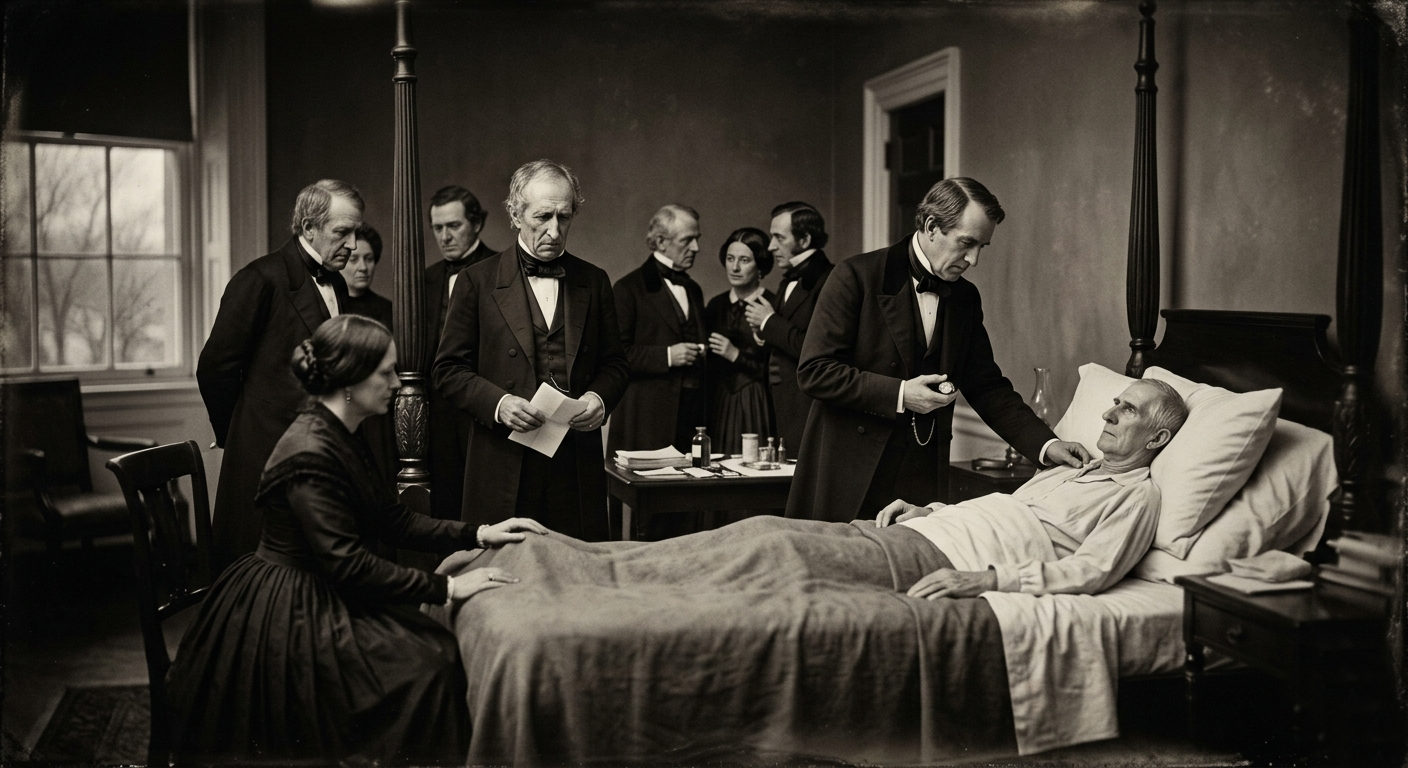
At 12:30 in the morning on April 4, 1841, William Henry Harrison — the ninth President of the United States, war hero of the Battle of Tippecanoe, conqueror of the great Shawnee chief Tecumseh, and the man whose rollicking ‘Log Cabin and Hard Cider’ campaign had swept him into the White House just thirty-one days earlier — died in his bed at the executive mansion. He was sixty-eight years old. He had been the oldest man ever elected to the American presidency. He had delivered the longest inaugural address in the history of the office. He had served the shortest term of any American president before or since. And his death, which came so swiftly and so unexpectedly, threw the young republic into its first genuine constitutional crisis, raising urgent questions about presidential succession that the framers of the Constitution had left dangerously ambiguous.
Harrison’s last words, spoken on the evening before his death to the physician attending him, were addressed not to the doctor but apparently to Vice President John Tyler, who was not present: ‘Sir, I wish you to understand the true principles of the government. I wish them carried out. I ask nothing more.’ They were the words of a man who had spent most of his adult life in public service and who died still thinking about the republic he had served. The irony that permeated his end was almost too perfect for fiction: the man who had campaigned as an indestructible frontier hero, who had refused to wear a coat or hat while delivering his endless speech in the rain, who had wanted so desperately to demonstrate his vigor and fitness that he had made himself demonstrably vulnerable, was dead after a month in office without having accomplished a single significant act of governance. What he accomplished in death, however, would reshape the American presidency in ways that endure to the present day.
Berkeley Plantation and the Virginia Aristocracy: The Making of William Henry Harrison
The popular image of William Henry Harrison as a humble log-cabin frontiersman, sipping hard cider by the fire and embodying the democratic spirit of the American West, was one of the most successful political fabrications in the history of American campaigns. The real Harrison was born on February 9, 1773, at Berkeley Plantation in Charles City County, Virginia — one of the grandest estates in one of the grandest states in colonial and early American life. Berkeley Plantation was a showcase of Tidewater aristocracy, a working plantation sustained by enslaved labor, and the ancestral seat of one of Virginia’s most politically prominent families. His father, Benjamin Harrison V, was not a minor figure in American history. He had been a member of the Continental Congress, a signer of the Declaration of Independence, and three times the governor of Virginia. William Henry Harrison was born into the innermost circle of the founding generation’s elite.
Harrison was the youngest of seven children, and he grew up surrounded by the expectation of public service that characterized the Virginia gentry class. He attended Hampden-Sydney College in Prince Edward County, Virginia, studying classics and history in the manner of a cultivated gentleman. In 1790 he transferred to the School of Medicine of the College of Philadelphia — today’s University of Pennsylvania — with the intention of becoming a physician, a profession his father had specifically encouraged. But in 1791, the year his father died, Harrison abruptly changed direction. Whether because his father’s death had disrupted the family’s finances, because the prospect of a military career seemed more exciting, or simply because the turbulent conditions on the American frontier offered opportunities that a medical practice could not, Harrison secured a commission as an ensign in the First Infantry of the Regular Army and set out for the Northwest Territory. He was eighteen years old, and he would spend the next decades of his life on that frontier, transforming himself from a Virginia aristocrat into something the American public would eventually recognize as a different kind of hero entirely.
Harrison’s early military career was shaped by service under General ‘Mad Anthony’ Wayne, the brilliant and volatile officer who had been given command of American forces in the Northwest following a series of devastating defeats at the hands of the Western Confederacy of Native American nations. In 1794, at the Battle of Fallen Timbers near present-day Toledo, Ohio, Wayne’s forces decisively defeated the confederacy, opening the Ohio country to American settlement and effectively ending organized Native American military resistance in that region. Harrison served in the battle and distinguished himself for bravery, winning Wayne’s personal commendation. He rose to the rank of captain and was appointed commandant of Fort Washington, near present-day Cincinnati. In 1795, he married Anna Tuthill Symmes — the daughter of John Cleves Symmes, a prominent land speculator and New Jersey judge who had obtained a large grant in the Ohio territory — on November 25 of that year. Together they would have ten children, nine of whom survived to adulthood.
Governor of Indiana Territory: Treaties, Tecumseh, and the Road to Tippecanoe
In 1800, President John Adams appointed Harrison as the first governor of the newly created Indiana Territory — an enormous expanse of land that encompassed the present-day states of Indiana, Illinois, Michigan, and Wisconsin, as well as parts of Minnesota and Ohio. Harrison was twenty-seven years old, and the appointment would define the next twelve years of his life. The primary task assigned to the governor of Indiana Territory was the one that defined American frontier governance in the era: the acquisition of Native American lands for white settlement. Harrison understood this mission with exceptional clarity and executed it with exceptional effectiveness. Over twelve years, he negotiated and signed treaties with various tribal leaders that transferred millions of acres of Native American territory to the United States, opening the Old Northwest to the flood of white settlers that was already pushing westward from the eastern states.
The most significant of these land acquisitions was the Treaty of Fort Wayne, signed in September 1809, by which Harrison purchased approximately three million acres of territory from several tribal leaders for a payment that worked out to roughly one penny for every four acres. The treaty was immediately and furiously contested by the Shawnee war chief Tecumseh, one of the most formidable political and military leaders in the history of the American frontier. Tecumseh had been building a pan-tribal confederacy of Native American nations that rejected the authority of any individual tribal leader to sell lands held in common by all the peoples of the region. He confronted Harrison directly at Vincennes, the territorial capital, in August 1810, telling the governor in language that Harrison’s own accounts describe as forceful and eloquent that the land sales would not be accepted and that Native resistance to American expansion would continue to grow. The meeting ended badly. Tecumseh departed, and both men understood that a confrontation was coming.
While Tecumseh was away from his base at Prophetstown — the settlement on the Tippecanoe River near present-day Lafayette, Indiana, that served as the center of his confederacy — recruiting additional allies among tribes to the south, Harrison received authorization from the federal government to move against the confederacy. In October 1811, he assembled an army of approximately one thousand men — regular Army troops and militia from Indiana and Kentucky — and marched toward Prophetstown. The force camped on high ground overlooking the settlement on the evening of November 6, 1811, after reaching an agreement with Tecumseh’s brother, Tenskwatawa (known to whites as ‘the Prophet’), that no hostilities would occur until Tecumseh’s return. In the predawn hours of November 7, 1811, that agreement was broken when the confederacy warriors launched a surprise attack on Harrison’s camp.
The Battle of Tippecanoe was a fierce, confused, and costly engagement. Harrison’s troops, taken completely by surprise in the darkness, nevertheless held their position and drove back the attackers after more than two hours of intense fighting. The Americans suffered more than two hundred casualties — a casualty rate exceeding twenty percent — but held the field and subsequently burned Prophetstown. The outcome was militarily ambiguous: the confederacy was disrupted rather than destroyed, and Tecumseh’s return demonstrated that the battle had not ended Native American military resistance on the frontier. But politically, the battle was transformative. It gave Harrison the nickname that would define his public identity for the next three decades: ‘Old Tippecanoe.’ In the mythology of the American frontier, the Battle of Tippecanoe became a symbol of American courage and military prowess, and Harrison’s reputation as the man who had stood firm against the Native American threat in the darkness at Tippecanoe made him a national figure.
The War of 1812 provided Harrison with further military distinction. He was appointed a general and given command of the Army of the Northwest, with the mission of defending the northern frontier against the combined forces of the British and their Native American allies. The war went badly at first: General William Hull surrendered Detroit to the British in August 1812 in one of the most humiliating episodes in American military history. Harrison eventually recaptured territory and, on October 5, 1813, won a decisive victory at the Battle of the Thames in present-day Ontario, Canada, in which both the British forces were routed and Tecumseh himself was killed. Tecumseh’s death — he fell in the battle, though the exact circumstances are disputed — effectively ended the organized Native American military resistance in the Northwest that Harrison had been fighting for more than two decades. Harrison resigned his commission in 1814, having achieved the military objectives that had defined his career.
From War Hero to Log Cabin: The 1840 Presidential Campaign That Invented Modern Politics
The decades between Harrison’s resignation from the Army in 1814 and his 1840 presidential campaign were a period of fitful political activity, financial difficulty, and declining public prominence that might have ended his political career entirely. He served in the U.S. House of Representatives from Ohio from 1816 to 1819, in the Ohio state senate from 1819 to 1821, and as a U.S. senator from Ohio from 1825 to 1828. President John Quincy Adams appointed him as American minister to Colombia in 1828 — a prestigious but ultimately disastrous posting from which he was recalled after offending the Colombian leader Simon Bolivar by lecturing him on the dangers of dictatorship. When Andrew Jackson became president in 1829, Harrison lost his diplomatic position and returned to his farm in North Bend, Ohio, where by 1834 his financial situation had deteriorated so badly that he was reduced to working as a clerk for the Hamilton County Court of Common Pleas. The war hero of Tippecanoe and the Thames was serving as a county clerk.
The political vehicle that rescued Harrison’s career was the newly formed Whig Party, which had coalesced in the early 1830s around opposition to Andrew Jackson and his Democratic Party. The Whigs represented a coalition of interests that was ideologically diverse but united by a shared commitment to legislative supremacy over executive authority, support for the national bank, internal improvements, and a general opposition to what they characterized as Jacksonian despotism. In 1836, the Whigs ran four regional candidates simultaneously—Harrison being the western candidate—in an attempt to deny Democrat Martin Van Buren a majority in the Electoral College and throw the election to the House of Representatives. The strategy failed; Van Buren won. But Harrison’s strong showing in the West established him as a viable national candidate, and when the economic catastrophe known as the Panic of 1837 destroyed Van Buren’s political standing, the Whigs had both the motivation and the momentum to win the presidency in 1840.
The Whig convention in Harrisburg, Pennsylvania, in December 1839 passed over the party’s most prominent intellectual figures — Henry Clay of Kentucky and Daniel Webster of Massachusetts, both of whom had stronger claims to the presidency on the merits — and nominated Harrison as the presidential candidate and former Virginia senator John Tyler as his running mate. Tyler was a Southern states’ rights Democrat who had broken with Andrew Jackson; his selection was entirely strategic, designed to attract Southern voters who might be wary of the Whigs’ nationalist economic program. The pairing produced one of the most famous campaign slogans in American political history: ‘Tippecanoe and Tyler Too.’
The campaign that followed was the first truly modern presidential campaign in American history, and it transformed American politics in ways that have never been reversed. The transformation began with an accidental gift from the Democrats. A Democratic newspaper writer, attempting to mock Harrison’s age and lack of recent political activity, sneered: ‘Give him a barrel of hard cider and settle a pension of two thousand a year on him, and my word for it, he will sit the remainder of his days in his log cabin.’ The Whigs seized on this intended insult and converted it into their campaign’s central image: Harrison as the man of the people, the hard-cider-drinking frontier hero who lived in a log cabin, in deliberate and pointed contrast to the aristocratic, champagne-sipping Martin Van Buren. The irony was spectacular: Harrison was in fact a scion of the Virginia plantation aristocracy, had grown up in a mansion, and did not drink hard cider. Van Buren was in fact the son of a modest tavern keeper in New York. The ‘Log Cabin and Hard Cider’ campaign was pure political theater — and it worked magnificently.
The Whigs turned the 1840 campaign into a national carnival. They distributed hard cider in miniature log-cabin-shaped bottles. They organized massive rallies of unprecedented size — a Whig gathering in Columbus, Ohio on February 22, 1840 drew more than thirty thousand people, with a mile-long parade featuring log cabins on wheels with revelers drinking hard cider on the roof. They produced campaign songs, slogans, and an avalanche of printed materials on a scale never before seen in American politics. For the first time in American history, a presidential candidate — Harrison himself — personally campaigned for the office, traveling and giving speeches in violation of the accepted gentlemen’s convention that the office should seek the man rather than the man seeking the office. Voter turnout increased by thirty-eight percent over 1836 levels. Harrison won the popular vote by less than 150,000 votes out of more than 2.4 million cast — about six percent — but swept the Electoral College 234 to 60, carrying nineteen of the twenty-six states.
Inauguration Day, March 4, 1841: The Speech That May Have Killed the President
When William Henry Harrison arrived in Washington in February 1841 to prepare for his inauguration, he was sixty-eight years old — the oldest man ever inaugurated as President of the United States up to that time — and he was acutely aware of the gap between the virile frontier hero the campaign had portrayed and the aging man he actually was. The entire logic of the ‘Log Cabin and Hard Cider’ campaign had been built on Harrison’s image as a tough, vigorous man of the wilderness, still possessed of the physical hardiness he had displayed at Tippecanoe thirty years earlier. The whisper campaign against him — that he was too old, too frail, too mentally diminished for the demands of the presidency — had been a persistent feature of the Democratic opposition throughout the campaign. Harrison was determined to demonstrate, publicly and unmistakably, that he was equal to the office.
His inaugural address — prepared with the assistance of Daniel Webster, the great Massachusetts senator and orator who served as his chief political ally and would become his Secretary of State, who reportedly complained that he had ‘killed seventeen Roman Proconsuls as dead as smelts’ in the course of editing it for length—ran to 8,445 words, the longest in American presidential history before or since. It took Harrison approximately one hour and forty-five minutes to deliver. The speech was a detailed exposition of Whig political philosophy, full of classical allusions and constitutional arguments, as though Harrison were determined to demonstrate not only his physical fitness but his intellectual seriousness. He had enlisted Webster to help, and Webster had already shortened it considerably; what remained was still an exhaustive survey of Harrison’s views on executive power, congressional authority, and the constitutional principles he intended to follow.
March 4, 1841, the day of the inauguration, was cold, wet, and windy in Washington. Harrison, in a final and fatal demonstration of the vigor he was so anxious to display, delivered his interminable address outdoors, in the cold and the rain, without wearing a hat or an overcoat. He rode to the ceremony on horseback rather than in a carriage. After the address, he stood for hours at the inaugural parade and shook hands at a series of receptions until late in the evening. By the time he went to bed on inauguration night, he already had what his attendants described as a bad cold.
The days that followed were not restful. Harrison’s transition into office was immediately consumed by the overwhelming demands of the spoils system — the practice by which incoming administrations distributed government appointments to their political supporters, which meant that the White House was besieged from the first day of the new administration by an unrelenting flood of office-seekers, favor-seekers, and petitioners. Harrison later told friends he was so occupied that he had barely time to perform ‘the necessary functions of nature.’ He regularly worked past midnight. He continued taking his daily morning walks around Washington, frequently without appropriate cold-weather clothing, apparently unable or unwilling to rest even as his cold from inauguration day lingered and worsened. On March 17, he issued a proclamation calling Congress into special session on May 31, at the urgent request of Treasury Secretary Thomas Ewing, who had informed him that the federal government’s financial situation was so dire that it could not sustain operations until Congress’s regular December session. The wheels of the new administration were turning — but the man at the center of it all was deteriorating.
The Illness and Death of a President: March 24 to April 4, 1841
On the morning of March 24, 1841, Harrison went for his customary morning walk to the local markets — again without a coat or hat — and came home with a severe cold that quickly became something far more serious. By March 26, just three weeks after his inauguration, the president was so ill that a team of physicians was summoned to the White House. The diagnosis was pneumonia, though Harrison also displayed acute gastrointestinal symptoms that suggested a secondary infection or illness of a different character. The physicians who attended him were products of their era’s medical understanding, which was advanced enough to recognize the seriousness of his condition but offered no effective treatments for what ailed him.
The medical treatments administered to Harrison in the nine days between his becoming gravely ill and his death were a catalogue of the remedies available to nineteenth-century medicine: laxatives, castor oil, calomel (a mercury compound used as a purgative), opium, brandy, camphor, and a liniment made from Virginia snakeweed. None of these had any therapeutic value for the conditions from which Harrison was suffering; several, particularly the mercury-based calomel and the repeated purgatives, were actively harmful. The physicians were doing everything the medical science of their day suggested, which was to say they were largely intervening in counterproductive ways in a process they did not understand and could not effectively treat. Harrison’s own constitution, which had genuinely been robust through his years on the frontier and his military service, fought back as best it could, but the cumulative assault of his illness, his physicians’ treatments, and the physical exhaustion that had preceded his collapse was too much.
Modern medical scholarship has revisited the question of what actually killed Harrison, and the answer may be more complex than the pneumonia diagnosis that dominated accounts at the time. In 2014, historians Jane McHugh and Philip A. Mackowiak published research in the journal Clinical Infectious Diseases arguing that Harrison most likely died not primarily from pneumonia but from enteric fever — typhoid fever and paratyphoid fever — caused by bacteria in contaminated drinking water. The White House’s water supply in 1841 was drawn from a source approximately seven city blocks downstream from a depository for human sewage. The proximity of the drinking water source to this sanitation hazard created conditions ideal for the transmission of enteric diseases. On this interpretation, Harrison’s gastrointestinal symptoms — the severe diarrhea and abdominal distress that accompanied and may have contributed to his decline — were not secondary complications but primary evidence of the disease that was actually killing him.
Whether the proximate cause was pneumonia, enteric fever, or some combination of the two, Harrison’s decline through the final days of March and the first days of April 1841 was relentless. He was attended throughout by multiple physicians and by the household staff of the White House. His wife Anna, who had been packing for the trip to Washington when the news of his election had arrived and who had been in no particular hurry to make the journey to the capital — she had planned to travel to Washington in May — received word of her husband’s critical illness too late. She was still in North Bend, Ohio when he died. Their daughter-in-law Jane Irwin Harrison, the widow of Harrison’s son William Henry Harrison Jr., had been serving as the White House hostess in Anna’s place during the brief presidency, and she was present in the executive mansion during his final illness.
On the evening of April 3, Harrison grew feverish and delirious. At 8:30 in the evening, he spoke what would prove to be his final coherent words — directed, apparently, at Vice President John Tyler, though Tyler was not present: ‘Sir, I wish you to understand the true principles of the government. I wish them carried out. I ask nothing more.’ They were remarkable last words: not personal, not domestic, not sentimental, but constitutional. A man who had spent his entire adult life in military and public service was, at the end, still thinking about governance. At 12:30 in the morning on April 4, 1841, President William Henry Harrison died. It was exactly one month after he had taken the oath of office on March 4. He had served thirty-one days as the ninth President of the United States.
John Tyler and the Constitutional Crisis: Who Succeeds a Dead President?
The death of William Henry Harrison triggered the first genuine constitutional crisis over presidential succession in American history. The Constitution’s language on the subject was, to put it generously, imprecise. Article II, Section 1 provided that in the case of the president’s removal from office, death, resignation, or inability, the ‘powers and duties’ of the office would ‘devolve on the Vice President.’ But this formulation left a crucial question unanswered: did the Vice President actually become President, with full title to the office, or did he merely act as president — performing the duties of the office in a caretaker capacity until either the original president recovered or a new election was held? The difference was enormous, both symbolically and practically.
John Tyler had been at his home in Williamsburg, Virginia, when Harrison died. A messenger arrived early on the morning of April 4 with the news, and Tyler — born March 29, 1790, in Charles City County, Virginia, the same county where Harrison had been born seventeen years earlier — immediately set out for Washington, arriving in the early morning hours of April 6. He was met by the members of Harrison’s cabinet, who had been deliberating on exactly the question of Tyler’s status since Harrison’s death. The cabinet consulted with Chief Justice Roger Brooke Taney of the Supreme Court and reached the conclusion that if Tyler took the presidential oath of office, he would assume the office of president in full. Tyler agreed, and was sworn into office on April 6, 1841, by Chief Justice Cranch of the District of Columbia Circuit Court.
Tyler’s assumption of the full title and powers of the presidency was immediately controversial. Some members of Congress, and some in Harrison’s cabinet, argued that Tyler was merely an acting president — that the Constitution’s language about powers ‘devolving’ meant only that he should perform presidential functions in a caretaker capacity, not that he should exercise the full authority of the office. Tyler’s response was direct and uncompromising. He informed those who addressed letters to him as ‘Acting President’ that the letters would be returned unopened. He made clear that he intended to exercise the full powers of the presidency, not a diminished subset of them, and that he would not accept any qualification of his title or his authority. Congress debated the matter and on May 31, 1841, passed a joint resolution confirming Tyler as president for the remainder of Harrison’s term.
The principle established by Tyler’s assumption of the full presidency became known as the Tyler Precedent, and it governed presidential succession in the United States for the next 126 years. On seven subsequent occasions when an incumbent president died before completing a term — Lincoln in 1865, Garfield in 1881, McKinley in 1901, Harding in 1923, Roosevelt in 1945, Kennedy in 1963 — the vice president assumed the full title and powers of the presidency in accordance with the Tyler Precedent. The ambiguity that Tyler resolved by force of personality and political determination was not formally addressed in the Constitution until the passage of the Twenty-Fifth Amendment in 1967, which explicitly provides that in the event of the president’s death, ‘the Vice President shall become President’ — the precise words of clarification that had been lacking since 1787.
The Whig Party’s Catastrophe: Tyler’s Presidency and the Collapse of Harrison’s Coalition
Whatever constitutional precedent Harrison’s death established, it was politically catastrophic for the Whig Party that had worked so hard and spent so much political capital to elect him. The entire point of the ‘Log Cabin and Hard Cider’ campaign had been to put a Whig president in the White House who would implement the Whig program: re-establishing a national bank to replace the one Andrew Jackson had destroyed, promoting internal improvements, and restoring legislative supremacy over the executive. Harrison had been sympathetic to this program. He had indicated in his inaugural address that he would follow Congress’s lead rather than imposing his own will, and the Whig leadership — particularly Henry Clay, who had effectively expected to be the power behind the presidency — had anticipated a cooperative, malleable executive who would sign the legislation they prepared.
John Tyler was none of these things. Tyler had been added to the ticket as a Southern states’-rights Democrat to attract votes; he had no genuine commitment to the Whig economic program, and his states’-rights philosophy was directly hostile to the national bank and internal improvements agenda that Clay and the Whig majority in Congress were determined to enact. When the Whig Congress passed a bill re-establishing a national bank in August 1841, Tyler vetoed it. When Congress modified the bill and passed it again in September 1841, Tyler vetoed it again. The result was a political explosion: the entire Harrison cabinet — all of whom Tyler had inherited — resigned simultaneously, with the sole exception of Daniel Webster, who remained as Secretary of State to complete delicate ongoing negotiations with Britain. The Whig congressional caucus voted to expel Tyler from the party he had ostensibly represented as vice president. Harrison’s presidency had been replaced by what Whigs sardonically called a ‘His Accidency’ — a president whose entire agenda was the opposite of what the people had voted for.
The consequences of Harrison’s death, mediated through Tyler’s unexpected and unwanted presidency, extended far beyond the failed national bank legislation. Tyler’s administration initiated the process that led to the annexation of Texas in 1845 — a development that massively escalated the sectional tensions over slavery that would eventually produce the Civil War. Tyler negotiated the Webster-Ashburton Treaty with Britain in 1842, which settled the disputed Maine-Canada border and avoided a potential war over the Oregon Territory. He was the first president to face serious impeachment proceedings, when the House of Representatives voted to bring articles of impeachment against him in January 1843 over his repeated vetoes of Whig legislation; the effort failed to achieve the necessary votes, but the constitutional precedent it set had its own long-term significance.
The Cause of Death Revisited: Pneumonia, Typhoid, and the White House Water Supply
The question of what actually killed William Henry Harrison has been the subject of scholarly debate ever since his death, with the medical understanding of the early nineteenth century giving way to retrospective diagnoses enabled by modern clinical knowledge. The official diagnosis at the time was pneumonia — inflammation of the lungs — which was the obvious presenting condition as Harrison’s illness progressed. The conventional popular narrative that followed attributed his death directly to the cold and wet conditions of his inauguration day, suggesting that the lengthy outdoor exposure without appropriate clothing had triggered the respiratory illness that killed him. This narrative was compelling in its irony: the man who refused to wear a coat to prove his physical strength died of a cold caught while not wearing a coat.
The 2014 research by McHugh and Mackowiak challenged this interpretation by drawing attention to the gastrointestinal symptoms that were prominently noted in contemporary accounts of Harrison’s illness — the severe diarrhea that accompanied his respiratory distress and that the physicians treating him regarded as a secondary complication. McHugh and Mackowiak argued that these symptoms were primary indicators of enteric fever, most likely caused by bacteria in the White House’s contaminated drinking water supply. The White House in 1841 obtained its drinking water from a source on the south grounds of the property that was located approximately seven city blocks downstream from the depository for human sewage that served the densely populated neighborhood to the north of the executive mansion. Salmonella typhi — the bacterium that causes typhoid fever — thrives in exactly these conditions and produces precisely the combination of respiratory and gastrointestinal symptoms that Harrison exhibited.
On this revised interpretation, the irony of Harrison’s death takes a different form. He may have died not primarily because he stood in the cold and rain without a coat on inauguration day but because the White House itself was a death trap — the drinking water that the President consumed daily was contaminated by the human waste of the city he led. The same sanitation crisis that killed thousands of ordinary Americans in the era of pre-germ-theory medicine killed the President of the United States within a month of his taking office, with the additional factor of a respiratory illness that may have compromised his immune response and made the enteric infection more quickly lethal. If the McHugh-Mackowiak hypothesis is correct, the physicians who treated Harrison bear no special blame — they were working with the knowledge available to them — but the domestic infrastructure of the executive mansion bears a heavy one.
Anna Harrison: The First Lady Who Never Reached the White House
Among the many poignant details of William Henry Harrison’s brief presidency is the story of his wife Anna Tuthill Symmes Harrison, who holds the distinction of being the only First Lady in American history who never lived in the White House during her husband’s presidency. Anna Harrison was born on July 25, 1775, the daughter of John Cleves Symmes, one of the prominent early settlers of the Northwest Territory. She had married Harrison on November 25, 1795, in a union that her father had initially opposed because he considered the young Army officer an unsuitable match — not wealthy enough, not established enough, not the kind of reliable provider his daughter deserved. Anna spent the next forty-six years proving her father wrong, managing the household and raising their ten children through the long years of Harrison’s frontier service, his political career, and the two decades of relative obscurity before his presidential triumph in 1840.
Anna Harrison was in her mid-sixties when her husband was elected president, and she was not well. Her doctors advised against a winter journey to Washington, and she planned to travel to the capital in May 1841 once the worst of the cold weather had passed. She was still in North Bend, Ohio, packing for the trip when word arrived of her husband’s critical illness. She never made it to Washington in time. Harrison was dead before she could reach him, and she spent the remainder of her life in North Bend, becoming the first presidential widow in American history. She outlived her husband by twenty-three years, dying on February 25, 1864, at the age of eighty-eight, having seen her country descend into the Civil War whose seeds Harrison’s death had indirectly helped to plant. She was the grandmother of Benjamin Harrison, who would become the twenty-third President of the United States in 1889, making the Harrisons the only grandfather-grandson pair of American presidents.
The Funeral, the Legacy, and the Harrison Dynasty in American History
The funeral of William Henry Harrison was, by the standards of the era, an elaborate state ceremony — the first state funeral for a president who died in office, and therefore the occasion on which the rituals and protocols for mourning a dead American president were established for the first time. Before Harrison’s death, there was no established form for the official mourning and burial of a president who died while in office, because no president had ever died while in office before. The ceremonies surrounding Harrison’s death and burial thus had an inevitably improvised quality, drawing on the general conventions of Victorian mourning culture and state ceremony while creating new precedents specific to the presidency.
Harrison’s body lay in state in the East Room of the White House, where it was visited by thousands of Washington residents and officials before being transported for burial. His remains were eventually interred at the William Henry Harrison tomb in North Bend, Ohio — a site Harrison had chosen himself, on Mount Nebo, with a view of the Ohio River Valley and the corners where three states — Ohio, Indiana, and Kentucky — met. The tomb became a memorial site in its own right, and was eventually expanded to accommodate the remains of Anna Harrison and other family members. It remains a National Historic Landmark and a site of historical pilgrimage for those interested in the early American presidency.
The most direct legacy of William Henry Harrison’s life was neither his own brief presidency nor his military career but the dynastic thread he represented in American political history. His father Benjamin Harrison V had been a signer of the Declaration of Independence and governor of Virginia. His own political career — Indian fighter, territorial governor, war hero, congressman, senator, diplomat, president — spanned the formative decades of the American republic. His son John Scott Harrison would serve as a congressman from Ohio. And his grandson Benjamin Harrison would be elected the twenty-third President of the United States in 1888, defeating the incumbent Grover Cleveland in the Electoral College while losing the popular vote — a feat that his grandfather might have recognized, having himself won an election where the margins of the popular vote were similarly contested. The Harrison family’s presence in American political life stretched from the founding generation through the Gilded Age, spanning nearly a century of national history.
The Curse of Tippecanoe: Legend, Coincidence, and American Presidential Mythology
The circumstances of Harrison’s death — specifically the coincidence that he died in office and had defeated the forces of Tecumseh at the Battle of Tippecanoe thirty years earlier — eventually became the foundation for one of the most enduring legends in American presidential mythology. According to the story, Tecumseh, before his death at the Battle of the Thames in 1813, cursed all American presidents elected in years ending in zero, condemning them to die in office. The ‘Curse of Tippecanoe,’ sometimes called ‘Tecumseh’s Curse’ or ‘Tippecanoe’s Curse,’ cites as evidence a remarkable series of presidential deaths: Harrison (elected 1840, died in office), Lincoln (elected 1860, assassinated), Garfield (elected 1880, assassinated), McKinley (elected 1900, assassinated), Harding (elected 1920, died in office), Roosevelt (elected 1940, died in office), and Kennedy (elected 1960, assassinated). Every president elected in a year ending in zero from 1840 through 1960 died in office.
The legend, of course, is precisely that — a legend, constructed retrospectively around a pattern of coincidence and given mythological shape long after the fact. There is no historical evidence that Tecumseh pronounced any such curse, and the association of the pattern with Tippecanoe specifically is an attribution that serves the narrative requirements of the story rather than any documented historical reality. Ronald Reagan, elected in 1980 and thus the next president to face the supposed curse, survived an assassination attempt on March 30, 1981, but lived through his two terms and into his eighties. The pattern, such as it was, had been broken. George W. Bush, elected in 2000, also completed his terms in office. The ‘curse’ belongs to American presidential folklore rather than American presidential history.
What is historically real and historically significant is the impact that Harrison’s death had on the trajectory of American political development. The Tyler Precedent settled the question of presidential succession in a way that shaped the exercise of executive power for over a century. The collapse of the Whig Party’s legislative program under Tyler set the stage for the political realignments of the 1840s and 1850s that produced the Republican Party and, ultimately, the Civil War. The revelation that the White House’s water supply was potentially lethal contributed to the broader national conversation about sanitation, public health infrastructure, and the responsibilities of government for the physical conditions of American life. And the first state funeral for a president who died in office established the ceremonial protocols that would be applied, in various forms, to every subsequent presidential death.
Conclusion: Thirty-One Days That Reshaped the American Presidency
William Henry Harrison served as President of the United States for thirty-one days. He never signed a significant piece of legislation. He never conducted a state visit. He never resolved the constitutional crises that the Whig Party had promised its supporters he would address. He was the oldest president yet elected, and he died the youngest death — in terms of time in office — in presidential history. He is remembered today primarily for these ironies: the longest speech, the shortest term; the most physical demonstration of vigor, the swiftest physical decline. His presidency is, in any conventional assessment of presidential achievement, essentially blank.
And yet the consequences of Harrison’s death were anything but blank. They forced a constitutional clarification that would govern executive succession for 126 years. They destroyed the first unified Whig government and replaced it with a presidency whose agenda accelerated the sectional conflicts that led to civil war. They established the ceremonial and institutional precedents for presidential death that subsequent generations would inherit and elaborate. They made the question of vice-presidential selection a matter of urgent national concern in a way it had never been before — because after April 4, 1841, every American voter understood that the vice president they chose might very well become the president they governed under.
Harrison died on April 4, 1841, just past midnight on Palm Sunday, in the White House, where he had lived for barely a month. His last words had been about the true principles of government. The principles he had in mind — constitutional restraint, legislative supremacy, and republican virtue — were not the ones that his successor would follow. But the constitutional machinery his death set in motion, the precedents it established, and the political consequences it unleashed were among the most consequential in American history. Thirty-one days. Not a single major act of governance. And an enduring impact on the American presidency that no president with a full term has exceeded.