At 6:01 in the evening on April 4, 1968, a single bullet fired from the bathroom window of a rooming house on South Main Street in Memphis, Tennessee, struck the Reverend Doctor Martin Luther King Jr. on the second-floor balcony of the Lorraine Motel. The bullet entered the right side of his face, severed his spinal cord, and fractured his jaw. King fell backward onto the balcony. His colleagues rushed to him. The Reverend Ralph Abernathy, his closest friend and most constant companion, cradled his head. An ambulance arrived and rushed King to St. Joseph’s Hospital, where a team of physicians worked desperately to save him. At 7:05 p.m., they pronounced him dead. He was thirty-nine years old.
The death of Martin Luther King Jr. on April 4, 1968 was not merely the end of a life. It was the violent interruption of the most morally consequential career in twentieth-century American public life, the silencing of the voice that had done more than any other to move the United States toward the fulfillment of its founding promises. In the days that followed, more than one hundred American cities experienced riots, looting, and violence. Forty-six people were killed. More than 3,500 were injured. Twenty-seven thousand were arrested. National Guard troops were deployed across the country. The United States Army occupied the streets of Washington D.C., the capital of a nation that had just killed the man who had spent his adult life trying to make it live up to the words engraved on its monuments.
Atlanta, Georgia, 1929: The Birth of a Leader Destined to Transform America
Martin Luther King Jr. was born Michael King Jr. on January 15, 1929, in Atlanta, Georgia, the second child and first son of the Reverend Michael Luther King Sr. and Alberta Williams King. He was born into a family of extraordinary spiritual and intellectual distinction. His maternal grandfather, Adam Daniel Williams, had been the pastor of Ebenezer Baptist Church in Atlanta since 1894, transforming it from a small struggling congregation into one of the most prominent Black churches in the South. His father, Michael King Sr., who would later change both his own name and his son’s to Martin Luther King in honor of the German Protestant reformer, had succeeded his father-in-law as pastor of Ebenezer and built the church into a center of community life, civic engagement, and faith. Martin Luther King Jr. grew up watching his father stand up to segregation in daily life, refusing to accept racially demeaning treatment and leading a march of several hundred Black Atlantans to city hall in 1936 to protest voting rights discrimination. The church and the family were inseparable, and the commitment to dignity, justice, and the moral authority of the church was the air young King breathed from birth.
King was a prodigy. He left high school at fifteen to enter Morehouse College, the historically Black men’s institution in Atlanta from which both his father and maternal grandfather had graduated. At Morehouse he was deeply influenced by the college’s president, Benjamin Elijah Mays, a social gospel activist and theologian who believed that the Black church had a special obligation to confront racial injustice in the here and now. Mays’s influence shaped King’s understanding of the relationship between faith and social action. King decided in his senior year to enter the ministry rather than medicine or law, graduated from Morehouse in 1948, and enrolled at Crozer Theological Seminary in Chester, Pennsylvania, where he was elected president of a predominantly white senior class and graduated with a Bachelor of Divinity in 1951. He then pursued doctoral studies at Boston University’s School of Theology, completing his doctorate in systematic theology in 1955. It was in Boston that he met and courted Coretta Scott, whom he married on June 18, 1953. They would have four children together: Yolanda Denise, Martin Luther III, Dexter Scott, and Bernice Albertine.
The Montgomery Bus Boycott, 1955: The Young Minister Who Became a National Figure
King had been appointed pastor of Dexter Avenue Baptist Church in Montgomery, Alabama in 1954, and was just twenty-five years old when history chose him. On December 1, 1955, Rosa Parks, a seamstress and NAACP activist, was arrested in Montgomery for refusing to give up her bus seat to a white passenger in violation of the city’s segregation ordinance. Her arrest catalyzed a community that had been building toward confrontation for years. Local civil rights leaders organized a boycott of Montgomery’s bus system and chose King to lead it. The Montgomery Bus Boycott lasted 381 days. During this period, King’s home was bombed, his family received death threats, and he was arrested on a pretextual speeding charge. But the boycott held, and on November 13, 1956, the United States Supreme Court ruled in Browder v. Gayle that racial segregation on Montgomery’s public buses was unconstitutional. King had been transformed, in little more than a year, from a promising young minister into the most prominent civil rights leader in the country.
In 1957, King joined with other civil rights activists including the Reverend Ralph Abernathy, the Reverend Fred Shuttlesworth, and the Reverend Joseph Lowery, as well as the organizer Bayard Rustin, to found the Southern Christian Leadership Conference (SCLC). The SCLC was designed to harness the moral authority and organizational infrastructure of Black churches to conduct nonviolent protests against racial injustice. The SCLC’s founding motto was: Not one hair of one head of one person should be harmed. King became its first president, a position he held until his death. The SCLC, working in coalition with other civil rights organizations including the NAACP and the Student Nonviolent Coordinating Committee (SNCC), would become the organizational backbone of the civil rights movement’s most consequential campaigns over the following decade.
Gandhi, Thoreau, and the Philosophy of Nonviolent Resistance That Defined King’s Strategy
The strategy that defined Martin Luther King Jr.’s civil rights leadership was not simply a pragmatic tactical choice but a deeply considered philosophical and theological commitment rooted in multiple intellectual traditions. King had been introduced to Gandhi’s philosophy of nonviolent resistance at Crozer, and the Mahatma’s influence on his thinking was profound. In 1959, King traveled to India for thirty days under the sponsorship of the Gandhi Memorial Trust, meeting with family members and followers of Gandhi and deepening his understanding of how nonviolent resistance had been applied in the Indian independence movement. He returned convinced that nonviolent resistance was not merely effective but was the only morally defensible strategy for a movement committed to the transformation of social relationships rather than simply the replacement of one form of power with another.
King’s philosophy drew on Henry David Thoreau’s essay on civil disobedience, which argued that individuals had a moral obligation to refuse to comply with unjust laws; on the Christian theology of suffering love and redemption through sacrifice; and on the practical wisdom that nonviolent tactics forced the violence of the oppressor into public view, creating the moral conditions for transformative social change. Nonviolent direct action seeks to create such a crisis and foster such a tension, King argued, that a community which has constantly refused to negotiate is forced to confront the issue. The strategy was designed not to defeat the opponent but to convert them, or failing conversion, to make the cost of maintaining injustice so high in the eyes of the watching world that change became unavoidable. It required extraordinary courage from its practitioners, who had to endure violence without retaliating.
Birmingham 1963, the Letter from Birmingham Jail, and the March on Washington
The campaign that transformed the civil rights movement from a regional struggle into a national political crisis was the 1963 campaign in Birmingham, Alabama, described at the time as the most segregated city in America. King and the SCLC launched a sustained campaign of sit-ins, marches, and economic boycotts designed to force Birmingham’s business community and political leadership to negotiate the desegregation of public facilities and the adoption of fair hiring practices. Public Safety Commissioner Eugene Bull Connor’s police turned fire hoses with water pressure strong enough to tear bark from trees on nonviolent demonstrators, including children. Police dogs were set on peaceful marchers. The images, broadcast on television and published in newspapers across the country and around the world, shocked American and international public opinion in ways that abstract arguments about segregation could not.
Arrested on April 12, 1963, King was held in solitary confinement. In his cell, writing in the margins of newspapers and on scraps of paper, he composed the Letter from Birmingham Jail, a masterwork of moral argument that remains one of the greatest documents in the history of American political philosophy. Addressed to white clergymen who had called for patience and legal means rather than direct action, King declared that injustice anywhere is a threat to justice everywhere, and that we are caught in an inescapable network of mutuality, tied in a single garment of destiny. Later that year, on August 28, 1963, King was among the central organizers of the March on Washington for Jobs and Freedom, drawing between 200,000 and 300,000 participants to the National Mall. From the steps of the Lincoln Memorial, he delivered the address that would define his legacy and become one of the most celebrated speeches in the English language. He told the crowd he had a dream that one day this nation would rise up and live out the true meaning of its creed. The speech was seventeen minutes long. Parts of it had not been in his prepared text; the most famous passages emerged from inspired improvisation in one of the transcendent moments of American public life.
In 1964, at the age of thirty-five, King became the youngest person ever to receive the Nobel Peace Prize. He donated the entire prize money of $54,123 to civil rights organizations including the SCLC. The Nobel Committee recognized him as the first person in the Western world to have shown that a struggle can be waged without violence. That same year, Congress passed the Civil Rights Act of 1964, which outlawed discrimination based on race, color, religion, sex, or national origin in employment and in public accommodations. The following year, the Voting Rights Act of 1965, passed in the aftermath of the brutal assault on marchers at the Edmund Pettus Bridge in Selma, Alabama on Bloody Sunday, March 7, 1965, struck down the literacy tests, poll taxes, and other mechanisms that had been used to systematically disenfranchise African American voters across the South.
The Memphis Sanitation Workers Strike: King’s Final Campaign for Economic Justice in 1968
The final chapter of Martin Luther King Jr.’s life was defined by a cause that reflected the expansion of his vision beyond racial segregation to the deeper questions of economic justice and the dignity of labor. He was organizing the Poor People’s Campaign, a planned gathering of poor people of all races in Washington D.C. to demand economic reforms including jobs, income, and housing, when events in Memphis drew him south. The Memphis sanitation workers’ strike had begun on February 12, 1968, sparked by a tragedy of terrible clarity. On February 1, two Black sanitation workers, Echol Cole and Robert Walker, were crushed to death when the compactor on their garbage truck malfunctioned while they were sheltering from the rain inside the loading hopper. Their deaths were the final straw for workers already enduring wages of approximately one dollar per hour, dangerous working conditions, and systematic disrespect from white supervisors who routinely sent Black workers home without pay during rain delays while white workers received their full wages. Thirteen hundred sanitation workers, nearly all African American, went on strike. They carried signs bearing three words: I Am a Man.
The strike’s leader was the Reverend James Lawson Jr., one of the most respected civil rights organizers in the country and a friend of King’s, who contacted him for support. King flew to Memphis on March 18, 1968, and addressed a crowd of between 15,000 and 25,000 people at Bishop Charles Mason Temple, said to be the largest indoor gathering in the history of the civil rights movement. He announced he would return to lead a march in support of the strikers. He returned on March 28 and led a march with Abernathy and thousands of participants, but the demonstration descended into chaos when a group of young activists broke away and began breaking store windows. A young man named Larry Payne was killed by police. King was devastated. He left Memphis the following day but was determined to return and redeem the failed march, to demonstrate that nonviolent protest could still succeed.
I’ve Been to the Mountaintop: King’s Final Speech and the Night Before His Assassination
King returned to Memphis on April 3, 1968, despite exhaustion and despite a bomb threat that had delayed his flight from Atlanta. That evening he was scheduled to speak at Bishop Charles Mason Temple. Stormy weather had suppressed attendance, and Ralph Abernathy had initially gone in his place, sensing the crowd’s disappointment, and called King by phone to convince him to appear. What King delivered that night became known as the I’ve Been to the Mountaintop speech, his final public address and one of the most remarkable valedictories in the history of American oratory. Fighting a cold and exhausted from weeks of travel, he spoke in passages of extraordinary power, drawing on Biblical imagery and the long history of the movement to articulate why the sanitation workers’ cause mattered and why the struggle had to continue.
Near the end of the speech, King spoke in terms that many who heard it would later describe as prophetic. He told the crowd that he had been to the mountaintop, that he did not mind whatever came next, that longevity has its place but he was not concerned about that now, that he only wanted to do God’s will. He said that God had allowed him to go up to the mountain, that he had looked over, and that he had seen the promised land. He acknowledged he might not get there with them, but he told them that as a people they would get to the promised land. He closed by saying that his eyes had seen the glory of the coming of the Lord. It was as if he knew what was coming. He was thirty-nine years old.
On the morning of April 4, King remained at the Lorraine Motel, a Black-owned establishment at 450 Mulberry Street that had been a gathering place for African American travelers, musicians, and civil rights workers for decades. It was listed in the Negro Motorist Green Book, the guide identifying establishments welcoming to Black travelers in a segregated America, and had hosted guests including Cab Calloway, Count Basie, Nat King Cole, and Aretha Franklin. Walter Bailey, a Black businessman, had purchased the property in 1945 and renamed it the Lorraine after his wife Loree and the popular jazz song Sweet Lorraine. King had stayed there on his previous Memphis visits and was assigned to room 306 on the second floor.
6:01 p.m., April 4, 1968: The Shot at the Lorraine Motel That Silenced a Generation
James Earl Ray had arrived in Memphis on April 4 after learning from newspaper reports and television broadcasts that King was staying at the Lorraine Motel in room 306. At approximately 3:30 p.m., he registered at Bessie Brewer’s Rooming House at 422 and one-half South Main Street under the false name John Willard, requesting a room change from room 8 to room 5B after discovering that room 5B’s bathroom window had a direct line of sight to the balcony of room 306 at the Lorraine. At approximately 4:00 p.m., he purchased binoculars at the York Arms Company for $41.55 and returned to his room to wait and watch.
At 5:55 p.m., King and Abernathy emerged from their rooms and prepared for dinner at the home of the Memphis minister Samuel Billy Kyles. King stepped onto the balcony to speak with colleagues gathered in the parking lot below, including Jesse Jackson and others from the SCLC, while Abernathy remained inside. The atmosphere was relaxed, with conversation and laughter. At 6:01 p.m., a single shot rang out. The bullet struck King on the lower right side of his face, shattering his jaw and severing his spinal cord. He fell backward. Abernathy and others rushed to him immediately. Solomon Jones, King’s driver, pointed across the street toward the rooming house. Jesse Jackson, standing in the parking lot below, looked up and saw King fall. SCLC aides raced to the balcony and tried to staunch the bleeding. The ambulance arrived, and King was rushed to St. Joseph’s Hospital. At 7:05 p.m., he was pronounced dead.
At 6:10 p.m., the first description of the suspected shooter was dispatched by police. At 6:30 p.m., police found a bundle dropped near the Canipe Amusement Company, adjacent to Bessie Brewer’s Rooming House. The bundle contained a Remington Model 760 Gamemaster .30-06 rifle fitted with a Redfield scope, a pair of binoculars, clothing, the Commercial Appeal newspaper carrying the article that had revealed King’s location at the Lorraine, two beer cans, and a radio. Ray’s fingerprints were on the rifle and binoculars. By this time, Ray had driven his white Ford Mustang out of Memphis, heading south through Mississippi and then into Alabama, stopping to dump film equipment into a roadside ditch. The largest manhunt in FBI history had begun.
James Earl Ray: The Assassin, the International Manhunt, and the Conspiracy Question
James Earl Ray was born March 10, 1928, in Alton, Illinois, the oldest of nine children in a desperately poor family. He had spent much of his adult life in and out of prison for a series of small-time thefts and robberies. On April 23, 1967, he had escaped from the Missouri State Penitentiary, where he was serving a twenty-year sentence for grocery store robbery, by hiding in a box of bread. After his escape, he traveled extensively through Chicago, Montreal, Birmingham, Los Angeles, and Atlanta, living under a series of aliases. He had a documented history of making openly racist statements to family members and acquaintances, expressing his particular hatred of King. The FBI investigation that followed the assassination was the largest in the bureau’s history. Fingerprints found at the rooming house and on the abandoned bundle were matched to Ray on April 19, two weeks after the assassination.
The investigation traced Ray’s movements from Memphis to Atlanta, then to Canada, where he had obtained a false passport under the name Ramon George Sneyd. By late May, investigators knew he was in Europe. On June 8, 1968, Ray was arrested at London’s Heathrow Airport by officers of Scotland Yard as he attempted to check in for a flight to Brussels using his false Canadian passport. The ticket agent noticed the name Ramon George Sneyd appeared on a Royal Canadian Mounted Police watchlist. Ray was extradited to the United States on July 19, 1968, arriving in Memphis in a bulletproof vest. On March 10, 1969, his forty-first birthday, Ray appeared before a Memphis judge and pleaded guilty to first-degree murder, receiving a sentence of ninety-nine years in prison. He recanted his plea three days later, claiming he had been framed by a mysterious figure he called Raoul, and spent the remainder of his life insisting he had not acted alone. He died of kidney and liver disease in prison on April 23, 1998, at the age of seventy.
The conspiracy question has never been fully resolved to the satisfaction of all parties. The House Select Committee on Assassinations, which conducted a reinvestigation of the King and Kennedy assassinations in 1979, concluded that James Earl Ray fired the shot that killed King but acknowledged that a limited conspiracy may have existed involving one or more accomplices. In December 1993, Lloyd Jowers, owner of Jim’s Grill across the street from the Lorraine Motel, claimed on ABC television that he had been paid $100,000 by organized crime figures to arrange the assassination and that someone other than Ray had fired the fatal shot. In 1999, the King family filed a wrongful death civil lawsuit against Jowers, seeking only $100 in symbolic damages. The Memphis jury concluded that Jowers and others, including governmental agencies, were part of a conspiracy to kill King, and awarded the $100 the family requested. The United States Department of Justice conducted its own investigation and in 2000 concluded that the civil trial evidence was insufficient to warrant a new criminal investigation.
The Riots of April 1968: More Than One Hundred American Cities in Grief and Fire
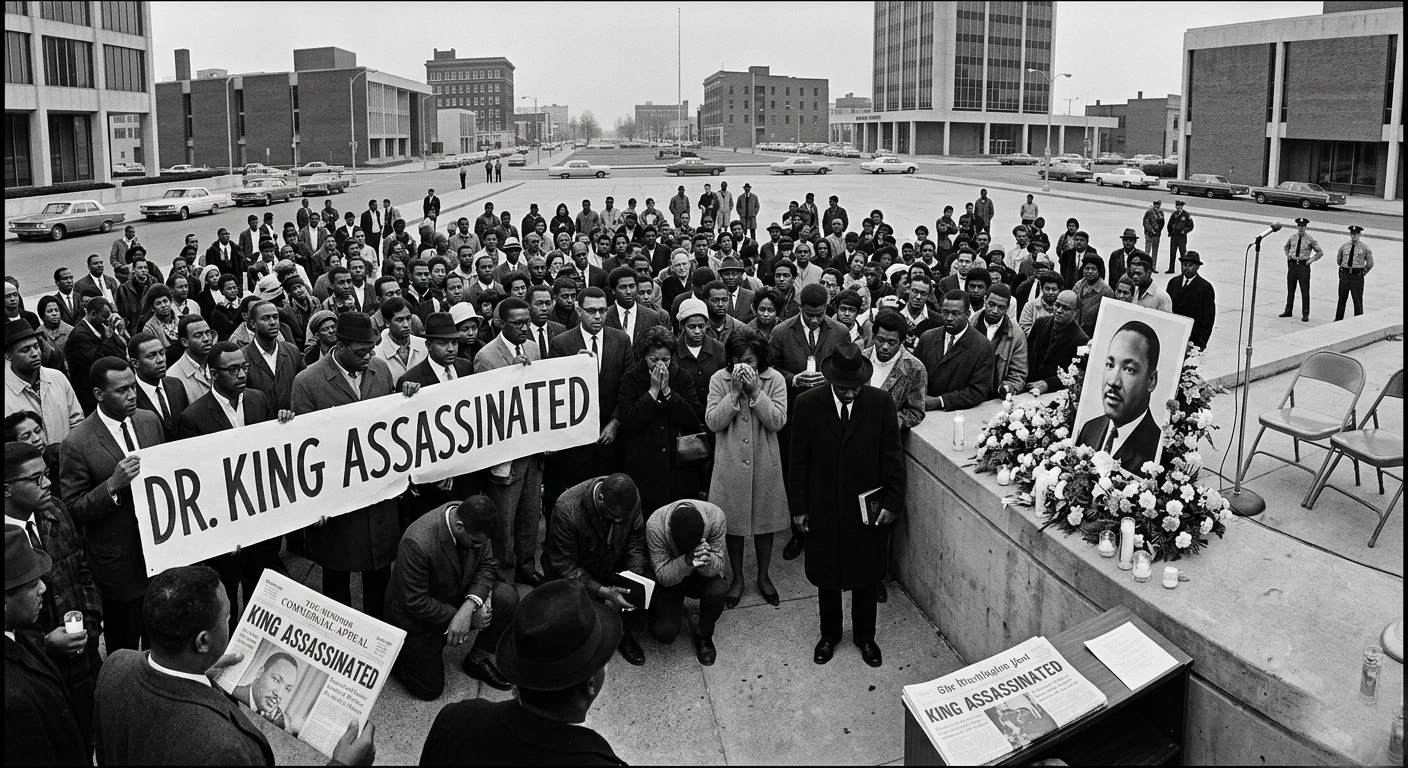
The news of King’s assassination spread across the United States with shattering speed, and the response in African American communities was an explosion of grief, rage, and despair. The man who had devoted his life to nonviolent protest, who had counseled discipline and love even in the face of fire hoses and police dogs and bombs, had been murdered. The message was unmistakable: the most prominent advocate of the patient, legal, nonviolent path to justice had been shot dead. In more than one hundred American cities, riots erupted within hours of the announcement of King’s death. In Washington D.C., fires burned within sight of the White House. President Lyndon B. Johnson called out the Army. Soldiers with rifles took up positions around the Capitol and the White House. In Chicago, Mayor Richard J. Daley controversially ordered police to shoot to kill arsonists. In Baltimore, Governor Spiro Agnew called in the National Guard. By the time the violence subsided, forty-six people had been killed, more than 3,500 had been injured, and approximately 27,000 had been arrested.
Senator Robert F. Kennedy of New York, who was campaigning for the Democratic presidential nomination and was in Indianapolis, Indiana when the assassination occurred, gave one of the most moving impromptu speeches in American political history that night. Standing on a flatbed truck in a Black neighborhood and telling the crowd news most of them had not yet heard, Kennedy said that Martin Luther King dedicated his life to love and to justice between fellow human beings and that he died in the cause of that effort. Kennedy himself was assassinated two months later, on June 5, 1968, after winning the California Democratic primary. The year 1968 became one of the most violent and disorienting in American political history, beginning with the Tet Offensive in Vietnam in January and ending with the chaos of the Democratic National Convention in Chicago in August.
The Funeral in Atlanta: 100,000 Mourners and a Nation Saying Goodbye to Its Conscience
On April 8, 1968, four days after the assassination, Coretta Scott King led a march of approximately 40,000 people through the streets of Memphis in silence, honoring her slain husband and demonstrating that his cause and his method had not died with him. The sanitation workers received their victory twelve days later: on April 16, 1968, the city of Memphis agreed to improved wages and to recognize the sanitation workers’ union, conceding every significant point of the strike. It was the goal for which King had returned to Memphis and had given his life in support.
King’s funeral was held on April 9, 1968, at Ebenezer Baptist Church in Atlanta, the church where three generations of his family had served. The service was attended by many of the nation’s political and civil rights leaders, including Jacqueline Kennedy, Vice President Hubert Humphrey, former Vice President Richard Nixon, Senator Robert Kennedy, and United Nations Ambassador Ralph Bunche. More than 300 million Americans watched the funeral on television. Benjamin Elijah Mays, the Morehouse College president who had been King’s mentor, delivered the eulogy, saying that if death had to come, he was sure there was no greater cause to die for than fighting to get a just wage for garbage collectors. It was precisely the kind of thing King himself would have said.
After the church service, King’s coffin was placed on a simple wooden farm cart pulled by two Georgia mules, a deliberate symbol of solidarity with the working poor whose cause he had championed. A procession of more than 100,000 mourners followed it three and a half miles through the streets of Atlanta to the campus of Morehouse College, where a second memorial service was held. King was initially interred at South-View Cemetery in Atlanta. His remains were later moved to a permanent memorial site at the Martin Luther King Jr. National Historic Site in Atlanta, where an eternal flame burns above his crypt, which bears the inscription from his 1963 speech: Free at last, free at last, thank God Almighty, I’m free at last.
From Room 306 to the National Mall: The Monuments, Holidays, and Lasting Impact of Martin Luther King Jr.
Martin Luther King Jr. was thirty-nine years old when he was killed. He had packed into those thirty-nine years an achievement that most extraordinary figures cannot match in a full lifespan. He had transformed the moral landscape of the most powerful nation on earth, changed its laws, changed its public consciousness, and helped force the distance between the promise of its founding documents and the reality of its practice to become shorter than it had ever been. The Civil Rights Act of 1964 and the Voting Rights Act of 1965, the two most significant pieces of domestic legislation since the New Deal, were direct results of the movement he led. Millions of African Americans who had been systematically excluded from political life were able to register, vote, and participate in democracy because of the work he had done.
The honors that came after his death reflected the belated recognition of what he had been. He was posthumously awarded the Presidential Medal of Freedom in 1977 by President Jimmy Carter, and the Congressional Gold Medal in 2003. In 1983, Congress established Martin Luther King Jr. Day as a federal holiday, observed on the third Monday of January. The holiday was first observed in 1986. It was the first federal holiday honoring an individual American since Abraham Lincoln’s birthday was added to the national calendar, and the only federal holiday honoring a private citizen rather than a president. In 2011, the Martin Luther King Jr. Memorial was dedicated on the National Mall in Washington D.C., the first memorial on the Mall to honor a Black American and only the second to honor a private citizen rather than a president. King stands on the Mall in stone, looking out across the Tidal Basin toward the Jefferson Memorial, with words from his 1964 Nobel Peace Prize address carved on the adjacent wall: Out of the mountain of despair, a stone of hope.
His speeches and writings rank among the most significant in the English language. The March on Washington address is studied in universities around the world. The Letter from Birmingham Jail is taught in virtually every serious course on political philosophy, civil rights, or American history. Where Do We Go from Here: Chaos or Community, his final book published in 1967, reads today as a diagnosis of the challenges that have persisted into the twenty-first century: the poverty and economic inequality that formal legal equality alone does not address, the persistence of racism in structures and institutions rather than only in individual hearts, the interconnection between racial justice and economic justice and peace.
Conclusion: April 4, 1968 and the Unfinished Business of American Democracy
Martin Luther King Jr. was murdered on April 4, 1968, at 6:01 in the evening, on the balcony of a Black-owned motel in Memphis, Tennessee, while supporting a strike by sanitation workers who wanted to be treated as men. He was there because he believed that the dignity of those workers was inseparable from the dignity of every human being, and that the work of justice could not stop at the color line but had to extend to the economic and social conditions that kept people poor and excluded. He was thirty-nine years old, and he had already changed his country more than most people change it in a lifetime.
His death did not stop the movement. The sanitation workers won their strike. The civil rights legislation he had fought for remained on the books. The organizing he had done, the coalitions he had built, the consciousness he had raised did not die with him. Coretta Scott King, who became the keeper of his legacy and co-founder of the King Center for Nonviolent Social Change in Atlanta, spent the remaining decades of her life ensuring that what he had started continued. His children carried the work forward. The organizations he had helped build continued their missions.
The question King himself posed in his final book, where do we go from here: chaos or community, remains unanswered in the only way that matters, which is in the ongoing choices of a nation still working to reconcile its democratic ideals with the realities of racial and economic inequality. He believed it was possible. He believed that the arc of the moral universe is long, but it bends toward justice. Whether he was right depends, as it did then, on what the living choose to do with what the dead have left them. April 4, 1968 took from the world a voice that cannot be replaced. What it could not take is the truth of what that voice said.