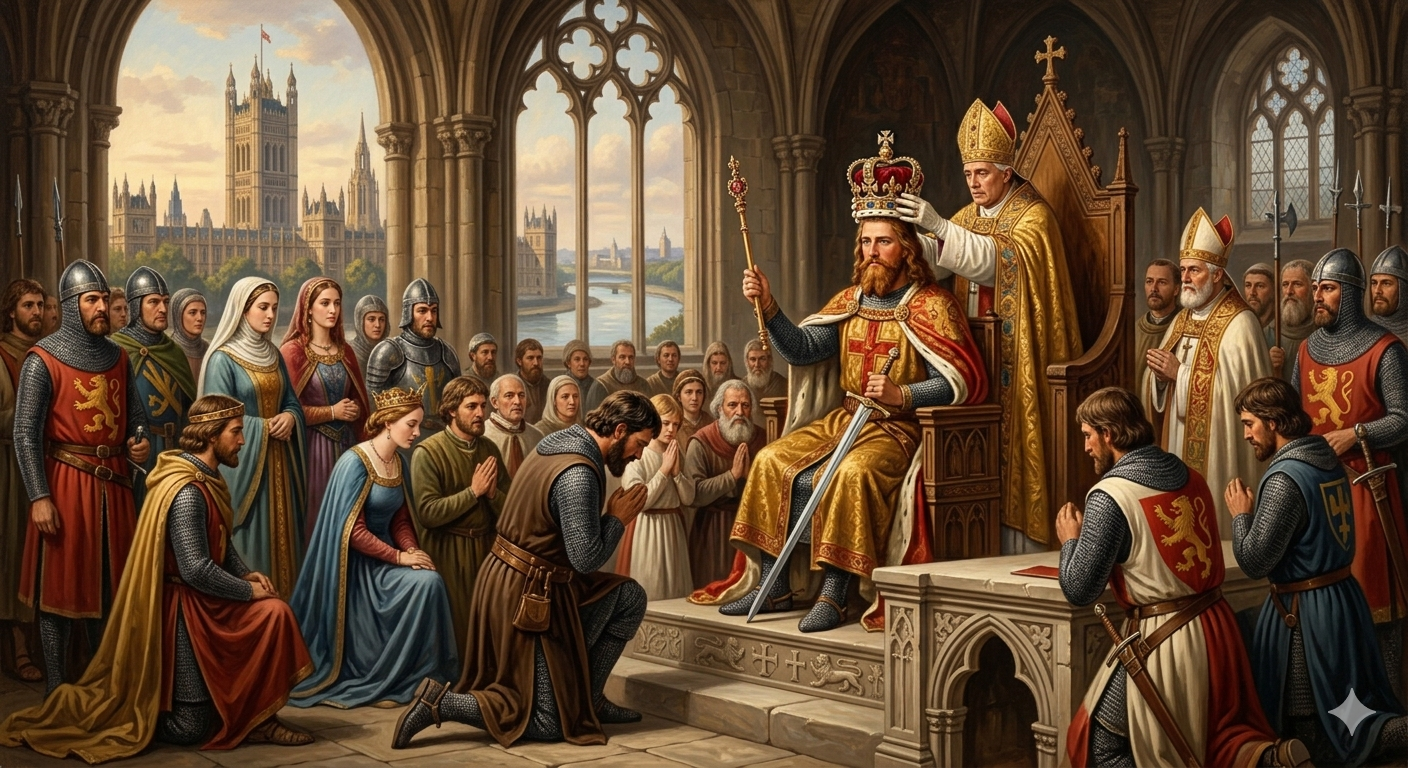
On Sunday, September 3, 1189 — the feast day of the ordination of Pope Saint Gregory — the great doors of Westminster Abbey opened before a solemn procession that carried through the nave of England’s most sacred royal church a man whom most of his new subjects had never seen. Richard, the third son of King Henry II and Eleanor of Aquitaine, was thirty-one years old, tall and powerfully built with reddish-blond hair and pale eyes, and had spent most of his life in the continental territories of the Angevin Empire rather than in the kingdom he was about to receive. He was already a renowned warrior, already a man who had commanded armies since his mid-teens and had put down rebellions with a ferocity that earned him the nickname by which he would be remembered for eight centuries: Coeur de Lion — the Lionheart. Now, in the elaborate ritual of medieval royal consecration, he was about to become King of England.
Richard’s coronation on September 3, 1189 was not merely the beginning of a reign. It was a moment of exceptional historical importance for reasons that extend beyond the investiture of a single monarch. It is the first coronation in English history for which a complete contemporary account exists — documented in meticulous detail by the chronicler Roger of Howden, whose description records the ritual, names the participants, and preserves the oaths that the new king swore at the altar. The account, preserved at the Bodleian Library in Oxford, represents the beginning of the detailed documentary record of English coronation ceremonies that continues to the present day. And the coronation was followed, on the very day of its celebration and in the days that followed, by an explosion of anti-Jewish violence in London and then across England that cast a dark shadow over the festivity and revealed the dangerous currents of religious bigotry and social tension that ran beneath the surface of medieval English society.
Richard the Lionheart: The Man Who Was Never Supposed to Be King
Richard’s path to the English throne was not the straightforward succession of a designated heir but the product of a series of family tragedies and political catastrophes that progressively eliminated his older brothers from the line of succession. He was born on September 8, 1157, probably at Beaumont Palace in Oxford, the third of five sons of King Henry II and Eleanor of Aquitaine. His elder brother William had died in infancy before Richard’s birth. His second elder brother, Henry — known as Henry the Young King — had been crowned as a junior king alongside his father in 1170, an arrangement intended to secure the succession but that produced instead a dangerous rivalry between the crowned but powerless young Henry and his father, who retained all real authority. Henry the Young King died in 1183 without ever exercising independent royal power, leaving Richard as the new heir to the English throne.
But between the death of Henry the Young King in 1183 and Richard’s accession in 1189, the relationship between Richard and his father descended into open warfare. Henry II, who seemed constitutionally unable to relinquish control to any of his sons, refused to grant Richard the secure confirmation of his position as heir that would have allowed the younger man to feel safe. The specific flashpoint was Aquitaine: Henry II demanded that Richard surrender the duchy of Aquitaine — the territory Richard had governed since the age of eleven, his mother’s ancestral inheritance, the land he regarded as his own — to his younger brother John. Richard refused absolutely. He was not willing to give up Aquitaine, and his refusal was the beginning of the final rupture with his father.
Richard found a powerful ally in Philip II of France — Philip Augustus — the young and ambitious King of France who was always eager to exploit divisions within the Angevin family and weaken the grip of the English king over his continental territories. In November 1188, Philip made a dramatic gesture at a peace conference, publicly offering Henry II generous terms if the English king would finally formally designate Richard as his heir and confirm his betrothal to Philip’s sister Alys. Henry prevaricated, as he always did when it came to empowering his sons. In early 1189, Richard and Philip launched a military campaign against Henry II. On July 4, 1189, their forces defeated Henry’s army at Ballans. Henry, already gravely ill from a bleeding ulcer, had to be held upright on his horse by attendants during the subsequent peace negotiations. He accepted Richard’s terms — confirming Richard as his heir, agreeing to a substantial payment to Philip, and acknowledging himself defeated — and was then carried back to Chinon castle on a litter. Two days later, on July 6, 1189, Henry II died at Chinon, aged fifty-six.
The Death of Henry II and Richard’s Accession: A Kingdom in Transition
The death of Henry II on July 6, 1189, was one of those moments in medieval history that changed the political landscape of two countries simultaneously. Henry had been one of the most remarkable rulers in English history: the founder of the Angevin dynasty, the king who had transformed the English legal system through his common law reforms, the man who had created an empire stretching from the Scottish border to the Pyrenees. His death after more than thirty-four years on the throne left a kingdom that was administratively sophisticated by twelfth-century standards, militarily experienced, and financially strained by the costs of his wars and administrative ambitions. The chronicle tradition records that when Richard came to view his father’s body at Fontevraud Abbey, where Henry had been buried, blood flowed from the corpse’s nostrils — a phenomenon that the medieval mind interpreted as a sign that the dead man had been wronged by those in his presence. Roger of Howden preserved this detail, and its recording reflects the ambivalence that contemporaries felt about the son who had driven his father to his death.
One of Richard’s first acts upon learning of his father’s death was to send William Marshal to England with orders to release his mother from confinement. Eleanor of Aquitaine had been kept under varying degrees of restriction since 1173, when she had actively encouraged and supported the rebellion of her sons against their father. Her confinement had lasted fifteen years. Her release was both a personal act of filial loyalty and a practical political decision: Eleanor was one of the most formidable figures in the political landscape of the Angevin world, a woman of extraordinary intelligence and political skill who had been Queen of France before becoming Queen of England, who had accompanied the Second Crusade, who had governed Aquitaine, and who was now free at last to apply her considerable abilities to the service of her favorite son. She immediately began touring England, as Roger of Howden records, going from city to city and castle to castle, holding queenly courts, releasing prisoners, and exacting oaths from all freemen to be loyal to Richard as their as-yet-uncrowned king.
Richard himself did not hurry to England. He spent time in his continental territories securing his position as Duke of Normandy — a title formally invested on July 20, 1189, at Rouen — and making the political arrangements that would allow him to depart on crusade as quickly as possible after his coronation. The crusade was, from the beginning, the primary purpose of his kingship as Richard conceived it. Saladin had captured Jerusalem in October 1187, and Pope Gregory VIII had called for a new crusade to recover the holy city. Richard had taken the cross — the formal vow to go on crusade — in November 1187, at Tours, even before his father’s death and long before he had any certainty that he would be king. When Richard finally sailed from Calais to England, he came not to govern but to be crowned, and then to raise the resources for the campaign he had already committed himself to.
Eleanor of Aquitaine’s Role in Planning the Coronation
The coronation ceremony of September 3, 1189, was extraordinary in its elaborateness, and the responsibility for much of its organization is attributed by contemporaries to Eleanor of Aquitaine, who threw herself into planning her son’s investiture with the energy of a woman liberated after fifteen years of confinement. Eleanor understood pageantry and its political function with a sophistication that few of her contemporaries matched: she had been present at the courts of two of the most culturally refined monarchies in Europe, had organized celebrations at the courts of both France and England, and knew that a coronation was not merely a religious ceremony but a political statement — a demonstration to the barons, the clergy, the people of London, and the watching world of the magnificence and legitimacy of the new king.
The coronation she helped plan was, by contemporary accounts, lavish almost to the point of extravagance — exactly the kind of grand event that Henry II, famously indifferent to ceremony and physical display, would not have enjoyed, but precisely what Richard and Eleanor wanted. It was also historically significant as a peaceful transfer of power: for the first time in 102 years, since the death of William the Conqueror in 1087, a son was being crowned King of England after the natural death of his father rather than during his lifetime or amid armed conflict. Everyone in England remembered the Anarchy — the civil war between 1135 and 1153 during which the rival claims of King Stephen and Empress Matilda had devastated the country — and the peaceful succession represented by Richard’s coronation was itself a cause for celebration regardless of the specific character of the new king.
The Procession and the Ceremony: Roger of Howden’s Historic Account
The coronation ceremony of September 3, 1189 is the first in English history for which a full and detailed contemporary account exists, preserved by the chronicler Roger of Howden in his Gesta Regis Ricardi — the Deeds of King Richard. Thanks to Howden’s meticulous record, we know not merely that the coronation took place but who participated in it, what they carried, what rites were performed, what oaths were sworn, and how the ceremony unfolded from beginning to end. This documentation makes the coronation of Richard I a watershed moment in the history of English kingship: before September 3, 1189, the ceremonies by which English kings were made are known only in outline; after it, the ritual of English coronation is documented in the kind of detail that allows scholars to trace its evolution from the twelfth century to the present.
Howden records that the ceremonial procession to Westminster Abbey was an extraordinary display of ecclesiastical and secular magnificence. The clergy led the way: bishops, abbots, and large numbers of the clergy wearing silken hoods, preceded by the cross, taper-bearers, censers, and holy water. Behind them came the nobility bearing the regalia. John Marshal carried two large and heavy golden spurs from the king’s treasure. Godfrey de Lucy carried the royal cope. William Marshal — the greatest knight in England, the man who had remained loyal to Henry II even in his final defeat and whom Richard had confirmed in his honors immediately upon his accession — carried the royal sceptre, on the top of which was a golden design. Six barons and earls bore the regalia of gold cups and a great golden paten. Three earls bore the swords. And at the heart of this procession, surrounded by the most powerful men in the kingdom in both their spiritual and secular roles, came Richard himself.
Nineteen archbishops, bishops, and bishops-elect attended. Thirteen abbots were present, two of them from France. Eleven earls participated in the ceremony. Seventeen great barons and officials took part. The total assembly represented the entire governing class of England gathered in one place, their presence itself a statement of recognition and allegiance: by attending Richard’s coronation, each of these men was acknowledging his kingship and pledging the loyalty that his rule would require. Among those watching with particular intensity was Eleanor of Aquitaine, the Dowager Queen of England, for whom the coronation of her son must have felt like the culmination of everything she had fought for across a lifetime of political struggle. Watching Richard crowned must, as one historian has observed, have felt like the crowning moment of her whole life.
At the altar, Richard knelt surrounded by abbots and bishops. The holy relics of saints and the Bible were placed before him. Then, according to Roger of Howden, Richard took the coronation oath — a formal public commitment to the principles that would govern his kingship. He swore that he would all the days of his life observe peace, honor, and reverence towards God, the Holy Church, and its ordinances. He swore that he would exercise true justice and equity towards the people committed to his charge. He swore that he would abrogate bad laws and unjust customs, if any such had been introduced into his kingdom, and would enact good laws, and observe the same without fraud or evil intent. These oaths bound Richard, at least theoretically, to a vision of kingship that was not merely about power and conquest but about justice and the welfare of his subjects — a vision that the subsequent record of his reign would test in complicated ways.
The Anointing: The Sacred Heart of the Coronation Ritual
The theological and ceremonial center of the coronation was the anointing — the application of holy oil to the king’s body by the Archbishop of Canterbury, which transformed the act of investiture from a political ceremony into a sacred one, conferring on the king a quasi-priestly character that distinguished him from ordinary secular rulers. The anointing was performed by Baldwin of Forde, the Archbishop of Canterbury, who had held that position since 1185 and who would accompany Richard on the Third Crusade, dying at the siege of Acre in November 1190. Baldwin was a man of genuine religious seriousness — a Cistercian monk before his appointment to Canterbury — and his performance of the anointing carried the weight of both his personal religious authority and his position as the leading churchman of England.
Before the anointing, Richard’s outer garments were removed, leaving him in his shirt and breeches. His shirt had been specially prepared beforehand: it was modified to leave his right shoulder and the front of his chest bare, the surfaces to which the holy oil would be applied. He put on sandals embroidered with gold. Then Baldwin of Forde poured the chrism — the holy oil blessed for this specific purpose — upon Richard’s head, his chest, and his right arm. The three-part anointing echoed the biblical anointing of the kings of Israel: head for wisdom, chest for valor, arm for strength. The moment when the Archbishop poured the oil was the moment at which, in the theology of medieval kingship, the king received divine approval for his rule — the moment at which he ceased to be merely a powerful man and became a monarch chosen by God to govern a Christian people.
After the anointing, Richard was clothed in the royal vestments: the tunic, the dalmatic worn over it, the mantle clasped on his shoulders. The crown was placed upon his head. The scepter was placed in his right hand. The rod with the golden cross was placed in his left. Fully vested and crowned, Richard was led to his throne by the Archbishop of Canterbury and the other senior clergy. He was now King of England — King by hereditary right, King by the oath sworn at the altar, King by the anointing of the Church, King by the acclamation of the assembled nobility and clergy who witnessed his investiture. The transition from the son who had fought his father to the anointed King of England was complete.
The Anti-Jewish Riots: The Dark Shadow Over a Royal Celebration
The coronation of Richard I on September 3, 1189 is inseparable from the events that followed it — events that transformed the celebration of a new reign into one of the most notorious episodes of anti-Jewish violence in medieval English history. The tradition of the coronation had barred all Jews and women from attending the investiture ceremony itself. Despite this prohibition, a delegation of Jewish community leaders appeared at the court on the day of the coronation, intending to present the new king with gifts as a mark of respect and a gesture of goodwill toward the new sovereign. The exact sequence of what happened next is disputed in the sources, but the outcome was unambiguous: the Jewish delegation was set upon by courtiers, stripped, flogged, and thrown out of the court.
According to Ralph of Diceto, one of the contemporary chroniclers, the attack on the Jewish delegation was carried out by Richard’s own courtiers. When rumor spread through the streets of London that the king had ordered the Jews to be killed — a rumor that may have been entirely false but that spread with the speed and destructive power that false rumors have always possessed — the people of London attacked the Jewish population of the city. Jewish homes were broken into, plundered, and burned. Jewish residents were beaten, killed, and in some cases forcibly baptized — a particularly terrible fate in medieval terms, because it was theoretically irreversible and removed the victim permanently from the community of their faith. Among those killed in the London riots was Jacob of Orléans, a respected Jewish scholar who had been living in England. Some Jews managed to escape or sought sanctuary in the Tower of London, while others fled the city entirely.
The riots were not confined to London. As news of the coronation and the anti-Jewish violence spread throughout England, similar attacks broke out in other cities and towns. The most catastrophic episode came in York in March 1190, several months after the coronation, when the Jewish community of York — which numbered perhaps 150 people — took refuge in Clifford’s Tower following an outbreak of violence against Jewish homes and persons. Surrounded by a mob, trapped in a tower that was also on fire, and faced with the prospect of massacre if they surrendered, most of the York Jews died in a mass suicide and fire rather than fall into the hands of their attackers. The York massacre remains the worst episode of anti-Jewish violence in medieval English history, and its proximate cause was the atmosphere of murderous hostility that the coronation day riots had helped create.
Richard’s response to the coronation day violence was a mixture of genuine anger and pragmatic calculation. He was furious, according to the chroniclers, but his fury was driven at least partly by the consideration that the Jews of England were under his personal protection as a source of royal revenue — they were, in the brutal economic logic of medieval kingship, a financial asset that his barons and subjects had no right to destroy without royal authorization. He issued orders for the punishment of those responsible for the most egregious murders and persecutions, including rioters who had accidentally burned down Christian homes in the course of attacking Jewish ones. He ordered that a Jew who had been forcibly baptized be allowed to return to his native religion. The Archbishop of Canterbury, Baldwin of Forde, who had performed the coronation anointing, reacted to the violence with a remark that captured the depth of the problem: If the King is not God’s man, he had better be the Devil’s — an expression less of theological criticism than of exasperation at the breakdown of order on the very day of the royal consecration.
A King Without Interest in England: Richard’s Attitude Toward His Kingdom
Almost from the moment of his coronation, Richard demonstrated the attitude toward England that would define his entire reign and that has provoked debate among historians from his own time to the present. He regarded England primarily as a source of revenue for his crusade — a vast estate from which money could be extracted to fund the campaign in the Holy Land that he had already committed himself to before he became king. The chronicler Roger of Howden claimed that Richard put up for sale all he had: offices, lordships, earldoms, sheriffdoms, castles, towns, lands, everything. According to the tradition preserved in multiple sources, Richard himself joked that he would sell London if he could find a buyer. Whether or not he actually said it, the remark captures something genuine about his priorities.
Richard did not merely sell titles and offices; he sold the machinery of governance itself. Sheriffdoms — the administrative positions that governed England’s counties — were sold to the highest bidders. Church offices were sold. Royal demesne lands were alienated. The treasure that his father had accumulated through decades of careful financial management was turned into crusade funding. Richard’s own explanation, according to the chroniclers, was characteristically direct: he was going to do what a crusading king needed to do, and he needed money to do it. The political consequences of this wholesale commercialization of royal governance were significant: it transferred power and wealth from the crown to the barons and bishops who could afford to buy what Richard was selling, weakening the administrative machinery that Henry II had spent thirty years building.
Richard spent a total of perhaps six months in England during his ten-year reign. The rest of his time as King of England was spent in the Holy Land, in Austrian captivity, in France defending his continental territories against Philip II, or traveling between these locations. He never learned to speak English with any fluency — French was the language of the Angevin court and the language in which Richard was educated, composed poetry, and conducted most of his important business. He was, in the phrase that historians have frequently used, an absentee king, though whether this absence constituted neglect of his kingdom or simply reflects the different conception of medieval monarchy that made the king’s person less important than his administrative machinery is a question that historians continue to debate.
The Saladin Tithe and the Financial Mobilization for the Third Crusade
One of Richard’s first acts after his coronation was to implement what became known as the Saladin tithe — a ten-percent tax on income and movable property imposed across England to fund the crusade. The tithe had actually been decreed by Henry II in 1188, following the fall of Jerusalem to Saladin, but it had not been fully implemented before Henry’s death. Richard revived and extended it, collecting it with an efficiency that demonstrated he was at least capable of systematic administration when the goal was crusade funding. The tax was deeply unpopular — no tax is popular, but a ten-percent income tax imposed in the late twelfth century represented an extraordinary fiscal burden on a society in which the crown had never previously claimed such a percentage of personal income — but it raised substantial revenue.
Richard supplemented the Saladin tithe with the wholesale sale of royal assets described above, and with the contributions of wealthy barons and churchmen who joined the crusade bringing their own forces and resources. By 1190, he had assembled what was, by the standards of the time, a formidable military force: a large fleet of purpose-built transport ships and warships, tens of thousands of soldiers drawn from England, Normandy, Aquitaine, and other Angevin territories, and the financial resources to sustain a major campaign in a distant theater of war for an extended period. The logistical achievement of the Third Crusade — the ability to move and supply such a force across the Mediterranean and to maintain it in the field through months of siege warfare and open battle — was itself a considerable military administrative accomplishment.
Departure for the Crusade: A King Who Never Really Came Home
Richard departed England on December 12, 1189 — just over three months after his coronation — sailing from Dover to Calais on his way toward the Holy Land. Before departing, he made the administrative arrangements that would govern England in his absence. He appointed Hugh de Puiset, Bishop of Durham, as one of the chief justiciars. William Longchamp, his chief minister, was appointed chancellor with broad administrative authority. Although Eleanor of Aquitaine was not formally designated regent, the chroniclers make it clear that both de Puiset and Longchamp deferred to her authority, and that she exercised a quasi-regential oversight of English affairs during the early years of Richard’s absence.
The Third Crusade that Richard joined was among the most significant and most complex military undertakings of the medieval period. He traveled to the Holy Land via Sicily and Cyprus — taking the time along the way to capture Cyprus from its Byzantine governor, Isaac Komnenos, after the governor had mistreated shipwrecked survivors of Richard’s fleet, including the ship carrying his betrothed Berengaria of Navarre. On Cyprus, on May 12, 1191, Richard married Berengaria — a politically motivated match that Eleanor had helped arrange, intended to secure the southern border of Aquitaine through an alliance with the neighboring Kingdom of Navarre. The marriage produced no children, and Berengaria would not set foot in England until after Richard’s death.
In the Holy Land, Richard’s military reputation was thoroughly justified. He was one of the most effective battlefield commanders of his era, combining physical courage with tactical intelligence in a way that was rare even among the celebrated warriors of the crusading age. He led the successful siege of Acre, which fell to the Crusaders in July 1191. On September 7, 1191, his carefully disciplined march down the coast to Jaffa, and the brilliant defensive battle of Arsuf in which his cavalry charge shattered Saladin’s army at the precise tactical moment, demonstrated a mastery of large-scale military operations that impressed even his Muslim opponents. Muslim historians writing in Saladin’s court praised Richard’s valor and generalship — a remarkable tribute from the very enemies he was fighting.
Richard vs. Saladin: The Most Celebrated Rivalry of the Third Crusade
The relationship between Richard I and Saladin — Salah ad-Din Yusuf ibn Ayyub — is one of the most celebrated rivalries in medieval history, elevated by later legend and romantic literature into a paradigm of chivalric conflict between worthy opponents who admired each other across the divide of religion and political enmity. The reality was complex. Richard and Saladin never met in person. Their conflict was conducted through battle, siege, negotiation, and the exchange of messages and gifts — a kind of diplomatic conversation conducted against a background of warfare that reflects the medieval understanding of war as a regulated activity governed by codes of honor as well as by the imperative of victory.
The legends of the rivalry were built on real foundations. Saladin was a formidable commander and a genuinely impressive figure — a Kurdish Muslim ruler who had united the fractious Islamic world of the Levant under his authority and who had captured Jerusalem from the Crusaders in 1187 through a combination of military skill and political astuteness. His treatment of the Christian population of Jerusalem after its capture — in contrast to the massacre that the Crusaders had perpetrated when they first took the city in 1099 — generated genuine admiration in Europe and helped create the image of a magnanimous Muslim prince that persisted through the centuries. Richard’s famous gesture of sending horses to Saladin when the sultan was unhorsed during a battle — an act of chivalric generosity toward an enemy that the chronicles record, though its historical accuracy has been questioned — became one of the defining stories of the crusading legend.
Despite his military successes — the fall of Acre, the victory at Arsuf, the capture of coastal fortresses — Richard ultimately failed to achieve the primary objective of the Third Crusade: the recapture of Jerusalem. He led his army to within a few miles of the city twice, but on both occasions the practical difficulties of besieging and then holding Jerusalem — the problems of supply, the political divisions among the Crusader forces, the reality of Saladin’s ability to concentrate force for a counterattack — persuaded him to pull back. In September 1192, Richard and Saladin negotiated a truce that gave Christian pilgrims free access to the holy places of Jerusalem without requiring the Muslim garrison to evacuate the city. It was a diplomatic compromise that preserved the essentials of the Crusader cause without achieving its ultimate goal.
Captivity, Ransom, and the Second Coronation of 1194
Richard’s return journey from the Holy Land became one of the most extraordinary episodes in his extraordinary life. His ship was wrecked in the Adriatic, forcing him to travel overland through territory controlled by European rulers who had grievances against him — grievances that Richard had accumulated through the combination of diplomatic tactlessness and personal arrogance that was as much a part of his character as his military brilliance. In December 1192, traveling in disguise through Austria, he was recognized and captured by Duke Leopold of Austria, whom Richard had deeply insulted during the siege of Acre by tearing down his banner when Leopold presumed to plant it alongside the banners of the kings. Leopold handed Richard over to the Holy Roman Emperor Henry VI, who held him prisoner in the castle of Durnstein on the Danube and then in various other German fortresses.
The ransom demanded for Richard’s release — 150,000 marks of silver, equivalent to roughly three times the annual royal revenue of England — was one of the largest ransoms in medieval history. The effort to raise it fell primarily on England, where Eleanor of Aquitaine, now in her seventies but still politically active and formidable, organized a national fundraising effort that stripped the English church and nobility of silver plate, demanded extraordinary levies from the merchant class, and imposed what amounted to a second extraordinary tax on a kingdom already strained by the Saladin tithe and the sale of royal assets. While Richard sat in German captivity, his younger brother John — who had been plotting to seize power with the encouragement of Philip II of France — attempted to take control of England, though his efforts were largely frustrated by the loyalty of Richard’s administrators and Eleanor’s intervention.
Richard was released in February 1194, after the ransom had been substantially paid, and returned to England. Concerned that his captivity and his brother’s machinations might have undermined the legitimacy of his kingship, he underwent a second coronation ceremony — a formal re-crowning at Winchester Cathedral on April 17, 1194 — to reaffirm his royal status. The second coronation was primarily a political statement rather than a religious necessity, emphasizing that Richard’s return from captivity was a restoration of proper royal authority. After this second ceremony, he moved to reassert control over England, restored the administration to proper order, confronted John and forgave him with a calculated magnanimity that was itself a political statement, and then departed England for the last time, sailing to Normandy to deal with the ongoing war against Philip II of France.
The Angevin Empire and Richard’s Continental Legacy
Richard’s kingship was above all a continental kingship, expressed most fully in the governance and defense of the vast territorial complex that historians call the Angevin Empire. This empire was not a unified state but a collection of territories held by the King of England through inheritance, feudal tenure, and conquest: England itself, of course, but also Normandy, Anjou, Maine, Touraine, Aquitaine, Gascony, and at various times Brittany, parts of Berry, and the island of Cyprus. The management of this complex of territories required constant movement, constant negotiation, and a capacity for military response that demanded a king who was personally present and personally capable of leading armies. Richard was all of these things, and the defense of the continental territories against Philip II’s persistent efforts to dismantle the Angevin territorial complex occupied much of his reign.
Richard’s most significant military achievement in his final years was the construction of Chateau Gaillard — the Castle of Impudence, as Richard himself called it — a massive fortification on the Seine at Les Andelys in Normandy, built in a single year from 1197 to 1198 as a cornerstone of his defensive system against Philip II. Chateau Gaillard was, by the standards of its time, a revolutionary piece of military architecture: it incorporated the most advanced features of crusader castle design that Richard had observed in the Holy Land, featuring multiple concentric defensive lines, a keep of innovative design, and a position of extraordinary natural strength above the Seine valley. Its construction in twelve months was itself a military and logistical achievement, and the fortress was considered virtually impregnable by contemporaries. Philip II eventually captured it in 1204, five years after Richard’s death, after a siege of several months — but even this eventually successful siege took longer than Philip had hoped.
The Death of the Lionheart: Chalus-Chabrol, April 6, 1199
Richard I died as he had lived — in the midst of military activity, on a campaign against a minor lord who had refused to submit to his authority. In March 1199, while besieging the castle of Chalus-Chabrol in the Limousin — a minor fortification held by Aimar of Limoges, who had apparently found a treasure on his land and declined to share it with his overlord — Richard was struck by a crossbow bolt while walking through the lines without full armor in the early evening. The wound, in the shoulder or neck depending on the source, was initially treated but developed gangrene over the following days. Richard, who according to several accounts bore his fatal wound with the same composed courage that had characterized his military career, lived for eleven days after being struck. He died on April 6, 1199, at the age of forty-one, having reigned for just under ten years.
The manner of Richard’s death was both ironic and symbolically resonant. He had been one of the most celebrated warriors of his age — a man who had led armies in dozens of engagements, who had fought in some of the most intense siege warfare of the medieval world, who had been present at battles against thousands of opponents — and he died from a crossbow bolt shot by a single defender of a minor, insignificant castle in one of the most obscure corners of his empire. According to the chronicler tradition, Richard had the crossbowman who shot him brought before him as he was dying, expecting to find a worthy opponent. The crossbowman was, in different versions of the story, a young man or a boy who gave various reasons for his action, including the death of his own family at Richard’s hands. Richard, moved either by the boy’s courage or by a final act of chivalric magnanimity, ordered him released and given money. After Richard’s death, his attendants had the young man hanged regardless of the king’s order.
Richard left no legitimate heirs — his marriage to Berengaria of Navarre had remained childless. The succession passed to his younger brother John, the same John who had plotted against him during his German captivity, the same John who would eventually be forced by his barons to sign Magna Carta in 1215. Richard’s heart was buried at Rouen, his entrails at Chalus-Chabrol, and his body at Fontevraud Abbey, where it was interred beside the body of his father Henry II — the father he had helped drive to his death. Eleanor of Aquitaine, who survived her son by five years, dying in 1204 at the age of perhaps eighty, was also eventually buried at Fontevraud.
The Legend of the Lionheart: How Richard I Became England’s Most Romantic King
Richard I’s historical reputation has fluctuated between the extremes that historian John Gillingham has described as wildly variable: the crusading hero of medieval romance and the absent king who exploited England for crusade money. In his own lifetime and for several centuries after his death, Richard was regarded as a model king and a paragon of chivalric virtue — brave, generous to his followers, faithful to his crusading vow, and personally magnificent. Contemporary writers in both the Christian and Muslim worlds praised him with a unanimity that is unusual in medieval historical writing, where positive assessments of powerful rulers are often complicated by the grievances of those the ruler had wronged. Even historians attached to the court of his enemy Philip II acknowledged that if Richard had not fought against Philip then England would never have had a better king.
The association between Richard and the Robin Hood legend — which began in the sixteenth century with tales that placed Robin Hood as a contemporary and supporter of the Lionheart, driven to outlawry by the misrule of the evil Prince John while the righteous Richard was away on crusade — contributed enormously to the romantic construction of Richard as the ideal medieval king. In this narrative, the real England, the just England, awaited Richard’s return; the corrupt England of John and his henchmen was a temporary aberration to be corrected when the true king came home. This narrative has no firm historical basis — the historical Robin Hood is a fictional character, and the Richard of history was not the unmixed hero of romance — but it has proved extraordinarily durable, surviving and flourishing through eight centuries of retelling in literature, theater, and film.
The second great seal of Richard I, designed in 1198, introduced the coat of three lions passant-guardant that remains the royal arms of England to this day. These three golden lions on a red field — inherited from the two-lion design that Richard had used earlier and traced back to the heraldic traditions of the Angevin house — have been the symbol of English kingship and English identity for over eight centuries. They appear on coins of the pound sterling, on the badge of the England national football team, and on countless other expressions of English national identity. The crowning of the Lionheart at Westminster Abbey on September 3, 1189 thus bequeathed to England not merely a king but a symbol that has outlasted every dynasty and every political transformation of the subsequent centuries.
Conclusion: September 3, 1189 and the King Who Defined an Era
The coronation of Richard I at Westminster Abbey on September 3, 1189 was a pivotal moment in medieval English history, and its significance extends in multiple directions simultaneously. It was the beginning of a reign that shaped the political, military, and cultural landscape of England and the broader Angevin world in ways that persisted long after Richard’s death. It was the first English coronation for which we have a complete contemporary account, establishing the documentary tradition of royal investiture that continues to the present day. It inaugurated the Third Crusade — the most ambitious and most famous of the crusading expeditions — as the defining project of Richard’s kingship. And it was followed, within hours of its completion, by violence that revealed the dangerous fault lines of medieval English society and that has cast a shadow over Richard’s coronation day ever since.
Richard I reigned for just under ten years and spent perhaps six months of that reign in England. He left no legitimate heirs and did not capture Jerusalem, the primary objective of his crusade. He sold off the machinery of English governance to fund his military ambitions and left England financially strained and politically destabilized. By the standards of practical governance, his reign was at best mixed. Yet the image that has endured — the image that the coronation ceremony of September 3, 1189 inaugurated — is not the administrator or the fiscal exploiter of his kingdom but the warrior king, the crusader, the knight who embodied the medieval ideal of Christian martial valor in a form so complete and so compelling that it became the template for a thousand subsequent representations of the heroic king.
The man who knelt at the altar of Westminster Abbey on September 3, 1189, while Baldwin of Forde, Archbishop of Canterbury, poured holy oil on his head, his chest, and his right arm, and swore to observe peace, honor, and reverence towards God, the Holy Church, and its ordinances — and to exercise true justice and equity towards the people committed to his charge — was thirty-one years old, at the height of his physical and military powers, and already committed to the crusade that would define his reign. Whether the England he ruled for ten years experienced the justice and equity he swore to provide on that September Sunday is a question historians continue to debate. What is beyond question is that the coronation of Richard the Lionheart became one of the defining moments of English medieval history, and that the king who received his crown in Westminster Abbey in 1189 has never stopped capturing the imagination of the world he briefly, brilliantly, and turbulently ruled.