
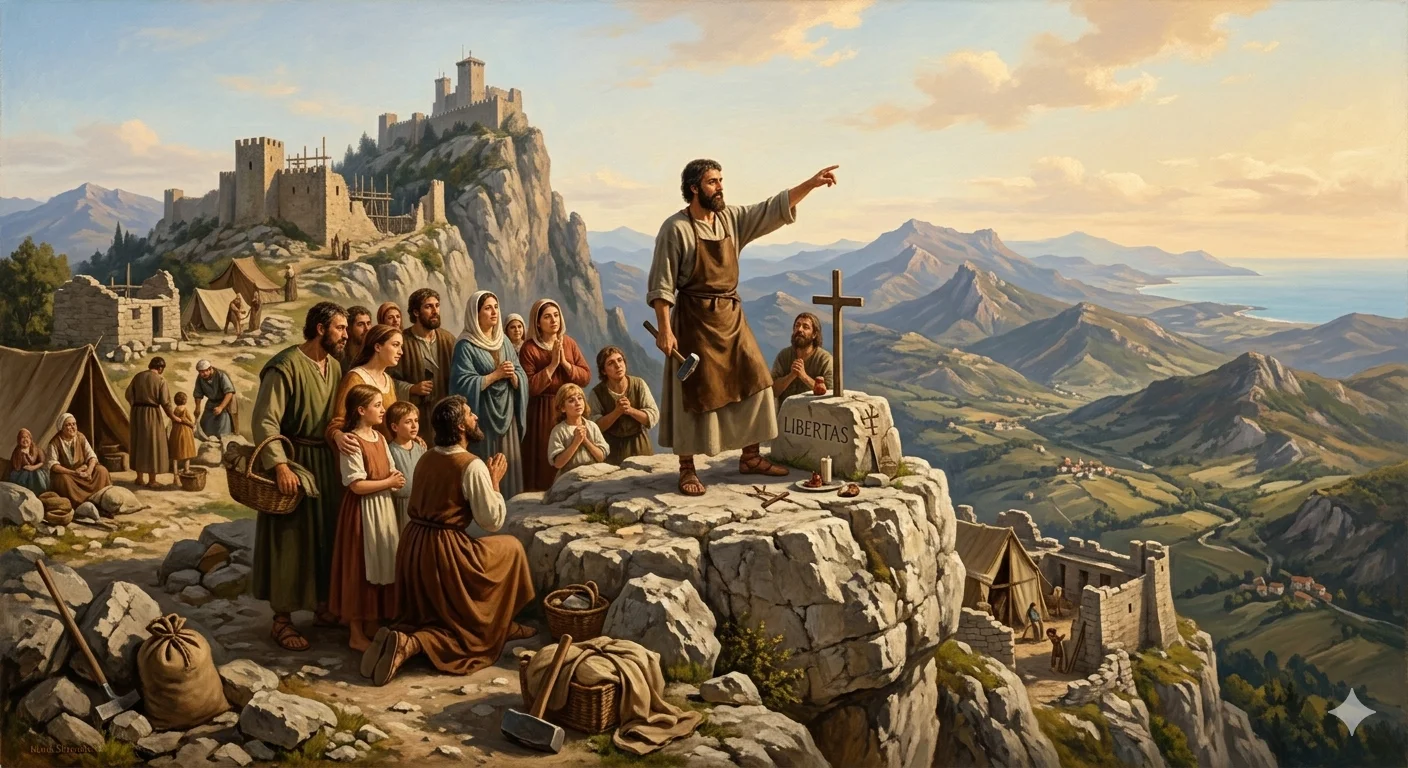
On September 3, 301 AD, according to the founding tradition that the Republic of San Marino has observed as its national day for over seventeen centuries, a Christian stonemason named Marinus climbed to the rocky summit of Monte Titano in the Apennine Mountains of what is now north-central Italy, built a small chapel on its heights, and uttered the words that became the founding statement of an entire nation: Relinquo vos liberos ab utroque homine—I leave you free from both men—meaning free from the domination of both the Roman Emperor and the Pope. In that moment, according to the tradition the Sammarinese have carried through more than seventeen hundred years of history, the world’s oldest republic was born.
The Republic of San Marino is extraordinary by almost any measure that can be applied to the nations of the world. It occupies just 61 square kilometers — roughly 24 square miles — of hilly terrain in the Apennine Mountains, making it the third-smallest country in Europe after Vatican City and Monaco and the fifth-smallest country on earth. It is entirely surrounded by Italy, forming a complete enclave within the territory of its much larger neighbor, and its entire population numbers fewer than 35,000 people. Yet this tiny microstate claims, with considerable historical justification, to be the oldest extant sovereign state and the oldest constitutional republic in the world — a republic that has maintained its independence, its governmental institutions, and its founding values of liberty through the fall of the Western Roman Empire, the chaos of the medieval centuries, the ambitions of Renaissance condottieri and papal legates, the upheavals of Napoleon, the pressures of Italian unification, two world wars, and the entire span of modern geopolitical history. San Marino’s story begins, as the Sammarinese themselves insist, with one stonemason from Dalmatia and a mountain.
Saint Marinus of Rab: The Dalmatian Stonemason Who Founded a Nation
The founding figure of San Marino was a man named Marinus, born on the island of Rab—a Roman island off the Dalmatian coast, in what is now Croatia — in the late third century AD. The tradition that the Sammarinese have preserved about his life and mission is a mixture of hagiographical legend and possible historical memory, filtered through centuries of oral tradition and written accounts that were first committed to text in a twelfth-century anonymous hagiography, long after the events they describe. Historical scholars have described these accounts as a mixture of fables and miracles, but perhaps containing some grains of fact — a characterization that fairly captures the status of most early medieval founding legends. What the tradition preserves, whatever its historical accuracy, is a coherent narrative of origin that has shaped Sammarinese identity for centuries.
According to this tradition, Marinus came to the Italian mainland around 257 AD from the island of Rab, traveling with his lifelong friend Leo, also a native of Rab. He arrived in the city of Rimini — the ancient Roman port city on the Adriatic coast, known in antiquity as Ariminum — where he worked as a stonemason helping to reconstruct the city’s walls, which had been damaged by Liburnian pirates. Emperor Diocletian had issued a decree calling for the reconstruction of Rimini’s fortifications, and workers had been recruited from throughout the empire. Marinus was among them. He was skilled in his trade, industrious, and devoutly Christian — a faith that, in the reign of Diocletian, carried increasing personal risk as the Emperor’s relationship with the growing Christian community within his empire deteriorated toward active persecution.
Marinus was ordained as a deacon by Gaudentius, the Bishop of Rimini, and began preaching Christianity openly in the city. It was this preaching, according to the tradition, that brought him into danger. A woman from the city claimed to recognize him as her estranged husband — an accusation that the legend describes as the act of a disturbed or malicious person — and this claim, combined with the broader danger of Diocletian’s persecution of Christians, drove Marinus to seek refuge away from the city. He fled to Monte Titano, the highest of the seven hills that rise from the plain around Rimini, a rocky and isolated peak whose natural defensibility made it a practical refuge from both the Roman imperial authorities and the social conflicts of the lowland city. On Monte Titano, Marinus built a small church and founded the monastic community that would eventually become the city and state of San Marino.
Monte Titano: The Mountain That Made a Republic Possible
The physical geography of Monte Titano is inseparable from the political history of San Marino. The mountain rises to 749 meters above sea level — 2,457 feet — from the relatively flat coastal plain of the Romagna region, its three distinctive peaks crowned by the medieval towers that have become the symbols of Sammarinese identity. Its rocky, steep slopes made it naturally defensible in an era when fortifications were the primary means of territorial protection. Its isolation from the major lowland political and commercial centers of the Rimini area — close enough to maintain connections and trade relationships but far enough to resist casual administrative control — created a kind of institutional distance that allowed a small community to develop its own customs and self-governance without constant interference from the surrounding powers.
The account of how Marinus came to possess Monte Titano adds another element to the founding legend. According to the tradition preserved in the hagiographical accounts, the owner of the mountain was a woman named Felicissima, a sympathetic lady of Rimini who was grateful to Marinus for healing her son through his gifts as a thaumaturge — a worker of miracles. In gratitude, Felicissima bequeathed the land of Monte Titano to Marinus and the small Christian community that had gathered around him, exhorting them to remain always united. With the land formally in the community’s possession, the settlement gained a legal basis for its existence that would eventually support its claims to territorial sovereignty against the surrounding political powers. The mountain that Marinus had chosen as a refuge from persecution became, through this gift, the physical foundation of an independent state.
Monte Titano’s role in Sammarinese history was not merely passive geography. Its natural defensibility was enhanced over the centuries by the three fortified towers — the Guaita, the Cesta, and the Montale — that were built on its three peaks and that still define the skyline of the city of San Marino today. The Guaita Tower, the oldest and largest, was constructed in the eleventh century on the first and highest peak, serving as both a military fortification and, for a period, as a prison. The Cesta Tower, on the second peak, dates to the thirteenth century and now houses a Museum of Ancient Weapons. The Montale Tower, the smallest, stands on the third peak and was built in the fourteenth century to complete the mountain’s defensive system. Together, these three towers — the Tre Penne, or Three Feathers, as they appear on the Sammarinese coat of arms — represent the physical expression of the state’s determination to defend its independence through seven centuries of construction and maintenance.
The Diocletianic Persecution: The Historical Context That Created San Marino
The founding of San Marino is inseparable from one of the most significant events in the history of late Roman Christianity: the Great Persecution initiated by Emperor Diocletian, who ruled the Roman Empire from 284 to 305 AD. Diocletian’s persecution of Christians, which began formally in 303 AD with a series of edicts targeting Christian churches, scriptures, clergy, and eventually ordinary believers, was the most systematic and widespread official attack on Christianity in Roman history. The edicts required the destruction of churches and sacred texts, prohibited Christian worship, removed legal protections from Christians who refused to sacrifice to the Roman gods, and ultimately demanded that all inhabitants of the empire demonstrate their loyalty by performing the official religious rites of the Roman state religion.
The persecution drove many Christians throughout the empire to seek refuge in geographically isolated or politically marginal locations where imperial enforcement was weakest. Remote mountain communities, islands, deserts, and frontier regions became sanctuaries for those fleeing persecution — a pattern that recurred throughout early Christian history and that shaped the geography of early Christian monasticism. Monte Titano, remote enough from Rimini to be outside the immediate reach of the urban imperial administration but close enough to maintain contact with the wider Christian community, was precisely the kind of refuge that the Diocletianic persecution created demand for. The community that Marinus founded on Monte Titano was, in this reading of the tradition, both a spiritual retreat and a practical shelter for Christians seeking to practice their faith away from imperial scrutiny.
The historical chronology of the founding tradition has some complications worth noting. The tradition places Marinus’s arrival in Rimini around 257 AD and the founding of the community on Monte Titano in 301 AD — before the formal beginning of the Diocletianic persecution in 303 AD, though the tradition also refers to Marinus fleeing the persecution. Some accounts suggest that Marinus had already retreated to Monte Titano before the formal persecution began, driven there by earlier local difficulties, including the accusation by the woman who claimed he was her husband, and that the community he founded predated the formal edicts by several years. The tradition preserves a September 3, 301 AD founding date — the date that San Marino celebrates annually as its national day — which falls two years before the formal start of the Great Persecution.
The Last Words of Saint Marinus: Relinquo Vos Liberos Ab Utroque Homine
The founding tradition of San Marino culminates in the dying words of Marinus himself, which have been preserved as the founding statement of the republic and the expression of its essential character. According to the legend recorded in the anonymous twelfth-century hagiography, on September 3, 301 AD, as Marinus lay dying on Monte Titano, he uttered the Latin phrase Relinquo vos liberos ab utroque homine”—I leave you free from both men — meaning free from the domination of both the Roman Emperor and the Bishop of Rome, the Pope. The phrase encapsulates the dual independence that the Sammarinese have claimed throughout their history: independence from secular imperial power and independence from ecclesiastical authority. It is simultaneously a political statement and a spiritual testament, and it has served as the foundational text of Sammarinese national identity for seventeen centuries.
The community that Marinus left behind when he died took his name as their own: the land became the Terre di San Marino — the Land of San Marino — in memory of its holy founder. The Sammarinese people’s relationship with their founding saint has been central to their national identity ever since. Marinus is venerated as a saint in the Catholic Church, and his feast day — September 3, the date of both his death and the founding of the republic — is San Marino’s national holiday. The Festa di San Marino e della Repubblica, celebrated on September 3 each year, combines religious ceremonies honoring the saint with civic celebrations of the republic’s independence, marking both the death of a man and the birth of a nation in a single commemorative event that no other country in the world has replicated.
The phrase Relinquo vos liberos ab utroque homine also established the principle of neutrality and independence from great powers that has governed Sammarinese foreign policy through the centuries. The republic’s declared freedom from both emperor and pope was not merely a statement about the specific political configuration of the late Roman world; it was a declaration of the principle that small states could claim and maintain sovereignty independent of the great powers that surrounded them, and that this sovereignty was worth defending even at the cost of isolation and hardship. This principle has guided San Marino through every major historical challenge it has faced — from the medieval expansion of the Papal States to the ambitions of Renaissance condottieri, from Napoleon’s conquests to the pressures of Italian unification — and it remains the animating value of the Sammarinese constitution today.
The Earliest Historical Evidence: The Placito Feretrano of 885 AD
The legendary founding of San Marino on September 3, 301 AD is precisely that—legendary, in the sense that the accounts that describe it were written centuries after the events they purport to record and cannot be verified through contemporary documentation. The earliest historical evidence for an organized community on Monte Titano comes not from the time of Marinus but from the early medieval period. A monk named Eugippius, who lived in the fifth or sixth century AD, recorded in several documents that another monk had lived in a monastery in the area of Monte Titano, providing the earliest textual evidence for a monastic community on the mountain. This reference establishes that by the fifth or sixth century, the site was known as a monastic settlement, which is consistent with the founding tradition even if it does not confirm the specific details of the Marinus story.
The first historical document that speaks unambiguously of an organized, self-governing community on Monte Titano is the Placito Feretrano of 885 AD — a judicial document, preserved in the State Archive of San Marino, that records a legal dispute between Abbot Stefano of San Marino and the Bishop of Rimini over territorial rights. The Placito Feretrano is significant not merely as an early reference to the San Marino community but as evidence that by 885 AD the community had a recognized legal identity, the ability to assert territorial claims before an authoritative judicial forum, and a documented history of sovereign possession that predated the dispute. The document implies that San Marino had never been in enemy control and thus had to remain in the possession of the Sammarinese despite outside territorial claims — a formulation that suggests an established tradition of independence by the ninth century.
The gap between the legendary founding in 301 AD and the first solid historical documentation in the 885 AD Placito Feretrano is the space in which the Marinus legend lives — four centuries of history during which the community on Monte Titano developed from a monastic refuge into a self-governing entity without leaving a clear paper trail. Historical scholars have noted that this gap is not unusual for early medieval communities, particularly those in geographically remote areas, and that the absence of documentation does not constitute evidence against the community’s existence. What can be said with confidence is that by the ninth century, a community on Monte Titano was asserting independence from the surrounding powers, that this independence was recognized in legal proceedings, and that the community traced its founding to the figure of Saint Marinus with a conviction that had the weight of centuries of tradition behind it.
The Arengo and the Captains Regent: How the World’s Oldest Republic Governed Itself
The political institutions through which San Marino has governed itself over its seventeen centuries of existence are as remarkable as its longevity. The earliest form of government recorded for the Sammarinese community was the Arengo — a popular assembly formed from the heads of each family, analogous in some respects to the original Roman Senate, which had also been composed of the patres, the heads of the great families. The Arengo was the foundational democratic institution of San Marino, a gathering of the community’s leading members to discuss and decide matters of common concern. It represented the fundamental principle of collective self-governance that has characterized San Marino’s political life from its earliest recorded history.
As the community grew and its governance became more complex, the Arengo gradually developed into more formalized institutions. In the thirteenth century, power was transferred from the Arengo to the Grand and General Council — the Consiglio Grande e Generale — which became the principal legislative body of the republic. The Grand and General Council is a sixty-seat unicameral parliament whose members are directly elected by popular vote for five-year terms. It remains the central institution of Sammarinese governance today, selecting the government, passing legislation, and performing the most distinctive act of San Marino’s constitutional system: the election every six months of two Captains Regent to serve as joint heads of state.
The institution of the Captains Regent — the Capitani Reggenti — was established in 1243 and represents one of the most innovative constitutional devices in the history of democratic governance. Every six months, on April 1 and October 1, the Grand and General Council elects two citizens of San Marino to serve simultaneously as joint heads of state with equal powers. The two Captains Regent are customarily chosen from opposing political parties within the ruling coalition, ensuring that no single political faction exercises exclusive control of the executive function. Neither Captain Regent may seek re-election until three years have elapsed after the end of their term — a rule established in the sixteenth century to promote rotation, prevent entrenchment, and ensure that the office cycles through a broad range of citizens rather than becoming concentrated in the hands of a permanent political class. The system is a sophisticated solution to the problem that has defeated most attempts at republican governance throughout history: how to prevent the concentration of power in the hands of a single ruler or faction.
The Captains Regent exercise their authority jointly and with equal powers; neither can act without the other’s concurrence on most matters. They preside over the Grand and General Council, promulgate legislation, and represent San Marino in its foreign relations. Their six-month terms are deliberately brief — brief enough to prevent the formation of a personality cult or the accumulation of personal political power, long enough to accomplish the day-to-day functions of executive governance. When their term ends, the outgoing Captains Regent face a three-day period during which any citizen may bring a formal complaint against their conduct in office, a mechanism of accountability that has no exact parallel in any other democratic system. This combination of shared executive authority, strict rotation, and formal accountability has given San Marino a governmental system whose resistance to autocracy has been tested and proven over nearly eight centuries of continuous operation.
The Statutes of 1600: The World’s Oldest Written Constitution Still in Force
San Marino’s claim to possess the world’s oldest written constitution still in continuous force rests on the Statutes of 1600 — the Statuta Decreta ac Ordinamenta Illustris Reipublicae ac Perpetuae Libertatis Terrae Sancti Marini, to give them their full Latin title. The Statutes were promulgated on October 8, 1600, when the government of San Marino gave binding legal force to a comprehensive compilation of the republic’s customs, laws, and institutional arrangements, drafted by a jurist named Camillo Bonelli. Written in Latin and organized into six books, the Statutes codified the institutions and practices that had governed San Marino for centuries, giving them the permanent and authoritative form of a constitutional document.
The Statutes of 1600 were not created from nothing. They were the culmination of a long process of legal development that had begun with the Arengo’s earliest decisions and had been progressively refined through a series of earlier statutes, including the Statuti Comunali that had served San Marino from approximately 1300 and various revisions and updates in the intervening centuries. The first book of the 1600 Statutes contains sixty-two articles that are constitutional in character, describing the various councils of San Marino, its courts, a number of administrative positions including the Captains Regent, and the powers assigned to them. The remaining five books cover civil law, criminal law, procedural law, and other areas of governance. The entire document represents a comprehensive ordering of the republic’s legal and institutional life that has never been entirely replaced — subsequent legislation has supplemented and modified the Statutes, but they remain at the core of the Sammarinese constitutional framework to this day.
The significance of the Statutes of 1600 for San Marino’s claim to constitutional primacy is both historical and symbolic. Historically, the Statutes predate all other constitutional documents that can be described as currently in force: the United States Constitution was adopted in 1787, nearly two centuries after the San Marino Statutes; the constitutions of the major European states are products of the nineteenth and twentieth centuries. Symbolically, the unbroken continuity of the Sammarinese constitutional tradition from 1600 to the present is itself a statement about the durability of republican institutions when they are genuinely rooted in a community’s values and history. San Marino’s constitution has survived the Napoleonic Wars, the Risorgimento, two world wars, and the entire span of modern political history — an endurance that no other constitutional document on earth can match.
Challenges to Independence: Cesare Borgia, Cardinal Alberoni, and the Republic’s Greatest Threats
The seventeen centuries of San Marino’s existence have not been without serious threats to the independence that its founding legend proclaims. The small republic has faced military occupation three times in its history, each time emerging with its sovereignty intact — a record that testifies to the combination of diplomatic skill, geographic advantage, and sheer good fortune that has preserved the Sammarinese state through the turbulent centuries of Italian and European history. The most dangerous of these occupations came in the context of the power struggles of the Renaissance and the early modern period, when the political fragmentation of the Italian peninsula made it a battlefield for competing dynasties, foreign powers, and ambitious ecclesiastical officials.
In 1503, Cesare Borgia — the son of Pope Alexander VI, the model for Machiavelli’s Prince, and one of the most feared military commanders of the Renaissance — occupied the Republic of San Marino as part of his campaign to carve out a personal domain in central Italy from the lands of the Papal States. Borgia’s occupation lasted for six months, until the death of his father Pope Alexander VI in August 1503 deprived him of the papal support that had made his conquests possible. The new pope, Julius II, moved quickly to restore San Marino’s independence — partly out of political calculation about the implications of a Borgia-dominated central Italy, and partly from a recognition that the Sammarinese independence had a legitimacy that was difficult to simply set aside. Borgia himself was defeated and eventually died in 1507 in Spain, his Italian empire dissolving within months of his father’s death.
The second and more dangerous occupation came in 1739, when Cardinal Giulio Alberoni, the Papal Legate of Romagna, used military force to occupy San Marino, imposed a new constitution on the republic, and attempted to incorporate it permanently into the Papal States. Alberoni was a formidable figure — he had served as the effective prime minister of Spain and had been one of the most powerful diplomatic operators in Europe — and his occupation was more systematic than Borgia’s raid had been. He dismissed the Grand and General Council, abolished the office of Captains Regent, and imposed direct papal governance on the republic. The Sammarinese responded with a combination of civil disobedience and diplomatic appeals, smuggling clandestine petitions to Pope Clement XII documenting the illegality of Alberoni’s actions. The Pope, persuaded that Alberoni had acted without proper authority and that the traditional independence of San Marino had legal and moral weight, restored the republic’s independence in February 1740, just four months after the occupation began. Alberoni’s humiliation was complete and the republic’s sovereignty was reaffirmed.
A less successful attempt at conquest occurred on June 4, 1543, when Fabiano di Monte San Savino, nephew of the future Pope Julius III, led an attack on San Marino with five hundred infantry and cavalry. According to the Sammarinese tradition, his forces became lost in a dense fog that descended on Monte Titano, preventing the attack from succeeding. The Sammarinese attributed the fog to the miraculous intervention of Saint Quirinus, whose feast day it happened to be — a story that reflects the deeply intertwined nature of religious and political identity in Sammarinese culture. Whether divine intervention or natural geography, the republic survived yet another attempted conquest.
Napoleon Bonaparte and San Marino: Respect for the World’s Oldest Republic
The advance of Napoleon Bonaparte’s armies through Italy in 1797 presented San Marino with one of its most delicate diplomatic challenges. Napoleon had dissolved the ancient republics of Venice and Genoa, redrawing the map of the Italian peninsula with a thoroughness that no conqueror had managed since the Roman Empire. San Marino’s independence appeared to be in serious jeopardy as French forces swept through the surrounding territories of the Romagna and Emilia. What saved San Marino in this moment of maximum danger was a combination of diplomatic skill, the personal intervention of a Sammarinese Regent, and — perhaps most importantly — the ideological resonance between San Marino’s republican tradition and the revolutionary values that France officially championed.
The Regent responsible for San Marino’s diplomatic salvation in 1797 was Antonio Onofri, who managed to gain the personal respect and friendship of Napoleon himself. Onofri presented San Marino’s case to the French commander in terms that struck at Napoleon’s self-conception as a champion of liberty and republican government: here was a republic that had maintained its independence and its republican institutions for fifteen centuries, that had never compromised with tyranny even when surrounded by it, and that embodied in its very existence the principles of liberty and self-governance that the French Revolution claimed to advance. Napoleon was persuaded. He wrote to the scientist and French Government commissary Gaspard Monge, guaranteeing the independence of the Republic of San Marino and offering to extend its territory according to its needs. He exempted Sammarinese citizens from taxation, gave the republic one thousand quintals of wheat as a gift, and promised four cannons — though the cannons were, for reasons unknown, never actually delivered.
The Sammarinese response to Napoleon’s generosity was a diplomatic masterpiece of principled restraint. The offer to extend San Marino’s territory was politely but firmly declined. The Regents thanked Napoleon warmly for the offer of territorial expansion but explained that the republic was satisfied with the borders it already had — a response that reflected a deep and practical wisdom about the dangers of accepting territorial gifts from powerful patrons who might later require reciprocal concessions, and about the risks of trying to govern more territory than a small republic could manage without losing its distinctive character. This refusal of Napoleon’s territorial offer has been celebrated in Sammarinese historiography as one of the wisest decisions in the republic’s long history, a moment when the instinct for political survival overrode the temptation of expansion.
Giuseppe Garibaldi’s Refuge and Abraham Lincoln’s Honorary Citizenship
San Marino’s tradition of offering asylum to those persecuted for their political beliefs reached one of its most historically significant expressions in August 1849, when Giuseppe Garibaldi — the military hero of Italian republican nationalism, commanding roughly 2,000 followers fleeing the Austrian and French armies after the fall of the short-lived Roman Republic — sought refuge within Sammarinese territory. Garibaldi arrived at San Marino on July 31, 1849, exhausted and pursued by superior forces. His wife Anita was with him, pregnant with their fifth child and already dangerously ill; she would die before they could reach safety, near Comacchio, after leaving San Marino. The Sammarinese authorities faced an agonizing choice: offering refuge to Garibaldi invited Austrian military intervention against the republic, while refusing him contradicted the principles of liberty and asylum that went back to the founding legend.
San Marino chose to honor its tradition of asylum. The authorities gave Garibaldi and his men sanctuary, allowing them to rest and reorganize within Sammarinese territory. They then managed to ensure that the Austrian troops surrounding the republic were held at bay long enough for Garibaldi and his surviving followers to escape without the republic being forcibly entered. Garibaldi never forgot the hospitality he received in San Marino, and he honored it in the most concrete way he could when Italian unification became a practical political project in the late 1850s and early 1860s. Despite San Marino being an obvious candidate for incorporation into the unified Italian state — a tiny enclave with an Italian-speaking population completely surrounded by Italian territory — Garibaldi explicitly promised to honor San Marino’s desire not to be included in the Italian unification. He used his considerable personal influence to pressure King Victor Emmanuel II to call off a planned annexation of San Marino in 1860, and San Marino and the Kingdom of Italy signed a Convention of Friendship in 1862, formally recognizing Sammarinese sovereignty within the new Italian national framework.
The relationship between San Marino and the democratic tradition of the wider world found expression in another remarkable episode in 1861, when the government of San Marino wrote to United States President Abraham Lincoln proposing a form of alliance between the two democratic republics and offering the President honorary citizenship of San Marino. The letter, written in both Italian and English, referred to the desire of the Republic of San Marino to make alliance with the United States of America in the manner possible between a great power and a very small country. Lincoln, at the time dealing with the outbreak of the American Civil War, took time from the crisis to respond with a letter that expressed sincere respect for the older republic. I have received and read with great sensibility the letter which as Regent Captains of the Republic of San Marino you addressed to me, Lincoln wrote. Although your dominion is small, your State is nevertheless one of the most honored in all history. Lincoln became the first honorary citizen ever granted by San Marino — a distinction that recognized both the personal qualities of the man and the symbolic kinship between the world’s oldest constitutional republic and the republic that had become, within Lincoln’s lifetime, a working model of democratic self-governance for the entire world.
San Marino in the World Wars: Neutrality, Refuge, and Survival
San Marino’s tradition of neutrality, traced back to the founding words of Marinus himself, was tested severely during both world wars. In the First World War, San Marino maintained its neutrality while many of its citizens volunteered to fight with Italian forces in the Italian campaigns. The republic’s neutrality was respected by the combatant powers, and San Marino survived the conflict with its sovereignty intact. In the Second World War, the situation was more complex and more dangerous. San Marino declared neutrality, but its geographic position within Italy and the involvement of the surrounding Italian territory in the war made genuine neutrality difficult to maintain.
San Marino’s most remarkable contribution during the Second World War was its role as a place of refuge. In 1943, as the German occupation of Italy began and the fighting moved up the Italian peninsula, an estimated 100,000 refugees flooded into San Marino seeking safety — roughly eight times the republic’s entire population at the time. The Sammarinese absorbed this enormous influx with the same tradition of hospitality and asylum that had characterized their republic since its founding, providing shelter, food, and protection to refugees whose own homes and communities had been consumed by the war. The physical territory of San Marino was bombed on June 26, 1944, by Allied aircraft — a bombing that killed 63 civilians and injured many more and that was acknowledged to be an error by the Allied command. German forces occupied San Marino briefly in September 1944 before being expelled by Allied forces. Through all of these ordeals, the republic maintained its institutions and its identity.
The fascist period presented a different kind of challenge. San Marino, like many European countries, experienced the rise of fascist political movements in the 1920s and 1930s. The Sammarinese Fascist Party, under Giuliano Gozi, took over the government of San Marino as fascism took hold in neighboring Italy, and the republic went through a period of authoritarian governance that compromised but did not extinguish its republican traditions. After the liberation of 1944, San Marino returned to democratic governance, and in 1945 it held what many describe as the first free elections in the region after the war. The republic’s democratic institutions, however badly stressed during the fascist interlude, had not been permanently dismantled and were capable of reviving when the political conditions changed.
The Constitution, UNESCO Heritage, and Modern San Marino
Modern San Marino maintains a constitutional framework built on the foundation of the Statutes of 1600, supplemented by subsequent legislation including the Declaration of the Rights of Citizens and Fundamental Principles of the San Marino Legal Order, adopted on July 12, 1974. This declaration, which constitutes a kind of bill of rights for the Sammarinese constitutional order, begins with a repudiation of war and proceeds to establish the sovereignty of the people, the separation of powers, and a comprehensive list of individual rights including equality, inviolability, freedom of expression, and universal suffrage. Women received the right to vote in San Marino in 1960 — the active suffrage — and the right to stand for election in 1973. Today, San Marino’s democratic institutions function according to the principles established in the founding tradition and refined over seventeen centuries of constitutional evolution.
The historic center of San Marino and the mountain of Monte Titano were inscribed as a UNESCO World Heritage Site in 2008, in recognition of the extraordinary significance of the site as the location of the world’s oldest surviving constitutional republic and as a landscape whose built environment preserves an unusually complete picture of medieval and early modern republican governance. The UNESCO designation describes the historic center and Monte Titano as an outstanding universal value, reflecting the exceptional qualities of a place where the continuous exercise of self-governance by a community has left physical traces in the architecture, urban planning, and material culture of a small mountain city that has been the capital of a sovereign state for over seventeen centuries.
San Marino is a member of the Council of Europe and the United Nations. It uses the euro as its official currency through a monetary agreement with the European Union, though it is not itself a member of the EU. Its economy is based primarily on tourism — drawing more than two million visitors annually to see the medieval towers and city of a genuine living republic of ancient origin — as well as banking, manufacturing, and agriculture. The Sammarinese are Italian in language and largely Catholic in religion, sharing the cultural characteristics of the surrounding Italian population while maintaining a distinct national identity rooted in their unique history. The Grand and General Council continues to meet and elect its Captains Regent every six months, in the institutional pattern that has governed the republic since 1243.
Why San Marino Is Recognized as the World’s Oldest Republic
San Marino’s claim to be the world’s oldest republic rests on a combination of historical tradition, documentary evidence, and the unbroken continuity of its governing institutions. The claim is qualified, as all such historical claims must be, by the nature of the available evidence and the definitions employed. San Marino claims to be the oldest extant sovereign state, the oldest constitutional republic, and the home of the world’s oldest written constitution still in force — three related but distinct claims, each with its own evidentiary basis.
The claim to be the oldest sovereign state is the broadest and the most difficult to evaluate, because it depends on what counts as a sovereign state and when the continuity of statehood is considered to have been interrupted or maintained. San Marino has been occupied three times in its history — by Cesare Borgia in 1503, by Cardinal Alberoni in 1739, and by German forces briefly in 1944 — but each occupation was short-lived and ended with the restoration of Sammarinese sovereignty. The republic’s governing institutions, while disrupted during these occupations, were not permanently dismantled. The claim to continuity is therefore defensible even if it requires acknowledging that the continuity was not absolutely unbroken.
The claim to be the oldest constitutional republic is stronger, because it rests on the combination of the founding date of 301 AD, the unbroken tradition of republican governance since that date, and the existence of formal constitutional documents dating to 1600. No other state in the world can simultaneously claim a founding date as ancient as 301 AD, a continuous tradition of republican self-governance through the intervening seventeen centuries, and a written constitutional document from 1600 that remains at the core of its legal system today. Athens had its democratic institutions, but the ancient Athenian state did not survive antiquity. Venice was a republic for a thousand years, but it was abolished by Napoleon in 1797 and never restored. The Roman Republic itself lasted several centuries but gave way to the Empire. San Marino is unique not because it was the first republic but because it is the one that has continued without permanent interruption from antiquity to the present.
The Feast of Saint Marinus: How San Marino Celebrates Its Founding After 1,700 Years
Every year on September 3, the Republic of San Marino celebrates the Festa di San Marino e della Repubblica — the Feast of Saint Marinus and of the Republic — in a national holiday that combines religious veneration of the founding saint with civic celebration of the republic’s independence. The celebration has been observed for over seventeen centuries, making it one of the oldest continuously observed national commemorations in the world. The festivities include religious services honoring Saint Marinus in the Basilica di San Marino, the neoclassical church built in the nineteenth century on the site of the medieval church that Marinus is said to have founded; public parades and historical pageants reenacting episodes from the republic’s history; official ceremonies at the Palazzo Pubblico — the seat of the government and the Grand and General Council — during which the Captains Regent preside over official functions; and popular festivities throughout the city and the surrounding territory.
The annual celebration of September 3 is more than a public holiday. It is the most visible expression of the Sammarinese national identity — a statement made by an entire community once a year that their founding legend is alive, that the values it encapsulates remain meaningful, and that the continuity of their republic is something worth celebrating with ceremonial seriousness and popular enthusiasm. In a world where most national celebrations mark events of the nineteenth or twentieth century, San Marino’s September 3 celebration reaches back to the fourth century AD and the dying words of a Dalmatian stonemason who told his followers to remain free. The persistence of that celebration, year after year for seventeen centuries, is itself the most powerful evidence for the proposition that San Marino is what it claims to be: the world’s oldest republic, founded on a principle of freedom that has outlasted empires, dynasties, and the entire span of recorded European history.
Conclusion: The Stonemason’s Legacy and the Meaning of San Marino
The founding of San Marino on September 3, 301 AD is simultaneously a historical event, a founding legend, and a statement of political philosophy. As a historical event, it is imperfectly documented — the gap between the legendary founding and the first solid historical evidence is four centuries long, and the accounts that describe Marinus’s life and death were written centuries after he is said to have lived. As a founding legend, it is as coherent and compelling as the founding stories of any nation on earth: a man fleeing persecution, a mountain refuge, a community built on shared values, a dying declaration of freedom. As a statement of political philosophy, Relinquo vos liberos ab utroque homine remains as radical and as relevant as it was in 301 AD — a declaration that legitimate authority belongs neither to emperors nor to popes but to the free community of people who choose to govern themselves.
What makes San Marino’s story remarkable is not the founding legend itself, which is not unlike the founding stories of many communities, but what came after it: seventeen centuries of republican governance, of Captains Regent elected and replaced every six months, of constitutional documents preserved and honored, of independence maintained against much larger and more powerful neighbors through diplomacy, geographic advantage, and a consistent refusal to be absorbed into someone else’s empire. The scale of San Marino is tiny — twenty-four square miles, fewer than 35,000 people — but the significance of its existence is disproportionate to its size. San Marino is the proof that small communities can maintain self-governance over very long periods of time, that republican institutions can be durable when they are genuinely rooted in popular values, and that freedom, once established as the founding principle of a community, can be defended through centuries of challenge.
When Abraham Lincoln wrote to the Captains Regent of San Marino in 1861 that their state was one of the most honored in all history, he was recognizing something real and important: that the republic on Monte Titano, whatever the legendary character of its founding, had demonstrated over fifteen centuries what his own new republic had just begun to attempt. San Marino had shown that a republic could last, that self-governance was not merely an idealistic aspiration but a practical possibility, and that the principles of liberty and shared governance that Marinus had proclaimed on a mountain in the Apennines in 301 AD were not too fragile for the realities of history. In 2025, as the Republic of San Marino approaches its 1,724th year of continuous existence, that demonstration continues.