
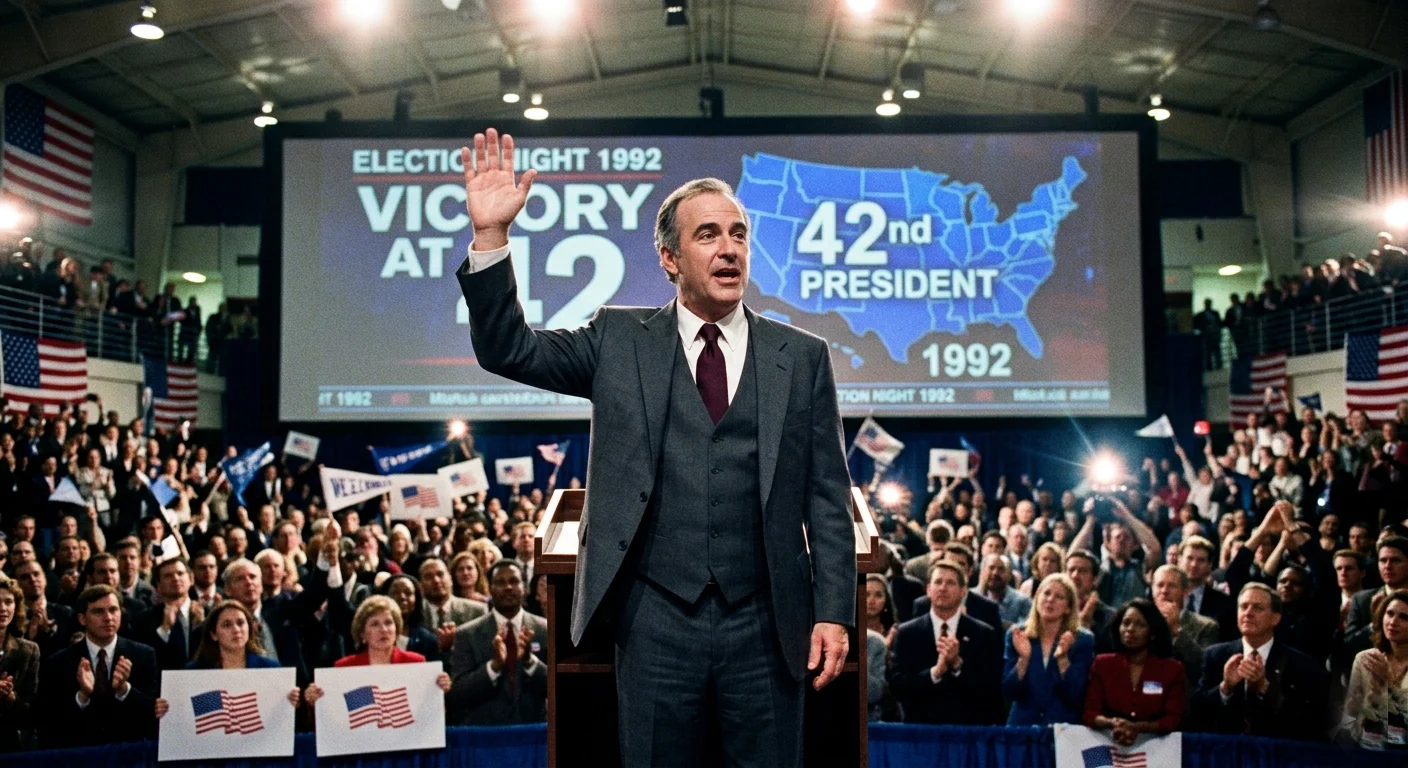
On November 3, 1992, American voters ended twelve consecutive years of Republican control of the White House by electing Arkansas Governor Bill Clinton as the 42nd President of the United States. Clinton received 43 percent of the popular vote, winning 370 electoral votes to incumbent President George H.W. Bush’s 168. Texas billionaire Ross Perot, running as an independent candidate, received 18.9 percent of the popular vote, the largest share won by any third-party candidate since Theodore Roosevelt’s Progressive Party campaign in 1912. It was a three-way election unlike anything American voters had seen in decades, and its outcome reflected a political climate transformed by economic anxiety, shifting cultural values, and a deep public hunger for change after a generation of conservative governance.
The 1992 election was the campaign that produced the most famous campaign slogan in modern American politics: “It’s the economy, stupid.” Those words, written by Clinton’s chief strategist James Carville on a whiteboard in the Clinton campaign headquarters in Little Rock, Arkansas, captured in five words the strategic insight that guided everything about Clinton’s campaign. Bush had entered the election year as one of the most popular presidents in modern history, his approval ratings having briefly touched 90 percent in the wake of the Gulf War victory in 1991. By November 3, he had become the fourth incumbent president since World War II to lose his bid for re-election.
Bill Clinton: The Man from Hope and the Road to the White House
William Jefferson Clinton was born on August 19, 1946, in Hope, Arkansas, a small town in the southwestern corner of the state. His father, William Jefferson Blythe III, was killed in a car accident three months before Clinton was born, and his mother Virginia Dell Cassidy later married Roger Clinton Sr., whose name the future president adopted. Clinton grew up in Hot Springs, Arkansas, attended Georgetown University in Washington, D.C., then studied at Oxford University as a Rhodes Scholar, and earned his law degree from Yale Law School in 1973, where he met Hillary Rodham.
Clinton was elected Attorney General of Arkansas in 1976 and Governor in 1978, making him the youngest governor in the country at age thirty-two. He lost re-election in 1980 but won the governorship back in 1982 and served multiple subsequent terms, building a reputation as an innovative governor who emphasized education reform and economic development in one of the poorest states in the nation. He was a founding member and leader of the Democratic Leadership Council, the centrist organization that argued the Democratic Party had drifted too far left in the 1970s and 1980s and needed to embrace market-oriented policies and personal responsibility alongside its traditional commitments to social justice.
By the early 1990s, Clinton was widely regarded as one of the most talented politicians of his generation. He was articulate, intellectually voracious, and possessed of an unusual ability to connect with voters across class, regional, and racial lines. He had been considered as a presidential candidate since the mid-1980s and had nearly run in 1988 before deciding the time was not right. In October 1991, he announced his candidacy from the Old State House in Little Rock, positioning himself as a “New Democrat” who could break the Republican stranglehold on the White House.
Bush’s Vulnerability: The Economy, Taxes, and the Post-Cold War Shift
The political terrain that made Clinton’s election possible was shaped by events that had little to do with Clinton himself. George Herbert Walker Bush had been an enormously effective foreign policy president, guiding the United States through the end of the Cold War, the dissolution of the Soviet Union, the liberation of Kuwait in the Gulf War, and the reunification of Germany. At the peak of his popularity, in March 1991, his approval rating had reached 89 percent, a figure almost without precedent in the polling era.
But the Cold War consensus that had rewarded Republican candidates for their foreign policy credentials since the 1950s had evaporated. The Soviet Union no longer existed. The Gulf War had been won. The existential foreign policy threats that had been the backdrop of every presidential election since 1948 were suddenly absent. What voters were focused on in 1992 was the domestic economy, and the domestic economy was struggling.
The recession that had begun in mid-1990 had technically ended by early 1991, but recovery was slow, unemployment remained elevated at around 7.3 percent, and many Americans felt economically insecure in ways that aggregate statistics did not fully capture. The manufacturing jobs that had formed the backbone of the American working class were disappearing to overseas competition. Middle-class wages were stagnating. The federal budget deficit, swollen by the Reagan-era military buildup and the savings and loan bailouts, seemed to represent a bill that was being passed to the next generation. Bush, comfortable with foreign policy and uncomfortable with domestic political retail, seemed to many voters out of touch with economic reality.
The decisive blow to Bush’s political standing had come from within his own party. At the 1988 Republican National Convention, Bush had made one of the most memorable promises in presidential campaign history: “Read my lips: no new taxes.” The pledge was an unconditional commitment, the kind of political statement that is almost impossible to walk back. In 1990, facing a soaring budget deficit, Bush negotiated a bipartisan budget deal with Congress that included tax increases. The deal was economically sound and arguably the right decision. But it shattered his credibility with conservative Republicans and provided his opponents with a permanent emblem of broken promises.
Conservative commentator and former Reagan White House communications director Pat Buchanan ran against Bush in the Republican primaries on a platform of cultural conservatism and economic nationalism. Though Buchanan never came close to winning the nomination, his challenge exposed real divisions within the Republican coalition, and his speech at the Republican National Convention in Houston, which opened the convention in August 1992 by declaring a “culture war” in America, alienated many moderate and suburban voters who found its tone harsh and exclusionary. Bush managed the convention poorly, allowed the cultural conservatives to dominate the early messaging, and watched his post-convention bounce fail to materialize.
The Comeback Kid: Clinton’s Path Through the Democratic Primary
Clinton’s road to the Democratic nomination was one of the most dramatic in modern primary history, and his survival through the scandals of the early primary season established the narrative of resilience that would define his political identity.
The Democratic primary field in 1992 was initially considered weak. Many of the party’s most prominent figures, including New York Governor Mario Cuomo, Senator Bill Bradley of New Jersey, Congressman Dick Gephardt of Missouri, and Senator Al Gore of Tennessee, had declined to run given Bush’s towering post-Gulf War approval ratings. The Democratic field that did emerge included former Massachusetts Senator Paul Tsongas, Iowa Senator Tom Harkin, Nebraska Senator Bob Kerrey, former California Governor Jerry Brown, Virginia Governor Douglas Wilder, and Clinton.
Just weeks before the New Hampshire primary, Clinton’s campaign was hit by two separate scandals. Gennifer Flowers alleged a twelve-year extramarital affair, and questions arose about whether Clinton had misled the Army Reserve to avoid service in the Vietnam War. The conventional wisdom in Washington was that Clinton’s campaign was finished. He responded by doing something no candidate had done before: he appeared with his wife Hillary on CBS’s 60 Minutes, broadcast after Super Bowl XXVI, and spoke directly to the American people about his marriage and his commitment to it. The interview did not eliminate the questions about his character, but it reframed the story and demonstrated a willingness to engage with difficult questions that impressed many voters.
Clinton lost the New Hampshire primary to Tsongas but finished a stronger-than-expected second. His speech that night, in which he declared himself “The Comeback Kid,” became one of the most quoted moments of the primary season and showed the political gifts that would carry him through the rest of the campaign. He went on to win decisively on Super Tuesday, sweeping the Southern primaries, and eventually secured the nomination after winning the critical New York and California contests.
At the Democratic National Convention in New York City in July 1992, Clinton chose Senator Al Gore of Tennessee as his running mate, a pairing that was initially described as unconventional because both men were Southerners in their mid-forties. But the choice was politically astute. Gore’s centrist credentials and his vote to authorize the use of force in the Gulf War made the ticket resistant to Republican attacks about being weak on national security. The image of Clinton and Gore, both Baby Boomers, both from the South, both positioning themselves as a new generation of leadership, provided a visual and generational contrast with Bush and his vice president Dan Quayle that the campaign exploited effectively. Clinton and Gore famously rode a campaign bus tour through the American heartland after the convention, generating enthusiasm and media coverage that maintained momentum through the summer.
The Wikipedia article on the 1992 United States presidential election documents the complete story of the campaign, from the Democratic primaries through the three-way general election contest between Clinton, Bush, and Perot.
Ross Perot and the Most Significant Third-Party Campaign in Eighty Years
The 1992 election was shaped in important ways by the candidacy of Henry Ross Perot, the Texas billionaire and founder of Electronic Data Systems who mounted the most successful independent presidential campaign since Theodore Roosevelt’s Progressive Party run in 1912.
Perot announced on CNN’s Larry King Live in February 1992 that he would run for president if supporters collected enough petition signatures to put him on the ballot in all fifty states. His supporters delivered, and Perot’s campaign tapped into deep public frustration with the two-party system and specifically with what he portrayed as Washington’s failure to address the national debt and trade deficits. His opposition to the North American Free Trade Agreement, which was then being negotiated, resonated with working-class voters in manufacturing states who feared the consequences of economic integration with Mexico.
Perot financed his own campaign entirely, spending approximately $65 million of his personal fortune. He hired experienced operatives from both parties and purchased large blocks of prime-time television to air his infomercials, half-hour programs featuring charts and graphs and his own folksy commentary about the nation’s economic problems. At the peak of his popularity in June 1992, Perot led national polls with 39 percent of the vote, ahead of both Bush at 31 percent and Clinton at 25 percent.
Then, with his campaign apparently on the verge of becoming a genuine phenomenon, Perot suddenly withdrew from the race on July 16, 1992, the day Clinton was nominated at the Democratic convention. He gave confusing and contradictory explanations for the withdrawal, eventually claiming, without evidence, that Republican operatives were planning to disrupt his daughter’s wedding. When he re-entered the race in October, his credibility had been severely damaged by the withdrawal, and many of his supporters had drifted to Clinton or Bush. Nevertheless, he remained in the race through Election Day and secured 18.9 percent of the popular vote, or approximately 19.7 million votes, without winning a single electoral vote.
The role of Perot’s candidacy in Bush’s defeat has been debated by political scientists ever since. Contemporary exit poll analysis suggested that Perot drew roughly equally from both Bush and Clinton supporters, meaning that Bush would likely have lost the election even without Perot in the race. But the combination of Perot’s populist anti-incumbent message and the resources he devoted to attacking Bush’s economic record clearly contributed to the hostile political environment that the incumbent faced on Election Day.
November 3, 1992: The Results and What They Meant
When the votes were counted on the night of November 3, 1992, the results were unmistakably a verdict on twelve years of Republican governance and a demand for domestic change. Clinton received 44,909,806 popular votes, or 43.0 percent of the total, while Bush received 39,104,550 votes, or 37.5 percent, and Perot received 19,743,821 votes, or 18.9 percent.
The electoral college distribution told the story more dramatically. Clinton won 370 electoral votes, taking 32 states plus the District of Columbia. He swept the entire Northeastern United States, which would become a reliable Democratic regional stronghold in subsequent elections. He won the key Midwestern industrial states of Michigan, Ohio, Illinois, Pennsylvania, and Wisconsin, rebuilding the “blue wall” that had been crumbling throughout the Reagan-Bush era. He won several Southern states, including his home state of Arkansas, Tennessee, Georgia, Louisiana, and Kentucky. He broke into the previously Republican West, winning Montana, Colorado, New Mexico, Nevada, and California.
Bush won 168 electoral votes from 18 states, carrying the traditionally Republican Southern and Mountain West states that Clinton had not been able to reach: Texas, the Carolinas, Virginia, Indiana, the Great Plains states, and Alaska.
The Britannica article on the 1992 United States presidential election provides an analysis of the election’s results, including the significance of Perot’s independent candidacy, the geographic patterns of Clinton’s coalition, and the historical context of Bush’s defeat as an incumbent president.
The 1992 election also earned the distinction of being called the “Year of the Woman” in congressional politics. Four women were elected to the Senate, tripling the number of female senators from two to six, and the number of women in the House increased substantially. Carol Moseley Braun of Illinois became the first African American woman elected to the Senate. The cultural shift that the election represented extended well beyond the presidency.
Clinton’s Presidency and the Legacy of the 1992 Election
Bill Clinton was inaugurated as the 42nd President of the United States on January 20, 1993, at the age of forty-six, becoming the first Baby Boomer president and the first person born after World War II to hold the office. His inaugural address emphasized renewal and generational transition, invoking the passing of responsibility from the generation that had fought World War II to the generation that had come of age in the Cold War’s shadow.
Clinton’s presidency combined genuine domestic policy achievements with political difficulties that climaxed in his impeachment by the House of Representatives in 1998 on charges related to his conduct in the Monica Lewinsky affair. The Senate acquitted him, and he completed his second term. His presidency oversaw the longest economic expansion in American history, welfare reform, the signing of NAFTA, the Brady Bill on gun control, and the Family and Medical Leave Act. The budget deficit that had so defined the economic anxieties of 1992 was converted into a surplus by the late 1990s.
The History.com profile of Bill Clinton’s election victory traces his journey from the governorship of Arkansas to the White House, covering the campaign dynamics of 1992 and the governing record of his two-term presidency through both its achievements and its controversies.
The 1992 election marked a genuine generational and political turning point in American history. It ended the Reagan Revolution’s twelve-year hold on the White House, introduced the Baby Boom generation to the presidency, and reframed the Democratic Party’s identity around the centrist “Third Way” politics of the Democratic Leadership Council. The strategic insight that James Carville captured with five words on a whiteboard proved to be exactly right: it was the economy that decided the 1992 election, and it was Bill Clinton’s ability to speak to ordinary Americans about their economic anxieties, and to offer a credible alternative to twelve years of Republican governance, that made him the 42nd President of the United States.