
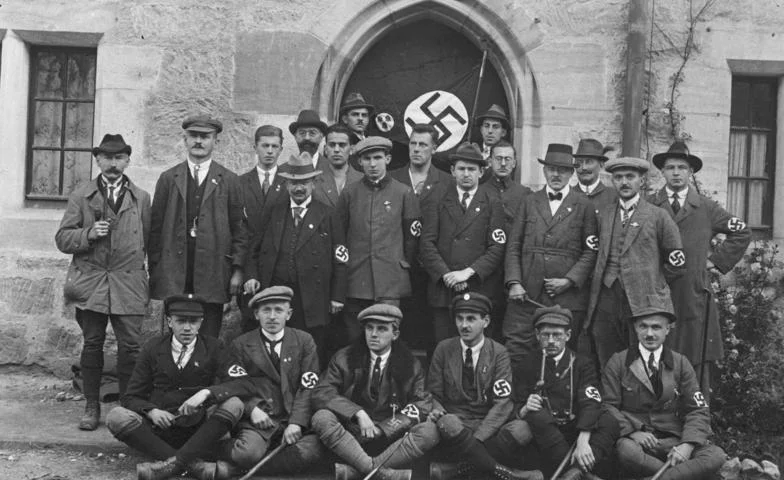
The Nazi Party has been a political group, the effects of which are as devastating as any in modern history, and is one that has been extensively researched. The movement, officially known in German as the Nationalsozialistische Deutsche Arbeiterpartei, or NSDAP, took control of one of the strongest nations in Europe and transformed it into a totalitarian nation that caused World War II and the Holocaust. A first step towards understanding the Nazi Party is to understand its name, its structure and what it stood for.
What Was the Nazi Party? A Clear Definition
Nazi party definition, to its strictest definition, is: a far-right, ultranationalist, violently anti-Semitic political party that ruled Germany from 1933 to 1945 under the totalitarian regime of Adolf Hitler. The party was not at all a political party in the democratic sense. It was a mass movement with a totalitarian ideology, which called for the radical racial and authoritarian remodelling of German society.
It was a party that had an aggressive German nationalism, a state directed economic policy, a strong anti-Marxist and anti-parliamentary democracy stance and a pseudoscientific racial hierarchy that put so-called “Aryan” Germans at the top and Jews at the bottom. They were the backbone of all of the party’s actions from its inception to its demise in May 1945.
In the widest terms, what is the nazi party? The political instrument that Adolf Hitler and his associates used to destroy the Weimar Republic, establish a dictatorial government, initiate a global war and organize the mass killing of six million Jews and millions of others in the Holocaust. These outcomes would be a part of any definition of the party without any ideology or structure.
What Is the Nazi Party Full Name in German?
The German name of the nazi party is Nationalsozialistische Deutsche Arbeiterpartei. Literally it reads: National-socialistische, German, Arbeiterpartei, which is “National Socialist Workers’ Party. The entire English translation is the National Socialist German Workers’ Party.
The party used the official NSDAP as its acronym. From 1920 to 1945, this abbreviation was used on official party documents, letterheads and uniforms throughout the party’s history. This is the same organization, and historians and institutions use this shorthand for the organization.
In the English-speaking world the term “the Nazi party” came into general use for “the Nazi Party. This was taken from the first two sounds of the German “Nationalsozialistische,” which in German pronunciation sounds “Nat-si. In Germany, the party came to be derisively known as this from the 1920s as a Bavarian slang term for a ‘clumsy, backward peasant’.
Where Did the Name “Nazi” Come From?
History, or foreigners, did not create the term “Nazi. It arose in Germany as a political insult. In the 1920s, those who opposed the NSDAP in the labor movement shortened ‘Nationalsozialistische’ to ‘Nazi’ just as they had shortened ‘Sozialist’ to ‘Sozi’. It was an insult, and a reference to ‘unsophisticated’ and ‘provincial’, which were already pejorative terms that the party adopted.
The term “Nazi” was first used by a NSDAP member, namely in a pamphlet authored by Joseph Goebbels in 1926, “Der Nazi-Sozi. Even in those places Goebbels shortened “Nazi-Sozi” to “Nazi” – not to “Nazi” alone. In 1934 the party briefly tried to take back the label by publishing some articles under the “Nazi” name in the newspaper Volkischer Beobachter but soon gave it up.
The party, and its members, almost invariably spoke of themselves as “National Socialists” and of their movement as “National Socialism. The term “Nazi” was mostly employed overseas and by German exiles. Following the defeat of Germany in 1945, the term was re-introduced into Germany by the Allies and it was adopted as the accepted historical term for the party and the system it had established throughout the world.
What Is the NSDAP? Understanding the Acronym and Its Meaning
The answer to the question “What is the nsdap” is simple and complex. In short, the NSDAP is the official name (Nationalsozialistische Deutsche Arbeiterpartei) of the Nazi Party in Germany. It was the term that was implemented in all official party and government communications in Germany in the period of the Third Reich.
What was the political nature of the nsdap? The party officially declared itself to be not just a political party, but also a movement. All leaders highlighted many times that the NSDAP was not just playing a game of votes in a parliamentary system. It sought to supplant it completely, and establish a new racial state based on the Fuhrerprinzip (leadership principle) whereby all authority was vested in the supreme leader and passed down from one step to the next without any democratic oversight.
The nsdap party was unique in German history in that after July 1933, it was the only legal political party in the country. On 14th July 1933 a Law against the Formation of New Political Parties was published, which meant that the creation of any other party, or support thereof, became a crime. From there on, the germany nsdap relationship was not one of a party within a state, rather a party that had become a part of, and overruled, the state.
What Was the Original Name Before the NSDAP?
The group that evolved into the NSDAP actually started with a different name. The Deutsche Arbeiterpartei (German Workers’ Party), or DAP as it is often called in German, was established on 5 January 1919 by Anton Drexler, a Munich locksmith and railway employee. Together with journalist Karl Harrer and sports writer Dietrich Eckart, Drexler established the party and early meetings were quite small, held in Munich beer halls.
On September 12, 1919, Adolf Hitler attended his first meeting of the DAP as an army intelligence officer who was monitoring political groups. He wasn’t impressed by the speakers, but when another person at the conference denounced Bavarian unification with Germany, Hitler rose to the occasion with an impromptu and impassioned rebuttal. Hitler’s extraordinary oratoric skills were known to Anton Drexler, who personally invited him to join. The DAP membership card number was 555, although the actual membership at that time was much less than the number suggested, for appearances’ sake, the party had raised their membership number.
A few months later, Hitler was accepted into the DAP’s executive committee. In February 1920 he brought the party to change its name to a more ambitious one and to draw up a 25-point political programme, from which the Deutsche Arbeiterpartei was renamed the Nationalsozialistische Deutsche Arbeiterpartei (NSDAP) in February 1924.
Why Was the Party Named the National Socialist German Workers’ Party?
It is a deliberate political move, and not an accurate reflection of the ideology of the party, that the name national socialist german workers party was chosen. Every word was selected to target a certain group of Germans during the volatile post-World War 1 atmosphere.
The word “National” was directed towards the German nationalists and conservatives who desired a united and strong Germany free from what they considered humiliations of the Treaty of Versailles in 1919. Germany, post-war, was a nation of nationalists, and the name indicated that this was a nationalist German party.
The term “Socialist” and the expression “Workers’ Party” was meant to appeal to the German working class and divert it away from Marxist socialism and the Social Democratic Party. Adolf Hitler said that “actual socialism” was not international class struggle but serving the “national community,” in a 1923 interview with American journalist George Sylvester Viereck. In his answer to a question asked in 1934 Hitler stated that he used the word “worker” in the party name because “I took this word back into the national force” and “cleaned out its international, Marxist overtones.
The idea of combining “German” and “Workers’” was meant to signal a new version of community in Germany that would cross class lines, based on racial and national solidarity. In this sense, this is the “Volksgemeinschaft,” or the people’s community, and it was a people’s community where class was replaced by race.
What Was the NSDAP’s Organizational Structure?
The nsdap german party was structured authoritarianly according to the Fuhrerprinzip, or leadership principle. Which implied that everything had to be done from the top down and Adolf Hitler was at the top. There was never a party official who was elected democratically. Above were all the appointments and below were no answers to the one above except that he was accountable to his superiors.
The number of “Reich Leaders” (Reichsleiter) increased to eighteen at the top, just under Hitler’s name. The Reichsleiter did not govern geographic territories but were each responsible for a specific area of party and state activity. Together they established the so-called ‘Brown House’ (Braunes Haus) in Munich, the historic headquarters of the Nazi party, under the name ‘Reichsleitung der NSDAP’ (Reich leadership of the Nazi party).
Under the Reichsleiter were the Gauleiter, or District Leaders. For party purposes Germany was divided for administrative purposes into Gaue (singular: Gau). A Gauleiter led each Gau and was personally appointed by Hitler and directly responsible to him. The power of the Gauleiter was immense in their territories, and he was also responsible for all party affairs – and, since 1933, more and more for state administration as well. Leaders like Julius Streicher (Franconia), Josef Terboven (Ruhr) and Baldur von Schirach (the Hitler Youth) were among the most influential Gauleiters.
How Was the Nazi Party Structured at the Local Level?
Below the Gauleiter level, the NSDAP extended its organizational network down to the smallest unit of German society. Each Gau was subdivided into Kreise (counties), each headed by a Kreisleiter or County Leader. Counties were further divided into Ortsgruppen (local chapters) led by Ortsgruppenleiter, or Local Chapter Leaders. These local chapters were then subdivided into Zellen (cells) led by Zellenleiter, and at the very bottom of the hierarchy were the Blocke (blocks) led by Blockleiter or Block Leaders.
The Blockleiter was the party’s most direct point of contact with ordinary German citizens. Each Blockleiter was responsible for approximately 40 to 60 households in their neighborhood. Their role was to monitor political loyalty, ensure participation in Nazi activities, report any signs of dissent or non-compliance, and facilitate the collection of party dues and charitable contributions such as the Winter Relief Fund. This grassroots surveillance network made it extremely difficult for any German to remain detached from the party’s reach.
This layered structure gave the NSDAP an organizational depth that few political parties in history have matched. By the time it came to power in 1933, the party had established an administrative apparatus that mirrored government ministries at every level and was ready to absorb and reshape the existing German state.
Who Were the Key Leaders and Stakeholders of the NSDAP?
The nazi history of the party’s leadership over the years shows a bunch of men, many from the fringes of German society, who, in many instances, came to wield complete power over a nation of millions. The Fuhrer and leader of the party and state from 1934, Adolf Hitler was born on April 20, 1889, in Braunau am Inn, Austria.
World war I fighter-ace Hermann Goring was one of Hitler’s early and strongest defenders. He was President of the Reichstag, Prime Minister of Prussia and a general in the Luftwaffe (German Air Force). Rudolf Hess was Hitler’s deputy and was the one to whom Hitler dictated much of Mein Kampf when he was imprisoned in 1924.
Born October 7th, 1900, Heinrich Himmler rose to become the leader of the SS (Schutzstaffel), the most formidable weapon of terror and racial policy in the Reich. He was the head of the concentration camp system and, as his deputy, was in charge of the machinery of the Holocaust. On January 20, 1942, Heydrich presided over the Wannsee Conference where high-ranking officials planned for the final solution.
Joseph Goebbels was born on October 29th, 1897, was a Reich Minister of Public Enlightenment and Propaganda. He directed all German media, arts and cultural affairs and was the mastermind behind transforming the NSDAP into a mass movement via a series of spectacles, film, radio and the press. Albert Speer was Reich Minister of Armaments and War Production, and the planner of many of the grand building projects of the Third Reich. From 1941, Martin Bormann, head of the Party Chancellery, was the last word on who could see Hitler and one of the most influential men in the last years of his regime.
What Were the Main Sub-Organizations of the NSDAP?
The national socialist german workers party was not a single unit, but a collection of affiliated groups, each focusing on a specific group within German society. These groups worked together to ensure that all Germans – from birth to death – were within “the orbit of the party.
The party’s initial paramilitary organization was the Sturmabteilung (SA) or “Brownshirts” or “Storm Troopers. The SA was established in 1921 by the veterans of World War One and unemployed young men. It was used as Ernst Rohm’s party’s street fighting arm, disrupting other political gatherings and terrorizing political opponents. When Hitler took power, the SA was given less importance. On June 30, 1934, Hitler ordered Rohm and a dozen SA leaders to be killed, which was dubbed the Night of the Long Knives, in order to replace the domination of the SA with the domination of the SS.
The Schutzstaffel (SS), or Protection Squadron, started in 1925 as a group of Hitler’s personal bodyguards. It grew enormously in size, under the leadership of Heinrich Himmler, and its main tool for state terror, racial policy and mass murder. The SS was the system of concentration and extermination camps, it commanded the killing units, the Einsatzgruppen, in the occupations territories, and it was a state within a state.
The Hitler Youth (Hitlerjugend) was a group of boys aged fourteen to eighteen, led by Baldur von Schirach from 1933. Young women were organised by the League of German Girls (Bund Deutscher Madel). As of 1939, boys were required to join the Hitler Youth and membership was in excess of eight million. The National Socialist German Students’ League (NSDStB) aimed at university students, and was established in 1926. By 1938 the number of members in the National Socialist Women’s League (NS-Frauenschaft) was around two million. German workers’ organizations were under the control of the German Labour Front (Deutsche Arbeitsfront or DAF) headed by Robert Ley, which was succeeded by the banned trade unions after May 1933.
What Was the Relationship Between the NSDAP and the German State?
The relationship of the national socialist party of germany to the formal institutions of the German state after 1933 is one of the most important and misunderstood topics of nazi history. They were not necessarily in direct competition or conflict with one another, but they did exist in a delicate and complex interaction, in what has been called a “polycratic” relationship, so that power was not concentrated in a single coherent bureaucracy.
The Law to Secure the Unity of Party and State was enacted on 1 December 1933, which officially declared that the NSDAP and the German state were one. This law granted the SA quasi-governmental status and the right of its leader to be a cabinet minister. In fact, however, the party’s offices and government ministries were rivals in their quest for control, funds, and Hitler.
As time went on more and more functions were taken over by party institutions or merged with them. The SS was the party organization that effectively operated the concentration camp system, racial policy, and internal security, which could more typically be the responsibility of a government ministry. The Gaue (district groups), which were erstwhile party districts, absorbed the practical administration of German territory; the traditional Lander (state governments) were deprived of their sovereignty by the Law on the Reconstruction of the Reich of January 30, 1934.
How Did the Nazi Party Rise from a Fringe Group to a Mass Movement?
The history of the Nazi party between 1919 and 1933 is an example of how economic failure and political turmoil can create an environment where extremist groups can flourish. The NSDAP was a Bavarian regional movement in the early 1920s, numbering a few thousand members. The party’s weakness was shown in Hitler’s Beer Hall Putsch of 8-9 November 1923, in which he and General Erich Ludendorff led some 2,000 followers into Munich, trying to inspire a national uprising.
In November 1923, Hitler was jailed and the party was outlawed, operating for a short time under the name of Deutsche Partei (German Party). On December 20, 1924, Hitler was released from Landsberg Prison after serving less than nine months in prison, and was able to resume the building of the NSDAP on February 26, 1925. He promised to wield power in legal rather than armed rebellion.
By 1932, German unemployment had risen to more than six million (as a result of the Wall Street Crash of October 1929 and the ensuing Great Depression), and the NSDAP had become a mass movement. The results of the July 1932 election to the Reichstag were: the NSDAP received 37.4 percent of the votes and 230 seats in the German parliament. On 30 January 1933, President Paul von Hindenburg named Hitler as Chancellor of Germany, paving the way to the total collapse of German democracy.
How Did the NSDAP Define “National Socialism” Differently From Socialism?
One of the most common misunderstandings about the national socialist party is that it is called the national socialist party.One of the most common misunderstandings about the national socialist party is that the party is called national socialist party. To understand the meaning of this word is very necessary to grasp the meaning of the Nazi party’s ideology.
The national socialist party of germany was not Marxist socialism or the class based politics of Karl Marx and Friedrich Engels. Indeed, the NSDAP hated Marxism, which it deemed to be a Jewish conspiracy aimed at undermining national cohesion, leading its workers against their own countrymen. It outlawed trade unions, rounded up communists and socialists in the thousands beginning in 1933 and finally sought to annihilate “Jewish Bolshevism” in the Soviet Union.
The term “socialism” was emptied of its internationalist meaning and applied to the state’s service to the people of the racial community of ethnic Germans for Hitler and the NSDAP. The party’s name was “workers” as a reference to German workers, not the general working class. The party’s economic policies involved massive expenditure on rearmament, public works projects like the Autobahn (highway) network, and state intervention in private industry, but always in support of the racial national community and not in any name of workers’ ownership or class equality.