
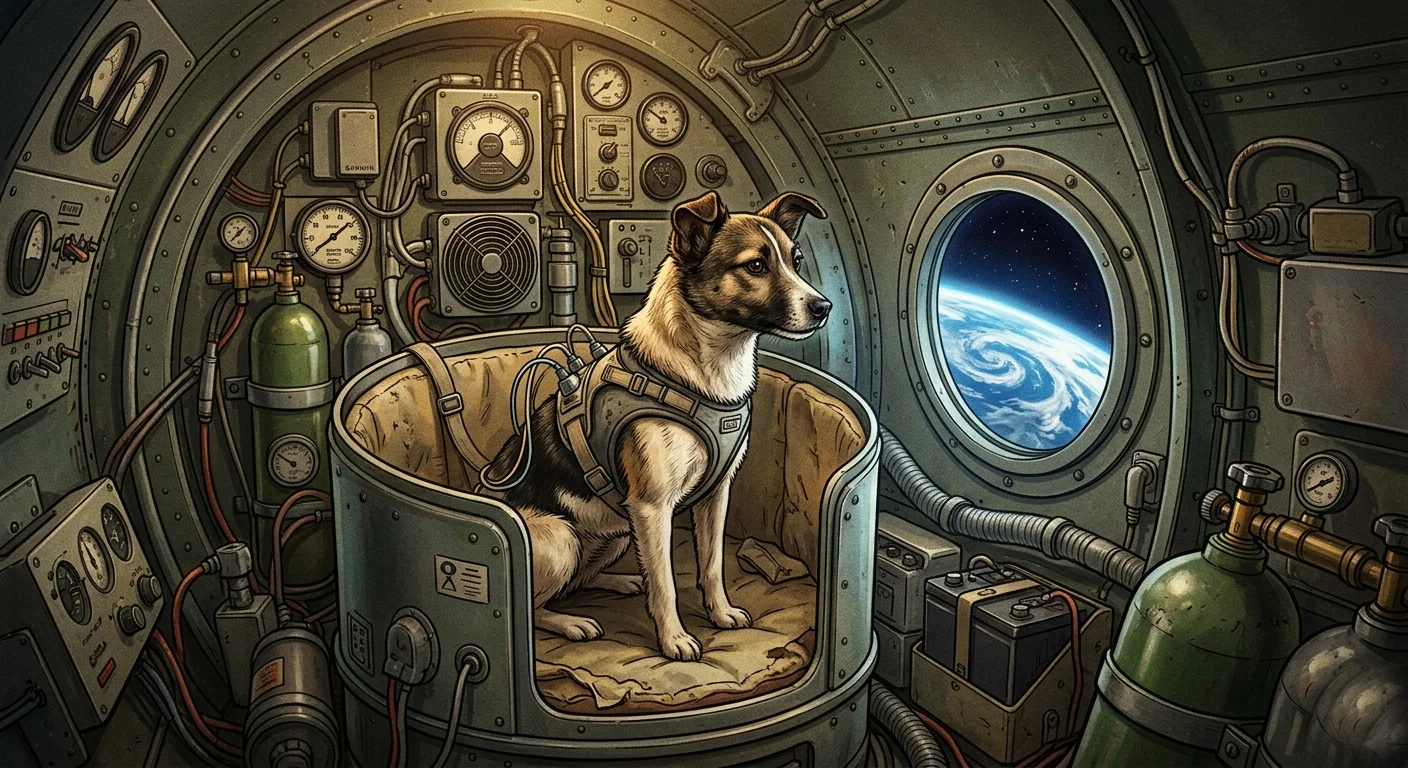
On November 3, 1957, at 02:30 UTC, a modified R-7 intercontinental ballistic missile lifted off from Launch Complex 1 at the NIIP-5 Test Range in the Kazakh steppe, the same pad that had launched Sputnik 1 just thirty days earlier. Riding in a pressurized cabin at the top of a cone-shaped capsule called Sputnik 2 was a small, mixed-breed female dog weighing approximately 6 kilograms, roughly 13 pounds. She was known to the world as Laika, a name derived from the Russian word for “barker.” She was approximately three years old. She had been a stray on the streets of Moscow. And on that November morning, she became the first living creature to orbit the Earth.
The flight of Sputnik 2 and its passenger Laika was a defining moment in the early space race between the Soviet Union and the United States and one of the most emotionally complex events in the history of space exploration. It demonstrated that a living organism could survive launch into orbit; that the Soviet space program was advancing with stunning speed, and that the race to put a human being into space was accelerating beyond anything most people had imagined possible just two years earlier. It also launched a global conversation about scientific ethics and the treatment of animals in the service of human ambitions that has never entirely been resolved.
The Space Race Context: Sputnik 1 and the Soviet Drive for the Next Victory
To understand why Laika was sent into space in November 1957, it is necessary to understand the political and scientific context in which the mission was conceived, designed, and rushed to completion in an almost impossibly short time.
On October 4, 1957, the Soviet Union had launched Sputnik 1, the world’s first artificial satellite, into Earth orbit. The simple metal sphere, emitting its rhythmic radio beep as it passed overhead, had shocked the world and electrified the Cold War rivalry between the Soviet Union and the United States. For the Soviet leadership under Nikita Khrushchev, Sputnik 1 had been a propaganda triumph of extraordinary proportions, demonstrating Soviet technological capability in the most dramatic way imaginable. Khrushchev immediately understood that the momentum had to be sustained.
November 7, 1957, was the fortieth anniversary of the Bolshevik Revolution, the foundational event of the Soviet state. Khrushchev wanted a second spectacular space achievement to mark the occasion, and he wanted it to be more dramatic and scientifically significant than the first. He instructed Sergei Korolev, the Soviet Union’s chief rocket designer and the man behind both Sputnik 1 and the R-7 rocket that had launched it, to prepare a second satellite for launch on or around November 7. He wanted the new spacecraft to carry a living creature.
The instruction was given approximately four weeks before the desired launch date. What Khrushchev was demanding was, in the estimation of every engineer involved, essentially impossible to accomplish properly in the available time. Korolev and his team at OKB-1 had no spacecraft ready for an animal mission of this complexity. The thermal control systems, life support equipment, and recovery technology that would have been necessary for a safe flight did not exist in a form that could be built, tested, and integrated within four weeks. The engineers understood from the moment they received the instruction that the animal they sent into orbit would not come back alive. There was simply no time to design a recovery mechanism.
Korolev himself was reportedly deeply uncomfortable with the decision to send an animal on a one-way mission. He had planned for an animal mission eventually, but under conditions that would allow a safe return. The political deadline eliminated that option. The spacecraft would carry a dog into orbit, monitor its vital signs, and the dog would die when the oxygen ran out or the temperature became unmanageable, whichever came first.
Selecting Laika: The Soviet Space Dog Program
The Soviet decision to use dogs as test animals for space research, rather than the primates that the Americans preferred, had roots that predated the Space Race by more than a decade. The Soviet military had been using dogs in high-altitude rocket research since the late 1940s, launching animals on suborbital trajectories using modified versions of the German V-2 rockets captured at the end of the Second World War. The first Soviet dogs to reach space, Dezik and Tsygan, had been launched in 1951 on a suborbital flight and recovered alive. Between 1951 and 1957, the Soviet program had sent numerous dogs into space on suborbital tests, gaining experience with animal physiology under the stresses of acceleration, weightlessness, and reentry.
The scientific rationale for preferring dogs over primates was partly rooted in the extensive work of the physiologist Ivan Pavlov, whose pioneering research on canine physiology at the turn of the century had made dogs the best-understood non-human animal in Soviet biomedical science. Soviet engineers and physicians were confident they understood dog physiology well enough to interpret the data that would be returned from an orbiting animal mission.
The specific requirements for Sputnik 2’s canine passenger were defined by the constraints of the spacecraft: the animal had to be small enough to fit in a pressurized cabin of limited volume, calm enough to tolerate the training and preparation process, and physiologically suitable for the medical monitoring that would provide the mission’s scientific value. The Soviet canine recruitment program deliberately targeted female stray dogs from the streets of Moscow, reasoning that strays would be tougher, more adaptable to confinement and stress, and already accustomed to extreme temperature variations than pampered domestic animals. Female dogs were preferred for anatomical reasons related to the design of the life support and waste management systems within the cabin.
From a pool of candidates, the selection process narrowed to three finalists. The dog chosen as prime candidate for the mission was a calm, even-tempered animal named Kudryavka, which means “Little Curly” in Russian, in reference to her slightly wavy coat. Her backup was Albina, who had also performed well in training but had recently given birth to puppies and had won such affection from her handlers that they were reluctant to send her on a fatal mission. A third dog named Mushka served as a control animal remaining on the ground.
Kudryavka was introduced to the Soviet public via radio before her flight, during which she barked. The barking led to her being renamed Laika, the Russian generic term for several breeds of dog similar to the husky. In the American press, she was variously called “Muttnik,” “Pupnik,” “Woofnik,” and “Sputpup” before “Muttnik” settled as the most commonly used nickname, a pun on Sputnik. NASA’s later assessment described her as “a part-Samoyed terrier.” Britannica describes her as “small, even-tempered, and mixed-breed.” She weighed approximately 6 kilograms and was approximately three years old at the time of her flight.
Vladimir Yazdovsky, one of the scientists overseeing the biological aspects of the mission, took Laika home to play with his children in the days before the launch, an act of personal kindness that he later recalled: “I wanted to do something nice for the dog.” One of the technicians who prepared the capsule for final liftoff later stated: “After placing Laika in the container and before closing the hatch, we kissed her nose and wished her bon voyage, knowing that she would not survive the flight.”
The Wikipedia article on Laika provides the complete scientific and historical account of the mission, including the details of her training, the design of the spacecraft, and the revelation in 2002 of the true cause and timing of her death.
Sputnik 2: The Spacecraft Built in Four Weeks
The spacecraft that carried Laika into orbit was built, remarkably, in approximately four weeks under conditions of extreme pressure. Sputnik 2 was a cone-shaped capsule measuring 4 meters in height and 2 meters at its widest base, weighing approximately 500 kilograms. It did not separate from the R-7 rocket’s Block A core stage after reaching orbit, meaning the total mass in orbit was approximately 7.79 tonnes, dwarfing anything the Americans had yet launched or were preparing to launch.
The spacecraft contained several distinct compartments: the pressurized dog cabin with its life support system, scientific instruments for measuring solar radiation and cosmic rays, radio transmitters and telemetry equipment, and the sensors attached to Laika’s body that would provide biomedical data. The cabin was equipped with a video camera that provided footage of Laika in flight. Electrodes were embedded in her body during surgery to monitor heart rate, blood pressure, breathing, and physical movement. The life support system was designed to provide enough food and oxygen for approximately seven days, after which Laika was expected to die from oxygen deprivation in what the Soviet planners described as a planned and painless end.
Laika was placed in the payload container at midday on October 31, 1957, three days before launch. The container was heated via an external tube against the cold temperatures at the Baikonur launch site. In the final hours before launch, her fur was sponged with a weak ethanol solution and groomed, while iodine was applied to the areas where sensors were placed.
At peak acceleration during launch, Laika’s respiration increased to between three and four times her pre-launch rate. Her heart rate, which had been 103 beats per minute before launch, increased to 240 beats per minute during the early acceleration phase. After reaching orbit and entering weightlessness, her pulse began to stabilize, settling back to approximately 102 beats per minute after three hours. This was three times longer than it had taken during ground-based simulations of weightlessness, indicating the significant physiological stress of the actual launch and orbital entry.
The Truth About Laika’s Death: A Decades-Long Deception
In the hours and days after Sputnik 2’s launch, the Soviet government and state media presented carefully crafted accounts of Laika’s fate that were designed to avoid both international criticism and domestic political embarrassment. The initial official account claimed that Laika lived comfortably in orbit for seven days before dying peacefully when her oxygen supply was exhausted, as planned. A later version suggested she had been euthanized by a dose of poisoned food before the oxygen ran out, to spare her distress.
Neither account was true. The real cause and timing of Laika’s death remained classified Soviet information for more than four decades.
What had actually happened was that a critical design failure had sealed Laika’s fate within hours of launch, not days. After reaching orbit, the rocket’s core stage failed to separate from the satellite as planned. This failure directly interfered with the spacecraft’s thermal control system, which was designed to operate correctly only after separation. With the thermal control compromised, temperatures inside the cabin began rising rapidly. By the time of the spacecraft’s fourth orbit, approximately five to seven hours after launch, the heat inside the cabin had become unsurvivable. Laika died of hyperthermia and the combined stress of the launch and overheating, not from oxygen deprivation after seven days.
Sputnik 2’s batteries expired on November 10, seven days after launch, ending the transmission of data. The spacecraft, still carrying Laika’s remains, continued to orbit the Earth. Over five months and approximately 2,570 orbits later, Sputnik 2 reentered and disintegrated in the Earth’s atmosphere on April 14, 1958.
The truth was finally made public in October 2002, when Dimitri Malashenkov, one of the scientists who had worked on the Sputnik 2 mission, revealed the actual circumstances of Laika’s death at the World Space Congress in Houston, Texas. He stated plainly: “It turned out that it was practically impossible to create a reliable temperature control system in such limited time constraints.” The revelation confirmed what many had long suspected and generated a new wave of ethical debate about the Soviet space program’s treatment of animal test subjects.
The Britannica article on Laika covers her selection, training, the mission’s scientific objectives, and the decades-long misrepresentation of her death, along with her enduring cultural legacy as a symbol of the Space Race.
The Scientific Legacy: What Laika’s Mission Proved
Despite the ethical complexities and the operational failure that cut the mission short, Sputnik 2 provided genuinely valuable scientific data. The biomedical telemetry returned during Laika’s hours of orbital survival gave scientists their first real data on how a living organism responded to the conditions of actual spaceflight: the accelerations of launch, the transition to weightlessness, the radiation environment of low Earth orbit, and the cardiovascular and respiratory responses to the combined stresses of the experience.
The data confirmed something that was not entirely known before the flight: that a living organism could survive the launch process and enter orbit without immediately catastrophic physiological collapse. Laika’s heart rate and respiration elevated dramatically during launch but were returning toward manageable levels during the hours of weightlessness before overheating killed her. This provided cautious encouragement that a human being could similarly survive launch and the initial period of orbital flight.
Robert Gilruth, who would later become the director of the NASA Manned Spacecraft Center and one of the architects of the American human spaceflight program, captured the impact that the flight had on American thinking when he said: “When I saw the dog go up, I said, ‘My God, we better get going because it’s going to be a legitimate program to put man in space.'”
Future Director of the Manned Spacecraft Center’s comment was matched by the anxiety of the American public and political establishment. Sputnik 2, which weighed over 1,100 pounds, was six times heavier than Sputnik 1 and vastly heavier than anything the Americans were attempting to launch. The Vanguard TV3 rocket, which was supposed to be America’s first satellite, would fail catastrophically on December 6, 1957, exploding on the launch pad on live television. The contrast between Soviet capability and American humiliation was stark and politically galvanizing.
International Reaction, Ethics, and the Road to Human Spaceflight
The international response to Laika’s flight was sharply divided between admiration for Soviet technological achievement and moral concern about the dog’s fate. Animal welfare organizations in Britain and the United States immediately protested the mission. The National Canine Defence League in Britain called for a minute of silence for Laika. The Royal Society for the Prevention of Cruelty to Animals condemned the experiment. The Soviet official response was defensive: “The Russians love dogs. This has been done not for the sake of cruelty but for the benefit of humanity.”
The ethical question that Laika’s mission raised has never fully been resolved. The Soviet scientists who oversaw the mission operated under political pressure that left them no practical alternative to sending an animal on a mission without recovery capability, and they genuinely believed that the data obtained would be essential for human space missions that would ultimately save human lives. But the deliberate decision to send a living creature into orbit with no means of return, under political rather than scientific deadlines, represented a subordination of animal welfare to political competition that many found and continue to find difficult to defend.
The NASA historical article on the first animal in orbit provides the American perspective on the Sputnik 2 mission, including the galvanizing effect it had on the US space program and the key differences between Soviet and American approaches to using animals in space research.
The Soviet space dog program continued after Laika. In August 1960, three years after Laika’s flight, the dogs Belka and Strelka became the first animals to orbit the Earth and return alive, aboard Korabl-Sputnik 2 in a flight that was directly testing the Vostok capsule that would carry the first human into space. Strelka later had puppies, and Khrushchev gave one of them to President John F. Kennedy as a diplomatic gesture. On April 12, 1961, Yuri Gagarin became the first human being to orbit the Earth, a milestone made possible in part by the data and experience gained from the Soviet animal missions that began with Laika on November 3, 1957.
In 2008, fifty-one years after her flight, a small monument to Laika was unveiled near the military research facility in Moscow that had prepared her for space. The monument depicts her standing atop a rocket. She also appears on the Monument to the Conquerors of Space in Moscow. Streets, squares, and schools in Russia bear her name. Her image has appeared on postage stamps from dozens of countries. She was the subject of a Belgian graphic novel, an American rock band, and countless works of popular culture that have tried to reckon with her significance. She went into space alone, died within hours, and orbited the Earth 2,570 times before returning as ash. She made human spaceflight possible.