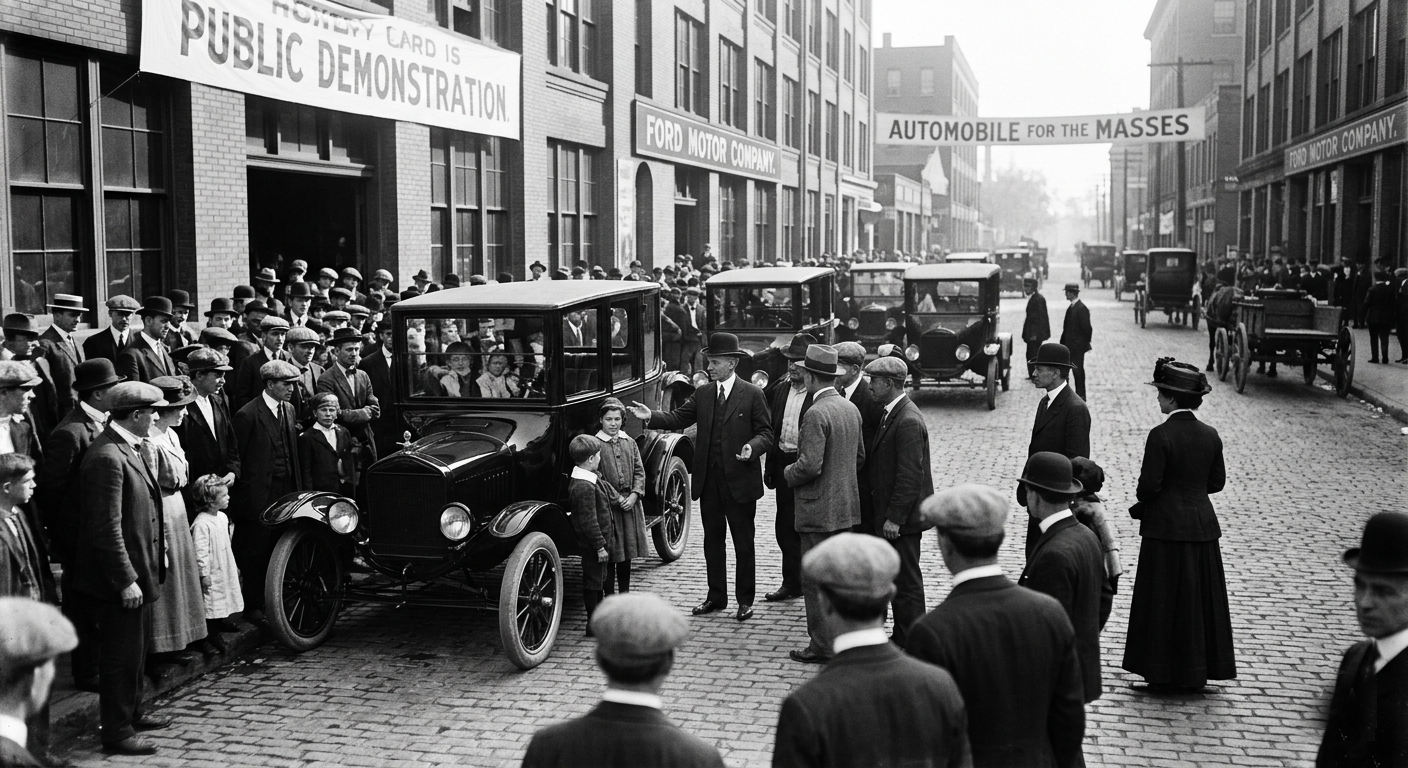
On October 1, 1908, the Ford Motor Company shipped the first production Ford Model T to its customer. Henry Ford had tested a pre-production example himself just weeks before, taking it on a hunting trip through Wisconsin and northern Michigan, covering more than 1,300 miles on rough country roads without significant mechanical difficulty. Satisfied with what his engineers had built, Ford sent the car to its first buyer and announced the Model T to the world with a statement of purpose that became one of the most famous declarations in the history of American commerce: “I will build a motor car for the great multitude. It will be large enough for the family, but small enough for the individual to run and care for. It will be constructed of the best materials, by the best men to be hired, after the simplest designs that modern engineering can devise. But it will be so low in price that no man making a good salary will be unable to own one.”
Ford could not have predicted the scale at which that promise would be fulfilled. Over the next nineteen years, the Ford Motor Company would manufacture more than 15 million Model Ts, at one point accounting for as much as 40 percent of all automobiles sold in the United States. The car’s price would fall from $850 in 1908 to $260 in 1924, driven down by manufacturing innovations that transformed not just the automobile industry but the entire relationship between industrial production, wages, consumer culture, and the physical landscape of America. In 1999, a panel of automotive journalists and executives would name the Model T the most influential car of the twentieth century in the Car of the Century competition, placing it ahead of the BMC Mini, the Citroen DS, and the Volkswagen Beetle. The first car shipped on October 1, 1908, had earned that tribute several thousand times over.
Henry Ford, the Road to the Model T, and the Vision of Universal Mobility
Henry Ford was born on July 30, 1863, on a farm in Dearborn, Michigan. He showed mechanical aptitude from childhood, took apart and reassembled watches as a boy, and was drawn toward the machinery of industrialization rather than the agricultural life his father had lived. He left the farm at sixteen to work as a machinist in Detroit, and by 1896 he had built his first functioning gasoline-powered vehicle, the Quadricycle, in a small workshop behind his home on Bagley Avenue in Detroit. He drove it through the streets of Detroit at 3:00 in the morning on June 4, 1896, the first test of a machine that pointed toward everything that followed.
Ford founded the Ford Motor Company on June 16, 1903, with twelve investors who contributed a combined capital of $28,000. The original shareholders included John Gray as president, Alexander Malcomson as a key backer, John and Horace Dodge who supplied the engines and transmissions, and twelve other investors. Ford himself contributed his engineering knowledge and his name and held 25.5 percent of the stock. The company’s first product, the Model A, was a modest success. The company followed it with a series of alphabetically named vehicles, some more successful than others. The Model N, introduced in 1906 and priced at $600, came closest to Ford’s vision of affordable transportation but still fell short. The cars before the Model T were either expensive, unreliable, or both. Ford wanted something fundamentally different.
In 1907, Ford sealed off a small experimental room in the corner of the company’s Piquette Avenue plant in Detroit’s Milwaukee Junction neighborhood and assembled a handpicked team of engineers and designers to work in secrecy on the car he envisioned. The central figures in designing the Model T were Childe Harold Wills, who handled the metallurgical and structural aspects of the design, and Joseph A. Galamb, a Hungarian-born engineer who was the principal designer and whose sketches and calculations shaped the car’s essential character. Eugene Farkas, another Hungarian-born engineer, contributed significantly to the design alongside Galamb. Henry Love, C. J. Smith, Gus Degner, and Peter E. Martin were also part of the design team. Henry Ford supervised the entire effort himself, reviewing every major decision and pushing the team constantly toward simplicity, durability, and low cost.
One of the team’s most significant material decisions was the use of vanadium steel, a lightweight high-strength alloy that Ford had encountered through a French racing car whose wrecked chassis he had examined. American steel manufacturers initially told Ford that vanadium steel could not be produced domestically. He found a small Ohio steel company willing to try, and the resulting alloy was approximately three times stronger than the conventional steel used in other American automobiles of the period. Vanadium steel allowed the Model T to be both stronger and lighter than any comparable vehicle, and its strength was a key reason the car could survive the punishment of America’s notoriously poor rural roads.
The Car That Could Survive American Roads: Technical Innovation and Practical Design
The technical design of the Model T was oriented toward the reality of American roads in 1908, which were overwhelmingly unpaved, rutted, muddy, and in many cases nearly impassable by conventional vehicles. Ford understood that a car designed for the smooth roads of European cities would be useless to the majority of American buyers, who lived in rural areas and needed a vehicle that could handle whatever terrain lay between them and their destination.
The car’s most conspicuous practical feature was its exceptional ground clearance. At a time when many automobiles sat low over their chassis, the Model T rode high above the road surface, allowing it to pass over obstacles and through mud that would have immobilized other vehicles. The suspension system was designed with flexibility rather than rigidity, so the car could rock and flex over uneven terrain rather than transmitting every road shock rigidly to the chassis. These features, more than any other technical characteristic, explained the Model T’s extraordinary commercial success in rural America.
The engine was a 177 cubic inch four-cylinder unit that produced approximately 20 horsepower. It featured a detachable cylinder head, which simplified maintenance enormously, and a one-piece cylinder block, which made the engine compact and reliable. The car used a simple two-speed planetary transmission rather than the sliding-gear transmissions common in other automobiles, which were notoriously difficult to operate. The planetary transmission made the Model T much easier for inexperienced drivers to manage, a crucial advantage in a market where most potential buyers had never driven any motorized vehicle.
The car also introduced what was, for its time, a sophisticated electrical system driven by a flywheel magneto that charged the ignition system without requiring a separate battery. It had mechanical brakes on the rear wheels and a reliable oil lubrication system designed for vehicles that might travel through remote areas far from any service facility. Ford intended the Model T to be maintained by its owners with ordinary tools and basic mechanical knowledge, and the car’s design facilitated this to an unusual degree. Countless rural Americans learned to be competent mechanics through the ownership and maintenance of Model Ts.
The Wikipedia article on the Ford Model T provides the comprehensive technical specifications, the full production history, and the detailed account of how the car’s design was translated into mass manufacturing at the Highland Park plant.
The Moving Assembly Line and the Manufacturing Revolution at Highland Park
When the Model T was first introduced in October 1908, it was built at the Ford Piquette Avenue Plant using conventional hand assembly methods. Workers stood at fixed stations while teams moved from car to car completing their assigned tasks. The process was slow and labor-intensive. Only 11 cars were built in the entire first month of production, completely inadequate to meet the demand that immediately materialized. By the end of 1908, Ford had sold more than 6,000 orders that it was struggling to fill.
Ford recognized that conventional assembly methods could not deliver the volumes he needed at the costs he required. In 1910, he moved Model T production to a vast new facility at Highland Park, Michigan, designed by the industrial architect Albert Kahn. The Highland Park plant was the largest automobile factory in the world at the time of its opening. Its five-story brick building provided roughly 260,000 square feet of manufacturing space, with natural light flooding in through hundreds of windows in what became known as the “Crystal Palace.” The plant’s design anticipated the production system it would eventually house.
On October 7, 1913, the Highland Park plant implemented the first continuously moving automotive assembly line in history. A motor and rope pulled automobile chassis past a fixed sequence of workers and parts arranged along the factory floor, with each worker performing a single specific task as the chassis moved past. The innovation was breathtaking in its effects. Before the moving assembly line, assembling one Model T chassis required approximately 12 hours and 8 minutes of labor. Within a year of implementing the moving line, that time had been reduced to 93 minutes, a reduction of approximately 87 percent in the labor time required.
The moving assembly line was not invented from nothing. Ford’s engineers, led by Charles Sorensen, who was production superintendent, and including Peter Martin and other key manufacturing figures, drew inspiration from the continuous-process methods used in Chicago meatpacking plants, grain mills, and other industries. But they applied these principles to the manufacture of a complex manufactured product with hundreds of components in a way that had never been attempted before, and the result was a genuine industrial revolution.
The Britannica article on the Ford Model T covers the car’s production history, the introduction of the assembly line, and the social and economic consequences that flowed from the Model T’s transformation of American automobile ownership.
The falling price of the Model T as manufacturing efficiency improved was staggering. The $850 introductory price of 1908, which was roughly equivalent to eighteen months’ wages for an average American worker, fell to $490 by 1914, $360 by 1916, and $260 by 1924, at which point it represented approximately four months’ wages. By the mid-1920s, an average assembly line worker at the Highland Park plant could purchase a new Model T with three to four months of earnings.
The Five Dollar Day and the Social Revolution Ford Triggered
The extraordinary productivity gains of the assembly line created both enormous profits and enormous social problems for the Ford Motor Company. The assembly line transformed manufacturing work from skilled craft labor into repetitive, unskilled, machine-paced task performance. Workers found the work monotonous and physically exhausting, and the labor turnover at Highland Park became catastrophic. In 1913, the Ford Motor Company had to hire 52,000 new workers to maintain a workforce of about 14,000, an annual turnover rate of nearly 400 percent.
On January 5, 1914, the Ford Motor Company made an announcement that electrified the industrial world. It would nearly double its prevailing wage rate to five dollars per day, more than twice what most competitors paid for similar work. The announcement was made publicly by Henry Ford and his business partner and company treasurer James Couzens, who had been a key driver of the company’s commercial strategy since its founding. Ford later claimed to have been the primary advocate for the wage increase. Couzens’s biographers have argued convincingly that Couzens was equally or more responsible for the decision.
The five dollar day transformed the social meaning of the Model T. By creating workers who could afford to buy the products they manufactured, Ford had invented a new economic relationship between producer and consumer that would become the foundation of twentieth-century American prosperity. Workers from across the country and from Europe were drawn to Detroit by the wages Ford offered, accelerating the urbanization of America and transforming Detroit into the industrial heart of the country. By the early 1920s, Ford was employing over 100,000 workers at the River Rouge complex that had replaced Highland Park as the company’s primary production facility.
Black and Simple: The Model T’s Cultural Impact on American Life
The Model T entered American popular culture on a scale that no consumer product had previously achieved. It was nicknamed the “Tin Lizzie” and the “flivver,” affectionate names that reflected both the car’s utilitarian simplicity and the warmth with which Americans regarded it. Jokes about the Model T became a genre of American humor, with some collections running to hundreds of examples. The car’s famous limitation of color choices, captured in the often-quoted phrase attributed to Ford that a customer could have any color they wanted as long as it was black, was actually only true after 1913 when the black Japan enamel that dried fastest was standardized for production efficiency. In the first years of production, the car was offered in multiple colors corresponding to different body styles.
The Model T democratized travel in ways that permanently altered American society. Before the Model T, rural Americans were largely confined to the geographic range of a horse. The car connected farm families to cities, allowed workers to seek employment over a wider area, and began the transformation of American settlement patterns away from dense urban concentrations toward the dispersed, automobile-dependent suburban landscape that defines American geography today.
The History.com article on Ford Motor Company’s introduction of the Model T covers the October 1, 1908 introduction, Henry Ford’s stated vision for the car, and the dramatic changes in American life that followed from its mass adoption.
Farm families who purchased Model Ts often modified them beyond their original automotive function, using the vehicles to power water pumps, sawmills, and threshing machines by removing the rear wheels and connecting the drive train to farm machinery. This adaptability, never specifically intended by Ford’s engineers, revealed the depth of the Model T’s integration into the practical life of rural America.
Roads improved across the country in response to automobile ownership rather than the other way around. The Good Roads Movement, which had advocated for better rural roads since the bicycle era of the 1890s, gained enormous momentum from the explosion of automobile ownership that the Model T accelerated. The Federal Aid Road Act of 1916 began the process of federal involvement in road improvement that would eventually produce the Interstate Highway System. The oil industry expanded dramatically to supply the fuel the Model T and its successors demanded. The steel, glass, and rubber industries were transformed by automotive manufacturing requirements. The suburban landscape, the shopping center, the roadside hotel, the filling station, the drive-in restaurant, all of these were consequences set in motion by a car first shipped to its customer on October 1, 1908.
The End of the Model T and the Legacy of the Tin Lizzie
By the early 1920s, the Model T’s dominance was beginning to erode. General Motors, under the strategic leadership of Alfred P. Sloan, was successfully marketing a range of vehicles at different price points with annual design changes that the Model T’s unchanging black simplicity could not match. American consumers, who had been grateful for an affordable and reliable car, were increasingly interested in comfort, style, and power in addition to basic transportation. The Model T remained technically adequate but was perceived as old-fashioned in a country whose prosperity was generating aspirations beyond mere basic transportation.
Henry Ford resisted changing the Model T for years longer than market conditions justified, believing that its fundamental virtues were permanent. His son Edsel Ford, who had become president of the Ford Motor Company in 1919, argued repeatedly for modernization and was consistently overruled by his father. By the mid-1920s, even Henry Ford had to acknowledge that the Model T’s era was ending. Production of the final Model Ts wound down through early 1927.
On May 26, 1927, Henry Ford and his son Edsel drove the fifteen-millionth Model T out of the Highland Park plant, accompanied by production superintendent Peter Martin and Charles Sorensen. Eight of Ford’s longest-serving employees, including John Wandersee, August Degener, Frank Kulick, and Fred Rockleman, each stamped the final car with a commemorative mark. The ceremony honored the end of production with genuine solemnity. The car that had been first shipped to a customer nineteen years earlier, that had been produced in quantities no one in 1908 could have imagined, that had built the industrial empire and the industrial methodology that defined the century, was done.
The Library of Congress research guide on Ford’s moving assembly line and the Model T provides the archival and bibliographic context for the Model T’s production history and the broader industrial history it represents.
The Ford Model T was designated an ASME Historic Mechanical Engineering Landmark on May 20, 2005. The 15 millionth Model T, the one Edsel and Henry Ford drove out of Highland Park on May 26, 1927, has remained in the possession of Ford Motor Company and The Henry Ford museum ever since. It is a touring car with a four-cylinder engine producing 20 horsepower, priced at $380 at the time of its production, a figure that compared with the $850 first price of 1908 measured exactly what nineteen years of assembly line innovation had accomplished. What Henry Ford had promised in October 1908, a car for the great multitude, had been delivered so completely that the world through which the 15 millionth car was driven in 1927 was genuinely, measurably different from the world into which the first had been shipped nineteen years before.
.