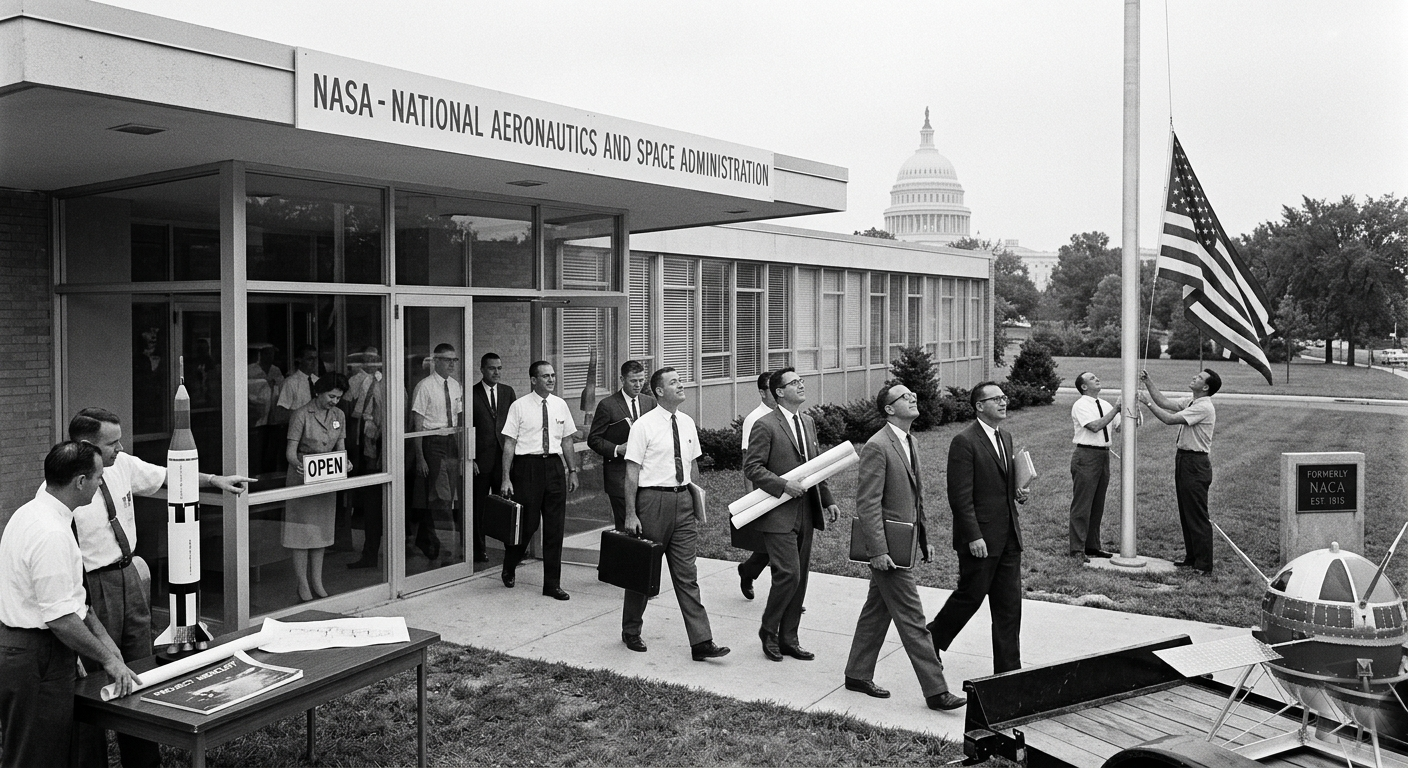
On the morning of October 1, 1958, the National Aeronautics and Space Administration officially opened for business at its first headquarters, the Dolley Madison House on Lafayette Square in Washington, D.C. The new agency absorbed the entire staff, facilities, and budget of the forty-three-year-old National Advisory Committee for Aeronautics, taking on 8,000 employees and a $100 million annual budget in a single day. T. Keith Glennan, NASA’s first administrator, and Hugh L. Dryden, its first deputy administrator, had been sworn in six weeks earlier on August 19 by President Dwight D. Eisenhower at the White House. On October 1, those formalities translated into the practical reality of an operational space agency, and within days NASA had already begun work on what would become America’s first human spaceflight program.
The creation of NASA was one of the most consequential institutional decisions in the history of modern science. The agency that officially opened on October 1, 1958, would within eleven years put human beings on the Moon, within thirty years launch a space telescope that transformed humanity’s understanding of the universe, and within seventy years operate rovers on the surface of Mars. None of that was inevitable in October 1958. What was clear, in the anxious atmosphere of the early Space Race, was that the United States needed a civilian agency dedicated to space exploration, and that it needed one quickly.
NACA: The Forty-Three-Year Foundation That Made NASA Possible
NASA did not emerge from nothing. Its intellectual and institutional foundations had been laid over more than four decades by a body that most Americans had never heard of but that had quietly shaped the development of aviation from biplanes to jet aircraft.
The National Advisory Committee for Aeronautics was established by an act of Congress on March 3, 1915, as a rider to the Naval Appropriations Bill. The legislation directed the new committee to “supervise and direct the scientific study of the problems of flight with a view to their practical solution.” Congress acted because the United States, despite being the birthplace of powered flight at Kitty Hawk in 1903, had fallen significantly behind European powers in aviation technology by the early years of the First World War. France, Germany, and Britain had all developed sophisticated aviation industries while America lagged. The NACA was the government’s response to that technological gap.
The committee began modestly, meeting for the first time on April 23, 1915, in the Office of the Secretary of War in Washington, D.C. It consisted of twelve representatives from government agencies, academia, and the military. Orville Wright himself was among its early members. In its first years, the NACA coordinated and reported on existing aeronautical research rather than conducting its own work. That changed as the committee established research facilities and grew into a genuine research organization of the first rank.
The NACA’s most important contribution to aviation came through its research laboratories. Langley Aeronautical Laboratory, established in 1917 near Hampton, Virginia, became the heart of American aeronautical research over the following decades. Ames Aeronautical Laboratory, activated in 1941 in Mountain View, California, in the area that would later become Silicon Valley, and Lewis Flight Propulsion Laboratory, established in 1943 in Cleveland, Ohio, completed the network of major NACA research facilities. Two smaller test facilities, the Muroc Dry Lake High-Speed Flight Station in California’s Mojave Desert and a sounding rocket facility at Wallops Island in Virginia, extended the NACA’s experimental reach.
The NACA’s achievements were remarkable in scope. Its researchers developed the cowling for radial aircraft engines that dramatically improved engine cooling and fuel efficiency, an innovation that won the 1929 Collier Trophy and was rapidly adopted by the aviation industry worldwide. Its airfoil research transformed the design of aircraft wings. After the Second World War, the NACA became interested in supersonic flight and in the possibilities of rocket-powered aircraft. In close collaboration with the U.S. Air Force and Bell Aircraft, NACA engineers supported the development of the X-1 rocket plane that Chuck Yeager flew to break the sound barrier on October 14, 1947, the first time any aircraft had exceeded the speed of sound in level flight. The NACA also developed, in 1952, the concept of the blunt-body reentry capsule, the design principle that would be used in every American human spacecraft from Mercury through Apollo and that remains fundamental to spacecraft reentry design today.
Sputnik, the Space Race, and the Political Decision That Created NASA
The catalyst that transformed the NACA from an aeronautics research body into the seed of a space agency arrived from space itself on the night of October 4, 1957.
At 22:28 Moscow time on that date, the Soviet Union launched Sputnik 1 into low Earth orbit from the Baikonur Cosmodrome in Kazakhstan. The satellite was a polished aluminum sphere 58 centimeters in diameter, weighing 83.6 kilograms, and carrying nothing more than batteries and a radio transmitter that emitted a rhythmic beep on frequencies that amateur radio operators around the world could hear. The beep was the most unsettling sound in the history of American technology. It demonstrated that the Soviet Union had developed a rocket powerful enough to place an object in orbit, which meant it had developed a rocket potentially powerful enough to carry a nuclear warhead to any point on earth.
President Eisenhower later described the American public reaction to Sputnik as “near hysteria and panic,” and while he personally viewed the strategic implications more calmly than most, recognizing that an orbiting satellite demonstrated no targeting capability and posed no immediate military threat, he understood the political and psychological dimensions of the Soviet achievement. The Sputnik crisis, as it quickly became known, created immediate pressure for a visible and decisive American response.
Congress began hearings in November 1957. Senate Majority Leader Lyndon B. Johnson, a Democrat from Texas, chaired the Preparedness Investigating Subcommittee of the Senate Armed Services Committee and convened six weeks of hearings on the perceived “missile gap” between the superpowers. Seventy-three expert witnesses provided more than 1,300 pages of testimony. Johnson’s own view of space evolved through these hearings from a battlefield perspective to an appreciation of its scientific and commercial potential. Meanwhile, on November 21, 1957, Eisenhower established the President’s Scientific Advisory Committee to advise him on the response to Sputnik. The committee’s February 1958 report recommended the creation of a new civilian space agency built around the existing NACA.
The Advanced Research Projects Agency, known as ARPA, was created within the Department of Defense in February 1958 to develop space technology for military application, separating the military and civilian dimensions of the American space program. On April 2, 1958, Eisenhower wrote to Congress calling for the creation of a civilian National Aeronautics and Space Agency based on the NACA. Congress drafted the legislation through the spring and summer of 1958, with one important modification: Eilene Galloway, a Congressional Research Service expert on space law who advised the committee drafting the legislation, successfully lobbied to designate the new organization an “Administration” rather than an “Agency,” a distinction that gave it broader authority to coordinate with other government entities.
The Wikipedia article on the National Aeronautics and Space Act covers the legislative process that produced NASA’s founding statute, the key provisions of the 1958 act, and the legal framework it established for civilian space exploration that distinguished the American approach from the Soviet military model.
The National Aeronautics and Space Act and the Men Who Led NASA
On July 29, 1958, President Eisenhower signed the National Aeronautics and Space Act of 1958 into law. The act declared it to be the policy of the United States that “activities in space should be devoted to peaceful purposes for the benefit of all mankind,” a statement of principle that would eventually find its most famous expression in the inscription left on the Moon by Apollo 11: “We came in peace for all mankind.”
The act abolished the NACA, transferring its activities and resources to the new NASA effective October 1, 1958. It created a Civilian-Military Liaison Committee to coordinate civilian and military space activities and ensure that NASA and the Department of Defense remained “fully and currently informed” of each other’s activities. The act also established the National Aeronautics and Space Council to provide high-level policy coordination, with the President himself as chair.
On August 8, 1958, Eisenhower nominated T. Keith Glennan and Hugh L. Dryden to serve as NASA’s first administrator and deputy administrator, respectively. The Senate confirmed both within a week, and they were sworn in at the White House on August 19. Glennan was fifty-one years old and serving as president of the Case Institute of Technology in Cleveland, Ohio, when he was nominated. He was a competent administrator with management experience but without a background in aeronautics or space science, a choice that reflected Eisenhower’s view that NASA needed sound management more than technical brilliance at its highest level.
Hugh Dryden was the more technically distinguished of the two. He had been the director of the NACA since 1947 and was one of the most respected figures in American aeronautics. His retention as deputy administrator ensured continuity with the NACA’s scientific tradition and gave NASA immediate credibility in the technical community. Dryden would later have the NASA Armstrong Flight Research Center at Edwards Air Force Base named in his honor, a recognition of his foundational contributions to American aviation and space research.
October 1, 1958: NASA Opens for Business and Immediately Gets to Work
When NASA officially began operations on October 1, 1958, it inherited from the NACA three major research laboratories, two test facilities, 8,000 employees, and a $100 million annual budget. The three NACA research laboratories, Langley Aeronautical Laboratory in Hampton, Virginia; Ames Aeronautical Laboratory in Mountain View, California; and Lewis Flight Propulsion Laboratory in Cleveland, Ohio, transferred to NASA along with the Muroc Dry Lake High-Speed Flight Station in California and the Wallops Island facility in Virginia.
The new agency did not take long to demonstrate what it had been created to do. On October 8, 1958, just one week after NASA opened, Administrator Glennan gave formal approval for a team at Langley Research Center to begin developing a spacecraft capable of carrying a single human into space and returning him safely to Earth. The NACA engineers at Langley had already been studying this problem since 1952, when they had developed the blunt-body capsule concept that would eventually define American human spacecraft design. On November 5, 1958, the Space Task Group formally came into existence, with Robert R. Gilruth named as project manager and Charles J. Donlan as his assistant. On November 14, the Space Task Group released specifications for the crewed capsule to twenty prospective contractors. NASA formally named the program Project Mercury in November, launching the series that would put the first Americans in space.
The NASA official history page on the agency’s beginning documents the first weeks and months of the agency’s operations, including the formation of the Space Task Group, the early Pioneer Moon missions, and the creation of Project Mercury that would eventually carry the first Americans into space.
Before the end of 1958, NASA had absorbed additional elements that significantly expanded its capabilities. By December 31, 1958, the agency had taken on elements of the Army Ballistic Missile Agency in Huntsville, Alabama, including the team led by Wernher von Braun that had built the Jupiter-C rocket used to launch Explorer 1, America’s first satellite, in February 1958. It had also absorbed the Naval Research Laboratory in Washington, D.C., including its Project Vanguard satellite program, and the Jet Propulsion Laboratory in Pasadena, California, a contractor facility operated by the California Institute of Technology that had been conducting pioneering rocket and satellite research. These additions brought approximately 420 more direct employees and 2,300 contractors to NASA’s workforce and increased its annual appropriations to more than $330 million.
The first NASA-sponsored space mission launched just ten days after the agency opened. On October 11, 1958, Pioneer 1 lifted off from Cape Canaveral, Florida, aboard a Thor-Able rocket, intended to orbit the Moon. A rocket malfunction prevented it from achieving its intended lunar orbit, but Pioneer 1 reached a then-record altitude of approximately 70,000 miles and returned scientific data confirming the existence of the Van Allen radiation belts before burning up on reentry forty-three hours after launch. Three Pioneer missions followed, with Pioneer 4 eventually becoming the first American spacecraft to achieve solar orbit in March 1959, itself a milestone for the young agency.
The Space Race Context and NASA’s Civilian Mission
The decision to make NASA a civilian agency rather than a military one was not obvious and was genuinely contested in the debates preceding the act’s passage. The Soviet space program was entirely military in organization and command. America’s existing rocket programs were all managed by the Army, Navy, or Air Force, each of which had its own institutional interests and its own designs on controlling the space program. The service rivalry that had delayed America’s satellite program while the Soviets launched Sputnik was a direct consequence of military management of space.
Eisenhower’s preference for civilian oversight was both principled and practical. On principle, he believed that space exploration should be a peaceful and scientific enterprise, conducted openly and shared with humanity. The National Aeronautics and Space Act’s declaration that space activities should serve “peaceful purposes for the benefit of all mankind” was not merely rhetoric; it encoded a genuine philosophical distinction between the American and Soviet approaches to space. Practically, Eisenhower understood that inter-service rivalry had crippled the American satellite program and that consolidating space activities under a single civilian authority would produce more efficient results.
The civilian character of NASA also shaped its culture in ways that proved enormously productive. The integration of academic scientists, industry engineers, and government researchers in a collaborative framework that was not subject to military classification requirements meant that NASA’s work could be published, debated, and built upon by the broader scientific community. The culture of openness that resulted, combined with the competitive pressure of the Space Race, produced results that the closed Soviet system would eventually struggle to match.
The Britannica account of NASA’s founding and early years provides the historical context of the agency’s establishment within the Cold War space race, covering its relationship to the NACA, the political decisions that shaped its structure, and the early missions that established its credibility as an institution.
The First Years and the Race to the Moon
The first years of NASA’s operations were defined by the dual imperatives of catching up with Soviet achievements and building the organizational and technical infrastructure needed for more ambitious missions. The agency’s formative period established the programs, facilities, and culture that would carry it to the Moon.
Project Mercury dominated NASA’s human spaceflight agenda through 1963. The program conducted six crewed missions between May 1961 and May 1963, beginning with Alan Shepard’s suborbital flight on May 5, 1961, which made him the first American in space, and culminating in Gordon Cooper’s twenty-two-orbit flight in May 1963. Between Shepard’s flight and Cooper’s, John Glenn became the first American to orbit the Earth on February 20, 1962, aboard Friendship 7, achieving one of the most celebrated moments in NASA’s history. Each Mercury mission demonstrated technical capabilities and gathered operational experience that would be essential for the more complex Gemini and Apollo programs to follow.
The political stakes of Mercury and everything that followed were elevated dramatically on May 25, 1961, when President John F. Kennedy addressed a joint session of Congress and committed the United States to landing a man on the Moon and returning him safely to Earth before the end of the decade. Kennedy’s challenge was one of the most ambitious political commitments in the history of science and technology, made at a time when no American had yet orbited the Earth and when the technical requirements of a lunar landing were only partially understood. NASA’s response to that challenge consumed the remainder of the decade and culminated on July 20, 1969, when Neil Armstrong and Buzz Aldrin landed on the Moon while Michael Collins orbited above.
The Smithsonian National Air and Space Museum’s historical overview of NASA covers the full arc of the agency’s history from its 1958 founding through the Apollo program, the Space Shuttle era, and the agency’s ongoing missions in planetary science and human spaceflight.
NASA’s Legacy and Its Enduring Impact on Science and Human Exploration
The agency that opened its doors in the Dolley Madison House on October 1, 1958, has over the following decades become one of the most consequential scientific institutions in history. Its achievements include twelve humans who walked on the Moon between 1969 and 1972, the deployment of the Hubble Space Telescope in 1990 that revolutionized astronomy, the Mars Pathfinder mission in 1997 that demonstrated robotic surface exploration of other planets, the Curiosity and Perseverance rovers that have operated on the Martian surface, the New Horizons spacecraft that flew past Pluto in 2015, and the James Webb Space Telescope launched in December 2021 that has looked further into the history of the universe than any instrument before it.
The technologies developed by NASA in pursuit of its space missions have generated practical benefits that permeate civilian life. Memory foam, scratch-resistant lenses, the digital image sensor at the heart of modern cameras, improvements in water filtration, advances in firefighting equipment, and the foundations of modern wireless networking all trace at least part of their development to NASA research. The satellite-based weather forecasting systems that save lives and the GPS navigation that guides billions of daily journeys worldwide both originated in the space program that NASA has led and supported throughout its existence.
The fundamental vision that President Eisenhower articulated when he signed the National Aeronautics and Space Act in July 1958, that America’s activities in space should serve peaceful purposes for the benefit of all humanity, has remained the philosophical foundation of the agency through every change in administration, budget, and mission priority. That the beeping of a Soviet satellite over American skies in October 1957 could produce, within a decade, footage of human beings walking on the Moon that was watched live by approximately 600 million people worldwide, is testimony to what the decision to create NASA on October 1, 1958, ultimately set in motion.