
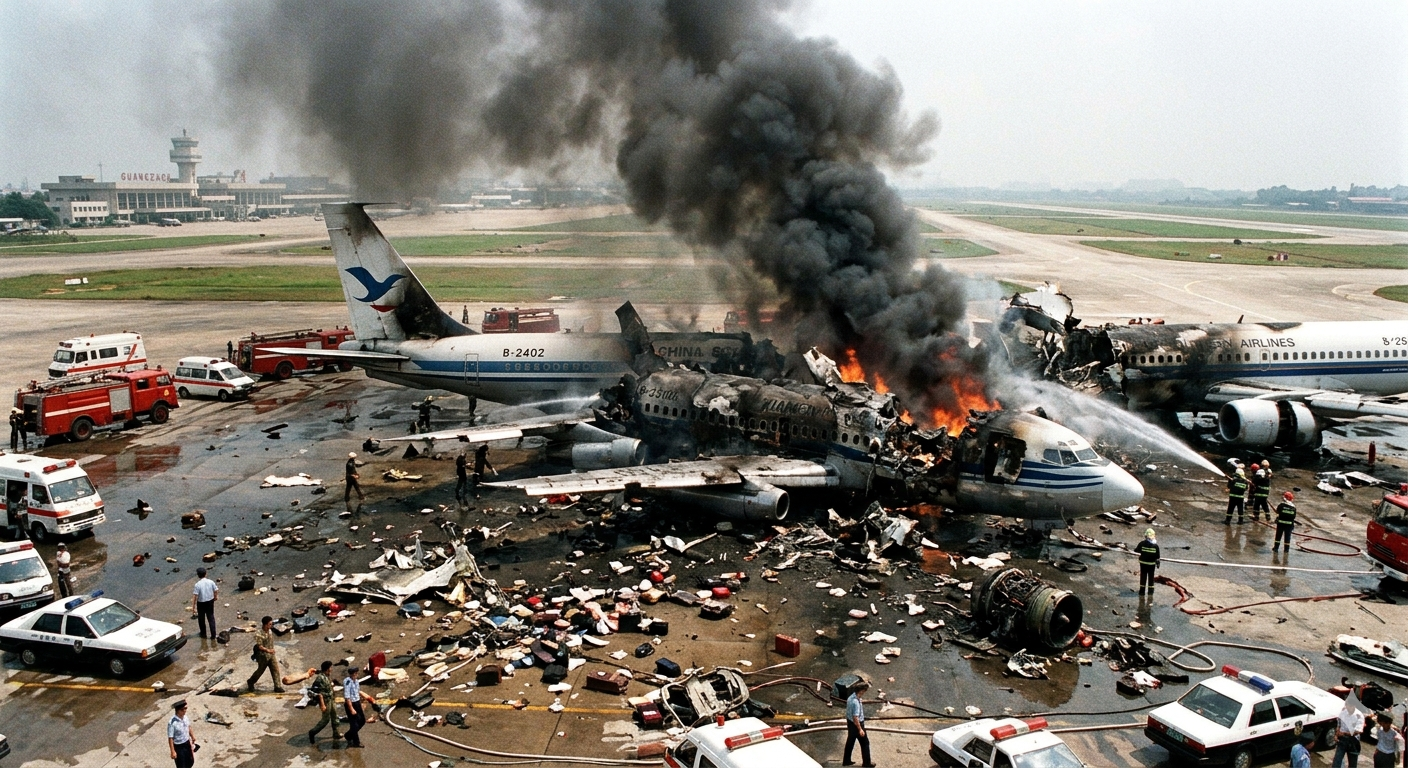
On the morning of October 2, 1990, Xiamen Airlines Flight 8301, a Boeing 737-200 carrying 93 passengers and 9 crew members, took off from Xiamen Gaoqi International Airport at 6:57 a.m. on what was scheduled to be a routine domestic flight to Guangzhou. The flight time was short, little more than an hour. By 9:30 that morning, three aircraft were destroyed on the apron of Guangzhou Baiyun International Airport. One hundred and twenty-eight people were dead. The incident became the deadliest aircraft hijacking in history prior to the September 11 attacks, the first fatal hull loss involving a Boeing 757, and a catastrophic demonstration of how a single individual’s desperate act could destroy not one aircraft but two others that had nothing to do with his grievances.
The man who set the entire sequence in motion was Jiang Xiaofeng, a twenty-one-year-old purchasing agent from Linli County in Hunan Province who had no quarrel with any airline, any government, or any of the 128 people who would die because of his actions. He simply wanted to escape.
Jiang Xiaofeng: The Fugitive Who Hijacked a Plane
Jiang Xiaofeng was born on August 11, 1969, in Linli County, Hunan Province, in the People’s Republic of China. He had worked as a purchasing agent, handling money on behalf of his employer, and in July 1990 he had taken 17,000 yuan in company funds that had been given to him for purchasing goods and had fled. The amount was equivalent to approximately $3,600 at the time, but the act of theft and flight made him a wanted man. He had also been arrested for theft in September 1988 in a prior incident that had already marked him in the eyes of local authorities.
By late September 1990, Jiang was staying at a hotel near the Xiamen border area, a man who knew he was wanted and who had no clear path forward in mainland China. The China-Taiwan political relationship in 1990 was such that Taiwan was widely seen by mainland Chinese seeking to escape their circumstances as a place of potential refuge. Cross-strait visits had only been permitted since the late 1980s, and the political dynamics meant that anyone who managed to reach Taiwan from mainland China might receive asylum rather than extradition. For Jiang, Taiwan represented not political ideology but personal escape from criminal accountability.
On September 29, three days before the hijacking, Jiang purchased a ticket for Xiamen Airlines Flight 8301. He checked out of his hotel around 6 a.m. on the morning of October 2, dressed in a black suit and black dress shoes, carrying a black suitcase and holding plastic roses. The roses, it would turn out, were a calculated detail.
The Hijacking: Cockpit Breach and the Demand for Taiwan
Flight 8301 began boarding at 6:15 a.m. and departed on schedule at 6:57. Jiang was seated in row 16. Approximately thirty minutes into the flight, around 7:20 a.m., he left his seat and moved toward the front of the aircraft.
What happened next has been described in slightly different ways by different sources, reflecting the chaos and the subsequent investigation’s limitations. According to a Time magazine account, Jiang used the plastic roses he had been carrying as a Moon Festival offering, and the flight attendant or security personnel allowed him forward, perhaps believing he intended to present the flowers to the cockpit crew as a traditional gesture during the autumn celebration. Other accounts say he simply forced his way past a male flight attendant who tried to stop him. Both accounts agree that the cockpit door was unlocked and that Jiang gained entry.
Once inside the cockpit, Jiang opened his jacket or produced a black plastic box approximately the size of a cigarette pack and displayed what appeared to be wires connected to it. He claimed he was carrying seven kilograms of explosives and threatened to detonate them if his demands were not met. He ordered all crew members to leave the cockpit except for the captain, Cen Longyu, and demanded that the aircraft be diverted to Taiwan Taoyuan International Airport. He threatened to “go down together” if the aircraft did not comply with his demand.
Captain Cen Longyu complied with the initial demand to clear the cockpit. The flight’s audio communication with the ground transmitted the situation to air traffic control, which contacted the Civil Aviation Administration of China’s Central South Regional Bureau. The Bureau made a decision that was designed to prioritize passenger safety: it authorized the aircraft to land at any airport, domestic or international, including airports in Taiwan. In practical terms, this was a significant authorization: it meant the Chinese government had effectively sanctioned the aircraft diverting to Taiwan without fear of interception by Chinese military aircraft.
The Wikipedia article on the 1990 Guangzhou Baiyun airport collisions provides the comprehensive technical and factual record of the hijacking, the flight path, the collision sequence, and the investigation findings.
The Deception: Running Out of Fuel and Running Out of Options
What followed was a slow-motion tragedy shaped by three converging factors: the fuel state of the aircraft, the captain’s deliberate strategy of deception, and the eventual catastrophic failure of that strategy.
Captain Cen Longyu did not immediately divert the aircraft to Taiwan. Taiwan was approximately 800 kilometers to the east of Xiamen, a distance that was technically feasible to reach given the aircraft’s initial fuel load. But Cen appears to have made a conscious decision not to fly to Taiwan, for reasons that have never been definitively established. The most plausible explanation involves a combination of factors: the pilot’s loyalty to Chinese authorities, a genuine concern that diverting to Taiwan would create political complications regardless of the authorization he had received, and a strategy of keeping Jiang under the impression that the aircraft was heading toward the hijacker’s desired destination while actually conserving fuel and delaying in order to force a landing in mainland China.
For approximately thirty minutes, the aircraft circled in the area near Xiamen. Cen reportedly told Jiang that the aircraft needed to fly toward Hong Kong rather than Taiwan because there was insufficient fuel to reach Taipei directly. This was either partially true or a deliberate deception, but it served the captain’s purpose of gaining time. The aircraft then flew southwest rather than northeast toward Taiwan, heading toward Guangzhou, which lies southwest of Xiamen. Jiang, who was not a pilot and had limited knowledge of navigation, may not have immediately recognized the deception.
As the flight approached Guangzhou, the aircraft circled for an additional forty minutes in the holding pattern while emergency procedures were established at Baiyun Airport below. Air traffic control cleared the Boeing 737 for landing at approximately 9:04 a.m. The fuel situation had become genuinely critical. With insufficient fuel to divert to Hong Kong, which would have been possible with a slightly earlier decision, and certainly insufficient fuel to reach Taiwan, Guangzhou was the only viable option.
It was at the most critical moment, during the final approach to Guangzhou, that the deception collapsed. As the aircraft descended and the familiar landscape of Guangzhou appeared below him, Jiang Xiaofeng recognized that he was not over Hong Kong or approaching Taiwan. He understood that the captain had tricked him, and that he was about to land in mainland China, where he faced criminal prosecution for both the theft and the hijacking itself.
The Collision: Three Aircraft Destroyed in Seconds
What happened next unfolded in only a few seconds but produced consequences that echoed across the history of aviation. Jiang, realizing he had been deceived, physically attacked Captain Cen Longyu in the cockpit during the final approach. A struggle broke out between the hijacker and the pilot at the worst possible moment: with the aircraft on short final approach, at low altitude, low speed, and fully committed to the landing.
The struggle in the cockpit caused the aircraft to lose controlled flight characteristics. The Boeing 737 landed hard, at high speed and with the aircraft not properly aligned, and began skidding uncontrollably down the runway and across the apron. The aircraft was moving too fast and too erratically to stop in any normal fashion.
The hijacked Boeing 737 struck China Southwest Airlines Flight 4305 first. This aircraft, a Boeing 707 registered B-2402 that had been parked on the apron, absorbed the initial impact. The collision with the 707 caused relatively minor structural damage to that aircraft, and its twelve crew members evacuated without fatalities. But the impact did not stop the 737. It continued moving across the apron and struck China Southern Airlines CAAC Flight 3523, a Boeing 757-200 registered B-2812 that was waiting on the runway with 110 passengers and 12 crew aboard, preparing to take off.
The impact between the Boeing 737 and the Boeing 757 was catastrophic. The larger 757 was struck with sufficient force to flip the 737 onto its back. A fireball erupted from the ruptured fuel tanks. The collision and fire killed 46 of the 110 passengers on the 757, while all 12 crew members of the 757 survived. Among the passengers of the 757 who died, eight were from Taiwan. A tour group from Taiwan consisting of ten members who were all aboard the 757 perished entirely.
On the hijacked 737 itself, seven of the nine crew members died, and 75 of the 93 passengers were killed, including 30 Taiwanese, four people from Hong Kong, one person from Macau, and one American. Jiang Xiaofeng, the hijacker, was among the dead. Of the 46 fatalities aboard the CAAC 757, most died instantly, while five others survived long enough to be taken to hospital before succumbing to their injuries.
The total death toll was 128, making the Guangzhou Baiyun disaster the deadliest hijacking in aviation history up to that point and the deadliest incident involving Taiwanese travelers since mainland China had allowed cross-strait visits in the late 1980s.
The Aviation Safety Network record on the Xiamen Airlines Flight 8301 accident provides the technical details of the aircraft involved, the collision sequence, and the casualty breakdown by aircraft.
The Aircraft and Its Prior Hijacking History
An additional dimension of the Guangzhou disaster was that the Boeing 737 involved in the 1990 incident had already been hijacked once before, on May 12, 1988. In that earlier incident, two individuals named Zhang Qingguo and Long Guiyun, armed with knives, had hijacked the same aircraft and forced it to fly to Taichung Ching-Chuan-Kang Airport in Taiwan, making it the first aircraft from mainland China ever hijacked to Taiwan. The 1988 hijacking ended without loss of life, but the fact that the same aircraft was hijacked twice in two years raises profound questions about the state of aviation security in China during that period.
The China Southwest Airlines Boeing 707 involved in the collision also had its own prior hijacking history. On November 3, 1989, just eleven months before the Guangzhou collision, Flight 4305 had been the target of an attempted hijacking during a flight from Harbin to Guangzhou. That attempt was unsuccessful, but the pattern of incidents across Chinese aviation during this period reflects a broader security environment in which hijacking was a genuine and recurring threat.
The Beijing-Taiwan political context was an important background factor in the hijacking wave that afflicted Chinese aviation in the late 1980s and early 1990s. Cross-strait travel had only been permitted since the late 1980s, and the relative accessibility of Taiwan combined with the political asymmetry between the two governments created a situation in which hijacking to Taiwan was perceived by some individuals as a viable escape route. The Guangzhou disaster did not immediately solve this structural problem: between 1993 and 1998, eleven more hijacking attempts occurred on Chinese soil, though none resulted in comparable loss of life.
The Investigation, the Aftermath, and Aviation Security Reforms
The investigation into the Guangzhou Baiyun disaster examined both the security failures that allowed Jiang to bring what appeared to be an explosive device onto the aircraft and the decision-making of Captain Cen Longyu during the critical hours between the hijacking and the crash.
On the security question, the investigation identified the absence of reinforced cockpit doors on the aircraft as a critical vulnerability. In 1990, the cockpit doors on most civilian airliners worldwide were not hardened against forced entry, and this gap in security architecture, which would become a central focus of aviation security reform after the September 11 attacks, was already apparent as a contributing factor at Guangzhou.
The New China News Agency’s reporting on the disaster pointed toward institutional failures at both the airline and the airport, stating that the incident “revealed the existing problems of the airport and airline company.” Chinese aviation authorities implemented enhanced screening procedures and security measures following the disaster, though the hijacking wave of the 1990s demonstrated that these reforms took years to fully take effect.
The disaster also resulted in a significant policy re-evaluation of how Chinese authorities handled hijacking situations. The decision to authorize the aircraft to land anywhere, including Taiwan, was a reasonable prioritization of passenger safety, but the consequences of the captain’s subsequent decision not to divert to Taiwan suggested that the interaction between policy authorization and individual pilot decision-making under extreme stress required clearer protocols.
The Transport Security International account of the 30th anniversary of the Xiamen Airlines hijacking provides a detailed retrospective analysis of the security failures that contributed to the disaster and the broader political context of cross-strait tensions that made Taiwan a perceived refuge for mainland Chinese fugitives.
Records, Legacy, and the Permanent Lessons of October 2, 1990
The Guangzhou Baiyun disaster holds several grim distinctions in aviation history. It was the deadliest hijacking in history prior to the September 11 attacks. It was the first fatal hull loss involving a Boeing 757, a type that had until then maintained a perfect safety record. Three aircraft were completely destroyed. The incident remains the third-deadliest aviation disaster in Chinese history overall, after China Southern Airlines Flight 3943 and China Northwest Airlines Flight 2303.
For Taiwan, the disaster had particular resonance. Thirty Taiwanese nationals died on the hijacked 737 alone, and eight more died on the 757. The complete loss of the ten-member Taiwanese tour group that was aboard the 757 was one of the most concentrated tragedies for Taiwan-linked travelers in the disaster’s overall toll, and it occurred during the early years of cross-strait tourism when the people-to-people connections between Taiwan and mainland China were just beginning to develop.
For aviation security globally, the Guangzhou disaster contributed to an evolving understanding of the systemic vulnerabilities of commercial aviation that would take years to fully address. The unlocked and unfortified cockpit door that allowed Jiang to breach the flight deck in 1990 was the same vulnerability that the September 11 hijackers exploited eleven years later, though on a scale of incomparably greater planning and destruction. The reinforcement of cockpit doors that became mandatory in commercial aviation after September 11 was a reform that the Guangzhou disaster had already argued for in the clearest possible terms, albeit a reform that the aviation industry globally had not yet made a priority.
The Xiamen Airlines disaster of October 2, 1990, stands as a sobering reminder that the consequences of a single individual’s desperate decision can reach far beyond that individual’s original intentions or calculations. Jiang Xiaofeng wanted to escape justice. He got onto a plane with what he claimed were explosives. He told a captain to fly somewhere, and the captain chose a different route. The result was 128 deaths, three destroyed aircraft, and a wound in the early history of cross-strait Chinese tourism that took years to fade.