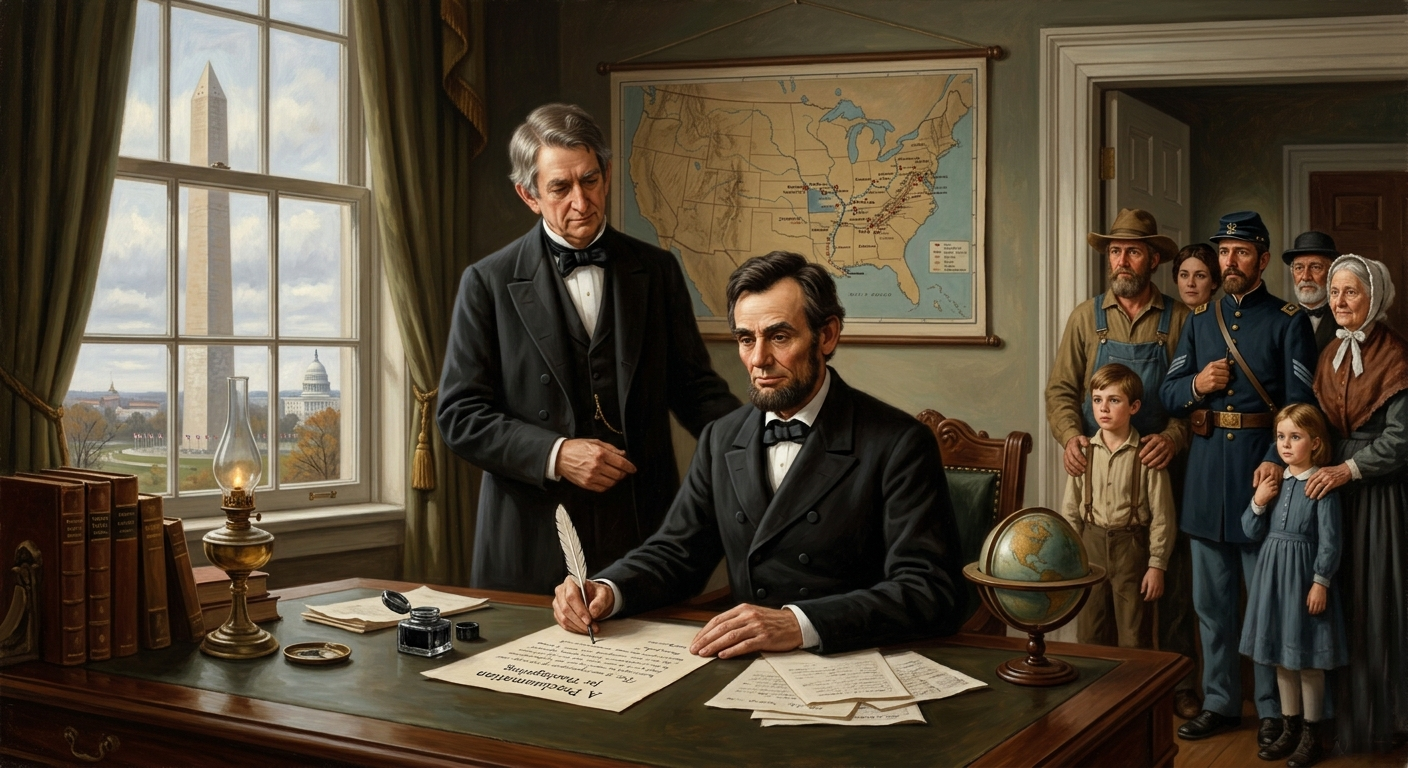
On October 3, 1863, in the middle of the bloodiest war in American history, President Abraham Lincoln issued Presidential Proclamation 106, declaring that the last Thursday of every November would henceforth be observed as a national day of Thanksgiving. The proclamation, which was actually drafted by Secretary of State William Seward based on a request from Lincoln, described the year as one “filled with the blessings of fruitful fields and healthful skies” and invited “every part of the United States” to observe the day as one of “Thanksgiving and Praise.” It ordered government offices in Washington to close. And it concluded with a plea, couched in the language of religious humility, for national healing: citizens were urged to implore God “to heal the wounds of the nation and to restore it as soon as may be consistent with the Divine purposes to the full enjoyment of peace, harmony, tranquility and Union.”
The timing of Lincoln’s proclamation was significant in a way that transcended the calendar. October 3, 1863, was the seventy-fourth anniversary of George Washington’s 1789 Thanksgiving proclamation, and the date was almost certainly chosen deliberately. Less than three months had passed since the Battle of Gettysburg, the July 1863 engagement that represented the most significant Union military victory of the war to that point. Lincoln was issuing a proclamation of gratitude at the most difficult possible moment, in the middle of a war that had already cost hundreds of thousands of lives, as a declaration of faith that the nation would survive.
The History of Thanksgiving Before Lincoln: Harvest Feasts, Puritan Prayers, and Presidential Proclamations
To understand the significance of what Lincoln proclaimed in 1863, it is necessary to understand the history of Thanksgiving in America before Lincoln made it a permanent national institution. The holiday did not begin with the Pilgrims at Plymouth in 1621, though that gathering would later become the founding myth around which the national holiday was organized. It did not begin with Washington, though his 1789 proclamation established the first nationally recognized version of the observance. It was, before Lincoln, a fragmented tradition practiced in different ways at different times in different parts of the country.
The 1621 feast at Plymouth Colony, between Pilgrim settlers and members of the Wampanoag Nation, has become the foundational story of American Thanksgiving. It was a harvest celebration rather than a religious observance, a three-day event attended by approximately 90 Wampanoag people and 53 Pilgrims, prompted by a successful harvest after the Pilgrims’ first devastating winter in the New World. The feast was not called Thanksgiving by anyone present, and it was not repeated as an annual observance. The English Puritan tradition did include formal days of thanksgiving, but these were solemn days of prayer and fasting called in response to specific events, not annual harvest celebrations. The two traditions, the harvest feast and the day of prayer, became gradually conflated in popular memory.
President George Washington issued the first national Thanksgiving proclamation on October 3, 1789, designating “Thursday the 26th day of November” as “a day of public thanks-giving and prayer” to celebrate the new Constitution and the establishment of the republic. Washington’s 1789 proclamation was followed by a second one in 1795. John Adams issued Thanksgiving proclamations in 1798 and 1799 during the Quasi-War with France. James Madison issued two during the War of 1812. But Thomas Jefferson refused to issue any Thanksgiving proclamation, believing such observances violated the constitutional separation of church and state, and the tradition fell entirely out of presidential practice after 1815. For nearly fifty years, there was no national Thanksgiving proclamation from any president. Regional celebrations continued, particularly in New England, but there was no unified national holiday.
Sarah Josepha Hale and Thirty-Six Years of Tireless Advocacy
The woman who transformed Thanksgiving from a regional New England custom into a national institution is one of the most overlooked figures in American cultural history. Sarah Josepha Buell Hale was born on a New Hampshire farm in 1788, the daughter of a Revolutionary War veteran. She was educated by her parents and later by her lawyer husband David Hale, whose death in 1822 left her with five children to support through her writing. Hale turned her formidable intelligence and energy to a literary career that made her one of the most influential women in nineteenth-century America, though she largely worked to advance other people’s causes rather than her own celebrity.
Hale is perhaps most widely remembered as the author of “Mary Had a Little Lamb,” published in 1830 in her collection “Poems for Our Children.” But her more consequential legacy was her editorial work at Godey’s Lady’s Book, the Philadelphia-based women’s magazine of which she became the editor in 1837. Under Hale’s editorship, Godey’s Lady’s Book became, as Time magazine described it, “by far the most phenomenally successful of any magazine issued before the Civil War.” The publication popularized trends including white wedding dresses and Christmas trees in America. It also became, for thirty-six years, the primary platform for Sarah Josepha Hale’s campaign to make Thanksgiving a permanent national holiday.
Hale began her Thanksgiving campaign in 1837, the same year she took over Godey’s. The seeds of her conviction about the holiday’s importance appear even earlier, in her 1827 novel Northwood, where she wrote: “We have too few holidays. Thanksgiving, like the Fourth of July, should be a national festival observed by all the people as an exponent of our republican institutions.” Over the following decades, she published Thanksgiving-themed editorials, stories, poems, and recipes in Godey’s Lady’s Book every year, creating a cultural infrastructure around the idea of the holiday that made it familiar to women across the country long before it was officially recognized. She published recipes for roast turkey, pumpkin pie, and sweet potato pudding. She wrote stories of families gathering together at the Thanksgiving table. She made the observance feel real, familiar, and desirable to millions of readers who might never have celebrated it in the New England fashion.
Alongside her editorial campaigns, Hale conducted a remarkable letter-writing campaign directed at every center of political power in the country. She wrote to governors, senators, congressmen, and presidents, always making the same argument: that a unified national day of Thanksgiving, celebrated on the same date in every state and territory, would bind the nation together and strengthen the common American identity. By the 1850s, she had succeeded in convincing many state governors to issue their own Thanksgiving proclamations, but the dates varied by state, preventing the emergence of a genuinely shared national observance. She wrote to Presidents Zachary Taylor, Millard Fillmore, Franklin Pierce, and James Buchanan, and was largely ignored by all of them.
The Britannica biography of Sarah Josepha Hale covers her extraordinary career as editor, writer, and advocate, including her thirty-six-year campaign to establish Thanksgiving as a national holiday and her broader influence on American cultural life through Godey’s Lady’s Book.
The Civil War Context: Why 1863 Was the Moment
By 1861, the urgency of Hale’s case had changed dramatically. The Civil War had begun, and the country was not merely divided between North and South in political sentiment but actively engaged in destroying itself in a conflict of increasing violence and scale. In this context, Hale’s argument that a unified national Thanksgiving could help “heal the wounds” between different parts of the country took on new resonance, even if the healing she had envisioned would now be delayed until after the war was won.
The turning point in the military situation came in July 1863. The Battle of Gettysburg, fought from July 1 to 3, resulted in the defeat of General Robert E. Lee’s Confederate army in its second invasion of the North, with an estimated 50,000 casualties on both sides over three days. The Union victory at Gettysburg, combined with General Ulysses S. Grant’s capture of Vicksburg on July 4, giving Union forces control of the Mississippi River, represented the strategic turning point of the war. Lincoln, who had spent three years managing one catastrophe after another, finally had concrete military progress to report.
On September 28, 1863, Sarah Josepha Hale sat down at her desk in Philadelphia and wrote a letter to President Lincoln. Her opening was characteristically direct and respectful: “Sir, permit me as Editress of the Lady’s Book to request a few minutes of your precious time, while laying before you a subject of deep interest to myself and, as I trust, even to the President of our Republic, of some importance.” She made the case for “the day of our annual Thanksgiving” to be made “a National and fixed Union Festival,” explaining that the observance needed only “National recognition and authoritive fixation” to “become permanently an American custom and institution.” She also wrote simultaneously to Secretary of State William Seward, making the same case through two different channels of access to the administration.
Lincoln received Hale’s letter and, within days, instructed Seward to draft a proclamation. Within five days of receiving Hale’s letter, the proclamation was ready.
October 3, 1863: The Proclamation Lincoln Signed
Seward’s draft, which Lincoln signed on October 3, 1863, was a document of remarkable rhetorical skill and emotional resonance given the circumstances under which it was issued. The proclamation opened by noting that the year “has been filled with the blessings of fruitful fields and healthful skies” before acknowledging that these blessings were not usually occasions for national attention precisely “because they are so constantly enjoyed that we are prone to forget the source from which they come.”
The proclamation then listed specific national achievements and advances, including the expansion of population, the maintenance of productive industries, the continuation of “peaceful industry” in the face of war, and the condition of the nation’s “mines, and the forests, and the fields, and the rivers and the harbors.” It spoke of the “multitude of strangers” from other nations who had sought asylum in America even during the war. And it explicitly acknowledged “the lamentable civil strife in which we are unavoidably engaged” while framing the national good fortune as being “too penetrating and too close to escape the attention of the most distracted and sluggish citizen.”
The proclamation then made its central request, inviting all Americans, including those at sea and those “sojourning in foreign lands,” to observe “the last Thursday of November next, as a day of Thanksgiving and Praise to our beneficent Father who dwelleth in the Heavens.” It explicitly requested prayers for those who had been left bereaved by the war, for those suffering in the hospitals, and for those in “every wounded heart and orphaned home.” And it concluded with its healing aspiration: that the nation might implore God “to heal the wounds of the nation and to restore it as soon as may be consistent with the Divine purposes to the full enjoyment of peace, harmony, tranquility and Union.”
The National Archives Lincoln Thanksgiving Proclamation resource presents the full text of Presidential Proclamation 106 and explains its place in the history of the national holiday and the broader tradition of presidential Thanksgiving proclamations from Washington through the present day.
The Broader Tradition Lincoln Was Drawing Upon
Lincoln’s choice of October 3 as the date for his proclamation was a deliberate echo of history. October 3, 1789, was the date on which George Washington had issued the first national Thanksgiving proclamation, designating November 26, 1789, as the day of observance. By issuing his own proclamation on the same calendar date, Lincoln was explicitly positioning himself within the tradition established by the father of the country and making the connection between Washington’s founding act of national gratitude and his own.
Washington’s 1789 proclamation had itself been a response to a congressional resolution and a genuine popular desire to mark the new nation’s first year under the Constitution with a formal expression of national thankfulness. The date Washington designated, the last Thursday of November, was the date that Lincoln’s proclamation also designated, reinforcing the continuity between the two presidential acts across seventy-four years of American history. In between, the tradition had been interrupted for nearly fifty years. Lincoln was not merely establishing a new holiday; he was reviving and formalizing one that Washington had begun and that had been allowed to lapse.
From Proclamation to Permanent Holiday: Roosevelt, Congress, and the Final Fixation
Lincoln’s proclamation of October 3, 1863, established Thanksgiving as an annual observance on the last Thursday of November, and every president from Lincoln onward issued an annual Thanksgiving proclamation continuing the tradition. The holiday had achieved the “national recognition and authoritive fixation” that Sarah Josepha Hale had spent thirty-six years pursuing. Hale lived to celebrate many Thanksgiving Days after 1863. She died on April 30, 1879, at the age of ninety, her life’s most important campaign successfully completed.
The last Thursday of November remained the standard date for Thanksgiving from 1863 until 1939, when President Franklin D. Roosevelt made a controversial change. With the country still recovering from the Great Depression, Roosevelt was persuaded by merchants and retailers that moving the holiday one week earlier, to the second-to-last Thursday of November in years when November had five Thursdays, would lengthen the Christmas shopping season and boost economic activity. Roosevelt moved the holiday in 1939, setting it for the third Thursday of that November. The reaction was immediate and fierce. Twenty-three states refused to change the date. Families that had been celebrating on the last Thursday for generations resented the sudden change. Critics nicknamed the new date “Franksgiving.”
The controversy over Roosevelt’s change was resolved by Congress, which passed a joint resolution, House Joint Resolution 41, declaring the fourth Thursday of November to be a legal federal holiday. The House passed the resolution on October 6, 1941. The Senate added an amendment specifying “fourth Thursday” rather than “last Thursday,” to ensure consistency in years when November had five Thursdays. Roosevelt signed the joint resolution, and the fourth Thursday of November has been the official federal Thanksgiving holiday ever since.
The History.com account of Lincoln’s proclamation of Thanksgiving covers the October 3, 1863 proclamation, the context of the Civil War in which it was issued, and the full history of the holiday from Washington through Roosevelt’s controversial 1939 change.
The Legacy of October 3, 1863: A Holiday Built on Gratitude and Grief
Thanksgiving, as Lincoln established it in 1863, was not a celebration of abundance in a casual sense. It was a formal national acknowledgment that gratitude was possible even in conditions of catastrophe, that a people at war could still find reasons to give thanks, and that the act of pausing to express collective appreciation for what remained intact was itself a necessary act of national resilience.
Lincoln issued his proclamation in the same year that he delivered the Gettysburg Address, the same year he signed the Emancipation Proclamation, and the same year he watched tens of thousands of soldiers die in the battles of Chickamauga and Chattanooga. The gratitude expressed in the Thanksgiving Proclamation was not naive or ignorant of suffering. It was gratitude chosen in full awareness of everything that the nation had lost, offered precisely because the nation’s survival was not guaranteed and therefore its continued existence was a genuine cause for thanksgiving.
The Smithsonian Magazine account of how Thanksgiving became a national holiday traces the full history from the Pilgrim harvest feast through Sarah Josepha Hale’s campaign to Lincoln’s proclamation, showing how a fragmented regional custom became one of the most observed holidays in the United States.
Sarah Josepha Hale spent thirty-six years arguing that the American people needed a fixed national day to gather together at the table and count what they still had. Abraham Lincoln, in the middle of the worst crisis in American history, agreed with her. What they created together, a woman editor who wrote to five presidents before one listened and a president who listened at the right moment, has been observed every year since 1863 and remains one of the most widely celebrated holidays in American life.