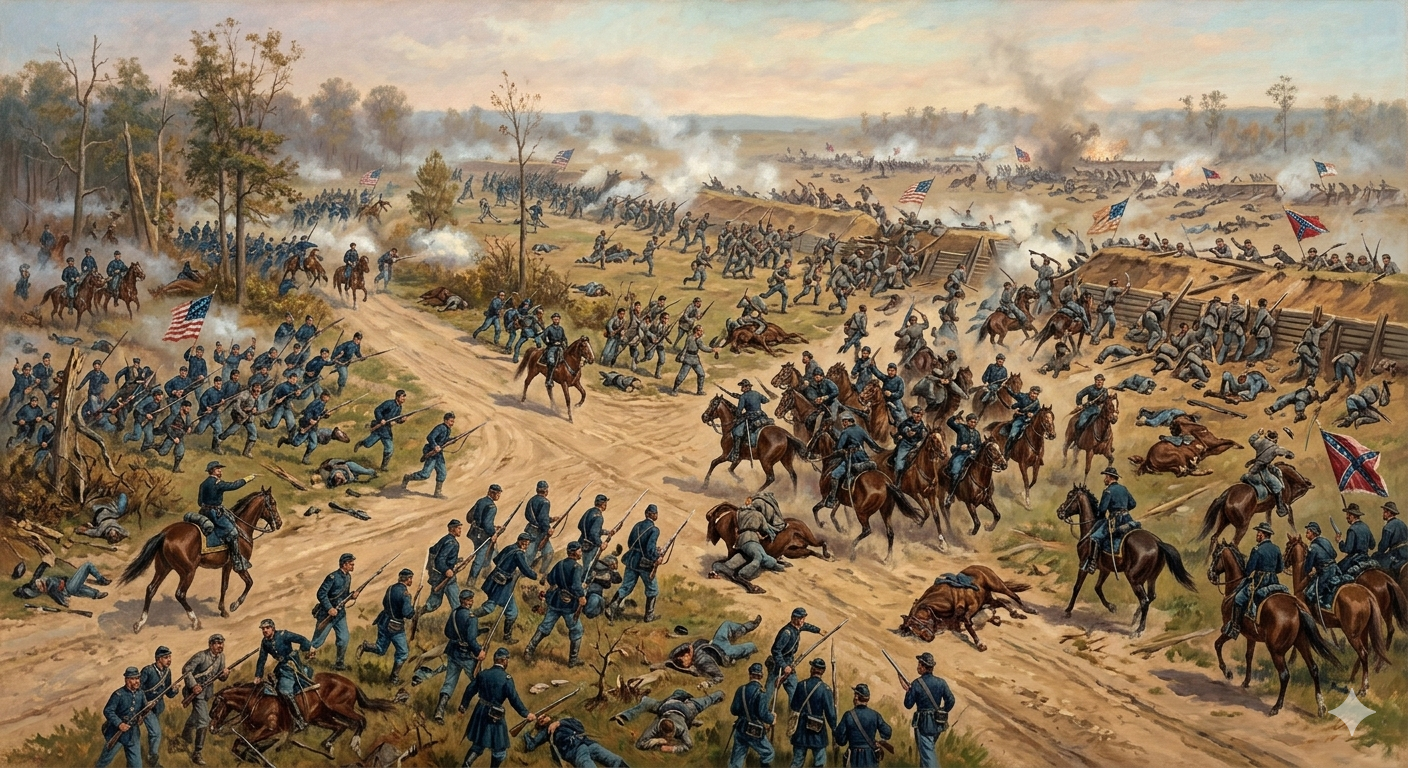
On April 1, 1865, Union forces decisively defeated Confederate troops at Five Forks, Virginia — a victory that cracked open Petersburg, doomed Richmond, and set the stage for the end of the American Civil War.
The Strategic Setting: Why Petersburg and Five Forks Mattered in the Final Year of the Civil War
By the early spring of 1865, the American Civil War had entered its final, grinding phase. For nearly ten months — from June 1864 through the bitter Virginia winter — the Union Army of the Potomac and the Confederate Army of Northern Virginia had faced each other in the exhausting Siege of Petersburg. The city of Petersburg, located approximately twenty miles south of the Confederate capital at Richmond, Virginia, was the vital hub through which almost every remaining supply line feeding both the army and the capital flowed. Without Petersburg, Richmond could not be held. Without Richmond, the Confederacy as a functioning political and military entity could not survive.
Union Lieutenant General Ulysses S. Grant had understood this from the moment he launched his siege operations in June 1864. His strategy throughout those long months had been methodical and relentless: use the Union army’s superior numbers and industrial strength to stretch Confederate General Robert E. Lee’s defensive lines ever further westward, gradually thinning them to the point of collapse. Each time Grant extended his lines to the west, Lee was forced to respond by extending his own lines to match, drawing men away from an already depleted force. By late March 1865, Lee’s army — once a formidable fighting force of over 100,000 men — had been ground down to a shadow of its former strength by casualties, desertion, disease, and starvation.
At the center of this strategic pressure was the South Side Railroad, also known as the Southside Railroad, which entered Petersburg from the west. By the spring of 1865, it was the last functioning supply artery feeding Lee’s army. Every other major railroad connection into the city had been cut. The South Side Railroad was the final lifeline. Approximately three miles north of a rural Dinwiddie County road junction called Five Forks, the railroad ran directly through terrain that Grant intended to seize. Control of Five Forks meant control of the roads leading to that railroad — and control of those roads meant the ability to sever it. The intersection took its name from the meeting of five roads at a single point: White Oak Road, Dinwiddie Court House Road, Scott’s Road, Ford’s Road, and Gravelly Run Church Road. It was a modest crossroads in the Virginia countryside, but in the spring of 1865, it would become the pivot point on which the fate of the Confederacy turned.
The Commanders: Grant, Sheridan, Warren, Pickett, and the Generals Who Would Define the Battle
The Union effort at Five Forks was directed at the highest level by Lieutenant General Ulysses S. Grant, the general-in-chief of all Union armies. Grant had earned his reputation through victories at Fort Donelson, Shiloh, Vicksburg, and throughout the Overland Campaign of 1864. Brutal in his willingness to absorb casualties and unyielding in his strategic vision, Grant had spent nearly a year methodically dismantling the Confederate defenses around Petersburg. By March 1865, he sensed that the moment for a decisive blow was finally at hand.
Grant’s instrument for the flanking operation would be Major General Philip H. Sheridan, one of the most aggressive and energetic generals in the Union army. Sheridan, then just 34 years old, had built his wartime reputation through his campaigns in the Shenandoah Valley, where in the autumn of 1864 he had devastated Confederate forces and stripped the valley of its ability to supply Lee’s army. Grant trusted Sheridan completely, famously calling him his “caged tiger.” For the Five Forks operation, Grant gave Sheridan overall command of a combined force of approximately 22,000 men — his own three cavalry divisions and the Army of the Potomac’s Fifth Corps of infantry.
Commanding that infantry corps was Major General Gouverneur K. Warren, a careful and intellectually gifted officer who had earned lasting fame at the Battle of Gettysburg in July 1863 by recognizing and defending the crucial position on Little Round Top. Warren was a talented engineer and a thorough planner, but he had developed a reputation in the final months of the Petersburg campaign for a certain deliberateness that frustrated more aggressive commanders. Sheridan, in particular, had little confidence in Warren and had privately secured permission from Grant in advance to relieve Warren of command if he judged it necessary during the coming operation.
Opposite them stood Major General George Edward Pickett, the Confederate commander whose name was already synonymous with one of the war’s most catastrophic military disasters — the doomed charge at Gettysburg on July 3, 1863, when he had led his division across nearly a mile of open ground into withering Union fire. Pickett had graduated last in his class at the United States Military Academy at West Point in 1846. For the defense of Five Forks, Lee assigned Pickett command of a mixed force of approximately 10,600 men: three brigades of his own infantry division, two additional infantry brigades detached from Major General Richard Anderson’s corps, and the remnants of three cavalry divisions under Major General Fitzhugh Lee — the son of General Robert E. Lee’s brother, and himself a capable cavalry commander. Assisting Fitzhugh Lee were cavalry division commanders Major General Thomas L. Rosser, Major General William H.F. “Rooney” Lee (Robert E. Lee’s own son), and Brigadier General Thomas T. Munford.
The Road to Five Forks: From Lewis Farm to Dinwiddie Court House, March 29–31, 1865
The movements that would culminate in the Battle of Five Forks began on the morning of March 29, 1865, when Grant launched the spring offensive that historians would later identify as the beginning of the Appomattox Campaign. Grant ordered Sheridan’s cavalry and Warren’s Fifth Corps to move west of the Union lines in an attempt to turn Lee’s right flank and threaten the South Side Railroad. The weather was miserable — rain had turned the Virginia roads into ribbons of mud, and the countryside was swampy and difficult for large bodies of men to traverse.
Before dawn on March 29, Warren’s Fifth Corps moved west while Sheridan’s cavalry took a longer, more southerly route toward Dinwiddie Court House, a small village approximately four miles west of the end of the Confederate lines and about six miles south of the Five Forks intersection. By around 5:00 p.m. that afternoon, Sheridan had led approximately 9,000 cavalrymen into Dinwiddie Court House without opposition. Meanwhile, Union infantry fought a small engagement at the Battle of Lewis Farm, pushing Confederate forces back and securing ground that would support the larger operation to come.
On March 30, cavalry skirmishing continued across the sodden landscape as both sides maneuvered for position. Confederate General Robert E. Lee, already deeply concerned about the sustainability of his position, had begun forming a mobile strike force under Pickett and Fitzhugh Lee to protect Five Forks. This force assembled south of the South Side Railroad in the vicinity of the crossroads, preparing for what Lee knew would be a Union thrust toward the vital junction.
March 31, 1865 brought two significant engagements that directly shaped the Battle of Five Forks. At the Battle of White Oak Road, Union infantry from Warren’s Fifth Corps fought Confederate forces under General Bushrod Johnson along the White Oak Road, the main route connecting Pickett’s position at Five Forks to the rest of the Confederate line. The fighting was fierce, with Union troops initially pushed back before counterattacking to recapture the lost ground and sever the direct road connection between Pickett’s isolated command and the main Confederate defensive line. Simultaneously, at the Battle of Dinwiddie Court House, Pickett took the offensive, advancing his combined force of infantry and cavalry against Sheridan south of Five Forks. The Confederate attack pushed Sheridan back to a defensive line just north of Dinwiddie, and for a few hours it seemed as though Pickett might be able to drive the Union cavalry away entirely. However, the arrival of a Union infantry brigade under Brigadier General Joseph J. Bartlett helped stabilize Sheridan’s position, and by nightfall Pickett had decided to fall back northward to the Five Forks intersection, which Robert E. Lee had ordered him to hold under any circumstances.
Lee’s Fateful Order: Hold Five Forks at All Hazards
On the morning of April 1, 1865, General Robert E. Lee issued one of the most consequential orders of his career. He directed Pickett to hold the Five Forks intersection unconditionally. The exact language of Lee’s order as reported by the National Park Service stated: “Hold Five Forks at all hazards. Protect road to Ford’s Depot and prevent Union forces from striking the Southside Railroad.” The instruction carried the full weight of Lee’s understanding of the strategic situation — Five Forks was not merely a convenient defensive position but the linchpin of the entire Confederate right flank. If it fell, the South Side Railroad would be exposed, Petersburg would become untenable, and the entire defensive architecture that Lee had maintained for nearly ten months would collapse.
Pickett received the order and proceeded to organize his defenses. His men constructed a roughly 1.75-mile defensive line of log and earthwork breastworks along the White Oak Road, with the main infantry force facing south and cavalry protecting the flanks. The Confederate left flank — the western end of Pickett’s line — rested without any natural obstacle to anchor it, leaving it vulnerable to being turned or flanked by a determined attacker. Aware of this weakness, Confederate officers attempted to “refuse” the left flank, meaning they bent a portion of the line back at a perpendicular angle to create a makeshift defensive anchor. It was a precaution, but it would prove insufficient against what was coming.
The Infamous Shad Bake: How Three Confederate Generals Abandoned Their Posts on the Eve of Battle
As the morning of April 1 wore on with no sign of an immediate Union assault, an extraordinary and ultimately fateful decision was made behind Confederate lines. Major General Thomas L. Rosser, one of Fitzhugh Lee’s cavalry division commanders, had obtained a large catch of shad — a freshwater fish whose spring run was a beloved seasonal tradition among Tidewater Virginians — which he had transported on ice from the Nottoway River when his division relocated to Five Forks. Rosser invited Fitzhugh Lee and George Pickett to join him for a shad bake at his camp on the north bank of Hatcher’s Run, roughly two miles behind the Confederate front lines.
Pickett and Fitzhugh Lee accepted the invitation. Around 2:00 p.m. on April 1, 1865 — with Union forces gathering for a massive assault and with Lee’s own order to hold Five Forks “at all hazards” in effect — the two senior Confederate commanders left their troops without informing any subordinate officer where they were going, when they would return, or who was in command in their absence. When Munford’s pickets brought word of Union infantry movements on the roads approaching Five Forks, Pickett and Fitzhugh Lee were unavailable. Critically, there was no chain of command in place to respond to the incoming threat.
What made the generals’ absence particularly catastrophic was a curious meteorological phenomenon known as an acoustic shadow. The dense pine forest and heavy atmospheric conditions between Rosser’s camp and the Five Forks battlefield effectively muffled the sounds of the coming battle. Despite the gunfire of tens of thousands of men engaged in combat, Pickett and Lee reportedly could neither hear nor see any indication of the fighting that was beginning to tear their lines apart just two miles away. Various accounts suggest that during the shad bake, reports arrived of Union activity on the roads, but Pickett and Lee, hearing nothing and seeing nothing that suggested an imminent catastrophe, chose to dismiss the warning signs as routine cavalry skirmishing.
By the time Pickett finally became aware of the battle and rode hard for Five Forks — reportedly galloping “Indian-style” with his head bent down behind his horse’s neck to avoid Union bullets as he cut through Crawford’s advancing infantry — his line had already collapsed. Fitzhugh Lee’s cavalry managed to hold off the Union advance long enough for portions of the Confederate force to escape, but the battle was effectively over before the commanding general arrived at the field. The shad bake episode stands as one of the most extraordinary failures of command in American military history, a dereliction of duty at the worst possible moment that contributed directly to the downfall of the Confederacy’s last major army.
The Union Plan of Attack: Sheridan’s Cavalry and Warren’s Fifth Corps Close the Trap
While Confederate commanders were at their fish lunch, the Union war machine was methodically assembling for its attack. Sheridan’s plan was elegant in its simplicity and devastating in its execution. He would use his dismounted cavalry — fighting on foot with carbines, effectively functioning as infantry — to fix the Confederate line in place by applying pressure along its entire front. This would pin Pickett’s men in their breastworks, preventing them from repositioning or reinforcing the flank. While the cavalry engaged the Confederate front, Warren’s Fifth Corps of approximately 12,000 infantry would execute the decisive blow: a massive assault against the exposed and weakly anchored Confederate left flank.
The practical execution, however, was plagued by difficulties. Rain-soaked roads, swampy ground, and dense undergrowth made moving large formations of infantry extremely difficult. Faulty maps and poor reconnaissance had also given Sheridan a mistaken picture of exactly where the Confederate left flank ended — his intelligence placed it approximately three-quarters of a mile further east than it actually was. As a result, when Warren’s corps finally advanced, the alignment was off: one of Warren’s three divisions, under Brigadier General Samuel W. Crawford, marched too far north and initially missed the Confederate flank altogether, pushing into open space rather than into the enemy position.
Sheridan grew increasingly impatient as the afternoon wore on without an attack. He had fretted that another day would slip away without a decisive engagement, and his frustration with Warren’s pace had been building for days. By around 4:00 p.m., Warren’s men were finally in line and ready. Sheridan, recognizing that he could wait no longer — with the April sun declining and darkness perhaps only two hours away — launched the assault at approximately 4:15 p.m. on April 1, 1865.
The Battle Begins: The Union Assault at 4:15 p.m. on April 1, 1865
At 4:15 p.m., Sheridan gave the order to attack and the full weight of the Union offensive crashed into the Confederate lines at Five Forks. Sheridan’s dismounted cavalry along the front opened fire on the Confederate breastworks, fixing Pickett’s men in place and preventing them from shifting reserves to meet the infantry assault on their flank. The noise of the cavalry engagement was the first indication to many Confederate soldiers that the quiet afternoon had ended.
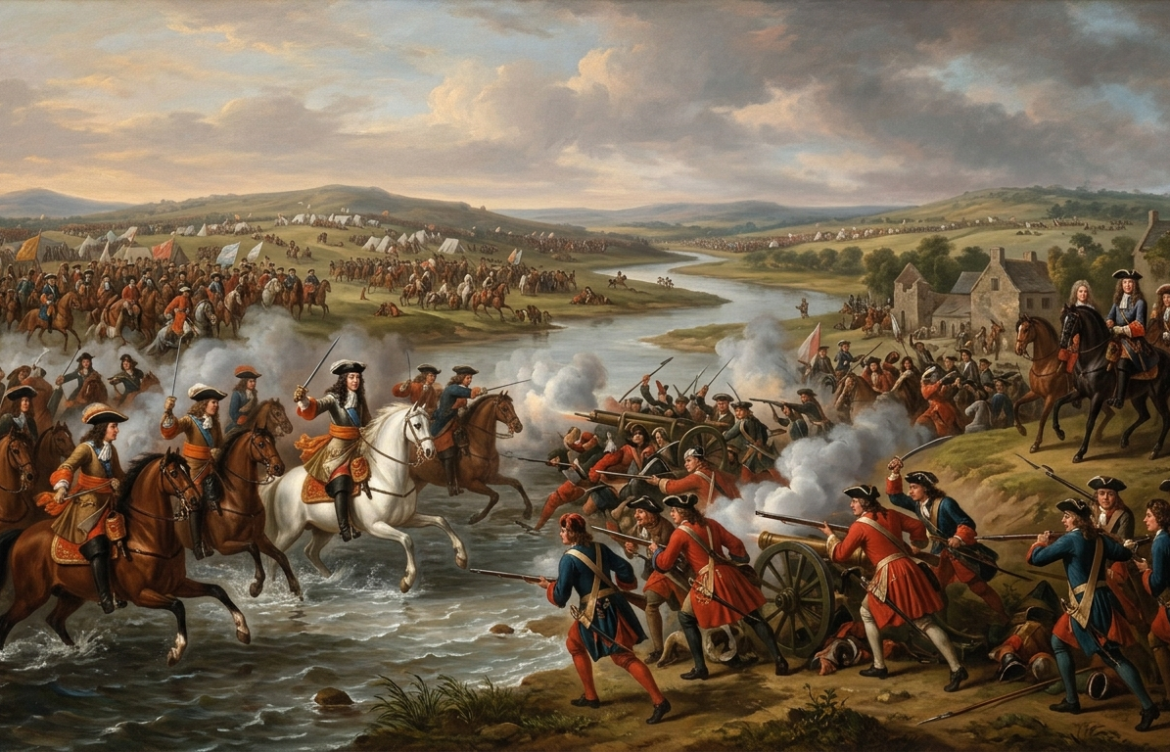
On the Confederate left, the Union assault was delivered by the division of Brigadier General Romeyn B. Ayres. By around 4:30 p.m., Ayres’s division slammed into the Confederate flank with tremendous force, striking the refused — or bent-back — portion of the Confederate left. The Confederate defenders, leaderless and already physically and psychologically depleted by months of grueling siege warfare, struggled to hold the line. The Union infantry poured through and around the flank, rolling up the Confederate position from west to east along the length of the breastworks.
Even as Ayres struck, Sheridan himself was at the front, personally leading and inspiring the Union troops with characteristically reckless bravery. He was seen riding up and down the line under fire, rallying hesitant soldiers and physically directing the attack. One of the more dramatic moments of the battle came when Sheridan personally led a charge with a portion of Ayres’s troops, crashing through the Confederate flank position. Colonel Joshua Chamberlain — the hero of Little Round Top at Gettysburg, who was now commanding a brigade under Ayres — quickly brought his men into the fight and contributed to breaking the Confederate line.
As Ayres’s division rolled up the Confederate left, Brigadier General Charles Griffin’s division swept forward on Ayres’s right, adding further pressure to the collapsing Confederate position. Warren, meanwhile, redirected Crawford’s division — which had overshot the flank and marched north into open ground — bringing it back south to strike the Confederates from an unexpected direction. Crawford’s men now attacked from the north and northwest, while Ayres and Griffin pressed from the south, and Sheridan’s cavalry swept around the Confederate flanks. Pickett’s command was being struck from three directions simultaneously.
The Confederate line simply melted away. With no overall direction, no reserve system, and no ability to coordinate a coherent response, individual Confederate units fought as best they could before being overwhelmed. Union Brigadier General Frederick Winthrop was killed during the fighting, one of the prominent Union casualties of the engagement. On the Confederate side, the beloved Confederate artillery officer Colonel William Johnson “Willie” Pegram — one of the most respected young officers in the Army of Northern Virginia — was mortally wounded during the battle, dying the following day. By around 6:45 to 7:00 p.m., all effective Confederate resistance at Five Forks had collapsed.
The Collapse of Pickett’s Command: Casualties, Prisoners, and the Rout of April 1
The scale of the Confederate defeat at Five Forks was staggering. Of Pickett’s force of approximately 9,200 to 10,600 men, nearly a third became casualties in the space of a few hours. Union forces took up to 4,000 Confederate prisoners — an extraordinary number that reflected the totality of the rout. The Confederates who were not captured or killed scattered northward toward the South Side Railroad, exactly the direction from which Lee had most feared a Union advance. The five-road intersection of Five Forks, which Lee had ordered held “at all hazards,” was firmly in Union hands by nightfall.
Total Union casualties at the Battle of Five Forks were approximately 830 killed, wounded, and missing. Confederate casualties are estimated at around 800 killed and wounded, in addition to the roughly 4,000 captured, giving a total Confederate loss approaching 5,000 men — more than half of Pickett’s original effective force. The disparity between Union and Confederate losses reflected both the numerical advantage enjoyed by Sheridan’s command and the devastating effect of striking an already demoralized and leaderless enemy formation from multiple directions simultaneously.
For George Pickett personally, Five Forks was the final chapter in what had become an increasingly troubled relationship with General Lee. Lee had long harbored reservations about Pickett’s performance since Gettysburg, and the debacle at Five Forks — including the revelation of the shad bake — deepened that estrangement permanently. In the days following Five Forks, during the chaos of the Confederate retreat, Lee reportedly told Pickett that he no longer needed him. Pickett would serve out the final days of the war in diminished capacity and was never fully rehabilitated in the Confederate command hierarchy.
Sheridan Relieves Warren of Command: The Controversial Decision That Ended a Military Career
Even as the Union troops were celebrating their decisive victory at Five Forks, a dramatic and deeply controversial incident unfolded that would cast a shadow over the battle’s legacy for decades. At approximately 7:00 p.m. on April 1, 1865 — even as Confederate resistance was still collapsing around them — Major General Philip Sheridan relieved Major General Gouverneur K. Warren of command of the Fifth Corps on the spot.
Sheridan’s displeasure with Warren had been building for days. He was furious at the delays that had pushed the main infantry assault back to late afternoon, blamed Warren’s personal leadership for the Fifth Corps’s alignment problems during the attack, and was angered by what he perceived as Warren’s failure to maintain close enough contact with him during the battle. Sheridan had received advance authorization from Grant to relieve Warren if he judged it necessary, and he exercised that authority without hesitation. Command of the Fifth Corps passed immediately to Major General Charles Griffin.
The move was deeply unjust by most historical assessments. Warren and his corps had performed creditably during the battle — it was Warren’s infantry that had delivered the decisive blow against the Confederate flank, and the corps had fought effectively despite the terrain difficulties and alignment problems caused largely by faulty maps and poor intelligence provided to Sheridan himself. Warren protested his removal bitterly and spent years fighting to clear his name. He was reduced to the rank of major in the Corps of Engineers, continuing to serve the army in that capacity while devoting enormous personal effort to seeking vindication.
Warren’s case became a landmark in American military justice. In 1879, President Rutherford B. Hayes convened a formal court of inquiry to investigate the circumstances of Warren’s relief. After one hundred days of hearings and testimony, the court found that Sheridan’s decision had been unjustified and that Warren had not failed in his duty at Five Forks. The findings vindicated Warren’s honor, but the ruling came too late to restore his military career. Gouverneur K. Warren died in 1882, just three days after receiving news of the court’s verdict, without ever having been publicly rehabilitated during his lifetime. He was buried in civilian clothes and without military honors at his own request — a final expression of the bitter wound inflicted by Sheridan’s impulsive decision on the evening of April 1, 1865. A bronze statue of Warren stands today at Little Round Top at Gettysburg, commemorating his crucial role in saving that position on July 2, 1863.
The Fall of Petersburg and Richmond: How Five Forks Triggered the Final Collapse of the Confederacy
When news of the Union victory at Five Forks reached Grant’s headquarters, the general-in-chief responded with immediate and decisive action. That same night, Grant ordered a massive general assault along the entire length of the Confederate lines at Petersburg, to be launched at dawn on April 2, 1865. The Confederate defenses, which had held for 292 days since the beginning of the siege, were now thinly stretched and psychologically shaken. The loss of Five Forks had exposed the South Side Railroad and turned the right flank of the entire Confederate position.
At dawn on April 2, the Union assault went forward along the Petersburg lines with overwhelming force. The Confederate defenses cracked and then shattered. The Sixth Corps under Major General Horatio Wright broke through the Confederate line at a critical point, and Union forces poured through the breach. Among the casualties of April 2 was Confederate Lieutenant General Ambrose Powell Hill, one of Lee’s most trusted corps commanders, who was killed while riding to assess the breakthrough. The Confederate hold on Petersburg, maintained through ten months of extraordinary sacrifice and determination, had reached its end.
Robert E. Lee immediately recognized the catastrophic implication of what had happened. On the afternoon of April 2, he sent a dispatch to Confederate President Jefferson Davis warning that Petersburg and Richmond would have to be evacuated that night. Davis received the message while attending Sunday services at St. Paul’s Episcopal Church in Richmond and quietly departed. The Confederate government fled Richmond that evening, and Confederate forces began their evacuation of both cities under cover of darkness.
Union forces entered Petersburg and Richmond on the morning of April 3, 1865. The Confederate capital, which had been the symbolic heart of the Southern rebellion since 1861, fell without a final stand. Retreating Confederate forces had set fire to warehouses and supply depots in Richmond, and the resulting fires spread through portions of the city. Union troops, including African American regiments, marched into the burning capital to the astonishment and, in some cases, the joy of the city’s residents — particularly its formerly enslaved population, who greeted the arrival of Union soldiers as liberation.
The Appomattox Campaign: From Five Forks to Lee’s Surrender Eight Days Later
The fall of Petersburg and Richmond launched what became the Appomattox Campaign, the final military pursuit of Robert E. Lee’s Army of Northern Virginia. Lee’s original intention was to move his retreating army southwest to join with the forces of General Joseph E. Johnston, who commanded Confederate troops in North Carolina. If Lee and Johnston could unite their armies, they might have sufficient strength to continue the war — perhaps offering meaningful resistance in the interior of the South.
Grant moved quickly to prevent this. Union forces pursued the retreating Confederates relentlessly, moving parallel to and ahead of Lee’s line of march in an effort to cut off his escape routes. Lee’s starving, exhausted army fought a series of rear-guard actions and skirmishes as it struggled westward along the Appomattox River. The Battle of Sayler’s Creek on April 6, 1865, was particularly devastating, resulting in the capture of approximately 7,700 Confederate soldiers — roughly a quarter of what remained of Lee’s army — including eight generals. Lee, surveying the carnage at Sayler’s Creek, reportedly said, “My God, has the army been dissolved?”
By April 8, Union cavalry under Sheridan had raced ahead of Lee’s column and blocked the road at Appomattox Court House, cutting off the last Confederate route of escape to the southwest. Lee probed the Union position and found it too strong to break through. Surrounded, outnumbered, and with his men reduced to near starvation, Lee made the decision to surrender rather than continue a hopeless fight that would only add to the suffering of his soldiers. On the afternoon of April 9, 1865 — just eight days after the Battle of Five Forks — Robert E. Lee met Ulysses S. Grant in the parlor of Wilmer McLean’s house at Appomattox Court House and surrendered the Army of Northern Virginia, effectively ending the Civil War in Virginia and setting in motion the surrender of remaining Confederate forces across the South in the weeks that followed.
Key Figures at the Battle of Five Forks: Ayres, Crawford, Griffin, Chamberlain, Custer, and Mackenzie
Beyond the senior commanders, the Battle of Five Forks involved dozens of officers whose actions shaped its outcome. On the Union side, Brigadier General Romeyn B. Ayres commanded the First Division of the Fifth Corps, whose assault on the Confederate left flank at 4:30 p.m. delivered the decisive blow that broke the Confederate position. Ayres’s men absorbed initial confusion from faulty maps and alignment problems before crashing through the Confederate line with tremendous force.
Colonel Joshua Lawrence Chamberlain, commanding a brigade in Ayres’s division, played a particularly prominent role in the assault. Chamberlain, whose defense of Little Round Top at Gettysburg had already made him one of the most celebrated infantry officers in the Union army, personally led his brigade into the fight alongside Sheridan and contributed materially to collapsing the Confederate left flank. Chamberlain would later be selected by Grant to receive the formal surrender of Confederate arms at Appomattox Court House on April 12, 1865 — a final honor that recognized his service throughout the final campaign.
Brigadier General Samuel W. Crawford commanded the Third Division of the Fifth Corps. Though Crawford’s division initially overshot the Confederate flank during the attack, Warren redirected it to strike from the north, and Crawford’s men played a key role in cutting off Confederate retreat routes. It was through Crawford’s advancing infantry that Pickett had to ride when he finally attempted to reach his command. Major General Charles Griffin, commanding the First Division, drove forward on Ayres’s right and added weight to the collapse of the Confederate center and right.
On the cavalry side, Major General Wesley Merritt commanded Sheridan’s cavalry corps in the field, overseeing the operations of divisions under Major Generals George Armstrong Custer and Thomas Devin. Custer, already famous for his flamboyant battlefield presence and aggressive tactics, led his division in the dismounted assault that fixed the Confederate front during the main infantry attack. Brigadier General Ranald Mackenzie, commanding a small cavalry division transferred from the Army of the James specifically for this operation, was assigned to block Confederate retreat routes to the east. On the Confederate side, Brigadier General Thomas T. Munford, though he sent warnings of the Union advance, was unable to coordinate a coherent response in the absence of Pickett and Fitzhugh Lee.
The Significance of Five Forks: Why Historians Call It the Waterloo of the Confederacy
The Battle of Five Forks has been called the “Waterloo of the Confederacy” by historians and contemporaries alike, and the comparison is apt in its essentials. Just as Napoleon’s defeat at Waterloo in June 1815 ended French Imperial ambitions in a single afternoon of catastrophic military failure, the Confederate defeat at Five Forks on April 1, 1865, destroyed the last meaningful defensive position protecting the Confederacy’s most vital strategic assets and made the fall of both Petersburg and Richmond inevitable within hours.
The battle’s significance can be measured in several dimensions. Militarily, it represented the culmination of Grant’s nine-month strategy of attrition and flanking — a strategy that had been criticized throughout the war for its heavy casualties but that ultimately proved decisive by systematically stripping Lee of the manpower, supplies, and defensive depth needed to hold his position. The capture of Five Forks cut the South Side Railroad, Lee’s last supply line, and left the Confederate right flank completely exposed. There was no strategic reserve, no fallback position, and no realistic prospect of relief from outside forces.
Politically, Five Forks precipitated a cascade of consequences that brought the war to its conclusion within eight days. The fall of Petersburg on April 2 forced the evacuation of Richmond, which had served since May 1861 as the capital of the Confederate States of America. The flight of President Jefferson Davis and the Confederate government from Richmond on the night of April 2 was a moment of profound symbolic importance — it marked the practical dissolution of the Confederate government as a functioning administrative entity. The fall of the capital sent a clear signal throughout the South that the end had come.
The battle also had significant implications for two individual military careers, as noted by historian Peter C. Luebke of Encyclopedia Virginia. For George Pickett, Five Forks was the final episode in a career that had been marked by catastrophic failure at the most critical moments. For Gouverneur Warren, it was a profound personal injustice that overshadowed legitimate achievements across four years of distinguished service. The contrasting fates of these two men — one a Confederate general whose negligence contributed to the loss of a battle, the other a Union general whose careful competence was rewarded with disgrace — reflect the arbitrary and often cruel nature of military reputation in time of war.
The Battlefield Today: Five Forks Battlefield and the Preservation of a Historic Site
The Five Forks Battlefield is today preserved as part of Petersburg National Battlefield, administered by the National Park Service. The battlefield encompasses 419 acres of preserved land in Dinwiddie County, Virginia, allowing visitors to walk the ground where the decisive engagement of April 1, 1865 took place. The American Battlefield Trust has been active in preserving additional acreage at the related sites of Hatcher’s Run and White Oak Road, adding 387 and 903 acres respectively to the protected landscape of the final Petersburg Campaign.
The Five Forks site includes interpretive materials and trail systems that allow visitors to understand the tactical layout of the battle, including the Confederate breastworks along White Oak Road and the approach routes used by Union infantry during the assault. Nearby, the broader network of Petersburg Battlefield sites includes four antebellum homes, museums, and living history programs at Pamplin Historical Park, located on the ground where the Union Sixth Corps broke through the Confederate lines on the morning of April 2, 1865.
The battle is commemorated through numerous paintings and artistic works, including a dramatic oil painting acquired by the Virginia Museum of History and Culture in 2006, created by the French artist Paul Dominique Philippoteaux around 1885. Philippoteaux, who was known for his large-scale cyclorama paintings of Civil War battles, depicted the charge of Union cavalry under Sheridan crashing into the Confederate defenders at Five Forks — capturing the violent energy of the engagement in rich detail. The painting measures 40 by 65 inches and provides one of the most vivid visual records of the battle’s climactic moment.
Conclusion: April 1, 1865 and the Day the Confederacy’s Fate Was Sealed
The Battle of Five Forks, fought on April 1, 1865, in the rural crossroads of Dinwiddie County, Virginia, stands as one of the most consequential engagements in American military history. In the span of a single afternoon — from the 4:15 p.m. assault order to the collapse of all Confederate resistance by nightfall — Major General Philip Sheridan’s combined force of cavalry and infantry destroyed the defensive anchor of Robert E. Lee’s right flank, captured several thousand Confederate soldiers, and opened the road to the South Side Railroad that Lee had guarded at all costs.
The battle brought together, in a single dramatic narrative, many of the defining themes of the American Civil War in its final phase: the grinding attrition of Grant’s strategy, the aggressive energy of Sheridan’s command style, the exhaustion and desperation of Lee’s thinly stretched army, the catastrophic failure of Confederate leadership at the crucial moment, and the unjust sacrifice of Gouverneur Warren’s reputation on the altar of Sheridan’s impatience. It was shaped by mud and rain, by the acoustic quirks of a Virginia pine forest, by fish and fire, and by the individual decisions of men under extraordinary pressure.
Eight days after Five Forks, on April 9, 1865, Robert E. Lee surrendered the Army of Northern Virginia to Ulysses S. Grant at Appomattox Court House. The war in Virginia was over. The Civil War, which had claimed the lives of approximately 620,000 to 750,000 Americans over four years of unprecedented violence, was drawing to its close. At the center of that final, decisive sequence of events was the star-shaped intersection of five country roads in Dinwiddie County — a place that became, in a few hours on an April afternoon in 1865, the Waterloo of the Confederacy.