Introduction: The Day Science Changed Forever
On the evening of July 1, 1858, in the meeting rooms of the Linnean Society of London at Burlington House, Piccadilly, the Secretary of that learned body, John Joseph Bennett, rose and read aloud a pair of scientific papers to an audience of approximately thirty naturalists and gentleman scholars. The occasion was a special meeting, hastily arranged in the final days of June, and the subject of the papers — the laws governing the introduction and modification of species on the Earth — was so novel and so consequential that the room, by one account, fell into a stunned and extraordinary silence when the reading was complete. The president of the society, Thomas Bell, would later write in his annual report that the year had not been marked by any striking discoveries. He was, as history would prove, almost incomprehensibly wrong.
The two papers read that evening bore the names of Charles Robert Darwin, a fifty-year-old English naturalist who had been quietly accumulating evidence for a revolutionary theory for two decades in the comfortable seclusion of his country home at Down House in Kent, and Alfred Russel Wallace, a thirty-five-year-old English naturalist and explorer who was, at the time the papers were read, thousands of miles away in the Malay Archipelago collecting specimens from islands most Europeans had never heard of. Neither man was present in the room when his life’s most significant intellectual contribution was first presented to the scientific world. Darwin was in the Isle of Wight, burying his infant son. Wallace was somewhere in the Indonesian islands, entirely unaware that his private letter to Darwin had been transformed into a public announcement.
The title of the joint publication that emerged from that evening was ‘On the Tendency of Species to Form Varieties; and on the Perpetuation of Varieties and Species by Natural Means of Selection.’ Published on August 20, 1858, in the Journal of the Proceedings of the Linnean Society of London: Zoology, it is described today by many historians of science as the most important single scientific paper in the history of biology. It introduced to the world, for the first time in print, the theory of evolution by natural selection — the concept that would overturn centuries of received wisdom about the origin and diversity of life on Earth, transform biology from a largely descriptive science into a rigorously explanatory one, and fundamentally alter humanity’s understanding of its own place in the natural world.
Part I: Charles Darwin — The Man Who Thought for Twenty Years Before Speaking
Early Life, Education, and the Making of a Naturalist
Charles Robert Darwin was born on February 12, 1809, in Shrewsbury, Shropshire, England, the fifth of six children of Robert Waring Darwin, a wealthy physician, and Susannah Darwin née Wedgwood, daughter of the famous pottery entrepreneur Josiah Wedgwood. Darwin was therefore doubly connected to the intellectual and commercial elite of Georgian England — his paternal grandfather was Erasmus Darwin, the physician and poet who had himself speculated about the mutability of species in his work Zoonomia (1794-1796), decades before his grandson would prove it. The family wealth would later give Charles the financial independence to pursue scientific research as a gentleman without the need to earn a living, a circumstance that proved essential to the twenty years of quiet, methodical study that preceded his public announcement of the theory.
Darwin’s educational career began unpromisingly. His father, Robert, enrolled him in the medical programme at the University of Edinburgh in 1825, hoping he would follow in the family’s medical tradition, but Charles found surgery repellent and medical lectures dull. He left Edinburgh after two years without completing the degree. His father then dispatched him to Christ’s College, Cambridge, in 1828, with the intention that he should prepare for a career in the Anglican clergy — a respectable vocation for an educated gentleman of limited professional ambition. At Cambridge, however, something quite different happened. Darwin fell under the influence of the Reverend John Stevens Henslow, a brilliant botanist and geologist who taught natural philosophy at the university, and who recognized in his young student an exceptional capacity for careful observation and systematic thought. Under Henslow’s guidance, Darwin developed a passionate interest in natural history and beetle collecting, spent hours in the Cambridge Botanic Garden, and read with fierce attention Alexander von Humboldt’s Personal Narrative of Travels and John Herschel’s Preliminary Discourse on the Study of Natural Philosophy — works that inspired in him, as he later recalled, ‘a burning zeal to add even the most humble contribution to the noble structure of Natural Science.’
The Voyage of HMS Beagle — 1831 to 1836
The transformative event of Darwin’s intellectual life came in August 1831, when his mentor Henslow forwarded to him a letter from Captain Robert FitzRoy of HMS Beagle, offering a position as unpaid naturalist on a planned survey voyage to chart the coastlines of South America. FitzRoy, a precise and demanding officer of aristocratic background, wanted a gentleman companion who could provide educated conversation during the years at sea and conduct scientific observations along the way. Darwin was twenty-two years old when the Beagle departed from Plymouth Sound on December 27, 1831, beginning a voyage that had been planned to last two years but would stretch to nearly five, circumnavigating the globe and returning to Falmouth, England, on October 2, 1836.
During those five years, Darwin spent more time on land than at sea — the chronic seasickness that plagued him throughout the voyage made him grateful for every opportunity to disembark. He explored the geological formations of the Cape Verde Islands; excavated the fossil bones of enormous extinct mammals in the pampas of Argentina; witnessed a violent earthquake in Chile that permanently altered his understanding of the forces shaping the Earth’s surface; climbed the foothills of the Andes; surveyed the coral atolls of the Cocos Islands; and collected specimens of plants, animals, insects, and fossils at every stop. He filled notebooks with observations and theoretical speculations, and sent regular shipments of specimens back to Henslow in Cambridge, where they attracted the admiration of the British scientific establishment even before Darwin returned home.
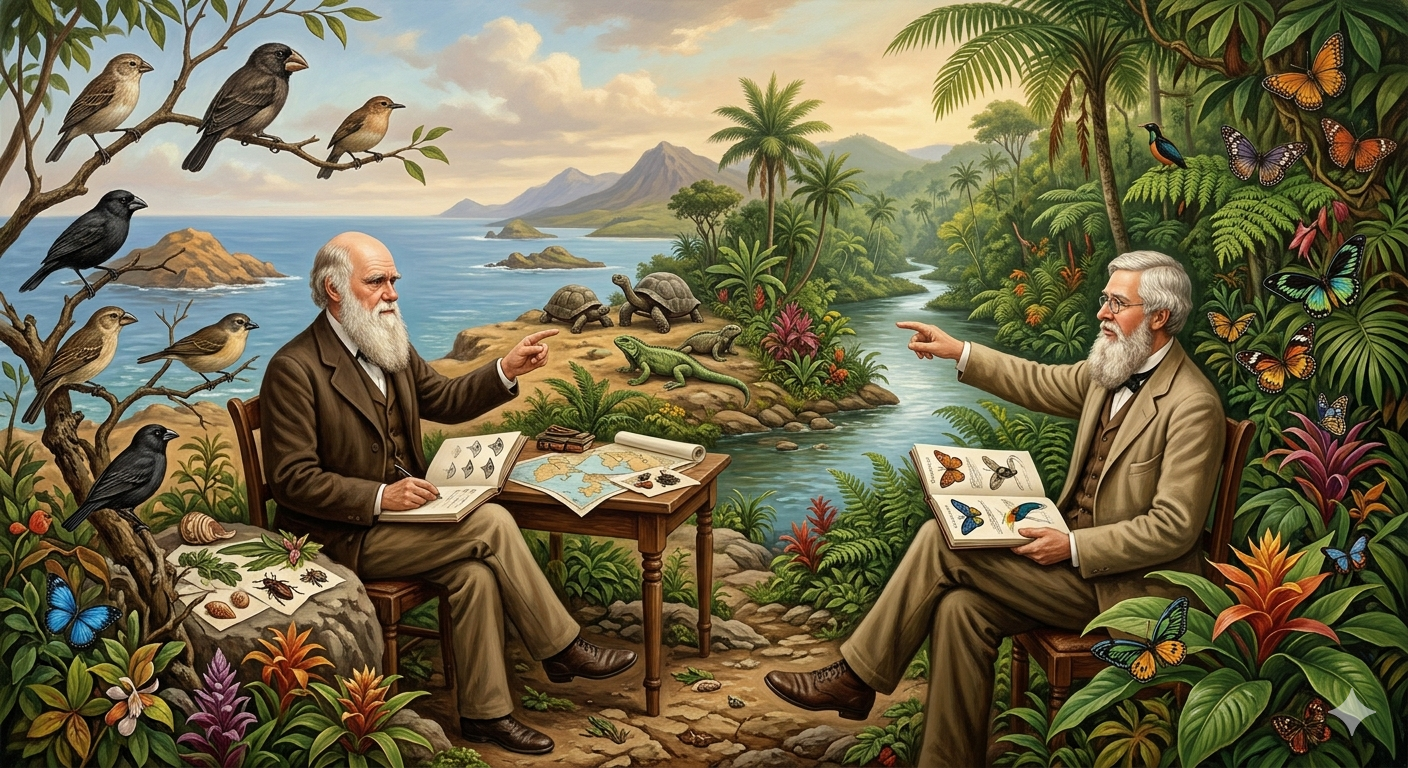
The observations that would prove most consequential were made during five weeks in September and October 1835, when the Beagle visited the Galápagos Islands — a volcanic archipelago approximately 966 kilometers off the coast of Ecuador, populated by species found nowhere else on Earth. Darwin was struck by the peculiarities of the island’s fauna: the giant tortoises that varied from island to island in the shape of their shells, the marine iguanas that had somehow learned to dive and feed on underwater algae, and — most famously, though he did not fully appreciate their significance until after he returned to England — the various species of finches adapted to different food sources on different islands. He noticed that the Galápagos mockingbirds differed between islands, and was informed by the island’s governor that the tortoises from different islands could be identified by their distinctive shells. These observations planted the seeds of a question he would spend the next two decades trying to answer: why did species vary so systematically by location, and what mechanism could account for the appearance of adaptation?
The Revelation of 1838 — Malthus and the Mechanism of Natural Selection
Darwin returned to England in October 1836 as a celebrated young naturalist, his reputation already established by the letters and specimens Henslow had shared on his behalf. He threw himself into the work of cataloguing and publishing the scientific results of the voyage, and by 1837 had opened his first private notebook on the transmutation of species — the question of whether and how living things changed over time. He was convinced by the Galápagos observations and by his analysis of the geographical distribution of fossils in South America that species were not fixed and immutable as conventional natural theology maintained, but changed over time in response to environmental conditions. What he did not yet understand was the mechanism by which this change occurred.
The crucial insight came in September 1838, when Darwin read the sixth edition of An Essay on the Principle of Population, written in 1798 by the Reverend Thomas Robert Malthus, an English clergyman and economist. Malthus had argued that human populations always tend to grow faster than the food supplies that sustain them, producing an inevitable struggle for resources among the surplus individuals that any population generates. Darwin, whose years of observing animal breeding and natural variation had already made him sensitive to the variation among individuals within any species, was electrified by the application of Malthus’s argument to the natural world. If all species produce far more offspring than can possibly survive, and if individuals within a species vary in heritable ways, then those individuals whose variations give them even a slight advantage in the struggle for food, shelter, mates, or survival would systematically leave more offspring than their competitors. Over many generations, favourable variations would accumulate and unfavourable ones disappear, gradually reshaping species to fit their environments. Darwin had found his mechanism. He called it natural selection.
Twenty Years of Silence — The 1844 Essay, Down House, and the ‘Big Book’
Darwin wrote up his theory in a preliminary thirty-five-page ‘Pencil Sketch’ in June 1842, and expanded this into a 230-page essay in 1844. He left instructions with his wife Emma that in the event of his death, she should arrange for the 1844 Essay to be published, with money set aside for the purpose and a list of trusted naturalists to oversee the work. This reflects both how seriously Darwin took his theory and how aware he was that he might never summon the courage to publish it himself. His reticence was not primarily the product of religious timidity, as is sometimes assumed, but of a methodical scientist’s determination to have his evidence complete and unassailable before offering it to a world he knew would be hostile. He wanted a mountain of facts, not a plausible argument.
In early 1844, Darwin shared his essay with his close friend Joseph Dalton Hooker, the brilliant young botanist who would become director of the Royal Botanic Gardens at Kew and one of Darwin’s most important scientific allies. Hooker read the manuscript and recognized its significance immediately. Darwin also disclosed the outlines of his thinking to the great geologist Sir Charles Lyell, author of Principles of Geology — the three-volume work that had introduced Darwin to the concept of gradual geological change during the Beagle voyage, and whose influence Darwin always acknowledged as fundamental to his own thinking. Lyell had become increasingly alarmed by the evolutionary theories circulating in scientific circles and urged Darwin repeatedly through the early 1850s to publish, warning him that he was in danger of being anticipated. Darwin took the warning seriously but continued to accumulate evidence, spending eight years on an exhaustive study of barnacles that established his credentials as a rigorous taxonomist and gave him intimate knowledge of variation within a real biological group. In May 1856, at Lyell’s urging, he finally began writing the ‘big book’ on natural selection that would lay out his evidence comprehensively.
Part II: Alfred Russel Wallace — The Man Who Thought the Same Thought in the Jungle
Early Life and the Poverty That Made a Naturalist
Alfred Russel Wallace was born on January 8, 1823, in Llanbadoc, near Usk in Monmouthshire, Wales, the eighth of nine children of Thomas Vere Wallace, a financially unfortunate solicitor who moved his family repeatedly as his means diminished, and Mary Anne Wallace née Greenell. Unlike Darwin, Wallace was born into modest circumstances and received only a basic formal education at Hertford Grammar School before the family’s financial collapse forced him to abandon schooling at the age of fourteen. He became an apprentice to his brother William, a surveyor, and spent his adolescence and early twenties working as a land surveyor and teacher in Wales and Leicestershire. These years, though economically precarious, were intellectually rich. Wallace read voraciously, teaching himself botany, geology, and natural history from books borrowed from local mechanics’ institutes. He was particularly influenced by the works of Malthus — whose Essay on Population he encountered in his teens — and by Alexander von Humboldt’s travel narratives, which stirred in him the same ambition to explore the natural world that Humboldt had kindled in Darwin a decade earlier.
The intellectual friendship that shaped Wallace’s scientific career began in 1844, when he met Henry Walter Bates, a young entomologist of exceptional talent, in the town of Leicester. Bates introduced Wallace to the practice of systematic insect collection and to the growing scientific debate about the origin of species, a debate that the anonymous publication of Robert Chambers’s Vestiges of the Natural History of Creation in 1844 had brought to wide public attention. Chambers’s book argued, based on the fossil record and embryology, that living things had progressed from simple to complex over time — a provocative and controversial claim that convinced neither the scientific establishment nor the orthodox religious opinion of the day, but which planted in both Wallace and Bates the conviction that transmutation of species was a real phenomenon in need of a rigorous mechanistic explanation.
The Amazon Expedition — 1848 to 1852
In 1847, Wallace and Bates agreed to mount a joint collecting expedition to the Amazon River basin of South America, with the twin goals of financing themselves by selling specimens to museums and private collectors, and — as Wallace wrote explicitly — ‘towards solving the problem of origin of species.’ They departed for Brazil in April 1848 and spent four years in the Amazon, collecting tens of thousands of specimens of insects, birds, reptiles, and plants. Wallace worked primarily in the Rio Negro region in the upper Amazon, venturing into territories that few Europeans had ever visited. His observations of the geographical distribution of species — the way clearly related forms were separated by rivers, or by barriers of terrain — reinforced his conviction that species were not independently created but were derived from related antecedent forms, changing over time and space in response to local conditions.
The Amazon expedition ended in near-catastrophe. In July 1852, as Wallace was sailing back to England aboard the brig Helen, the ship caught fire and sank in the Atlantic Ocean. Wallace escaped with his life and virtually nothing else — ten years of specimen collection, his notebooks, his drawings, and almost all of his biological material were lost beneath the waves. He was adrift at sea for ten days before being rescued. The financial loss was devastating, but Wallace retained his memories, his notes (largely), and his determination. He returned to England and spent two years in London, writing up his Amazon observations, presenting papers to scientific societies, and preparing for his next great expedition.
The Malay Archipelago — 1854 to 1862
In March 1854, Wallace departed for Singapore, beginning an eight-year journey through the Malay Archipelago — the vast island chain stretching from the Malay Peninsula eastward through Borneo, Sulawesi, the Moluccas, and New Guinea — that would prove to be one of the great naturalist expeditions of the nineteenth century. Over eight years, Wallace traveled approximately 22,000 kilometers through the archipelago, visiting more than ninety different islands and collecting more than 125,000 specimens, including some 1,000 species new to science. He was assisted throughout much of his time in the archipelago by a young Malay man named Ali, who became his most trusted and skilled collecting assistant and without whom, Wallace later acknowledged, many of his most important collections would never have been assembled.
In October 1854, Wallace arrived in Sarawak on the great island of Borneo, where he was welcomed by Sir James Brooke, the ‘White Rajah’ of Sarawak — a remarkable English adventurer who had been given sovereignty over the territory by the Sultan of Brunei in recognition of his help suppressing a local rebellion. During the wet season of early 1855, laid up with nothing to do but read and think, Wallace wrote the paper that would first alert the scientific world to his evolutionary thinking. Published in September 1855 in the Annals and Magazine of Natural History, this paper — ‘On the Law which has Regulated the Introduction of New Species,’ now known as the Sarawak Law paper — argued that ‘Every species has come into existence coincident both in space and time with a pre-existing closely allied species.’ This was a clear statement of evolutionary descent without common ancestry, though it did not yet propose a mechanism by which the change occurred. The paper concluded with the ‘Sarawak Law,’ Wallace’s way of describing the pattern of species distribution that both he and Darwin had independently observed: new species arise near their closest relatives, geographically and temporally.
The Wallace Line — A Discovery That Transformed Biogeography
Among the most scientifically durable contributions of Wallace’s Malay years was his identification of a striking faunal divide running through the Indonesian archipelago between the islands of Bali and Lombok and between Borneo and Sulawesi. To the west of this line, the fauna of the islands was essentially Asian in character — tigers, rhinoceroses, elephants, orangutans, and birds typical of the Oriental region. To the east of the line, the fauna was Australasian — marsupials, cockatoos, birds-of-paradise, and other creatures characteristic of the Australian continent. The transition was abrupt and decisive, far more dramatic than the small distance between adjacent islands would suggest was possible if animals had been moving freely across the region. Wallace recognized that the line represented a long-standing geographical barrier — a deep water channel that had prevented the exchange of land animals between the Asian and Australian continental landmasses even during periods of lower sea levels. This divide, now known as the Wallace Line, is recognized today as one of the most important biogeographical boundaries on Earth and is regarded as the foundational concept of the science of biogeography, which studies the distribution of species across the planet.
The Fever Epiphany — February 1858, Dodinga, Halmahera
The most celebrated moment of Wallace’s scientific career occurred in February 1858, in circumstances that could hardly have been more dramatic. Wallace had been using the Dutch colonial port of Ternate in the Moluccas as a base for his collecting operations, and in January 1858 he traveled to the nearby island of Halmahera — which he called Gilolo — to prospect for new specimens. He was staying in a small hut in the village of Dodinga when he was struck down by a fever, almost certainly malaria. Confined to his bed and unable to work, his mind turned to the intellectual problems that had occupied him for years. He began thinking about the ideas of Thomas Malthus — whose Essay on Population he had read as a young man and never forgotten — and applying them to the problem of animal variation.
The insight came with the force of revelation. If animal populations always produce more offspring than the environment can support, and if individuals within any species vary in ways that affect their survival — in speed, in strength, in colour, in resistance to disease — then those individuals best suited to their circumstances will systematically survive longer and leave more offspring. In every generation, the inferior, as Wallace put it, would inevitably be killed off and the superior would remain. Over successive generations, this relentless process would gradually reshape a species to fit its environment, and if populations were separated by geographical barriers, would lead them to diverge into distinct species adapted to their particular local conditions. In the grip of his fever in that small hut on Halmahera, Wallace had independently arrived at the same mechanism Charles Darwin had conceived twenty years earlier in his study at Down House: natural selection as the driver of evolutionary change.
Wallace was not a man to let an idea sit idle. As soon as the fever subsided sufficiently for him to write, he drafted his discovery into an essay of approximately twenty pages titled ‘On the Tendency of Varieties to Depart Indefinitely from the Original Type,’ completing it in the course of the next few days and posting it from Ternate, probably on March 9, 1858, when the Dutch mail steamer arrived. The essay was addressed to Charles Darwin, whom Wallace respected greatly and with whom he had exchanged a small amount of correspondence. He asked Darwin to review it and, if Darwin thought it worthwhile, to forward it to Sir Charles Lyell — whose work on geology Wallace admired and whose opposition to evolution Wallace hoped his essay might persuade. The letter and essay crossed thousands of miles of ocean over the following weeks and months, arriving at Down House on June 18, 1858.
Part III: Darwin’s Crisis — The Shock of June 18, 1858 and the Race to Justice
Darwin Receives Wallace’s Essay — The Letter That Changed Everything
Charles Darwin opened Wallace’s package on June 18, 1858, and experienced what he described to Charles Lyell in an immediately written letter as the most extraordinary coincidence he had ever seen. Reading Wallace’s essay, Darwin found — to his shock and dismay — an account of evolution by natural selection that was strikingly similar to his own theory in its essential structure and conclusions. Wallace had not used Darwin’s term ‘natural selection,’ but the mechanism he described was the same: individuals within a species vary, the struggle for survival eliminates those least suited to their environment, and successive generations of survivors gradually accumulate the favourable variations, leading over long periods to the modification of species. Darwin wrote to Lyell: ‘I never saw a more striking coincidence. If Wallace had my MS sketch written out in 1842, he could not have made a better short abstract! Even his terms now stand as heads of my chapters.’
Darwin was in a state of considerable distress, both scientific and personal. He recognized immediately that his priority over the theory — the two decades of private development and the 1844 essay that Hooker had read — was now at risk of being lost if Wallace published first. At the same time, he was a man of deep personal honour who genuinely did not want to steal credit from a colleague who had arrived at the same conclusion independently, and who had explicitly asked him to assist in getting the paper published. He wrote to Lyell that he would ‘of course, at once write and offer to send it to any journal’ that Wallace chose, adding despairingly that ‘all my originality, whatever it may amount to, will be smashed.’ He also wrote that he ‘would far rather burn my whole book than that he or any man should think that I had behaved in a paltry spirit.’
The personal crisis deepened further. On June 23, Darwin’s infant son Charles Waring Darwin, born less than two years earlier with what Darwin’s family recognized as signs of severe developmental disability, became dangerously ill with scarlet fever. On June 28, the child died. Darwin was overwhelmed — his household in turmoil, his wife Emma exhausted by grief, and himself torn between his personal anguish and the scientific crisis that Wallace’s letter had precipitated. He told Lyell that he could no longer trust himself to act with appropriate honour in the matter and asked his two most trusted scientific friends to resolve it as they saw fit.
The Role of Lyell and Hooker — Architects of the Joint Presentation
Sir Charles Lyell was born on November 14, 1797, in Kinnordy, Kirriemuir, Scotland, and had become by the 1850s the most eminent geologist in the English-speaking world. His Principles of Geology, published in three volumes between 1830 and 1833, had revolutionized the science by demonstrating that the Earth’s surface had been shaped by the same gradual, continuous processes — erosion, deposition, volcanic activity — that could be observed in the present day, operating over vastly longer periods than biblical chronology allowed. The concept of gradualism that underpinned Lyell’s geology would also underpin Darwin’s evolutionary theory: just as continents had changed incrementally over millions of years, species had changed incrementally through the accumulation of small hereditary variations. Darwin had absorbed Lyell’s thinking during the Beagle voyage and acknowledged its foundational importance to his own work. By the 1850s, Lyell had become one of Darwin’s closest scientific confidants, though Lyell himself remained publicly ambivalent about transmutation of species even as he privately urged Darwin to publish.
Joseph Dalton Hooker was born on June 30, 1817, in Halesworth, Suffolk, the son of the distinguished botanist William Jackson Hooker, who would later become director of the Royal Botanic Gardens at Kew. Joseph Dalton Hooker had followed his father into botany, going on a great survey voyage of the Southern Ocean as ship’s botanist before returning to establish himself as one of the leading systematic botanists of his generation. He was Darwin’s most intimate scientific friend — the person Darwin called his ‘beloved Hooker’ — and the only person who had read Darwin’s 1844 Essay in full before the events of 1858. Hooker understood Darwin’s theory as well as anyone outside Down House, and his commitment to Darwin’s priority was both principled and personal.
Together, Lyell and Hooker devised a solution that was intended to be both fair and scientifically productive. They would arrange for Wallace’s essay to be presented to the Linnean Society of London at a special meeting, but alongside extracts from Darwin’s own unpublished writings that would establish his independent prior development of the same theory. On June 30, 1858 — the day after Darwin’s baby son was buried — Hooker’s wife copied out the relevant extracts from Darwin’s manuscripts, and that evening Lyell and Hooker hand-delivered the package to the society’s secretary John Joseph Bennett with a covering letter explaining what they had arranged. Wallace was not consulted, a fact that has been the subject of considerable historical debate. Darwin had given Lyell and Hooker full discretion to act as they saw fit in his behalf, and Lyell and Hooker judged that the interests of science required both men’s work to be presented simultaneously rather than allowing either priority dispute or publication delay to deprive the scientific community of an idea whose time had come.
Part IV: July 1, 1858 — The Linnean Society Meeting That Changed the History of Science
The Venue, the Audience, and the Reading
The Linnean Society of London was founded in 1788 by the naturalist Sir James Edward Smith, who had purchased the entire natural history collection and library of the great Swedish taxonomist Carl Linnaeus after Linnaeus’s death in 1778. Named in Linnaeus’s honour, the society had become by the mid-nineteenth century one of the most prestigious learned bodies in natural history in Britain, bringing together the country’s leading botanists, zoologists, and naturalists in regular meetings at its rooms in Burlington House, Piccadilly. The meeting of July 1, 1858, had been hastily convened as a special session — the regular final meeting of the season had been postponed following the death on June 10 of the former society president and distinguished botanist Robert Brown, and the July 1 gathering was partly arranged to allow Lyell to deliver a memorial tribute to Brown.
The audience on the evening of July 1 numbered approximately thirty people — a small gathering for an occasion of such historical magnitude. Among those present were Darwin’s friends William Benjamin Carpenter, a physiologist, and William Henry Fitton, a geologist. Also present by coincidence was Samuel Stevens, Wallace’s natural history agent, who handled the sale of Wallace’s specimens and who was almost certainly unaware of what was about to be read. The president Thomas Bell, who would later describe the year so memorably as lacking any striking discoveries, chaired the meeting. The papers were read not by Lyell, as some accounts have stated, but by the Secretary, John Joseph Bennett, following the standard practice of the society. Neither Darwin nor Wallace was present — Darwin because he was attending to his family in the Isle of Wight following his son’s death, Wallace because he was still in the Malay Archipelago, entirely unaware of what was happening in London in his name.
The Structure and Contents of the Joint Paper
The published paper that resulted from the Linnean Society meeting comprised four distinct components, assembled under a single title by Lyell and Hooker’s covering letter. The first component was an extract from Darwin’s unpublished manuscript on species, written and copied in 1839 and 1844 respectively, focusing on ‘The Variation of Organic Beings in a state of Nature; on the Natural Means of Selection; on the Comparison of Domestic Races and true Species.’ This extract demonstrated that Darwin had developed the essential elements of his theory at least fourteen years before Wallace’s essay was written. The second component was an abstract of a private letter Darwin had written to the American botanist Asa Gray of Harvard University in October 1857, in which Darwin had outlined his theory of natural selection — providing contemporary documentary evidence that his ideas had not changed between 1844 and 1857. The third component was Wallace’s essay itself, titled ‘On the Tendency of Varieties to Depart Indefinitely from the Original Type,’ signed ‘Ternate, February, 1858.’ The four parts together constituted what Darwin and Wallace would later refer to as their ‘joint paper.’
Lyell and Hooker’s covering letter, addressed to the society’s secretary John Joseph Bennett, framed the presentation with notable care. It acknowledged that both men had ‘independently and unknown to one another conceived the same very ingenious theory to account for the appearance and perpetuation of varieties and of specific forms on our planet,’ and declared that both ‘may fairly claim the merit of being original thinkers in this important line of inquiry.’ The letter explained that the interest of science required that these views — Darwin’s matured over years of reflection, Wallace’s arrived at independently with the freshness of recent discovery — be placed before the scientific community without further delay. The letter was signed by ‘Charles Lyell’ and ‘Jos. D. Hooker’ and addressed to ‘J. J. Bennett, Esq., Secretary of the Linnean Society.’
The Muted Reception — Thomas Bell’s Missing Prophecy
The immediate response to the reading of the Darwin-Wallace papers at the Linnean Society on July 1, 1858, was, by all accounts, remarkably restrained. The room fell silent. There was, according to a letter written by Hooker to Darwin’s son Francis Darwin twenty-eight years later, no discussion at all — the subject appeared to Hooker to be ‘too novel and ominous’ for the audience to know how to respond. The Zoologist magazine, one of the few publications that commented on the papers after their publication in August, asked what the theory proved and concluded that the answer was merely ‘a possibility.’ President Thomas Bell’s annual report of May 1859 reviewed the society’s activities for the preceding year and stated memorably that ‘the year which has passed has not, indeed, been marked by any of those striking discoveries which at once revolutionize, so to speak, the department of science on which they bear.’ Bell’s failure to recognize what had been placed before him has made him one of history’s most quoted examples of scientific underestimation.
The muted reception at the Linnean Society did not reflect a genuine failure to comprehend the theory’s implications but rather the caution and conservatism natural to a body of naturalists trained in the tradition of natural theology — the view that the variety and perfection of living things demonstrated the hand of a benevolent divine Creator. For such an audience, the suggestion that all living things had descended by gradual modification from common ancestors, shaped solely by the mechanical process of natural selection, was not merely a scientific proposition but a theological challenge of the most fundamental kind. The silence of the room on July 1, 1858, was perhaps the silence of a world not quite ready to absorb what had just been said to it.
Part V: The Theory of Evolution by Natural Selection — What Darwin and Wallace Actually Proposed
The Core Mechanism — Variation, Struggle, and Selection
The theory of evolution by natural selection, as jointly presented by Darwin and Wallace in 1858, rested on four observations and two deductions. The first observation was that all species produce more offspring than can possibly survive to reproduce. A single pair of rabbits, if all their offspring survived and reproduced at the same rate, would produce millions of descendants within a few years. A single female codfish can produce millions of eggs in a single season. But the world is not overrun with rabbits or codfish, which means that the vast majority of offspring produced by any species must die before they reproduce. The second observation was that individuals within any species vary from one another in measurable ways — in size, in colour, in disease resistance, in speed, in the shape of their beaks or the thickness of their coats. The third observation was that these variations are at least partly heritable — offspring tend to resemble their parents more than they resemble unrelated members of the same species.
From these three observations, the deduction of natural selection followed logically and inexorably. If more individuals are produced than can survive, there must be competition for survival — a struggle for existence, in Darwin’s phrase (borrowed from Malthus). If individuals vary in ways that affect their ability to survive and reproduce in that struggle, and if those variations are heritable, then individuals with favourable variations will systematically produce more offspring than those with unfavourable ones. Over successive generations, favourable variations will become more common in the population, and unfavourable ones will become less common, until they disappear entirely. Given sufficient time — and the geological record that Lyell had documented provided nearly unlimited time — this process could accumulate changes of such magnitude as to produce organisms entirely unlike their ancestors, and to branch one species into many as populations became separated and adapted to different environments. The fourth observation was that the evidence of geology and the fossil record showed that species had indeed changed dramatically over the Earth’s history, a pattern that natural selection could explain in a way that fixed creation could not.
What Made Darwin’s and Wallace’s Versions Subtly Different
Despite the extraordinary convergence of Darwin’s and Wallace’s theories, historians of biology have identified subtle but significant differences in the emphases the two men placed on different aspects of the evolutionary process. Darwin’s formulation focused primarily on competition between individuals of the same species — the struggle among members of a single population for the same limited resources. It was this intraspecific competition that Darwin saw as the primary driver of the accumulation of favourable variations, and his thinking was deeply influenced by his knowledge of artificial selection by animal breeders, who had demonstrated how dramatically and rapidly the heritable characteristics of domestic animals could be changed by selective breeding. Wallace, by contrast, placed greater emphasis on environmental pressures on varieties and species as they adapted to local conditions, seeing natural selection more as a mechanism by which populations in different locations were forced to become adapted to their particular environments, leading populations in different places to diverge into distinct species. Wallace’s version was, in this sense, more explicitly geographical and biogeographical in its logic, rooted in his years of fieldwork across the extraordinary biological diversity of the Malay Archipelago.
There was also a significant difference in the analogies the two men drew. Darwin famously compared natural selection to the selection practiced by human breeders — an analogy of great persuasive power for Victorian readers familiar with the rapid transformation of domestic breeds of cattle, dogs, and pigeons. Wallace compared natural selection to the centrifugal governor of a steam engine — a mechanical feedback device that automatically regulates engine speed by expanding its rotating weights when the engine accelerates too much, reducing the fuel supply and slowing the engine down, and contracting them when it slows too much, increasing the fuel supply and speeding it up. This analogy pointed to natural selection as a cybernetic regulatory mechanism that kept species adapted to their environments, and the twentieth-century mathematician and anthropologist Gregory Bateson later observed that Wallace had in this passage ‘probably said the most powerful thing that had been said in the nineteenth century’ — anticipating by nearly a century the science of cybernetics and systems thinking.
Malthus as the Common Ancestor of Both Theories
Perhaps the most remarkable feature of the parallel discovery of evolution by natural selection is that both Darwin and Wallace explicitly credited the same source as the catalyst for their insight: An Essay on the Principle of Population by the Reverend Thomas Robert Malthus, published anonymously in 1798 and subsequently revised and expanded through multiple editions. Malthus had intended his essay as a pessimistic argument about the irresolvable tension between human population growth and food supply — a refutation of the optimistic social theories of William Godwin and the Marquis de Condorcet, who had argued that human society was capable of indefinite improvement. Malthus’s argument was stark: populations always tend to grow geometrically, while food supplies can at best grow arithmetically; therefore, poverty, hunger, disease, and premature death are the permanent condition of the human majority, held in check only by the ‘positive checks’ of war, famine, and epidemic.
Both Darwin and Wallace read Malthus’s argument and had the same electrifying realization: the same logic applied, with vastly greater force, to the natural world. If human populations struggled against the ceiling of limited resources, animal populations struggled against it with tenfold or a hundredfold greater intensity, since far fewer of their offspring survived to reproduce. And if the survivors were not random but were systematically those whose heritable characteristics gave them even a slight advantage in the struggle, then natural selection was the inevitable mathematical consequence of variation, inheritance, and differential survival in the context of resource limitation. Darwin read Malthus in 1838 and immediately conceived the mechanism of natural selection. Wallace read Malthus as a teenager and carried the memory of his argument through years of Amazon exploration and Malay collecting until, in a fever in February 1858, its application to the evolutionary problem struck him with the same sudden clarity that Darwin had experienced two decades before.
Part VI: After the Linnean Society — On the Origin of Species and the Revolution That Followed
Darwin’s ‘Abstract’ — The Writing of On the Origin of Species
The reading of the Darwin-Wallace papers at the Linnean Society had not produced the immediate intellectual storm that its contents warranted, but it had at least created the public record that Lyell and Hooker had sought and given Darwin the push he needed to complete his work. On July 20, 1858, Darwin began writing what he initially called an ‘abstract’ of his larger book on natural selection, working in holiday accommodation at Sandown on the Isle of Wight while his family recovered from the trauma of their baby’s death. He intended to produce a short paper for the Linnean Society, but as he wrote, the material expanded inexorably. By early October he was describing it as ‘a small volume, which will have to be published separately.’ By March 1859 his manuscript was substantially complete, and after revision and correction it was submitted to the London publisher John Murray.
On the Origin of Species by Means of Natural Selection, or the Preservation of Favoured Races in the Struggle for Life — the full title of what would become the most consequential book in the history of biology — was published on November 24, 1859. The entire first printing of 1,250 copies sold out on the day of publication. The book was immediately recognized as an extraordinary intellectual achievement — a sustained, evidentially overwhelming, rigorously argued case for the reality of evolution by natural selection, drawing on Darwin’s twenty years of accumulated research in geology, palaeontology, biogeography, embryology, comparative anatomy, and the study of domestic breeds. Thomas Henry Huxley, the brilliant and combative anatomist who became Darwin’s most effective public champion and who earned the nickname ‘Darwin’s Bulldog’ for his ferocious defence of evolutionary theory against its critics, recalled reading the Origin and exclaiming to himself: ‘How extremely stupid not to have thought of that!’
The 1860 Oxford Debate — Huxley, Wilberforce, and the Battle for Darwin’s Theory
The most famous early battle over the Origin took place at the annual meeting of the British Association for the Advancement of Science at Oxford on June 30, 1860, in a debate that pitted Thomas Huxley against Samuel Wilberforce, the Bishop of Oxford, who was coached by Darwin’s former teacher Richard Owen. The bishop, renowned as a formidable debater, reportedly asked Huxley whether it was through his grandfather or his grandmother that he claimed descent from an ape — a remark intended to reduce the theory of human descent to absurdity by making it personally insulting. Huxley’s response — that he would rather be descended from an ape than from a man who misused his considerable gifts to obscure scientific truth — brought down the house and became the defining symbolic moment of the Darwinian revolution in public culture. Darwin himself was absent from the debate, as he was from virtually all public controversy surrounding his theory, using illness as the shield behind which he continued his research while allies like Huxley fought his battles in the public arena.
Wallace’s Response to the Joint Paper and His Relationship with Darwin
Alfred Russel Wallace learned of the joint presentation to the Linnean Society only months after it had taken place, having been in the Malay Archipelago with no knowledge of the events in London. His response to what Lyell and Hooker had done — arranging the publication of his private letter without seeking his permission, presenting it alongside Darwin’s prior work in a way that established Darwin’s priority — was, by all accounts, one of extraordinary generosity and graciousness. Rather than protesting the arrangement or feeling that he had been outmaneuvered, Wallace expressed sincere gratitude at being given any share of the credit alongside the much more famous and socially established Darwin. He wrote that the joint publication gave him far more recognition than he could have obtained on his own, and he consistently referred to the theory in his subsequent writings as ‘Darwinism’ — a term he used even in the title of his 1889 book defending and extending the theory, Darwinism: An Exposition of the Theory of Natural Selection.
Darwin and Wallace, despite never becoming close friends — their social circumstances and personalities were too different for intimacy — maintained a respectful and genuinely warm correspondence for the rest of Darwin’s life. Darwin advocated on Wallace’s behalf with the scientific establishment, supporting his candidacy for various honours and positions, and the two men remained in substantial intellectual agreement on most points of evolutionary theory, though they differed significantly on the question of human mental faculties, which Wallace believed could not be entirely explained by natural selection but required some additional spiritual or teleological principle — a position Darwin found impossible to accept.
The Reaction of the Scientific Community — From Scepticism to Acceptance
The initial reception of the Darwin-Wallace theory in the scientific community was more mixed than the subsequent narrative of Darwinian triumph often suggests. Many naturalists were quickly convinced of the reality of evolution by common descent — the tree-of-life model that proposed all living things were connected by ties of ancestry — but were slower to accept natural selection as the primary mechanism of evolutionary change. In the late nineteenth century, many biologists who called themselves Darwinists actually preferred Lamarckian explanations for evolutionary modification — the idea that characters acquired during an organism’s lifetime could be passed to offspring — or saltationist theories in which evolution occurred in sudden jumps rather than gradual accumulation. The full vindication of natural selection came only with the Modern Evolutionary Synthesis of the 1920s and 1940s, when the theories of Darwin and Wallace were integrated with the discoveries of Mendelian genetics and population genetics into what became the neo-Darwinian synthesis that remains the foundation of modern evolutionary biology.
Thomas Henry Huxley described the reaction of scientists to the Origin with a metaphor that became famous: ‘It had the effect upon them of the flash of light, which to a man who has lost himself in a dark night, suddenly reveals a road which, whether it takes him straight home or not, certainly goes his way.’ The key word in Huxley’s metaphor is ‘road’: Darwin and Wallace had not answered every question about the history of life, but they had identified the path along which those questions could be productively pursued. Evolution by natural selection transformed biology from a science of description and classification into a science of explanation and prediction — one capable of making sense of the entire panorama of the living world, from the adaptations of individual organisms to the patterns of distribution of species across the globe.
Part VII: The Legacy of Darwin and Wallace — How the Theory of Evolution Changed the World
Darwin’s Later Works — Descent of Man, Expression of Emotions, and More
Charles Darwin continued to work and publish for the remaining years of his life after the Origin, refining and extending his theory in a series of major works. In 1868 he published The Variation of Animals and Plants under Domestication, a massive compendium of evidence for heritable variation in domestic species. In 1871 he published The Descent of Man, and Selection in Relation to Sex, in which he applied the theory of natural selection explicitly to human beings, arguing that humans shared a common ancestor with the great apes and that all the distinctively human mental and moral faculties were continuous with and evolved from those of our primate relatives. The Descent of Man also introduced the concept of sexual selection — the idea that competition for mates was an additional evolutionary mechanism, distinct from natural selection, that had shaped the extraordinary ornamental features of many animals, from peacock tails to deer antlers to the brightly coloured plumage of birds-of-paradise. In 1872 Darwin published The Expression of the Emotions in Man and Animals, a pioneering study of facial expression and emotional communication. He died on April 19, 1882, at Down House, and was buried with full national honours in Westminster Abbey, near the tomb of Isaac Newton.
Wallace’s Later Life — Biogeography, Social Reform, and Scientific Dissent
Alfred Russel Wallace returned to England from the Malay Archipelago in 1862, having spent eight years in the field. He published his account of the expedition in 1869 as The Malay Archipelago: The Land of the Orang-utan, and the Bird of Paradise, a narrative of extraordinary vividness and scientific richness that became one of the most popular books of scientific exploration of the nineteenth century and has never since gone out of print. He dedicated the book to Charles Darwin, ‘as a token of personal esteem and friendship.’ In 1876 he published The Geographical Distribution of Animals, the foundational work of the science of zoogeography, in which he systematically mapped the distribution of the world’s animal families and proposed the six biogeographical regions that, with modifications, are still used today. He was recognized, on the basis of this work, as the founding father of modern biogeography.
Wallace was awarded an extraordinary range of scientific honours in his later years. The Linnean Society awarded him the Darwin-Wallace Medal in 1908, on the fiftieth anniversary of the joint presentation, in a ceremony at which he was the last survivor of the extraordinary events of 1858. The Royal Society awarded him the Copley Medal, the Darwin Medal, and the Royal Medal. He was awarded the Order of Merit in 1908 by King Edward VII. He died on November 7, 1913, at his home in Broadstone, Dorset, at the age of ninety. In the century since his death, Wallace’s reputation has grown considerably among historians of science, who have come to recognize more fully the originality and depth of his contributions to evolutionary theory, biogeography, and the understanding of the natural world.
The Unsung Heroes — Lyell, Hooker, Asa Gray, and the Scientific Network
The story of the Darwin-Wallace theory is not only the story of two naturalists; it is also the story of a scientific network that made their joint discovery possible and brought it to public attention. Sir Charles Lyell, whose geological work had laid the intellectual foundations for evolutionary thinking by establishing the immensity of geological time and the principle of gradual change, served as Darwin’s mentor, advocate, and strategist throughout the years leading to the 1858 presentation. Joseph Dalton Hooker, the botanist who had read Darwin’s 1844 Essay and remained his closest scientific friend for decades, was the co-architect of the Linnean Society arrangement and the man who physically copied out the documents that were handed to the society’s secretary on June 30, 1858. Asa Gray, the American botanist at Harvard University to whom Darwin had written in October 1857 outlining his theory of natural selection, provided the evidence — his letter and Darwin’s — that Darwin’s views had been fully formed well before Wallace’s essay arrived. Without the active interventions of these three men, the Darwin-Wallace papers might never have been presented in July 1858, and the history of biology might have followed a very different course.
Evolutionary Theory in the Modern Age — The Enduring Power of Darwin and Wallace’s Insight
The theory of evolution by natural selection remains, one hundred and sixty-seven years after its joint presentation at the Linnean Society, the central organizing principle of all biological science. Every branch of modern biology — molecular genetics, developmental biology, ecology, conservation science, medicine, epidemiology — operates within the framework of evolutionary theory that Darwin and Wallace jointly built. The discovery of DNA and the genetic code in the mid-twentieth century provided the molecular mechanism of heredity that Darwin and Wallace knew must exist but could not describe, vindicating the theory at its most fundamental level. The field of evolutionary medicine, which applies evolutionary principles to the understanding of human disease, has produced insights that are transforming the practice of medicine. The theory of evolution by natural selection is, as the geneticist Theodosius Dobzhansky wrote in 1973 in one of the most quoted sentences in the history of biology, ‘the light in which all of biology makes sense.’
The story of how Charles Darwin and Alfred Russel Wallace independently conceived the same revolutionary theory, and how it was brought to the world through the efforts of Charles Lyell and Joseph Dalton Hooker on a summer evening in London in 1858, is one of the great stories in the history of human thought. It is a story about the power of patient observation and rigorous reasoning, about the role of economic theory (Malthus’s essay on population) in the birth of biological theory, about the simultaneous discovery that sometimes occurs when a scientific problem has been sufficiently defined by the accumulated work of many minds, and about the complex human drama of priority, honour, and intellectual generosity that surrounded the public announcement of a theory that would permanently alter humanity’s understanding of itself and its place in the natural world. On July 1, 1858, when John Joseph Bennett read those twenty pages of closely printed text to thirty attentive naturalists in Burlington House, the modern world — the world that knows itself to be the product of deep time and natural process — effectively began.
Key Dates and Complete Timeline of the Darwin-Wallace Theory
1798 — Reverend Thomas Robert Malthus publishes An Essay on the Principle of Population, which would later inspire both Darwin and Wallace to conceive natural selection.
1797 (November 14) — Charles Lyell is born in Kinnordy, Kirriemuir, Scotland.
1809 (February 12) — Charles Robert Darwin is born in Shrewsbury, Shropshire, England.
1817 (June 30) — Joseph Dalton Hooker is born in Halesworth, Suffolk, England.
1823 (January 8) — Alfred Russel Wallace is born in Llanbadoc, Monmouthshire, Wales.
1825–1827 — Darwin studies medicine at the University of Edinburgh; abandons the programme.
1828–1831 — Darwin studies at Christ’s College, Cambridge, under the influence of botanist John Stevens Henslow; develops a passion for natural history.
1830–1833 — Charles Lyell publishes Principles of Geology in three volumes, establishing the principle of gradual geological change over immense time.
1831 (December 27) — HMS Beagle departs Plymouth Sound with Charles Darwin as ship’s naturalist, beginning a nearly five-year voyage around the world.
1835 (September–October) — Darwin visits the Galápagos Islands, observing the variation in mockingbirds, tortoises, and finches that will later contribute to his theory.
1836 (October 2) — HMS Beagle returns to Falmouth; Darwin lands in England after five years of global travel.
1837 — Darwin opens his first private notebook on the transmutation of species.
1838 (September) — Darwin reads Malthus’s Essay on Population and conceives the mechanism of natural selection.
1842 (June) — Darwin writes a 35-page ‘Pencil Sketch’ of his theory of evolution by natural selection.
1844 — Darwin expands the sketch into a 230-page Essay and instructs his wife Emma to arrange its publication in the event of his death. Joseph Hooker reads the essay — the first person outside Darwin’s immediate family to see it.
1844 — Henry Walter Bates and Alfred Russel Wallace meet in Leicester; Wallace reads Vestiges of Natural History and becomes convinced of transmutation.
1847 — Wallace and Bates agree to mount a joint collecting expedition to the Amazon, intending to solve ‘the problem of the origin of species.’
1848 (April) — Wallace and Bates depart for Brazil and the Amazon basin.
1852 (July) — Wallace’s return ship, the brig Helen, catches fire in the Atlantic; Wallace loses nearly all his specimens and notes but survives.
1854 (March) — Wallace departs for Singapore and the Malay Archipelago, beginning an eight-year collecting expedition.
1854 (November) — Wallace arrives in Sarawak, Borneo, and is welcomed by Sir James Brooke.
1855 (September) — Wallace publishes ‘On the Law which has Regulated the Introduction of New Species’ (the Sarawak Law paper) in the Annals and Magazine of Natural History; the paper concludes that ‘every species has come into existence coincident both in space and time with a closely allied species.’
1855 (November) — Lyell reads Wallace’s Sarawak Law paper and begins a species notebook, beginning to take evolutionary ideas seriously.
1856 (April) — Lyell visits Darwin at Down House; Darwin reveals his hypothesis of natural selection to Lyell for the first time.
1856 (May) — At Lyell’s urging, Darwin begins writing his ‘big book’ on natural selection.
1857 (May 1) — Darwin writes to Wallace commenting that they ‘think much alike’ on the origin of species.
1857 (October) — Darwin writes a detailed letter to Asa Gray at Harvard, outlining his theory of natural selection — evidence that would later establish his priority.
1858 (January 8) — Wallace arrives at Ternate in the Moluccas; soon travels to Halmahera (Gilolo) island.
1858 (February) — Wallace, suffering from malarial fever in Dodinga on Halmahera, conceives natural selection after reflecting on Malthus’s ideas; drafts his essay ‘On the Tendency of Varieties to Depart Indefinitely from the Original Type.’
1858 (March 9, approximately) — Wallace posts his essay from Ternate, addressed to Darwin and asking him to review it and forward it to Lyell.
1858 (June 10) — Former Linnean Society president and botanist Robert Brown dies, causing the postponement of the society’s final meeting of the season.
1858 (June 18) — Darwin receives Wallace’s essay at Down House and writes immediately to Lyell in distress, recognizing that Wallace has independently conceived the same theory.
1858 (June 23–28) — Darwin’s infant son Charles Waring Darwin, already seriously ill, worsens and dies of scarlet fever on June 28.
1858 (June 29) — Darwin, overwhelmed by grief, sends Wallace’s essay plus the 1844 Essay and the 1857 letter to Gray to Hooker, leaving the matter in the hands of Lyell and Hooker.
1858 (June 30) — Lyell and Hooker write their covering letter to the Linnean Society; Hooker’s wife copies the extracts from Darwin’s manuscripts; the documents are handed to secretary Bennett that evening.
1858 (July 1) — The Darwin-Wallace papers are read to the Linnean Society of London by Secretary John Joseph Bennett. About thirty people are present. Neither Darwin nor Wallace is present. The audience falls silent; there is no discussion.
1858 (July 20) — Darwin begins writing his ‘abstract’ of his species book, working at Sandown on the Isle of Wight.
1858 (August 20) — The Darwin-Wallace papers are published in the Journal of the Proceedings of the Linnean Society of London, Zoology, volume 3, number 9, pages 45–62.
1859 (November 24) — On the Origin of Species by Charles Darwin is published by John Murray, London. The entire first printing of 1,250 copies sells out on publication day.
1860 (June 30) — The Oxford evolution debate: Thomas Huxley confronts Bishop Samuel Wilberforce at the British Association for the Advancement of Science meeting, becoming the defining public moment of the Darwinian revolution.
1862 — Wallace returns to England after eight years in the Malay Archipelago.
1869 — Wallace publishes The Malay Archipelago, dedicated to Charles Darwin; the book becomes one of the most popular works of scientific travel of the nineteenth century.
1871 — Darwin publishes The Descent of Man, and Selection in Relation to Sex, explicitly applying evolutionary theory to human beings and introducing the concept of sexual selection.
1876 — Wallace publishes The Geographical Distribution of Animals, the foundational work of biogeography.
1882 (April 19) — Charles Darwin dies at Down House, aged seventy-three; buried in Westminster Abbey.
1889 — Wallace publishes Darwinism: An Exposition of the Theory of Natural Selection, defending and extending the theory under Darwin’s name.
1908 (July 1) — On the fiftieth anniversary of the Linnean Society presentation, Wallace receives the Darwin-Wallace Medal as the only surviving participant in the events of 1858. The Copley Medal, Darwin Medal, and Royal Medal of the Royal Society and the Order of Merit are among Wallace’s other honours.
1913 (November 7) — Alfred Russel Wallace dies at Broadstone, Dorset, aged ninety.
1920s–1940s — The Modern Evolutionary Synthesis integrates Darwin and Wallace’s theory of natural selection with Mendelian genetics and population genetics, producing the neo-Darwinian framework that remains the foundation of modern biology.
1953 — Francis Crick and James Watson, building on the X-ray crystallography work of Rosalind Franklin and Maurice Wilkins, determine the double-helix structure of DNA, providing the molecular mechanism of heredity that Darwin and Wallace had known must exist but could not describe.
1973 — The geneticist Theodosius Dobzhansky publishes his famous essay ‘Nothing in Biology Makes Sense Except in the Light of Evolution,’ encapsulating the central role of the Darwin-Wallace theory in all of modern biological science.