The Day That Grounded the World’s Best-Selling Jet
On the morning of Sunday, March 10, 2019, Ethiopian Airlines Flight ET302 took off from Addis Ababa Bole International Airport at 8:38 AM local time, headed for Jomo Kenyatta International Airport in Nairobi, Kenya. It was a route the airline operated regularly, a shuttle of roughly one hour and forty minutes connecting two of East Africa’s most important cities. On board were 149 passengers from 35 different nationalities and 8 crew members, totaling 157 souls. Six minutes after takeoff, the brand-new Boeing 737 MAX 8 plunged nose-first into a field near the town of Bishoftu, roughly 62 kilometers southeast of the Ethiopian capital. There were no survivors.
The crash of Flight ET302 did not happen in isolation. Just four months and twelve days earlier, on October 29, 2018, Lion Air Flight 610 had vanished from radar screens thirteen minutes after departing from Soekarno-Hatta International Airport in Jakarta, Indonesia, crashing into the Java Sea and killing all 189 people on board. That aircraft, too, was a Boeing 737 MAX 8. The connection between the two disasters would trigger the most consequential aircraft grounding in the history of commercial aviation, expose deep-seated failures of engineering oversight and corporate transparency, and permanently reshape the relationship between regulators, manufacturers, and the flying public.
The Boeing 737 MAX: A New Aircraft Built on a Familiar Name
To understand why the Ethiopian Airlines crash happened, it is necessary to understand the aircraft itself and the business decisions that led to its creation. The Boeing 737 is the world’s most commercially successful jet airliner, a narrow-body workhorse that first entered service in April 1968. Over decades, Boeing repeatedly updated and reissued the 737 platform, taking advantage of airlines’ familiarity with the type and the favorable training economics that came with it. Pilots certified to fly one variant of the 737 required minimal additional training to fly the next.
By the early 2010s, Boeing faced a serious competitive threat from Airbus, which had announced the A320neo, a fuel-efficient update of its own popular narrow-body jet. Airlines that had traditionally ordered 737s began expressing interest in the neo. Boeing responded by launching the 737 MAX program in 2011, promising a new, more fuel-efficient version of the 737 using CFM International LEAP-1B engines. These engines, however, were significantly larger than those fitted to earlier 737 variants. Because the original 737 sat relatively low to the ground, a design feature that allowed it to service smaller airports with limited ground equipment, there was insufficient clearance beneath the wings for the larger engines. Boeing’s engineers solved this problem by repositioning the engines further forward and higher on the wing.
This seemingly straightforward aerodynamic fix had a cascading consequence. The repositioned engines changed the aircraft’s aerodynamic behavior, causing the nose to pitch upward under high-thrust conditions in ways that differed from the earlier 737 Next Generation models. Boeing’s response was to develop a piece of software called the Maneuvering Characteristics Augmentation System, universally known as MCAS. This system was designed to automatically push the nose of the aircraft downward whenever its sensors detected a dangerously high angle of attack, meaning an overly steep nose-up pitch that could lead to an aerodynamic stall. The goal was to make the MAX handle like the older 737 NG, preserving the all-important training commonality that airlines prized and Boeing depended on commercially.
The FAA certified the Boeing 737 MAX 8 in March 2017, and the aircraft entered commercial service with Malindo Air in May of that year. Airlines around the world placed massive orders. By the time of the Ethiopian Airlines crash, 387 MAX aircraft had been delivered to 59 airlines worldwide. Boeing had received orders for thousands more, and the MAX was the manufacturer’s best-selling airplane and a critical pillar of its financial future.
Lion Air Flight 610: The First Warning the World Ignored
On October 29, 2018, Lion Air Flight JT610 departed Jakarta with Captain Bhavye Suneja in command and First Officer Harvino as his co-pilot. The Boeing 737 MAX 8, registration PK-LQP, had been delivered to the Indonesian budget carrier Lion Air just ten weeks earlier on August 13, 2018. The aircraft had accumulated only around 800 hours of flight time. What investigators would later reveal was that on the flight immediately preceding JT610, the same aircraft had experienced problems with its angle-of-attack sensor. The crew of that earlier flight had managed to override the system using an existing checklist procedure for what is known as a runaway stabilizer condition, and they had safely reached their destination. They filed a maintenance report. The problem was not resolved before the aircraft was returned to service.
On the morning of October 29, a faulty angle-of-attack sensor on the captain’s side began transmitting incorrect data to the flight control computer almost immediately after takeoff. The sensor told MCAS that the aircraft’s nose was pitched dangerously high when it was not. MCAS responded automatically, repeatedly commanding the stabilizer to force the nose down. The pilots battled the system, pulling back on their control columns and attempting to trim the aircraft using manual controls. The conflict between the pilots’ inputs and the relentless automated nose-down commands continued for approximately thirteen minutes. At 6:33 AM local time, Flight JT610 struck the Java Sea at around 400 miles per hour, killing all 189 people aboard instantly. The wreckage was found on the seafloor in 30 to 35 meters of water.
In the days following the Lion Air crash, Boeing issued an Operations Manual Bulletin on November 6, 2018, directing pilots to existing flight manual procedures for erroneous angle-of-attack input. Critically, Boeing’s guidance did not mention MCAS by name. The FAA issued Emergency Airworthiness Directive 2018-23-51, requiring that 737 MAX operators insert amended operating procedures into their flight manuals. Pilots across the world were thus alerted that such a malfunction could occur, but many were still unaware that a specific automated system called MCAS existed on their aircraft. In November 2018, Aviation Week reviewed the 737 MAX flight crew operations manual and confirmed that MCAS was not mentioned in it at all. The Wall Street Journal later reported that Boeing had decided against providing more detailed disclosure to pilots due to concerns about overloading them with information.
March 10, 2019: Ethiopian Airlines Flight 302 — The Final Moments
Captain Yared Getachew was twenty-nine years old on the morning of Flight ET302, making him one of the youngest captains in Ethiopian Airlines history. He was also one of the most accomplished. Born in Kenya to an Ethiopian-Kenyan family, Yared had grown up in Ethiopia and had worked with the airline for nearly a decade, rising from cadet to senior captain. He had accumulated 8,122 total flight hours, including 4,120 hours specifically on Boeing 737 aircraft. His First Officer was Ahmednur Mohammed, a fully licensed co-pilot with approximately 207 hours on the Boeing 737. On that morning, Yared had spoken by telephone to his mother just before boarding, telling her simply that he was on his way to Nairobi and would call when he arrived.
The aircraft involved was Boeing 737 MAX 8, serial number 62450, registered to Ethiopian Airlines as ET-AVJ. It had been manufactured in 2018 and delivered to Ethiopian Airlines on November 15, 2018, just under four months before the crash. The jet had accumulated only 1,330 flight hours across 382 takeoff and landing cycles. Both the aircraft and its engines were in airworthy condition. A routine maintenance check had been performed on February 4, 2019. The weather at Addis Ababa that morning was warm and clear. There was no reason, by any external measure, to expect that anything would go wrong.
At 8:38:34 AM, Flight ET302 began its takeoff roll on runway 07R. Almost immediately, something went wrong. Within seconds of liftoff, at 8:38:44 AM, the angle-of-attack sensors on the left and right sides of the aircraft began to transmit conflicting data. The left AOA sensor started recording erroneous values, showing an unrealistically high angle of attack. The stick shaker, a device that physically vibrates the captain’s control column to warn of an impending stall, activated immediately and did not stop for the remainder of the flight. The master caution light illuminated. The airspeed indicators on both the captain’s and first officer’s sides began displaying different readings.
Approximately one minute into the flight, First Officer Ahmednur, acting on Captain Yared’s instructions, retracted the flaps. Within ten seconds of this action, the autopilot disengaged. MCAS, which activates only when the flaps are up, now received the faulty angle-of-attack signal from the left sensor and interpreted it as a real emergency. The system activated, commanding the horizontal stabilizer to push the nose down. Captain Yared applied nose-up electric trim to counteract the movement. The pilots radioed the control tower to report a flight control problem and requested clearance to return to Bole International Airport. The tower granted the request.
At 8:40:22 AM, the crew disabled the stabilizer trim cutout switches, following the Boeing runaway stabilizer checklist that had been issued following the Lion Air crash. With the switches in the cutout position, neither the pilots’ electric trim inputs nor MCAS could move the stabilizer. However, the aircraft was flying at an increasingly high airspeed due to the nose-down pitch. At high speed, the aerodynamic forces on the stabilizer made it physically very difficult to move manually. The pilots attempted manual trim but found the forces overwhelming. At 8:43:11 AM, the crew briefly re-engaged the electric stabilizer trim, apparently attempting to use it to relieve the aerodynamic load before making a manual correction. This momentary re-engagement allowed MCAS to activate again.
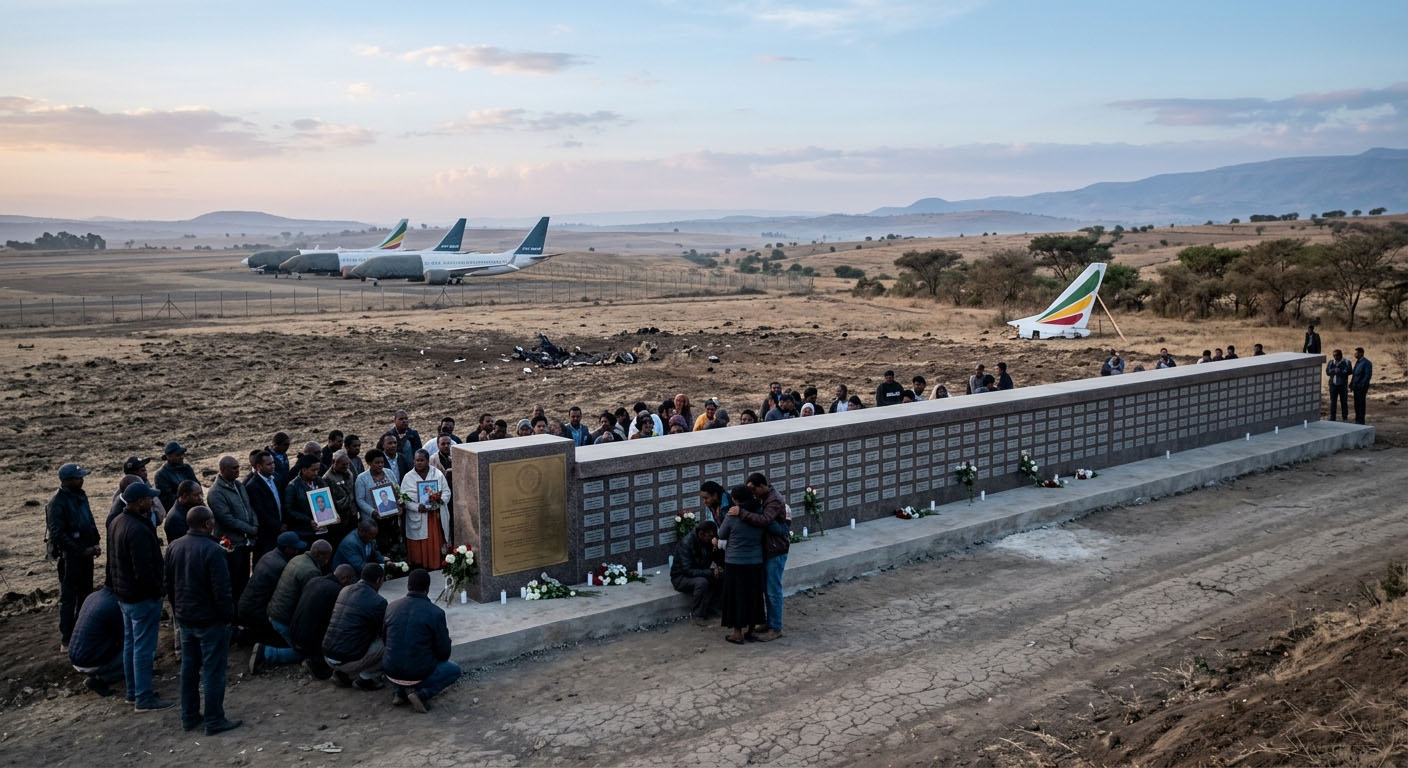
In the final seconds, the aircraft’s nose pitched violently downward. Captain Yared and First Officer Ahmednur pulled back with maximum force on their control columns, but the stabilizer was driven to its full nose-down limit. At 8:44 AM, just six minutes and twenty-six seconds after takeoff, Flight ET302 struck a field near the village of Ejere at approximately 575 miles per hour. The aircraft disintegrated on impact. A crater approximately 10 meters deep was excavated in the soft Ethiopian earth. The cockpit voice recorder, flight data recorder, and fragments of the aircraft and its passengers were found buried deep in the soil. The Ethiopian government later created a memorial garden at the site.
Who Were the 157 Victims of Ethiopian Airlines Flight 302?
The 157 people who lost their lives aboard Flight ET302 came from 35 nationalities and represented an extraordinary cross-section of international civic and professional life. Many were traveling to Nairobi to attend the fourth session of the United Nations Environment Assembly, the world’s highest-level decision-making body on environmental matters. The flight was so frequently used by UN personnel traveling between the African Union headquarters in Addis Ababa and the UN’s African regional headquarters in Nairobi that it was informally known as the ‘UN shuttle.’
A total of 22 people affiliated with the United Nations were killed, including seven staff members of the World Food Programme, employees of the UN Environment Programme office in Nairobi, staff of the International Telecommunication Union, and officers from the office of the UN High Commissioner for Refugees. Two employees of General Electric, an employee of the Norwegian Red Cross, a British intern with the Norwegian Refugee Council, four staff members of Catholic Relief Services, and a senior Ugandan police official on assignment with the African Union peacekeeping mission in Somalia were also among the dead. Notable passengers included Italian archaeologist Sebastiano Tusa, the Councillor for Cultural Heritage of Sicily, and Nigerian-Canadian academic Pius Adesanmi, a celebrated literary scholar. Among the American victims was twenty-four-year-old Samya Rose Stumo, who was traveling to Kenya to begin work with a health systems development organization. Her death would bring her father, Michael Stumo, to Washington to testify before Congress and become one of the most persistent advocates for accountability in the entire Boeing saga.
The process of identifying the victims took months. Nearly a hundred disaster victim identification experts from 14 countries joined the Interpol Incident Response Team at the site. Positive identification of all 157 victims was formally announced on September 13, 2019. For many of the families, the crash site offered no physical remains to bury. Ethiopian Airlines provided affected families with a small box of soil from the crater, a symbolic gesture that deepened the grief of those who had already lost everything.
The Global Grounding: 387 Aircraft, 59 Airlines, and 20 Months on the Ground
Within hours of the Ethiopian Airlines crash, the trajectory of global aviation regulation began to shift. China’s Civil Aviation Administration moved first, grounding all Boeing 737 MAX aircraft operating in Chinese airspace on March 11, 2019, the day after the crash. Within days, aviation authorities across Europe, Australia, Singapore, Indonesia, Malaysia, Canada, and dozens of other countries followed suit. The European Union Aviation Safety Agency suspended all 737 MAX operations in European airspace on March 12. The groundings were ordered despite Boeing CEO Dennis Muilenburg’s repeated public assurances that the 737 MAX was safe to fly and despite a telephone call Boeing arranged between Muilenburg and President Donald Trump in which the CEO reportedly told the President that the MAX was safe.
The United States Federal Aviation Administration initially resisted grounding the aircraft. On March 11, 2019, the FAA issued a Continued Airworthiness Notice, affirming that the 737 MAX remained safe for flight and stating that it had found no systemic issues. This position became increasingly untenable as evidence mounted. On March 13, acting on what it described as new satellite data and information from the crash site indicating that the jackscrew controlling the pitch of Flight ET302’s horizontal stabilizer had been found in the full nose-down position, identical to the position found after the Lion Air crash, President Trump announced that the FAA was grounding all Boeing 737 MAX aircraft in the United States. The FAA formal emergency order followed the same day, reversing the Continued Airworthiness Notice issued just two days earlier.
By March 18, 2019, every single Boeing 737 MAX aircraft in the world, a total of 387 jets, had been grounded. The grounding affected approximately 8,600 weekly flights operated by 59 airlines across the globe. Several ferry flights, repositioning aircraft to storage locations, were operated with the flaps partially extended in order to prevent MCAS from activating. The Boeing 737 MAX would remain out of commercial service for 20 months, the longest grounding of a major commercial aircraft type in history. Ethiopian Airlines CEO Tewolde Gebremariam later said that the crash and its aftermath had consumed enormous energy and resources but that the airline had managed to continue all its other flights without a single cancellation on the day of the accident.
What Caused the Crashes? The Technical Failure of MCAS
The investigation into Ethiopian Airlines Flight 302 was led by the Ethiopian Aircraft Accident Investigation Bureau, with accredited representation from the United States National Transportation Safety Board, Boeing, the FAA, and other parties. The flight data recorder and cockpit voice recorder were recovered from the crash site and sent to France’s Bureau d’Enquetes et d’Analyses for initial analysis before being transferred to Washington. On March 17, 2019, Ethiopian Transport Minister Dagmawit Moges announced that preliminary data from the flight data recorder showed a clear similarity with the Lion Air Flight 610 crash.
The investigation determined that MCAS was the central technical cause of both accidents. In its original design, MCAS received angle-of-attack data from only a single sensor, whichever sensor was connected to the captain’s flight control computer. It was not designed to compare input from both sensors or to cross-check the reading against other data. A single faulty sensor reading was therefore sufficient to activate the system. Moreover, in the 737 MAX as originally certified, MCAS could activate repeatedly, each time trimming the stabilizer further in the nose-down direction, up to a maximum of 2.5 degrees per activation. If the pilots corrected the trim input, the system would reset and could activate again as soon as they released the trim switch. There was no limit on how many times this cycle could repeat. The effect, under a persistently faulty sensor, was a relentless automated push toward a fatal nosedive that pilots were expected to counter using a checklist they had never been trained to associate with an automated system they may not have known existed.
The Ethiopian investigation’s preliminary report, released on April 4, 2019, stated clearly that the crew had followed the Boeing recommended and FAA-approved procedures for the runaway stabilizer scenario but had still been unable to control the aircraft. Aviation safety experts including Chesley Sullenberger, the pilot famous for safely landing US Airways Flight 1549 on the Hudson River in January 2009, conducted flight simulator replications of the scenario. Sullenberger commented publicly that even knowing in advance what was going to happen, he could see how flight crews would have run out of time and altitude before solving the problem. Former 737 pilot John Cox, a pilots’ union safety representative, described the rapid onset of unforeseen events as a breeding ground for confusion and task saturation.
A U.S. House committee investigation later revealed a document from within the FAA showing that, as far back as December 2018, the agency’s own engineers had concluded that if the MCAS design flaw were left uncorrected, it could result in as many as 15 additional fatal crashes over the life of the fleet, with a projection of roughly 2,900 deaths over 30 years. This assessment was known internally at the FAA before the Ethiopian Airlines crash occurred and was not disclosed publicly.
Boeing’s Corporate Failures: MCAS, Concealment, and the Culture of the Company
As investigations deepened, a portrait emerged of corporate decision-making that prioritized speed to market, cost reduction, and customer convenience over thoroughness and transparency. Boeing had originally developed MCAS as a relatively modest intervention, but during the certification process the system’s authority was expanded significantly. The maximum stabilizer movement MCAS could command was increased to 2.5 degrees per activation, a level that investigators and engineers later identified as capable of overwhelming pilots’ ability to recover. Internal Boeing communications, released during Congressional investigations and litigation, showed that some Boeing engineers had been aware of concerns about MCAS and had expressed those concerns internally without triggering sufficient action.
The decision not to include MCAS in pilot training materials or flight manuals was commercially motivated. Boeing had marketed the 737 MAX to airlines with the assurance that transition from the 737 NG would require only computer-based training, not expensive full-flight simulator sessions. Had MCAS been disclosed as a significant new system requiring specific training, regulators might have required simulator time, which would have reduced the aircraft’s attractiveness to airline customers. Internal messages released by Boeing during the Congressional investigation included communications in which Boeing employees discussed how to minimize training requirements and how to manage the FAA’s level of scrutiny.
The FAA’s certification process also came under severe criticism. The agency had long relied on a practice known as Organization Designation Authorization, which allowed Boeing’s own engineers to perform many of the certification assessments on the FAA’s behalf. In 2016, the FAA had actually approved Boeing’s request to remove references to the MCAS system from the 737 MAX flight crew operations manual, accepting Boeing’s argument that this would reduce pilot confusion. The congressional inquiry led by the House Committee on Transportation and Infrastructure concluded that the MAX certification was marred by a disturbing pattern of technical miscalculations and troubling management misjudgments at Boeing, combined with grossly insufficient oversight by the FAA.
Criminal Charges, Civil Litigation, and the $2.5 Billion Settlement
The legal aftermath of the two crashes was extensive and ongoing for years. On January 7, 2021, the United States Department of Justice charged Boeing with one count of conspiracy to defraud the United States, specifically by deceiving and misleading the FAA during the 737 MAX certification process. Boeing entered into a Deferred Prosecution Agreement, agreeing to pay a total criminal monetary amount of more than $2.5 billion. This sum was divided into a criminal monetary penalty of $243.6 million, compensation payments to Boeing’s 737 MAX airline customers of $1.77 billion, and the establishment of a $500 million crash-victim beneficiaries fund to compensate the heirs, relatives, and legal beneficiaries of the 346 people killed in the two crashes.
Families of many of the victims filed civil lawsuits against Boeing in United States federal court. U.S. District Judge Jorge Alonso presided over the consolidated litigation in Chicago. The lawsuits alleged that Boeing had knowingly placed a dangerous aircraft in service and had concealed critical information from regulators and pilots. Boeing’s legal defense initially focused on arguing that the pilots bore some responsibility for failing to follow established emergency procedures, a position that was sharply rebutted by investigators’ findings and by the pilots’ own families. Boeing eventually publicly accepted responsibility for the crashes. In a November 2025 development, Boeing agreed to pay an additional $1.14 billion in a further settlement, demonstrating the ongoing legal and financial consequences of the disasters.
The fallout extended to Boeing’s leadership. Dennis Muilenburg, who had served as Boeing’s CEO since 2015 and had been the public face of the company’s initial defense of the MAX, was removed from the role in October 2019. David L. Calhoun replaced him, first as chairman in October 2019 and then as CEO in January 2020, charged with rebuilding Boeing’s safety culture and managing the financial and reputational damage. Kevin McAllister, the president and CEO of Boeing Commercial Airplanes, had already been replaced by Stan Deal in October 2019.
The Return to Service: November 2020 and the Redesigned MCAS
Boeing’s engineers worked throughout the grounding period to redesign the MCAS software and address the underlying vulnerabilities identified in both crashes. The key changes to the system were substantial. The redesigned MCAS now reads data from both angle-of-attack sensors before activating, rather than relying on a single sensor. The system will only activate if both sensors agree that the angle of attack is dangerously high. MCAS can now only activate once for each high-AOA event, eliminating the repetitive cycling that made recovery so difficult for the Lion Air and Ethiopian Airlines crews. The maximum command authority of the system was significantly reduced, and the system now makes a nose-up correction when the angle of attack returns to normal. Pilots were also provided with updated training, including access to flight simulator sessions specifically addressing the 737 MAX’s unique characteristics.
The FAA completed its recertification of the Boeing 737 MAX on November 18, 2020, after a comprehensive review process during which the agency retained all certification compliance findings itself rather than delegating them to Boeing’s engineers. FAA Administrator Steve Dickson personally piloted a 737 MAX test flight on September 30, 2020, fulfilling a commitment he had made to fly the aircraft before signing off on its return to service. After the FAA’s action, aviation authorities in Canada, Brazil, and the European Union conducted their own independent reviews before lifting their own bans. The EASA, which covers European Union member states, cleared the MAX to return to European skies in January 2021, followed by Transport Canada in January 2021, and various other regulators over subsequent months.
American Airlines operated the first commercial 737 MAX flight after the grounding on December 29, 2020, from Miami to New York. Other airlines followed cautiously. Some carriers initially used the aircraft’s formal designations, such as 737-8 or 737-9, rather than the MAX name, recognizing that public distrust of the brand had become significant. The families of crash victims publicly urged passengers not to board the aircraft, arguing that the fixes were insufficient and that the culture that had produced the disasters had not genuinely changed. Michael Stumo, whose daughter Samya Rose died on Ethiopian Airlines Flight 302, stated publicly that he and his family would never fly on a MAX.
The Legacy of Flight ET302: Aviation Safety Transformed
The crash of Ethiopian Airlines Flight 302 and the subsequent global grounding of the Boeing 737 MAX produced changes in aviation safety regulation that will shape the industry for decades. The U.S. Congress passed the Aircraft Certification, Safety, and Accountability Act in December 2020, requiring the FAA to overhaul its certification processes, reform the delegation system that had allowed manufacturers to effectively self-certify their own aircraft, and dramatically increase transparency with international regulatory counterparts. The law mandated new protections for FAA safety engineers who raise concerns, attempted to formalize the independence of the agency’s technical staff from commercial and political pressure, and required that any future MCAS-like system be disclosed fully to pilots in training materials and flight manuals.
The crashes also reignited global debate about the appropriate relationship between aviation regulators and the manufacturers they oversee. The FAA’s initial two-day delay in grounding the MAX after the Ethiopian Airlines crash, and the contrast between the agency’s response and the faster action taken by China and European regulators, raised fundamental questions about whether the world’s most influential aviation safety authority had become too close to the industry it was meant to police. The International Civil Aviation Organization and individual national regulators in the years following the crashes reassessed their own reliance on the FAA’s certification determinations.
The January 2024 incident involving Alaska Airlines Flight 1282, in which a door plug blew out of a Boeing 737 MAX 9 shortly after takeoff from Portland, Oregon, reopened many of the same questions about Boeing’s manufacturing quality and regulatory oversight. While no one died in that incident, it led to the temporary grounding of the 737 MAX 9 fleet and revived intense scrutiny of Boeing’s production systems. For the families of the Ethiopian Airlines and Lion Air crash victims, the Alaska Airlines incident was a reminder that the systemic failures they had been warning about had not been fully addressed. Zipporah Kuria, who lost her fifty-five-year-old father Joseph in the Ethiopian crash, described the renewed scrutiny as a mixed blessing: deeply unwelcome as an event but valuable as a catalyst for attention that the crash families had long sought.
The Flight ET302 Families Foundation, established in August 2019 by a group of bereaved families from 35 countries, continued to advocate for stronger safety standards, full accountability, and meaningful structural change at Boeing and within the regulatory system. The foundation became an internationally recognized voice for aviation safety, testifying before legislative bodies in multiple countries and maintaining a memorial to those who died. For them, the six minutes that Flight ET302 was airborne on March 10, 2019 were not a historical footnote but an ongoing call to prevent the conditions that made those six minutes fatal from ever being recreated.
Understanding the Full Scope: 346 Lives, One Fundamental Flaw
Taken together, the Lion Air Flight 610 crash on October 29, 2018 and the Ethiopian Airlines Flight 302 crash on March 10, 2019 resulted in the deaths of 346 people: 189 on the Lion Air jet and 157 on the Ethiopian Airlines jet. Both aircraft were Boeing 737 MAX 8s. Both experienced failure of a single angle-of-attack sensor that fed erroneous data to the MCAS system. In both cases, the system activated repeatedly and pushed the aircraft’s nose toward the ground. In both cases, the flight crews were not fully aware of the system’s existence or the full scope of its authority and behavior. In both cases, the aircraft struck the ground at extreme speed with no survivors.
The fact that these events occurred within such a short span, with a known system flaw having been identified and notified to the industry between the two crashes, placed the deaths squarely within the realm of preventable disaster. The Lion Air crash was a warning. The Ethiopian Airlines crash was the consequence of not heeding it fully enough. The Boeing 737 MAX crisis stands as one of the most thoroughly documented cases in aviation history of how commercial pressures, regulatory inadequacy, and failures of corporate transparency can combine to produce catastrophic and avoidable loss of life.
For the 157 passengers and crew of Flight ET302, many of whom were on their way to serve the world’s most vulnerable populations through the United Nations, international NGOs, and diplomatic missions, the crash ended careers of service, futures of promise, and lives of extraordinary breadth. Their deaths, and the accountability that followed, represent both the worst of what aviation’s profit-driven system can produce and the beginning of the serious reckoning that the safety of flight demands.