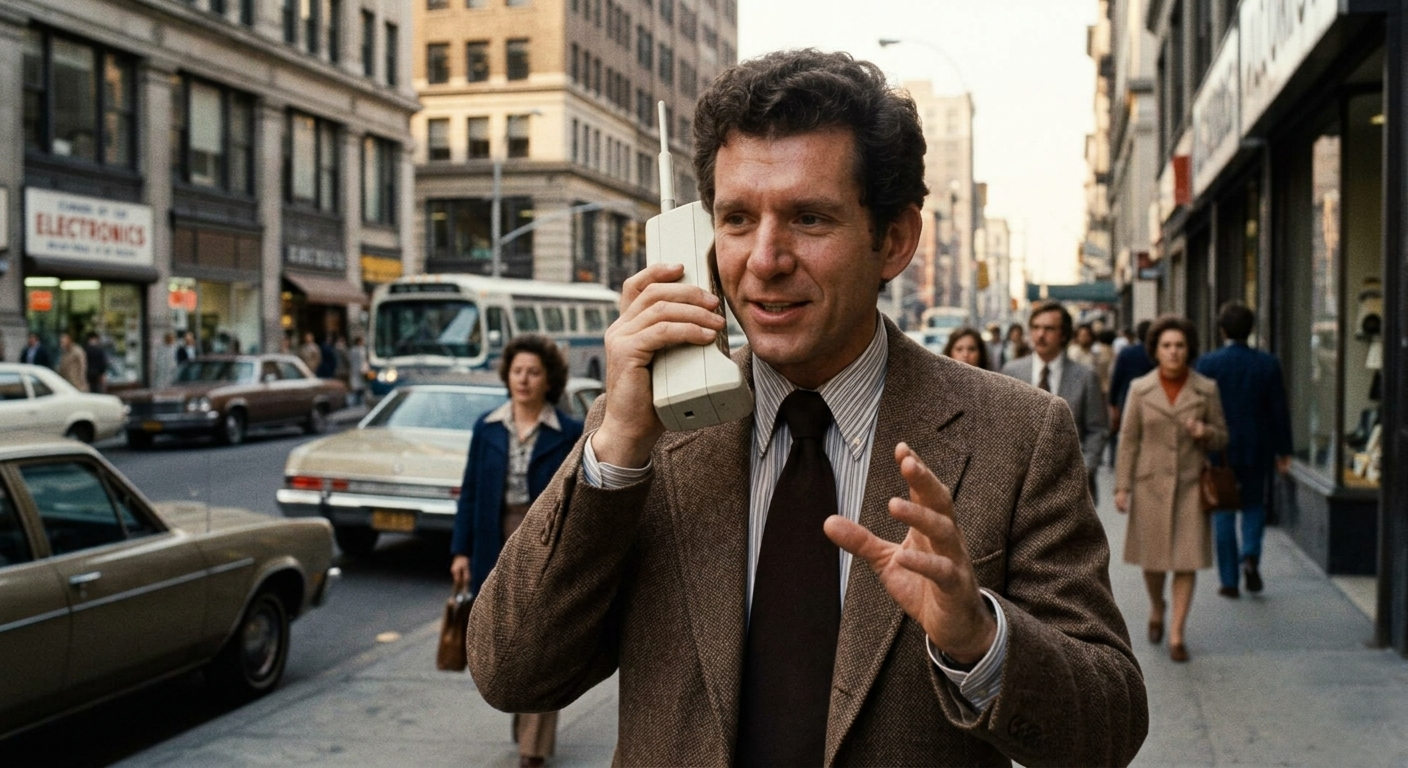
On the morning of April 3, 1973, a man stood on the sidewalk of Sixth Avenue in midtown Manhattan, directly outside the New York Hilton Hotel, and held a device the size and weight of a brick to his ear. The device — a prototype called the DynaTAC, weighing two and a half pounds and measuring nearly ten inches tall — had taken a team of Motorola engineers less than ninety days to design and assemble. The man holding it was Martin Cooper, head of communications systems at Motorola, and he was about to make a phone call unlike any in human history: the first call ever placed from a handheld cellular telephone.
The number Cooper dialed belonged to Dr. Joel S. Engel, the head of research at Bell Laboratories — AT&T’s legendary research arm and Motorola’s primary competitor in the race to develop cellular telephony. When Engel picked up his landline phone in his office, the voice he heard was cheerful, confident, and more than a little smug. ‘Joel,’ Cooper said, ‘this is Marty. I’m calling you from a cell phone — a real, handheld, portable cell phone.’ Cooper later recalled that there was a brief silence at the other end of the line. ‘I suspect,’ he said, ‘he was grinding his teeth.’ The call lasted only a matter of minutes. But in those minutes, standing on a busy Manhattan sidewalk while pedestrians gawked at the strange brick-like contraption pressed to his ear, Martin Cooper had announced the arrival of an entirely new era in human communication — one in which a telephone number would belong not to a place, a desk, or a household, but to a person.
More than five decades later, the world Cooper helped create has exceeded even the most optimistic projections his team made on that April morning. There are now more mobile phone subscriptions in the world than there are people — over eight billion active connections serving a global population of approximately eight billion. The slim, powerful computers that most people carry in their pockets bear almost no physical resemblance to the clunky DynaTAC prototype that Cooper brandished on Sixth Avenue, but every one of them is a direct descendant of that device and that call. April 3 is now recognized globally as Mobile Phone Day, a tribute to the moment when one engineer’s audacity and one team’s extraordinary effort transformed the landscape of human connection permanently and irreversibly.
Alexander Graham Bell to Car Phones: The Long Road to Cellular Telephony
The history of mobile communication did not begin with Martin Cooper in 1973. It began, in a sense, with Alexander Graham Bell in 1876, when Bell was awarded the first patent for a telephone — a device that transmitted human voice over copper wire. Bell’s invention was revolutionary, but it was anchored to infrastructure: you could only make a call from a place where the telephone lines had been run. For the next half-century, the telephone remained tethered to its wire, and communication remained tethered to place. The dream of communicating from anywhere — from a moving vehicle, a field, a mountain, the open sea — remained exactly that: a dream.
The first steps toward wireless voice communication came from an unexpected direction: radio. In December 1900, on the outskirts of Washington, D.C., Canadian-American inventor Reginald Fessenden accomplished something entirely new: he transmitted a human voice through radio waves, sending a signal from one radio tower to another. It was the first wireless voice transmission in history. Guglielmo Marconi had already demonstrated wireless telegraphy — the transmission of Morse code over radio waves — in the 1890s, but Fessenden’s achievement proved that voice itself could be carried without wires. The practical applications of this discovery would take decades to develop, but the conceptual foundation of mobile telephony had been laid.
The practical vehicle telephone — a radio telephone installed in an automobile — arrived in the 1930s and 1940s. Police departments in American cities began using two-way radio communications in their patrol cars, and AT&T launched the first commercial mobile telephone service in St. Louis, Missouri in June 1946 — a system that connected car-mounted radio equipment to the landline telephone network through a human operator. The service was useful but profoundly limited: users had to press a button to talk and release it to listen (a ‘push-to-talk’ arrangement that made normal conversation impossible), the equipment in the car trunk weighed approximately thirty pounds, and the available radio spectrum could support only a small number of simultaneous calls. In New York City, the most densely populated communications market in the United States, only twelve radio channels were available for mobile telephone service in the 1960s, meaning that 2,000 subscribers shared those twelve channels and typically waited thirty minutes or more to place a single call. The waiting list of people who wanted mobile telephone service was long; the service itself was essentially rationed.
The fundamental technical problem was spectrum efficiency. Radio communication requires frequency — a specific segment of the electromagnetic spectrum allocated for a particular use. In the early decades of mobile telephony, each radio channel could support only one call at a time, and the same frequency could not be reused anywhere within range of the transmitter without causing interference. This meant that adding more customers required adding more frequencies, and there were only so many frequencies available in any given band of spectrum. As the demand for mobile communication grew through the 1940s and 1950s, it became clear that solving this problem — finding a way to serve vastly more users within the same limited spectrum — was the essential technical challenge of the field.
The Cellular Concept: Donald Ring, Bell Labs, and the 1947 Breakthrough That Changed Everything
The solution to the spectrum efficiency problem was conceived not in a flash of inspiration but in a careful internal memorandum written by an engineer at Bell Laboratories on December 11, 1947. Douglas H. Ring, working with colleague W. Rae Young, proposed a concept that would eventually become the foundation of every cellular telephone system ever built: the cellular network. Ring’s insight was elegant. Instead of using a single powerful transmitter to cover an entire city — which required reserving that frequency for the entire city’s footprint and could only support one call at a time — why not divide the city into small geographic areas called ‘cells,’ each served by a low-power transmitter? The same frequency could be reused in non-adjacent cells, because the low power of each cell’s transmitter meant the signal would not travel far enough to interfere with the same frequency in a cell three or four cells away. The result was a dramatic increase in the number of calls the system could support simultaneously, using exactly the same total amount of spectrum.
Ring and Young further proposed that the cells should be arranged in a hexagonal pattern — like a honeycomb — and that as a mobile user traveled from one cell to another, their call should be automatically handed off from one cell’s transmitter to the next, without interruption. This ‘handoff’ capability was the crucial feature that made cellular telephony genuinely mobile rather than merely fixed to a specific location. A driver traveling across a city could maintain a continuous conversation as their call was silently transferred from cell to cell along their route. The concept was simple and brilliant. The problem was that the technology to implement it — computerized switching systems capable of tracking users as they moved between cells and executing handoffs in fractions of a second — did not exist in 1947, and would not exist for another twenty years.
Bell Labs continued refining the cellular concept through the 1950s and 1960s. Engineers Joel S. Engel and Richard H. Frenkiel developed practical system designs that built on Ring and Young’s theoretical framework. Amos Joel, another Bell Labs engineer, contributed a critical innovation: an automatic call handoff system that could seamlessly transfer a call from one cell to another without the caller or the person they were speaking with noticing any interruption. By 1971, AT&T had assembled a comprehensive proposal for a cellular telephone system and submitted it to the Federal Communications Commission, requesting permission to develop and operate a cellular network. The system AT&T had in mind was still primarily conceived as an enhancement to car-phone service — a more efficient way to provide telephone service to moving vehicles. Nobody at AT&T was seriously thinking about a telephone that a person could hold in their hand while walking down a street.
Martin Cooper: The Engineer Who Believed the Phone Should Belong to the Person
Martin Cooper was born on December 26, 1928, in Chicago, Illinois, to Ukrainian immigrant parents who had come to America with very little and built a modest livelihood selling goods door-to-door on credit. Cooper grew up in circumstances that his biographers describe as humble but intellectually stimulating — his curiosity about how things worked manifested early, and he spent his childhood taking things apart and reassembling them, trying to understand the mechanisms behind the objects in the world around him. Years later he would cite this early habit of curiosity as fundamental to everything he would go on to accomplish.
Cooper paid for his undergraduate education at the Illinois Institute of Technology in Chicago, in part, by joining the United States Army — which led him to serve in the Korean War in the early 1950s. He graduated in 1950 with a degree in electrical engineering and returned to IIT after his military service to earn a master’s degree in the same discipline in 1957. Between his undergraduate degree and his master’s, he worked at a company called Teletype Corporation in Chicago before joining Motorola in 1954 as a senior development engineer — a move he later described as one of the luckiest things that ever happened to him. At Motorola he found a company that valued engineering innovation, was willing to take risks on new technology, and had decades of deep expertise in radio communications.
Motorola in the 1950s and 1960s was already one of the most important companies in the history of portable communication. Founded as the Galvin Manufacturing Corporation in Chicago in 1928 — the same year Martin Cooper was born — the company had produced its first car radio in 1930, its first police radio in the mid-1930s, and its legendary Handie-Talkie portable two-way radio for the United States military in 1940. The Handie-Talkie, widely used by American troops in World War II, was one of the first practical hand-held radio communication devices and gave Motorola an institutional understanding of what it took to miniaturize radio technology into a device a person could carry. That legacy would prove directly relevant when the cellular telephone race began.
Cooper quickly made his mark at Motorola. In 1967, he led a team that developed a cellular-like portable handheld radio system for the Chicago Police Department — a project that gave him deep practical experience in the engineering challenges of building portable radio communication devices for urban environments. By the early 1970s, he had risen to head Motorola’s communications systems division. It was in this capacity that he encountered the challenge — and the opportunity — that would define his legacy. Cooper’s vision of what a cellular telephone should be was fundamentally different from AT&T’s. Where AT&T conceived of cellular service primarily as an enhancement to the existing car-phone system — a more efficient mobile telephone that happened to be in a vehicle — Cooper believed that the cellular telephone should be something entirely different: a personal communication device, assigned to an individual rather than a location.
‘The time was ripe for true personal communications,’ Cooper later recalled. ‘I believed the cellular phone should be a personal telephone — something that would represent an individual so you could assign a number — not to a place, not to a desk, not to a home, but to a person.’ This was not merely a technical preference. It was a philosophical conviction about the nature of communication, one that had profound implications for how the device should be designed. A telephone assigned to a car or a home was still, in essence, a place-based technology. A telephone assigned to a person was genuinely different in kind — it accompanied you, it was available whenever you needed it, it made you reachable and able to reach others regardless of where you happened to be. Cooper’s vision was not of a better car phone. It was of a phone that made geographical location irrelevant to communication.
John Mitchell, Rudy Krolopp, and the Team That Built the DynaTAC in 90 Days
The immediate catalyst for Motorola’s crash program to develop a handheld cellular telephone was competitive and regulatory. In 1968, the Federal Communications Commission formally asked AT&T to submit a proposal for using an underutilized portion of the UHF television band for cellular service. AT&T responded with a detailed proposal for a cellular system — one designed around car phones. The FCC’s request implicitly suggested that cellular spectrum would be allocated, and AT&T moved to position itself as the natural candidate to receive an exclusive license to operate it. If AT&T succeeded in this regulatory maneuver, Motorola’s existing business in radio communications — particularly its lucrative market serving taxi companies, police departments, and other users of private radio systems — would be directly threatened by a cellular monopoly controlled by the country’s dominant telephone company.
John Francis Mitchell, Motorola’s Chief of Portable Communication Products and Cooper’s manager and mentor, was the person who first recognized that Motorola needed to enter the cellular race not just as a supplier of equipment to AT&T but as an independent technology developer with its own vision for what cellular telephony could be. It was Mitchell’s recognition that Motorola could use the cellular telephone as a competitive weapon — not just to protect its existing business, but to seize a position in an entirely new market — that gave Cooper the institutional backing to pursue his vision. Mitchell championed the portable cellular concept within Motorola and provided the leadership that secured top management’s commitment to what would ultimately become a $100 million investment over twenty years before a single dollar of revenue was realized.
Cooper was given the task of assembling a team and developing a working prototype of a handheld cellular telephone — a device that had never existed in the world before — in the shortest possible time. The urgency was driven by the FCC hearings at which Motorola needed to demonstrate that handheld cellular telephony was not just theoretically possible but practically achievable, and that the cellular spectrum should therefore be allocated on a competitive basis rather than handed exclusively to AT&T. Cooper’s team began designing the DynaTAC prototype in November 1972. What followed was one of the most intensive engineering sprints in the history of consumer electronics.
Rudy Krolopp, Motorola’s lead industrial designer, was responsible for the physical design of the prototype — the ergonomic and aesthetic shape that would translate the electronic components assembled by the engineering team into a device that a human being could actually hold and use. The engineering challenges were formidable. The device needed to contain a radio transmitter and receiver capable of connecting to a cellular network, a battery capable of powering the radio circuitry, a standard telephone keypad and earpiece, and an antenna — all in a form factor that a person could carry and operate with one hand. There was no template for this. No one had ever built such a thing before. The team worked on essentially no prior art in the area of handheld cellular phones, relying on Motorola’s accumulated expertise in portable two-way radios and the creative engineering of the team members.
By February 1973, approximately ninety days after the project began, the team had produced a working prototype. The DynaTAC — an abbreviation of Dynamic Adaptive Total Area Coverage — weighed two and a half pounds, measured approximately ten inches tall and one and a half inches wide, and contained around thirty circuit boards packed into its rectangular plastic body. Its battery, which required a ten-hour charge, provided approximately thirty minutes of talk time. It had no display screen — there was nothing on its face but the keypad, the earpiece, and the microphone. It was, by the standards of any subsequent generation of mobile phones, enormous, heavy, and limited. By the standards of anything that had existed before, it was a miracle of miniaturization and a fundamental reimagining of what a telephone could be.
April 3, 1973: The Call Heard Around the World — A Minute-by-Minute Account
Motorola had scheduled a press conference at the New York Hilton Hotel in midtown Manhattan for the afternoon of April 3, 1973, to unveil the DynaTAC and Motorola’s cellular telephone concept to journalists and industry observers. But Cooper had a more dramatic demonstration in mind than a formal press conference presentation. Before walking into the hotel, he took a journalist outside onto Sixth Avenue and demonstrated the phone in the only setting that could truly show what it meant: on the sidewalk, in public, in the middle of one of the busiest cities in the world.
To make the demonstration as resonant as possible — and, it must be said, to deliver a message that his competitor would feel personally — Cooper chose Joel Engel as the recipient of the call. Engel was the head of Bell Labs’ cellular research program, the man who had spent years developing the theoretical foundation and system design for AT&T’s version of cellular telephony. He was, in the competitive landscape of the early cellular industry, Cooper’s direct professional counterpart and rival. Calling Engel first was not merely a demonstration of the technology; it was a statement — a declaration that Motorola had arrived in the cellular space, that it had beaten AT&T to the handheld phone, and that the race for the future of mobile communication was not going to be decided by size and institutional momentum alone.
Cooper recalled the moment in detail in numerous interviews over the subsequent decades. He had Motorola’s base station installed on the roof of the Burlington House building (now known as the AllianceBernstein Building) nearby, which connected the DynaTAC prototype to the AT&T landline telephone network. Standing on the sidewalk of Sixth Avenue near the Hilton, he placed the call to Engel’s number at Bell Labs. When Engel answered, Cooper delivered his carefully chosen words: ‘Joel, this is Marty. I’m calling you from a cell phone — a real, handheld, portable cell phone.’ There was a silence. Cooper had expected it. He described later that silence as one of his most satisfying professional memories. After the landmark call to Engel, Cooper continued making calls on the sidewalk — including, memorably, one in which he crossed Sixth Avenue while actively speaking to a New York radio reporter, which he later described as ‘probably one of the most dangerous things I have ever done in my life.’
Passersby on Sixth Avenue that April morning stopped and stared at the strange sight of a man speaking into a large brick-like object held to his ear. The concept of a handheld wireless telephone was so foreign to the public consciousness of 1973 that many of the people who witnessed Cooper’s demonstration did not initially understand what they were seeing. Some apparently assumed it was some kind of walkie-talkie. The idea that the device was a telephone — a device that could connect to the standard telephone network and call any number — was genuinely startling. The DynaTAC made the front cover of the July 1973 issue of Popular Science magazine following the demonstration, introducing the concept of the handheld cellular telephone to a national audience for the first time.
The Long Decade: FCC Hearings, Regulatory Battles, and the Ten-Year Wait for Commercial Launch
The gap between Cooper’s sidewalk demonstration and the availability of a commercial cellular telephone service for ordinary consumers was a full decade — a period filled with regulatory battles, technical refinement, competitive jockeying between AT&T and Motorola, and the slow, grinding work of building the infrastructure that a cellular network requires. The FCC, which controls the allocation of radio spectrum in the United States, was the critical bottleneck. Spectrum is a finite resource, and the FCC’s decisions about who could use which frequencies and under what conditions would determine the entire shape of the cellular industry. The commission was cautious, methodical, and subject to intense lobbying by multiple parties, each with its own preferred version of how cellular service should be structured.
AT&T, the dominant telephone company, had the advantages of size, institutional relationships, and an established national network infrastructure. Its cellular proposal was based on car phones and conceived of cellular service as an extension of the existing telephone system. Motorola, the smaller Chicago company that Cooper later described as a ‘flea on an elephant’ compared to AT&T, argued strenuously before the FCC that cellular spectrum should not be allocated exclusively to AT&T but should instead be opened to competitive bidding — a position that served Motorola’s interests directly but also happened to be better for consumers and for the development of a genuinely competitive wireless industry. Cooper and his colleagues made their arguments to the FCC in person, demonstrating the DynaTAC prototype at the commission’s offices in Washington to show that handheld cellular phones were not a distant aspiration but an immediate technical reality.
Motorola was awarded a patent for its cellular radio telephone system in September 1975, based on the application filed on October 17, 1973 — six months after Cooper’s landmark call. The patent, issued as U.S. Patent 3,906,166 and titled ‘Radio Telephone System,’ listed Cooper as the lead inventor, with John Mitchell and the other engineers who worked on the DynaTAC project also named. The patent established Motorola’s intellectual property position in cellular telephony and provided the legal foundation for the company’s subsequent commercial development. Meanwhile, Cooper and his team continued working on refining the DynaTAC, improving its battery life, reducing its weight and size, and developing the cellular system infrastructure that would be needed to support commercial operation.
Experimental cellular networks were tested in Chicago and Newark, New Jersey, in 1977 — AT&T’s trials used car phones, while Motorola’s Washington, D.C. trial was based on the DynaTAC handheld system. These trials demonstrated that cellular technology worked in real-world urban environments and provided data for the FCC’s deliberations. After years of hearings and deliberation, the FCC finally granted approval for commercial cellular service in 1982, and the first commercial cellular network in the United States — operated by Ameritech Mobile Communications in Chicago — launched on October 13, 1983. The commercial handset available for that launch was the Motorola DynaTAC 8000X, the commercial descendant of Cooper’s 1973 prototype, which had received FCC approval on September 21, 1983. Top management at Motorola had invested $100 million in the cellular telephone program between 1973 and 1983 before a single dollar of revenue was realized — one of the most patient and ultimately vindicated long-term technology bets in corporate history.
The DynaTAC 8000X: From Prototype to Product, and the $3,995 Brick That Launched an Industry
The commercial DynaTAC 8000X that went on sale in 1983 was a significantly refined descendant of Cooper’s 1973 prototype, though it remained, by the standards of any subsequent generation, an extremely large, heavy, and expensive device. It weighed 28 ounces — approximately 1.75 pounds, somewhat lighter than the original prototype — and stood ten inches tall, not including its flexible rubber antenna. Its battery provided 30 minutes of talk time or eight hours of standby. It could store thirty phone numbers in memory. And it cost $3,995 — approximately $12,400 in 2025 dollars, or more than seven months of minimum-wage earnings at the 1984 federal minimum wage of $3.35 per hour.
At $3,995, the DynaTAC was manifestly not a mass-market consumer product. It was a status symbol and a practical tool for wealthy executives, business people, and professionals for whom being reachable in any location was worth the extraordinary cost. It became instantly iconic, appearing in the 1987 Oliver Stone film Wall Street in the hands of Gordon Gekko — played by Michael Douglas — as the defining prop of a character who embodied ruthless, boundary-free capitalism. The image of Gekko striding along a deserted beach at dawn, the enormous brick-like DynaTAC pressed to his ear while he barked orders, became one of the most recognizable visual symbols of 1980s corporate culture, and it introduced the cellular phone to a vast movie audience that had never seen or used one. The DynaTAC was ‘the brick,’ and the brick had arrived.
Despite its price, the DynaTAC was a commercial success among its target demographic. By the time Motorola introduced it, demand for cellular service had been building for years — the waiting lists for the old IMTS car-phone system had demonstrated that there was enormous pent-up demand for mobile telephone service, and people who could afford the DynaTAC’s price tag were eager to pay it. Cooper left Motorola in 1983, the same year the DynaTAC launched commercially, and founded Cellular Business Systems, Inc. (CBSI), which became the leading company in billing systems for cellular phone services. In 1986, he and his partners sold CBSI to Cincinnati Bell for $23 million. Cooper then co-founded Dyna LLC with his wife and business partner Arlene Harris, which served as a base for launching a series of subsequent wireless communications ventures throughout the 1990s and 2000s.
From Brick to Smartphone: The Technological Evolution Cooper Set in Motion
The evolution of the mobile phone from the DynaTAC brick of 1983 to the glass-and-aluminum supercomputers that most people carry today is one of the most rapid and consequential technological transformations in human history. Each phase of that evolution built on the foundation that Martin Cooper and his team established on Sixth Avenue in April 1973, and each phase expanded the potential of mobile communication in ways that Cooper had glimpsed but could not have fully predicted.
The first generation of commercial cellular phones — known as 1G, for first generation — used analog radio technology and were, like the DynaTAC, primarily voice communication devices. Through the 1980s, the dominant constraint on mobile phones was physical: engineers worked to reduce their size, weight, and cost, while battery technology gradually improved to extend talk time and standby. The Motorola MicroTAC, introduced in 1989, was the world’s first flip phone — a form factor that allowed the device to be much smaller when not in use — and it established a new benchmark for portability. By the early 1990s, mobile phones had shrunk from foot-tall bricks to devices that could fit in a shirt pocket, and prices had fallen enough to make them accessible to a broader professional class rather than just the extremely wealthy.
The transition from analog 1G to digital 2G networks in the early 1990s was transformative in multiple respects. Digital networks used spectrum far more efficiently than analog ones, allowing many more simultaneous calls in the same frequency band. They also enabled a new form of communication that nobody had originally designed cellular networks to support: the Short Message Service, better known as text messaging or SMS. The first text message was sent in December 1992 by British engineer Neil Papworth to a Vodafone director, reading simply ‘Merry Christmas.’ Nobody anticipated that this simple feature — the ability to send brief text messages between phones — would become one of the most widely used forms of communication in human history, but by the mid-1990s text messaging had become enormously popular, particularly among younger users, establishing a pattern of mobile communication that was fundamentally different from voice calling.
The concept of the smartphone — a mobile phone that could run applications and connect to the internet — emerged gradually through the late 1990s and early 2000s, driven by the convergence of improving wireless networks, more powerful processors, better batteries, and the rapid expansion of the internet. The IBM Simon, released in 1994, is often cited as the first device that combined a mobile phone with personal digital assistant functions. Nokia’s Communicator series and various devices running the Symbian operating system developed the concept further. But the event that defined the smartphone era as the world now experiences it was the introduction of Apple’s iPhone on June 29, 2007, by Apple founder Steve Jobs. The iPhone’s combination of a touchscreen interface, a genuinely capable mobile web browser, and an ecosystem of downloadable applications created a new paradigm for what a mobile phone could be — one that essentially every subsequent smartphone has followed.
Joel Engel, Bell Labs, and the Rivalry That Drove Innovation
The rivalry between Martin Cooper at Motorola and Joel S. Engel at Bell Labs was one of the most productive competitive dynamics in the history of technology. Engel was not a peripheral figure in the cellular story — he was, alongside Richard Frenkiel, one of the principal architects of the cellular network concept at Bell Labs, the man who had spent years developing the technical framework for the system that AT&T hoped to build. When Cooper called Engel on April 3, 1973, he was calling the engineer who perhaps better than anyone else understood what the DynaTAC represented and what it would mean for the industry they were both shaping. Engel’s silence on receiving Cooper’s call was not merely the silence of a defeated competitor. It was the silence of a man absorbing the implications of a technological fait accompli.
The contributions of Bell Labs’ engineers to cellular telephony were fundamental and irreplaceable. Without Douglas Ring’s 1947 cellular concept, without Joel Engel and Richard Frenkiel’s system engineering, without Amos Joel’s automatic handoff technology, there would have been no cellular infrastructure for Cooper’s DynaTAC to connect to. The story of the first mobile phone call is in this sense not simply the story of Martin Cooper’s personal achievement but of a decades-long collaboration between competing institutions — Bell Labs providing the network theory and system design, Motorola providing the handheld device and competitive pressure that forced the rapid development and deployment of cellular service. The tension between AT&T’s institutional power and Motorola’s scrappy entrepreneurial energy was itself a driver of innovation, pushing both organizations to move faster and more ambitiously than either would have done in the absence of a serious competitor.
Joel Engel and Richard Frenkiel were jointly awarded the National Medal of Technology by President Clinton in 1994, recognizing their foundational contributions to cellular telephony. They shared the IEEE Alexander Graham Bell Medal in 1987, along with colleague Bill Jakes. Engel lived to see the full flowering of the industry his work had helped create, and he was gracious in his acknowledgments of both the collaborative and competitive dimensions of cellular telephony’s history. The rivalry between Bell Labs and Motorola that produced that April morning in 1973 was, in retrospect, one of the luckiest accidents in the history of technology: without AT&T’s size and institutional momentum driving Motorola to act quickly and boldly, the world might have waited considerably longer for a truly personal, portable telephone.
The Global Impact: Eight Billion Phones and the Transformation of Human Society
Martin Cooper and his team, standing on Sixth Avenue in 1973, predicted that eventually everyone in the world would have a mobile phone. Cooper recalled that they used to tell the story even then that someday when you were born, you would be assigned a phone number — and that if you did not answer the phone, you would die. The prediction proved more accurate than even they could have confidently expected. By 2023, there were approximately 8.4 billion mobile phone subscriptions globally — slightly more than one per person on earth. In regions that never developed extensive landline telephone infrastructure, including large parts of Africa and South Asia, mobile phones provided the first reliable means of individual telecommunication that populations had ever had access to. The mobile phone leap-frogged decades of landline infrastructure development, bringing telephone service — and eventually internet access — to communities that would otherwise have waited generations.
The economic and social impacts of mobile telephony are incalculable in their breadth and depth. The ability to communicate from anywhere transformed commerce: businesses could coordinate in real time across geographic distances that would previously have made coordination impossible or prohibitively expensive. Financial services were transformed: mobile banking and mobile payment systems extended access to financial infrastructure to billions of people who had never had bank accounts. Healthcare was transformed: mobile networks enabled telemedicine, remote patient monitoring, and rapid public health communication in ways that saved countless lives. Agriculture was transformed: farmers in remote areas gained access to market price information that allowed them to sell their products at fair prices rather than accepting whatever local middlemen offered. Education was transformed: mobile devices gave hundreds of millions of people access to educational content that would otherwise have been inaccessible.
The social dimensions of mobile communication’s impact are equally vast, though more complex in their effects. Mobile phones fundamentally altered the rhythms of social interaction — enabling continuous, location-independent contact between people, transforming the dynamics of family life, friendship, and romantic relationships, and creating new forms of social coordination that ranged from the deeply meaningful (organizing democratic movements, connecting diaspora communities, enabling support networks for isolated individuals) to the trivially quotidian (group chats, location sharing, constant notification streams). The same technology that allows a mother to receive a message from her child at any hour also enables the constant interruption, distraction, and social anxiety that critics of mobile phone culture identify as among its most damaging effects. Cooper himself, in his nineties and still intellectually engaged with the telecommunications industry, acknowledged these tensions while maintaining his fundamental optimism about the technology’s net benefit to humanity.
Martin Cooper’s Later Life, Awards, and the Legacy of a Living Inventor
Unlike many inventors whose legacies are entirely posthumous, Martin Cooper lived to see his creation reshape the world comprehensively. Still alive and intellectually active at the age of 97 as of 2026, Cooper has spent the decades since his landmark call of 1973 as an advocate, entrepreneur, and continuing innovator in the wireless communications field. After founding CBSI and selling it to Cincinnati Bell in 1986, he co-founded Dyna LLC with his wife Arlene Harris, from which they launched a series of subsequent ventures including Subscriber Computing Inc., Cellular Pay Phone Inc., SOS Wireless Communications, Accessible Wireless, and ArrayComm — a company founded in 1996 that developed antenna software for wireless systems. Cooper serves on advisory committees for the Federal Communications Commission and the United States Department of Commerce, contributing to spectrum policy at the highest level of government.
The honors that have been bestowed on Cooper in recognition of his contributions to cellular telephony reflect the scope of what he helped create. In 2009, he and Ray Tomlinson — the inventor of email — jointly received the Prince of Asturias Award for Scientific and Technical Research, with the jury ranking both the mobile phone and email as ‘key instruments’ for human advancement and among the greatest technological innovations of their era. In 2010, Cooper was elected to the National Academy of Engineering for his leadership in the creation and deployment of the cellular portable handheld telephone — one of that institution’s highest forms of recognition. In 2013, he received the Marconi Prize, widely regarded as the highest honor in communications and information science. In 2015, he received the IEEE Masaru Ibuka Consumer Electronics Award. He holds eleven patents in wireless communications, including the foundational 1973 patent for the radio telephone system that the DynaTAC exemplified.
Cooper has been characteristically generous in his acknowledgments of the collaborative nature of the cellular telephone’s creation. He consistently credits John Mitchell’s mentorship and institutional support, Rudy Krolopp’s industrial design genius, and the broader team of engineers at Motorola who made the DynaTAC prototype a reality in ninety days. He acknowledges the foundational contributions of Bell Labs’ researchers — Ring, Young, Engel, Frenkiel, Joel — without whose network theory there would have been nothing for his handheld phone to connect to. And he has been philosophically thoughtful about the meaning of his invention and the responsibilities that come with having transformed human communication. ‘Too many engineers are wrapped up in what they call technology and the gadgets, the hardware,’ Cooper has said, ‘and they forget that the whole purpose of technology is to make people’s lives better. We are trying to improve the human experience. That’s what technology is all about.’
Cooper’s specific inspiration for conceiving of the mobile phone as a personal device rather than a car-based one has been traced, in part, to popular culture. He has said that he was inspired by the handheld communicators used by Captain Kirk and crew in the 1960s Star Trek television series — palm-sized devices that crew members could use to communicate from any location in the galaxy. He has also cited Dick Tracy’s two-way wrist communicator from the comic strip as an early model of personal portable communication. The cultural imagination of science fiction, in Cooper’s telling, preceded and influenced the engineering imagination of the engineer — a reminder that the most consequential technological innovations often begin not with technical specifications but with visions of how human life could be different.
Conclusion: Sixth Avenue, April 3, 1973 and the Call That Never Ended
Martin Cooper stepped back onto Sixth Avenue after his press conference on April 3, 1973, having demonstrated that a new era of human communication was possible. The era did not begin immediately — it took a decade of regulatory battles, technical refinement, and infrastructure investment before the first commercial cellular phone became available to the public. But the call he placed that morning was the irrefutable proof of concept, the demonstration that moved the cellular telephone from the realm of engineering aspiration to the realm of technical reality. From that moment, the question was no longer whether a handheld cellular phone was possible. It was only when, and for how much.
The answer, it turned out, was sooner and for more impact than almost anyone — including Cooper and his team — had imagined. Within four decades of that April morning, more human beings carried mobile phones than had running water in their homes. The device that began as an instrument of competitive gamesmanship between Motorola and AT&T, wielded by one engineer to needle another on a Manhattan sidewalk, became the most widely distributed piece of technology in human history — a device so fundamental to modern life that its absence is now experienced as a form of deprivation. School children use them. Farmers in remote African villages use them. Emergency responders use them. Scientists in Antarctica use them. Grandparents use them to see their grandchildren’s faces. Refugees use them to navigate borders and find safety. The world Cooper helped create is a world in which geography has been, in a profound sense, defeated as a barrier to communication.
On the fiftieth anniversary of his landmark call in April 2023, Martin Cooper — then 94 years old — reflected on what he and his team had set in motion. He was not entirely satisfied. He remained convinced that the mobile phone had not yet reached its full potential, that the integration of artificial intelligence and health monitoring into mobile devices was the next frontier, that the phone of the future would be a genuinely intelligent personal health companion rather than merely a communication and entertainment device. ‘The future of cellular telephony is to make people’s lives better,’ he said. ‘The most important way, in my view, will be the opportunity to revolutionize healthcare.’ The inventor of the mobile phone, at ninety-four, was still thinking about what comes next. It is perhaps the most fitting tribute to the spirit that produced that first call: the conviction that the technology has not yet finished becoming what it is meant to be, that the conversation begun on Sixth Avenue on April 3, 1973 is still, in the fullest sense, ongoing.