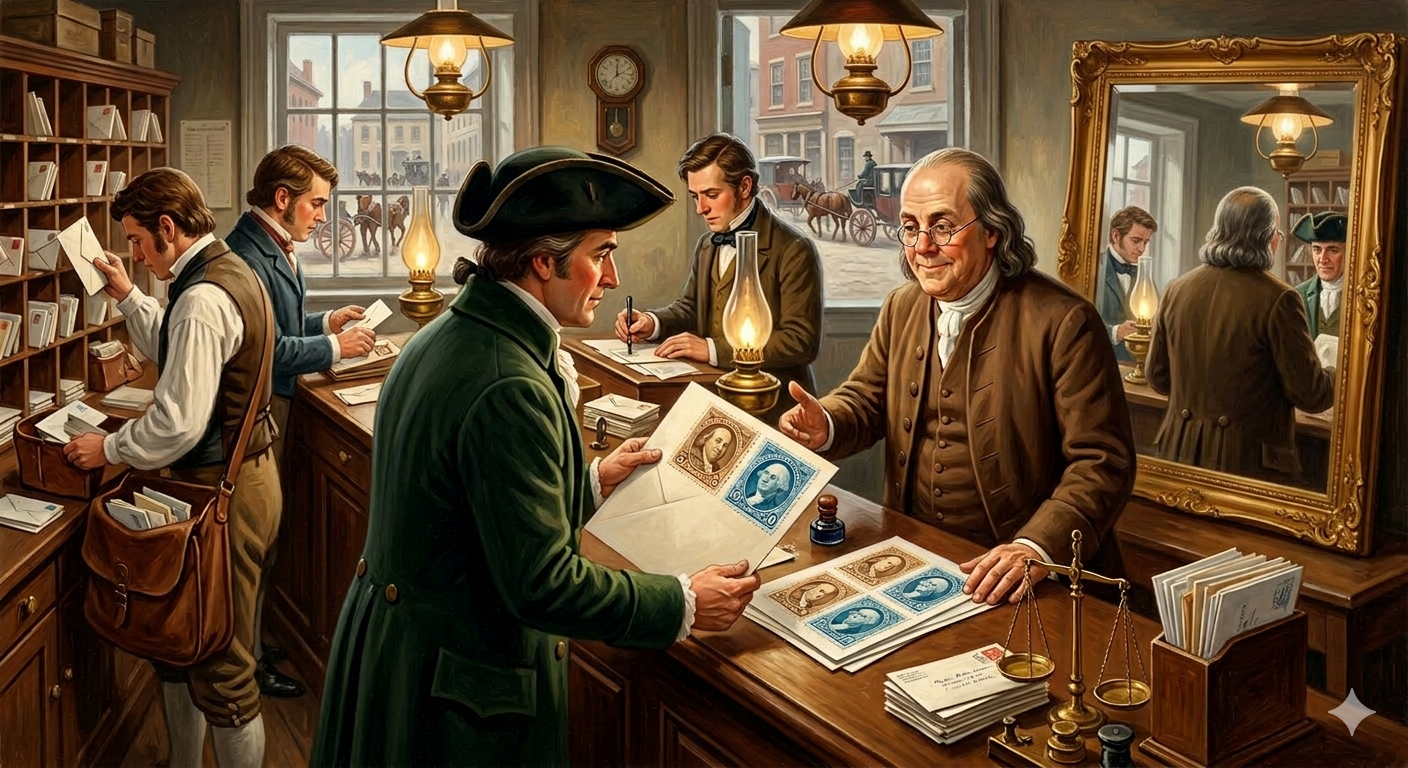
On July 1, 1847, a quiet revolution began in American postal history when the first official United States postage stamps went on sale in New York City. This momentous occasion marked the beginning of a new era in American communication, transforming how citizens paid for mail delivery and establishing a system that would endure for generations. The introduction of these first adhesive postage stamps, featuring Benjamin Franklin on the 5-cent denomination and George Washington on the 10-cent value, represented more than a simple administrative change; it signaled America’s entry into the modern postal age and established the foundation for what would become one of the world’s most extensive and efficient mail delivery systems.
The Pre-Stamp Era: Understanding America’s Early Postal Challenges
Before the introduction of adhesive postage stamps in 1847, the American postal system operated under a complex and often inefficient “collect on delivery” model that placed the financial burden on mail recipients rather than senders. This system, inherited from colonial practices and early British postal traditions, created numerous problems for both postal workers and citizens attempting to communicate across the growing nation. Letters arrived without prepayment, forcing recipients to pay postal fees that varied dramatically based on distance, weight, and local postal regulations.
The challenges of the pre-stamp postal system were manifold and growing more problematic as America expanded westward. Postal workers struggled to collect payment from recipients who might refuse letters due to inability to pay, lack of interest in the correspondence, or simple absence from their homes. These refused letters created administrative nightmares for postmasters who had to track unpaid mail, attempt multiple deliveries, and eventually return letters to senders when payment could not be collected. The inconsistent rate structure meant that identical letters might cost dramatically different amounts depending on local postal policies and the calculation methods used by individual postmasters.
Distance calculations presented another significant challenge in the pre-stamp era, as postal workers had to measure routes and calculate fees for each piece of mail individually. This process was both time-consuming and subject to errors, leading to frequent disputes between postal workers and mail recipients over proper payment amounts. The lack of standardization meant that sending a letter from New York to Philadelphia might cost differently depending on which postmaster calculated the route and which measurement methods they employed.
Private postal services had attempted to fill some gaps in the official system, recognizing the commercial opportunities created by inefficient government mail delivery. Companies like the American Letter Mail Company and various express services offered alternative mail delivery options, often providing faster and more reliable service than government post offices. However, these private services operated without legal authority and faced constant challenges from government officials seeking to protect the postal monopoly established by federal law.
Congressional Authorization: The Legislative Foundation for America’s First Stamps
The creation of America’s first postage stamps required specific congressional authorization, which came through An Act of Congress passed on March 3, 1847. This legislation represented the culmination of years of postal reform discussions and growing recognition that the existing mail payment system was inadequate for a rapidly expanding nation. The act authorized the Postmaster General to issue adhesive stamps for prepayment of postage and established the legal framework that would govern stamp production and use throughout the United States.
Postmaster General Cave Johnson, who served under President James K. Polk, played a crucial role in implementing the congressional authorization and overseeing the practical aspects of stamp introduction. Johnson recognized that successful stamp implementation would require careful planning, reliable production methods, and public education about the new prepayment system. His leadership during this transition period proved essential for establishing the credibility and effectiveness of America’s stamp-based postal system.
The legislation established specific rate structures that would be supported by the new stamps, setting postage at five cents for letters weighing up to half an ounce and traveling distances under 300 miles, and ten cents for letters traveling greater distances or carrying additional weight. These standardized rates represented a significant simplification compared to the complex and variable fee structures that had characterized earlier postal operations. The uniform pricing system made stamp production practical while providing clear value propositions for different types of postal service.
Congressional debates surrounding the stamp authorization revealed varying opinions about federal involvement in postal operations and concerns about the practical challenges of implementing a nationwide prepayment system. Some legislators worried about the cost of stamp production and distribution, while others questioned whether American citizens would adapt to the new prepayment requirements. These debates reflected broader political tensions about federal authority and the appropriate scope of government services in mid-19th century America.
The timing of congressional authorization reflected both domestic pressures for postal reform and international influences from successful stamp systems in other countries. Great Britain’s introduction of the Penny Black in 1840 had demonstrated the practical benefits of prepaid adhesive stamps, while various European nations had followed with their own stamp systems. American postal officials and legislators studied these international examples while adapting stamp concepts to meet specific American needs and conditions.
Rawdon, Wright, Hatch, and Edson: The Company Behind America’s First Stamps
The selection of Rawdon, Wright, Hatch, and Edson as the engraving firm responsible for producing America’s first postage stamps represented a crucial decision that would influence both the quality and security of the new postal system. This New York City-based company had established a reputation for producing high-quality engraved materials, including banknotes, certificates, and other security documents that required precision and anti-counterfeiting features. Their expertise in steel engraving and their experience with complex printing processes made them the ideal choice for creating stamps that would need to resist forgery while maintaining consistent quality across large production runs.
The partnership between the federal government and this private engraving firm established important precedents for how stamp production would be managed in the United States. Rather than creating government printing facilities specifically for stamp production, postal officials chose to contract with established private companies that possessed the necessary equipment, expertise, and security measures. This decision reflected both practical considerations about cost and efficiency, and broader philosophical questions about the appropriate role of government in manufacturing activities.
Rawdon, Wright, Hatch, and Edson faced significant technical challenges in creating America’s first stamps, as they had to develop production methods that could create large quantities of identical stamps while incorporating security features that would prevent counterfeiting. The company’s steel engraving process involved creating master plates with intricate line work that would be difficult to reproduce using available counterfeiting techniques. Each stamp design required hundreds of carefully engraved lines that created subtle variations in shading and texture, making accurate reproduction extremely challenging for potential counterfeiters.
The company’s proposal for two-color printing as an additional security measure was ultimately rejected by government officials who prioritized cost considerations over enhanced security features. This decision to use single-color printing for the first stamps reflected budget constraints and practical concerns about production complexity, though it may have made the stamps somewhat more vulnerable to counterfeiting attempts. The rejection of two-color printing established a precedent for prioritizing economic efficiency in stamp production, though later stamps would incorporate more sophisticated security features as counterfeiting threats increased.
Quality control represented another significant challenge for Rawdon, Wright, Hatch, and Edson, as they needed to ensure consistent printing quality across thousands of stamps while meeting tight delivery deadlines. The company’s use of steel plates for printing created durability challenges, as the relatively soft ink used in the process contained small pieces of quartz that gradually wore down the printing plates. This wear pattern explains why many surviving five-cent Franklin stamps show poor impression quality, particularly those printed later in the production run when plate deterioration was most pronounced.
Benjamin Franklin: The Logical Choice for America’s First Five-Cent Stamp
The selection of Benjamin Franklin for the five-cent stamp represented both a tribute to his foundational role in American postal development and recognition of his practical contributions to efficient mail delivery systems. As the first Postmaster General of the United States under the Continental Congress, Franklin had established many of the administrative procedures and operational principles that continued to govern American postal operations into the 1840s. His emphasis on reliable service, reasonable rates, and systematic delivery routes provided the philosophical foundation for the modern postal system that stamps would help to implement.
Franklin’s postal innovations during the colonial and revolutionary periods demonstrated his understanding of mail delivery as both a commercial enterprise and a public service essential for democratic communication. He implemented regular mail routes between major cities, established standardized delivery schedules, and worked to maintain reasonable postage rates that would encourage rather than discourage correspondence. These innovations reflected Franklin’s broader philosophical commitment to improving communication and facilitating the exchange of ideas that democracy required.
The practical aspects of Franklin’s postal leadership also influenced the decision to feature him on the first stamp. His efforts to establish reliable mail delivery between distant cities anticipated the challenges that a continental postal system would face as America expanded westward. Franklin’s understanding that efficient postal service required systematic planning, adequate funding, and professional administration provided important precedents for the stamp-based system that would emerge decades after his death.
Franklin’s broader reputation as a man of practical wisdom and scientific achievement reinforced the appropriateness of featuring him on a stamp designed to modernize American postal operations. His reputation for frugality and efficiency aligned perfectly with the cost-saving potential of prepaid stamps, while his scientific curiosity represented the spirit of innovation that stamp technology embodied. The choice of Franklin thus honored both his specific contributions to postal development and his broader significance as a symbol of American ingenuity and practical problem-solving.
The engraved portrait of Franklin used on the five-cent stamp was based on established artistic representations that emphasized his dignity and intellectual authority while remaining recognizable to the American public. The engraving process allowed for fine detail and subtle shading that captured Franklin’s distinctive appearance while incorporating security features that would make counterfeiting difficult. The artistic quality of Franklin’s portrait established important precedents for the visual standards that would characterize American stamp design for generations to come.
George Washington: The Natural Choice for the Ten-Cent Denomination
George Washington’s selection for the ten-cent stamp reflected his unparalleled status as the father of American independence and the nation’s first president, making him the obvious choice for the higher-value denomination that would be used for longer-distance mail delivery. Washington’s image on the stamp symbolized national unity and federal authority, reinforcing the legitimacy of the federal postal system and its expansion into new territories and states. His presence on the stamp also honored his role in establishing the constitutional framework that made federal postal operations possible.
The decision to place Washington on the higher-value stamp created an implicit hierarchy that recognized both Franklin’s specific contributions to postal development and Washington’s broader role in creating the American nation that required an effective postal system. This pairing of the two most revered figures in early American history provided powerful symbolic validation for the new stamp system while ensuring that both denominations would feature universally respected leaders whose integrity was beyond question.
Washington’s reputation for honesty and moral authority made his image particularly appropriate for a stamp that citizens would need to trust as legitimate currency for postal payments. The association of Washington’s image with the stamp helped establish public confidence in the new prepayment system, as his presence suggested that the stamps represented genuine value backed by federal authority. This psychological dimension of stamp design would prove crucial for encouraging public adoption of the new postal payment methods.
The artistic representation of Washington used on the ten-cent stamp drew from established presidential portraits that emphasized his dignity and authority while remaining immediately recognizable to American citizens. The engraving process captured Washington’s distinctive features while incorporating the fine line work that made counterfeiting extremely difficult with available reproduction technologies. The quality of Washington’s portrait reinforced the premium nature of the ten-cent denomination while establishing visual standards for future commemorative and definitive stamp issues.
The pairing of Franklin and Washington on America’s first stamps created a powerful symbolic statement about the relationship between practical innovation and national leadership that would characterize American postal development. Franklin’s scientific and administrative contributions combined with Washington’s political and military achievements to represent the full spectrum of qualities that the new stamp system embodied: efficiency, reliability, innovation, and federal authority.
The Technical Specifications and Production Process
The technical aspects of producing America’s first postage stamps required innovative solutions to challenges that had never been faced in American printing and manufacturing. The stamps were printed on thin, bluish wove paper that was specifically chosen for its strength, absorbency, and resistance to tampering or alteration. This paper selection reflected careful consideration of practical requirements for stamps that would need to withstand handling, storage, and application while maintaining their integrity and appearance throughout the postal delivery process.
The steel engraving process used by Rawdon, Wright, Hatch, and Edson represented the most sophisticated printing technology available for creating detailed, secure images that could resist counterfeiting attempts. Each stamp required hundreds of individually engraved lines that created subtle gradations in shading and texture, making accurate reproduction extremely challenging for potential counterfeiters. The hand-engraving process also ensured that each stamp possessed unique characteristics that could be used to verify authenticity and detect fraudulent reproductions.
Sheet layout and cutting procedures presented significant logistical challenges, as the stamps were produced in sheets of 200 without perforations, requiring postal clerks to cut individual stamps by hand using scissors or knives. This imperforate design created substantial variations in stamp margins and overall appearance, as the quality of individual stamps depended heavily on the cutting skills of postal workers. The lack of perforations also made stamp separation time-consuming and prone to errors that could damage stamps or create unusable fragments.
The printing process itself required careful attention to ink consistency, pressure uniformity, and plate maintenance to ensure that all stamps met quality standards throughout the production run. The specialized ink used for stamp printing needed to provide clear, dark impressions while drying quickly enough to prevent smearing or offsetting during the printing process. However, the inclusion of small quartz particles in the ink created unexpected problems by gradually wearing down the steel printing plates, leading to progressively poorer impression quality as production continued.
Quality control procedures during the initial production run were necessarily experimental, as no established standards existed for evaluating stamp quality or identifying acceptable variations in printing. The production team had to develop inspection methods that could identify serious defects while accepting minor variations that were inevitable in hand-engraving and steel-plate printing processes. These early quality control experiences established important precedents for managing stamp production that would influence American printing practices for decades to come.
The July 1, 1847 Release: A Quiet Revolution in American Postal History
The actual release of America’s first postage stamps on July 1, 1847, occurred with remarkably little fanfare or public recognition of the historic significance of the moment. Unlike modern stamp releases that are accompanied by elaborate first-day ceremonies and collector events, the 1847 stamp introduction was treated as a routine administrative change rather than a milestone in American communication history. This low-key approach reflected both the practical nature of postal operations and the general public’s limited understanding of how significantly stamps would transform mail delivery.
Robert Morris, the New York City postmaster, received the first delivery of stamps on the morning of July 1, consisting of 60,000 five-cent Franklin stamps and 20,000 ten-cent Washington stamps. These quantities represented careful estimates of initial demand based on existing mail volumes and projected public acceptance of the new prepayment system. The distribution of stamps to Morris marked the beginning of a new chapter in American postal history, though few observers at the time recognized the transformative impact that these small pieces of paper would have on national communication.
The initial public response to the new stamps was notably lukewarm, reflecting both unfamiliarity with the prepayment concept and continued preference for the traditional collect-on-delivery system that had characterized American postal operations for decades. Many citizens were reluctant to change established mail-sending habits, particularly when the new system required them to pay postage costs upfront without guarantees that their letters would be delivered successfully. This resistance to change was understandable given the significant financial investment that stamp purchases represented for average citizens in 1847.
Boston received stamps on July 2, followed by Philadelphia on July 7, demonstrating the gradual rollout process that characterized the nationwide stamp introduction. This phased distribution approach allowed postal officials to monitor public reception and address any operational challenges before expanding stamp availability to additional cities and regions. The sequential rollout also reflected practical limitations in stamp production and distribution that prevented simultaneous nationwide availability.
The first documented use of an American postage stamp occurred on July 7, 1847, six days after the initial New York release, suggesting that public adoption of the new system required several days of education and encouragement from postal workers. This delay between availability and usage highlighted the challenges of implementing new postal procedures and demonstrated the importance of public education in achieving successful adoption of innovative postal services.
Public Education and Adoption Challenges
The introduction of America’s first postage stamps required extensive public education efforts to explain the new prepayment system and encourage citizens to adopt stamp usage instead of relying on traditional collect-on-delivery mail service. Postmasters throughout the country played crucial roles as educators and advocates, explaining stamp benefits to customers while demonstrating proper attachment and usage procedures. These educational efforts were complicated by widespread illiteracy and limited understanding of postal operations among many Americans, particularly in rural areas where postal service was less common.
The concept of prepaying for mail delivery represented a fundamental change in how Americans thought about postal service, requiring citizens to trust that their stamp purchases would result in reliable mail delivery. This trust-building process was gradual and required consistent demonstration that stamp-paid letters received the same careful handling and delivery attention as traditional collect-on-delivery mail. Postal workers had to overcome skepticism from customers who worried that prepaid mail might receive less attention or priority than mail requiring payment upon delivery.
Economic factors also influenced public adoption of stamp usage, as many citizens viewed stamp purchases as an additional financial burden rather than a convenience or improvement in postal service. The requirement to pay postage costs upfront meant that letter writers needed to maintain stamp inventories and plan their correspondence expenses in advance, representing a significant change from the spontaneous nature of collect-on-delivery mail. These financial considerations were particularly challenging for citizens with limited incomes who might struggle to afford stamp purchases in advance of actual mail-sending needs.
Regional variations in stamp adoption reflected differences in urbanization, economic development, and familiarity with postal services across different parts of the country. Urban areas with established postal infrastructure and higher literacy rates generally embraced stamp usage more quickly than rural regions where mail service was less frequent and postal procedures were less familiar. These regional differences created challenges for postal administrators who needed to manage mixed systems that accommodated both stamp-paid and collect-on-delivery mail during the transition period.
The gradual nature of stamp adoption also reflected broader cultural resistance to change that characterized mid-19th century American society. Many citizens preferred familiar procedures and systems over innovations that required learning new skills or changing established habits. Overcoming this cultural resistance required patience, persistence, and careful demonstration that stamps offered genuine advantages over traditional postal payment methods.
The Economic Impact and Postal Revenue Revolution
The introduction of postage stamps created immediate economic benefits for the United States Postal Service by improving cash flow, reducing collection costs, and enabling more accurate financial planning and budgeting. The prepayment system eliminated the expensive and time-consuming process of collecting postage fees from recipients, reducing administrative costs while increasing the reliability of postal revenue collection. This improvement in financial efficiency allowed postal administrators to allocate resources more effectively while expanding service to previously underserved areas.
Stamp sales generated substantial revenue that exceeded initial projections, with more than 1.2 million stamps sold by 1851, demonstrating growing public acceptance and usage of the prepayment system. This revenue success enabled postal expansion and service improvements that would have been difficult to achieve under the previous collect-on-delivery system with its inherent collection uncertainties and administrative inefficiencies. The predictable revenue stream from stamp sales also facilitated long-term planning for postal infrastructure development and service enhancement.
The standardization of postal rates through stamp denominations eliminated much of the confusion and dispute that had characterized earlier postal fee collection, reducing administrative costs while improving customer satisfaction. The clear pricing structure represented by five-cent and ten-cent stamps made postal costs transparent and predictable, encouraging increased mail usage while reducing the time postal workers spent calculating and collecting variable fees. This standardization also facilitated interstate commerce by making long-distance communication costs more predictable and affordable.
Small businesses and commercial enterprises quickly recognized the advantages of stamp-paid mail for improving customer relationships and reducing transaction costs associated with postal communications. The ability to prepay postage demonstrated professionalism and consideration for recipients while ensuring that business correspondence would be delivered without requiring recipients to pay additional fees. This commercial adoption of stamps helped drive overall usage while establishing stamps as essential tools for business communication.
The success of stamp sales also demonstrated the potential for postal operations to generate surplus revenue that could support expanded government services or reduced taxation in other areas. The efficient collection of postal revenue through stamp sales provided a model for other government fee collection systems while demonstrating the practical benefits of prepayment systems for both service providers and customers.
Security Features and Anti-Counterfeiting Measures
The security features incorporated into America’s first postage stamps reflected careful consideration of counterfeiting threats and the need to protect postal revenue from fraudulent reproduction attempts. The steel engraving process used by Rawdon, Wright, Hatch, and Edson created intricate line work that was extremely difficult to reproduce accurately using available printing technologies. Each stamp contained hundreds of carefully engraved lines that created subtle variations in shading and texture, making precise counterfeiting nearly impossible with 1840s reproduction methods.
The choice of specific ink formulations and paper types also contributed to stamp security by creating unique physical characteristics that would be difficult for counterfeiters to replicate exactly. The specialized ink used for stamp printing had distinctive flow and adhesion properties that created characteristic appearance patterns, while the selected paper possessed specific texture and absorbency characteristics that affected ink appearance and durability. These material specifications were carefully guarded secrets that provided additional protection against counterfeiting attempts.
The intricate portrait engravings of Franklin and Washington incorporated multiple security features including fine line work, subtle shading variations, and complex geometric patterns that required exceptional skill to reproduce accurately. The artistic quality of these portraits served both aesthetic and security purposes, as the fine detail work made counterfeiting extremely challenging while creating stamps that citizens could easily recognize and trust. The distinctive appearance of legitimate stamps also made it easier for postal workers to identify suspicious or potentially fraudulent reproductions.
However, the decision to use single-color printing rather than the two-color system proposed by the engraving company may have reduced security effectiveness compared to what was possible with available technology. The rejected two-color proposal would have created additional obstacles for counterfeiters while providing more obvious visual verification features for postal workers and stamp users. This early decision to prioritize cost savings over maximum security would influence American stamp security policies for years to come.
Despite these security measures, the success of America’s first stamps in resisting counterfeiting was largely due to the limited circulation and relatively low economic incentives for counterfeiting compared to the technical challenges involved. The small-scale nature of early stamp usage and the vigilance of postal workers in examining stamps helped minimize counterfeiting problems during the initial years of stamp operation.
The Mandatory Adoption: The Act of 1855
While stamps were introduced in 1847 as an optional prepayment method, their truly revolutionary impact came with the Act of 1855, which made stamp usage mandatory for all mail delivery throughout the United States. This legislation represented the final step in transforming American postal operations from a collect-on-delivery system to a modern prepayment system that would serve as the foundation for postal operations throughout the remainder of the 19th century and beyond. The mandatory adoption reflected government recognition that stamps had proven their effectiveness and efficiency during the optional usage period.
The eight-year period between voluntary introduction and mandatory adoption allowed for gradual public education and system refinement that made the transition to required stamp usage smoother than it might have been with immediate mandatory implementation. During this transition period, postal administrators gained valuable experience in stamp distribution, inventory management, and usage verification while the public gradually became familiar with stamp purchase and application procedures. This extended transition period demonstrated wise policy implementation that prioritized public acceptance over rapid change.
The mandatory adoption legislation also addressed remaining loopholes and inconsistencies in postal payment systems that had created confusion and administrative challenges during the voluntary period. By requiring stamps for all mail, the legislation eliminated the need for postal workers to manage dual payment systems while ensuring that all mail received consistent handling regardless of payment method. This standardization improved postal efficiency while reducing opportunities for errors or disputes about payment requirements.
Resistance to mandatory stamp adoption was minimal by 1855, reflecting the success of the gradual introduction process and growing public appreciation for the convenience and reliability of prepaid mail service. Most citizens had already adopted stamp usage voluntarily, making the mandatory requirement largely a formalization of existing practices rather than a dramatic change in postal procedures. This smooth transition demonstrated the value of the extended voluntary period in building public acceptance and confidence.
The mandatory adoption also enabled postal administrators to implement more sophisticated mail handling procedures and expanded services that would have been impossible under mixed payment systems. The standardization of payment methods facilitated the introduction of registered mail, express delivery, and other specialized services that required consistent payment and handling procedures. These service improvements justified the mandatory adoption while demonstrating the continuing evolution of American postal capabilities.
The Legacy and Long-term Impact of America’s First Stamps
The introduction of America’s first postage stamps in 1847 established precedents and principles that would influence postal operations, government service delivery, and citizen communication for more than a century. The success of the prepayment system demonstrated the practical benefits of standardized government services while providing a model for efficient fee collection that would be adapted for various other government functions. The stamp system also established important precedents for federal-private partnerships in producing government materials and documents.
The artistic and design standards established by the Franklin and Washington stamps influenced American stamp design for generations, creating expectations for dignified portraiture, high-quality engraving, and symbolic representation that would characterize American philatelic production throughout the 19th and into the 20th centuries. The choice to honor historical figures rather than contemporary political leaders established important precedents for avoiding partisan controversy while celebrating shared American heritage and values.
The technological innovations required for stamp production also contributed to broader advances in American printing, engraving, and security document production that had applications far beyond postal operations. The expertise developed in creating secure, high-quality printed materials for stamps influenced the production of currency, certificates, and other official documents while establishing American printing capabilities that would serve various government and commercial needs.
The economic success of stamp sales demonstrated the potential for government services to generate revenue while improving service quality and efficiency. This model of self-supporting government operations through user fees rather than general taxation provided important precedents for funding other government services while reducing the burden on general tax revenues. The postal service’s financial success with stamps helped establish the principle that government services could be both efficient and profitable.
The social impact of reliable, affordable postal communication facilitated by stamps contributed to national unity and democratic participation by making correspondence more accessible to ordinary citizens. The ability to communicate reliably across long distances helped bind together an expanding nation while facilitating commerce, family relationships, and civic engagement that strengthened American democracy. The stamps thus played a crucial role in creating the communication infrastructure that modern American society required.
The international recognition of American stamp design and production quality also contributed to growing American prestige and technological reputation in the mid-19th century. The success of the American stamp system influenced postal development in other countries while demonstrating American capabilities in precision manufacturing and design. This international recognition helped establish American credibility in various technological and administrative fields that extended far beyond postal operations.
The collector interest that eventually developed around American stamps created an entirely new hobby and cultural phenomenon that would engage millions of Americans while preserving important historical artifacts and information. Stamp collecting helped maintain public interest in postal history and operations while creating communities of enthusiasts who contributed to historical research and preservation. The philatelic hobby thus became an unexpected but significant legacy of the 1847 stamp introduction.
The continuing evolution of American stamp design, production, and usage throughout the late 19th and early 20th centuries built upon the foundation established by the Franklin and Washington stamps while adapting to changing technological capabilities and social needs. The principles of quality, security, and artistic merit established by America’s first stamps remained influential even as production methods, design concepts, and usage patterns evolved with changing times and technologies.