Introduction: The Bluegrass State Enters the Union
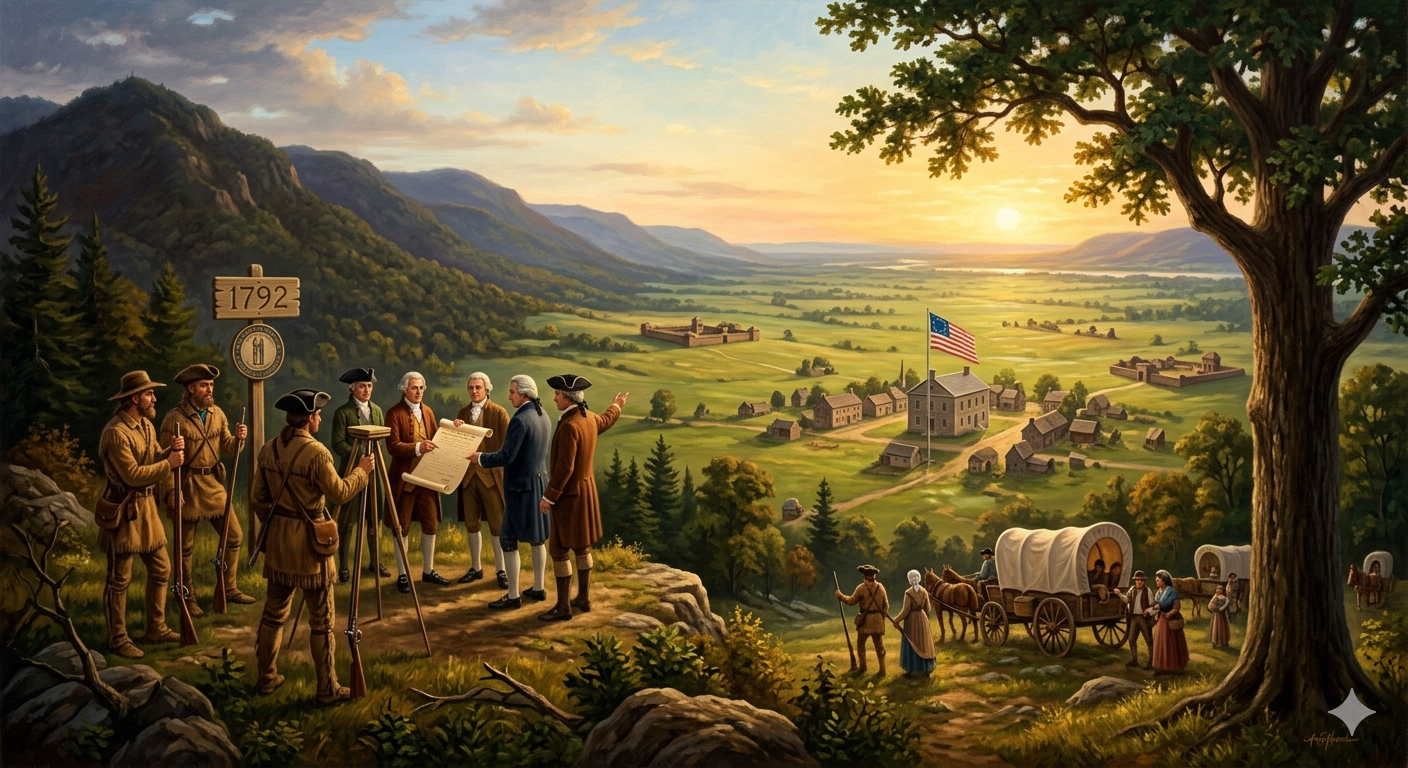
On June 1, 1792, Kentucky crossed the threshold of history and became the fifteenth state of the United States of America — the first state carved from territory lying entirely west of the Appalachian Mountains. It was a moment that arrived not in a single decisive act but at the end of a long, turbulent, and often treacherous journey stretching across nearly two decades of frontier conflict, political wrangling, constitutional debate, foreign intrigue, and persistent human determination. The land that became Kentucky had been wilderness to Europeans within living memory. It had been a battleground for Native American nations for centuries. And in the span of a single generation, it had been transformed from an unmapped hunting ground into a commonwealth capable of joining a young republic on equal terms with the original thirteen states.
The story of Kentucky’s statehood is a story about the relentless westward energy of the early American republic — the force that pushed settlers through mountain passes and down dangerous rivers in search of fertile land and new beginnings. It is a story about the political complexities of a young nation still figuring out the rules of its own expansion. It is a story about remarkable individuals, from the frontiersman Daniel Boone who opened the gateway to Kentucky, to the lawyer-statesman John Brown who navigated the corridors of Congress on Kentucky’s behalf, to the war hero Isaac Shelby who became the commonwealth’s first governor. And it is a story about the contradictions that ran through early American democracy — the same constitution that granted full manhood suffrage to all free men also entrenched the institution of slavery, planting the seeds of a conflict that would tear the commonwealth apart seven decades later.
To understand what happened on June 1, 1792, one must understand the long and complicated road that led to that day — beginning not in the halls of Congress or the convention chambers of Danville, but in the ancient forests and rolling bluegrass meadows of a land that Europeans barely knew existed.
Part I: The Land Before Statehood — Native Peoples, Early Explorers, and the First Europeans
Ancient Inhabitants and the Native Nations of Kentucky
Long before any European set eyes on the territory that would become Kentucky, the land was home to indigenous peoples whose presence stretched back thousands of years. Archaeological evidence indicates that human occupation of the region dates to approximately 9,500 BCE, with early inhabitants living as hunter-gatherers before a gradual transition toward agriculture began around 1,800 BCE. By 900 CE, a Mississippian culture had emerged in the western and central portions of what is now Kentucky, characterized by mound-building, agricultural communities, and complex social organization, while a Fort Ancient culture developed in the eastern regions. These were sophisticated societies with their own histories, territories, and relationships to the land that would soon become the subject of European ambition.
By the time of European contact, Kentucky had become a contested hunting ground for several powerful Native American nations rather than a place of permanent large-scale settlement. The Shawnee, whose territory lay primarily to the north along the Ohio River, regarded Kentucky as vital hunting ground and fiercely resisted any attempt to dispossess them of it. The Cherokee, based to the south in present-day Tennessee and the Carolinas, also held claims over portions of the territory and used it for hunting. The Iroquois Confederacy, whose influence extended across a vast swath of eastern North America, had been recognized as holding nominal sovereignty over much of the region through the Treaty of Fort Stanwix in 1768. The Chickasaw, based to the southwest, held rights to the lands west of the Tennessee River. These overlapping claims and the deep attachment of multiple nations to the Kentucky hunting grounds made the territory a flashpoint for violent conflict as European settlers began to push westward.
French and English Exploration in the Seventeenth and Early Eighteenth Centuries
The first Europeans to encounter the region that would become Kentucky came not as settlers but as explorers and traders, drawn by the rivers that penetrated the interior of the continent and by rumors of rich lands beyond the mountains. French explorers moving southward from Canada through the Great Lakes and down the Ohio River were among the earliest Europeans to pass through or near Kentucky in the late seventeenth century. The great French explorer René-Robert Cavelier de La Salle may have traveled along the Ohio River as early as the 1660s or 1670s, possibly reaching the falls near which the city of Louisville now stands. Father Jacques Marquette and Louis Jolliet, the explorer-priest and fur trader who together mapped much of the Mississippi River system in 1673, also contributed to the French geographic understanding of the region. Robert Cavelier likewise explored the area for France during his ambitious journeys of exploration.
From the English colonial side, the Virginia frontier produced explorers who ventured westward into the unknown with a mixture of commercial ambition and geographical curiosity. Colonel Abraham Wood, a Virginia trader, sent expeditions westward in the 1670s, and one of his agents, Gabriel Arthur, became the first known white man to cross the Cumberland Gap — the narrow mountain pass that would later become the gateway through which hundreds of thousands of settlers would pour into Kentucky. John P. Salling and others followed in subsequent decades, each adding to the fragmentary European knowledge of a land that remained, for most of the early eighteenth century, more legend than reality on the maps of the colonial powers.
Thomas Walker and the Walker Line — The 1750 Expedition That Named the Gap
The systematic European exploration of Kentucky began in earnest in 1750, when Dr. Thomas Walker, a Virginia physician, land agent, and explorer working on behalf of the Loyal Land Company of Virginia, led an expedition through the mountains with the specific aim of investigating the land beyond the Appalachian barrier. Walker’s party crossed into present-day Kentucky through a pass in the Cumberland Mountains that he named ‘Cave Gap’ — a name that would eventually evolve into ‘Cumberland Gap,’ in honor of the Duke of Cumberland, son of King George II and victor over the Scots at the Battle of Culloden in 1746. Walker named the nearby river the Cumberland River for the same reason. His party explored portions of southeastern Kentucky and his detailed reports of the expedition, though somewhat discouraging about the rough terrain of the area he surveyed, provided invaluable geographical intelligence for subsequent expeditions. Walker also established the so-called ‘Walker Line’ at 36 degrees 30 minutes north latitude, which became the southern boundary of what would eventually be Kentucky — an extension of the Virginia-North Carolina boundary.
Walker’s contemporary and rival Christopher Gist explored Kentucky in 1751, adding further detail to the European understanding of the territory. The French and Indian War of 1754 to 1763, which ended with Britain’s acquisition of French territories in North America and the securing of the Ohio River as a major pathway westward, set the stage for the next and most consequential phase of Kentucky’s exploration. The war’s end brought a surge of interest in the lands west of the mountains among Virginia’s land-hungry colonists, and it was from this environment of westward ambition that the most famous figure in Kentucky’s early history emerged.
Part II: Daniel Boone, the Wilderness Road, and the Opening of Kentucky
Daniel Boone: America’s First Western Hero
Daniel Boone was born on November 2, 1734, in Berks County, Pennsylvania, the sixth child of Squire Boone and Sarah Morgan Boone, a Quaker family that had emigrated from England. When Daniel was about sixteen, the family moved to the Yadkin Valley in North Carolina, a frontier region that suited perfectly a young man of Boone’s restless, adventurous temperament. He became an exceptional hunter and woodsman from an early age, spending months at a time in the forests on solitary hunting expeditions that took him deeper and deeper into the Appalachian backcountry. It was during the French and Indian War, while serving as a wagoner in General Braddock’s disastrous 1755 campaign against Fort Duquesne, that Boone is said to have first heard detailed descriptions of Kentucky from John Findley, a fur trader who had traveled down the Ohio River and glimpsed the interior of the territory. The stories of its extraordinary fertility, its vast herds of game, and its rolling grasslands stayed with Boone for years.
In 1767, Boone made his first crossing into Kentucky with his brother Squire, but the two did not penetrate deep enough to reach the fabled Bluegrass region. It was not until May 1, 1769 — a date Boone himself commemorated with careful pride — that he set out with a party of five others, including John Findley himself as guide, on the journey that would make him the defining figure of the American frontier. The party passed through the Cumberland Gap in late May and early June of 1769 and entered Kentucky, where Boone spent two years exploring, hunting, and trapping. He saw the Bluegrass region for the first time from the summit of Pilot Knob, a vista later described as ‘an icon of American history,’ and was captivated by the landscape’s extraordinary promise. He encountered the Shawnee repeatedly during this expedition — on December 22, 1769, he and his brother-in-law John Stewart were captured by a Shawnee party that confiscated all their furs and warned them to leave and never return. Boone ignored the warning.
The Transylvania Company, Richard Henderson, and the Treaty of Sycamore Shoals
The systematic settlement of Kentucky began with an ambitious and ultimately illegal private colonization scheme organized by Richard Henderson, a prominent judge and land speculator from North Carolina. Henderson formed the Transylvania Company in 1774-1775 with the goal of purchasing a vast tract of land from the Cherokee nation and establishing a proprietary colony — to be called Transylvania — in the territory between the Kentucky, Ohio, and Cumberland rivers. Henderson hired Daniel Boone to travel to several Cherokee towns and invite their leaders to a negotiating session. The resulting gathering was held at Sycamore Shoals on the Watauga River in present-day Tennessee in March 1775, where Henderson conducted a controversial treaty with the Cherokee — the Treaty of Sycamore Shoals, also known as the Henderson Purchase — through which the Cherokee ceded their claims to the Kentucky territory for what critics regarded as grossly inadequate compensation in trade goods.
The Sycamore Shoals transaction was legally dubious from the start. The Proclamation of 1763 had forbidden private individuals from purchasing land directly from Native American nations without royal approval, and the emerging American government would similarly prohibit such transactions. The Shawnee, moreover, had not been party to the treaty and had never ceded their rights to Kentucky. Virginia ultimately voided the Transylvania Company’s land claims in 1778 on the grounds that private individuals could not legally purchase land from Native nations. But Henderson and Boone did not wait for the legal debates to play out. Immediately after the treaty was concluded at Sycamore Shoals in March 1775, Boone led a party of about thirty men westward to blaze a trail from present-day Kingsport, Tennessee, through the Cumberland Gap and into the Kentucky interior.
The Wilderness Road: America’s First Gateway to the West
The trail that Daniel Boone cut through the Cumberland Gap in the spring of 1775 followed paths that had been used for centuries before him — by vast herds of buffalo whose hooves had worn grooves through the mountain terrain, and by the Native American nations who had hunted along these routes and whose name for the trail, Athowominee, translates variously as ‘Path of the Armed Ones’ or ‘The Great Warrior’s Path.’ Boone’s party widened and marked these existing traces, creating a passable route from the Holston River settlements of Virginia and North Carolina through the Cumberland Gap into central Kentucky. This trail became known first as Boone’s Trace, and later as the Wilderness Road — the most consequential pathway in the early history of American westward expansion.
Just before reaching their destination on the Kentucky River in late March 1775, Boone’s group was attacked by Shawnee warriors who had not accepted the Cherokee cession and who regarded the intrusion as a direct provocation. Several men were killed or injured, but most of the party survived. In April 1775, they arrived on the south side of the Kentucky River in what is now Madison County and built a fortification they called Fort Boonesborough — one of the first permanent English-speaking settlements west of the Appalachian Mountains. Harrodsburg, established a year earlier in 1774 by James Harrod and a party of thirty-seven men near the head of the Salt River, had the prior claim to being Kentucky’s first English settlement. Benjamin Logan established another fortification at St. Asaph’s, later known as Logan’s Fort. These three posts — Boonesborough, Harrodsburg, and Logan’s Fort — formed the nucleus of European settlement in Kentucky during the dangerous years of the Revolutionary War.
By the time Kentucky became a state in 1792, more than 200,000 settlers had traveled through the Cumberland Gap along the Wilderness Road, enduring attacks by Native American warriors, cold, hunger, disease, and the thousand ordinary hardships of frontier life. The road would serve as the primary gateway to Kentucky and the wider western territories for some 300,000 settlers over the next thirty-five years. It was, in the words of later historians, America’s first highway west — the artery through which the republic’s westward expansion first found its course.
Part III: From Virginia’s Frontier County to the Demand for Separation
Kentucky County, Virginia — Birth of a Political Entity
As the population of the Kentucky settlements grew during the Revolutionary War years, Virginia responded to the administrative challenges by formally incorporating the region into its governmental structure. On New Year’s Eve 1776, the Virginia General Assembly created Kentucky County from its vast western lands, making the entire territory a single county of the Commonwealth of Virginia with its county seat in present-day Harrodsburg. The Virginia government simultaneously appointed officers to form a militia for the county’s defense, naming a roster of frontier heroes who would go on to play central roles in Kentucky’s history: George Rogers Clark, John Todd, Benjamin Logan, Daniel Boone, and James Harrod were among those appointed to lead the defense of Kentucky County.
The Revolutionary War period was one of extraordinary violence in Kentucky. The British, recognizing that disrupting the western frontier would stretch American military resources and potentially prevent the consolidation of American control over the trans-Appalachian territories, actively encouraged and equipped the Shawnee, Cherokee, and other Native nations to raid the Kentucky settlements. The result was a brutal series of attacks throughout the late 1770s and early 1780s that cost many lives and threatened the survival of the settlements. Daniel Boone himself was captured by the Shawnee in February 1778 while leading an expedition to the salt springs on the Licking River, and was held for months before escaping to warn Boonesborough of a planned attack. George Rogers Clark conducted audacious military campaigns against British-held forts in the Illinois country and the Northwest Territory, most famously capturing Fort Vincennes in February 1779, which helped secure American claims to the western territories after the war.
By 1780, Kentucky County’s rapid population growth had made the original single-county structure unwieldy, and the Virginia General Assembly divided it into three counties: Fayette, Jefferson, and Lincoln. This was the first of many administrative subdivisions as settlement continued to expand. By the time Kentucky gained statehood in 1792, the original Kentucky County had grown into nine counties, and the entire region was organized as the District of Kentucky — a judicial and military district of Virginia with its own courts and administration, though still entirely subordinate to the Commonwealth of Virginia’s political authority.
Why Kentuckians Wanted Independence from Virginia — The Frontier’s Grievances
As the Revolutionary War wound down and the immediate threat of British-sponsored Native attacks diminished, Kentucky settlers increasingly turned their attention to a different kind of problem: the inadequacy of distant Virginia’s government to address the practical needs of a rapidly growing frontier population. The grievances were numerous, deep-rooted, and entirely legitimate. Kentuckians who needed to resolve legal disputes, register land claims, or seek government assistance had to travel hundreds of miles to Richmond, the Virginia capital, over roads that were barely tracks through the wilderness. A journey that might take weeks in each direction was required for matters that could have been resolved locally if Kentucky had its own courts and legislature. The practical impossibility of effective governance from such a distance was apparent to everyone.
The land question was particularly fraught. Kentucky’s land system was a nightmare of overlapping, conflicting, and often fraudulent claims arising from multiple systems of land grant — Virginia land warrants, Transylvania Company grants, military bounty claims, and simple squatter occupation all produced competing assertions of ownership over the same parcels of ground. Kentuckians complained bitterly that Virginia’s distant courts were resolving these disputes in favor of eastern land speculators rather than respecting the claims of settlers who had actually cleared and improved the land. The inadequacy of military protection was another serious grievance: while Virginia technically bore responsibility for defending its western county, the practical reality was that Kentucky settlers were largely left to organize their own defense against continued Native American raids, often without adequate supplies, equipment, or support from the east.
Perhaps the most economically significant grievance concerned access to the Mississippi River. The Ohio River, flowing along Kentucky’s northern border, was the territory’s natural commercial highway, connecting it southward to the Mississippi and from there to the port of New Orleans, through which Kentucky’s agricultural surpluses could reach the markets of the Atlantic world and beyond. Spain controlled New Orleans and, from 1779, effectively controlled the lower Mississippi River. Without the right of free navigation on the Mississippi — a right that Virginia, representing a state without direct commercial interest in the river, was not particularly motivated to fight for — Kentucky’s economic potential was severely constrained. The Mississippi question would become one of the most contentious issues in the decade-long process of achieving statehood, and would even threaten to push some Kentuckians into dangerous flirtation with a foreign power.
Part IV: The Ten Conventions of Danville — Eight Years of Political Struggle for Statehood
The First Danville Convention — December 27, 1784
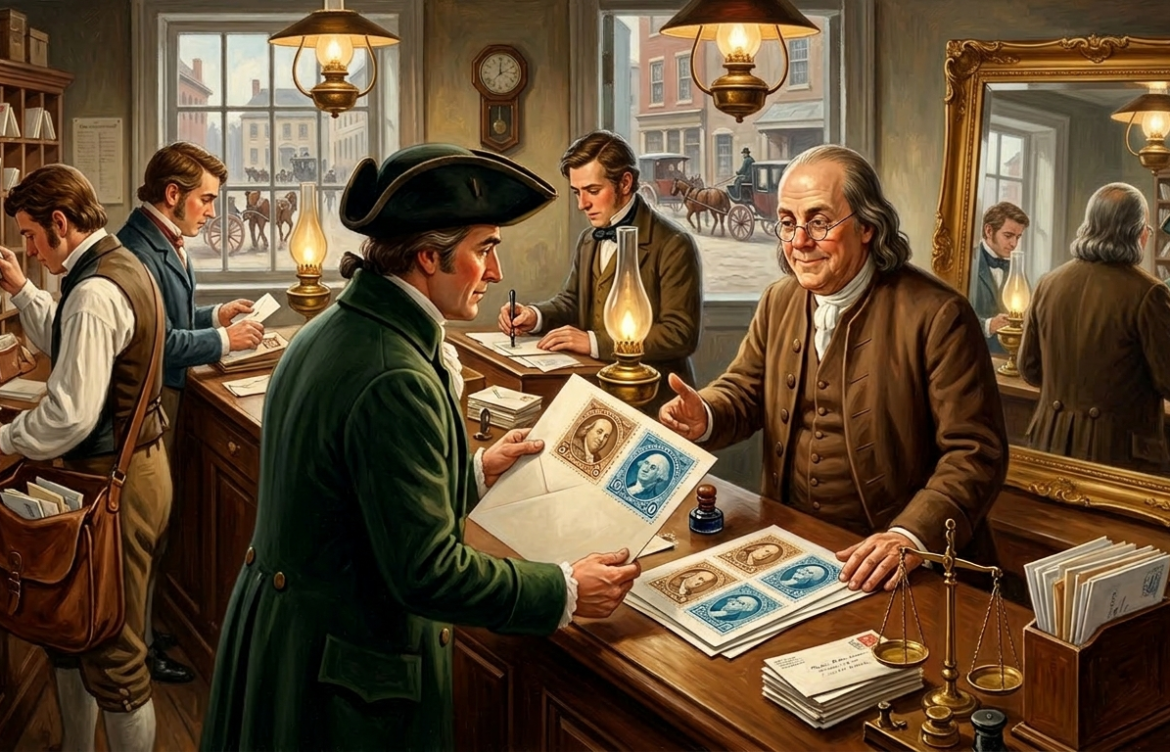
The formal movement for Kentucky’s separation from Virginia began with a convention that met in Danville on December 27, 1784 — the first of what would ultimately be ten conventions held between 1784 and 1792. Danville, established around 1775 as one of the earliest permanent settlements west of the Allegheny Mountains, had grown into the most significant political and commercial center of the Kentucky District and was the natural gathering place for the leaders of the statehood movement. The town would eventually earn the nickname ‘City of Firsts,’ not only for hosting the ten constitutional conventions but also for housing the first post office west of the Allegheny Mountains and the site of the world’s first successful ovarian surgery performed by Dr. Ephraim McDowell on Christmas Day 1809.
The conventions that met at Danville’s Constitution Square over the following eight years brought together the most capable and ambitious men in Kentucky’s rapidly growing population. Benjamin Logan, one of the original founders of Kentucky’s frontier settlements and a veteran of the Revolutionary War, was among the most persistent and forceful advocates for separation. He organized the Danville conferences and served as a delegate at multiple conventions, including the constitutional convention itself. Samuel McDowell, a Virginia-born judge who had become one of the most respected figures in Kentucky’s legal and political establishment, presided over several of the conventions. These men and their colleagues faced the challenge of building consensus around a separation movement among a population that was deeply divided over how, when, and on what terms separation should occur.
The Three Factions — Statehood, Independence, and the Spanish Question
The statehood movement was never a unified enterprise. Throughout the eight years of conventions, three broad factions competed for control of the process, their goals and strategies shifting with the changing political circumstances of the new nation. The most straightforward faction, comprising the majority of the settler population, simply wanted Kentucky to separate from Virginia and join the United States as a proper state, enjoying the full rights and protections that statehood would bring. A second, smaller but vocal faction went further, contemplating full independence as a separate nation rather than statehood within the American union — a vision rooted in the settlers’ sense that the eastern states fundamentally did not understand or represent the interests of the frontier.
The third and most dangerous faction was associated with the figure of General James Wilkinson, whose involvement in Kentucky’s statehood movement became one of the most colorful and alarming episodes in the early history of the republic. Wilkinson was born in Maryland in 1757 and had served in the Continental Army during the Revolutionary War, charming his way to the rank of brigadier general despite a mediocre military record that included involvement in a scheme to replace George Washington as commander. He moved to Kentucky in 1784, settling near Louisville and establishing a trading business in Lexington. His impressive military credentials, personal charm, and what contemporaries described as a ‘pleasing voice and pleasing manners’ quickly made him a figure of considerable influence in Kentucky politics.
James Wilkinson and the Spanish Conspiracy — Treason on the Frontier
By 1785, Wilkinson was deeply entrenched in Kentucky’s statehood movement and had emerged as a leading voice for separation from Virginia. But his ambitions went far beyond simple statehood. Recognizing that Spain controlled New Orleans and the lower Mississippi River — the economic lifeline of Kentucky’s agricultural economy — Wilkinson conceived a scheme to position himself as the indispensable broker between Kentucky and the Spanish Empire. In 1787, he traveled secretly to New Orleans, where he swore a secret oath of loyalty to the Spanish Crown and entered into a commercial arrangement with the Spanish Governor Esteban Rodríguez Miró, obtaining exclusive trading rights on the Mississippi River in exchange for his pledge to work toward detaching Kentucky from the United States and ultimately attaching it to the Spanish Empire.
Wilkinson received a pension of $7,000 from Governor Miró and requested additional pensions on behalf of several prominent Kentuckians — including Harry Innes, Benjamin Sebastian, John Brown, Caleb Wallace, Benjamin Logan, Isaac Shelby, George Muter, George Nicholas, and even Humphrey Marshall, who was at the time one of Wilkinson’s bitterest political rivals. Most of those named appear to have known nothing of this arrangement, and some were actively working against Wilkinson’s separatist agenda. But the episode illustrates how genuinely precarious Kentucky’s political loyalties appeared in the late 1780s, when the weakness of the Articles of Confederation government and Spain’s control of the Mississippi created a real possibility that the western territories might drift out of the American orbit entirely.
At the sixth and seventh Danville conventions in 1788, Wilkinson pushed actively for Kentucky to declare independence from both Virginia and the United States, arguing that an independent Kentucky could then negotiate directly with Spain for free navigation of the Mississippi on terms more favorable than the eastern-dominated American Congress would secure. His argument found real resonance among Kentucky landowners whose economic futures depended on access to New Orleans. But he could never muster a majority, and as Spain’s support for his scheme evaporated and the new United States Constitution provided a stronger framework for national governance, Wilkinson’s treasonous enterprise collapsed. He left Kentucky in 1791, deeply indebted, and received an army commission — a career in which he would continue his secret service to Spain and eventually conspire with Aaron Burr in yet another scheme of western separatism, becoming one of the most comprehensively treacherous figures in American history.
John Brown — Kentucky’s Champion in Congress
While Wilkinson plotted treason, a very different kind of Kentuckian was advancing the statehood cause through legitimate political channels. John Brown was born in Virginia in 1757, the son of a Presbyterian minister, and had studied law under none other than Thomas Jefferson before making his way to Kentucky. Intellectually gifted, politically skillful, and genuinely committed to Kentucky’s interests, Brown represented the District of Kentucky in the Virginia legislature in 1784-1785 before winning election to the Continental Congress under the Articles of Confederation. He served continuously as Kentucky’s representative in Congress — first under the Articles, then in the first House of Representatives under the new Constitution — for eight years, from 1784 to 1792, tirelessly advancing the case for Kentucky’s statehood.
Brown’s position gave Kentucky its most authoritative voice in the national government during the critical years of the statehood campaign. He worked closely with his mentors Thomas Jefferson and James Madison to build congressional support for Kentucky’s admission, navigating the complex politics of a Congress that was simultaneously grappling with the structure of the new republic, the question of the Northwest Territory, and the always delicate balance between free and slave states. Brown formally presented Kentucky’s petition for statehood to the House of Representatives and worked through the mechanisms of the new constitutional government to secure the necessary legislation. Kentucky officially became the 15th state on June 1, 1792, after which Brown resigned from the House of Representatives. On June 18, 1792, the Kentucky legislature elected him as one of the new state’s first two United States Senators — a fitting recognition of the man who had done more than anyone in Washington to make statehood a reality.
Virginia’s Consent and the Congressional Act of February 4, 1791
The process of achieving statehood under the new United States Constitution required several sequential steps, each of which had to be completed before the next could proceed. Virginia had to consent to the separation of Kentucky from its territory. Congress had to pass an enabling act authorizing Kentucky to proceed toward statehood. A constitutional convention had to draft a state constitution. And Congress had to pass a final act of admission. The navigation of this multi-step process through three different governmental bodies — the Virginia legislature, the Continental Congress under the Articles, and then Congress under the new Constitution — accounted for much of the delay and frustration of the eight-year convention process.
Virginia, to its credit, had been relatively cooperative about the prospect of Kentucky’s separation throughout the 1780s, passing a series of enabling acts that gave conditional consent to statehood, provided that Congress admitted Kentucky on terms acceptable to both Virginia and Kentucky. The complication was that Kentucky had nearly achieved statehood under the old Articles of Confederation government when the adoption of the new Constitution in 1788 required the entire process to begin again under the new constitutional framework. There was widespread frustration in Kentucky when this happened — Wilkinson exploited it skillfully — but ultimately the new Constitution provided a cleaner and more stable pathway to statehood than the Articles had offered. Congress passed the final enabling act on February 4, 1791, formally authorizing Kentucky to proceed with statehood effective June 1, 1792. This act was passed a full twenty-nine days before Congress approved Vermont’s petition for statehood in March 1791 — Vermont becoming the fourteenth state — making Kentucky’s approval actually prior in date, even though Vermont’s admission date of March 4, 1791 preceded Kentucky’s admission date by fifteen months.
Part V: The Constitutional Convention of 1792 — Drafting the First Kentucky Constitution
The Tenth and Final Danville Convention — April 2–19, 1792
With Congress’s enabling act of February 4, 1791 firmly in place and the admission date of June 1, 1792 established, the final step was the drafting of a state constitution. The tenth and final constitutional convention met in Danville beginning on April 2, 1792, and completed its work on April 19 — seventeen days of deliberation that produced the foundational legal document of the Commonwealth of Kentucky. The convention was presided over by Samuel McDowell, who had chaired several of the earlier Danville conventions and who embodied the continuity of Kentucky’s long statehood struggle. The delegates included many of the men who had been working toward this moment for years, their deliberations shaped by eight years of accumulated argument, faction, and compromise.
The dominant intellectual force at the convention was George Nicholas, a Virginia-born lawyer who had moved to Kentucky and quickly established himself as one of the most formidable political minds in the territory. Nicholas was obese to a degree that his friend James Madison once described him, with affectionate irreverence, as resembling ‘a plum pudding with legs,’ but his physical appearance belied an intellect of extraordinary precision and a political will of corresponding force. Nicholas led the conservative faction at the convention — those who wished to model Kentucky’s constitution closely on Virginia’s existing framework, maintaining strong protections for property, including the property of enslaved persons. He argued that a new state in a precarious frontier situation needed a stable, well-organized government modeled on proven constitutional principles rather than untested experiments. Over the seventeen days of the convention, Nicholas’s voice was the one that most consistently shaped the final document.
The Key Provisions of the 1792 Kentucky Constitution
The constitution drafted at Danville in April 1792 established the Commonwealth of Kentucky — notably using the word ‘Commonwealth’ in its title, placing Kentucky alongside Virginia, Massachusetts, and Pennsylvania as the four states that would carry this designation, which conveyed no legal distinction from ‘state’ but carried historical resonance with older English political traditions. The document established a tripartite system of government — executive, legislative, and judicial — closely mirroring the federal structure established by the United States Constitution. The legislative branch, called the General Assembly, was bicameral, consisting of a House of Representatives and a Senate. The executive power was vested in a governor. A bill of rights modeled on Virginia’s Declaration of Rights was included, enumerating twenty-six sections of rights and protections for free citizens.
One of the most progressive elements of the 1792 constitution was its provision for universal manhood suffrage — the right of all free male citizens to vote, without property qualifications or poll tax requirements. This made Kentucky the first state in the new nation to extend full voting rights to all free men regardless of their economic status, a remarkable democratic achievement for the era. The demand for this provision had come primarily from the ordinary farming and laboring population of Kentucky — people who had cleared land, fought Native American raids, and built the frontier settlements, but who owned no substantial property. They had argued, with considerable force, that a man who had contributed his labor and risked his life to build a new community deserved an equal voice in governing it regardless of how much land or wealth he had accumulated. The ‘farmer, the mechanic, and even the common laboring man,’ they insisted, should have a voice equal to ‘the lawyer, the colonel or the general.’
The same constitution that granted this democratic breakthrough also entrenched the institution of slavery with equal firmness. The delegates, under Nicholas’s leadership, included explicit protections for slaveholders, reflecting both the economic interests of Kentucky’s planter class and the prevailing social norms of a society that had been settled largely by Virginians carrying Virginia’s labor system westward with them. The enslaved people of Kentucky received no voice in the constitution that governed the new state; they received only the certainty that their bondage was legally protected. This contradiction — universal suffrage for free men coexisting with constitutional protection for slavery — was not unique to Kentucky; it was the founding paradox of the American republic itself, and it would define Kentucky’s political character for the next seventy years.
The Constitution Goes into Effect Without a Popular Vote
One notable feature of Kentucky’s path to statehood was that the constitution drafted at Danville in April 1792 was never submitted to the people of Kentucky for ratification. The delegates at the tenth convention approved Virginia’s final terms on April 19, 1792, and the constitution went into effect automatically on June 1 of that year, the date of admission established by Congress’s enabling act. This procedure was not without its critics, who argued that a document establishing the fundamental law of a new democratic state should require the direct endorsement of the citizens it would govern. But the convention delegates, operating under time pressure and perhaps also wary of reopening contentious debates that had been laboriously resolved, chose to implement the constitution directly rather than risk the delays and uncertainties of a popular ratification process.
Part VI: June 1, 1792 — The Day Kentucky Became the Fifteenth State
The Official Act of Admission and Its Historical Significance
June 1, 1792, was not marked in Danville or Lexington by anything as dramatic as the opening ceremonies that had attended some later state admissions, but its significance was profound and immediately recognized. Kentucky became the fifteenth state of the United States of America — the first state to be admitted west of the Appalachian Mountains, and therefore the first tangible proof that the republic’s expansion into the continental interior was not merely a theoretical possibility but a political reality. This was the beginning of what would become one of the great continuous processes of American history: the transformation of the vast western territories, acquired, explored, settled, and eventually organized as states, into a continental nation stretching from the Atlantic to the Pacific.
The admission was also historically significant in a more structural sense. Under an informal but politically important custom that was already beginning to emerge in the young republic, new states tended to be admitted in pairs — one from the North, one from the South — to maintain the sectional balance in Congress. Kentucky, a slave state, was linked in this custom with Vermont, which had been admitted as the fourteenth state on March 4, 1791. Congress had actually approved Kentucky’s enabling act on February 4, 1791, a full twenty-nine days before approving Vermont’s petition — making Kentucky’s authorization the prior act, even though Vermont’s actual statehood date came first. The pairing was a harbinger of the increasingly fraught arithmetic of sectional balance that would dominate American political life for the next seven decades.
Isaac Shelby — First Governor of the Commonwealth of Kentucky
The man selected to lead Kentucky through its first years as a state was Isaac Shelby, a figure whose life story encapsulated the frontier experience that had produced the commonwealth. Shelby was born on December 11, 1750, in Maryland — the son of Evan Shelby, a Welsh-born frontiersman and military officer of considerable distinction — and had spent his adult life on the successive frontiers of colonial and post-revolutionary America. He served as a deputy surveyor for Virginia in the Fincastle District in the early 1770s, acquiring both extensive knowledge of the western territories and substantial landholdings. During the Revolutionary War, Shelby distinguished himself at the Battle of King’s Mountain on October 7, 1780 — one of the decisive engagements of the southern campaign — where the militia forces he helped lead destroyed a Loyalist army and turned the tide of the war in the South. This victory made Shelby a genuine military hero and gave him a public reputation that would serve him well in the political contests of the statehood years.
Shelby had been deeply involved in the statehood movement from the beginning. He served on the chairman of the convention of military officers that met at Danville in November 1783 to consider both an expedition against the Native nations and the question of separation from Virginia. He founded the Kentucky Society for the Promotion of Useful Knowledge in December 1787. He served at the early statehood conventions and was a delegate to the final constitutional convention of April 1792 that drafted Kentucky’s first constitution. The Electoral College — the constitutional mechanism used at the time for the selection of the governor — appointed Shelby as the first Governor of Kentucky. His inauguration took place in Lexington on June 4, 1792, three days after statehood was formally achieved, in what Britannica describes as having taken place in a Lexington tavern — a rather informally frontier-appropriate setting for the organization of a new state government. The first General Assembly also convened in Lexington for its initial sessions before the capital was permanently established.
Shelby served as governor from 1792 to 1796, guiding the new commonwealth through the difficult early years of statehood. He would later be called back to the governorship during the War of 1812, when at the age of sixty-two he personally raised, organized, and led four thousand Kentucky volunteers to join the forces of General William Henry Harrison in a campaign that culminated in the decisive American victory at the Battle of the Thames on October 5, 1813. For this remarkable act of service in old age, he was offered the position of Secretary of War by President James Monroe in 1816, which Shelby declined. He died on July 18, 1826. A committee was immediately appointed to select a permanent site for the state capital, eventually settling on Frankfort, which would serve as the capital of the Commonwealth of Kentucky from its early establishment onward.
Frankfort: The Establishment of Kentucky’s Capital
The selection of Frankfort as Kentucky’s permanent state capital was part of the organizational work that followed immediately upon statehood. Frankfort, situated on the Kentucky River approximately midway between Lexington and Louisville, was chosen from among several competing candidates. The decision reflected the practical logic of frontier political geography: a capital centrally located within the settled territory, accessible by river, and not so dominated by any single regional faction as to disadvantage the others. The organization of state government in Frankfort — the establishment of its courts, its legislature, its executive offices — was the institutional expression of what the ten Danville conventions and three decades of frontier history had been building toward. Kentucky was no longer a distant county of Virginia, struggling to be heard in a legislature hundreds of miles away. It was a commonwealth, with its own capital, its own laws, its own governor, and its own voice in the councils of the nation.
Part VII: The Legacy of Kentucky Statehood — Westward Expansion, Democracy, and the Nation’s Growth
The First State West of the Mountains — A Precedent for Continental Expansion
Kentucky’s admission as the fifteenth state established a precedent of incalculable importance for the future development of the United States. It demonstrated that the republic could absorb new states from its western territories without disintegrating into sectional conflict or executive tyranny — that the mechanisms designed by the framers of the Constitution for admitting new states actually worked. It proved that communities of settlers could organize themselves into functioning democratic polities capable of assuming the responsibilities of statehood. And it opened the floodgates of westward expansion that would carry American settlement to the Pacific coast within the next sixty years. Tennessee followed Kentucky into the Union in 1796 as the sixteenth state, also carving its way through the same mountain barrier. Ohio came in 1803, Indiana in 1816, Illinois in 1818 — the entire pattern of the early republic’s expansion into the interior was set by the precedent that Kentucky established.
The Wilderness Road that Daniel Boone had blazed through the Cumberland Gap in 1775 — and which had carried more than 200,000 settlers to Kentucky by the time of statehood — continued to serve as the primary gateway to the west for another generation. By the 1790s, the Kentucky portion of the road had been improved to accommodate wagon traffic, expanding its capacity for the next great surge of western migration. Between 1775 and 1810, it is estimated that between 200,000 and 300,000 European-American settlers passed through the Cumberland Gap on their way into Kentucky and the wider Ohio Valley. The gap itself, and the road that ran through it, became symbols of American westward ambition — the physical embodiment of what a later generation would call Manifest Destiny.
Democratic Innovations — Universal Manhood Suffrage and Its Influence
Kentucky’s 1792 constitution left a lasting mark on American democratic development through its provision for universal manhood suffrage without property qualifications. In an era when most states still required voters to own a certain amount of property or pay a poll tax before they could exercise the franchise, Kentucky’s decision to extend voting rights to all free men regardless of economic status was a significant democratic innovation. The principle that every free man deserved an equal political voice — that the right to vote should not be conditioned on the accident of wealth — was a genuinely radical commitment for the time, and it reflected the character of the population that had fought for and settled Kentucky: ordinary farmers, laborers, and frontier men who had earned their stake in the new commonwealth through sweat and blood rather than inherited wealth.
This democratic impulse would find expression in subsequent Kentucky constitutions — the state drafted new constitutions in 1799, 1850, and 1891 as circumstances changed — and it contributed to broader national movements for democratic expansion that would eventually, through decades of political struggle, produce universal white male suffrage across the United States by the Jacksonian era of the 1820s and 1830s. Kentucky’s early example was not the only factor in this development, but it was a meaningful one, demonstrating that a functioning democratic polity could extend the franchise broadly without collapsing into chaos or disorder.
The Slavery Question — Kentucky’s Founding Contradiction
The institution of slavery was embedded in Kentucky from the beginning of European settlement. The early settlers brought enslaved people westward with them as they moved through the Cumberland Gap, and the plantation economy that developed in the fertile Bluegrass region closely mirrored the tobacco and hemp plantations of Virginia. By the time of statehood, slavery was a fundamental feature of Kentucky’s economy and social structure, and the 1792 constitution provided it with explicit legal protection. The antislavery voices that spoke at the Danville conventions — notably those of certain Baptist ministers and of the ‘Partisan Spirit’ faction, who had hoped to establish Kentucky as a free territory — were comprehensively outvoted by the conservative Gentry faction led by George Nicholas.
The central Bluegrass region and the western portions of the state had the highest concentrations of slaveholders, who cultivated tobacco and hemp on plantations using enslaved labor. During the early nineteenth century, Kentucky slaveholders began to sell enslaved people to the Deep South as cotton cultivation expanded there, and Louisville became a major slave market and departure point for the forced transportation of enslaved people down the Ohio River to the cotton states. By the 1860s, the slave trade and the tobacco economy had made Kentucky’s political loyalties profoundly ambiguous — too economically tied to Southern slavery to join the free states, but too geographically, commercially, and culturally connected to the North to secede. When the Civil War came in 1861, approximately 75,000 Kentuckians fought for the Union and 35,000 for the Confederacy. The commonwealth officially declared neutrality but was ultimately pulled into the Union column, living throughout the war with the anguish of divided families and divided loyalties that its founding compromise had made inevitable.
Kentucky’s Cultural Legacy — The Bluegrass State in American Memory
The Kentucky of the post-statehood era quickly developed the distinctive cultural identity that would make it one of the most recognizable American commonwealths. The lush Bluegrass region in the center of the state — named for the Kentucky bluegrass species introduced by European settlers, whose blue-green hue gives the rolling meadows their characteristic color in early spring — proved exceptionally well-suited for raising thoroughbred horses. By the early nineteenth century, Kentucky’s horse breeding industry had begun to achieve a national reputation that it has never lost. The Kentucky Derby, first run at Churchill Downs in Louisville in 1875, became not merely a horse race but a cultural institution, one of the most famous sporting events in the world.
The hemp and tobacco crops that had dominated Kentucky’s early agricultural economy gave way over time to a more diversified economy, though tobacco remained central to Kentucky farming well into the twentieth century. The introduction of steamboats on the Ohio and Mississippi rivers in the early nineteenth century transformed Kentucky’s commercial geography, connecting the state’s farmers to markets that the founders of the Wilderness Road era could barely have imagined. The bourbon whiskey industry, rooted in the grain surpluses and pure limestone-filtered water of the Kentucky countryside, developed throughout the nineteenth century into one of the state’s most distinctive and celebrated products. And the music traditions of the Kentucky mountains — the bluegrass music genre, itself named after the state — would eventually find a global audience in the twentieth century.
Conclusion: What June 1, 1792 Meant for America and Kentucky
On June 1, 1792, the Commonwealth of Kentucky took its place as the fifteenth state of the United States of America. The event was the culmination of a process that had begun with a Virginia physician named Thomas Walker walking through a mountain gap in 1750, continued through the explorations of Daniel Boone and the violent settlement of the frontier in the 1770s and 1780s, and reached its political conclusion through a decade of contentious conventions in Danville and years of patient advocacy in Congress. It brought together the efforts of pioneers, lawyers, soldiers, statesmen, and ordinary frontier families in a collective act of political self-creation that was, for all its imperfections and contradictions, a genuine achievement of American democratic governance.
The key figures whose efforts made Kentucky statehood possible deserve individual recognition. Daniel Boone blazed the trail that brought settlers to Kentucky, and his Wilderness Road was the physical foundation on which the commonwealth was built. James Harrod founded Harrodsburg, Kentucky’s first European settlement, in 1774. Benjamin Logan organized the first statehood conventions and provided the organizational energy that kept the movement alive through years of frustration. Samuel McDowell presided over the conventions with the steady authority of a trusted jurist. John Brown carried Kentucky’s case through eight years of congressional advocacy, working with Jefferson and Madison to build the political support that ultimately secured the enabling legislation. George Nicholas was the intellectual architect of the 1792 constitution, for good and ill. Isaac Shelby served as the first governor, translating the constitutional framework into a functioning state government. These men, and the hundreds of thousands of ordinary settlers who cleared the land, survived the raids, and built the communities, were the true makers of Kentucky’s statehood.
Kentucky’s admission as the first state west of the Appalachians was a turning point in American history. It announced to the world — and to the republic’s own citizens — that the United States was not merely a string of settlements along the Atlantic coast but a continental enterprise, committed to extending its democratic institutions across the vast interior of North America. The precedent set by Kentucky’s statehood would be followed by thirty-four more states over the next century and a half, as the republic expanded to the Pacific and eventually to Alaska and Hawaii. Every state that entered the Union after June 1, 1792, followed a path that Kentucky had first established. In this sense, the Commonwealth of Kentucky is not merely the fifteenth state; it is the beginning of America’s westward story.
Key Dates and Complete Timeline of Kentucky Statehood
c. 9,500 BCE — Human occupation of the Kentucky region begins.
c. 1673 — French explorers Father Jacques Marquette and Louis Jolliet explore the Mississippi River system.
c. 1660s–1670s — René-Robert Cavelier de La Salle may have traveled the Ohio River past present-day Louisville.
c. 1670s — Colonel Abraham Wood of Virginia sends expeditions westward; Gabriel Arthur becomes the first white man known to cross the Cumberland Gap.
1734 (November 2) — Daniel Boone is born in Berks County, Pennsylvania.
1750 — Dr. Thomas Walker leads an expedition from Virginia through the mountains, names ‘Cave Gap’ (later Cumberland Gap) and the Cumberland River. He establishes the ‘Walker Line’ as Kentucky’s southern boundary.
1750 (December 11) — Isaac Shelby is born in Maryland.
1751 — Christopher Gist explores Kentucky.
1754–1763 — The French and Indian War secures the Ohio River as Britain’s western frontier.
1763 — The British Proclamation of 1763 forbids settlement west of the Appalachians.
1769 (May 1) — Daniel Boone sets out on his landmark two-year exploration of Kentucky, passing through the Cumberland Gap in late May.
1769 (December 22) — Boone and his brother-in-law John Stewart are captured by the Shawnee.
1774 — James Harrod and thirty-seven men establish Harrodstown (later Harrodsburg), Kentucky’s first European settlement.
1774 — Lord Dunmore’s War concludes; the Shawnee relinquish their claims to Kentucky.
1775 (March) — Richard Henderson’s Transylvania Company concludes the Treaty of Sycamore Shoals with the Cherokee, purchasing their claims to Kentucky territory.
1775 (Spring) — Daniel Boone blazes the Wilderness Road through the Cumberland Gap into central Kentucky; Fort Boonesborough is established on the Kentucky River.
1776 — Virginia creates Kentucky County from its western lands on New Year’s Eve; George Rogers Clark, John Todd, Benjamin Logan, Daniel Boone, and James Harrod are appointed militia officers.
1778 (February) — Daniel Boone is captured by the Shawnee chief Blackfish; he escapes and warns Boonesborough of a planned attack.
1778 — The Virginia Assembly voids the Transylvania Company’s land claims.
1780 — Kentucky County is divided into Fayette, Jefferson, and Lincoln counties.
1780 (October 7) — Isaac Shelby distinguishes himself at the Battle of King’s Mountain during the Revolutionary War.
1783 — The Revolutionary War ends; British support for Native American raids in Kentucky diminishes significantly.
1784 — John Brown begins his eight-year congressional advocacy for Kentucky statehood; Benjamin Logan organizes the first Danville conventions.
1784 (December 27) — The first of ten statehood conventions meets in Danville, beginning the formal separation movement.
1785 — James Wilkinson moves to Kentucky and begins his deep involvement in frontier politics.
1787 — Wilkinson secretly swears allegiance to Spain and receives a pension from Spanish Governor Esteban Rodríguez Miró; he receives exclusive trading rights on the Mississippi River. The seventh convention discusses the Spanish question.
1787 — George Nicholas emerges as the leading conservative voice in Kentucky’s constitutional debates.
1788 — Virginia gives its consent for Kentucky to apply for statehood; however, the need to transition to the new United States Constitution delays the process.
1789 — Virginia formally allows Kentucky to begin the final statehood process under the new Constitution.
1791 (February 4) — Congress passes the enabling act authorizing Kentucky’s statehood, effective June 1, 1792.
1791 (March 4) — Vermont is admitted as the 14th state, linked as a ‘pair’ with Kentucky’s eventual admission as a slave-free/slave-state balance.
1791 — Wilkinson leaves Kentucky, deeply indebted, and receives a U.S. Army commission.
1792 (April 2–19) — The tenth and final Danville convention drafts the first Kentucky Constitution. George Nicholas leads the conservative faction; Samuel McDowell presides. The constitution provides universal manhood suffrage for free men and protects slavery.
1792 (June 1) — Kentucky is officially admitted as the 15th state of the United States of America — the first state west of the Appalachian Mountains. The 1792 Constitution takes effect.
1792 (June 4) — Isaac Shelby is inaugurated as Kentucky’s first Governor in Lexington.
1792 (June 18) — John Brown is elected by the Kentucky legislature as one of the new state’s first two United States Senators.
1792 (August 20) — Danville establishes the first post office west of the Allegheny Mountains.
1792–1793 — Frankfort is established as the permanent state capital of Kentucky.
1796 — Tennessee is admitted as the 16th state, following the precedent set by Kentucky.
1799 — Kentucky adopts its second constitution, replacing the 1792 document.
1820 (September 26) — Daniel Boone dies in St. Charles County, Missouri, at the age of 85.
1826 (July 18) — Isaac Shelby dies.
1861–1865 — The American Civil War splits Kentucky; approximately 75,000 Kentuckians fight for the Union, 35,000 for the Confederacy. Kentucky officially maintains neutrality while experiencing deep internal division.
1875 — The first Kentucky Derby is run at Churchill Downs in Louisville, establishing one of America’s most celebrated sporting traditions.
1891 — Kentucky adopts its fourth and current constitution.