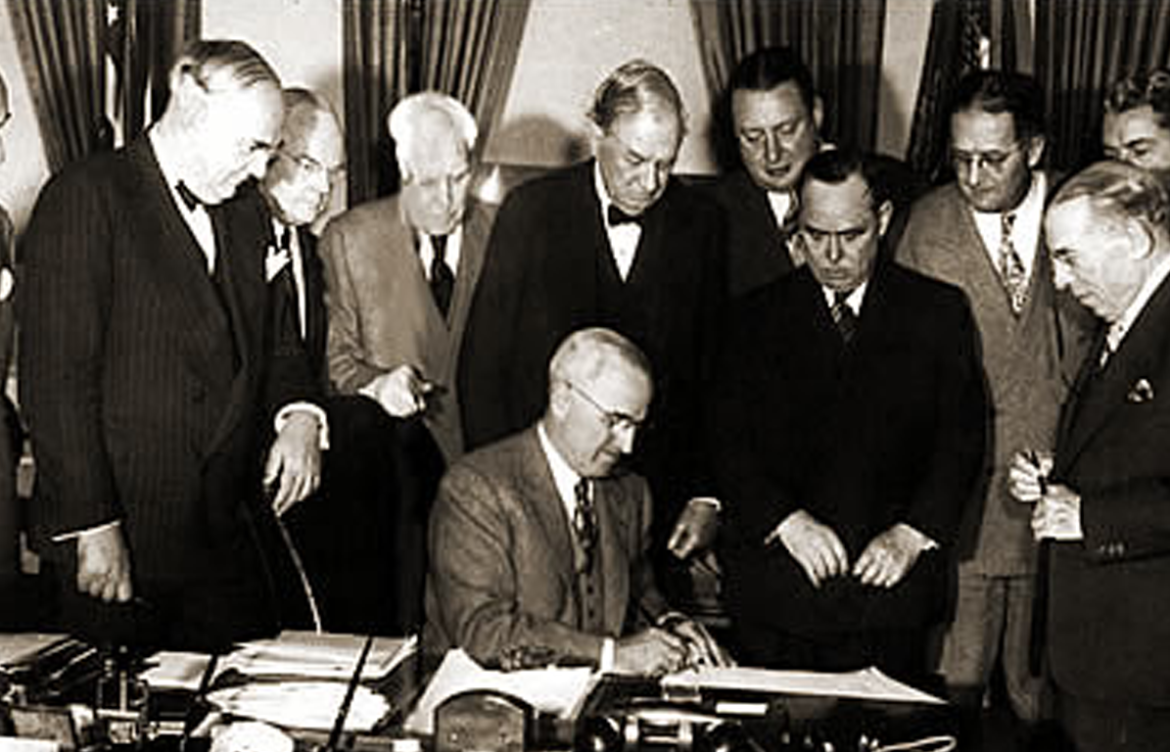
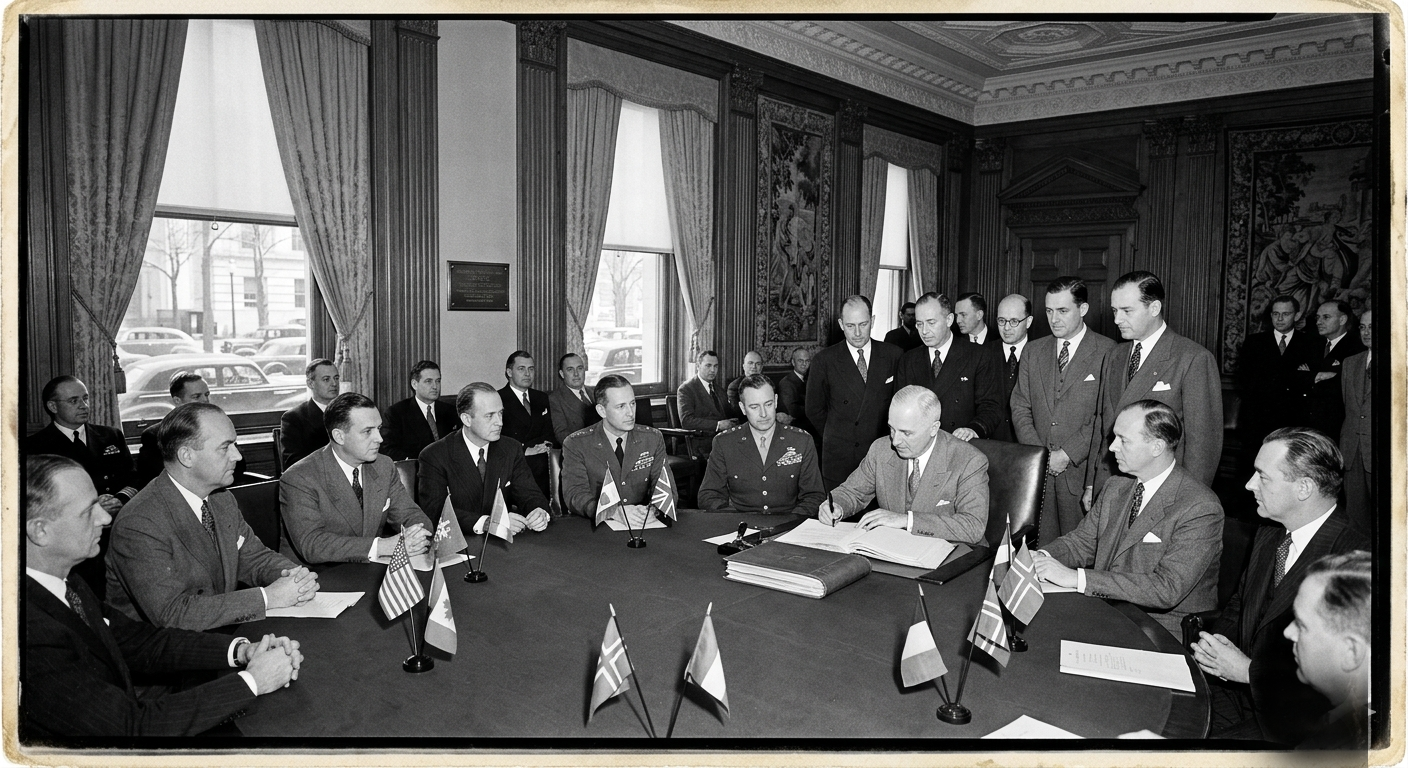
On April 4, 1949, in an auditorium near the White House in Washington, D.C., the foreign ministers and ambassadors of twelve nations gathered to sign a document of only fourteen articles that would fundamentally reshape the security architecture of the modern world. The North Atlantic Treaty — also known as the Washington Treaty — created the North Atlantic Treaty Organization, better known by its acronym NATO, a collective defense alliance that would bind the fate of Western Europe and North America together through the Cold War and into the twenty-first century. President Harry S. Truman, standing beside his Secretary of State Dean Acheson as the signing ceremony took place, declared that the treaty represented ‘a shield against aggression’ that would allow governments to concentrate on achieving ‘a fuller, happier existence for their citizens.’
The creation of NATO was one of the most consequential diplomatic acts in the history of American foreign policy. For the first time since the founding of the republic, the United States was entering a permanent military alliance with other nations in peacetime — a fundamental departure from the tradition of avoiding foreign entanglements that had shaped American strategy since George Washington’s Farewell Address. NATO was, from its inception, more than a military arrangement. It was simultaneously a commitment to collective security, a statement of Western political identity in opposition to Soviet totalitarianism, an instrument for preventing the revival of the nationalist militarism that had twice driven Europe to catastrophe, and a foundation for the economic and political integration that would eventually produce the European Union. The fourteen articles signed on April 4, 1949 launched an alliance that, as of 2024, encompasses thirty-two nations and remains the most successful and durable collective security organization in history.
The World in Ruins: Europe After World War II and the Conditions That Made NATO Necessary
To understand why NATO came into existence in 1949, it is essential to understand the catastrophic condition of Europe in the years immediately following the end of World War II in 1945. The war had been the deadliest conflict in human history, killing an estimated 70 to 85 million people worldwide, approximately 36.5 million of them Europeans, with 19 million of those civilian deaths. The physical destruction across the European continent was staggering: cities had been bombed flat, railways and bridges demolished, factories gutted, agricultural production shattered. In some regions, infant mortality rates in the years immediately after the war reached one in four. Millions of orphans wandered the ruined streets of former metropolises. In Hamburg alone, half a million people were homeless. The continent that had dominated world affairs for centuries was prostrate.
The economic collapse was as severe as the physical devastation. Currencies across Europe were either worthless or desperately devalued. Industrial output had collapsed to a fraction of pre-war levels. Trade networks had been severed. The transportation infrastructure required for any modern economy — railways, roads, bridges, ports — had been systematically destroyed by both sides during the war. Agricultural production was insufficient to feed the population, and food rationing remained a feature of daily life across much of the continent for years after the fighting stopped. In the words of Secretary of State George C. Marshall, speaking at Harvard University in June 1947, the dislocation of the European economy was ‘so much greater than her present ability to pay that she must have substantial additional help or face deterioration of a very grave character.’
The political landscape was no less alarming. Democratic institutions that had existed before the war had been swept away in many countries by years of occupation, collaboration, and conflict. Communist parties, funded and directed from Moscow, had emerged as major political forces in France and Italy — winning approximately 28 percent and 31 percent of the vote respectively in postwar elections. The Soviet Union, which had emerged from the war with the largest army in the world and with its forces occupying all of central and eastern Europe, was systematically imposing communist governments in the countries it controlled: Poland, Romania, Bulgaria, Hungary, Albania, and Yugoslavia all fell under communist domination in the years immediately following the war. The ‘Iron Curtain,’ as Winston Churchill famously described it in his Fulton, Missouri speech of March 5, 1946, had descended across Europe from Stettin in the Baltic to Trieste in the Adriatic, dividing the continent into two incompatible worlds.
The Truman Doctrine and the Marshall Plan: Building the Ideological and Economic Foundation for NATO
The American response to the postwar crisis in Europe began not with military alliances but with economic reconstruction and political commitment. The first major policy articulation came on March 12, 1947, when President Harry S. Truman appeared before a joint session of Congress to announce what became known as the Truman Doctrine. Responding immediately to a British government announcement that it could no longer afford to sustain its military and economic commitments in Greece and Turkey—where communist insurgency in the former and Soviet pressure in the latter threatened to draw both countries into Moscow’s orbit—Truman declared that it must be the policy of the United States ‘to support free peoples who are resisting attempted subjugation by armed minorities or by outside pressures.’ Congress approved $400 million in economic and military aid to Greece and Turkey, and the more general principle — that the United States would assist any democratic government resisting communist pressure — became the foundation of American Cold War policy.
Secretary of State George Catlett Marshall, the former Army Chief of Staff who had been the ‘organizer of victory’ in World War II and whose prestige was unmatched in American public life, followed the Truman Doctrine with an even more ambitious initiative. In his famous Harvard University commencement address of June 5, 1947, Marshall proposed that the United States provide large-scale economic assistance to enable European nations to rebuild their shattered economies. The resulting European Recovery Program — the Marshall Plan — ultimately channeled $13.3 billion in American economic aid to seventeen Western European nations between 1948 and 1951. The Marshall Plan was transformative: it provided the capital and materials that allowed European economies to rebuild, controlled inflation, revived trade, and began the process of economic integration that would eventually produce the European Common Market. But Marshall and Truman understood from the beginning that economic recovery alone was insufficient. Europeans would not invest, trade, and build for the future if they feared that the Red Army might arrive on their borders tomorrow. Security was a precondition for prosperity, and security required more than economic assistance.
The Truman Doctrine and the Marshall Plan were, in Truman’s own formulation, ‘two halves of the same walnut’: complementary instruments of a single strategy designed to prevent the spread of Soviet power by addressing both the economic desperation that created openings for communist political movements and the military vulnerability that left Western Europe unable to defend itself. The third element of this strategy — the collective military alliance that would provide the security umbrella under which economic and political recovery could proceed — was NATO. As Truman’s State Department formulated it, the goal was to create conditions in which free institutions could survive and flourish. The Marshall Plan addressed economic conditions; NATO would address security conditions.
The Prague Coup and the Berlin Blockade: The Crisis Events That Accelerated NATO’s Creation
The abstract strategic logic that pointed toward a transatlantic military alliance was given concrete urgency by two specific events in 1948 that demonstrated, with brutal clarity, the nature and seriousness of the Soviet threat to Western democracy. The first was the communist coup in Czechoslovakia in February 1948. Czechoslovakia was, at that point, the last surviving functioning democracy in Eastern Europe — a country with a genuine parliamentary tradition, free elections, and an active non-communist political life. The Czech Communist Party, with covert backing from the Soviet Union, exploited its position in the government coalition to execute a carefully planned seizure of power, eliminating all non-communist ministers and establishing a one-party state. The Czech Foreign Minister Jan Masaryk, son of the founder of the Czech republic and one of the most respected democratic politicians in Europe, died on March 10, 1948, when he fell from a window of the Foreign Ministry — a death officially ruled a suicide but widely believed to have been murder.
The Prague coup sent shockwaves through Western capitals. If Czechoslovakia — which had been spared the worst of Soviet military occupation and which had been regarded as a viable democratic state — could be swallowed in this fashion, what country in Europe was safe? British Foreign Secretary Ernest Bevin, who had been pressing for a broader collective security arrangement for months, immediately accelerated his efforts, arguing publicly that the best way to prevent the spread of the Prague scenario to other democratic nations was to build a joint Western military strategy with American participation. The United States, which had been cautious about the extent of its military commitments in Europe, was shaken into greater urgency. In Washington, the February coup convinced the Truman administration that a formal military alliance was no longer a desirable option but an urgent necessity.
The second galvanizing event came in June 1948, when Soviet Premier Joseph Stalin launched the Berlin Blockade — a complete land and water blockade of the Allied-controlled sectors of West Berlin, the former German capital that sat as an island of Western democracy surrounded entirely by Soviet-controlled East Germany. Stalin’s gambit was calculated: by cutting off all ground access to West Berlin, he hoped to either force the Western powers to abandon the city or to accept Soviet terms for the governance of Germany. The strategic importance of Germany — the industrial heart of Europe, whose direction would largely determine whether Western or Soviet power prevailed on the continent — made Berlin the most consequential flashpoint of the early Cold War. The Western powers’ response was the Berlin Airlift, a massive and sustained effort to supply West Berlin entirely by air that began on June 26, 1948 and ultimately lasted 323 days, transporting more than two million tons of supplies to the blockaded city. The airlift was a triumph of Western resolve, and on May 12, 1949 — weeks after the NATO treaty had been signed — Stalin lifted the blockade, having failed to achieve his objectives. But the blockade had made the Soviet threat viscerally real to Western publics and governments in a way that abstract strategic analysis could not.
The Brussels Treaty and the Western Union: Europe’s First Steps Toward Collective Security
The path to NATO began with a series of European collective security arrangements that preceded and prepared the ground for the transatlantic alliance. The first step was the Treaty of Dunkirk, signed on March 4, 1947 by France and the United Kingdom — a bilateral mutual defense treaty originally aimed at preventing a resurgent Germany from threatening either country again, reflecting the concerns that still dominated French and British security thinking in the immediate aftermath of World War II. The Treaty of Dunkirk was significant mainly as a precedent: it demonstrated that Britain was willing to enter formal peacetime alliance commitments with continental partners, which had been a matter of considerable uncertainty given Britain’s traditional preference for strategic autonomy.
The more important step came with the Treaty of Brussels, signed on March 17, 1948 — just weeks after the Prague coup had demonstrated the Soviet threat in its most concrete form. The Brussels Treaty expanded the Dunkirk arrangement to include Belgium, the Netherlands, and Luxembourg, creating what became known as the Western Union, a collective defense organization among five Western European democracies. The treaty committed all five signatories to come to each other’s assistance if any of them was attacked — the same principle of collective defense that would be enshrined in NATO’s Article 5. The Brussels Treaty was the direct organizational predecessor to NATO and its Western Union Defence Organisation provided the institutional nucleus around which the broader transatlantic alliance would be constructed. But its limits were equally clear: five relatively small Western European nations, economically exhausted by the war and militarily weak, had formed an alliance — but one that was far too limited to deter the Soviet Union. Only American participation could provide the military weight that the alliance needed.
The recognition that only American involvement could make Western European collective security meaningful drove the diplomatic effort to bring the United States into a formal military alliance. The challenge was formidable. American public opinion and Congressional sentiment were not enthusiastic about permanent peacetime entanglements in European affairs. The tradition of avoiding such commitments was deeply rooted in American political culture. President Truman was concerned that he could not secure either Congressional support or public backing for the kind of binding military commitment that European governments were requesting. The key political figure who unlocked this problem was Senator Arthur Hendrick Vandenberg of Michigan, the chairman of the Senate Foreign Relations Committee and a former isolationist who had been converted to internationalism by the attack on Pearl Harbor.
Senator Vandenberg, Dean Acheson, and Lester Pearson: The Architects of the Alliance
Arthur Hendrick Vandenberg, born March 22, 1884, in Grand Rapids, Michigan, was one of the most important figures in the creation of NATO despite — or perhaps because of — his earlier commitments to American isolationism. Before Pearl Harbor, Vandenberg had been one of the most prominent advocates of American non-entanglement in European affairs, arguing consistently that the United States should avoid the foreign alliances and commitments that had drawn it into World War I. The Japanese attack on Pearl Harbor on December 7, 1941 transformed his views fundamentally; he came to see international engagement and collective security as essential to American interests. His conversion was symbolically important because it gave the Truman administration’s internationalist foreign policy bipartisan cover: if even Vandenberg could support American commitment to European defense, the argument that such commitments were incompatible with American values and traditions was difficult to sustain.
In June 1948, Vandenberg introduced and secured passage of what became known as the Vandenberg Resolution — a Senate resolution, approved by a vote of 64 to 4 on June 11, 1948, that declared the Senate’s support for American participation in regional collective security arrangements within the framework of the United Nations Charter. The resolution was crucial because it established the congressional willingness to consider a formal military alliance that Truman needed before he could commit the United States to the North Atlantic Treaty. By passing the Vandenberg Resolution, the Senate effectively authorized the negotiation of what became NATO, removing the most significant domestic political obstacle to the alliance’s creation. Vandenberg remained a key figure throughout the subsequent ratification debate, shepherding the treaty through the Senate Foreign Relations Committee and managing the floor debate that resulted in the Senate’s approval of the treaty on July 21, 1949 by a vote of 82 to 13.
Dean Gooderham Acheson, born April 11, 1893, in Middletown, Connecticut, succeeded George Marshall as Secretary of State in January 1949 and became the principal American negotiator of the NATO treaty and the official who signed it on behalf of the United States. Acheson was a patrician Connecticut lawyer with a formidable intellect, a precise and forceful manner of expression, and a strategic vision that understood the Soviet threat with unusual clarity and insisted that only American power, deployed in sustained commitment to European security, could prevent Soviet domination of the continent. His tenure as Secretary of State from 1949 to 1953 was defined by NATO’s creation, the Korean War, and the construction of the network of alliances and commitments that formed the institutional architecture of the Western response to Soviet power. Acheson’s memoir of his years as Secretary of State, Present at the Creation, took its title from the sense that he and his colleagues were building the framework of a new international order — and NATO was its cornerstone.
On the Canadian side, Lester Bowles Pearson — born April 23, 1897, in Newtonbrook, Ontario — played a role that historians have sometimes underestimated. As Canada’s Secretary of State for External Affairs, Pearson was a key drafter and author of the North Atlantic Treaty text, and he was among the signatories at Washington on April 4, 1949. Pearson had a particular interest in ensuring that the treaty was not merely a military defensive pact but also an expression of shared political values — what he called the ‘Article 2’ approach, after his proposal that the treaty include a commitment to democratic values, free institutions, and economic cooperation alongside the military defense provisions. His vision of NATO as a community of values as well as a military alliance shaped the treaty’s preamble and influenced its subsequent interpretation. Pearson would later win the Nobel Peace Prize in 1957 for his role in resolving the Suez Crisis, but his contribution to NATO’s creation was among the most consequential acts of his distinguished diplomatic career. Canadian diplomat Theodore Achilles, also deeply involved in the treaty’s drafting, chaired the committee that finalized the Washington Treaty text.
The European foreign ministers who signed the treaty also brought their own crucial contributions. Belgium’s Paul-Henri Spaak, who signed as both Prime Minister and Foreign Minister, was one of the most committed advocates of European integration and transatlantic solidarity. France’s Robert Schuman, who would later become one of the founding fathers of the European Community with his 1950 Schuman Plan for a European Coal and Steel Community, represented the French perspective that a strong transatlantic alliance was essential to contain both Soviet power and German nationalism simultaneously. Britain’s representation at the signing was handled through Ambassador, as the Foreign Secretary Ernest Bevin — who had been perhaps the most energetic advocate for bringing the United States into a European security arrangement — was unable to attend the ceremony personally.
Negotiating the Treaty: The Difficult Questions That Had to Be Resolved
The negotiation of the North Atlantic Treaty, conducted through a series of meetings in Washington beginning in March 1948 and concluding with the formal treaty sessions in December 1948 through March 1949, required the resolution of several genuinely difficult questions on which the prospective allies held divergent views. The central question was the nature of the mutual defense obligation — specifically, how binding the commitment to come to each other’s defense would be. The United States, concerned about constitutional constraints (only Congress could declare war) and wary of being drawn automatically into conflicts by treaty obligations, insisted that the treaty should not require any specific military response to an attack on a member. The European states, which wanted the firmest possible guarantee of American military intervention, pushed for a clear automatic commitment to go to war.
The compromise that resolved this tension is embodied in Article 5 of the North Atlantic Treaty, which became and remains the most important provision of the alliance. Article 5 declares that an armed attack against one or more of the member states ‘shall be considered an attack against them all’ and that in response, each member will take ‘such action as it deems necessary, including the use of armed force.’ The crucial phrase is ‘as it deems necessary’ — each member retains the right to determine its own response to an attack on an ally. The treaty does not automatically commit any member to go to war; it commits each member to take ‘such action as it deems necessary,’ which could theoretically be as limited as a diplomatic protest. In practice, of course, the political and moral weight of the alliance means that the implied commitment to military action is overwhelming — but the treaty’s language was deliberately crafted to preserve American constitutional requirements and individual national sovereignty. This formulation satisfied the American need for constitutional flexibility while providing European allies with a guarantee strong enough to serve as a genuine deterrent.
A second contentious question was the geographic scope of the alliance — which territories and which attacks would be covered by Article 5. The final resolution defined NATO’s ‘area of responsibility’ as the territory of member states in Europe, North America, and the North Atlantic north of the Tropic of Cancer, including the Mediterranean. This definition deliberately excluded colonial territories; the United States, conscious of the political complications that would arise from being obligated to defend European colonial possessions, insisted that the Belgian Congo, France’s colonial empire, and other overseas territories be excluded. The question of whether the treaty should be of limited or unlimited duration was also debated; at Portugal’s insistence, the treaty was set for an initial term of twenty years, after which members could withdraw with one year’s notice.
A third question involved membership: which countries should be included in the original alliance beyond the five Brussels Treaty signatories and the United States. Canada’s inclusion was straightforward and broadly desired; Canada had fought in both world wars alongside Britain and the other allies and was an essential part of any genuine North Atlantic security arrangement. Italy’s inclusion was more controversial — Italy had been on the opposing side in World War II — but was judged essential given the strength of the Italian Communist Party and Italy’s strategic position in the Mediterranean. Portugal’s inclusion was similarly strategic despite the undemocratic nature of António de Oliveira Salazar’s authoritarian regime; Portugal’s geographic position on the Atlantic coast and its possession of the Azores, crucial for transatlantic air and sea communications, made its inclusion militarily indispensable. Denmark, Norway, and Iceland completed the alliance, providing coverage of the northern approaches. Ireland was considered for membership but declined because of its policy of neutrality. Sweden and Switzerland similarly chose not to join despite their geographic relevance.
April 4, 1949: The Signing Ceremony at the Departmental Auditorium in Washington
The North Atlantic Treaty was signed on April 4, 1949, at the Departmental Auditorium in Washington, D.C. — a neoclassical building on Constitution Avenue that served as the venue for the ceremony. The twelve founding member nations were represented by their foreign ministers and ambassadors: Belgium by Prime Minister and Foreign Minister Paul-Henri Spaak and Ambassador Baron Robert Silvercruys; Canada by Secretary of State for External Affairs Lester B. Pearson and Ambassador H.H. Wrong; Denmark by Foreign Minister Gustav Rasmussen and Ambassador Henrik Kauffmann; France by Foreign Minister Robert Schuman and Ambassador Henri Bonnet; Iceland by Foreign Minister Bjarni Benediktsson and Ambassador Thor Thors; Italy by Foreign Minister Carlo Sforza and Ambassador Alberto Tarchiani; Luxembourg by Foreign Minister Joseph Bech and Ambassador Hugues Le Gallais; the Netherlands by Foreign Minister Dirk Stikker and Ambassador Eelco van Kleffens; Norway by Foreign Minister Halvard Manthey Lange and Ambassador Wilhelm Munthe de Morgenstierne; Portugal by Foreign Minister Jose Caeiro da Mata and Ambassador Jose Leite Vasconcelos; the United Kingdom by Foreign Secretary Ernest Bevin (who attended despite earlier uncertainty about his availability) and Ambassador Sir Oliver Franks; and the United States by Secretary of State Dean Acheson, with President Truman and Vice President Alben W. Barkley present.
The treaty itself was short — only fourteen articles — but those fourteen articles established the entire legal and institutional framework of the alliance. Article 1 committed members to settle international disputes by peaceful means. Article 2 pledged to strengthen free institutions and promote conditions of stability and well-being. Article 3 established the obligation to maintain and develop individual and collective capacity to resist armed attack. Article 4 provided for consultation when any member’s security was threatened. Article 5 established the core collective defense commitment. Articles 6 through 14 addressed the treaty’s geographic scope, its relationship to the United Nations Charter, the establishment of the North Atlantic Council, the process for admitting new members, and the duration and amendment procedures. The entire document was built on Article 51 of the United Nations Charter, which explicitly recognized the right of individual and collective self-defense — a legal foundation that insulated NATO from Soviet charges that it violated the UN system.
President Truman’s remarks at the signing ceremony captured the alliance’s dual character as both a military deterrent and a political statement of values. He described NATO as ‘a simple document’ but one with ‘profound meaning,’ and emphasized that the signatory nations were not merely allies of military convenience but peoples who shared fundamental commitments to democracy, individual freedom, and the rule of law. The treaty, Truman said, was not directed against any particular country but against ‘aggression and war’ as such. It was a shield, not a sword — a defensive arrangement that sought to prevent conflict by making the cost of attacking any member nation too high for any potential aggressor to contemplate. The Senate subsequently ratified the treaty on July 21, 1949, by a vote of 82 to 13, with the decisive margin reflecting the bipartisan consensus that Vandenberg and Acheson had built.
Building the Military Structure: SHAPE, Eisenhower, and the Korean War’s Impact
The signing of the North Atlantic Treaty on April 4, 1949 created the alliance’s legal and political framework, but it did not initially create the military structure needed to make collective defense a practical reality. The treaty committed members to come to each other’s defense but did not specify how. NATO was, for its first year, more a political commitment than an operational military force. This changed rapidly — and dramatically — in response to two events that occurred within months of the treaty’s signing: the Soviet Union’s first successful test of a nuclear weapon in August 1949, which shattered the American nuclear monopoly and transformed the strategic calculus of the Cold War; and the outbreak of the Korean War in June 1950, when North Korean forces invaded South Korea in an attack that Western leaders interpreted as evidence of Soviet willingness to use military force to extend communist power.
The Korean War created an urgent sense in NATO capitals that the alliance needed to be transformed from a treaty commitment into an integrated military force capable of actually defending Western Europe against Soviet attack. The United States took dramatic steps to demonstrate its commitment to European security: it substantially increased the number of American troops stationed in Europe, secured the agreement of NATO members to admit Greece and Turkey to the alliance in 1952, and appointed General Dwight D. Eisenhower — the Supreme Allied Commander in World War II and the most celebrated American military figure of the era — as the first Supreme Allied Commander Europe (SACEUR) in December 1950. SHAPE — Supreme Headquarters Allied Powers Europe — was established in the Parisian suburb of Rocquencourt, near Versailles, with Eisenhower personally leading the effort to plan and coordinate the defense of Western Europe. NATO also appointed its first Secretary General, Lord Ismay of the United Kingdom, who gave the alliance its permanent civilian leadership structure.
The admission of West Germany to NATO in 1955 was the most politically charged membership decision of the alliance’s first decade. France, whose security concerns about a resurgent Germany remained acute, had initially blocked German rearmament and German membership, proposing instead a European Defence Community that would integrate German forces into a supranational European army. When the French National Assembly rejected the European Defence Community in August 1954, NATO membership became the alternative framework for German rearmament, with the Western European Union serving as the organizational mechanism. West Germany (the Federal Republic of Germany) became a NATO member on May 5, 1955, and the Soviet Union responded six days later by creating the Warsaw Pact — a Soviet-dominated military alliance encompassing East Germany, Poland, Czechoslovakia, Hungary, Romania, Bulgaria, and Albania. Europe was now formally divided into two armed camps, each organized under a collective defense alliance, and the Cold War had assumed the institutional shape it would maintain for the next thirty-five years.
Article 5 in Theory and Practice: Collective Defense, Nuclear Deterrence, and the Cold War
Throughout the Cold War, NATO’s primary military purpose was deterrence rather than actual combat. The strategy of deterrence rested on the calculation that the cost of attacking any NATO member — the certainty of triggering not just that nation’s defense but the collective military response of the entire alliance, including the United States’ nuclear arsenal — would be too high for the Soviet Union to accept. The concept of ‘extended deterrence’ — the idea that the American nuclear umbrella covered all NATO members — was the central military doctrine of the alliance. Western Europe was effectively sheltered under the threat of American nuclear retaliation against any Soviet attack, a situation that gave European NATO members security they could not have provided for themselves.
The specific formulation of nuclear strategy evolved through multiple phases. The early 1950s doctrine of ‘massive retaliation’ — the threat of a large-scale nuclear response to any Soviet aggression, conventional or nuclear — gave way in the early 1960s to ‘flexible response,’ which envisioned a range of graduated military options rather than an all-or-nothing nuclear response. The debate about nuclear strategy within NATO was often intense: European members who hosted American nuclear weapons on their territory wanted assurance that those weapons would actually be used if they were attacked, while the United States wanted flexibility to control nuclear escalation. The balance between American strategic primacy and European allied influence was a persistent source of tension that was never fully resolved but was managed successfully enough to preserve alliance cohesion through the Cold War’s most dangerous phases.
Article 5’s collective defense commitment was formally invoked only once during the first seventy-five years of NATO’s existence — and the occasion was not the Cold War confrontation with the Soviet Union that the treaty’s authors had envisioned but the September 11, 2001 terrorist attacks on the United States. NATO’s North Atlantic Council determined on October 4, 2001 that the attacks met the treaty’s definition of an armed attack against a member state, and the invocation was confirmed, representing the first time in history that an attack on the United States had triggered a collective defense response from all of America’s European allies. The invocation led to NATO members’ participation in Operation Enduring Freedom in Afghanistan and the subsequent International Security Assistance Force mission, the alliance’s longest and most complex military operation.
NATO Expansion After the Cold War: From 12 to 32 Members
The dissolution of the Soviet Union in December 1991 and the end of the Cold War raised fundamental questions about NATO’s continued purpose and relevance. With the threat that had justified the alliance’s creation having ceased to exist, some argued that NATO should be dissolved or significantly transformed. The alliance’s response was to redefine its mission — from pure collective defense against Soviet aggression to what NATO officials called ‘cooperative security,’ encompassing crisis management, peacekeeping, democratic consolidation, and the stabilization of the post-communist transitions in Central and Eastern Europe. This transformation required the alliance to adapt both its doctrine and its membership.
The most significant change in NATO’s post-Cold War evolution was its dramatic expansion eastward. Former Warsaw Pact members and Soviet republics, freed from Soviet domination, overwhelmingly sought NATO membership as the most reliable guarantee of their newly recovered independence and security. Poland, Hungary, and the Czech Republic joined in 1999. Bulgaria, Estonia, Latvia, Lithuania, Romania, Slovakia, and Slovenia joined in 2004. Albania and Croatia joined in 2009. Montenegro joined in 2017. North Macedonia joined in 2020. Finland joined in April 2023, becoming NATO’s thirty-first member, following Russia’s invasion of Ukraine in February 2022. Sweden joined as the thirty-second member in March 2024, completing a dramatic transformation of the Nordic security landscape. NATO’s eastward expansion has been one of the most consequential geopolitical developments of the post-Cold War era and a persistent source of tension with Russia, which has argued that the expansion violated informal assurances made during German reunification negotiations in 1990.
NATO’s first military operations also came in the 1990s, when the organization intervened in the conflicts arising from the dissolution of Yugoslavia. NATO enforced no-fly zones over Bosnia-Herzegovina, conducted air strikes against Bosnian Serb forces in 1995, and led the Implementation Force and its successor the Stabilization Force following the Dayton Peace Accords. In 1999, NATO conducted a 78-day air campaign against Yugoslavia in response to the Kosovar Albanian population’s situation in Kosovo, ultimately forcing the withdrawal of Yugoslav forces and establishing the UN-mandated KFOR peacekeeping force that remains in Kosovo to this day. These operations represented NATO’s first active use of military force in its history and its first operations outside its original North Atlantic area of responsibility.
Lord Ismay’s Famous Formula: Keeping the Americans In, the Russians Out, and the Germans Down
NATO’s first Secretary General, Hastings Lionel Ismay, 1st Baron Ismay — who served from 1952 to 1957 and had previously served as Winston Churchill’s Chief Military Assistant during World War II — is credited with articulating what became one of the most quotable summaries of the alliance’s purpose. Asked to describe NATO’s purpose, Ismay is said to have replied that NATO existed ‘to keep the Russians out, the Americans in, and the Germans down.’ The formula was characteristically pithy and memorable, and it captured three of the alliance’s actual founding purposes with remarkable economy: deterring Soviet expansion into Western Europe, maintaining American military engagement on the European continent, and embedding West Germany within a collective security framework that would prevent the nationalist militarism that had twice devastated the continent.
The ‘Germans down’ dimension of Ismay’s formula referred not to a permanent subordination of Germany but to the channeling of German power and nationalism into constructive institutional frameworks — NATO for defense, what would become the European Community for economics — that would make a unilateral German bid for continental hegemony both unnecessary and impossible. In this sense, NATO was from its inception an institution designed not only to deter external threat but to manage and transform the internal dynamics of European politics. The fear of a revived German militarism was as present in the minds of French, British, and American policymakers in 1949 as the fear of Soviet expansion, and NATO’s institutional framework addressed both simultaneously. The success of this design was evident in the fact that a reunified Germany remained within NATO after 1990 — channeling its enormous economic and political power into the alliance and into the European Union rather than into the kind of independent strategic action that had twice produced world war.
The Legacy of April 4, 1949: NATO in the Twenty-First Century
The North Atlantic Treaty Organization that was founded on April 4, 1949 with twelve member states and an annual budget reflecting the military exhaustion of postwar Western Europe had, by its seventy-fifth anniversary in 2024, grown to thirty-two member states with a combined GDP representing approximately fifty-five percent of global economic output and a collective defense spending of more than one trillion dollars annually. It had survived the Cold War, the dissolution of the Soviet Union, the September 11 attacks, a civil war in Libya, a war in Afghanistan, the Russian annexation of Crimea in 2014, and Russia’s full-scale invasion of Ukraine in 2022 — the last of which triggered the most significant NATO mobilization since the Cold War’s end, with the alliance positioning additional forces in its eastern member states and providing military assistance to Ukraine on an unprecedented scale.
Russia’s invasion of Ukraine in February 2022 demonstrated the continuing relevance of NATO’s founding purpose with a clarity that no one who had watched the alliance navigate the post-Cold War decades of uncertain mission could have entirely anticipated. The invasion provoked Finland and Sweden — two nations that had maintained strict neutrality throughout the Cold War and post-Cold War periods — to apply for NATO membership within months, completing the Nordic security architecture that Finland and Sweden’s presence had always left incomplete. The war in Ukraine also demonstrated the practical value of NATO’s institutional infrastructure: the alliance’s logistics networks, intelligence-sharing arrangements, standardized military procedures, and political consultation mechanisms all proved essential to the coordination of Western support for Ukraine even in a conflict that Ukraine was conducting largely with its own forces.
The question of NATO’s future — whether the alliance can maintain the unity of purpose and the equitable burden-sharing arrangements necessary to remain effective as a security organization in the twenty-first century — is one of the central strategic questions of our time. Debates about whether NATO members are spending enough on defense (the two-percent-of-GDP target that became a formal guideline in 2006 and a point of persistent American political pressure in subsequent years), whether the alliance can effectively address new domains of conflict such as cyber warfare and disinformation, and whether its collective defense commitment can be maintained in the face of both external pressure and internal political divergence are all active subjects of debate within the alliance. None of these challenges alters the basic assessment that NATO’s creation on April 4, 1949 was among the most consequential and enduring diplomatic achievements of the twentieth century.
Conclusion: Fourteen Articles That Changed the World
The North Atlantic Treaty that was signed in Washington on April 4, 1949 was, as President Truman noted, a simple document — only fourteen articles, totaling a few hundred words. Its core commitment, embodied in Article 5, could be stated in a single sentence: an attack on any member shall be considered an attack against them all. But the consequences of that commitment, and of the institution created to give it practical force, have been anything but simple.
NATO was created at one of the most dangerous and uncertain moments in modern history, when Western democracy faced the combined threats of economic collapse, political instability, Soviet military power, and the possibility that the continent of Europe — which had been the cockpit of two world wars in thirty years — might be permanently lost to freedom. The men who gathered in Washington on April 4, 1949 — Truman, Acheson, Vandenberg, Pearson, Spaak, Schuman, Bevin, and their colleagues — were under no illusions about the stakes. They were building, as Acheson’s memoir title would later describe it, a new international order, and NATO was its security foundation.
What they built has lasted. The twelve founding members of 1949 have grown to thirty-two. The Soviet threat that NATO was created to deter no longer exists in its original form, though a revanchist Russia has reasserted an analogous threat in a new century. The institutional structures established in NATO’s early years — SHAPE, the North Atlantic Council, the Secretary General, the standardized procedures and integrated command arrangements — have proven durable enough to outlast the Cold War and adapt to a range of challenges their creators could not have foreseen. And Article 5, the collective defense commitment that lies at NATO’s heart, remains as the foundational promise of the alliance: that no member nation stands alone, that the freedom of each is bound up with the freedom of all, and that the strength of democratic solidarity is greater than any threat it may face. Those were the principles on which NATO was founded on April 4, 1949. They remain the principles on which it stands today.