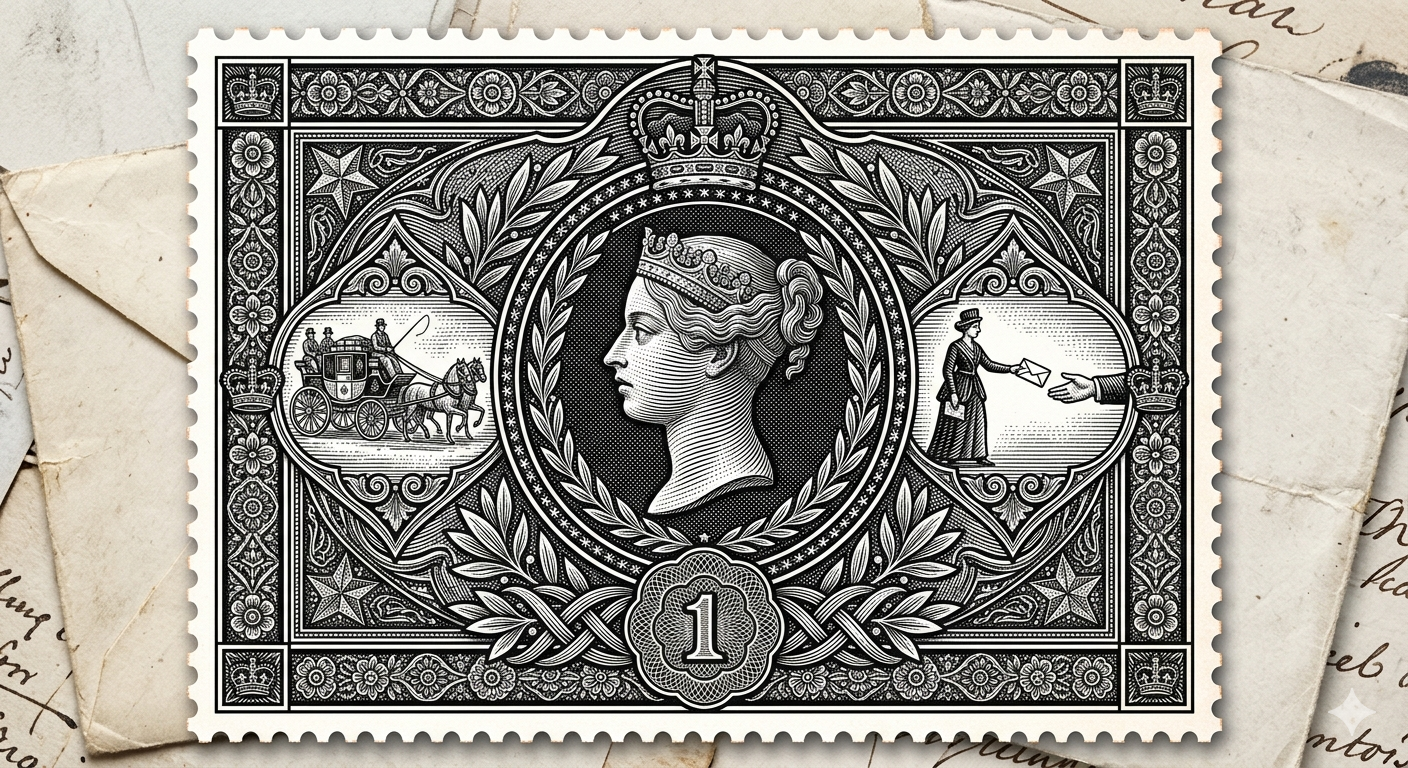
Introduction: A Small Stamp That Changed the World
In May 1840, a tiny rectangular piece of gummed black paper measuring less than one square inch was introduced to the British public. It cost a single penny. Yet its impact on the way human beings communicated, organized commerce, and connected with one another across geographical distances was nothing short of revolutionary. This was the Penny Black — the world’s first adhesive postage stamp used in a public postal system. It did not merely simplify letter-sending; it democratized communication itself, placing the ability to correspond with anyone in the British Isles within reach of nearly every citizen regardless of social standing or economic class.
Before the Penny Black arrived, the act of sending a letter in Great Britain was a complicated, expensive, and often frustrating affair. The recipient paid upon delivery, costs varied wildly based on the number of sheets and the miles traveled, and corruption within the postal system ran deep. A working-class family receiving a letter from a distant relative might face a charge equivalent to a full day’s wages. Many letters were refused outright because the intended recipient simply could not afford to accept them. It was a system that served no one well — except, perhaps, the entrenched interests that profited from its complexity.
Into this dysfunctional landscape stepped Rowland Hill, an English teacher, inventor, and social reformer whose determination to fix a broken institution would ultimately transform not just British communication but the entire global postal order. The Penny Black was the tangible product of his vision, a small slip of paper that became one of the most historically significant objects ever manufactured in the modern era.
Part I: The Broken Postal System of Pre-Victorian Britain
How Letters Were Sent Before the Penny Black
To understand why the Penny Black was so transformative, one must first understand the chaos it replaced. In early nineteenth-century Britain, the postal system was governed by a labyrinthine set of rules that had accumulated over centuries without any unifying logic. The cost of sending a letter was calculated based on two primary factors: the distance it needed to travel and the number of sheets of paper it contained. A single sheet sent a short distance might cost only a few pence, while a multiple-sheet letter journeying from London to Edinburgh could cost more than a shilling — a sum beyond the means of most ordinary citizens.
The system also operated on an unusual financial arrangement. Rather than the sender paying the cost of postage at the time of dispatch, the burden typically fell upon the recipient. Upon delivery of a letter, the postal carrier would collect the required fee directly from the person receiving the correspondence. This arrangement created enormous practical problems. Recipients who could not afford the fee — or who simply chose not to pay — could refuse the letter entirely, leaving postal workers with unrecoverable delivery costs. The Post Office carried substantial financial losses as a result, and the overall volume of letters passing through the system remained far below its potential.
Corruption, Franking Privileges, and the Culture of Evasion
The pre-reform postal system was also riddled with structural inequalities that further undermined public confidence. Members of Parliament enjoyed what was known as the ‘franking privilege’ — the right to send and receive a certain number of letters entirely free of charge. This privilege was widely abused. MPs routinely allowed friends, family members, and constituents to attach their correspondence to parliamentary mail, effectively bypassing the postal fees entirely. Similar exemptions applied to various other officials and individuals by virtue of their positions, creating a two-tiered system in which the wealthy and well-connected escaped the costs borne by ordinary citizens.
The public, in turn, developed its own creative methods of evasion. Because senders paid nothing until delivery, resourceful letter-writers devised ways of conveying information through the envelope itself without its ever being opened. A person waiting for news from a traveling relative might arrange a code: certain markings on the outside of the envelope could signal whether the sender was safe and well. Upon seeing the letter delivered, the recipient would examine the outside, deduce the message, and then refuse to accept the letter — avoiding the fee while still receiving the communication. The Post Office, of course, received no revenue from these transactions at all. The entire system was, by any rational assessment, broken beyond incremental repair.
Part II: Rowland Hill and the Vision of Postal Reform
The Man Behind the Stamp — Rowland Hill’s Life and Background
Rowland Hill was born on December 3, 1795, in Kidderminster, Worcestershire, England, the son of Thomas Wright Hill, a progressive schoolmaster who ran an institution that emphasized student self-governance and democratic principles. Rowland followed his father into education, becoming a teacher himself and developing a broad range of intellectual interests that extended far beyond the classroom. His curiosity encompassed printing, astronomy, mathematics, and transportation systems — a combination of interests that would ultimately converge in his groundbreaking analysis of the British postal service.
Hill first turned his attention to postal reform around 1835, after years of observing the dysfunction of the existing system. He was struck not only by the practical inefficiencies but by the moral injustice of a system that effectively taxed the correspondence of the poor while allowing the privileged classes to communicate freely. He spent two years conducting exhaustive research, acquiring official Post Office documents through the assistance of Robert Wallace, a Member of Parliament and persistent advocate for postal reform who used his own franking privilege to supply Hill with the government materials he needed.
Post Office Reform: Its Importance and Practicability — The 1837 Pamphlet
In January 1837, Rowland Hill published the results of his research in a pamphlet titled Post Office Reform: Its Importance and Practicability. Distributed initially in a version marked ‘Private and Confidential,’ the pamphlet was passed to Thomas Spring-Rice, the Chancellor of the Exchequer, as part of a government inquiry into the state of the postal service. In it, Hill laid out his argument with the precision and rigor of a mathematician, demonstrating that the high postal rates were economically counterproductive — that the cost of managing the complex charging system, combined with the revenue lost through evasion and refused deliveries, made the entire model financially irrational.
Hill’s proposed solution was disarmingly simple. He called for a low, uniform rate of postage — one penny per half-ounce letter — to apply regardless of the distance the letter needed to travel, anywhere within the British Isles. This flat-rate model would be based on weight rather than distance, eliminating the complex calculations that made the existing system so cumbersome. Most importantly, Hill proposed that postage should be prepaid by the sender, not collected from the recipient upon delivery. This single change would eliminate the enormous administrative burden of chasing down payments after the fact and would guarantee revenue for the Post Office at the point of dispatch.
To facilitate prepayment, Hill suggested two methods. The first was a prepaid envelope or lettersheet that would already carry the postage marking. The second, almost offhandedly described, was ‘a bit of paper just large enough to bear the stamp, and covered at the back with a glutinous wash.’ This throwaway description was, in essence, the conceptual birth of the adhesive postage stamp — the idea that would become the Penny Black.
Parliamentary Resistance and the Fight for Acceptance
Hill’s proposals were not immediately embraced by the establishment. The Post Office itself, under its then-leadership, strongly opposed the reforms, dismissing them as financially reckless and logistically impractical. Critics labeled the idea of uniform penny postage ‘wild and visionary,’ arguing that the dramatic reduction in postal rates would devastate government revenues without producing the surge in mail volume that Hill predicted would compensate for the lower per-letter income. The entrenched interests within the postal bureaucracy had every reason to resist a reform that would strip away the complexity — and the patronage opportunities — that the existing system provided.
Hill’s campaign, however, quickly captured the public imagination. A committee of merchants, traders, and businesspeople who were acutely aware of how high postal rates impeded commerce organized in support of his proposals. Henry Cole, a versatile Victorian reformer who would later become famous for his role in founding the Victoria and Albert Museum and introducing the commercial Christmas card, became a key ally, producing a propaganda newspaper called The Post Circular to build popular pressure for change. The campaign eventually gained enough traction to force a formal parliamentary inquiry under Robert Wallace MP, and in August 1839, Queen Victoria gave royal assent to the Postage Duties Bill, officially authorizing the reform program.
Rowland Hill was then appointed to the Treasury to oversee the implementation of his proposals, with Henry Cole serving as his assistant. The Victorian postal revolution was about to begin in earnest.
Part III: Designing the World’s First Stamp — The Treasury Competition
The 1839 Public Design Competition and Its 2,600 Entries
With the legal framework for postal reform now in place, the immediate practical challenge was determining exactly how the prepayment of postage would work — and what the proposed adhesive label, Hill’s ‘bit of paper with a glutinous wash,’ would look like. In September 1839, the British Treasury announced a public competition, inviting citizens to submit proposals for the best method of implementing the prepaid postage system. The competition offered prize money of two hundred pounds for the best suggestion and one hundred pounds for the second best, and entries would be judged on four criteria covering practicality, security, and economy.
The response was extraordinary. More than 2,600 entries were submitted from across Britain and beyond. The proposals ranged from the ingenious to the absurd, from elaborate mechanical cancellation systems to fantastical multilayered designs that would have been hopelessly impractical to produce at scale. Working with Henry Cole, Rowland Hill methodically reviewed every entry, completing a comprehensive report in December 1839. The Treasury ultimately awarded the two prizes — to Henry Cole himself and to Charles Whiting, a printer who had been involved in producing postal reform propaganda — but concluded that none of the 2,600 submissions was entirely suitable for adoption as the final design.
The Artistic Stakeholders: William Wyon, Henry Corbould, and the Heath Family
With the competition failing to produce an acceptable design, Hill and his colleagues turned to a different approach. The key question was whose portrait should appear on the stamp. For security purposes — to make the stamps as difficult as possible to counterfeit — it was decided that the image of Queen Victoria would serve as the central design element. A recognizable royal portrait, it was reasoned, was the hardest possible design for forgers to replicate convincingly.
The image of Queen Victoria used on the Penny Black was derived from a remarkable chain of artistic collaboration. William Wyon, the Chief Engraver at the Royal Mint, had created a medal in 1837 to commemorate Queen Victoria’s visit to the City of London in November of that year. For this City Medal, Wyon had engraved a portrait of the young queen based on a sketch made in 1834 when Victoria was only fifteen years old. The resulting image captured a youthful, dignified profile that was widely considered one of the most perfect likenesses ever engraved. Rowland Hill identified this portrait as the ideal basis for the stamp design.
To translate Wyon’s medal portrait into a printable format suitable for the stamp, artist Henry Corbould was commissioned to create a detailed sketch based on the medal. This sketch was then passed to Charles Heath and his son Frederick Heath, professional engravers who were tasked with cutting the portrait into a steel die for intaglio printing. The process proved challenging: the first engraving failed to transfer properly to the printing plate, requiring the entire die to be engraved a second time before it met the necessary standards. The printing contract for the actual production of the stamps was awarded to the firm of Perkins, Bacon and Petch, whose steam-powered cylinder press — originally invented by the American engineer Jacob Perkins and patented in 1819 — provided the secure intaglio printing technology required.
Security Features, Corner Letters, and the Sheet Format
The final design of the Penny Black incorporated several security features designed to prevent forgery and unauthorized reuse. The background of the stamp was filled with intricate white-line machine engraving — the same type of engine turning used on banknotes — which made exact reproduction extremely difficult without the specialized equipment used by the original printers. The upper two corners of the design featured distinctive star-like decorations incorporating Maltese crosses with radiant solar discs at their centers.
One of the most ingenious security features was a system of variable corner letters in the lower two corners of each stamp. Each stamp bore a unique pair of letters indicating its precise position within the printed sheet: the letter in the lower-left corner identified the stamp’s row (running from A at the top to T at the bottom), while the lower-right corner letter identified its column (running from A on the left to L on the right). This meant that every single stamp in a sheet was uniquely identifiable, providing a powerful deterrent against forgery and allowing postal authorities to detect any attempt to copy an individual stamp. The stamps were printed in sheets of 240 — arranged in 20 rows of 12 columns — which was a deliberate choice reflecting the monetary system: 240 pennies equaled one pound sterling, so each complete sheet cost exactly one pound.
The plate for the one-penny black labels was completed on April 1, 1840, and a proof impression was taken from it that same day. Printing on watermarked paper commenced on April 11, and by the time the stamps went on sale, the production operation was running at a remarkable rate of approximately 600,000 stamps per day. The word ‘POSTAGE’ was inscribed at the top of the design in capital letters, clearly distinguishing the new adhesive label from the revenue stamps that had long been used in Britain for tax purposes, while ‘ONE PENNY’ appeared at the bottom, stating the amount of postage prepaid.
Part IV: May 1840 — The Official Launch and Public Reception
May 1, 1840: First Day of Sale and the Unofficial Early Adoptions
On May 1, 1840, both the new adhesive postage stamps — the one-penny black and the two-penny blue, the latter covering the double-letter rate for letters up to one ounce — and the Mulready stationery went on sale to the public in London. The Mulready stationery, designed by the Royal Academician William Mulready and engraved by John Thompson, featured an elaborate allegorical design depicting Britannia at the center surrounded by images of the British Empire, described by its admirers as ‘poetic.’ All London post offices received official supplies of the new stamps, though many post offices elsewhere in the United Kingdom had not yet received their allocations and continued accepting cash payments for postage during a transitional period.
Although the stamps went on sale on May 1, they were not officially valid for use as postage until May 6, 1840. Despite this, some post offices — most notably the one in Bath — sold stamps unofficially before the designated date, and postal covers bearing Penny Black stamps postmarked as early as May 2 are known to exist. A single example of a cover dated May 1, 1840, has been documented. The earliest known piece of mail bearing a Penny Black and definitively sent through the postal system was mailed on the evening of May 2, 1840, dispatched from London to William Blenkinsop Jr., the thirty-five-year-old manager of a Victorian iron works in the north of England — a journey of more than three hundred miles.
May 6, 1840: Official First Day of Use and the Public Enthusiasm
May 6, 1840, marked the official first day on which the Penny Black was valid for postage. More than seventy first-day covers bearing Penny Black stamps are known to have survived. The public response to the adhesive stamp was immediate and enthusiastic. In sharp contrast, the Mulready stationery was met with instant ridicule — its ornate allegorical design was widely mocked, giving rise to a flood of satirical caricature versions that parodied the original. The Mulready stationery had to be withdrawn from sale in 1841, its vast unsold stocks redirected to government departments for official use.
The introduction of the Penny Black also brought with it a new accessory item. Postmasters were now required to apply an ink cancellation to each stamp to prevent it from being removed and reused on a subsequent letter. For this purpose, a distinctive ‘Maltese Cross’ design was selected as the standard cancellation mark, to be applied in red ink. The choice of red was intended to create maximum visibility against the black background of the stamp. Additional cancellation information — the date and location of posting — was provided by a separate circular date stamp applied at the same time.
Part V: Immediate Impact, Practical Problems, and the Transition to the Penny Red
The Communication Revolution and the Explosion of Letter Writing
The impact of the Penny Black on British letter-writing habits was staggering and immediate. In 1839, the year before the reform took effect, the British postal service handled approximately 76 million chargeable letters. Within the first year of the Penny Black’s introduction, that number effectively doubled: over 160 million letters were sent using the new prepaid postal system by the end of 1840. By 1850, the volume had grown to nearly 350 million letters annually, and by the turn of the century, more than 2.3 billion pieces of mail were being processed each year. The Penny Black had not merely streamlined postal administration — it had fundamentally transformed the culture of written communication in Britain, making letter-writing accessible to virtually every social class.
The wider social consequences rippled through Victorian society in ways that extended far beyond simple correspondence. The explosion of affordable postage contributed directly to the emergence of the Christmas card tradition from the late 1840s onward. The demand for convenient access to postal services led to the installation of post boxes in public places across Britain and the adoption of letter boxes in private homes. The new postal culture also encouraged greater literacy, as the ability to send and receive letters provided a powerful practical incentive for ordinary people to learn to read and write. The Penny Black, in this sense, was not merely a postal innovation but a catalyst for broader social transformation.
The Fatal Flaw: Red Ink Cancellations and Stamp Reuse
Despite its extraordinary popular success, the Penny Black contained a fundamental technical vulnerability that would ultimately bring about its early retirement. The problem lay with the cancellation system. Because the stamps were printed in black ink, the red Maltese Cross cancellations required to mark used stamps were difficult to see clearly, particularly in the dimly lit conditions of Victorian post offices before the advent of electric lighting. Postmasters often struggled to apply the cancellations consistently, and a poorly applied red mark was sometimes nearly invisible against the dark background.
Worse still, the red cancellation ink proved to be chemically removable without significantly damaging the underlying stamp. Enterprising Victorians quickly discovered that a used Penny Black could be carefully cleaned of its cancellation mark and restored to an apparently unused condition, making it possible to reuse stamps that had already served their postal purpose. The potential for fraud was obvious and immediate. As the problem became apparent, the Treasury and Post Office began exploring solutions, conducting extensive trials with different cancellation inks and methods in an attempt to find a combination that was both clearly visible and impossible to remove.
February 1841: The Switch to the Penny Red
By February 1841, less than a year after the Penny Black’s official introduction, the Treasury had concluded that the black color of the stamps was fundamentally incompatible with effective cancellation. The solution was elegantly simple in concept if operationally substantial in practice: reverse the color relationship between the stamp and the cancellation ink. A new stamp, printed in red-brown ink rather than black, would be introduced — the Penny Red — and cancellations would henceforth be applied in black ink, which would be clearly visible against the lighter background and chemically much more resistant to removal.
The transition from the Penny Black to the Penny Red was completed in February 1841. In total, the Penny Black had been printed from eleven separate plates — though Plate 1, which required extensive repairs due to excessive wear, is generally treated by philatelists as two distinct plates, designated 1a and 1b. Plate 11 had originally been intended solely for the printing of the new red stamps, but a small number of Penny Blacks were inadvertently printed from it before the color switch occurred, making stamps from Plate 11 among the rarest and most sought-after in the entire Penny Black series. Across all eleven plates, a total of 286,700 sheets were printed, containing 68,808,000 individual stamps — a production run of extraordinary scale for its era.
Even after the switch to the Penny Red, the problem of stamp reuse was not entirely solved. Determined individuals found ways to cut uncancelled portions from two different used stamps and reassemble them into an apparently complete unused specimen. This practice prompted a further modification in 1864, when the top corner stars on the Penny Red were replaced by additional check letters in the lower corners, but in reverse order, making it even harder to create convincing fakes from parts of genuine stamps.
Part VI: The Physical Design and Technical Specifications of the Penny Black
Dimensions, Materials, and the Imperforate Edge
The Penny Black was a small stamp measuring approximately three-quarters of an inch wide by seven-eighths of an inch tall — dimensions that Rowland Hill had initially specified as simply three-quarters of an inch before adjusting the height to accommodate the inscription at the bottom. The stamps were printed on white paper bearing a small watermarked crown as an additional security measure, using black ink applied through the intaglio printing process on the cylinder press invented by Jacob Perkins.
One of the most immediately practical characteristics of the Penny Black — and one that created significant variations in surviving specimens — was that the stamps were imperforate. There were no perforations or roulette cuts to guide separation from the sheet. Instead, postal clerks and members of the public were required to cut individual stamps from the sheet using scissors, a process that demanded considerable care and dexterity. The result was that the margins surrounding each stamp — the strips of paper between adjacent stamps on the sheet — varied considerably depending on the skill and attention of whoever did the cutting. Stamps cut with wide, even margins on all four sides are significantly rarer and more valuable than those with narrow, irregular, or missing margins.
The Queen’s Portrait and Its Artistic Lineage
The portrait of Queen Victoria that appeared on the Penny Black was, in a sense, younger than the queen herself at the time of the stamp’s introduction. The image was based on a sketch of Victoria made in 1834, when she was only fifteen years old and still a princess — six years before the stamp was issued and three years before she ascended to the throne in 1837 at the age of eighteen. The youthful quality of the portrait, with its clean profile showing the queen facing left, struck contemporaries as both dignified and approachable, conveying the authority of the crown without the formality of full royal regalia.
This portrait, once established on the Penny Black, proved remarkably durable. It remained essentially unchanged on British postage stamps for the entirety of Queen Victoria’s reign, which lasted from 1837 until her death on January 22, 1901 at Osborne House on the Isle of Wight — nearly sixty-four years. While Victoria’s portraits on coins and medals were updated periodically to reflect her aging appearance, her stamp portrait maintained the eternal youth of Wyon’s 1834-based engraving throughout. The tradition established by the Penny Black — that British stamps should bear the profile of the reigning monarch — has continued without interruption to the present day.
The VR Official Stamp: A Rare Variant for Government Mail
In addition to the standard Penny Black issued for public use, a variant version was prepared for official government correspondence. This VR Official stamp was identical to the standard design except that the Maltese cross decorations in the upper two corners were replaced by the letters ‘V’ and ‘R’ — standing for Victoria Regina — indicating that the stamps were intended for official mail. However, the rapid and enthusiastic public acceptance of the adhesive stamps, combined with the simultaneous public ridicule heaped upon the Mulready stationery, led to a rapid change of plan: the vast stockpiles of unsold Mulready letter sheets were redirected to government departments as a way of using up the inventory, making a separate official stamp unnecessary.
As a result, the VR Official Penny Black was never placed into general postal use. Only a small number of postally used examples are known to exist, most of which appear to have originated from Post Office circulars sent out in advance as notices of the new stamps. Four examples are known on covers, though all were subsequently cut from their envelopes and replaced. The great majority of surviving VR Official examples are cancelled specimens from trials of cancellation types and inks — the very experiments that ultimately led to the switch from the Penny Black to the Penny Red.
Part VII: The Global Legacy of the Penny Black — How One Stamp Changed the World
Britain’s Unique Distinction: The Only Country Without a Name on Its Stamps
One enduring consequence of the Penny Black’s pioneering status is a distinctive anomaly in British philately that continues to this day. When the Penny Black was designed in 1840, there was no precedent for postage stamps — and no existing convention requiring the issuing country to be identified on them. Since Britain was the first country to introduce adhesive postage stamps, it needed no name: the portrait of the British monarch was itself sufficient identification. No foreign postal system yet existed with which British stamps might be confused.
As other countries subsequently adopted the postage stamp system and began identifying their nations on their issues, Britain — having established the tradition without a country name — simply continued it. The United Kingdom remains to this day the only country in the world whose postage stamps do not include the nation’s name, a distinction that is formally recognized by the Universal Postal Union. The monarch’s profile on a British stamp, facing to the left in the tradition established by the Penny Black, serves as the country’s unique identifier in the global philatelic system.
The International Adoption of the Postage Stamp Model
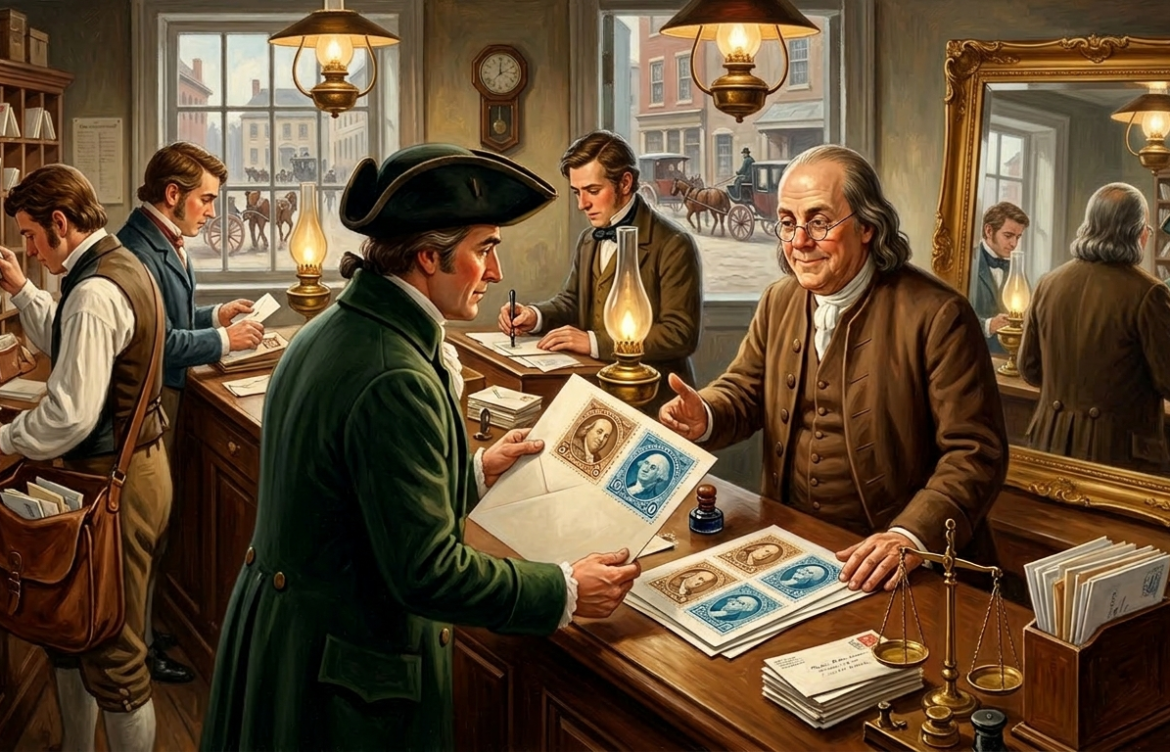
The success of the Penny Black inspired postal administrations around the world to adopt the adhesive prepaid stamp system with remarkable speed. The United States introduced its first adhesive postage stamps in 1847, featuring portraits of Benjamin Franklin and George Washington. Switzerland, Brazil, and several German states followed in 1843 with their own first issues, making these among the earliest stamp-issuing entities outside Britain. By the 1850s and 1860s, virtually every major postal system in the world had adopted some form of the prepaid adhesive stamp, and the model pioneered by the Penny Black had become the universal standard for postal communication.
The broader social consequences were profound. The combination of the railway revolution that was simultaneously transforming transportation across the industrialized world and the new affordable postal system created a communications infrastructure of unprecedented reach and reliability. Businesses could correspond with suppliers and customers across vast distances at minimal cost. Families separated by migration and employment could maintain regular contact. Newspapers and printed matter could be distributed through the post at reduced rates, accelerating the spread of literacy and public information. The Penny Black had, in the words of former Smithsonian National Postal Museum Director Allen R. Kane, served as ‘the microchip that revolutionized worldwide communications.’
The Birth of Philately: How the Penny Black Created Stamp Collecting
The Penny Black also inadvertently gave birth to an entirely new hobby and commercial field. The appeal of collecting postage stamps — preserving them as artifacts of postal history, studying their designs and variations, and building comprehensive collections — emerged almost immediately after the Penny Black’s introduction and grew into one of the most popular leisure activities of the Victorian era. The practice came to be known as philately, from the Greek words for ‘love of that which is exempt from tax,’ a reference to the prepaid nature of postage stamps.
Queen Victoria herself was among the first enthusiastic stamp collectors, and her example helped establish philately as a respectable and even fashionable pursuit among the British upper classes. The hobby spread rapidly across Europe and North America, and the market for rare stamps became a significant commercial enterprise. The Penny Black, as the world’s first stamp and a specimen of genuine historical significance, occupied a position of special prestige in this new field from the very beginning — a status it has never relinquished.
Part VIII: The Penny Black as a Collector’s Item — Rarity, Value, and Authentication
Survival Rates and the Scale of the Original Print Run
With a total print run of 68,808,000 stamps across 286,700 sheets, the Penny Black was produced in quantities that make it a far less rare stamp in absolute terms than many later issues with much smaller print runs. Nevertheless, only a small fraction of those original stamps have survived to the present day. Philatelic experts estimate that approximately 1.3 million Penny Black stamps exist in some form today — a survival rate of roughly 2 percent of the original production. This somewhat higher-than-expected survival rate is attributable in part to the postal customs of the 1840s: envelopes were not commonly used, and letters were instead written on sheets of paper that were folded and sealed with wax, with the stamp affixed to the outer surface. Many of these folded letter sheets were preserved by their recipients as personal mementos, particularly in the exciting early days of the new postal system.
As of 2024, Stanley Gibbons — the world’s oldest and most prestigious stamp dealer, established in 1856 — estimates that fewer than 5 percent of surviving Penny Black stamps are in ‘fine’ to ‘very fine’ condition, meaning that the great majority of survivors show varying degrees of damage, poor margins, heavy cancellations, or other condition issues. The British Postal Museum in London holds the only known complete sheet of Penny Black stamps, making it one of the most remarkable single items in all of philatelic history.
Plate Varieties, Condition Factors, and the Rarity of Specific Stamps
Within the broader category of Penny Black stamps, philatelists recognize significant variations in rarity and value based on several factors. The eleven printing plates used to produce the stamps each have distinct characteristics that allow experienced collectors to identify which plate a given stamp was printed from — a process known as ‘plating.’ Stamps from Plate 2 are among the rarest of all, as only approximately 16,800 stamps were printed from this plate across 700 sheets. Stamps from Plate 11, the plate originally reserved for the Penny Red but from which a small number of black stamps were inadvertently printed, are also extremely scarce and command substantial premiums.
Individual stamps are also assigned collector value based on the quality of their margins — with four clear, even margins indicating a careful cut and commanding higher prices — as well as the condition and legibility of the cancellation, the presence or absence of original gum on the reverse, and whether the stamp is on or off its original cover. A used Penny Black in average condition can be acquired for relatively modest sums on the philatelic market, while exceptional mint examples — those never used for postage and retaining their original gummed reverse intact — command extraordinary prices. The original gum on a mint Penny Black is sometimes described as the most valuable substance on earth by weight, as its presence can multiply the stamp’s value by a factor of ten or more.
Auction Records and the Modern Market
The auction market for exceptional Penny Black specimens has consistently produced remarkable results. In 2009, the London stamp dealer Stanley Gibbons sold a single fine marginal Penny Black example for £250,000. In 2021, Sotheby’s offered a particularly significant specimen — described by Sotheby’s Head of Treasures as ‘unequivocally the most important piece of philatelic history to exist’ — with an estimated hammer price of between £4 million and £6 million, or approximately $5.5 million to $8.25 million at the prevailing exchange rate. In January 2024, Sotheby’s New York offered the earliest known piece of mail sent using a prepaid stamp — a Mulready letter-sheet combined with a Penny Black dated May 2, 1840, addressed to William Blenkinsop Jr. in Dalston, Cumbria — with an estimate of between $1.5 million and $2.5 million.
For those seeking to acquire a Penny Black without spending a small fortune, used examples in average condition are available through reputable philatelic dealers and auction houses at prices ranging from approximately £100 to several hundred pounds, depending on condition and plate. Any purchase of a Penny Black, however, should be authenticated through recognized philatelic organizations such as the British Philatelic Association or the Royal Philatelic Society to guard against the significant market in forgeries and expertly cleaned and regummed examples that do not represent their true condition.
Part IX: The Penny Black’s Enduring Cultural Significance and Legacy
Recognition as a British Cultural Icon
The Penny Black has long transcended its origins as a functional postal instrument to become one of the defining cultural icons of British history. Its significance is recognized across multiple dimensions: as a milestone in the history of communications, as a triumph of Victorian practical ingenuity, as an emblem of social progress and democratic access to information, and as a work of art in miniature that continues to be admired for the quality of its engraving nearly two centuries after its creation. In 2015, the Penny Black design was featured in the innovations section of the redesigned Series B British passport, placing it alongside other defining achievements of British civilization. That same year, Google marked the 175th anniversary of the postage stamp with a dedicated Google Doodle celebrating the Penny Black.
Rowland Hill’s Honors and the Recognition of Reform
The man who conceived the reform that made the Penny Black possible was eventually recognized with appropriate honors, though not without considerable delay and political difficulty. After overseeing the implementation of the penny postage reform, Rowland Hill was not immediately rewarded by the establishment — he lost his Treasury appointment in 1842 when the government that had supported him changed. He went on to serve as a director of the London and Brighton Railway, where he again distinguished himself through practical reform, before returning to the Post Office as Secretary to the Postmaster General and subsequently as Secretary to the Post Office from 1854 to 1864. Hill was knighted as a Knight Commander of the Order of the Bath and elected a Fellow of the Royal Society in recognition of his contributions. He died on August 27, 1879, at Hampstead, London, having lived long enough to witness the global transformation his reform had set in motion. The Post Office subsequently established the Rowland Hill Fund for postal workers in need, and Royal Mail created the Rowland Hill Awards recognizing philatelic innovation.
The Penny Black in Popular Culture and Commemoration
The Penny Black has been commemorated repeatedly through the decades since its introduction. In 1990, Royal Mail issued a set of stamps marking the 150th anniversary of the world’s first postage stamp, and in 2020, a miniature sheet was released to commemorate the 180th anniversary. The development of the Penny Black and the broader story of postal reform has been dramatized in historical productions including the television series Victoria, where the stamp’s creation features in the first season. The British Postal Museum in London, which holds the only complete sheet of Penny Blacks, makes its philatelic collections accessible to the public, and the Smithsonian National Postal Museum in Washington, D.C., maintains significant holdings related to the history of the world’s first postage stamps.
Beyond formal commemoration, the Penny Black exerts a quiet but persistent influence on everyday life that most people never consciously register. The convention of the sender paying for postage in advance, the practice of affixing a small adhesive label to a letter or package as proof of payment, the identification of the issuing authority through a standardized design — all of these elements of the postal system that people across the world take for granted today trace their origins directly to the tiny black stamp first placed on sale in London on May 1, 1840.
Conclusion: The Penny Black and the Dawn of Modern Communication
The Penny Black was, in every meaningful sense, the beginning of the modern communications age. Its introduction on May 1, 1840, and its official validation on May 6 of that year, marked the moment when communication by letter ceased to be a privilege of the prosperous and became, for the first time in human history, a practical reality for virtually every member of society. For a single penny — less than a working person’s hourly wage — anyone in Britain could send a letter to anyone else in the British Isles, over any distance, with the absolute certainty that it would be delivered.
The stakeholders who brought the Penny Black into existence — Rowland Hill with his visionary analysis and stubborn persistence, Henry Cole with his organizational energy and propaganda skills, Robert Wallace with his parliamentary advocacy, William Wyon with his engraving artistry, Henry Corbould with his skilled draughtsmanship, Charles and Frederick Heath with their delicate engraving work, and the firm of Perkins, Bacon and Petch with their industrial printing capacity — each contributed an essential element to what was, in sum, one of the most consequential acts of practical innovation in the nineteenth century.
The Penny Black lasted in service for less than a year before the technical problems with its cancellation system forced its replacement by the Penny Red. But in that brief period of active use, and in the century and three-quarters of cultural memory and philatelic veneration that followed, it accomplished something extraordinary: it changed the way the world thought about communication, about community, about the relationship between citizens and the institutions that serve them. It remains, as Sotheby’s Henry House said of a particularly important specimen in 2021, ‘the stamp that started the postage system as we know it’ — and that is a legacy that no subsequent postal innovation has ever diminished or displaced.
Key Dates and Timeline of the Penny Black
1795 — Rowland Hill is born on December 3 in Kidderminster, Worcestershire, England.
1834 — A sketch of the fifteen-year-old Princess Victoria is made, which will later serve as the basis for the Penny Black portrait.
1835 — Rowland Hill begins his systematic research into postal reform.
1837 (January) — Hill publishes Post Office Reform: Its Importance and Practicability, proposing uniform penny postage.
1837 (February 13) — Hill formally proposes the idea of prepaid adhesive stamps to a Parliamentary inquiry.
1837 (November) — William Wyon creates the City Medal portrait of Queen Victoria, which will become the basis for the stamp’s design.
1839 (August 17) — Queen Victoria gives royal assent to the Postage Duties Bill.
1839 (September) — The Treasury Competition is announced, seeking designs for the new prepayment system.
1839 (October 15) — The Treasury Competition closes, having received over 2,600 entries.
1839 (December 5) — Postal rates are reduced to 4d as a transitional measure.
1839 (December) — Hill completes his review of the competition entries; none are judged entirely suitable.
1840 (January 10) — The Uniform Penny Post formally takes effect; free franking abolished.
1840 (April 1) — The printing plate for the Penny Black is completed; a proof is taken.
1840 (April 11) — Printing of the Penny Black on watermarked paper commences.
1840 (May 1) — Penny Black stamps go on sale to the public; also the first day of sale for Mulready stationery.
1840 (May 2) — Earliest known piece of mail bearing a Penny Black is posted from London to William Blenkinsop Jr.
1840 (May 6) — Official first day on which Penny Black stamps are valid for postal use.
1840 (May 8) — The Two Penny Blue, covering the double-letter rate, goes on sale.
1841 (February) — The Penny Black is replaced by the Penny Red; black ink cancellations replace red ones.
1847 — The United States issues its first adhesive postage stamps.
1864 — Additional security modifications are made to the Penny Red design to combat ongoing stamp reuse.
1879 (August 27) — Rowland Hill dies at Hampstead, London.
1901 (January 22) — Queen Victoria dies; the youthful portrait used on stamps since 1840 is finally replaced.
1990 — Royal Mail issues stamps marking the 150th anniversary of the Penny Black.
2009 — Stanley Gibbons sells a fine Penny Black example for £250,000.
2015 — The Penny Black design appears in the British passport’s innovations section; Google commemorates its 175th anniversary with a Doodle.
2020 — A Royal Mail miniature sheet marks the 180th anniversary of the world’s first stamp.
2024 — Sotheby’s offers the earliest surviving piece of mail sent using a Penny Black, estimated at $1.5–2.5 million.