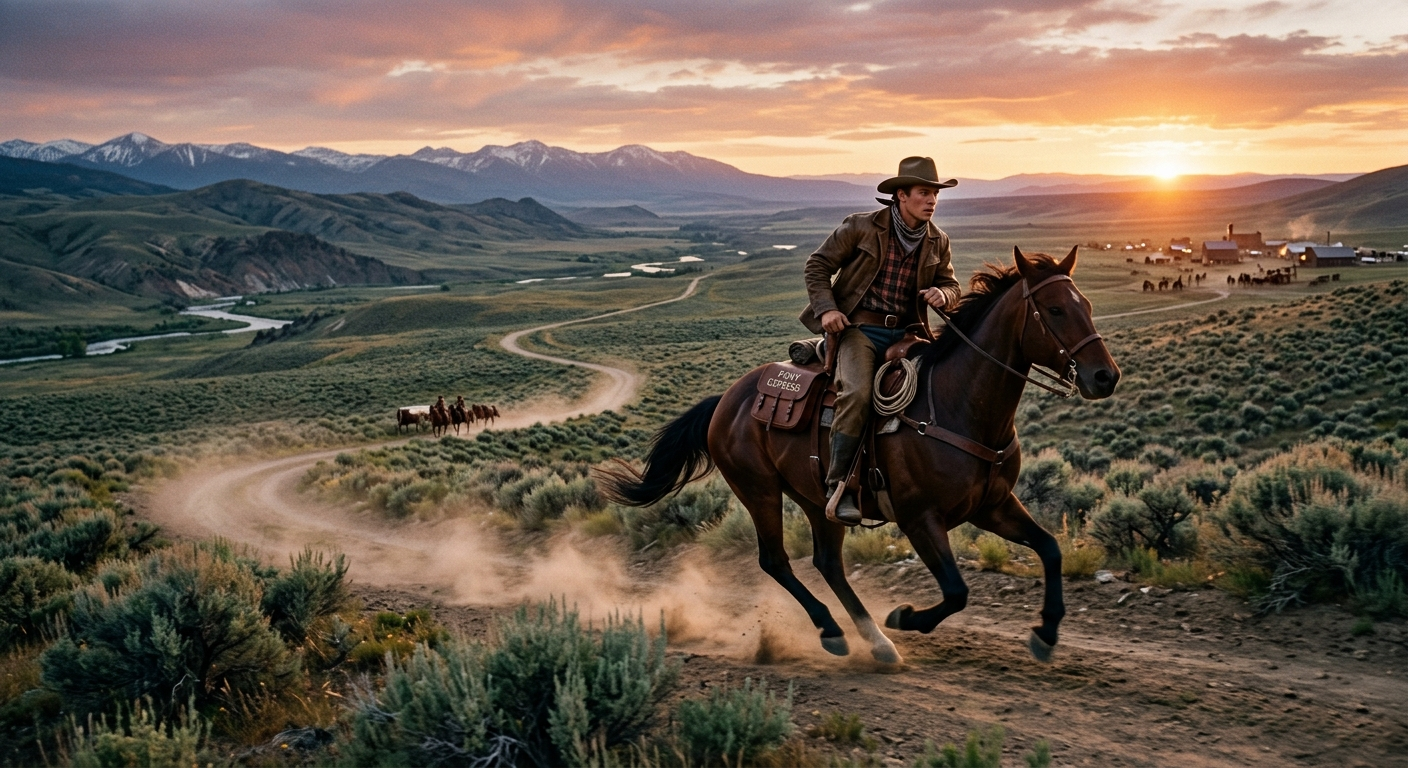
On the evening of April 3, 1860, a cannon boomed in the streets of St. Joseph, Missouri, and a young rider — his identity still disputed by historians a century and a half later — galloped down toward the Missouri River carrying a specially designed leather saddlebag called a mochila packed with 49 letters, five private telegrams, and several newspapers. The crowd that had gathered throughout that long afternoon cheered as the horse and rider crossed the river by ferry and disappeared into the darkness of Kansas, heading west at a gallop into the most audacious communications experiment in the history of the American frontier. The Pony Express had begun.
Simultaneously, nearly 2,000 miles away in Sacramento, California, a rider named Harry Roff departed at noon on April 3 with the first eastbound mail, racing toward the Sierra Nevada and the long plains beyond. The two streams of mail — one moving west from Missouri, one moving east from California — were the opening moments of a relay system that would change the way Americans thought about distance, speed, and the possibility of unifying a nation stretched across an entire continent. In 18 months of operation, from April 3, 1860 to October 26, 1861, the Pony Express would reduce the delivery time for mail between the East Coast and California from more than three weeks to approximately ten days, carry some of the most consequential news in American history, and burn itself so deeply into the national imagination that its legend has never fully faded, long outlasting the service itself.
America’s Communication Crisis: Why a Nation Needed the Pony Express in 1860
To understand the Pony Express, it is essential to understand the communication crisis that the United States faced in the late 1850s. California had achieved statehood in 1850, just two years after the Gold Rush transformed it from a remote Mexican territory into the destination of hundreds of thousands of fortune-seekers. By 1860, the population of the western states had grown to approximately half a million people, with roughly three hundred thousand in California alone. These were transplanted Americans — former New Englanders, Midwesterners, Southerners, and immigrants from across the world — who were deeply attached to their families, their financial interests, and their political lives in the eastern states. They wanted news from home. They wanted letters from their wives and mothers. They wanted to know what was happening in Washington, what the stock markets were doing, what Congress was debating. And they wanted this news in something approaching real time, not weeks after the events had occurred.
The problem was staggering in its scale. A letter sent from New York to San Francisco in 1859 had essentially three options, none of them fast. The ocean route — by steamship around Cape Horn at the southern tip of South America — took at least a month and often considerably longer, depending on weather and the reliability of the vessels involved. An alternative ocean route crossed the Isthmus of Panama by land, transferring passengers and mail between the Atlantic and Pacific by mule train or later by a short railway, cutting the journey to perhaps three weeks but adding the hazards of tropical disease and unreliable connections. The overland stagecoach option was provided by John Butterfield’s Overland Mail Company, which had won a government contract in September 1858 to operate what became known as the Butterfield Route — a 2,795-mile southern arc that went from Tipton, Missouri, through Fort Smith, Arkansas, El Paso, Texas, Tucson, Arizona, Yuma, and Los Angeles before reaching San Francisco. Butterfield’s stages could cover this distance in approximately 24 days at their fastest, but the route was vulnerable to attacks by Apache, Comanche, and Kiowa peoples and, increasingly, to the growing sectional tensions that would soon erupt into Civil War. As 1860 approached, the southern route was clearly going to be the first casualty of any conflict between North and South.
The political dimension of the communication crisis was as urgent as the personal one. The United States was heading toward a catastrophic rupture over slavery, and both the northern and southern factions desperately wanted California — with its vast natural wealth, its substantial population, and its two Senate seats — in their camp. California’s political sympathies in 1860 were genuinely uncertain; the state had a significant population of Southern-born residents and a political culture that was not obviously aligned with either section. The ability to communicate rapidly with California, to shape public opinion there, and to bind the state’s loyalties to the Union before secession became a reality was not merely a postal convenience — it was a matter of national survival. Congress and the Lincoln administration understood this clearly, even before Lincoln’s election in November 1860.
William H. Russell, Alexander Majors, and William Waddell: The Men Who Built the Pony Express in Two Months
The Pony Express was conceived, organized, and financed by three men who formed the most powerful freight and transportation company in the American West: William Hepburn Russell, Alexander Majors, and William Bradford Waddell. Their firm, which operated under the formal name of the Central Overland California and Pikes Peak Express Company, controlled a massive network of freight wagons, stagecoaches, horses, oxen, mules, and employees stretching across the western frontier. They were, in the language of the era, the kings of the overland transportation business — but by 1860 they were also men under severe financial pressure, having overextended themselves through a series of government contracts and speculative ventures that had not yielded the expected returns.
William Hepburn Russell (born January 31, 1812, in Burlington, Vermont; died September 10, 1872) was the entrepreneur and promoter of the partnership, a man of compelling personal charisma and daring business imagination whose tendency to commit to ventures before securing the financing to support them was both his greatest strength and his eventual downfall. Russell was the salesman and visionary of the operation: he could persuade almost anyone of almost anything, and his proposal for the Pony Express was itself an act of extraordinary promotional confidence. The origin of the idea is most often attributed to California Senator William M. Gwin, a Southern Democrat who was anxious to establish the viability of the central overland route as an alternative to the vulnerable Butterfield southern route. Gwin had discussed the concept with Russell during a stagecoach journey in late 1860, suggesting that a fast mail service along the central route would demonstrate its practicality and help secure a government contract. Russell, recognizing both the business opportunity and the political moment, agreed on the spot. He then had to convince his partners.
Alexander Majors (born October 4, 1814, in Franklin County, Kentucky; died January 13, 1900) was the operational genius of the partnership — the man who actually made things work across the vast distances of the western frontier. Deeply religious, personally abstemious, and extraordinarily organized, Majors was the partner who managed the day-to-day logistics of the firm’s enormous operations. He initially opposed the Pony Express proposal, recognizing that it would require massive upfront investment with no guaranteed return, but once his partner Russell committed the firm, Majors threw himself into making it work with characteristic thoroughness. It was Majors who supervised the actual assembly of the Pony Express system, purchasing more than 400 horses, organizing the construction or staffing of approximately 184 relay stations along the route, hiring the riders, and establishing the operational protocols that would govern the service. He was a man who prayed before making major decisions and kept a Bible in his pocket. He required all his employees to sign a pledge swearing not to curse, fight, drink, or abuse their animals. He presented each rider with a small Bible at the time of hiring. Whether out of genuine piety or practical discipline, Majors’s moral requirements created a workforce of unusual reliability.
William Bradford Waddell (born October 14, 1807, in Fauquier County, Virginia; died April 1, 1872) was the financial partner of the firm, the man responsible for securing the capital needed to fund its operations. Like Majors, Waddell had serious reservations about the Pony Express project, and like Majors, he found himself committed to it once Russell made his public announcement. Waddell managed the firm’s financial relationships with banks, investors, and the federal government, a task that became increasingly desperate as the Pony Express’s costs mounted and the hoped-for government mail contract failed to materialize. The financial dimensions of the Pony Express would ultimately destroy all three men. Russell, Majors, and Waddell accomplished the extraordinary feat of building the entire Pony Express system — stations, horses, riders, equipment, and administrative infrastructure — in approximately two months during the winter of 1859-1860, without the benefit of telephone, telegraph, or any other rapid communication technology. The organizational achievement alone was remarkable.
The Route: 1,900 Miles Across Prairie, Desert, and Mountain
The route of the Pony Express was a feat of geographical imagination and practical daring. Beginning at St. Joseph, Missouri—the westernmost point reached by the railroad in 1860, and thus the natural gateway between the connected East and the disconnected West — it stretched approximately 1,900 miles to Sacramento, California, from which a steamboat carried the mail the final leg to San Francisco. The specific path the riders followed roughly traced the established Oregon and California trails west through present-day Kansas and Nebraska, following the Platte River valley northwest through what is now Wyoming, then turning south to Fort Bridger, continuing along what was called the Mormon Trail or Hastings Cutoff to Salt Lake City, Utah, then crossing the Nevada desert and climbing the Sierra Nevada mountain range before descending to Sacramento.
This was not easy or safe terrain. The Great Plains of Kansas and Nebraska, while relatively flat, were subject to violent weather, capable of producing blizzards in winter, floods in spring, and brutal heat in summer. The high desert of Nevada and Utah was one of the most unforgiving environments in North America — waterless stretches of alkali flats and sagebrush where a rider who lost his way could die of thirst before finding help, where the temperature could swing from burning midday heat to freezing nights, and where the Pony Express stations were isolated enough to make stationkeepers and riders genuinely vulnerable to attack. The Sierra Nevada, rising to passes above 7,000 feet, could be impassable in winter and treacherous at almost any season, with narrow paths along cliff faces above sheer drops and sudden weather changes that could strand a rider in a whiteout blizzard within minutes of clear skies. The Donner Party disaster of 1846-47, when a group of California-bound emigrants had been trapped by early Sierra snows and resorted to cannibalism to survive, was only fourteen years in the past when the Pony Express began operation. The mountains’ dangers were not merely theoretical.
Along this route, Russell, Majors, and Waddell established a network of relay stations spaced approximately 10 to 15 miles apart. These were of two types. The ‘home stations’ — spaced about 75 to 100 miles apart — were larger, better-equipped facilities where riders would complete their runs, hand the mochila to the next rider, eat and sleep before their return trip. The ‘relay stations’ or ‘swing stations’ between the home stations were smaller, sometimes consisting of little more than a crude shelter, a water trough, and a corral with fresh horses. The entire network encompassed approximately 184 to 190 stations, stretching across what are now the states of Missouri, Kansas, Nebraska, Colorado, Wyoming, Utah, Nevada, and California — eight states in modern terminology, though several of these were only territories in 1860. Hundreds of stationkeepers and stock tenders were employed to maintain this network, making the Pony Express a far larger enterprise than its popular image as a lone rider galloping across the wilderness would suggest.
The Horses and the Mochila: Engineering Speed Across a Continent
The horses of the Pony Express were as carefully selected as the riders. Alexander Majors purchased more than 400 horses for the service, paying an average of $200 per animal at a time when this represented a significant sum. He selected horses specifically for speed and endurance rather than size, drawing on breeds from across the western territories: Mustangs for their hardiness and knowledge of the terrain, Morgans for their stamina and reliability, Pintos, and Thoroughbreds for their explosive speed. The animals averaged approximately 14.2 hands tall — about 58 inches at the shoulder — and weighed around 900 pounds. They were, as the name ‘pony’ suggested, on the smaller side of the equine spectrum, chosen not for their impressiveness but for their ability to sustain galloping pace for the 10 to 15 miles between relay stations and then be replaced by a fresh mount.
The mechanics of the relay system were engineered for maximum speed. At each station, the goal was for the rider to transfer the mochila from one horse to the next in under two minutes — experienced riders could do it faster. The mochila itself was an ingenious piece of equipment: a flat leather covering designed to be thrown over the entire saddle, with four locked cantinas (pouches) at the corners, two in front of the rider’s legs and two behind. The mail — which had to be written on thin paper to save weight, and which was wrapped in oiled silk to protect it from rain and river crossings — was locked into these cantinas at the start of the journey and not opened until the final destination. The key to the cantinas was held only by officials at the endpoints. A rider arriving at a relay station would have only to lift the mochila from one horse and drop it over the saddle of the next, mount up, and be gone. The entire handoff could theoretically be accomplished while the horse was still moving.
Weight was a constant consideration throughout the system. The riders were required to be light — young men of small stature, typically weighing no more than 125 pounds, who could sit in the saddle for 75 to 100 miles per day without fatiguing the horse. The mail they carried was also strictly limited in weight, which is why the initial price was set at the extraordinary sum of $5 per half-ounce — 250 times the standard postal rate of two cents. At these prices, only the most urgently needed communication traveled by Pony Express: business dispatches, legal documents, newspaper reports, and personal letters of exceptional importance. The initial mail carried on April 3, 1860 included letters from bankers, merchants, and businessmen in the eastern states, as well as the first dispatch from the St. Joseph Gazette — the only newspaper included in the inaugural bag.
April 3, 1860: The First Ride — A Cannon, a Crowd, and the Mail That Changed America
The drama of April 3, 1860, began before the rider even mounted his horse. The mail from the eastern states was supposed to arrive in St. Joseph on time for a 5:00 p.m. departure, allowing the ceremony to proceed in the early evening light. Instead, the mail had been delayed in Chicago during transfer to the Hannibal and St. Joseph Railroad. When the delay became apparent, the railroad took extraordinary action: a special locomotive was stripped down — no passenger cars, no freight, nothing but the engine and a single car — and dispatched from Hannibal on what became a record run across Missouri, covering 206 miles in 4 hours and 51 minutes at an average speed of 40 miles per hour. The locomotive, itself named Missouri, arrived at the Patee House at 12th and Penn Street — the company’s new headquarters — just in time.
The first pouch was loaded with its 49 letters, five private telegrams, and newspapers. St. Joseph Mayor M. Jeff Thompson gave a speech to the assembled crowd. William H. Russell spoke. Alexander Majors spoke. The mochila was loaded and handed to the waiting rider. At approximately 7:15 p.m., with darkness already falling, a cannon was fired to signal the departure, and the first rider galloped through the cheering streets of St. Joseph toward the Missouri River ferry at the foot of Jules Street. The crowd’s enthusiasm was genuine and enormous — the people of St. Joseph understood that they were witnessing something historic. Once across the river, the rider — believed by some sources to be Johnny Fry, and by others to be Johnson William Richardson, with no definitive consensus among historians — began the first leg of the 1,900-mile relay at what contemporaries described as a breakneck speed.
The identity of the first westbound rider has never been definitively established. The St. Joseph Weekly West reported on April 4, 1860, that Johnson William Richardson was the first rider. The Pony Express National Museum has historically given the honor to Johnny Fry, a young Kansan who was said to have ridden the first 90 miles to Seneca, Kansas, on a horse named Sylph. The disagreement reflects a broader truth about the Pony Express: almost no records survived from the actual operation, and the history that was written about it was substantially constructed after the fact, shaped by the romanticizing impulses of journalists, novelists, and showmen. What is certain is that at 7:15 p.m. on April 3, 1860, a rider crossed the Missouri River headed west, and the Pony Express was underway.
In Sacramento, the inaugural eastbound ride was a more orderly affair. Harry Roff, the first eastbound rider, departed at noon on April 3 to considerable fanfare. The route east from Sacramento climbed immediately into the Sierra Nevada, crossing at Placerville before descending into the Nevada desert. The eastbound mail reached its destination in St. Joseph on April 13, ten days and a few hours after departure — meeting the promised delivery time with precision. The westbound mail from St. Joseph arrived in Sacramento on April 14 at 1:00 a.m., slightly behind the eastbound arrival but still within the ten-day window that many had called impossible. Jessie Benton Fremont, the widow of the famous western explorer John C. Fremont, was among those who had gathered to witness the arrival in San Francisco, which was greeted with what contemporaries described as tumultuous excitement, the streets filling with celebrating people.
The Riders: Young, Lean, and Fearless — Life on the Trail
The riders of the Pony Express were among the most extraordinary employees in American business history. The famous advertisement that is associated with recruitment — ‘Wanted: Young, Skinny, Wiry Fellows not over eighteen. Must be expert riders willing to risk death daily. Orphans preferred. Wages $25 per week’ — is now believed by many historians to be apocryphal, probably constructed after the fact as a colorful summary of what the riders were actually like rather than a real advertisement. But its underlying accuracy is undeniable: the men who rode for the Pony Express were, by and large, very young, very light, very skilled on horseback, and willing to accept risks that would have deterred most adults.
The pay was genuinely good for the era. Riders received between $25 and $125 per month depending on the difficulty of their section of the route, at a time when unskilled laborers earned roughly $0.43 to $1.00 per day and skilled workers like carpenters earned less than $2 per day. The dangerous Nevada desert sections commanded the highest pay. Before being hired, every rider was required to sign Alexander Majors’s famous oath: ‘I do hereby swear, before the Great and Living God, that during my engagement, and while I am the employ of Russell, Majors, and Waddell, I will, under no circumstances, use profane language; that I will drink no intoxicating liquors; that I will not quarrel or fight with any other employee of the firm, and that in every respect I will conduct myself honestly, be faithful to my duties, and so direct all my acts as to win the confidence of my employers. So help me God.’ Each rider also received a small Bible from Alexander Majors at the time of hiring. How faithfully these pledges were kept in practice is a matter of some historical uncertainty, but the oath itself established the moral framework within which Majors expected his service to operate.
Each rider was assigned a section of route — typically 75 to 100 miles long — which he would ride in one direction before resting and riding back. The mochila would be passed from rider to rider at the home stations, with each man responsible only for his own stretch but collectively maintaining the continuous relay that kept the mail moving. The riders carried no weapons beyond a knife and, sometimes, a revolver — firearms beyond these were considered unnecessary weight. They rode day and night, in all weather, through terrain that ranged from muddy river crossings to blinding desert glare to Sierra snowdrifts. Their motto, unofficial but universally acknowledged, was ‘The mail must go through.’ In 18 months of operation, the service lost only one bag of mail — an extraordinary record of reliability given the conditions.
Famous Riders: Pony Bob Haslam, Johnny Fry, and the Legend of Buffalo Bill
Among all the riders who served the Pony Express during its 18 months of operation, Robert ‘Pony Bob’ Haslam stands as the most documented and celebrated example of the service’s extraordinary demands. Haslam rode the Nevada section of the route — one of the most dangerous stretches, crossing the Great Basin desert through territory where conflicts with the Paiute people made isolated stationkeepers and riders especially vulnerable. His most legendary ride occurred during the Pyramid Lake War of May 1860, when a dispute between settlers and the Paiute nation had resulted in a series of attacks on Pony Express stations throughout Nevada, killing stationkeepers, driving off horses, and effectively shutting down portions of the route. When Haslam arrived at Buckland’s Station having just ridden his own section, he found that his relief rider, a man named Johnson Richardson, refused to take the mail forward because of the danger from Paiute attacks. Haslam took Richardson’s section himself, riding all the way to Smith’s Creek — a total of 190 miles without rest — through territory where stations had been burned and riders killed. After a nine-hour rest at Smith’s Creek, he rode back with the westbound mail, covering the entire 380-mile round trip despite finding on his return that the stationkeeper at Cold Springs had been killed and the horses driven off. During one leg of this return ride, he was shot through the jaw by an arrow, losing three teeth. He completed the run.
Johnny Fry, the most commonly cited first westbound rider on April 3, 1860, had a career that illustrated both the romance and the harsh reality of the Pony Express era. He quit the service in May 1861 and joined Union forces in Kansas as a mounted courier — taking his skills from the postal service to the Civil War. He was later killed in a shootout with Missouri Confederate raiders near Baxter Springs, Kansas, a death that placed him among the many young men of his generation consumed by the conflict whose proximity the Pony Express had been created partly to prevent. The mail he had carried across Kansas in April 1860 was itself a kind of prologue to the war that would follow.
The most famous name associated with the Pony Express is William F. ‘Buffalo Bill’ Cody, who later became the most celebrated showman of the American West and whose traveling Wild West show featured the Pony Express as one of its centerpiece acts for decades. Cody claimed in his 1879 autobiography to have ridden for the service at the age of 14 or 15, and he told detailed stories about his rides — including one in which he supposedly covered 322 miles in 21 hours and 40 minutes after finding his relief rider had been killed. The reality, established by careful historical investigation, is that Cody almost certainly never rode for the Pony Express. During the actual 18 months of the service’s operation, he was a schoolboy in Leavenworth, Kansas. He had worked briefly as a messenger boy for the freight firm of Majors and Russell when he was eleven — before the Pony Express existed — and this genuine connection apparently evolved, through the natural processes of self-mythologizing that characterized his entire career, into a claim of actual Pony Express ridership. Buffalo Bill’s Wild West show became, as historians have noted, the ‘primary keeper of the pony legend,’ and it was through his romanticized theatrical presentations that the image of the lone Pony Express rider as the symbol of American frontier courage became fixed in the national consciousness. The irony that the most important popularizer of the Pony Express myth never actually rode for the service is one of the most revealing facts in the history of American self-mythology.
James Butler ‘Wild Bill’ Hickok, another legendary figure of the Old West, did have a genuine documented connection to the Pony Express — though not as a rider. Hickok worked as a stock tender at the Rock Creek Station in Nebraska, responsible for caring for the horses rather than riding them. He was too old and too heavy to qualify as a rider. On July 12, 1861, while working at Rock Creek, Hickok was confronted by station owner David McCanles over unpaid rent owed by Russell, Majors, and Waddell. A violent confrontation erupted in which three men, including McCanles, were shot dead. Hickok and the stationkeeper Horace Wellman were charged with murder but later acquitted. The incident launched Hickok’s career as a gunfighter and lawman — and his connection to the Pony Express, however tangential, became another thread in the elaborate tapestry of Western legend.
Dangers Along the Route: Native American Resistance, Weather, and the Pyramid Lake War
The Pony Express operated through the territories of multiple Native American nations whose relationship with the expansion of American settlement along the central overland route ranged from tense accommodation to outright resistance. The Pony Express stations in Nevada and Utah cut through the heart of Paiute, Shoshone, and other nations’ territories, and the stations themselves represented the advancing edge of the settler colonialism that was disrupting traditional patterns of land use and threatening the survival of communities that had lived in these regions for generations. The service’s relationship with the peoples of the Great Basin was, from the beginning, one of intrusion into territory that was not available for the purpose without confrontation.
The most serious disruption came in May 1860 with the outbreak of what became known as the Pyramid Lake War. The immediate trigger was the brutal treatment of a Paiute woman by white men at Williams Station in Nevada — an incident that ended with four white men dead at the hands of Paiutes seeking justice for the assault. The violence escalated quickly, with Paiute warriors attacking a series of Pony Express and emigrant stations throughout Nevada, killing stationkeepers, driving off horses, and burning facilities. The attacks forced a suspension of mail service along the Nevada section of the route for nearly a month and a half. The United States military was brought in to escort riders through the most dangerous sections, and additional stations were fortified. Several riders and stationkeepers were killed during the conflict, and the disruption cost Russell, Majors, and Waddell enormous sums in horses, equipment, and delayed operations.
Beyond the specific crisis of the Pyramid Lake War, the riders faced constant environmental dangers that the romanticized popular image of the service often underplays. River crossings were genuinely life-threatening; one rider was killed when his horse stumbled crossing the Platte River in Nebraska in July 1860, and the mail was lost with him — one of only two documented instances of lost mail in the service’s entire history. A rider was presumed dead in August 1860 when only his horse arrived at the Carson City station. Blizzards in the Sierra Nevada could strand riders or make mountain passes impassable for days. The Nevada desert’s heat, dehydration risk, and disorienting sameness — the track was sometimes marked by nothing more substantial than wagon ruts and occasional cairns — meant that a rider who lost his bearing could find himself in genuine mortal danger with no hope of rescue before dehydration became fatal.
Historic Dispatches: Lincoln’s Election and the Inaugural Address
The Pony Express’s most historically significant moments came during the election season of 1860 and the first months of 1861, when the service served as the primary means of carrying the most consequential political news in a generation across the vast gap between the connected East and the isolated West. When Abraham Lincoln won the presidential election on November 7, 1860, Pony Express riders carried the news from Fort Kearney, Nebraska — the western terminus of the telegraph at the time — to Placerville, California in a record five days, days faster than the regular schedule. The message was written on the outsides of the envelopes so that people along the route would know the result even before the sealed letters arrived at their destinations. The news of Lincoln’s election, which everyone understood might mean civil war, reached California faster than it had ever been possible to communicate such news before.
On March 4, 1861, when Lincoln delivered his First Inaugural Address in Washington — a speech whose carefully calibrated appeal to Southern moderates represented the new president’s last attempt to avoid war — the address was telegraphed from Washington to Fort Kearney, Nebraska, and Pony Express riders carried it west from there to Placerville, California, where it was relayed by telegraph to San Francisco. Pony Bob Haslam carried the Inaugural Address on part of his run and was attacked by Paiute warriors during the delivery, completing his 120-mile section in a record eight hours and twenty minutes despite the attack. Lincoln’s words urging peace and Union reached California within days of being spoken, at a moment when the possibility that California might align itself with the Confederacy was a genuine concern in Washington. The Pony Express’s role in delivering this communication — and in establishing California firmly within the Union’s information network — was recognized at the time as a matter of national political importance.
Financial Catastrophe: Why the Pony Express Lost Money Despite Its Fame
For all its drama, speed, and organizational achievement, the Pony Express was a financial disaster from its first day of operation. The fundamental economics of the service never worked. The cost of maintaining 184 relay stations across nearly 2,000 miles of frontier, staffing them with stationkeepers and stock tenders, purchasing and caring for 400 horses, and paying riders salaries that were genuinely competitive for the era, far exceeded the revenue generated even at the premium price of $5 per half-ounce of mail. The initial rate of $5 per half-ounce was later reduced to $2.50 and eventually to $1 as the company tried to attract more customers. At the initial rate, it cost approximately $38 to deliver a single letter — a figure that the volume of mail being carried could never sustain.
The hoped-for government contract that Russell had counted on to make the operation financially viable never arrived. The federal government was paying John Butterfield’s Overland Mail Company an annual subsidy of $600,000 to carry mail along the southern route, and political considerations — including the imminent prospect of Butterfield’s route being disrupted by Confederate military action — made the administration reluctant to commit to a new contract before the political and military situation clarified. When the government did eventually provide a subsidy, it was far less than Russell had anticipated and came too late to save the firm. The Pony Express operated as a private enterprise for its first three months, then became a subcontracted mail route of the United States Post Office Department beginning July 1, 1860, and operated under the Overland Mail Company from July 1, 1861 — but none of these arrangements generated the revenue needed to cover costs.
The financial crisis was compounded by a scandal involving Russell personally. He was arrested in January 1861 on charges related to accepting fraudulent government bonds — bonds that had been improperly taken from the Indian Trust Fund and used as collateral for government contracts with his firm. Russell spent time in jail before being released on a legal technicality in March 1861, but the scandal destroyed the firm’s credit and its ability to attract new investment. When the transcontinental telegraph was completed in October 1861 and the Pony Express ceased operations, Russell, Majors, and Waddell were bankrupted beyond recovery. William Waddell returned to Lexington, Missouri, so deeply in debt that he sold his home to his son for one dollar and lived there in poverty until his death on April 1, 1872. William Russell went to New York, failed as a stockbroker, and filed for bankruptcy on April 3, 1865 — exactly five years after the first Pony Express rider left St. Joseph. Alexander Majors moved to Colorado, and his final years were marked by poverty until his old employee William ‘Buffalo Bill’ Cody found him destitute and helped him publish his memoirs, provided him a role in the Wild West show, and gave him a place to stay at his Nebraska ranch. Majors died on January 13, 1900.
The Transcontinental Telegraph: How a Wire Ended the Horse
The death sentence for the Pony Express was signed not in any boardroom or courtroom but in the halls of Congress, on June 16, 1860 — just ten weeks after the service began operation. On that date, Congress authorized a bill directing the Secretary of the Treasury to subsidize the construction of a transcontinental telegraph line connecting the Missouri River to the Pacific Coast. The legislation was a direct recognition of what the Pony Express had demonstrated: that fast, reliable communication between the East and West was not only possible but essential. The only question was which technology would provide it.
Construction of the telegraph proceeded with remarkable speed on both ends simultaneously, with the Western Union Telegraph Company driving eastward from the Pacific and the Pacific Telegraph Company driving westward from the Missouri River. The Pony Express continued to operate as the telegraph lines were built, handling the sections of the route not yet covered by wire. Riders effectively became the connective tissue linking the advancing telegraph termini, carrying messages by horse between the points where the wires ended and the next telegraph station began. By the summer of 1861, the telegraph had progressed far enough that Pony Express riders were operating mainly in the middle portion of the route, between the advancing wire-ends in Nevada and Nebraska. On August 13, 1861, Pony Express news was reaching San Francisco two full days before Pony Express letters arrived — the telegraph was already outrunning the horses.
On October 24, 1861, at Salt Lake City, Utah, the eastern and western telegraph lines were joined, completing the first transcontinental telegraph connection in American history. Western Union’s Hiram Sibley sent the first transcontinental telegram that day. Two days later, on October 26, 1861, the Pony Express officially ceased operations, its final letters completing their journeys in November. The service had operated for exactly 18 months and 23 days. In that time, it had carried an estimated 35,000 letters, lost only one bag of mail, and made — for the men who created it — not a single dollar of profit. It had, however, proved something that no telegraph wire or stagecoach route had managed to prove: that the central overland route was practical for year-round service, and that the American continent could be reliably spanned, in any season, by a system of continuous communication. The transcontinental railroad, completed in 1869, would follow the route that the Pony Express had pioneered.
The Legacy of the Pony Express: Symbol, Myth, and the Making of American Identity
The Pony Express lasted only 18 months. It never made a profit. It ruined its founders financially. Only approximately 35,000 letters survive from its entire operation, giving historians relatively little primary source material to work with. And yet the Pony Express has become one of the most enduring symbols in the history of the American West — an image of individual courage, frontier ingenuity, and national ambition that has been reproduced in paintings, novels, films, television shows, and popular histories for more than 160 years. Understanding how a failed business operating for less than two years became a cultural icon requires understanding what it meant, in 1860 and afterward, to Americans who were trying to make sense of themselves.
The Pony Express captured the American imagination because it embodied, in vivid and accessible form, several values that Americans of the mid-nineteenth century held dear: the courage of the individual against impossible odds, the triumph of human will over geography and weather and danger, the democratic openness of opportunity in a country where a young man with skill and nerve could do something that had never been done before. It also captured the specific anxieties of its moment: the fear that the nation was coming apart, the desperate need to believe that East and West could be bound together, the hope that technology and human ingenuity could solve problems that politics could not. When a Pony Express rider galloped through a blizzard to deliver Lincoln’s Inaugural Address, he was doing something that resonated far beyond the literal act of postal delivery — he was physically enacting the connectivity of a nation that was trying not to dissolve.
Benjamin Ficklin, who served as the general superintendent of the Pony Express route and organized its division structure, was another significant figure often overlooked in the popular accounts. He died on March 10, 1871, from an accident unrelated to the Pony Express, but his organizational work in the winter of 1859-60 was essential to transforming Russell’s vision into operational reality. He divided the route into five divisions, hired superintendents for each, and oversaw the construction or establishment of the relay stations that made continuous relay possible.
The legacy of the Pony Express lives on in institutional form in the Pony Express National Historic Trail, which traces the original route across eight states and is maintained by the National Park Service and the National Pony Express Association. The annual Re-Ride, organized by the National Pony Express Association, follows the original route each June with modern volunteer riders carrying commemorative mail pouches — an exercise in living history that draws participants from across the country and from other countries as well. The Pony Express National Museum in St. Joseph, Missouri, occupies the former Patee House hotel that served as the service’s headquarters. The Pony Express has been commemorated on multiple United States postage stamps, including a 1940 stamp issued on the 80th anniversary of the service and a 1960 stamp marking the centennial. The name ‘Pony Express’ has entered the English language as a synonym for fast communication or urgent delivery, used in contexts ranging from business to sports to technology that have nothing to do with Missouri, California, or the winter of 1860.
Conclusion: Eighteen Months That Bound a Nation
The Pony Express began on April 3, 1860, with a cannon shot in St. Joseph, Missouri, and ended on October 26, 1861, made obsolete by the very technology whose construction it had helped to justify. In the eighteen months between those dates, it carried news of a presidential election and an inaugural address, it proved the viability of a central overland route that would become the transcontinental railroad’s path eight years later, it kept California in the Union’s information orbit at a moment when the nation’s survival was genuinely uncertain, and it established a record of reliable delivery across the most difficult terrain in North America that astonished every observer who watched it operate.
The men who built it — William H. Russell, Alexander Majors, and William Bradford Waddell — were ruined by their creation. The riders who rode it — Johnny Fry, Harry Roff, Pony Bob Haslam, and the eighty others whose names are recorded with varying degrees of certainty — endured dangers and hardships that the romanticized legend tends to acknowledge in the abstract but rarely conveys in the specific. The horses that carried the mail across prairies and deserts and mountain passes have no names in the historical record. The stationkeepers and stock tenders who maintained the relay network in isolation along 1,900 miles of frontier have been almost entirely forgotten. The Pony Express was, like all great human enterprises, the product not of heroes and visionaries alone but of the hundreds of ordinary people who made it work from day to day, mile to mile, station to station, in conditions that were often cold, often dangerous, and sometimes fatal.
What it left behind was not profits or infrastructure or even intact records. What it left behind was the demonstrated possibility of a connected continent — the proof that America’s geography need not be its destiny, that the vast distances between its coasts were not permanent barriers to communication and unity, and that young people willing to risk death daily for reasonable wages could, if the system was good enough and the horses fast enough and the determination deep enough, carry the news from Missouri to California in ten days. In 1860, that was a miracle. It still seems like one.