Born from German bombing raids, political crisis, and a visionary South African general’s report, the Royal Air Force was established as an independent British military branch on April 1, 1918 — forever changing the nature of modern warfare.
The Dawn of Military Aviation: Britain’s Early Air Services Before World War One
The story of the Royal Air Force begins not on April 1, 1918, but in the first fragile years of the twentieth century, when the military possibilities of powered flight were only just beginning to be grasped by European governments. The Wright Brothers had achieved their historic first flight at Kitty Hawk, North Carolina, in December 1903, and within a few years the great powers of Europe were scrambling to determine how this remarkable new technology might be harnessed for war. Britain was no exception, though it moved cautiously at first, uncertain of how exactly aircraft might fit into established military doctrine.
In April 1911, eight years after the Wright Brothers’ breakthrough, the British Army formed an Air Battalion of the Royal Engineers at Larkhill in Wiltshire. This modest unit represented the British Army’s first formal acknowledgment that powered flight had military utility. The battalion brought together aircraft, airships, balloons, and even man-carrying kite companies under a single organizational roof — a recognition that aerial observation and reconnaissance could support ground operations in ways that cavalry scouts and hilltop lookouts never could. Meanwhile, the Royal Navy had not been idle. In December 1911, the British Admiralty established the Royal Naval Flying School at Eastchurch in Kent, beginning the process of training naval aviators and exploring how aircraft might serve the needs of a maritime power.
In May 1912, the government moved to consolidate these early efforts with the creation of the Royal Flying Corps (RFC), which was intended to serve both the Army and the Navy under a single administrative structure. The RFC established a new flying school at Upavon in Wiltshire and began forming dedicated aircraft squadrons. The organization was placed under the command of Lieutenant General Sir David Henderson, a Scottish soldier who would prove to be one of the most influential figures in the entire story of British military aviation. Henderson was a forward-thinking officer who understood not only the tactical value of aircraft but also their potential for operations entirely independent of army or navy control — a vision that would eventually shape the creation of the RAF itself.
The theoretical unity of the Royal Flying Corps did not last long. By July 1914, the specialized requirements of naval aviation had become sufficiently distinct from those of army aviation that the Admiralty moved to establish its own dedicated service. The Royal Naval Air Service (RNAS) was officially recognized as a separate organization, operating under Admiralty control and focusing on coastal patrol, anti-submarine work, airship operations, and the air defense of Britain’s coastline and cities. Winston Churchill, then serving as First Lord of the Admiralty, was a strong advocate for the RNAS and invested considerable energy in expanding its capabilities. This division of British military aviation between two separate services, each answerable to a different parent department with different priorities, would create the organizational friction and resource competition that ultimately drove the creation of a unified independent air force.
The RFC and RNAS at War: Air Power’s Transformative Role in the First World War
When Britain declared war on Germany on August 4, 1914, the Royal Flying Corps possessed just 84 aircraft and the Royal Naval Air Service had 71 aircraft and seven airships — a combined force that would have seemed laughably small to anyone who witnessed the air battles of just a few years later. Within weeks of the declaration of war, four RFC squadrons were deployed to France to support the British Expeditionary Force, tasked primarily with reconnaissance and artillery spotting for ground commanders. Their role was to be the eyes of the army, not independent combatants in their own right.
In those early months, the RFC performed this observational role with considerable effectiveness. David Henderson himself accompanied the squadrons to France to command RFC operations at the front. However, the nature of air warfare transformed with extraordinary speed. As aircraft became faster, more maneuverable, and more powerful, both sides began arming them and the first true aerial combat took place. The Germans moved rapidly to exploit the possibilities of air power, developing coordinated tactics and producing outstanding aviators. By 1915 and 1916, Germany had taken the lead in air strategy, and British and Allied pilots suffered heavily against a series of technically superior German aircraft and tactically innovative opponents. Names like Manfred von Richthofen — the legendary Red Baron — became synonymous with German air supremacy during certain phases of the war.
When Henderson returned to Britain in 1915, Hugh Trenchard replaced him as commander of RFC operations in France. Trenchard was a forceful, opinionated, and intensely energetic commander whose belief in the importance of maintaining aerial offensive pressure would shape both his wartime leadership and his later role in building the independent RAF. During the brutal aerial campaigns of 1916 and 1917, including the infamous Bloody April of April 1917 when the RFC suffered catastrophic losses during the Battle of Arras, Trenchard consistently advocated for maintaining offensive operations even at heavy cost, believing that relinquishing air superiority would be even more damaging to ground forces than the losses sustained in fighting for it.
Behind the front lines, the competition between the RFC and the RNAS for scarce resources was growing into a serious problem. The two services were in effect rivals for the same pool of aircraft, engines, trained pilots, and industrial capacity. The RFC had employed over 140 different aircraft models and variants by the middle of the war, and there was no meaningful coordination with the RNAS regarding procurement, maintenance standards, or industrial planning. Both services lobbied separately with manufacturers and government ministries, frequently working at cross-purposes and generating enormous inefficiency. Attempts to manage this problem through coordinating boards chaired at various times by Lord Derby, Lord Curzon, and Lord Cowdray had failed, largely because both the Admiralty and the War Office consistently prioritized their own institutional interests over any coordinated national air strategy.
The Gotha Bomber Raids of 1917: The German Attack That Changed British History
The crisis that would ultimately force the British government to create a unified independent air force arrived from an unexpected direction — not from the trenches of the Western Front but from the skies above London itself. In the spring and summer of 1917, the German military launched a devastating new phase of its strategic air campaign against Britain, using a new weapon that proved far more effective than the Zeppelin airships that had raided British cities in 1915 and 1916. The weapon was the Gotha G.IV, a large twin-engined biplane bomber capable of carrying a significant bomb load to England from airfields in occupied Belgium and the Netherlands.
The first major Gotha raid on London took place on June 13, 1917, when Hauptmann Ernst Brandenburg led 20 Gotha bombers of the EnglandGeschwader from airfields near Ghent toward the British capital. Two aircraft turned back due to mechanical problems, but the rest continued to their target. A single Gotha broke formation and dropped bombs on Margate, but the main formation pressed on toward London. When the bombers reached the city, they dropped 72 bombs within a one-mile radius of Liverpool Street Station in broad daylight, killing sixteen people and injuring fifteen more at the station alone. The Royal Albert Docks were hit, killing eight dock workers. Four people were killed in East Ham. In total, the raid killed 162 people — including 18 children at a school in Poplar in east London — and injured more than 400 others.
The public reaction was one of fury and profound shock. Britain had not experienced a direct enemy attack of this nature since the Dutch fleet sailed up the Thames in 1667. The sight of large formations of German bombers flying over the capital in broad daylight, virtually unopposed, was deeply humiliating and delivered a serious blow to civilian morale. The British air defenses had responded chaotically — ninety-five Army and Royal Navy pilots flying twenty-one different aircraft types managed to shoot down only one German bomber while losing two of their own aircraft. Mobs turned on anyone with a German-sounding name, smashing shops and attacking businesses. The psychological impact far exceeded the physical damage. Four days after the June 13 raid, King George V announced that the Royal Family was changing its name from Saxe-Coburg-Gotha to Windsor — a direct acknowledgment of how deeply the German assault had penetrated British national consciousness.
The raids continued throughout the summer. A second major London raid on July 7, 1917, caused further casualties and prompted Parliament to convene in special session to debate the crisis. In all, German Gotha bombers conducted 27 raids on Britain between May 1917 and May 1918, killing a total of 836 people. The political crisis created by these attacks was the immediate catalyst that drove Prime Minister David Lloyd George to appoint a committee to examine Britain’s entire air organization and to consider whether a fundamental restructuring was necessary. The Gotha raids had demonstrated, in the most direct and painful way possible, that control of the skies above Britain could no longer be entrusted to two competing services with divided responsibilities and incompatible command structures.
David Lloyd George and the Decision to Act: Appointing Jan Smuts to Reshape British Air Power
David Lloyd George, the Welsh Liberal politician who had become Prime Minister of Britain in December 1916, was a man of considerable political instinct and intellectual energy. He had grown increasingly frustrated with the military establishment’s management of the war and was by 1917 deeply dissatisfied with both the direction of operations in France and the adequacy of Britain’s home air defenses. The Gotha raids on London crystallized his conviction that something fundamental had to change. He needed someone capable of examining Britain’s fragmented air services without the institutional loyalties and departmental prejudices that made reform so difficult to achieve from within the War Office or the Admiralty.
On July 11, 1917, the day after Parliament met in emergency session following the July 7 London raid, Lloyd George established the Prime Minister’s Committee on Air Organisation and Home Defence Against Air Raids. To chair this committee, he chose a man of remarkable and unusual background: Lieutenant General Jan Christian Smuts, a South African soldier-statesman who had been invited to serve on the Imperial War Cabinet as the representative of the Union of South Africa. Smuts was a figure of genuine historical complexity — he had fought against the British as a Boer commando during the South African War of 1899 to 1902, employing guerrilla tactics that greatly frustrated British commanders. Yet in the decade and a half since that conflict, he had become one of the most trusted and respected figures in the British imperial world, commanding Allied forces in East Africa before coming to London in 1917.
Lloyd George’s choice of Smuts was deliberate and shrewd. As an outsider to the British military establishment, Smuts could assess the competing claims of the Army and the Navy regarding air power without the institutional bias that made senior British officers so resistant to any proposal that threatened their service’s control over its own aviation assets. He was, in Lloyd George’s words, a man with a fresh mind free of departmental prejudices — exactly what was needed to cut through the bureaucratic stalemate that had prevented meaningful reform of British air organization for years. Smuts had already concluded before he began his investigation that Britain needed a proper Air Ministry with a staff organized on the lines of the Army or the Navy. He knew little of the technical details of air warfare, however, and wisely relied heavily on Lieutenant General Sir David Henderson for expert guidance on aviation matters.
Henderson, the first commanding general of the Royal Flying Corps, was the ideal adviser. He had spent years thinking about the proper organizational relationship between air power and the other services, and he had arrived at the conviction that aviation had matured to the point where it required its own independent institutional home. Henderson advocated the creation of a separate air force capable of conducting operations both in support of the Navy and the Army and, critically, independently of both — conducting strategic operations against enemy territory that no ground or naval force could carry out. Henderson’s vision of independent air power would permeate every element of the report that Smuts eventually produced.
The Smuts Reports of 1917: The Blueprint for the World’s First Independent Air Force
Jan Smuts worked with extraordinary speed. Within eight days of his appointment, he had produced his first report, focusing on the immediate problem of London’s air defenses. This report recommended the establishment of the London Air Defence Area, a unified command structure bringing together Royal Flying Corps squadrons, anti-aircraft gun batteries, and observation posts under a single authority. The London Air Defence Area was formally established on July 31, 1917, under the command of Brigadier General Edward B. Ashmore, a former RFC officer with experience in artillery. For the first time, the disparate elements of Britain’s capital city air defense were placed under a single coordinated command — a lesson that would prove enormously valuable when Germany attacked again in 1940.
The second Smuts report, submitted to the War Cabinet on August 17, 1917, was an altogether different and far more ambitious document. It is this report that historians regard as arguably the most important document in the entire history of the Royal Air Force — the founding intellectual charter of independent air power. Smuts and Henderson argued that British air policy and air operations should be placed under a new Air Ministry and that the Royal Flying Corps and the Royal Naval Air Service should be merged into a single unified and independent air service, standing on equal footing with the British Army and the Royal Navy.
The report’s most striking passage articulated a vision of future warfare that was visionary almost to the point of prophecy. Smuts wrote that aerial operations, with their devastation of enemy lands and destruction of industrial and populous centres on a vast scale, may become the principal operations of war, with the older forms of military and naval operations playing a secondary and subordinate role. These words, written in August 1917, anticipated the strategic bombing campaigns of the Second World War with an accuracy that seemed almost impossible given how primitive air technology still was at the time they were composed. The report also argued that there was absolutely no limit to the future use of aircraft in an independent role, and that an independent role of this magnitude called inescapably for an independent service to carry it out.
The War Cabinet considered Smuts’s second report on August 24, 1917. Despite vigorous opposition from representatives of both the Admiralty and the War Office, who naturally resisted any measure that would strip their services of their aviation assets and organizational authority, the report was approved in principle. Field Marshal Sir Douglas Haig, the Commander-in-Chief of the British Expeditionary Force in France, expressed his concerns that the reorganization would disrupt the delivery of air support to his ground forces — concerns that were not entirely unreasonable given the timing during an active war. Trenchard, still commanding the RFC in France, was also initially opposed to the merger, fearing it would dilute the close air support relationship his squadrons had developed with the British Army. But the political momentum generated by the Gotha raids, combined with the compelling logic of Smuts’s analysis, was too powerful to resist.
The Air Force Constitution Act 1917: The Legal Foundation for Britain’s New Military Branch
Once the War Cabinet approved the Smuts report in principle, the process of turning its recommendations into law moved with impressive speed given the complexity of what was being proposed. The creation of an entirely new military service, independent of both the Army and the Navy and answerable to its own ministry, required not only new legislation but also a complete restructuring of the administrative machinery of government. An Air Ministry had to be created, staffed, and housed. A new command structure had to be designed from scratch. The legal relationships between the new service and its parent departments had to be defined and enforced.
The Air Force (Constitution) Act was passed by Parliament on November 23, 1917, receiving Royal Assent and passing into law on November 29, 1917. The Act created the legal framework for the establishment of an Air Council and an Air Ministry, which would have responsibility for the organization, training, equipment, and deployment of Britain’s new independent air force. The Air Ministry was formally established in January 1918, three months before the Royal Air Force itself came into existence, allowing the new administrative machinery to be put in place before the merger of the two existing services was completed.
The naming of the new service was settled by Royal decree. On March 7, 1918, King George V issued a formal royal decree at St James’s Palace declaring that the new service was to be styled the Royal Air Force. The choice of name was deliberate in its implications. By incorporating the word Royal, the new service was placed on the same symbolic footing as the Royal Navy and the British Army — institutions of centuries’ standing — and invested with the prestige of the Crown. The word Air distinguished it from the other services and identified its unique domain. The word Force carried connotations of military power and national defense. Together, Royal Air Force announced to the world that Britain had created something genuinely new: a military service whose entire identity was defined by its mastery of a medium that no army or navy could claim.
April 1, 1918: The Day the Royal Air Force Was Born and Became the Largest Air Force in the World
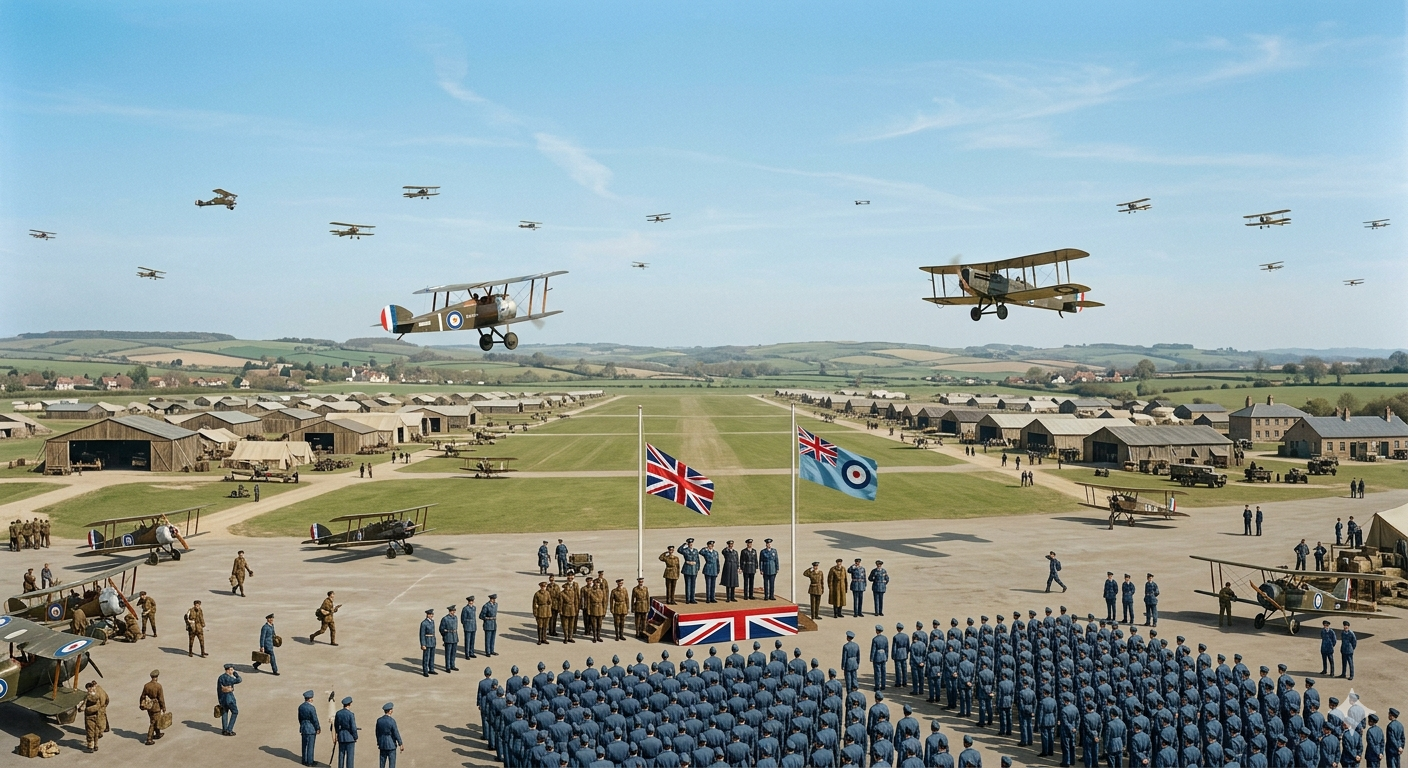
On April 1, 1918 — the first day of the fourth year of the most destructive war the world had yet witnessed — the Royal Air Force came into existence through the formal amalgamation of the Royal Flying Corps and the Royal Naval Air Service. It was a moment of genuine historical significance, not only for Britain but for the entire future of warfare. The new service was, at the moment of its creation, the largest and most powerful air force in the world. The RAF inherited from its two predecessor services a combined strength of over 20,000 aircraft and more than 300,000 personnel, including the newly created Women’s Royal Air Force (WRAF) which was formed on the same day.
The organizational mechanics of the merger were handled with considerable care given the circumstances of an ongoing war. The squadrons of the Royal Flying Corps retained their existing numerals, maintaining continuity with their established identities and traditions. The squadrons of the Royal Naval Air Service were renumbered from 201 onwards, creating a new series that distinguished the former naval units while integrating them into the unified service. At the time of the merger, the former naval air service had contributed 55,066 officers and men, 2,949 aircraft, 103 airships, and 126 coastal stations to the new service. The RAF’s first headquarters were established at the former Hotel Cecil on the Strand in London, a grand Victorian building that provided the administrative home for the new service’s rapidly growing bureaucracy.
On the very first day of the RAF’s existence, Bristol F.2B fighters of the 22nd Squadron flew the first official missions of the new service. The timing of the RAF’s creation was dramatic in the extreme. Just weeks earlier, on March 21, 1918, Germany had launched its massive Spring Offensive — Operation Michael — the most powerful German military assault since the opening weeks of the war. The German thrust had achieved alarming breakthroughs along the Western Front, threatening to divide the British and French armies and drive the British back to the sea. The new RAF was therefore born into crisis, immediately called upon to demonstrate its value in the most demanding possible operational environment. It met that challenge. Contact patrols flown by RAF fighter aircraft proved key in slowing the German Spring Offensive, and by the time Germany launched subsequent offensive operations in the following weeks, the RAF had established sufficient air superiority to provide crucial support to Allied ground forces.
The badge of the Royal Air Force was first adopted in August 1918, just months after the service’s creation. In heraldic terms, it depicted an eagle displayed and affronted — a bird that had become associated with British aviation during the war years — set before a circle inscribed with the service’s newly adopted motto: Per Ardua ad Astra, a Latin phrase meaning Through Adversity to the Stars. The motto captured something essential about the character of the new service: an acknowledgment that the path to mastery of the air would be difficult and costly, but that the reward — dominion over the skies — was worth every sacrifice.
Hugh Trenchard: The Controversial Father of the Royal Air Force and His Troubled Start
The creation of the RAF was accompanied by a period of intense political maneuvering over the senior appointments that would define the new service’s direction. Hugh Trenchard had been recalled from his command of the RFC in France to serve as the first Chief of the Air Staff of the new Royal Air Force, a position of enormous significance in determining how the new service would be organized, equipped, and employed. The first Secretary of State for Air — the civilian minister responsible for the RAF — was Harold Harmsworth, Lord Rothermere, the newspaper magnate and brother of the press baron Lord Northcliffe.
The relationship between Trenchard and Rothermere collapsed almost immediately after the RAF’s formation. The two men had fundamental disagreements about strategy, organization, and the proper role of the new service, and Rothermere had also developed a close relationship with Major General Sir Frederick Sykes, whom he preferred over Trenchard for the top military post. Extraordinarily, just two weeks after the RAF came into existence, Trenchard resigned as Chief of the Air Staff. Rothermere himself resigned shortly afterwards, under pressure from Lloyd George who was unhappy with his management of the new ministry. The RAF had barely drawn its first breath before it had lost both its senior military chief and its ministerial head.
Trenchard was not finished with the RAF, however. He was appointed to command the newly formed Independent Force — an RAF bombing organization established specifically to carry out strategic attacks on German industrial targets and cities from bases near Nancy in France. In this role, Trenchard developed his conviction that strategic bombing, carried out independently of tactical support for ground forces, could be a war-winning weapon in its own right. He believed that sustained bombing of German cities would create widespread anxiety among the civilian population, undermine industrial production, and break the enemy’s will to continue fighting. These ideas, developed in the final months of the First World War, would shape RAF doctrine for decades to come and would inform the massive strategic bombing campaigns of the Second World War.
Frederick Sykes replaced Trenchard as Chief of the Air Staff, while Lord Weir — Sir William Weir — succeeded Rothermere as Secretary of State for Air. Weir proved a far more effective ministerial head than Rothermere, and Sykes brought organizational competence to the running of the Air Staff. Together they guided the RAF through the final months of the First World War, by the end of which the service had grown into a formidable fighting force. By November 1918, the RAF’s strength had reached nearly 300,000 officers and airmen and more than 22,000 aircraft across 399 squadrons — testimony to the industrial mobilization that had accompanied its creation and to the seriousness with which the British government had invested in the new service.
Women’s Royal Air Force: How Women Served in Britain’s Newest Military Branch from Day One
One of the most historically significant aspects of the Royal Air Force’s founding was that it created a formal female branch of the service on the very day it came into existence. The Women’s Royal Air Force, known as the WRAF, was established on April 1, 1918, alongside the RAF itself, making it the first women’s service to be created simultaneously with a new military branch rather than being added as an afterthought after the male service had been operating for some time. The WRAF was formed to release male personnel for flying and combat duties by filling administrative, technical, and support roles that did not require the physical presence of a man.
WRAF members served in a wide range of capacities across RAF stations in Britain, including as clerks, drivers, cooks, storekeepers, fitters, and riggers who maintained aircraft on the ground. The service attracted women from a variety of social backgrounds and offered something genuinely new: a formal place within the military structure for women who wished to contribute directly to the war effort. The public response was not entirely welcoming. The aviation press of the time expressed concerns about women’s suitability for military life, and the service faced bureaucratic obstacles including restrictions on where members could be billeted. Nevertheless, the WRAF grew steadily during the final months of the war and established a precedent for women’s service in the RAF that would be revived and expanded enormously when the Second World War began in 1939.
The Air Ministry and the New Command Structure: How Britain Governed Its Independent Air Force
The creation of the Air Ministry three months before the formal establishment of the RAF was a deliberate act of institutional preparation, ensuring that the administrative machinery needed to govern the new service was in place before the merger of the RFC and RNAS took effect. The Air Ministry was modelled on the War Office and the Admiralty, with an Air Council serving as the collective governing body that included both military and civilian members. The Air Council was responsible for the professional organization, training, equipment, and operational deployment of the RAF, while the Secretary of State for Air acted as the political head of the department and answered to Parliament for all RAF matters.
The creation of a dedicated government ministry for air power was itself a statement of intent. It meant that for the first time in British history, the interests of air power had an institutional advocate with direct representation in the Cabinet and access to Treasury resources independent of the Army and the Navy. The Air Ministry could argue for aircraft procurement, personnel recruitment, and operational priorities without having to compete within the internal budget processes of the War Office or the Admiralty. This institutional independence was the essential precondition for the RAF’s survival as an independent service in the difficult postwar years when both the Army and the Navy would campaign vigorously for the return of their aviation assets.
The RAF’s motto, Per Ardua ad Astra — Through Adversity to the Stars — encapsulated the spirit with which the new service approached its responsibilities. The service’s founding members were acutely conscious that they were building something entirely without precedent. There were no models to follow, no established traditions to draw on, no institutional memory accumulated over centuries of military service. Every custom, every uniform, every rank, every doctrine had to be created fresh. The last known surviving founder member of the RAF was the First World War veteran Henry Allingham, who died in 2009 at the extraordinary age of 113 — a human bridge between the primitive biplanes of 1918 and the jet-powered air force of the twenty-first century.
The RAF in the Final Months of World War One: Proving Its Worth in the Crucible of War
The Royal Air Force faced an immediate and severe test of its capabilities in the weeks and months following its creation. Germany’s Spring Offensives of 1918, which began on March 21 with Operation Michael and continued through April and May with Operations Georgette, Gneisenau, and Blücher-Yorck, represented the most dangerous military crisis Britain had faced since the opening months of the war. The German Army had achieved breakthroughs along multiple sections of the Western Front, and the Allies were fighting desperately to contain the advances and prevent a catastrophic rupture of their defensive lines.
RAF squadrons contributed critically to the Allied defense during these offensives. Contact patrols — missions in which RAF fighters flew low over the battlefield to observe the positions of German and British troops and report back to ground commanders — proved invaluable in coordinating the Allied response to German breakthroughs. RAF bombers attacked German supply lines, troop concentrations, and railway junctions behind the front, disrupting the German logistics that were necessary to sustain the offensive momentum. As the German offensives ran out of steam in the late spring and early summer of 1918, the RAF continued to build its operational strength and refine its tactics.
By the autumn of 1918, when the Allies launched the Hundred Days Offensive that would ultimately bring Germany to the armistice table, the RAF had established clear air superiority along significant sections of the Western Front. The Independent Force under Trenchard was attacking German industrial targets from its bases in France. RAF fighters were engaging German aircraft over the front lines with increasing effectiveness. By the end of the war in November 1918, the RAF could claim to have justified its creation in operational terms, having contributed materially to the Allied victory and demonstrated that an independent air force was capable of conducting warfare across multiple dimensions — tactical, operational, and strategic — simultaneously.
The Inter-War Years: Trenchard’s Fight to Keep the RAF Independent and His Lasting Legacy
The end of the First World War brought immediate and severe pressure on the Royal Air Force’s existence as an independent service. Britain was financially exhausted after four years of total war, and the demobilization of 1919 was rapid and sweeping. From a peak strength of 291,206 men and 399 squadrons in November 1918, the RAF’s strength fell to a mere 35,000 men and just twelve squadrons by the end of 1919. Both the Army and the Navy moved quickly to reclaim their air assets, arguing that in peacetime there was no justification for maintaining an independent air force that duplicated the aviation capabilities both services required for their own missions.
Trenchard returned as Chief of the Air Staff in February 1919, replacing Frederick Sykes, and held that position until January 1930 — a tenure of more than a decade that made him the dominant figure in the RAF’s institutional development during its most vulnerable period. His principal task was to defend the RAF’s independent existence against the persistent campaigns of the Army and the Navy to absorb its functions. Trenchard proved a formidable institutional fighter, deploying political connections, rhetorical skill, and strategic arguments to preserve the RAF’s independence. He found a powerful ally in Winston Churchill, who as Colonial Secretary in the early 1920s was enthusiastic about using the RAF for colonial policing operations in British-controlled territories, demonstrating that the new service could project British power at significantly lower cost than traditional land or naval forces.
In 1921, the RAF was given responsibility for all British military forces in Iraq, a task it carried out through a combination of air patrols and occasional punitive strikes — a doctrine that came to be known as air control or air policing. This role gave the RAF a practical justification for its continued independent existence that went beyond the theoretical arguments of the Smuts Report. It demonstrated that air power could substitute for expensive ground forces in certain strategic environments, making the RAF not merely redundant in peacetime but actively cost-effective. Trenchard championed this doctrine vigorously and used it to secure the RAF’s position in the post-war defense budget.
Trenchard’s work in establishing the RAF and preserving its independence earned him the title that has followed him through history: the Father of the Royal Air Force. Interestingly, Trenchard himself resisted this designation throughout his life, insisting that the honor belonged more properly to Sir David Henderson, who had been the first commanding general of the RFC and whose intellectual contribution to the Smuts Report had been so central to the RAF’s creation. Trenchard’s own posthumous reputation has been more complicated — his advocacy of strategic bombing as a war-winning weapon proved both enormously influential and deeply controversial, as the bomber offensives of the Second World War demonstrated the devastating human consequences of the doctrine he had helped pioneer.
The RAF and the Battle of Britain: How Britain’s Independent Air Force Saved a Nation in 1940
The ultimate vindication of the decision to create an independent Royal Air Force came in the summer of 1940, when the RAF faced the most direct and existential challenge in its brief history. Adolf Hitler, having conquered France and much of Western Europe with remarkable speed in May and June 1940, turned his attention to Britain. His plan for the invasion of England — Operation Sea Lion — required first that the Luftwaffe, Germany’s formidable air force, establish air superiority over the English Channel and southern England, neutralizing the RAF’s ability to attack the invasion fleet. In July 1940, Luftwaffe commander Hermann Goering promised Hitler that his air force would destroy the RAF within weeks.
What followed was one of the most extraordinary military campaigns in modern history. The Battle of Britain, fought from July to October 1940, pitted the outnumbered RAF Fighter Command against wave after wave of Luftwaffe bombing raids. RAF Fighter Command was led by Air Chief Marshal Hugh Dowding, who had spent the late 1930s building the integrated air defense system that Smuts’s first report had pioneered in embryonic form in 1917. Dowding’s system combined the new technology of radar — first developed for military use in Britain in the mid-1930s under the direction of Robert Watson-Watt — with the Royal Observer Corps, ground-controlled interception, and a centralized operations room network to create a defensive architecture of unprecedented sophistication. Air Vice-Marshal Keith Park commanded the crucial No. 11 Group, whose Spitfires and Hurricanes bore the brunt of the fighting over southern England.
The RAF’s pilots came from across the British Empire and from the occupied nations of Europe — Poles, Czechs, Canadians, Australians, New Zealanders, South Africans, and others flew alongside British airmen in the defense of Britain. The battle was ferocious and the losses on both sides were heavy. But the RAF held. By September 1940, it had become clear that the Luftwaffe could not achieve the air superiority it needed, and Hitler indefinitely postponed Operation Sea Lion. Prime Minister Winston Churchill captured the RAF’s achievement in the most celebrated words of the entire war when he told the House of Commons that never in the field of human conflict was so much owed by so many to so few.
The Battle of Britain demonstrated in the most dramatic possible terms that the visionaries who had created the RAF in 1918 had been right. An independent air force, equipped with the right aircraft and commanded by officers who understood both the technology and the doctrine of modern air warfare, could defend a nation against an enemy that commanded the ground and the sea. The institutional independence that Trenchard had fought to preserve through the difficult inter-war years, and that Dowding had used to build his integrated air defense system without interference from the Army or the Navy, proved to be the decisive factor in Britain’s survival.
The RAF’s Global Significance: How Britain’s Creation Inspired the World’s Independent Air Forces
The establishment of the Royal Air Force on April 1, 1918, had implications that extended far beyond Britain and far beyond the immediate context of the First World War. The RAF was the world’s first truly independent national air force — the first military aviation service anywhere to be separated completely from the organizational control of either an army or a navy and given its own ministry, its own command structure, its own budget, and its own doctrine. In creating the RAF, Britain had invented an institutional model that every other major military power in the world would eventually adopt.
The United States, which had used its Army Air Service during the First World War, eventually established an independent United States Air Force in September 1947, nearly three decades after the RAF’s founding. The influence of RAF doctrine and organizational thinking on the development of American strategic bombing theory was substantial, with figures like Trenchard directly influencing American airpower theorists such as Billy Mitchell. The creation of independent air forces in the Commonwealth nations — the Royal Canadian Air Force, the Royal Australian Air Force, the South African Air Force, and others — all followed the RAF’s template. By the end of the twentieth century, virtually every nation with significant military capabilities had an independent air force modelled, at least in part, on the organizational principles that Britain established in 1918.
The Royal Air Force Museum, which operates sites in London and Cosford in Shropshire, preserves the history and heritage of the RAF across more than a century of British military aviation. St Clement Danes Church on the Strand in London serves as the Central Church of the Royal Air Force and as a memorial church to those who have lost their lives in service. The church contains numerous RAF artifacts and memorials and functions as a place of commemoration and reflection for the service’s ongoing community. These institutions speak to the depth of the cultural identity that the RAF has developed in the more than a century since its founding — an identity rooted in the original vision of Jan Smuts, David Henderson, Hugh Trenchard, and the thousands of men and women who built the service from nothing in the spring of 1918.
Conclusion: April 1, 1918 and the Permanent Transformation of How Nations Wage War
The Royal Air Force was founded on April 1, 1918, through the merger of the Royal Flying Corps and the Royal Naval Air Service, under the authority of the Air Force (Constitution) Act of November 1917, at the direction of Prime Minister David Lloyd George, on the recommendation of General Jan Smuts and Lieutenant General Sir David Henderson, and named by Royal decree of King George V on March 7, 1918. It was born from crisis — from German bombing raids that killed civilians on the streets of London, from bureaucratic dysfunction that wasted scarce resources, and from the forward-looking vision of men who understood that air power was not merely a supplement to armies and navies but a genuinely new dimension of warfare.
At the moment of its creation, the RAF was the largest and most powerful air force in the world, with over 20,000 aircraft and more than 300,000 personnel. It would be drastically reduced in the peacetime years that followed, and would face sustained institutional threats from the services whose aviation assets it had absorbed. But under the leadership of Hugh Trenchard and with the support of political champions including Winston Churchill, it survived. It built doctrine, trained officers, developed aircraft, and constructed the administrative and intellectual infrastructure of a mature military service. When the Second World War arrived in 1939 and the Battle of Britain tested its existence to the limit in 1940, it proved equal to the challenge, protecting the skies above Britain and ensuring that Hitler’s invasion plans were thwarted.
The founding of the Royal Air Force was not merely a British military administrative event. It was one of the pivotal moments in the history of modern warfare — the point at which humanity formally acknowledged that the sky had become a new domain of conflict, requiring its own institutions, its own commanders, its own doctrine, and its own warriors. The RAF had set the template for every independent air force that would follow. Per Ardua ad Astra — Through Adversity to the Stars — had proven to be more than a motto. It was the story of the RAF itself.