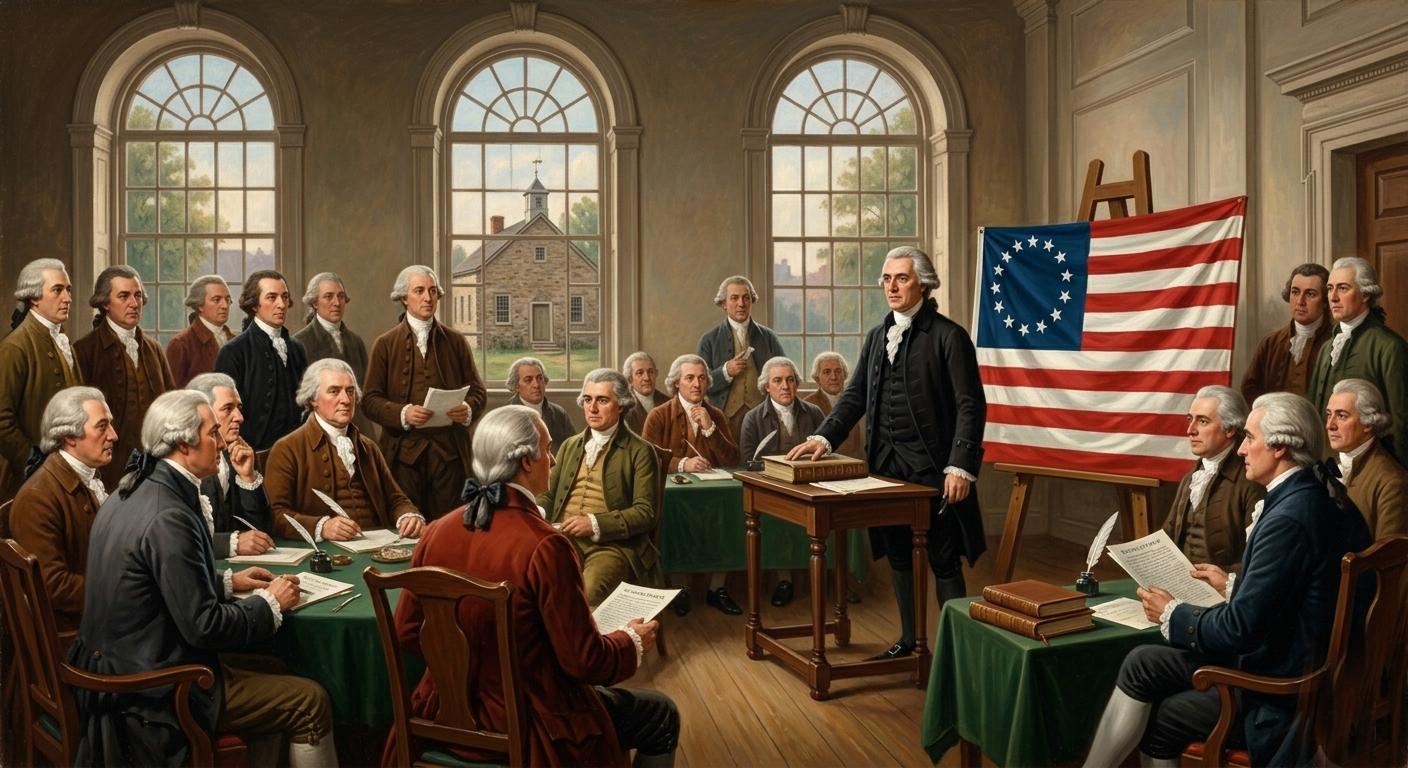
On June 14, 1777, the Second Continental Congress of the United States met in Philadelphia and passed a resolution of just thirty-one words that would launch one of the most enduring and recognizable symbols in world history. The resolution read: ‘Resolved, That the flag of the United States be thirteen stripes, alternate red and white; that the Union be thirteen stars, white in a blue field, representing a new Constellation.’ With those words, the new nation — barely a year old, in the middle of a desperate war for its survival, with no guaranteed future and no certainty that it would even exist long enough to need a permanent flag — formally defined the design of its national banner. Thirteen stripes for thirteen colonies. Thirteen stars for thirteen states. Red, white, and blue, in arrangements that were deliberately left unspecified, to be interpreted by the many hands that would sew the flag in the years ahead.
That brief resolution, passed in the midst of the American Revolutionary War, established the foundational design that every version of the American flag since 1777 has maintained. Today’s flag — with its fifty stars representing fifty states, its seven red stripes and six white stripes totaling thirteen in honor of the original colonies — is directly descended from the decision made on that June day in Philadelphia. The flag has been redesigned twenty-seven times in the two and a half centuries since 1777, each change adding a star for a new state, but the core architecture of the design — stripes, stars, red, white, and blue — has never changed. June 14 is now observed annually as Flag Day, a national day of recognition for the resolution that created what Americans call ‘Old Glory.’
A Nation at War Without a Flag: The Urgent Need for a National Symbol in 1776-1777
The American Revolution that produced the Flag Resolution of 1777 had been underway for more than two years by the time Congress addressed the question of a national flag. The first shots of the war were fired at Lexington and Concord on April 19, 1775. The Declaration of Independence had been adopted on July 4, 1776. The Continental Army under General George Washington had been fighting, retreating, suffering, and occasionally triumphing for the better part of two years. And throughout all of this, the new nation had no agreed-upon national flag — an absence that created practical problems of military identification and symbolic problems of national identity simultaneously.
The practical problem was genuine and urgent. In the fog and confusion of eighteenth-century battle, visual identification was a matter of life and death. Troops needed to know which formations were friendly, which positions were held by their own side, which ships in a harbor were allied vessels. Before 1777, American military units flew a bewildering variety of flags: regimental standards made by individual states, improvised banners, colonial militia flags, and whatever other identifying markers commanders could devise. The lack of standardization caused confusion on the battlefield and at sea, where American ships risked being fired upon by their own allies or failing to be recognized as vessels of a state that required the respect of the international community. A unified national flag was not merely a symbolic luxury — it was a military necessity.
The symbolic problem was equally pressing. A nation that had declared its independence from Britain and was fighting to make that independence real needed visual symbols that expressed its new identity and distinguished it from the colonial status it was rejecting. The flags that had been flying over American forces in the early stages of the war often incorporated elements — most notably the British Union Jack — that were directly contradictory to the message of independence and separation from Britain. Replacing those vestigial symbols of colonial loyalty with something new, distinctly American, and expressive of the nation’s revolutionary ideals was both practically necessary and politically important. The question was: what should the new flag look like, and who would decide?
Before the Stars and Stripes: The Flag Landscape of Revolutionary America
The history of the American flag does not begin on June 14, 1777. It begins decades earlier, in the visual culture of colonial protest and revolutionary organizing that gradually created the symbolic vocabulary from which the Stars and Stripes would eventually be assembled. The red and white stripes that would become the most recognizable element of the American flag did not appear from nowhere in 1777 — they had a history in pre-revolutionary colonial life that gave them specific political meaning before they were ever adopted as the national flag’s defining feature.
The Sons of Liberty, the revolutionary organization that organized colonial resistance to British taxation through actions including the Boston Tea Party, flew a flag in Boston as early as 1765 that featured nine alternating red and white stripes. The ‘rebellious stripes,’ as they came to be known, were a defiant visual declaration of resistance to British authority. In 1775, Captain Abraham Markoe’s Philadelphia Light Horse Troop flew a flag with thirteen blue and silver stripes — a direct reference to the thirteen colonies united in opposition to Britain. The specific symbolism of stripes as an expression of colonial unity and resistance was well established in revolutionary consciousness well before the Continental Congress made it official.
The stars that would form the other half of the design also had precedents in colonial American visual culture. Stars appeared in colonial flags as early as 1676, and regimental flags featuring stars in a blue canton — such as those of the Green Mountain Boys of Vermont and the 1st Rhode Island Regiment—it had been in use since the early stages of the Revolution. Stars were important symbols in European heraldry, and their appearance on American flags carried connotations of aspiration, sovereignty, and celestial guidance that resonated with the ideals of the revolutionary cause. The specific pairing of stars with stripes in the national flag’s design represented a synthesis of these two distinct but related visual traditions.
The first flag that actually resembled what would become the American national flag was the Grand Union Flag, also known as the Continental Colors, the Cambridge Flag, or the Somerville Flag. This flag, which served as the unofficial national flag from early 1776 until the adoption of the Stars and Stripes in June 1777, consisted of thirteen alternating red and white horizontal stripes — representing the thirteen colonies — combined with the British Union Jack in the upper left canton. It was raised for the first time on a seventy-six-foot liberty pole at Prospect Hill in Charlestown, Massachusetts on January 1, 1776, at the behest of General George Washington, whose headquarters were nearby. The thirteen stripes expressed colonial unity; the Union Jack expressed the — by then very faint — hope of reconciliation with Britain.
The Grand Union Flag presented an obvious problem: it flew the British flag in its most prominent position. As American independence became not just a possibility but an actuality — following the Declaration of Independence on July 4, 1776 — the continued use of a flag incorporating the British Union Jack became increasingly untenable. The confusion it could cause was demonstrated when some British observers, seeing the Grand Union Flag for the first time, mistook the American striped flag for a flag of colonial surrender or submission rather than defiance. The same design that expressed colonial solidarity also, paradoxically, continued to symbolize attachment to the British crown that the colonists were fighting to be rid of. A new flag was needed — one that expressed independence fully and unambiguously.
The Continental Congress, the Marine Committee, and the Path to June 14, 1777
The resolution that created the Stars and Stripes was passed by the Second Continental Congress, which was the governing body of the United States from 1775 to 1781. The Second Continental Congress had been meeting since May 1775 in Philadelphia, where it had declared independence, authorized the Continental Army, issued currency, conducted diplomacy with foreign powers, and managed the enormous administrative challenges of running a revolution and a war simultaneously. It operated as the de facto national government of the United States in a period when no constitution had yet been drafted and no permanent governmental structures had been established. Its members were among the most prominent political figures in America: men like John Hancock of Massachusetts (president of the Congress and first signer of the Declaration of Independence), Benjamin Franklin of Pennsylvania (diplomat, scientist, and elder statesman of the Revolution), John Adams of Massachusetts (lawyer and future president), and dozens of other lawyers, merchants, planters, and intellectuals who had committed themselves to the cause of independence.
The specific committee responsible for flag matters within the Continental Congress was the Marine Committee — so named because it oversaw the affairs of the Continental Navy and was concerned primarily with naval ensigns and the flags that American ships would fly at sea and in foreign harbors. The 1777 Flag Resolution appears in the records of the Continental Congress between other resolutions from the Marine Committee, strongly suggesting that its original purpose was to establish a naval ensign rather than a broader national symbol in the modern sense. The concept of a national flag as we understand it today — a symbol representing the entire nation and displayed everywhere from government buildings to private homes — did not fully exist in the late eighteenth century; the notion was only just emerging, and the 1777 resolution was the act that helped bring it into being for the new United States.
The resolution was passed on June 14, 1777, but its origins can be traced earlier. The Marine Committee had been developing guidelines for American flags since at least July 4, 1776, when the Declaration of Independence was signed. The context for the June 1777 resolution included a petition by a Native American nation on June 3, 1777 requesting an American flag — an indication that the question of national flag design had practical diplomatic as well as military dimensions. The exact deliberations that led to the specific language of the resolution are not well documented in the congressional records of the period, partly because the Congress did not yet routinely record all of its proceedings in detail. What the record shows is that on June 14, 1777, the Marine Committee’s resolution was adopted, establishing for the first time in law the basic design of what would become the United States flag.
Francis Hopkinson: The Most Likely Designer of the Stars and Stripes
The question of who actually designed the American flag — who decided that it should have thirteen stars and thirteen stripes, that the stars should be white on a blue field, and that the stripes should alternate red and white — is one of the most contested in American history, wrapped in a combination of missing records, competing claims, and retrospective mythology that makes a definitive answer impossible. But the evidence that exists points most consistently toward a single figure: Francis Hopkinson of New Jersey, a delegate to the Continental Congress, a signer of the Declaration of Independence, and at the relevant time the chairman of the Continental Navy Board’s Middle Department.
Francis Hopkinson was born in Philadelphia on September 13, 1737, and was one of the most versatile figures of the American founding generation. A lawyer, writer, composer, poet, artist, and public official, he was exactly the kind of polymath who combined artistic sensibility with practical civic engagement that the revolutionary cause consistently attracted. He served in the Continental Congress and was one of the signers of the Declaration of Independence, representing New Jersey. In his capacity as chairman of the Continental Navy Board’s Middle Department — the body directly under the Marine Committee — he was involved in the design of naval flags, seals, and other official visual symbols of the new United States. This institutional position placed him at the center of exactly the kinds of design decisions that the Flag Resolution embodied.
The most direct evidence for Hopkinson’s claim to have designed the flag comes from Hopkinson himself. In a letter and subsequent bill submitted to the Continental Board of Admiralty in 1780, he claimed credit for designing ‘the flag of the United States of America’ along with other official symbols including the Great Seal of the United States. He initially requested a quarter cask of wine as payment for his design work; when this request went unanswered, he submitted a more detailed bill to the Board of Treasury for £2,700. The government’s response to this bill was revealing: the Auditor General James Milligan and the Chamber of Accounts investigated the claim and declined to pay, on the grounds that Hopkinson was not the only person involved in the relevant committees and therefore could not be singled out for sole compensation. Significantly, the government did not dispute that Hopkinson had made a genuine contribution to the flag’s design — only that he was one contributor among several and that his contribution did not justify sole payment.
No surviving illustrations from Hopkinson’s hand of his flag design exist, but historians believe his design most likely featured thirteen red and white stripes with thirteen six-pointed stars arranged in a blue field. In designing various official American symbols during this period, Hopkinson showed a consistent preference for six-pointed stars rather than five-pointed ones. If the five-pointed stars that eventually became standard on the American flag were indeed Hopkinson’s preferred design, the evidence for this has not survived; if they were a modification introduced by someone else, the record of that modification has also been lost. What is clear is that Hopkinson was, as Britannica has described, ‘most likely’ the designer of the flag, and that his claim — made during his own lifetime, when anyone who knew otherwise could have challenged it — was the most contemporaneous and documentarily supported claim of any individual to the flag’s design.
Betsy Ross and the Legend of the First Flag: History, Myth, and Meaning
No element of American flag history is more familiar, more widely taught, or more historically contested than the legend of Betsy Ross. According to the story, a Philadelphia seamstress named Elizabeth ‘Betsy’ Ross sewed the first American flag in 1776, after being visited at her upholstery shop by General George Washington, Robert Morris (a wealthy Philadelphia merchant and financier of the Revolution), and George Ross (a member of Congress who happened to be the uncle of Betsy’s deceased first husband, John Ross). The three men, the story goes, presented Betsy with a sketch of a proposed flag design featuring six-pointed stars, and she persuaded them to adopt five-pointed stars instead — demonstrating by folding a piece of paper and making a single cut how a five-pointed star could be produced easily and efficiently. Washington revised the sketch on the spot, and Betsy sewed the first Stars and Stripes.
It is a compelling story, suffused with the particular romance of ordinary Americans making history in ordinary settings — a seamstress in her shop, a general seeking advice on domestic craft, a practical demonstration with folded paper that changed the look of a nation’s symbol forever. And Betsy Ross was a real person. Elizabeth Griscom was born on January 1, 1752, in Philadelphia, the eighth of seventeen children in a Quaker family. She learned upholstery from her great-aunt Sarah, apprenticed with an upholsterer named William Webster, and married her first husband John Ross — who died in 1776, leaving her to manage the upholstery business alone. She made flags for the Pennsylvania State Navy Board in 1777, and payment records for this work survive in the historical archives. She continued making flags for decades and died in Philadelphia in 1836 at the age of eighty-four. There is no question that Betsy Ross was a real flagmaker who contributed to the Revolutionary cause.
The problem is with the specific legend of her designing and sewing the first national flag. The story did not surface publicly until 1870 — thirty-four years after Betsy Ross’s death — when her only surviving grandson, William J. Canby, presented a paper to the Historical Society of Pennsylvania based on family oral tradition. Canby’s account was based entirely on stories he had heard from his grandmother and other relatives, with no supporting documentary evidence. His own research through the Journals of Congress and other official records, which he acknowledged in his paper, failed to find any corroborating evidence for the story. George Washington’s diaries, which are extensive and detailed, make no mention of any meeting with Betsy Ross to discuss a flag design. The Continental Congress’s records contain no reference to any committee to design a flag in 1776. George Henry Preble, one of the nineteenth century’s most authoritative historians of the American flag, wrote in his 1882 study that no combined stars-and-stripes flag was in common use before June 1777, and that no one knew who had designed the 1777 flag.
Modern historians are largely skeptical of the Betsy Ross legend as a factual account, while acknowledging that she was a real flagmaker who likely made and contributed to many early American flags. Ross biographer Marla Miller has argued that the relevant question about Betsy Ross is not whether she designed the flag but whether she made it — that her real contribution was one of production and entrepreneurship rather than original design. Historian Laurel Thatcher Ulrich has gone further, arguing that the question of who made the ‘first’ American flag is itself a misconception, because the flag evolved gradually from many different hands and there was no single first flag. ‘The flag, like the Revolution it represents,’ Ulrich has written, ‘was the work of many hands.’ What the Betsy Ross legend does capture, whatever its historical limitations as a factual account, is something true about the nature of the flag’s creation: it was made by ordinary people, in ordinary workplaces, using the skills of craftswomen and seamstresses who have largely been written out of official historical narratives.
The Thirteen Colonies, Thirteen Stripes, and Thirteen Stars: What the Design Represented
The core symbolism of the 1777 Flag Resolution is the number thirteen — repeated twice, in the thirteen stripes and the thirteen stars. This repetition was not decorative; it was the design’s central political statement. The thirteen stripes and thirteen stars each represented the thirteen original colonies that had declared independence from Britain in 1776 and that had organized themselves into the United States of America. Those colonies were Connecticut, Delaware, Georgia, Maryland, Massachusetts, New Hampshire, New Jersey, New York, North Carolina, Pennsylvania, Rhode Island, South Carolina, and Virginia — the complete enumeration of British colonial settlements along the eastern seaboard of North America that had united in rebellion against the Crown.
The choice of stripes as one of the two visual elements representing the thirteen colonies drew directly on the tradition of the ‘rebellious stripes’ that had been associated with colonial resistance since the Sons of Liberty flag of 1765. In the visual language of the Revolution, stripes meant defiance, unity, and the collective strength of the colonies acting together. The stripes’ alternating red and white colors had no single official assigned meaning — the Flag Resolution of 1777 did not specify the symbolism of the colors — but Charles Thomson, the Secretary of the Continental Congress who played a key role in designing the Great Seal of the United States, offered an interpretation that has been widely quoted ever since. In describing the colors of the Great Seal, Thomson wrote: ‘White signifies purity and innocence, Red, hardiness and valour, and Blue… signifies vigilance, perseverance and justice.’ These descriptions were not formally adopted as the official meaning of the flag’s colors, but they have shaped popular understanding of flag symbolism ever since.
The thirteen stars in the blue canton represented the same thirteen states but in a different visual register. Stars carried connotations of aspiration, celestial guidance, and — in the specific phrasing of the Flag Resolution — the formation of a ‘new Constellation.’ The use of the word ‘constellation’ was deliberate and evocative: it suggested that the thirteen states, arranged in the blue field like stars in the sky, formed a new pattern of political organization that was unprecedented in history — a union of independent states, each retaining its own sovereignty while united under a common national identity. The image of a new constellation being named and given its place in the heavens was a powerful metaphor for the act of national creation that the Declaration of Independence and the Revolution represented.
The choice of a blue background for the stars may have drawn on the blue canton of Washington’s headquarters flag, which had featured stars in a blue field and had served as a recognized symbol of American military authority during the early stages of the Revolution. The combination of blue, red, and white also reflected the visual heritage of the British Union Jack and the colonial flags that had been derived from it — a continuity of color palette that acknowledged the colonists’ British heritage even as the stars-and-stripes design expressed their rejection of British political authority. The colors were not, as far as historians can determine, chosen for their specific symbolic meanings but rather derived organically from the visual tradition in which American flag design was embedded.
The Flag at Fort Schuyler: The Stars and Stripes’ First Battle, August 3, 1777
The Flag Resolution of June 14, 1777 created a legal definition of the national flag, but it did not immediately put that flag into use across the Continental Army. The resolution passed in Philadelphia, and news of it had to travel to military units scattered across the thirteen states, many of whom had neither the materials nor the craftspeople available to immediately produce compliant flags. The new Stars and Stripes reportedly first appeared in battle as military colors on September 11, 1777, at the Battle of Brandywine in Pennsylvania — but an even earlier documented instance of the flag’s use in a military context is the famous improvised flag at Fort Schuyler.
When Massachusetts reinforcements arrived at Fort Schuyler (also called Fort Stanwix) in August 1777 during the Siege of Fort Stanwix in upper New York, they brought with them news of the Continental Congress’s adoption of the new flag design. The garrison, eager to display the new national colors, improvised a flag from materials at hand: soldiers cut up their white shirts to make the white stripes, red flannel petticoats belonging to the wives of officers were cut up to provide the red material, and the blue for the union — the canton with the stars — was secured from Captain Abraham Swartwout’s blue cloth coat. A voucher exists in the congressional records showing that Congress paid Captain Swartwout for his coat, which became part of the flag. This improvised Stars and Stripes was flown over Fort Schuyler on August 3, 1777 — the first documented instance of the official national flag being flown under fire, made from the most literally democratic of materials: the shirts off soldiers’ backs.
The Ambiguity of the Resolution: Star Arrangements, Flag Variations, and the Chaos of Early American Flags
The Flag Resolution of 1777 was remarkable for what it did not specify as much as for what it did. The resolution established that the flag should have thirteen alternating red and white stripes and thirteen white stars on a blue field — but it said nothing about how the stars should be arranged, how many points the stars should have, what size the flag should be, how the stripes should be proportioned, or even definitively whether the red or the white stripe should appear at the top and bottom edges. The resolution left these questions to the discretion of individual flag makers, and the result was an extraordinary diversity of flag designs that all technically complied with the 1777 resolution while looking quite different from each other.
Star arrangements varied enormously in the early years of the republic. Some flags arranged the thirteen stars in a single circle, with no star above any other — a design that symbolized the equality of the thirteen states, since a circle has no beginning and no end, and every point on its circumference is equidistant from the center. This arrangement became the basis for what is now known as the ‘Betsy Ross flag’ design, though as discussed the connection to Betsy Ross is historically uncertain. Other flags arranged the stars in rows — three rows, four rows, various configurations of five and eight stars. Some flags placed the thirteen stars in the shape of a single large star, using small stars to form the outline of a bigger one. Still others used letters or numbers in place of some stars to identify the state that flew the flag. The stars themselves might have five points or six points; early American flags used both, with six-pointed stars actually appearing more commonly in the earliest documented examples.
Even the stripe arrangement varied. The resolution specified ‘alternate red and white’ stripes but did not specify whether red or white should appear at the top and bottom of the flag. Some flags began and ended with red stripes; others began and ended with white. Some flags had more than thirteen stripes — historical records document examples with fifteen, seventeen, and even more stripes from the Revolutionary era. Captain John Manley, a Continental Navy officer, reportedly believed as late as 1779 that the United States ‘had no national colors’ and that each ship flew whatever flag pleased its captain. As late as May 1779, Secretary of the Board of War Richard Peters expressed concern in a letter that ‘it is not yet settled what is the Standard of the United States’ — a remarkable admission that the flag’s design remained effectively undefined in practice two full years after the resolution that was supposed to have defined it.
Benjamin Franklin and John Adams, writing in an official diplomatic letter to Ferdinand I of the Two Sicilies on October 3, 1778, described the American flag as consisting of ’13 stripes, alternately red, white, and blue’ — with blue stripes listed as part of the design, which contradicts the 1777 resolution’s specification of red and white only. Whether this was a misremembering, a description of a specific variant they had seen, or an attempt to describe the overall appearance of the flag including the blue canton is unclear, but it illustrates how unsettled the flag’s design remained in the minds even of senior American officials in the years immediately following the resolution.
The First Flag Act in Battle and at Sea: John Paul Jones and the Stars and Stripes Abroad
Despite the confusion surrounding the flag’s precise design in the early years, the Stars and Stripes began appearing on American ships in foreign ports and in naval engagements with increasing regularity from 1777 onward. The most celebrated naval officer of the American Revolution, John Paul Jones, used a variety of thirteen-star flags on his ships and helped introduce the American flag to the courts and harbors of Europe. Jones was born in Scotland in 1747 as John Paul before adding the surname Jones and becoming an American naval hero. His most famous engagement — the September 1779 battle between his flagship Bonhomme Richard and the British warship Serapis off the coast of England — was the occasion for his legendary refusal to surrender even as his ship was sinking: ‘I have not yet begun to fight!’
The flags Jones flew on his ships during his European campaigns are among the earliest well-documented examples of thirteen-star American flags in use. The flag of his ship Serapis, documented by Dutch government officials in October 1779, had three rows of eight-pointed stars with red, white, and blue stripes — with blue stripes included alongside the specified red and white, matching the description Franklin and Adams gave to the King of the Two Sicilies. The flag of the Alliance, also documented in October 1779 by the Dutch, had five rows of eight-pointed stars with thirteen red and white stripes, with white stripes at the outer edges. These early documented naval flags demonstrate both the variety of designs in use and the fact that the Stars and Stripes was already serving its essential international diplomatic function: identifying American ships as vessels of a recognized sovereign state.
The Second and Third Flag Acts: Stars and Stripes Through the Growth of the Nation
As the United States expanded beyond its original thirteen states, the question of how to represent new states in the flag became a recurring legislative challenge. The Flag Act of 1777 had specified thirteen stripes and thirteen stars, but it had said nothing about what to do when the fourteenth, fifteenth, or twentieth state joined the Union. The first two new states — Vermont, admitted in 1791, and Kentucky, admitted in 1792 — precipitated the second major piece of flag legislation. Congress passed the second Flag Act on January 13, 1794, and it came into effect on May 1, 1795. The Act added two new stars and two new stripes to the flag to represent Vermont and Kentucky, creating a fifteen-star, fifteen-stripe flag.
It was this fifteen-star, fifteen-stripe flag — not the original thirteen-star, thirteen-stripe version — that flew over Fort McHenry during the British bombardment on the night of September 13-14, 1814, which inspired Francis Scott Key to write the poem that would become the national anthem. Mary Pickersgill, a Baltimore flagmaker assisted by her thirteen-year-old African American apprentice Grace Wisher, had sewn the enormous garrison flag — measuring approximately 30 feet by 42 feet — that flew over the fort. The Star-Spangled Banner that Key saw ‘by the dawn’s early light’ was therefore not the thirteen-stripe flag of 1777 but the fifteen-stripe modification of 1795. The flag that inspired the national anthem was already a second-generation design, reflecting the growth of the nation from thirteen to fifteen states.
The logic of adding both a stripe and a star for each new state quickly became unworkable as the nation continued to expand. When five more states were admitted between 1796 and 1817 — Tennessee (1796), Ohio (1803), Louisiana (1812), Indiana (1816), and Mississippi (1817) — the flag remained at fifteen stars and fifteen stripes, reflecting no change, because Congress had not passed a new flag act to accommodate them. The problem was obvious: if the pattern of adding a stripe for each new state continued indefinitely, the flag would eventually become so cluttered with stripes as to be visually incoherent. Something had to be done to prevent the flag’s design from being overwhelmed by the nation’s growth.
The solution was provided by the third and final Flag Act, passed on April 4, 1818. This act, which has governed the structure of the American flag ever since, established the principle that the number of stripes should be permanently fixed at thirteen — in permanent honor of the original thirteen colonies — while the number of stars would be adjusted to match the number of states in the Union, with each new star added on the Fourth of July following a state’s admission. The 1818 act restored the thirteen-stripe design while creating the flexible star-field mechanism that has allowed the flag to grow with the nation ever since. When the 1818 act was passed, there were twenty states in the Union, so the new flag had twenty stars and thirteen stripes. Since then, with each state admission, a new star has been added on the Fourth of July, producing the current fifty-star design that has been in use since July 4, 1960.
Flag Day: The Centennial, June 14, 1877, and the Path to National Recognition
The date of the original Flag Resolution — June 14, 1777 — did not immediately become a widely observed national holiday. For nearly a century, the anniversary passed without formal recognition. It was not until June 14, 1877, the hundredth anniversary of the adoption of the Stars and Stripes, that a nationwide observance of what was called Flag Day was held, with Congress directing that the flag be flown from all public buildings across the country in recognition of the centennial. This first Flag Day observance triggered a broader popular interest in the flag’s anniversary, and several states began holding annual observances in subsequent decades.
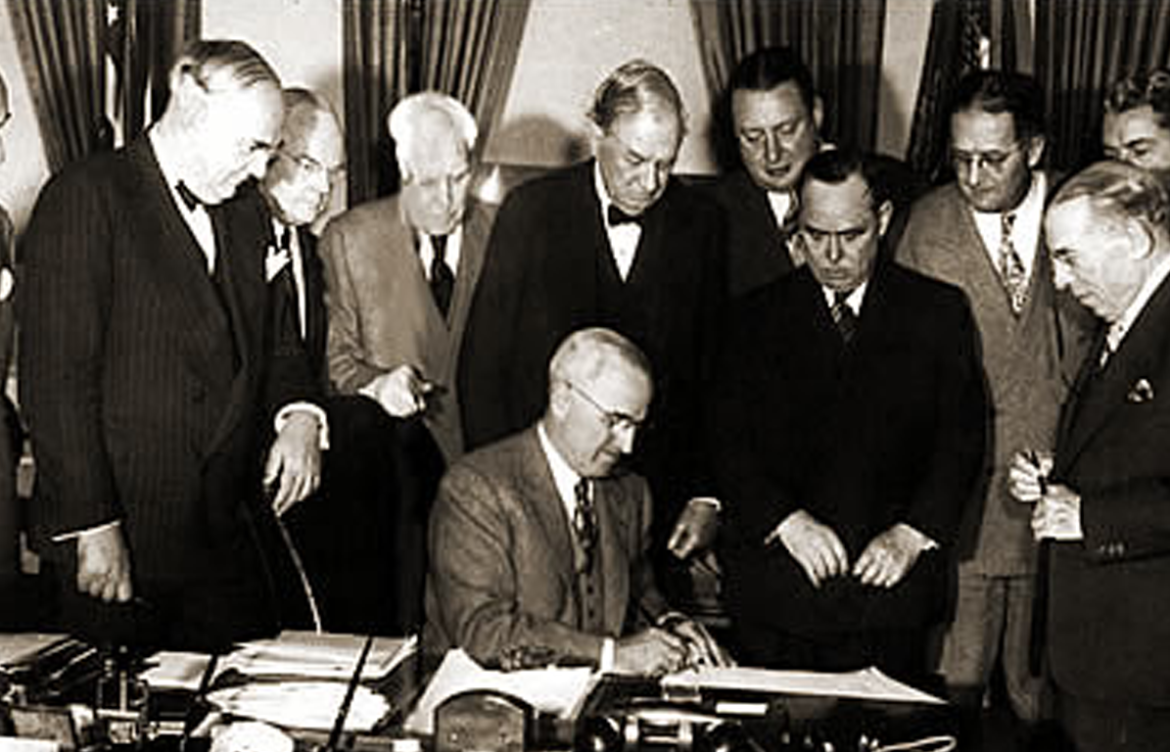
The campaign to establish Flag Day as a permanent national observance gathered momentum through the late nineteenth and early twentieth centuries, driven partly by the wave of patriotic sentiment that accompanied the Civil War and its aftermath and partly by the growing importance of the flag as a symbol of national unity in a period when immigration, industrialization, and social change were transforming American society. In 1916, President Woodrow Wilson issued a proclamation calling for June 14 to be observed as Flag Day. The formal legal establishment of Flag Day as a national day of observance came on August 3, 1949, when President Harry S. Truman signed legislation making June 14 Flag Day, a national observance — though not a federal holiday, since it does not provide a paid day off for federal workers. The date’s significance rests entirely on its connection to the Marine Committee resolution of June 14, 1777.
The Evolution of the Flag: Twenty-Seven Designs from 1777 to 1960
The United States flag has been officially modified twenty-seven times since the original 1777 design, making it one of the most frequently updated national flags in history. Each modification after the 1818 Flag Act involved only the addition of one or more stars to reflect the admission of new states to the Union. The general progression traced the westward expansion and eventual continental and territorial completion of the United States: from thirteen stars when the nation was founded on the Atlantic coast, to the current fifty stars reflecting the admission of Alaska and Hawaii in 1959, the only two non-contiguous states.
Significant milestones in the flag’s evolution include the twenty-star flag of 1818, which restored the thirteen stripes after the fifteen-stripe period; the thirty-five-star flag used during the Civil War; the forty-eight-star flag that flew from 1912 to 1959 and represents the longest continuous use of any single flag design (forty-seven years); the forty-nine-star flag used briefly in 1959-1960 after Alaska’s admission; and the fifty-star flag adopted on July 4, 1960, following Hawaii’s admission as the fiftieth state on August 21, 1959, which has now been in use for over sixty-five years — making it the longest-used version of the American flag in history.
The physical specifications of the flag — the precise proportions of its elements, the exact shades of its colors — remained surprisingly vague for much of American history, given the strict standardization that later generations would apply to such matters. As late as 1912, sixty-six different designs of the American flag were reportedly in use simultaneously, reflecting the long tradition of leaving specific design details to individual flag makers. It was President William Howard Taft’s Executive Order 1556 on October 29, 1912, that first standardized the proportions and relative sizes of the flag’s design elements. The exact shades of color were not standardized until 1934. Further refinements have been made through subsequent executive orders, but none of the design specifications have ever been codified into formal law — the flag’s design remains, in its details, a matter of executive order rather than congressional statute.
The Meaning of the Flag in American History: Symbol, Controversy, and Enduring Power
The American flag that was defined by the resolution of June 14, 1777 has become, over two and a half centuries, one of the most powerful and contested national symbols in the world. Its power derives from the same qualities that have made it controversial: it represents not just the United States government but the United States itself — its people, its ideals, its history, and its contradictions — in a way that few national symbols in the world manage to do. The flag has been carried into battle by American soldiers, raised over the South Pole and on the surface of the moon, planted at Iwo Jima in a photograph that became one of the most reproduced images of the twentieth century, and held over the coffins of fallen servicemen and women at military funerals across the country.
The flag has also been the subject of burning, protest, and legal controversy. The Supreme Court ruled in Texas v. Johnson (1989) and United States v. Eichman (1990) that flag burning is protected political speech under the First Amendment — decisions that affirmed the flag’s status as a political symbol subject to the same freedoms of expression that it nominally represents. This tension between the flag as an object of reverence and the flag as a symbol that can be appropriated, criticized, or rejected is itself an expression of the democratic values the flag was designed to embody. A nation that protects the right to burn its own flag is demonstrating, in the most direct possible way, that it takes seriously the freedoms it claims to stand for.
The thirteen stripes that were specified in the resolution of June 14, 1777 have remained unchanged through every version of the flag since that day. They are the constant in a design that has otherwise changed twenty-seven times. Their permanence is a deliberate act of historical memory — a decision, codified in the 1818 Flag Act and maintained ever since, that the original thirteen colonies should always be represented in the flag regardless of how large the Union grows. In a nation that has sometimes been accused of historical amnesia, the thirteen stripes stand as a persistent reminder of the revolutionary origins, the desperate circumstances, and the extraordinary act of political imagination that created the United States of America.
Conclusion: June 14, 1777, and the Thirty-One Words That Made a Symbol
The thirty-one words of the Flag Resolution of June 14, 1777, are among the most consequential in American history. They were written in the middle of a war, by a congress whose members had pledged their lives, their fortunes, and their sacred honor to a cause that was far from assured of success. They specified thirteen stripes and thirteen stars, red and white and blue, and a new constellation in a blue field. They left unspecified the arrangement of the stars, the size of the flag, the proportions of its elements, and dozens of other details that later generations would have to work out for themselves.
The incompleteness of the resolution was, in retrospect, appropriate. A flag that was made by many hands rather than designed by a single authoritative person, that varied from maker to maker in the years after its adoption; that was improvised from soldiers’ shirts and petticoats on the ramparts of besieged forts; that was carried by sailors onto oceans that no American ship had sailed before—this flag was, from the beginning, a democratic object. It belonged to the people who made it and flew it and were willing to die for what it represented, not to the government officials who wrote its description in a document in Philadelphia.
The flag that was defined on June 14, 1777, has flown over a nation that has expanded from thirteen states on the eastern seaboard to fifty states spanning a continent and two Pacific islands. It has been carried through wars and conflicts, raised over triumphs and disasters, borne to the moon and back. It has been the object of reverence and protest, of patriotic pride and political controversy. It has been sewn by Betsy Ross or Francis Hopkinson or neither or both, depending on which accounts you trust and how you interpret the evidence. It was designed for a navy and became the symbol of a nation. It was specified in thirty-one words and has generated libraries of interpretation. The thirteen stripes remain, as they have always been, the visual foundation of a republic that began with thirteen colonies and that, in its best moments, has tried to be worthy of the revolution that created it.