
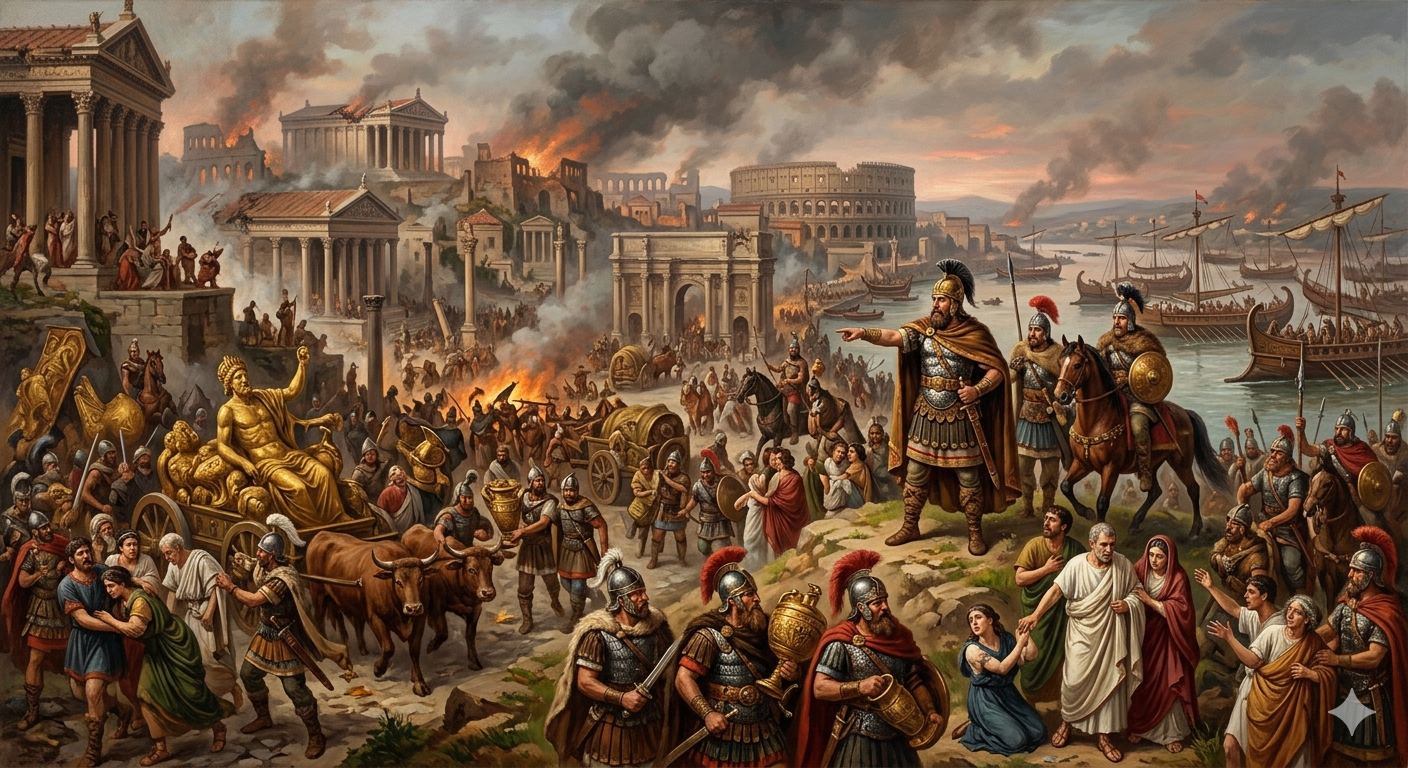
On June 2, 455 AD, the gates of Rome swung open to admit an army that had sailed from North Africa to seize the greatest city in the Western world. No legions defended the walls. No emperor waited to negotiate. The man who had seized the throne just weeks before had already been murdered by his own people in the streets outside the city. At the gates stood Pope Leo I, the only authority figure left, asking the Vandal king Gaiseric for mercy.
What followed was fourteen days of systematic looting that gave the world a new word. The term “vandalism” was born from those two weeks in June 455, and it has described wanton destruction ever since. The sack of Rome by the Vandals was the second time in less than half a century that the Eternal City had fallen to barbarian forces, and this time the plundering lasted nearly five times longer than the three days the Visigoths had spent there in 410.
Who Were the Vandals: From the Baltic to North Africa
The Vandals were a Germanic people who had migrated southward from the region of modern-day Scandinavia and Poland over many centuries, moving into contact with the Roman Empire and oscillating between alliance and open warfare with Rome for generations. By the late fourth century, they had been pushed by the movement of the Huns westward through Pannonia and into Roman Gaul, which they ravaged along with their allies the Alans and the Suebi in 406 AD. By 409, they had crossed the Pyrenees into the Iberian Peninsula, seizing territories in what is now southern Spain in a region the Romans called Hispania Baetica.
Their position in Spain was always precarious. The Visigoths, settled in Gaul with Roman backing, pressed them constantly. The Romans themselves continued to contest Vandal territories. Under King Gunderic, who ruled until 428 AD, the Vandals held their ground but could never achieve true security. When Gunderic died in 428, his half-brother Gaiseric succeeded him at the age of approximately thirty-nine, and everything changed.
Gaiseric, also recorded in sources as Genseric, was one of the most consequential military and political leaders of the fifth century. He recognized that the Vandals could not achieve lasting power while hemmed in between the Visigoths and the Romans in Spain. His solution was audacious: he would relocate his entire people to North Africa. In 429 AD, he led between 20,000 and 80,000 Vandals, Alans, and allied peoples across the Strait of Gibraltar into the Roman province of Africa Proconsularis, the richest agricultural territory in the Western Empire.
Gaiseric Conquers North Africa and Threatens Rome
The circumstances of the Vandal crossing to Africa remain somewhat murky in historical sources. Some accounts suggest that Gaiseric had been invited by the Roman governor of North Africa, Bonifacius, who was embroiled in a dispute with the powerful Roman general Aetius and sought Vandal military support. Others suggest Gaiseric simply saw an opportunity and took it. Whatever the precise motivation, once in Africa, Gaiseric moved with characteristic decisiveness.
The Vandals swept through the Roman provinces of Africa, encountering resistance but overcoming it steadily. They laid siege to Hippo Regius in 430, a siege that lasted fourteen months and during which the city’s famous bishop, Saint Augustine, died. Gaiseric continued pressing the Roman forces, exploiting the Empire’s simultaneous involvement in campaigns against the Huns in Gaul and the resulting thin stretching of Roman military resources. On October 19, 439 AD, Gaiseric took Carthage, the greatest city in Roman Africa and one of the most important ports in the Mediterranean world.
With Carthage in Vandal hands, the balance of power in the Western Mediterranean shifted dramatically. Gaiseric reduced taxes on the common population, replaced the wealthy Roman landowning class with Vandal lords, and invested heavily in naval power. He seized Sicily, Sardinia, Corsica, and the Balearic Islands. From his base at Carthage, he built a fleet capable of raiding any coast in the Mediterranean, making the Vandal Kingdom the preeminent maritime power of its era.
The Romans could not ignore this transformation. In 442 AD, Emperor Valentinian III formally recognized the Vandal Kingdom as an independent state rather than a group of foederati, or allied troops operating under Roman authority. This was the first barbarian kingdom to receive such formal recognition as a sovereign entity in former Roman territory. To cement the peace, the two powers agreed to a marriage alliance: Eudocia, the daughter of Valentinian III, would marry Huneric, the son of Gaiseric. The betrothal was arranged even though Eudocia was only about five years old at the time. The formal peace treaty of 442 gave the Vandals official control of Byzacena, Tripolitania, and the eastern half of Numidia, confirming Proconsular Africa as the heart of their kingdom.
For over a decade, the alliance held. Rome and the Vandals coexisted, their treaty secured by the promise of a future royal marriage. Then, in the space of a few weeks in early 455, the entire diplomatic edifice collapsed.
The Chain of Conspiracies That Brought the Vandals to Rome
The events that led directly to the sack of Rome in 455 began with a cascade of murders and betrayals at the highest levels of the Western Roman Empire.
Flavius Aetius had been the most powerful military commander in the Western Empire for decades. Known to contemporaries as the “last of the Romans” for his ability to hold the Empire together against successive barbarian incursions, Aetius had been the architect of the coalition that defeated Attila the Hun at the Battle of the Catalaunian Plains in 451. Despite this service, Valentinian III, who regarded Aetius as a threat to imperial authority, had him summoned to the palace and personally killed him on September 21, 454 AD. The murder of his most capable general fatally weakened the Emperor.
Petronius Maximus, a wealthy and ambitious Roman senator, had reportedly been one of the driving forces behind the execution of Aetius, and he now plotted the Emperor’s destruction as well. On March 16, 455, Valentinian III was assassinated by two of Aetius’s former followers who were acting at Maximus’s direction. The next day, March 17, Maximus declared himself Emperor.
Maximus’s position was immediately precarious. His claim to legitimacy was widely questioned both in the West and entirely unrecognized by the Eastern Roman court in Constantinople. To shore up his position, Maximus took desperate measures. He forced Licinia Eudoxia, the widow of Valentinian III, to marry him within days of her husband’s murder. He then arranged for his son Palladius to marry Eudocia, the daughter who had been promised to Huneric of the Vandals under the 442 treaty.
These decisions proved catastrophic. Licinia Eudoxia, outraged at being forced to marry the man who had engineered her husband’s death, reportedly dispatched a letter to Gaiseric appealing for intervention. For Gaiseric, the situation was a perfect pretext. By marrying Eudocia to Palladius rather than to Huneric, Maximus had violated the terms of the 442 treaty. The betrothal between Huneric and Eudocia, in Gaiseric’s interpretation, meant that Eudocia was already his daughter-in-law. The broken promise gave him both a legal justification and a personal grievance. He assembled his fleet and sailed from Carthage.
May 31 to June 2: The Fall of Petronius Maximus and the Opening of the Gates
News that Gaiseric’s fleet had landed at Ostia, the port city at the mouth of the Tiber River just a few miles from Rome, spread through the capital with terrifying speed. Maximus, who had held the imperial title for only about eleven weeks, immediately recognized that he could not defend the city. His generals were far away, attempting to gather Visigothic support. The army was insufficient. The city had no realistic defense.
Maximus attempted to flee Rome. He urged the Senate to accompany him. The senators declined. His bodyguard abandoned him. As he rode out of the city alone on May 31, 455 AD, a Roman mob recognized him and turned on him. The Emperor of the Western Roman Empire was stoned to death in the streets by his own people, his body reportedly thrown into the Tiber River. His son Palladius may have been killed in the same episode.
Three days later, on June 2, the Vandals arrived at Rome’s walls. Before entering the city, they demolished the aqueducts that supplied Rome’s water. At the gates, Pope Leo I came forward to meet Gaiseric. Leo had performed this same service in 452, when Attila the Hun had turned back from Italy following a meeting with the Pope, an event that burnished Leo’s reputation as a defender of Rome through spiritual authority. Now he appealed to Gaiseric not to burn the city, not to torture its inhabitants, and to exercise restraint in whatever the Vandals chose to take.
Gaiseric agreed to those terms, and by most accounts he kept them. Prosper of Aquitaine, a direct contemporary witness who recorded the event in his chronicle, wrote that Gaiseric refrained from fire, slaughter, and executions, accepting peaceful surrender in exchange for the right to plunder at will.
Fourteen Days of Plunder: What the Vandals Took from Rome
The pillaging of Rome lasted from June 2 to June 16, 455 AD. These two weeks represented the most systematic looting of the ancient city in its history.
Gaiseric established himself in the imperial palace and directed the stripping of Rome’s wealth in an organized and methodical way. The Vandals did not rampage randomly through the streets. They moved systematically through the palaces, temples, churches, and private houses of the city, removing everything of value. The scale of what they found and took was staggering even by the standards of an age accustomed to the spoils of conquest.
Among the most symbolically significant acts of plunder was what the Vandals did to the Temple of Jupiter Optimus Maximus, the ancient temple on the Capitoline Hill that had stood for nearly a millennium as the most sacred site in Roman religious life. Gaiseric’s forces stripped away the gilt bronze roof tiles that covered the temple, effectively tearing off half its roof. The loss of those gilded tiles gave future generations one of the most concrete images of the sack, and the connection between the Vandal name and the willful destruction of magnificent things eventually produced the modern English word “vandalism,” coined in 1794 by Henri Grégoire, Bishop of Blois, to describe the destruction of artworks during the French Revolution.
From the imperial palace, the Vandals removed the accumulated treasures of centuries of Roman power. Among the items taken were the Menorah and other sacred objects that the Roman Emperor Titus had looted from the Temple in Jerusalem when he destroyed it in 70 AD. Those objects had been displayed in Rome for nearly four centuries as symbols of Roman conquest. Now they were carried to Carthage. The Byzantine historian Procopius recorded that the Vandals also stripped gilded bronze from the roof of at least one church, and that some buildings were damaged in ways that violated the spirit of Leo’s agreement.
Licinia Eudoxia and her two daughters, Eudocia and Placidia, were taken by the Vandals as captives and brought to Carthage. The imperial women were apparently treated with a degree of dignity appropriate to their status: Huneric and Eudocia were subsequently married, fulfilling the original treaty’s terms under the most perverse of circumstances, and Eudocia eventually returned to Constantinople. Placidia also eventually returned to the Eastern Empire.
Victor of Vita, writing in the late fifth century, recorded that several shiploads of Roman captives arrived in North Africa from the sack, who were then distributed among the Vandal leaders. Deogratias, the Bishop of Carthage, responded with remarkable charity: he sold all the gold and silver objects from his churches to purchase the freedom of as many captives as he could, housing and feeding them in the basilicas of Carthage until they could be returned to Rome.
The Wikipedia article on the Sack of Rome in 455 provides detailed scholarly coverage of the events and their immediate aftermath at the Wikipedia entry on the Sack of Rome 455.
The Political Aftermath: A Western Empire Without Center
When the Vandals sailed back to Carthage on June 16, 455, loaded with the wealth of Rome, the Western Roman Empire was effectively leaderless and in chaos. The imperial government had been paralyzed for the entire duration of the sack. Rome, though it had ceased to be the official capital of the empire by the early fourth century, still carried enormous symbolic and administrative weight. Its humiliation reverberated across the Roman world.
The succession crisis that followed was immediate. Avitus, who had the military and political backing of the Visigothic King Theodoric II, was acclaimed emperor by the Roman army in Arles on July 9 or 10, 455, and was later recognized by the Senate in Rome. His reign lasted barely a year before he was deposed in a coup led by the Roman general Ricimer and the Eastern-backed candidate Majorian in 456, triggering a Roman civil war that further destabilized the already crumbling Western Empire.
The treasures looted by the Vandals remained in Carthage for nearly eighty years. When the Byzantine general Belisarius defeated the last Vandal king Gelimer in the Vandalic War of 533 to 534 AD, he recovered much of the plunder from Rome and transported it to Constantinople. The Menorah and the other treasures of the Jerusalem Temple, which had traveled from Jerusalem to Rome to Carthage to Constantinople, were reportedly then sent on to Jerusalem at the request of a Jewish dignitary who warned that these objects brought catastrophe to whatever city held them.
The Vandal Kingdom itself was completely destroyed in 534 AD. The Vandals ceased to exist as a recognizable political and cultural entity following Belisarius’s conquest. Their name survived only in the vocabulary of destruction.
Britannica’s account of the Vandals’ history and their sack of Rome is available at the Britannica entry on the Vandals.
The Legacy of 455: “Vandalism,” the Fall of Rome, and What It All Meant
The sack of 455 is generally considered more historically significant in its impact than the more famous Visigoth sack of 410, even though the 410 event produced more immediate literary and theological response from writers like Saint Jerome and Saint Augustine. The Visigoths had spent three days in Rome. The Vandals spent fourteen. The systematic, organized nature of Gaiseric’s plundering left the city stripped to a degree that its earlier sacking had not achieved.
The silence that greeted the 455 sack in the contemporary historical record is itself revealing. In 410, Jerome had written in despair asking what could be saved if Rome itself was perishing. Augustine had preached to frightened North African Christians who took the event as a sign of the world’s end. In 455, as Prosper of Aquitaine observed, no such literary outpouring followed. The looting of Rome had become, in the space of forty-five years, something almost ordinary, a symptom of a decline so advanced that the sacking of the world’s greatest city no longer shocked the way it once had.
The Western Roman Empire collapsed twenty-one years later, in 476 AD, when the Germanic chieftain Odoacer deposed the last emperor, Romulus Augustulus. The sacks of 410 and 455 were the most visible markers of the process that led to that final collapse, demonstrating to all who witnessed them that the empire which had ruled the Mediterranean world for five centuries could no longer protect even its own symbolic and spiritual center.
The word “vandalism” has endured in English and European languages for more than two centuries as the Vandals’ most lasting legacy. It is a strange immortality for a people who set out not to destroy but to enrich themselves, who kept their promises to a Pope not to burn or kill, and who for fourteen days in June 455 AD simply took everything they could carry and sailed home to Carthage.
The TheCollector’s detailed analysis of the Vandal sack of Rome and the political context that made it possible is available at the TheCollector article on how the Vandals sacked Rome in 455.