The establishment of Yellowstone National Park on March 1, 1872, represents one of the most significant conservation milestones in human history. When President Ulysses S. Grant signed the Yellowstone National Park Protection Act into law, he created not just America’s first national park, but the world’s first national park, setting a precedent that would inspire global conservation efforts for generations to come.
The Geographic Wonder That Captured a Nation’s Imagination
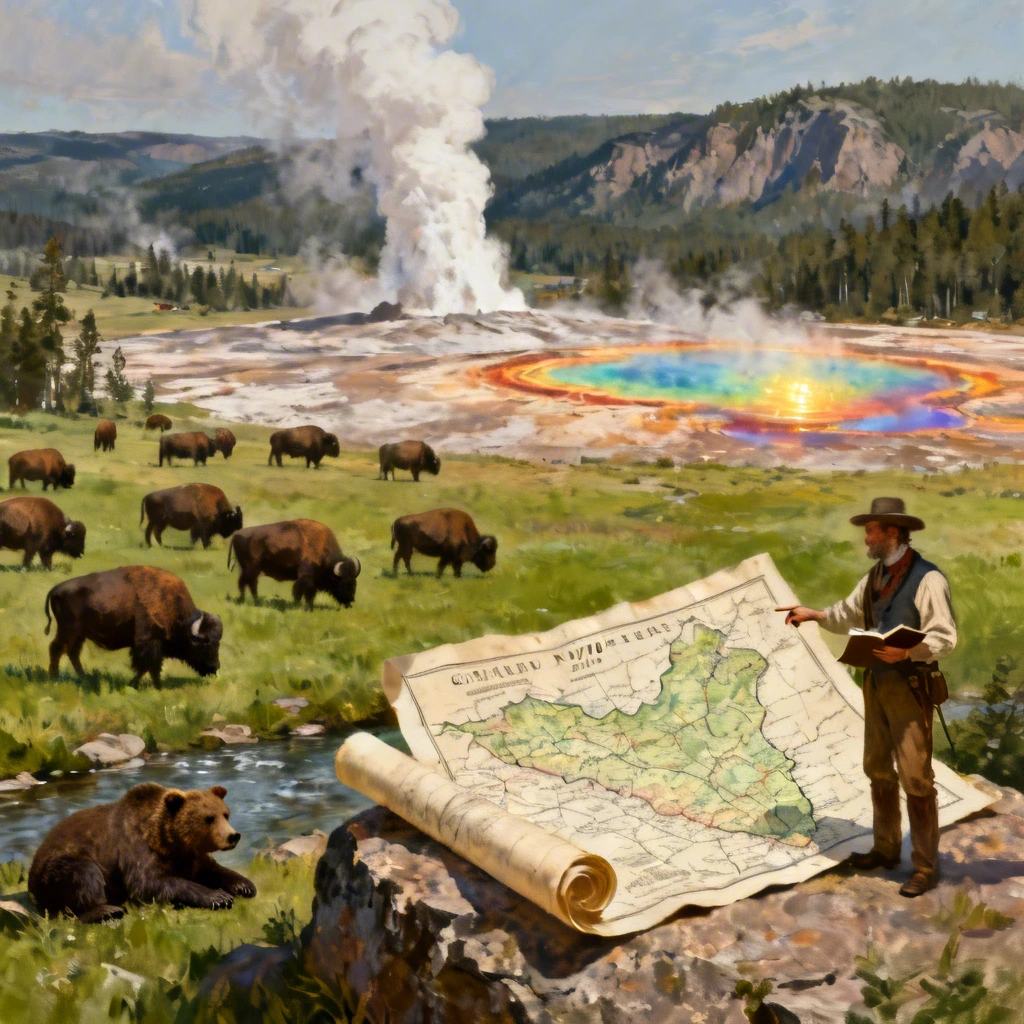
Yellowstone encompasses over 2.2 million acres across the northwestern corner of Wyoming, with smaller portions extending into Montana and Idaho. Located at the convergence of the Great Plains, Great Basin, and Columbia Plateau, this remarkable landscape features an unprecedented collection of geothermal wonders, including more than 10,000 hydrothermal features such as geysers, hot springs, fumaroles, and mudpots. The region’s unique geology, created by volcanic activity over millions of years, produces the largest concentration of thermal features found anywhere on Earth.
The park’s boundaries encompass the Yellowstone Caldera, a massive volcanic crater measuring approximately 30 by 45 miles, formed during a catastrophic eruption 640,000 years ago. This geological foundation creates the conditions for Yellowstone’s famous geothermal activity, including the iconic Old Faithful geyser, which has become synonymous with the park itself. Beyond its thermal features, Yellowstone contains dramatic canyons, pristine lakes, roaring waterfalls, and vast wilderness areas that support diverse ecosystems ranging from subalpine forests to grasslands.
Indigenous Heritage and Early Human Presence in the Yellowstone Region
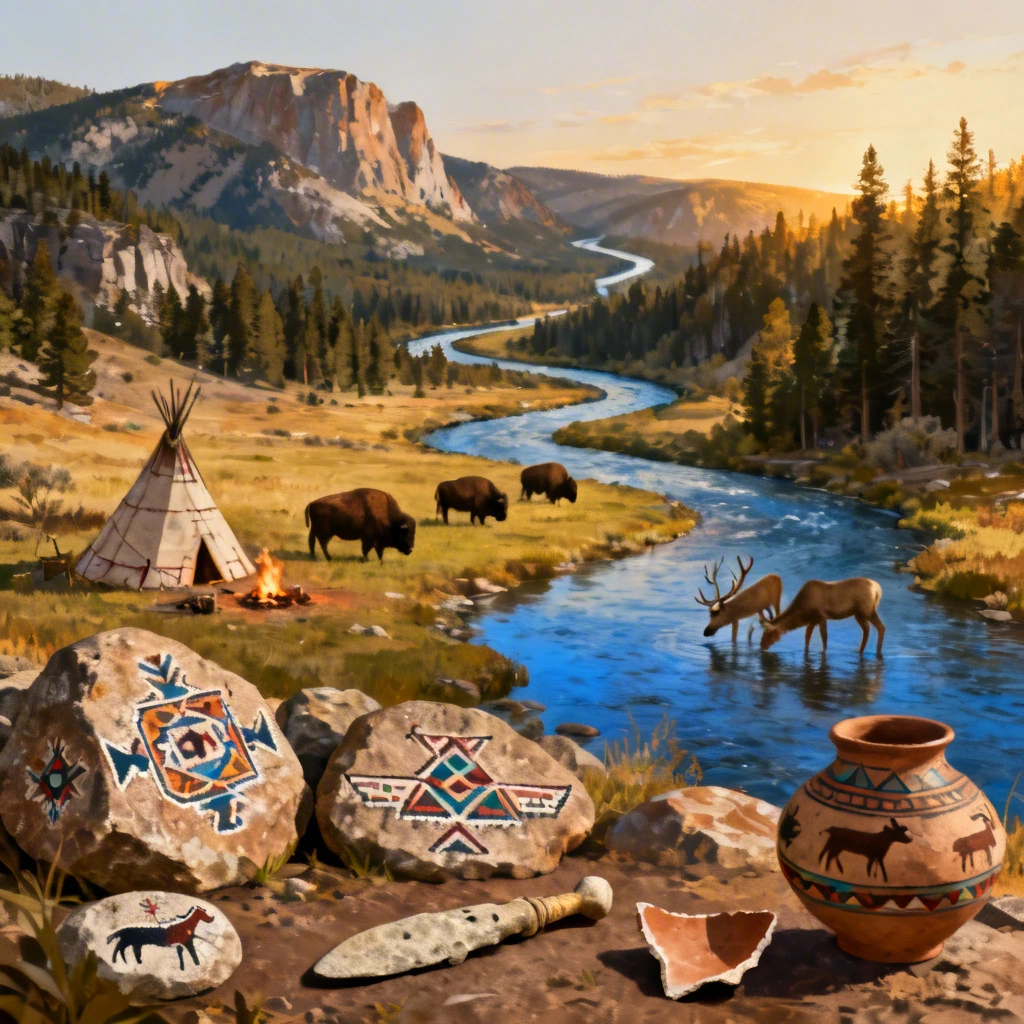
Long before European exploration, the Yellowstone region served as home and sacred ground for numerous Native American tribes for more than 11,000 years. Archaeological evidence reveals continuous human presence dating back to the end of the last Ice Age, with over 1,000 indigenous archaeological sites documented within the park boundaries. Multiple tribes, including the Crow, Shoshone, Nez Perce, Blackfeet, and others, used the area as hunting grounds, transportation routes, and sources of spiritual renewal.
The Eastern Shoshone, particularly the band known as “Sheepeaters,” were the only year-round residents of the region. These skilled hunters specialized in pursuing bighorn sheep in the high mountain terrain and maintained seasonal camps throughout what would become the park. Native peoples utilized the thermal features for religious ceremonies and medicinal purposes, quarried obsidian for tools and weapons, and developed extensive trail networks that would later guide European explorers through the wilderness.
The indigenous relationship with Yellowstone represented the first form of conservation in the region, as tribes managed resources sustainably and maintained the ecological balance that early explorers would later marvel at. However, the establishment of the national park effectively excluded Native Americans from their ancestral lands, despite treaty agreements that had guaranteed hunting rights in the region.
Early European Exploration and the Mountain Men Era
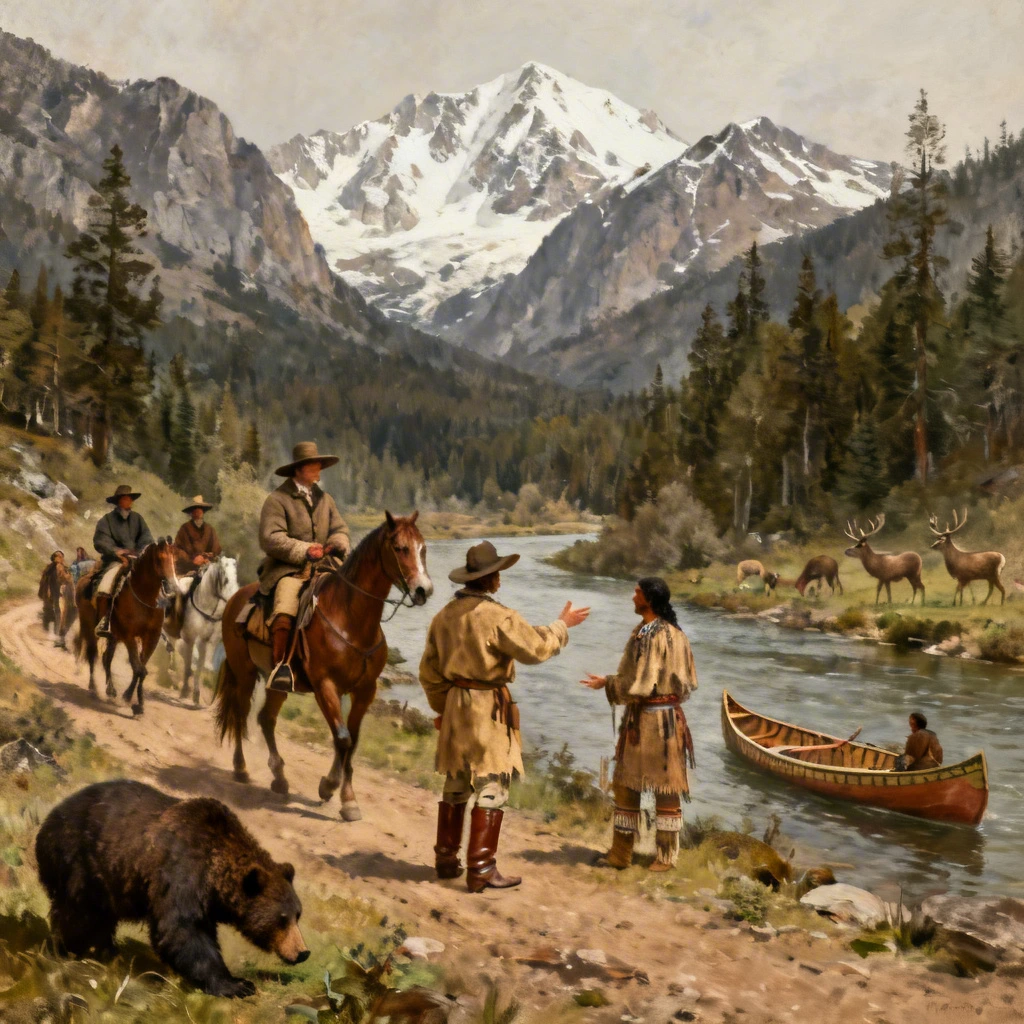
The first documented European contact with the Yellowstone region occurred during the Lewis and Clark Expedition of 1805-1806, when the explorers encountered Native American tribes who described the mysterious thermal lands to the south. While the expedition chose not to investigate these reports directly, John Colter, a member of the Lewis and Clark party, left the expedition in 1806 to join fur trappers and became the first European American to explore the Yellowstone region.
Colter’s descriptions of boiling springs, spouting geysers, and steaming landscapes earned ridicule from skeptics who dismissed his accounts as “Colter’s Hell.” Throughout the early 1800s, mountain men and fur trappers continued to venture into the region, bringing back increasingly detailed reports of its extraordinary features. Notable figures like Jim Bridger, a legendary mountain man and guide, provided vivid descriptions of the geothermal wonders, though their accounts were often embellished with tall tales that further obscured the truth about Yellowstone’s genuine marvels.
These early explorers established crucial trade routes and gathered geographic knowledge that would prove invaluable to later official expeditions. However, the remote location and dangerous travel conditions meant that systematic exploration remained limited until the mid-19th century, when improved transportation and government interest in western territories created opportunities for more comprehensive investigation.
The Cook-Folsom-Peterson Expedition of 1869: First Systematic Exploration
The first organized attempt to systematically explore the Yellowstone region began with the Cook-Folsom-Peterson Expedition of 1869. This privately funded expedition consisted of David E. Folsom, Charles W. Cook, and William Peterson, three Montana residents who sought to verify the numerous reports of geothermal wonders in the region. The expedition lasted 36 days, from September 6 to October 11, 1869, and covered approximately 500 miles of wilderness terrain.
The Cook-Folsom-Peterson party followed the Yellowstone River to its source at Yellowstone Lake, becoming the first organized group to document the lake’s impressive dimensions and crystal-clear waters. They observed and recorded numerous geothermal features, including geysers in what would later be named the Upper Geyser Basin, and marveled at the Grand Canyon of the Yellowstone with its spectacular waterfalls. Charles Cook maintained detailed journals throughout the expedition, providing the first systematic written record of Yellowstone’s natural features.
Despite the significance of their discoveries, the expedition members initially struggled to find credible outlets for publishing their findings. Eastern newspapers and magazines remained skeptical of reports describing such extraordinary natural phenomena. However, their eventual publication of articles and lectures in Montana helped generate local interest and laid the groundwork for subsequent, more influential expeditions that would ultimately lead to the park’s creation.
The Washburn-Langford-Doane Expedition of 1870: Building Scientific Credibility
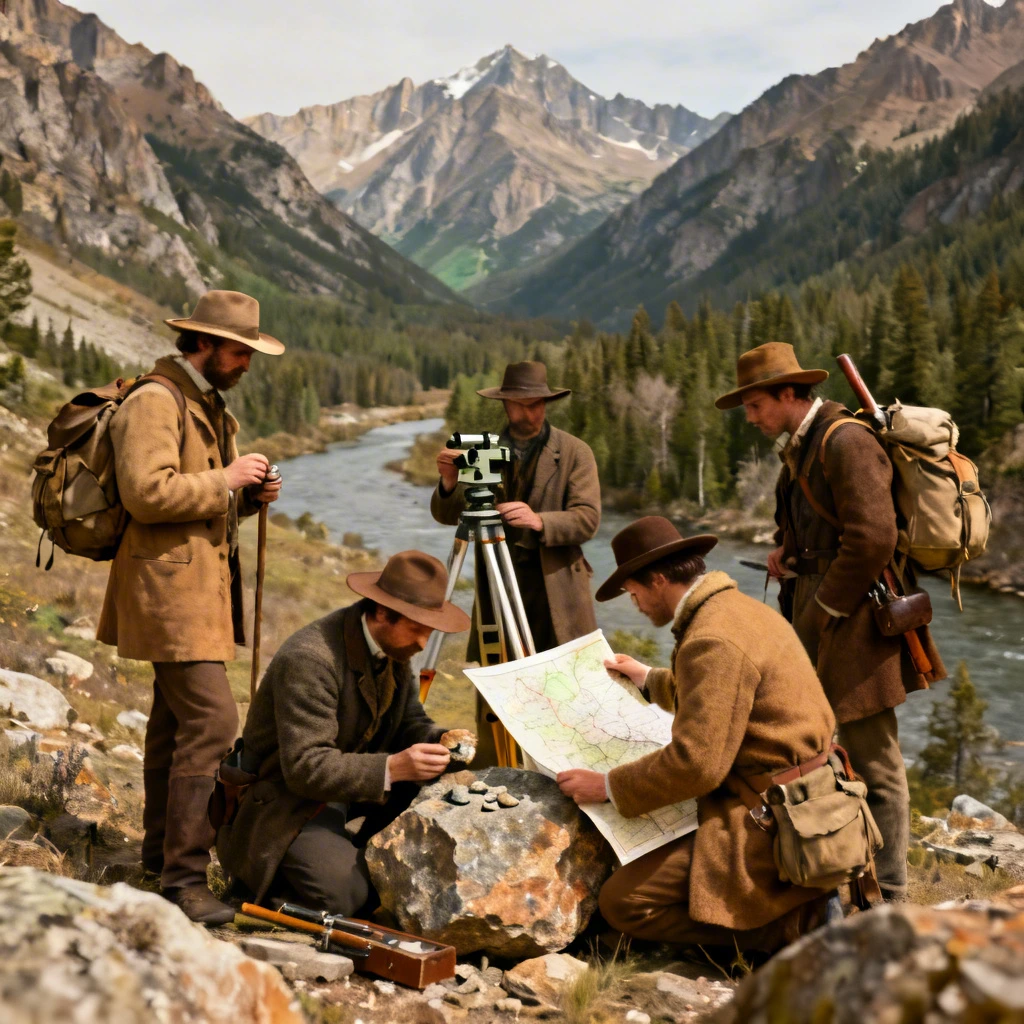
Building on the foundation laid by the Cook-Folsom-Peterson Expedition, the Washburn-Langford-Doane Expedition of 1870 brought enhanced credibility and scientific rigor to Yellowstone exploration. Led by Montana Territorial Surveyor-General Henry D. Washburn, the expedition included prominent Montana citizens and a U.S. Army escort commanded by Lieutenant Gustavus C. Doane. The most influential member proved to be Nathaniel Pitt Langford, who would later become known as “National Park” Langford due to his role in promoting the park’s creation.
The expedition spent 35 days in the Yellowstone region, from August 22 to September 27, 1870, conducting the most comprehensive survey to date. Members systematically named geographic features, collected scientific specimens, and documented their observations in detailed journals. Lieutenant Doane’s official military report provided governmental credibility to the expedition’s findings, while Langford’s extensive notes formed the basis for influential lectures delivered in eastern cities during the winter of 1870-1871.
Among the expedition members was Cornelius Hedges, a Montana lawyer and writer who later claimed to have first proposed the idea of preserving Yellowstone as a national park during evening discussions around the campfire. While historical research has questioned the accuracy of the famous “campfire myth,” Hedges undoubtedly played a crucial role in promoting the park concept through his detailed articles published in the Helena Herald newspaper between 1870 and 1871. These articles provided the first widely distributed accounts of Yellowstone’s wonders and helped build public support for preservation efforts.
Ferdinand Hayden and the Pivotal 1871 Geological Survey
The expedition that ultimately convinced Congress to establish Yellowstone National Park was the Hayden Geological Survey of 1871, led by Dr. Ferdinand Vandeveer Hayden, a prominent geologist and director of the U.S. Geological Survey. Unlike previous privately funded expeditions, Hayden’s survey received $40,000 in federal funding from Congress, lending official government credibility to the exploration efforts. The expedition represented the most comprehensive scientific study of the Yellowstone region to date and produced documentation that would prove instrumental in the park’s creation.
Hayden assembled a team of 34 specialists, including geologists, botanists, meteorologists, and topographers, ensuring comprehensive scientific coverage of the region’s natural features. The expedition spent 45 days in the Yellowstone region during the summer of 1871, from July 15 to August 30, conducting detailed surveys and collecting extensive scientific data. Team members mapped the region’s geography, catalogued flora and fauna, analyzed geological formations, and documented the mechanics of geothermal activity with unprecedented precision.
The expedition’s most significant contribution to the park’s eventual creation came through the visual documentation provided by photographer William Henry Jackson and artist Thomas Moran. Jackson’s large-format photographs captured the grandeur of Yellowstone’s landscapes with stunning clarity, providing Congress and the public with irrefutable proof of the region’s extraordinary features. His images of the Grand Canyon of the Yellowstone, Lower Falls, geysers, and thermal pools transported viewers across 2,000 miles to witness Yellowstone’s majesty firsthand.
Thomas Moran’s paintings and sketches added artistic interpretation to Jackson’s photographic realism, helping viewers understand the emotional impact and aesthetic significance of Yellowstone’s landscapes. Moran’s watercolor paintings, particularly his depictions of the Grand Canyon of the Yellowstone and various geothermal features, became iconic representations of the American West and played a crucial role in building public and political support for the park’s preservation.
The Legislative Journey: From Scientific Reports to Congressional Action
Following the conclusion of the 1871 survey, Dr. Hayden worked tirelessly to transform scientific findings into legislative action. He compiled a comprehensive 500-page report detailing the expedition’s discoveries, complete with maps, scientific data, and recommendations for the region’s preservation. Hayden understood that scientific merit alone would not ensure the region’s protection; he needed to build political support and demonstrate the area’s potential value to the nation.
Hayden’s strategic approach involved presenting his findings, Jackson’s photographs, and Moran’s artwork to key political figures in Washington, D.C., during the winter of 1871-1872. He personally lobbied senators and congressmen, emphasizing both the scientific importance and the recreational potential of the Yellowstone region. His political connections proved crucial, particularly his relationship with Congressman Henry L. Dawes of Massachusetts, who had supported funding for the expedition and whose son Chester had participated in the survey.
The timing of Hayden’s advocacy efforts proved fortuitous, as Congress was already considering the disposition of western territories and the management of public lands. The precedent of the Yosemite Grant Act of 1864, which had set aside Yosemite Valley for preservation under state management, provided a legal framework for similar federal action. However, the proposed Yellowstone park would be significantly larger and would remain under federal rather than state control, representing a departure from established land policy.
The visual evidence provided by Jackson’s photographs and Moran’s paintings proved instrumental in overcoming congressional skepticism. Many legislators had dismissed earlier reports of Yellowstone’s wonders as exaggerated tall tales, but the photographic documentation provided undeniable proof of the region’s extraordinary features. The combination of scientific credibility, artistic interpretation, and visual evidence created a compelling case for preservation that resonated with both practical and romantic sensibilities.
Key Stakeholders and Political Champions Behind the Park’s Creation
The successful establishment of Yellowstone National Park resulted from the coordinated efforts of numerous individuals who recognized the region’s unique value and worked tirelessly to secure its protection. Dr. Ferdinand Hayden emerged as the primary scientific advocate, leveraging his position as head of the U.S. Geological Survey to provide authoritative documentation and political credibility to the preservation effort. His comprehensive report and strategic lobbying efforts in Washington created the scientific foundation for congressional action.
Nathaniel Langford played a crucial role as a public advocate and educator, delivering lectures throughout the eastern United States during the winter of 1870-1871 that introduced Yellowstone to influential audiences. His presentations, enhanced by early photographs and detailed descriptions, helped build public awareness and support for the preservation concept. Langford’s business background and political connections in Montana provided valuable insights into the practical challenges of managing such a vast wilderness area.
Jay Cooke, a prominent financier and president of the Northern Pacific Railroad, provided crucial behind-the-scenes support for the park’s creation. Cooke recognized the potential for tourism development along the railroad route and understood that a national park would create a significant tourist attraction that would benefit railroad interests. His financial influence and political connections helped secure support from key congressional leaders who might otherwise have opposed setting aside such vast public lands.
Congressman Henry L. Dawes of Massachusetts emerged as the primary legislative champion of the park bill in the House of Representatives. Dawes had supported funding for the Hayden expedition and possessed personal connections to the survey team through his son Chester’s participation. His political skill and timing proved crucial in navigating the bill through congressional committees and securing floor votes in both chambers.
Senator Samuel C. Pomeroy of Kansas introduced the park bill in the Senate, while Representative William H. Clagett of Montana Territory shepherded the legislation through the House. Both legislators faced the challenge of convincing their colleagues that preserving such a vast area for public enjoyment represented sound public policy rather than wasteful government spending. Their success required careful coalition building and strategic timing that capitalized on the momentum created by Hayden’s scientific advocacy.
The Yellowstone National Park Protection Act: Legislative Details and Historic Significance
The legislative process that created Yellowstone National Park began in earnest during the winter of 1871-1872, when Representative William H. Clagett of Montana Territory introduced H.R. 764 in the House of Representatives on December 18, 1871. Senator Samuel C. Pomeroy of Kansas simultaneously introduced companion legislation S. 392 in the Senate, ensuring that both chambers would consider the park proposal during the same congressional session. The bills proposed to reserve approximately 2.2 million acres of public land in Montana and Wyoming territories “for the benefit and enjoyment of the people.”
The proposed legislation drew upon the precedent established by the Yosemite Grant Act of 1864 but departed significantly from that earlier model by maintaining federal rather than state control over the preserved area. The bills specified that the designated region would be “reserved and withdrawn from settlement, occupancy, or sale under the laws of the United States, and dedicated and set apart as a public park or pleasuring-ground for the benefit and enjoyment of the people.” This language established the fundamental principle that national parks would serve public rather than private interests.
Congressional debates over the Yellowstone bill reflected broader tensions about federal land policy, western development, and the appropriate role of government in managing natural resources. Supporters argued that the region’s unique geothermal features and scenic wonders represented irreplaceable national treasures that deserved permanent protection from private exploitation. They emphasized that the area’s high elevation, harsh climate, and rugged terrain made it unsuitable for agriculture or conventional settlement, reducing concerns about removing valuable land from potential economic development.
Opposition to the park bill came primarily from legislators who questioned the constitutional authority for such federal land reservations and worried about the precedent of permanently withdrawing large areas from private ownership. Some critics argued that the proposed park would lock up valuable timber, mineral, and water resources that could contribute to western economic development. However, the visual evidence provided by Jackson’s photographs and Moran’s artwork, combined with scientific testimony from Hayden’s team, effectively countered claims that the region possessed significant economic value beyond tourism.
The House of Representatives passed the park bill on January 30, 1872, by a voice vote, indicating broad support among members who were present for the vote. The Senate followed suit on February 27, 1872, also passing the legislation without recorded opposition. The rapid congressional approval reflected both the compelling nature of the visual and scientific evidence presented by Hayden’s team and the strategic lobbying efforts that had built bipartisan support for the preservation concept.
President Grant’s Historic Signature and the Birth of the National Park Idea
On March 1, 1872, President Ulysses S. Grant signed “An Act to set apart a certain Tract of Land lying near the Head-waters of the Yellowstone River as a public Park” into law, creating the world’s first national park. Grant’s signature represented more than the preservation of a single magnificent landscape; it established a revolutionary concept that natural wonders could possess value transcending immediate economic exploitation and deserved protection for future generations of all humanity.
President Grant’s personal involvement in the park’s creation remains somewhat mysterious, as historical records provide limited insight into his private views on the legislation. However, his presidency had already demonstrated support for progressive federal policies, including civil rights legislation and economic modernization programs. Grant’s military background had given him extensive experience with western territories, and his administration generally supported scientific exploration and mapping projects that advanced national knowledge of frontier regions.
The signing ceremony itself was relatively modest, lacking the elaborate public celebrations that might accompany such momentous legislation today. Grant signed the bill in his office, surrounded by a small group of officials and supporters who understood the historic significance of the moment. The legislation immediately took effect, legally transforming 2.2 million acres of territorial wilderness into America’s first national park and establishing a precedent that would eventually spread around the globe.
The Act specified that the Secretary of the Interior would assume responsibility for managing the new park, though Congress provided no initial funding for administration or protection. The legislation granted the Secretary broad authority to “provide for the preservation, from injury or spoliation, of all timber, mineral deposits, natural curiosities, or wonders within said park, and their retention in their natural condition.” This language established the fundamental principle that national parks would prioritize preservation over exploitation, even though implementing this principle would prove challenging in practice.
Early Challenges and the Appointment of Nathaniel Langford as First Superintendent
The establishment of Yellowstone National Park created immediate practical challenges that revealed the gap between legislative idealism and administrative reality. Congress had created the world’s first national park but provided no funding for its management, expecting the preserve to operate without cost to the federal government. This unrealistic expectation reflected both the experimental nature of the national park concept and congressional reluctance to commit taxpayer resources to an untested preservation program.
Secretary of the Interior Columbus Delano faced the challenge of appointing someone to manage this vast wilderness area without salary or operating budget. Delano decided to select someone who possessed personal knowledge of the region and had demonstrated commitment to its preservation. His choice fell upon Nathaniel Pitt Langford, the prominent member of the 1870 Washburn expedition who had become a leading advocate for the park’s creation through his lectures and writings.
Langford received his appointment as Yellowstone’s first superintendent on May 10, 1872, accepting the unpaid position as a public service while maintaining his business interests to support his family. The appointment letter from Secretary Delano provided general guidance about preserving the park’s natural features but offered little specific direction about management policies or enforcement procedures. Langford faced the enormous challenge of protecting 2.2 million acres of wilderness with no staff, no budget, and no legal framework for addressing violations.
During his five-year tenure as superintendent, from 1872 to 1877, Langford entered the park on only two documented occasions. His first official visit occurred as part of the 1872 Hayden expedition, which continued the scientific mapping and documentation work begun the previous year. His second visit, in 1874, involved investigating reports of illegal settlement and successfully evicting a squatter who had established unauthorized claims within park boundaries.
Langford’s limited physical presence in the park reflected both practical constraints and the ambiguous nature of his position. Without salary or staff, he could not relocate to the remote wilderness or establish permanent administrative facilities. Nevertheless, he worked diligently from his Montana base to promote the park concept, investigate reported problems, and advocate for congressional funding that would enable effective management. His efforts included writing detailed reports that documented the park’s needs and pressed Congress to provide necessary resources for protection and development.
Army Administration and the Development of Effective Park Management
Congressional frustration with ineffective park administration reached a breaking point in 1886, when legislators refused to appropriate funds for continued civilian management. The Secretary of the Interior, acting under congressional authority, requested assistance from the Secretary of War, leading to a pivotal transition in Yellowstone’s management history. On August 20, 1886, the United States Army assumed control of Yellowstone National Park, beginning a 30-year military administration period that would establish many enduring principles of national park management.
The Army’s assumption of park management responsibilities brought immediate improvements in protection and visitor services. Military personnel possessed the training, discipline, and organizational structure necessary to patrol vast wilderness areas effectively and enforce park regulations consistently. Troops established permanent camps at key locations throughout the park, including the main administrative headquarters at Mammoth Hot Springs, which became known as Fort Yellowstone as permanent structures replaced temporary facilities.
Captain Moses Harris led the first military expedition to Yellowstone in August 1886, accompanied by Company M of the First U.S. Cavalry. Harris and his successors implemented systematic patrol schedules that covered the park’s major attractions and backcountry areas, dramatically reducing poaching, vandalism, and unauthorized commercial activities that had plagued the park during its early years. The cavalry’s mobility and expertise in wilderness operations proved particularly valuable for monitoring the park’s extensive boundary areas and interior regions.
The Army developed comprehensive regulations governing visitor behavior, wildlife protection, and resource preservation that provided clear legal authority for enforcement actions. Military commanders worked closely with federal prosecutors to ensure that violators faced meaningful consequences for illegal activities within park boundaries. The establishment of clear rules and consistent enforcement created a more orderly environment that enhanced both conservation effectiveness and visitor safety.
Under military management, Yellowstone began developing the infrastructure necessary to accommodate growing numbers of tourists while protecting natural resources. Army engineers designed and constructed roads, bridges, and visitor facilities that provided access to major attractions without compromising scenic values. The military administration also established standardized procedures for guiding visitors, collecting fees, and maintaining accurate records that provided valuable data for future management decisions.
The Creation of the National Park Service and Modern Park Management
The success of Army management in Yellowstone contributed to growing recognition that national parks required specialized administration by professionals trained in both conservation science and public service. By the early 1900s, the United States had established several additional national parks, creating a system that clearly needed coordinated management under unified policies and standards. Influential conservationists, including Stephen Mather and Horace Albright, led advocacy efforts for creating a dedicated federal agency responsible for national park administration.
The campaign for a national park service gained momentum through strategic coalition building that united diverse interests behind the common goal of improved park management. Railroad companies supported the concept because enhanced park facilities and services would increase tourism traffic along their routes. Conservation organizations endorsed professional park management as essential for protecting natural resources from commercial exploitation. Tourism industry representatives recognized that standardized services and reliable access would attract more visitors to park destinations.
Congressional consideration of national park service legislation intensified during 1915 and 1916, as supporters emphasized both conservation and recreational benefits of professional park management. The legislation faced opposition from some western legislators who worried about federal control over natural resources and from budget-conscious representatives concerned about creating new government bureaucracy. However, the demonstrated success of park preservation in Yellowstone and other early parks provided compelling evidence for the value of dedicated management.
President Woodrow Wilson signed the National Park Service Organic Act into law on August 25, 1916, creating the agency responsible for managing all national parks under unified policies and professional standards. The Act specified that the National Park Service would “conserve the scenery and the natural and historic objects and the wild life therein and to provide for the enjoyment of the same in such manner and by such means as will leave them unimpaired for the enjoyment of future generations.” This language established the fundamental tension between preservation and public access that continues to shape park management decisions today.
The transition from Army to National Park Service management in Yellowstone occurred on October 31, 1918, when Horace M. Albright assumed the position of superintendent under the new civilian administration. Albright had worked closely with Stephen Mather, the first Director of the National Park Service, in developing management principles and policies that would guide park administration for decades. His leadership established administrative frameworks, visitor services, and conservation programs that demonstrated the effectiveness of professional park management.
The Global Impact and Enduring Legacy of Yellowstone’s Establishment
The establishment of Yellowstone National Park as the world’s first national park created a revolutionary concept that would spread globally and fundamentally transform humanity’s relationship with natural landscapes. The principle that certain areas possessed such exceptional natural value that they deserved permanent protection from commercial exploitation represented a radical departure from prevailing attitudes toward land use and resource development. Yellowstone’s success demonstrated that preservation could coexist with public enjoyment and economic benefit through sustainable tourism.
Within the United States, Yellowstone’s establishment provided the foundation for a national park system that would eventually encompass more than 400 protected areas covering over 85 million acres. Each subsequent park designation built upon precedents established through Yellowstone’s creation, including federal ownership, professional management, and the balance between conservation and public access. The principles embedded in the 1872 legislation continue to guide park policy decisions and legal interpretations today.
Internationally, the Yellowstone model inspired conservation efforts throughout the world as other nations recognized the value of preserving their own natural treasures for future generations. Canada established Banff National Park in 1885, just thirteen years after Yellowstone’s creation, marking the beginning of international adoption of the national park concept. Today, virtually every nation possesses some form of protected area system modeled after the principles first established in Yellowstone.
The scientific legacy of Yellowstone’s establishment extends far beyond park boundaries, as the preserve has provided unparalleled opportunities for research in geology, ecology, wildlife biology, and environmental science. The park’s relatively intact ecosystems offer rare opportunities to study natural processes without significant human interference, contributing to fundamental understanding of ecological relationships and environmental change. Research conducted in Yellowstone has informed conservation strategies worldwide and continues to advance scientific knowledge across multiple disciplines.
Yellowstone’s cultural significance transcends its scientific and conservation value, as the park has become an enduring symbol of America’s commitment to preserving natural heritage for all humanity. The park’s establishment reflected democratic ideals that natural wonders should belong to all citizens rather than wealthy private interests, establishing a principle that has influenced environmental policy and social justice movements worldwide. Yellowstone’s story continues to inspire new generations of conservationists who work to protect irreplaceable natural landscapes around the globe.
The economic impact of Yellowstone’s establishment extends far beyond the park’s boundaries, demonstrating that conservation can generate substantial economic benefits through sustainable tourism and related industries. The park welcomes over four million visitors annually, contributing billions of dollars to regional economies while supporting thousands of jobs in gateway communities. This economic model has been replicated worldwide, proving that protected areas can serve both conservation and development goals when properly managed.