
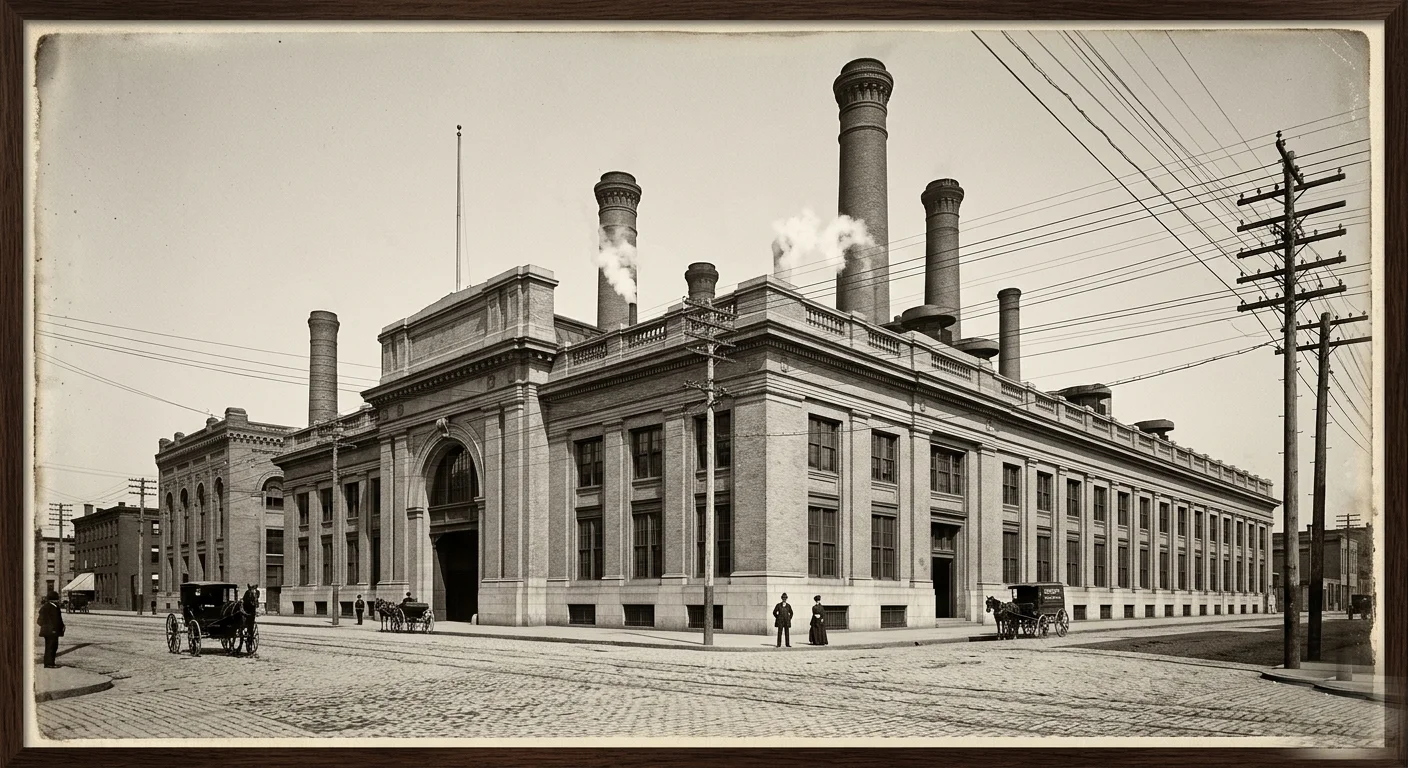
How Thomas Edison’s First Commercial Power Station Opened in New York and Launched the Electric Age
At precisely 3:00 in the afternoon on September 4, 1882, a stocky thirty-five-year-old inventor stood in the Wall Street office of J. Pierpont Morgan, one of the most powerful financiers in the United States, and gave a quiet signal. Nine blocks away, in a converted building at 255 and 257 Pearl Street in lower Manhattan, chief electrician John W. Lieb heard the signal relayed and closed the main switch. Somewhere beneath the streets of lower Manhattan, 80,000 feet of copper wire — more than fifteen miles of it, buried in iron conduits packed with insulation — carried electrical current to eighty-two customers who had been waiting with a mixture of curiosity and skepticism. In the offices, homes, and newspaper rooms of the First District, the flickering yellow light of gas lamps was replaced, for the first time in history, by the steady white glow of incandescent electric bulbs. Thomas Alva Edison had just launched the electric age.
The Pearl Street Station, as it came to be known, was not merely a power plant. It was the proof of a concept that had consumed Edison for four years, the culmination of thousands of experiments, a feat of engineering, logistics, finance, and showmanship that had required the building of new machines, the invention of new technologies, the negotiation of permits from skeptical city officials, and the persuasion of some of the richest men in America to fund a project whose commercial viability was, until that September afternoon, entirely unproven. The New York Times, one of the first customers connected to the new system, reported the event the following day under the heading Miscellaneous City News, apparently not yet grasping that what had occurred was nothing less than the replacement of the steam age with the electric age. That understated coverage was itself a kind of historical footnote: even those who witnessed the birth of the modern electric utility industry did not fully comprehend what they were seeing.
Thomas Edison Before Pearl Street: The Wizard of Menlo Park and the Vision of Universal Electric Light
Thomas Alva Edison was born on February 11, 1847, in Milan, Ohio, and received little formal schooling beyond what his mother taught him at home. This educational informality did not constrain his intellectual development; if anything, it liberated him from the conventional boundaries of professional science and allowed him to approach technical problems with a freshness and practical orientation that academically trained engineers sometimes lacked. As a young telegrapher, he developed an intimate familiarity with electrical systems, and throughout the 1860s and 1870s he built a career as a professional inventor, working first in Newark, New Jersey, and then, from 1876, at his purpose-built laboratory complex in Menlo Park, New Jersey, which he conceived as an invention factory capable of producing a significant new invention every ten days and a major invention every six months.
By the summer of 1877, Edison had already established himself as a figure of international celebrity. His invention of the phonograph in 1877, demonstrated at the offices of Scientific American in New York on December 7 of that year, had earned him the nickname the Wizard of Menlo Park and brought him fame across the Atlantic. He was a man who combined genuine technical genius with an extraordinary capacity for self-promotion, and he understood better than almost any of his contemporaries that the commercial value of an invention depended not merely on its technical merits but on the story told about it and the financial ecosystem built around it. Both of these instincts would prove crucial to the story of the Pearl Street Station.
In the late summer of 1878, Edison turned his attention to the problem that would define the next four years of his life: the creation of a practical, economical, and universally applicable system of electric light. Electric lighting was not a new idea. Arc lighting, which produced light by passing an electric current across a gap between two carbon electrodes, had been publicly demonstrated as early as 1808 by the British chemist Sir Humphry Davy, and by the 1870s arc lights of considerable brightness were in commercial use for outdoor illumination and for very large indoor spaces. In 1878, arc lights were already illuminating Broadway from Fourteenth Street to Thirty-Fourth Street, and they had been installed on the Brooklyn Bridge when it opened in 1883. But arc lights were blindingly bright, technically temperamental, and wholly unsuited to the domestic and office environments where gentler, more controllable light was needed.
What the world did not yet have was an incandescent lamp: one that produced light by heating a filament to incandescence within a glass bulb, that could be dimmed and brightened, that could burn for hours without constant attention, and that could be manufactured cheaply enough for mass domestic use. Dozens of inventors across Europe and North America had been pursuing this goal for decades. The key technical challenge was finding a filament material that could sustain the temperatures required for incandescence without rapidly burning out, combined with a vacuum inside the bulb sufficient to prevent the filament’s oxidation. Edison was, in the technical sense, a late arrival to this problem. But what distinguished his approach from that of his predecessors was the scope of his ambition: he was not merely trying to invent a better light bulb. He was trying to create an entirely new industry.
The Edison Electric Light Company and the Search for Financial Backing in 1878
Edison announced in September 1878, with characteristic boldness, that he had already solved the problem of incandescent lighting and that it was merely a matter of weeks before his system would be ready for public demonstration. This announcement was a deliberate commercial strategy as much as a technical claim. By declaring success before the fact, Edison created a wave of anxiety in the gaslighting industry, whose stocks promptly fell, and simultaneously generated enormous enthusiasm among potential investors. In late 1878, with the assistance of his friend and financial advisor Grosvenor Lowrey, he organized the Edison Electric Light Company, capitalized at three thousand shares, two thousand five hundred of which were Edison’s.
The company attracted backing from some of the most prominent financiers in the United States. William Henry Vanderbilt, son of the railroad magnate Cornelius Vanderbilt, invested in the enterprise. Norvin Green, president of Western Union, contributed. Most significantly, J. Pierpont Morgan and his partners at Drexel, Morgan, and Company became major investors. The financiers collectively advanced fifty thousand dollars to Edison to fund his research. In return, Edison agreed to assign to the company any invention or improvement he might make in electric lighting during the following five years. It was a characteristically audacious arrangement: Edison was essentially selling the rights to inventions he had not yet made, funded by investors whose confidence rested entirely on his reputation and his claim, not yet verified, that he had already found the solution.
He had not, in fact, yet found the solution. His initial September 1878 announcement that the problem was essentially solved had been premature, and the project proved far more technically challenging than his confident declarations had suggested. What followed was one of the most intensive periods of experimental work in the history of invention, as Edison and his team of researchers at Menlo Park subjected thousands of materials to systematic testing in the search for a viable filament. They tried platinum, various metals, and early forms of carbon, none of which proved satisfactory. The project stretched from weeks into months and then into more than a year, testing the patience of investors and the credibility of Edison’s claims.
The Invention of the Practical Incandescent Lamp: October 21, 1879
The breakthrough came on October 21, 1879. On that afternoon at the Menlo Park laboratory, Edison and his team tested a lamp with a filament made of carbonized cotton thread, a hairlike strand of carbon in a high-vacuum glass bulb. The lamp lit and, crucially, stayed lit. When the team checked it in the early hours of the following morning, it was still burning. It burned for thirteen and a half hours before the filament finally broke. This result, while modest by the standards of what would follow, was transformative. No previous incandescent lamp had achieved anything close to this duration at a commercially useful brightness. On that October evening, Edison had proved the principle.
The lamp that burned for thirteen and a half hours was not the final product. Edison understood that a lamp with a lifespan of hours, rather than hundreds of hours, would not be commercially viable. The work of refinement continued, and within weeks the Menlo Park team had discovered that carbonized bamboo filaments produced dramatically better results. By 1880, a bamboo-filament Edison lamp could burn for up to 1,200 hours, a duration that made domestic and commercial electric lighting genuinely practical for the first time. Edison also developed improvements to the vacuum pump that allowed the air inside the bulb to be more completely removed, further extending filament life. He invented the Edison screw base, which became and remains the standard socket fitting for light bulbs worldwide. He developed parallel wiring circuits that allowed each lamp in a system to operate independently of the others, a critical advance over series wiring where the failure of a single lamp would extinguish the entire circuit.
On December 31, 1879, Edison staged the first large-scale public demonstration of his incandescent lighting system at Menlo Park. The Pennsylvania Railroad ran special trains from New York City to carry the crowds that gathered to witness the event. The streets and buildings of the Menlo Park laboratory complex were lit with incandescent lamps, and the effect on the thousands of visitors was electrifying in the most literal sense. The New York Herald had published Edison’s experimental results on December 21, and the announcement had been greeted with amazement across the United States and in Europe. The Wizard of Menlo Park had done what the scientific establishment had doubted was possible: he had created a practical incandescent lamp. Now he had to build the system to power it.
The System Concept: Edison’s Vision for Central Station Power Distribution
The significance of what Edison was attempting from 1879 onward cannot be overstated. The light bulb itself, however ingenious, was merely one component of a vastly more ambitious project. Edison recognized from the very beginning that a practical incandescent lamp was commercially worthless without an infrastructure to supply it with electricity. Creating that infrastructure meant solving not one but a dozen distinct technical and commercial problems simultaneously: how to generate electricity reliably and cheaply at a central location, how to distribute it through underground conductors over a meaningful distance, how to measure how much electricity each customer consumed so they could be charged appropriately, how to regulate the voltage to prevent lamps from burning out when demand fluctuated, and how to make all of this work continuously and reliably, day and night, in a real urban environment.
Edison’s model for this entire system was the gas lighting infrastructure that already served the cities of the world. Gas companies had already solved many of the commercial and physical problems that Edison faced: they had underground pipe networks, metered consumption, central generating facilities, and customer billing systems. Edison consciously designed his electric lighting system to mirror the gas model as closely as possible, right down to charging per unit of light rather than per unit of electricity, pricing his service competitively with gas lighting to ease the transition for customers. This strategic insight, borrowed not from electrical engineering but from commercial analysis, was arguably the most important single contribution Edison made to the creation of the modern electric utility industry.
The team at Menlo Park worked on every component of the system in parallel. Francis Upton, a mathematician and physicist who worked closely with Edison, contributed the mathematical rigor that Edison himself sometimes lacked in tackling generator design. Charles L. Clarke, another key collaborator, worked on electrical distribution systems. Charles Batchelor, Edison’s chief experimenter and most trusted technical lieutenant, coordinated much of the experimental work. The result of this collective effort was not merely a light bulb but a complete, integrated system: generators, underground conductors, voltage regulators, safety fuses, junction boxes, meters, and lamps, all designed to work together as a coherent whole. In November 1880, Edison tested the first experimental underground electrical system at Menlo Park. It worked.
Proving the Concept: The Holborn Viaduct Installation in London, January 1882
Before risking the enormous investment required by the New York project, Edison sought to prove the central station concept in a real urban environment. The opportunity came in London, where Edison had been exhibiting his incandescent lighting system at the Crystal Palace Exhibition in 1881. In January 1882, Edison installed a central station power system beneath the Holborn Viaduct in London, connecting it to street-level businesses and providing electricity for incandescent lighting along that stretch of London’s commercial district. The installation used one of the Jumbo dynamos that Edison had built for the 1881 Paris Electrical Exposition, a machine of then-unprecedented power that Edison’s team had constructed with the help of Upton and Clarke.
The Holborn Viaduct installation proved technically successful and operated for approximately two years. It was the world’s first coal-fired public power station, opening about two months before the Pearl Street Station, and its smooth operation gave Edison and his financial backers the confidence that the much larger and more elaborate New York project was feasible. The London experience also surfaced the practical challenges that the New York team would need to address: the reliability of the steam engines, the efficiency of the dynamos, the quality of the underground insulation, and the management of voltage fluctuations as the number of connected lamps varied. Each lesson learned in London contributed to the design refinements that made Pearl Street possible.
Choosing the First District: Edison’s Market Research for the New York Site
For the New York project, Edison conducted what amounted to a careful exercise in market research long before that term had entered the business vocabulary. He understood that the location of his first full-scale central station needed to satisfy multiple criteria simultaneously. It had to be densely populated to ensure a sufficient base of paying customers within the half-mile radius that the limitations of low-voltage direct current transmission imposed. It needed to include high-profile commercial users whose satisfaction with the new service would generate favorable publicity. It required proximity to influential financial and business figures who were already Edison’s investors and whose patronage would reassure potential customers. And it had to be an area where the disruption of digging up the streets to install underground conduits could be justified and where the city government could be persuaded to grant the necessary permits.
The area Edison selected became known as the First District: a rectangular area in lower Manhattan bounded by Wall Street on the south, Nassau Street on the west, the East River on the east, and Spruce Street and the former Ferry Street on the north. This was the financial heart of New York City and of the United States. It contained the offices of Drexel, Morgan & Company on Wall Street, whose principal, J. Pierpont, was Edison’s most important financial backer. It contained the editorial offices of the New York Times, one of the city’s most influential newspapers. It contained numerous other banks, commercial houses, law firms, and newspapers. It was, in short, precisely the right place to launch a new technology: a neighborhood of opinion-makers, financial gatekeepers, and early adopters who, if satisfied with the new service, would spread the word most effectively.
Building the Pearl Street Station: Engineering, Politics, and the Underground Wiring Challenge
In December 1880, Edison formed the Edison Electric Illuminating Company of New York, the corporate vehicle through which the Pearl Street project would be financed, built, and operated. This company was a direct predecessor of what is today the Consolidated Edison Company of New York, or Con Edison, which continues to serve New York City’s electrical needs more than a century and a half later. In April 1881, Edison secured the critical franchise from the New York City Board of Aldermen that authorized him to install electric conduits and wires in the public streets. This permission had not been easily won. New York’s politicians were initially skeptical of Edison’s proposal to dig up the streets of lower Manhattan, and it required sustained lobbying, considerable persuasion, and possibly some of the strategic publicity that Edison was adept at generating, before the Board of Aldermen granted approval.
With the franchise secured, Edison purchased two adjoining four-story commercial buildings at 255 and 257 Pearl Street, just south of the intersection of Pearl and Fulton Streets. Each building measured twenty-five feet by one hundred feet. The building at 257 Pearl Street was designated as the main generating station and required substantial structural reinforcement before it could accommodate the weight of the machinery that would occupy it. Edison installed a free-standing ironwork structure inside 257 Pearl Street to carry the enormous load of the dynamos and their associated steam engines on the reinforced upper floors. The first floor housed the coal-fired boilers. The second floor, specially reinforced, carried the steam engines and the dynamos. The third and fourth floors held the control and testing equipment.
The building at 255 Pearl Street was held in reserve as a possible future expansion space. By keeping this adjacent building available, Edison was implicitly acknowledging that the system he was building was expected to grow beyond its initial capacity, a confidence in commercial success that was either visionary or foolhardy, depending on one’s perspective in the months before the station opened. The total cost of the Pearl Street installation, including the Manhattan real estate, the power station and all the wires, underground conduits, and other fixtures, came to approximately three hundred thousand dollars, a sum equivalent to many millions in twenty-first century terms.
The Jumbo Dynamos: Engineering the Heart of the World’s First Power Station
The generating machinery that made Pearl Street work was itself a significant engineering achievement. The central piece of equipment was the Edison Jumbo dynamo, a constant-voltage direct current generator that Edison’s team had developed with the help of Francis Upton and Charles Clarke, first built for exhibition at the 1881 Paris Electrical Exposition. The Jumbo was named, with Edison’s characteristic flair for the theatrical, after Jumbo the elephant, a famous circus attraction then owned by P. T. Barnum. The name acknowledged both the machine’s enormous size and its connection to popular culture, a typical Edisonian touch that blended engineering with showmanship.
Each Jumbo dynamo weighed approximately twenty-seven tons and stood about nine feet tall. Each one was rated at approximately 100 kilowatts and could supply enough direct current at 110 volts to power roughly 1,200 incandescent lamps. Pearl Street was initially equipped with six of these machines, giving the station a theoretical maximum capacity of around 600 kilowatts and the ability to supply approximately 7,200 lamps simultaneously. The dynamos were driven by steam engines, initially custom-made Porter-Allen high-speed models designed to deliver 175 horsepower at 700 revolutions per minute. These original engines proved to be unreliable, their governors too sensitive to maintain the steady speed required for consistent electrical output. They were replaced, in a quiet but significant engineering revision, with engines from Armington and Sims that proved far more suitable for the task.
The steam for the engines was provided by fourteen coal-fired boilers on the first floor of 257 Pearl Street. Coal arrived by wagon from the New York waterfront, was shoveled into the furnaces by teams of workers, and the resulting heat converted water to steam that drove the engines that turned the dynamos that produced the electricity that lit the lamps. The entire system, from coal to light, embodied the industrial logic of the late nineteenth century: the conversion of fossil fuel energy through mechanical intermediaries into the electrical form that could be distributed to customers and converted back into light and, eventually, every other form of useful energy that electricity could provide.
The Underground Wiring Network: The Most Expensive Component of Pearl Street
Of all the technical and financial challenges involved in building the Pearl Street Station, the most demanding by any measure was the construction of the underground wiring network that would carry electricity from the generators at 257 Pearl Street to the customers scattered across the First District. Edison needed to run approximately 80,000 feet of copper conductors, more than fifteen miles, through iron conduits buried beneath the streets of lower Manhattan. At 3:00 in the afternoon on a September day, the streets of that neighborhood were among the busiest in America, and the disruption of opening them up to install electrical infrastructure was both politically and logistically immense.
The copper itself was the single most expensive component of the entire Pearl Street project, costing more than all of the generators, boilers, real estate, and lamps combined. Edison’s low-voltage direct current system operated at 110 volts, a choice made for safety reasons: lower voltages were less likely to electrocute workers or customers through accidental contact. But low voltage meant high current, and high current meant that the conductors needed to carry it had to be very thick to prevent unacceptable losses of energy in the resistance of the wires. The greater the current, the thicker the copper, and the more copper required, the higher the cost. This fundamental limitation of low-voltage direct current distribution would eventually prove to be the system’s most serious commercial weakness.
The conductors themselves were a technical innovation in their own right. Edison used a design consisting of two parallel half-round copper wires per conductor, encased in a jacket of insulating material made from a compound of beeswax, linseed oil, and asphaltum, the whole assembly then placed inside an iron pipe or conduit buried in the street. The insulation had to withstand the moisture, temperature variation, and mechanical stress of the underground environment without degrading, allowing the current to leak away into the surrounding earth. The design Edison’s team developed was, for its time, highly effective. After the system was operating, inspections found the insulation to be in good condition throughout the underground network, a tribute to the care with which the installation had been carried out.
The city’s initial resistance to the street-opening project eventually gave way to a carefully managed permission, but the work itself was enormously disruptive. Gangs of laborers spent months digging trenches in the already congested streets of lower Manhattan, laying pipe, drawing wire through conduits, backfilling, and repaving. The work attracted continuous attention from passersby, journalists, and curious New Yorkers who had never seen anything like it. By the summer of 1882, the network was nearly complete, and the buildings of the First District had been wired with Edison’s lamps and the fixtures necessary to connect them to the underground supply.
The Electric Meter: Inventing the First Electric Bill
One technical problem that had not been solved when the Pearl Street project began was the question of how to measure how much electricity each customer consumed. Since the earliest days of electrical experimentation in the early nineteenth century, instruments had existed to detect the flow of electrical current and indicate its magnitude at any given moment. But no instrument had been developed to record the accumulation of current flow over time in a way that could serve as the basis for a commercial bill. The gas lighting companies solved this problem with gas meters, precision devices that measured the volume of gas consumed by each customer. Edison needed an equivalent device for electricity.
The solution came in the spring of 1882, just months before Pearl Street opened. Edison developed an electrolytic meter, a device that exploited the fact that when electrical current passes through a solution of zinc sulfate, it deposits zinc on electrodes within the solution at a rate proportional to the amount of electricity flowing. By weighing the zinc deposited on the meter’s electrodes at regular intervals and comparing the result to a calibration standard, the electricity company could determine precisely how much electricity each customer had consumed and issue an accurate bill. The electrolytic meter was crude by later standards, requiring physical collection and weighing of the electrode plates, but it worked. It gave Pearl Street’s customers their first electric bills, and it gave Edison’s company the means to charge for its product in proportion to consumption, the foundational commercial logic of the electric utility industry.
September 4, 1882: The Day the Electric Age Began
By early September 1882, everything was in place. The two buildings at 255 and 257 Pearl Street had been fitted out with their dynamos, steam engines, and boilers. The underground conduit network connecting the station to the First District was complete. The customer premises throughout the service area had been wired with Edison’s incandescent lamps and the necessary connecting hardware. The electrolytic meters had been installed. The first batch of customers, representing eighty-two accounts in the First District, had signed up for the service.
The events of September 4, 1882, were carefully staged by Edison for maximum impact. Rather than being present at the Pearl Street Station itself when the system was activated, Edison chose to be in the office of J. Pierpont Morgan at Drexel, Morgan, and Company on Wall Street, accompanied by his board of directors. The choice of venue was deliberate: Morgan’s office was one of the most prestigious addresses in American finance, and Edison’s presence there symbolized the alliance between technological innovation and financial power that the entire Pearl Street project embodied. Edison and Morgan had their watches synchronized with the team at the station. At 3:00 in the afternoon, Edison gave the signal.
At Pearl Street, chief electrician John W. Lieb received the signal and closed the main switch, energizing the underground network for the first time under load. With a sound that contemporary accounts describe as a loud thunk, the circuit was completed, and throughout the First District, the flickering amber light of gas lamps was extinguished or dimmed as the steady white radiance of incandescent electric bulbs took its place. Morgan’s office was bathed in the new light. The New York Times building on Park Row, another of Edison’s early customers, was similarly illuminated. The effect, on those who witnessed it in those first moments, was deeply strange and wonderful: a light that neither flickered nor flickered out, that produced no smoke, no heat, no smell of burning gas, that could be turned up and down with simple switches, and that cast a quality of illumination that gas could not match.
Edison was later quoted as telling a reporter from the New York Times that the giant dynamos had been started at 3:00 in the afternoon and that, according to him, they would go on forever unless stopped by an earthquake. On that first day, the system served approximately eighty-two customers with a total of about four hundred lamps. The six dynamos could have supplied as many as 7,200 lamps, meaning the system was operating at a tiny fraction of its capacity. But the first day was not about capacity. It was about demonstration, about proof of concept, about the public inauguration of something that neither Edison nor anyone else had ever done before.
The New York Times Reports the Birth of the Electric Age
The following morning, September 5, 1882, the New York Times published its account of the previous day’s events. The paper was itself a customer of the new service and had been among the first commercial establishments connected to the Pearl Street network. The article appeared not as a major front-page story heralding a new era of civilization but under the modest heading of Miscellaneous City News, buried among accounts of other routine matters of urban life. The unnamed reporter who had witnessed the inauguration described how the station’s dynamos had been started, how the lights had come on throughout the service area, and how Edison himself had been present in the Morgan office for the occasion.
The tone of the New York Times piece was one of interested reportage rather than historical consciousness, a quality that is perhaps inevitable in the moment of great events. The reporter did not declare that the steam age had ended and the electric age had begun. He noted the facts and moved on. Yet the facts were extraordinary: for the first time in history, a commercial enterprise was generating electricity at a central location, distributing it through an underground network to multiple paying customers, and billing those customers for the electricity they consumed, all in the world’s most commercially important city. The mechanisms, the business model, and the technology that would eventually bring electric light and power to every home and office and factory on earth had been successfully demonstrated for the first time.
Growth and Financial Challenges: From 400 Lamps to 10,164 in Two Years
The months following September 4, 1882, saw the Pearl Street system grow steadily, though not without difficulties. By the end of September 1882, the number of customers had grown from eighty-two to fifty-nine; wait, in fact, to fifty-nine new additions, bringing the total to just under sixty by the end of the month in some accounts. By the end of 1882, the number of customers was growing week by week as word spread through the First District that the new electric lighting was everything Edison had claimed and more. Within a year of opening, the system had grown from four hundred lamps serving about eighty customers to approximately ten thousand lamps serving five hundred and thirteen customers. By 1884, Pearl Street was serving five hundred and eight customers with 10,164 lamps, a growth of more than twenty-five-fold in the number of lamps in just two years.
Behind the scenes, however, the financial picture was considerably less triumphant. The initial capital cost of the Pearl Street installation had been high, approximately three hundred thousand dollars, and the system’s operating expenses were substantial. The boilers consumed enormous quantities of coal day and night, representing a continuous major expense. Pearl Street’s operating expenses exceeded its income in 1882 and again in 1883. The station did not become profitable until 1884, two years after opening. In some ways, as contemporary analysts noted, Pearl Street was a victim of its own success: the more customers connected to the system, the more the demand for electricity grew, and the more expensive it became to maintain the distribution network at adequate capacity.
The profitability challenge reflected a more fundamental economic limitation of Edison’s direct current system. Because the low-voltage direct current operated at 110 volts, customers could not be located more than approximately half a mile from the generating station without the electrical losses in the conductors making the service economically unviable. This half-mile radius constraint meant that each Edison central station could serve only a limited geographic area, and that to serve an entire city of the size of New York would require dozens of separate stations, each with its own capital investment in real estate, machinery, and underground conductors. The economics of this arrangement were ultimately untenable, a fact that the emergence of alternating current technology in the mid-1880s would bring into sharp relief.
The First District as a Living Laboratory: The Pearl Street Station’s Operational Record
Despite its financial difficulties and technical limitations, the Pearl Street Station was a remarkable operational achievement. From its opening on September 4, 1882, to the fire that devastated it on January 2, 1890, a period of more than seven years, the station delivered electric power to its customers with only one interruption, a service outage of three hours. This established an early benchmark for utility system reliability that was extraordinary given the state of electrical technology in the early 1880s, and it demonstrated that electric power distribution could be as reliable as the gas service it was displacing.
The station was also the world’s first cogeneration plant, a fact rarely mentioned in popular accounts. While the steam engines provided the mechanical energy that drove the dynamos to generate electrical power, Edison made productive use of the thermal energy that would otherwise have been wasted as exhaust heat. The waste steam from the engines was piped to nearby manufacturers and buildings for heating purposes, making the overall energy efficiency of the Pearl Street installation significantly higher than a simple power station alone. This concept of using waste heat from power generation for useful purposes remains a cornerstone of modern sustainable energy engineering.
The station employed a team of skilled operators who monitored the equipment around the clock, as the early electrical systems required continuous attention and adjustment. The operation of fourteen boilers, six large steam engines, and six massive dynamos in a two-story building in lower Manhattan was a physically demanding and technically complex undertaking. Coal had to be delivered and shoveled by hand. Boilers had to be maintained at precise pressures. Engine governors had to be watched and adjusted to maintain steady speed. Dynamo output had to be monitored and the system balanced as customers added and removed lamps throughout the day and night. The men who operated the Pearl Street Station were pioneers not only of electrical technology but of the operational practices that would eventually become the utility industry’s standard procedures.
The Key People Behind Pearl Street: The Team That Built the Electric Age
Thomas Edison is rightly remembered as the architect and driving force behind the Pearl Street Station, but the scale and complexity of the enterprise meant that his success depended on a team of exceptional individuals whose contributions have often been overshadowed by Edison’s own towering celebrity. Understanding the Pearl Street achievement fully requires acknowledging the men who made it possible alongside the inventor who conceived it.
J. Pierpont Morgan was more than merely a financial backer; he was a crucial enabler of the entire project. Morgan’s personal commitment to the Pearl Street venture, his willingness to allow his own Wall Street offices to serve as the ceremonial location for the system’s inauguration, and his social and financial influence in New York’s commercial elite all contributed to the project’s credibility and ultimate success. Morgan’s earlier involvement in electric lighting went back to the installation of a self-contained private electric lighting system in his Madison Avenue mansion in 1882, one of the first private residences in New York to be so equipped. He was not merely an investor but a genuine enthusiast for the new technology, and his personal endorsement carried enormous weight in the financial community whose support Edison needed.
John W. Lieb, who served as chief electrician at the Pearl Street Station and who personally closed the main switch on September 4, 1882, went on to become one of the leading figures in the early electric utility industry. He served as president of the American Institute of Electrical Engineers from 1904 to 1905 and received the AIEE Edison Medal in 1923 for his contributions to the development and operation of electric central stations for illumination and power. His role at Pearl Street was both technical and managerial: he was responsible for the day-to-day engineering operations of the station and for the training of the operators who kept it running around the clock.
Francis Upton brought mathematical rigor and formal scientific training to Edison’s team at Menlo Park, contributing especially to the design of the Jumbo dynamo and to the calculations that underpinned the electrical distribution system. Charles Batchelor was Edison’s most trusted experimental assistant, a skilled mechanic and experimenter who coordinated much of the practical laboratory work and who had accompanied Edison’s systems to exhibitions in Paris. Charles L. Clarke worked on the electrical distribution system design. Together, these men and a wider team of mechanics, electricians, and engineers translated Edison’s vision into physical reality, solving the dozens of technical sub-problems that stood between concept and the operational station that opened on September 4, 1882.
J.P. Morgan’s Private Installation: The Dress Rehearsal for Pearl Street
One of the most revealing episodes in the history of the Pearl Street project was J. P. Morgan’s decision in 1882 to install a private electric lighting system in his mansion at 219 Madison Avenue in New York City. The installation was managed by Edison’s team and represented one of the earliest residential applications of incandescent electric lighting in America. The system consisted of a dynamo driven by a steam engine installed in the mansion’s basement or a nearby auxiliary building, connected to a network of Edison lamps throughout the house. It demonstrated to Morgan personally and viscerally what the technology could do, turning the financier from an investor into a true believer.
The Morgan installation was not without its difficulties. The steam engine that drove the dynamo was noisy, the vibrations were occasionally problematic, and the system required the attention of a skilled operator to keep running properly. Mrs. Morgan and the neighbors reportedly complained about the noise. But the quality of the electric light itself was undeniably superior to gas, and Morgan remained committed to the technology. His mansion’s private electric lighting system served as a kind of dress rehearsal for Pearl Street, identifying practical problems with residential installation that informed the design of the commercial service. It also served as a powerful demonstration to other wealthy New Yorkers, many of whom visited Morgan’s home and came away impressed enough to sign up as customers for the Pearl Street service when it was announced.
The Fire of 1890, the Rebuilding, and the End of Pearl Street
The Pearl Street Station operated continuously and with extraordinary reliability for more than seven years after its September 4, 1882 opening. It survived its initial financial difficulties, grew its customer base beyond five hundred accounts, and proved the commercial viability of central station power generation to a skeptical world. But on the morning of January 2, 1890, disaster struck. A fire broke out in the station and burned through the building with devastating speed and thoroughness. By the time it was extinguished, the fire had destroyed all of the major equipment in the station except for one of the six original Jumbo dynamos, number nine, which survived the blaze and was salvaged from the ruins.
Edison and his engineers responded with characteristic determination. They worked around the clock for eleven days to restore service to the station’s customers, rebuilding what could be rebuilt and replacing what had been destroyed. The reconstructed Pearl Street Station resumed operations and continued to serve customers into the early 1890s. But the fire had exposed the station’s vulnerability, and the technology of electric power generation had advanced far enough in the seven years since 1882 that the rebuilt Pearl Street was already becoming obsolete. Larger and more efficient power plants, capable of serving much greater geographic areas and larger numbers of customers, were being built elsewhere in New York City and in other cities across the country.
By 1895, Pearl Street had been decommissioned. The equipment was removed, and the buildings at 255 and 257 Pearl Street were sold. The buildings themselves were eventually demolished. Today, the site of the world’s first commercial central power station is occupied by a public parking lot, a monument to the invisibility of historical significance in urban real estate development. Of all the original machinery installed at Pearl Street in 1882, only Jumbo dynamo number nine survives. It was sent to the World’s Columbian Exposition in Chicago in 1893, was rebuilt and re-exhibited several times over the following decades, and eventually found a permanent home at the Henry Ford Museum and Greenfield Village in Dearborn, Michigan, where it was designated a National Historic Mechanical Engineering Landmark by the American Society of Mechanical Engineers in 1980.
The Commemorative Legacy: Plaques, Models, and the IEEE Milestone
The historical significance of Pearl Street was recognized relatively quickly after the station’s demolition. In 1917, the American Scenic and Historic Preservation Society and the New York Edison Company, by then a direct successor to the original Edison Electric Illuminating Company of New York, placed a bronze plaque at the former site to commemorate what had occurred there. The plaque carried an image of the Pearl Street dynamo room, reproduced from an illustration that had appeared in the August 26, 1882 issue of Scientific American magazine, published just days before the station opened. This plaque still exists at the site today.
In 1929, as Thomas Edison was preparing to celebrate the fiftieth anniversary of his incandescent lamp demonstration, the Edison Company constructed three working scale models of the Pearl Street Station under the supervision of John W. Lieb, who by then was senior vice president of the New York Edison Company. The models were built to a scale of 1:24, measuring sixty-two inches long, thirty-four inches high, and thirteen inches wide, by thirty-one skilled mechanics working under George K. Jessup, superintendent of shops, over approximately six months. The models showed every detail of the station’s four-level layout, with cut-out sections revealing the boilers on the first level, the steam engines and dynamos on the reinforced second level, and the control and testing equipment on the upper levels. When a button was pressed, a small motor turned the model engines and dynamos, illuminating the miniature lamps connected to the system.
All three models survive today. One is displayed at the Smithsonian Institution’s National Museum of American History in Washington, D.C. One is at the Consolidated Edison Learning Center in Long Island City, New York, a testament to the corporate lineage that connects the present-day utility company to Edison’s original venture. The third is at the Henry Ford Museum in Dearborn, Michigan, alongside Jumbo dynamo number nine. On May 10, 2011, in a ceremony hosted by Consolidated Edison, the Pearl Street Station was formally named an IEEE Milestone in Electrical Engineering by the Institute of Electrical and Electronics Engineers, recognizing it as one of the foundational achievements of the entire discipline.
The War of Currents: Edison’s DC System Against Tesla’s AC and the Battle That Defined Modern Power
The Pearl Street Station delivered direct current at 110 volts, and this choice of system was not merely a technical decision but a philosophical commitment that would eventually put Edison on the wrong side of one of the most consequential technological debates in American history. Direct current, as Edison had designed it, had significant advantages: it was safe at the voltages used for lighting, it was well understood, and the technology to generate and distribute it had been thoroughly developed. But it had one fundamental and ultimately fatal disadvantage: it could not be transmitted economically over distances beyond approximately half a mile without unacceptable energy losses in the resistance of the conductors.
By the mid-1880s, European and American inventors including Nikola Tesla, George Westinghouse, William Stanley, Elihu Thomson, Lucien Gaulard, and John Gibbs had been developing alternating current systems that could solve this problem. Alternating current, when transmitted at high voltage and then stepped down to safe levels for domestic use by transformers, could travel tens or hundreds of miles with far smaller energy losses than direct current. A single alternating current power station could serve an entire metropolitan area, rather than the half-mile radius that limited each of Edison’s direct current installations. The economics of AC were vastly more favorable for large-scale power distribution than those of DC.
George Westinghouse, an industrialist and inventor who had built his fortune on the air brake for railroad trains, recognized the potential of AC and began building an AC power distribution business in competition with Edison’s DC system. Nikola Tesla, the brilliant Serbian-American inventor who had briefly worked for Edison himself before the two men parted acrimoniously over a dispute about compensation, developed the polyphase AC motor and other AC technologies that Westinghouse incorporated into his system. The commercial and technical competition between the Edison DC system and the Westinghouse-Tesla AC system became one of the defining industrial conflicts of the 1880s and 1890s, a controversy that historians have called the War of Currents.
Edison, characteristically, refused to acknowledge the limitations of his chosen system and mounted an increasingly aggressive defense of DC that extended beyond technical argument into what can only be described as propaganda. He arranged demonstrations of the dangers of alternating current, most notoriously using high-voltage AC to electrocute animals in public demonstrations intended to show how lethal the technology was. He lobbied against the adoption of AC by public utilities and argued that the higher voltages required for AC transmission made it fundamentally unsafe for public use. He even developed methods of execution by electricity that he hoped would be associated in the public mind with alternating current: the electric chair, first used by the state of New York in 1890, was designed to use AC in part because of Edison’s campaign to link AC with death. These efforts, while energetic, were ultimately unsuccessful. The superior economics of AC for large-scale power distribution proved decisive, and by the end of the 1890s, AC had won the War of Currents. In 1892, Edison General Electric and Thomson-Houston Electric merged to form General Electric, and the new company quickly embraced AC technology.
What Pearl Street Got Right: The Enduring Business Model of the Electric Utility
Whatever the limitations of its technology, the Pearl Street Station established the business model and the operational template that the entire subsequent history of the electric utility industry would follow. Edison’s central insight, that electricity should be sold as a metered commodity from a central generating station through a distribution network to multiple paying customers, remains the fundamental business structure of every electric utility in the world today. The concepts of the service territory, the underground distribution network, the meter that measures consumption, the monthly bill based on units consumed, and the continuous round-the-clock operation of the generating plant, all invented or perfected at Pearl Street in 1882, are recognizable features of electricity service in the twenty-first century.
The specific technical details have changed almost beyond recognition. Alternating current replaced direct current. Generators grew from hundred-kilowatt machines to units producing hundreds of thousands of kilowatts. Distribution voltages climbed from 110 volts to hundreds of thousands of volts for long-distance transmission and then stepped back down through multiple transformer stages to domestic supply voltages. Nuclear power, hydroelectric power, natural gas, solar panels, and wind turbines replaced coal-fired boilers as the primary energy sources. Digital meters replaced Edison’s electrolytic zinc-sulfate devices. Computerized control systems replaced the human operators who watched the gauges at Pearl Street. Yet the fundamental concept, the commercially organized conversion of primary energy into electricity and its distribution to paying customers through a network, remains unchanged from what Edison built and proved at 257 Pearl Street in September 1882.
The Global Legacy of Pearl Street: From One Building in Manhattan to Electrification of the World
The success of Pearl Street was rapidly replicated. Within months of the September 4, 1882 opening, Edison’s organization was licensing his central station technology to entrepreneurs in cities across North America, Europe, South America, and Japan. Similar Edison direct current central station systems were installed in dozens of cities during the 1880s, each modeled on the Pearl Street design and each requiring its customers to purchase the Edison equipment that the various Edison manufacturing companies were producing. The Pearl Street Station was not just a working power plant but a demonstration model, a physical proof-of-concept that franchisees around the world could point to when convincing their own investors and municipal authorities that commercial electric power distribution was viable.
By 1890, more than thirty companies were generating or distributing electricity in New York City and Westchester County alone. The territory that would eventually be served by the Consolidated Edison Company, the direct corporate descendant of Edison’s original Edison Electric Illuminating Company of New York, had grown from the First District’s quarter square mile to encompass all five boroughs of New York City and several surrounding counties. This growth was made possible not by the Pearl Street design’s technology, which was superseded by AC in the early 1890s, but by the commercial template that Pearl Street had established: the idea of a regulated utility company with a defined service territory, a metered product, and a mandate to provide continuous reliable service to all customers within its area.
The electrification of the world that followed from Pearl Street transformed human civilization in ways that dwarf almost every other technological development of the nineteenth and twentieth centuries. Electric light extended the productive day, allowing work, study, and social life to continue after sunset in ways that were simply impossible with candles or gas lamps. Electric motors replaced steam engines in factories, producing dramatically greater efficiency and flexibility in manufacturing. Electric streetcars and railways transformed urban geography. Electric communication systems, from the telegraph through the telephone to radio and television, became the nervous system of modern society. Refrigeration, heating, computing, medical technology, and every other domain of modern life became dependent on reliable electric power.
All of this can be traced back, in a direct and unbroken line, to the afternoon of September 4, 1882, when John W. Lieb closed the switch at 257 Pearl Street and the lights came on in the First District of lower Manhattan. Edison himself was characteristically modest about the significance of what he had achieved when the New York Times reporter came to the station that first day, though his remark that the dynamos would go on forever unless stopped by an earthquake captured something of his confidence in the durability of what he had built. He understood that he had not merely invented a product or started a company. He had created an industry and, in doing so, had permanently altered the trajectory of human history.
Key Dates, Stakeholders, and Technical Facts: The Complete Reference for Edison’s Pearl Street Station
The following provides a comprehensive chronological reference to every major event, person, and technical detail in the history of the Pearl Street Station. Thomas Alva Edison was born on February 11, 1847, in Milan, Ohio. He established his Menlo Park laboratory in New Jersey in 1876. On December 7, 1877, he demonstrated the phonograph at the offices of Scientific American in New York, earning the title Wizard of Menlo Park. In mid-1878, Edison turned his attention to electric lighting and announced, prematurely, that he had already solved the problem of incandescent light. On October 12, 1878, the Edison Electric Light Company was formed with backing from J. P. Morgan, William Henry Vanderbilt, Norvin Green, and other prominent financiers, initially capitalized at three thousand shares with fifty thousand dollars in advance funding.
On October 21, 1879, Edison and his team at Menlo Park, including Francis Upton and Charles Batchelor, successfully tested a carbonized cotton thread filament lamp that burned for thirteen and a half hours, proving the principle of practical incandescent lighting. Later bamboo filament tests achieved lifespans of up to 1,200 hours. On December 31, 1879, Edison staged the first large-scale public demonstration of incandescent lighting at Menlo Park, with special trains bringing crowds from New York City. The carbon-filament incandescent lamp patent, U.S. Patent 223,898, was filed on November 1, 1879. The lamp was publicly reported in the New York Herald on December 21, 1879.
In January 1881, Edison’s first commercial installation on land, serving Hinds, Ketcham and Company in New York City, went into service. In December 1880, Edison formed the Edison Electric Illuminating Company of New York, the direct predecessor of Consolidated Edison Company of New York. In April 1881, Edison secured a franchise from the New York City Board of Aldermen to install electric conduits and wires in public streets. In January 1882, the Holborn Viaduct installation in London began operating as the world’s first coal-fired central power station, serving as the technical proof-of-concept for Pearl Street. In spring 1882, the electrolytic meter was developed, enabling commercial electricity billing based on consumption.
Edison purchased adjoining four-story buildings at 255 and 257 Pearl Street, each measuring twenty-five by one hundred feet. Six Jumbo dynamos, each weighing twenty-seven tons and rated at approximately 100 kilowatts, were installed on the reinforced second floor of 257 Pearl Street. Fourteen coal-fired boilers on the first floor provided steam to Porter-Allen steam engines, later replaced by more reliable Armington and Sims engines. Approximately 80,000 feet, equivalent to over fifteen miles, of copper conductors were installed in underground conduits beneath the streets of the First District at a cost that exceeded all other components of the project combined. The First District service area was bounded by Wall Street on the south, Nassau Street on the west, the East River on the east, and Spruce Street on the north, covering approximately one quarter of a square mile. The total construction cost was approximately three hundred thousand dollars.
On September 4, 1882, at 3:00 in the afternoon, Chief Electrician John W. Lieb closed the main switch at Pearl Street on Edison’s signal, given from the office of J. Pierpont Morgan at Drexel, Morgan and Company on Wall Street. The system began serving approximately eighty-two customers with approximately four hundred lamps. The New York Times reported the event the following day under Miscellaneous City News. By the end of September 1882, the customer count had grown. Within one year, Pearl Street served five hundred and thirteen customers with approximately ten thousand lamps. By 1884, it served five hundred and eight customers with 10,164 lamps. The station first became profitable in 1884. On January 2, 1890, a fire heavily damaged the station, destroying all equipment except Jumbo dynamo number nine, which survived and is preserved at the Henry Ford Museum. The station was rebuilt and operated through the early 1890s before being decommissioned in 1895. In 1917, a bronze commemorative plaque was placed at the site by the American Scenic and Historic Preservation Society and the New York Edison Company. In 1929, three working scale models of the station were built, now displayed at the Smithsonian Institution, the Consolidated Edison Learning Center, and the Henry Ford Museum. Jumbo dynamo number nine was designated a National Historic Mechanical Engineering Landmark by ASME in 1980. On May 10, 2011, Pearl Street Station was named an IEEE Milestone in Electrical Engineering. Today, the site of 257 Pearl Street is a public parking lot. Consolidated Edison Company of New York, the direct corporate descendant of Edison’s Edison Electric Illuminating Company of New York, continues to serve New York City’s electrical needs.
Edison Power Station
How Thomas Edison’s First Commercial Power Station Opened in New York and Launched the Electric Age
At precisely 3:00 in the afternoon on September 4, 1882, a stocky thirty-five-year-old inventor stood in the Wall Street office of J. Pierpont Morgan, one of the most powerful financiers in the United States, and gave a quiet signal. Nine blocks away, in a converted building at 255 and 257 Pearl Street in lower Manhattan, chief electrician John W. Lieb heard the signal relayed and closed the main switch. Somewhere beneath the streets of lower Manhattan, 80,000 feet of copper wire — more than fifteen miles of it, buried in iron conduits packed with insulation — carried electrical current to eighty-two customers who had been waiting with a mixture of curiosity and skepticism. In the offices, homes, and newspaper rooms of the First District, the flickering yellow light of gas lamps was replaced, for the first time in history, by the steady white glow of incandescent electric bulbs. Thomas Alva Edison had just launched the electric age.
The Pearl Street Station, as it came to be known, was not merely a power plant. It was the proof of a concept that had consumed Edison for four years, the culmination of thousands of experiments, a feat of engineering, logistics, finance, and showmanship that had required the building of new machines, the invention of new technologies, the negotiation of permits from skeptical city officials, and the persuasion of some of the richest men in America to fund a project whose commercial viability was, until that September afternoon, entirely unproven. The New York Times, one of the first customers connected to the new system, reported the event the following day under the heading Miscellaneous City News, apparently not yet grasping that what had occurred was nothing less than the replacement of the steam age with the electric age. That understated coverage was itself a kind of historical footnote: even those who witnessed the birth of the modern electric utility industry did not fully comprehend what they were seeing.
Thomas Edison Before Pearl Street: The Wizard of Menlo Park and the Vision of Universal Electric Light
Thomas Alva Edison was born on February 11, 1847, in Milan, Ohio, and received little formal schooling beyond what his mother taught him at home. This educational informality did not constrain his intellectual development; if anything, it liberated him from the conventional boundaries of professional science and allowed him to approach technical problems with a freshness and practical orientation that academically trained engineers sometimes lacked. As a young telegrapher, he developed an intimate familiarity with electrical systems, and throughout the 1860s and 1870s he built a career as a professional inventor, working first in Newark, New Jersey, and then, from 1876, at his purpose-built laboratory complex in Menlo Park, New Jersey, which he conceived as an invention factory capable of producing a significant new invention every ten days and a major invention every six months.
By the summer of 1877, Edison had already established himself as a figure of international celebrity. His invention of the phonograph in 1877, demonstrated at the offices of Scientific American in New York on December 7 of that year, had earned him the nickname the Wizard of Menlo Park and brought him fame across the Atlantic. He was a man who combined genuine technical genius with an extraordinary capacity for self-promotion, and he understood better than almost any of his contemporaries that the commercial value of an invention depended not merely on its technical merits but on the story told about it and the financial ecosystem built around it. Both of these instincts would prove crucial to the story of the Pearl Street Station.
In the late summer of 1878, Edison turned his attention to the problem that would define the next four years of his life: the creation of a practical, economical, and universally applicable system of electric light. Electric lighting was not a new idea. Arc lighting, which produced light by passing an electric current across a gap between two carbon electrodes, had been publicly demonstrated as early as 1808 by the British chemist Sir Humphry Davy, and by the 1870s arc lights of considerable brightness were in commercial use for outdoor illumination and for very large indoor spaces. In 1878, arc lights were already illuminating Broadway from Fourteenth Street to Thirty-Fourth Street, and they had been installed on the Brooklyn Bridge when it opened in 1883. But arc lights were blindingly bright, technically temperamental, and wholly unsuited to the domestic and office environments where gentler, more controllable light was needed.
What the world did not yet have was an incandescent lamp: one that produced light by heating a filament to incandescence within a glass bulb, that could be dimmed and brightened, that could burn for hours without constant attention, and that could be manufactured cheaply enough for mass domestic use. Dozens of inventors across Europe and North America had been pursuing this goal for decades. The key technical challenge was finding a filament material that could sustain the temperatures required for incandescence without rapidly burning out, combined with a vacuum inside the bulb sufficient to prevent the filament’s oxidation. Edison was, in the technical sense, a late arrival to this problem. But what distinguished his approach from that of his predecessors was the scope of his ambition: he was not merely trying to invent a better light bulb. He was trying to create an entirely new industry.
The Edison Electric Light Company and the Search for Financial Backing in 1878
Edison announced in September 1878, with characteristic boldness, that he had already solved the problem of incandescent lighting and that it was merely a matter of weeks before his system would be ready for public demonstration. This announcement was a deliberate commercial strategy as much as a technical claim. By declaring success before the fact, Edison created a wave of anxiety in the gas lighting industry, whose stocks promptly fell, and simultaneously generated enormous enthusiasm among potential investors. In late 1878, with the assistance of his friend and financial advisor Grosvenor Lowrey, he organized the Edison Electric Light Company, capitalized at three thousand shares, two thousand five hundred of which were Edison’s.
The company attracted backing from some of the most prominent financiers in the United States. William Henry Vanderbilt, son of the railroad magnate Cornelius Vanderbilt, invested in the enterprise. Norvin Green, president of Western Union, contributed. Most significantly, J. Pierpont Morgan and his partners at Drexel, Morgan and Company became major investors. The financiers collectively advanced fifty thousand dollars to Edison to fund his research. In return, Edison agreed to assign to the company any invention or improvement he might make in electric lighting during the following five years. It was a characteristically audacious arrangement: Edison was essentially selling the rights to inventions he had not yet made, funded by investors whose confidence rested entirely on his reputation and his claim, not yet verified, that he had already found the solution.
He had not, in fact, yet found the solution. His initial September 1878 announcement that the problem was essentially solved had been premature, and the project proved far more technically challenging than his confident declarations had suggested. What followed was one of the most intensive periods of experimental work in the history of invention, as Edison and his team of researchers at Menlo Park subjected thousands of materials to systematic testing in the search for a viable filament. They tried platinum, various metals, and early forms of carbon, none of which proved satisfactory. The project stretched from weeks into months and then into more than a year, testing the patience of investors and the credibility of Edison’s claims.
The Invention of the Practical Incandescent Lamp: October 21, 1879
The breakthrough came on October 21, 1879. On that afternoon at the Menlo Park laboratory, Edison and his team tested a lamp with a filament made of carbonized cotton thread, a hairlike strand of carbon in a high-vacuum glass bulb. The lamp lit and, crucially, stayed lit. When the team checked it in the early hours of the following morning, it was still burning. It burned for thirteen and a half hours before the filament finally broke. This result, while modest by the standards of what would follow, was transformative. No previous incandescent lamp had achieved anything close to this duration at a commercially useful brightness. On that October evening, Edison had proved the principle.
The lamp that burned for thirteen and a half hours was not the final product. Edison understood that a lamp with a lifespan of hours, rather than hundreds of hours, would not be commercially viable. The work of refinement continued, and within weeks the Menlo Park team had discovered that carbonized bamboo filaments produced dramatically better results. By 1880, a bamboo-filament Edison lamp could burn for up to 1,200 hours, a duration that made domestic and commercial electric lighting genuinely practical for the first time. Edison also developed improvements to the vacuum pump that allowed the air inside the bulb to be more completely removed, further extending filament life. He invented the Edison screw base, which became and remains the standard socket fitting for light bulbs worldwide. He developed parallel wiring circuits that allowed each lamp in a system to operate independently of the others, a critical advance over series wiring where the failure of a single lamp would extinguish the entire circuit.
On December 31, 1879, Edison staged the first large-scale public demonstration of his incandescent lighting system at Menlo Park. The Pennsylvania Railroad ran special trains from New York City to carry the crowds that gathered to witness the event. The streets and buildings of the Menlo Park laboratory complex were lit with incandescent lamps, and the effect on the thousands of visitors was electrifying in the most literal sense. The New York Herald had published Edison’s experimental results on December 21, and the announcement had been greeted with amazement across the United States and in Europe. The Wizard of Menlo Park had done what the scientific establishment had doubted was possible: he had created a practical incandescent lamp. Now he had to build the system to power it.
The System Concept: Edison’s Vision for Central Station Power Distribution
The significance of what Edison was attempting from 1879 onward cannot be overstated. The light bulb itself, however ingenious, was merely one component of a vastly more ambitious project. Edison recognized from the very beginning that a practical incandescent lamp was commercially worthless without an infrastructure to supply it with electricity. Creating that infrastructure meant solving not one but a dozen distinct technical and commercial problems simultaneously: how to generate electricity reliably and cheaply at a central location, how to distribute it through underground conductors over a meaningful distance, how to measure how much electricity each customer consumed so they could be charged appropriately, how to regulate the voltage to prevent lamps from burning out when demand fluctuated, and how to make all of this work continuously and reliably, day and night, in a real urban environment.
Edison’s model for this entire system was the gas lighting infrastructure that already served the cities of the world. Gas companies had already solved many of the commercial and physical problems that Edison faced: they had underground pipe networks, metered consumption, central generating facilities, and customer billing systems. Edison consciously designed his electric lighting system to mirror the gas model as closely as possible, right down to charging per unit of light rather than per unit of electricity, pricing his service competitively with gas lighting to ease the transition for customers. This strategic insight, borrowed not from electrical engineering but from commercial analysis, was arguably the most important single contribution Edison made to the creation of the modern electric utility industry.
The team at Menlo Park worked on every component of the system in parallel. Francis Upton, a mathematician and physicist who worked closely with Edison, contributed the mathematical rigor that Edison himself sometimes lacked in tackling generator design. Charles L. Clarke, another key collaborator, worked on electrical distribution systems. Charles Batchelor, Edison’s chief experimenter and most trusted technical lieutenant, coordinated much of the experimental work. The result of this collective effort was not merely a light bulb but a complete, integrated system: generators, underground conductors, voltage regulators, safety fuses, junction boxes, meters, and lamps, all designed to work together as a coherent whole. In November 1880, Edison tested the first experimental underground electrical system at Menlo Park. It worked.
Proving the Concept: The Holborn Viaduct Installation in London, January 1882
Before risking the enormous investment required by the New York project, Edison sought to prove the central station concept in a real urban environment. The opportunity came in London, where Edison had been exhibiting his incandescent lighting system at the Crystal Palace Exhibition in 1881. In January 1882, Edison installed a central station power system beneath the Holborn Viaduct in London, connecting it to street-level businesses and providing electricity for incandescent lighting along that stretch of London’s commercial district. The installation used one of the Jumbo dynamos that Edison had built for the 1881 Paris Electrical Exposition, a machine of then-unprecedented power that Edison’s team had constructed with the help of Upton and Clarke.
The Holborn Viaduct installation proved technically successful and operated for approximately two years. It was the world’s first coal-fired public power station, opening about two months before the Pearl Street Station, and its smooth operation gave Edison and his financial backers the confidence that the much larger and more elaborate New York project was feasible. The London experience also surfaced the practical challenges that the New York team would need to address: the reliability of the steam engines, the efficiency of the dynamos, the quality of the underground insulation, and the management of voltage fluctuations as the number of connected lamps varied. Each lesson learned in London contributed to the design refinements that made Pearl Street possible.
Choosing the First District: Edison’s Market Research for the New York Site
For the New York project, Edison conducted what amounted to a careful exercise in market research long before that term had entered the business vocabulary. He understood that the location of his first full-scale central station needed to satisfy multiple criteria simultaneously. It had to be densely populated to ensure a sufficient base of paying customers within the half-mile radius that the limitations of low-voltage direct current transmission imposed. It needed to include high-profile commercial users whose satisfaction with the new service would generate favorable publicity. It required proximity to influential financial and business figures who were already Edison’s investors and whose patronage would reassure potential customers. And it had to be an area where the disruption of digging up the streets to install underground conduits could be justified and where the city government could be persuaded to grant the necessary permits.
The area Edison selected became known as the First District: a rectangular area in lower Manhattan bounded by Wall Street on the south, Nassau Street on the west, the East River on the east, and Spruce Street and the former Ferry Street on the north. This was the financial heart of New York City and of the United States. It contained the offices of Drexel, Morgan and Company on Wall Street, whose principal J. Pierpont Morgan was Edison’s most important financial backer. It contained the editorial offices of the New York Times, one of the city’s most influential newspapers. It contained numerous other banks, commercial houses, law firms, and newspapers. It was, in short, precisely the right place to launch a new technology: a neighborhood of opinion-makers, financial gatekeepers, and early adopters who, if satisfied with the new service, would spread the word most effectively.
Building the Pearl Street Station: Engineering, Politics, and the Underground Wiring Challenge
In December 1880, Edison formed the Edison Electric Illuminating Company of New York, the corporate vehicle through which the Pearl Street project would be financed, built, and operated. This company was a direct predecessor of what is today the Consolidated Edison Company of New York, or Con Edison, which continues to serve New York City’s electrical needs more than a century and a half later. In April 1881, Edison secured the critical franchise from the New York City Board of Aldermen that authorized him to install electric conduits and wires in the public streets. This permission had not been easily won. New York’s politicians were initially skeptical of Edison’s proposal to dig up the streets of lower Manhattan, and it required sustained lobbying, considerable persuasion, and possibly some of the strategic publicity that Edison was adept at generating, before the Board of Aldermen granted approval.
With the franchise secured, Edison purchased two adjoining four-story commercial buildings at 255 and 257 Pearl Street, just south of the intersection of Pearl and Fulton Streets. Each building measured twenty-five feet by one hundred feet. The building at 257 Pearl Street was designated as the main generating station and required substantial structural reinforcement before it could accommodate the weight of the machinery that would occupy it. Edison installed a free-standing ironwork structure inside 257 Pearl Street to carry the enormous load of the dynamos and their associated steam engines on the reinforced upper floors. The first floor housed the coal-fired boilers. The second floor, specially reinforced, carried the steam engines and the dynamos. The third and fourth floors held the control and testing equipment.
The building at 255 Pearl Street was held in reserve as a possible future expansion space. By keeping this adjacent building available, Edison was implicitly acknowledging that the system he was building was expected to grow beyond its initial capacity, a confidence in commercial success that was either visionary or foolhardy, depending on one’s perspective in the months before the station opened. The total cost of the Pearl Street installation, including the Manhattan real estate, the power station and all the wires, underground conduits, and other fixtures, came to approximately three hundred thousand dollars, a sum equivalent to many millions in twenty-first century terms.
The Jumbo Dynamos: Engineering the Heart of the World’s First Power Station
The generating machinery that made Pearl Street work was itself a significant engineering achievement. The central piece of equipment was the Edison Jumbo dynamo, a constant-voltage direct current generator that Edison’s team had developed with the help of Francis Upton and Charles Clarke, first built for exhibition at the 1881 Paris Electrical Exposition. The Jumbo was named, with Edison’s characteristic flair for the theatrical, after Jumbo the elephant, a famous circus attraction then owned by P. T. Barnum. The name acknowledged both the machine’s enormous size and its connection to popular culture, a typical Edisonian touch that blended engineering with showmanship.
Each Jumbo dynamo weighed approximately twenty-seven tons and stood about nine feet tall. Each one was rated at approximately 100 kilowatts and could supply enough direct current at 110 volts to power roughly 1,200 incandescent lamps. Pearl Street was initially equipped with six of these machines, giving the station a theoretical maximum capacity of around 600 kilowatts and the ability to supply approximately 7,200 lamps simultaneously. The dynamos were driven by steam engines, initially custom-made Porter-Allen high-speed models designed to deliver 175 horsepower at 700 revolutions per minute. These original engines proved to be unreliable, their governors too sensitive to maintain the steady speed required for consistent electrical output. They were replaced, in a quiet but significant engineering revision, with engines from Armington and Sims that proved far more suitable for the task.
The steam for the engines was provided by fourteen coal-fired boilers on the first floor of 257 Pearl Street. Coal arrived by wagon from the New York waterfront, was shoveled into the furnaces by teams of workers, and the resulting heat converted water to steam that drove the engines that turned the dynamos that produced the electricity that lit the lamps. The entire system, from coal to light, embodied the industrial logic of the late nineteenth century: the conversion of fossil fuel energy through mechanical intermediaries into the electrical form that could be distributed to customers and converted back into light and, eventually, every other form of useful energy that electricity could provide.
The Underground Wiring Network: The Most Expensive Component of Pearl Street
Of all the technical and financial challenges involved in building the Pearl Street Station, the most demanding by any measure was the construction of the underground wiring network that would carry electricity from the generators at 257 Pearl Street to the customers scattered across the First District. Edison needed to run approximately 80,000 feet of copper conductors, more than fifteen miles, through iron conduits buried beneath the streets of lower Manhattan. At 3:00 in the afternoon on a September day, the streets of that neighborhood were among the busiest in America, and the disruption of opening them up to install electrical infrastructure was both politically and logistically immense.
The copper itself was the single most expensive component of the entire Pearl Street project, costing more than all of the generators, boilers, real estate, and lamps combined. Edison’s low-voltage direct current system operated at 110 volts, a choice made for safety reasons: lower voltages were less likely to electrocute workers or customers through accidental contact. But low voltage meant high current, and high current meant that the conductors needed to carry it had to be very thick to prevent unacceptable losses of energy in the resistance of the wires. The greater the current, the thicker the copper, and the more copper required, the higher the cost. This fundamental limitation of low-voltage direct current distribution would eventually prove to be the system’s most serious commercial weakness.
The conductors themselves were a technical innovation in their own right. Edison used a design consisting of two parallel half-round copper wires per conductor, encased in a jacket of insulating material made from a compound of beeswax, linseed oil, and asphaltum, the whole assembly then placed inside an iron pipe or conduit buried in the street. The insulation had to withstand the moisture, temperature variation, and mechanical stress of the underground environment without degrading, allowing the current to leak away into the surrounding earth. The design Edison’s team developed was, for its time, highly effective. After the system was operating, inspections found the insulation to be in good condition throughout the underground network, a tribute to the care with which the installation had been carried out.
The city’s initial resistance to the street-opening project eventually gave way to a carefully managed permission, but the work itself was enormously disruptive. Gangs of laborers spent months digging trenches in the already congested streets of lower Manhattan, laying pipe, drawing wire through conduits, backfilling, and repaving. The work attracted continuous attention from passersby, journalists, and curious New Yorkers who had never seen anything like it. By the summer of 1882, the network was nearly complete, and the buildings of the First District had been wired with Edison’s lamps and the fixtures necessary to connect them to the underground supply.
The Electric Meter: Inventing the First Electric Bill
One technical problem that had not been solved when the Pearl Street project began was the question of how to measure how much electricity each customer consumed. Since the earliest days of electrical experimentation in the early nineteenth century, instruments had existed to detect the flow of electrical current and indicate its magnitude at any given moment. But no instrument had been developed to record the accumulation of current flow over time in a way that could serve as the basis for a commercial bill. The gas lighting companies solved this problem with gas meters, precision devices that measured the volume of gas consumed by each customer. Edison needed an equivalent device for electricity.
The solution came in the spring of 1882, just months before Pearl Street opened. Edison developed an electrolytic meter, a device that exploited the fact that when electrical current passes through a solution of zinc sulfate, it deposits zinc on electrodes within the solution at a rate proportional to the amount of electricity flowing. By weighing the zinc deposited on the meter’s electrodes at regular intervals and comparing the result to a calibration standard, the electricity company could determine precisely how much electricity each customer had consumed and issue an accurate bill. The electrolytic meter was crude by later standards, requiring physical collection and weighing of the electrode plates, but it worked. It gave Pearl Street’s customers their first electric bills, and it gave Edison’s company the means to charge for its product in proportion to consumption, the foundational commercial logic of the electric utility industry.
September 4, 1882: The Day the Electric Age Began
By early September 1882, everything was in place. The two buildings at 255 and 257 Pearl Street had been fitted out with their dynamos, steam engines, and boilers. The underground conduit network connecting the station to the First District was complete. The customer premises throughout the service area had been wired with Edison’s incandescent lamps and the necessary connecting hardware. The electrolytic meters had been installed. The first batch of customers, representing eighty-two accounts in the First District, had signed up for the service.
The events of September 4, 1882, were carefully staged by Edison for maximum impact. Rather than being present at the Pearl Street Station itself when the system was activated, Edison chose to be in the office of J. Pierpont Morgan at Drexel, Morgan and Company on Wall Street, accompanied by his board of directors. The choice of venue was deliberate: Morgan’s office was one of the most prestigious addresses in American finance, and Edison’s presence there symbolized the alliance between technological innovation and financial power that the entire Pearl Street project embodied. Edison and Morgan had their watches synchronized with the team at the station. At 3:00 in the afternoon, Edison gave the signal.
At Pearl Street, chief electrician John W. Lieb received the signal and closed the main switch, energizing the underground network for the first time under load. With a sound that contemporary accounts describe as a loud thunk, the circuit was completed, and throughout the First District, the flickering amber light of gas lamps was extinguished or dimmed as the steady white radiance of incandescent electric bulbs took its place. Morgan’s office was bathed in the new light. The New York Times building on Park Row, another of Edison’s early customers, was similarly illuminated. The effect, on those who witnessed it in those first moments, was deeply strange and wonderful: a light that neither flickered nor flickered out, that produced no smoke, no heat, no smell of burning gas, that could be turned up and down with simple switches, and that cast a quality of illumination that gas could not match.
Edison was later quoted as telling a reporter from the New York Times that the giant dynamos had been started at 3:00 in the afternoon, and that according to him they would go on forever unless stopped by an earthquake. On that first day, the system served approximately eighty-two customers with a total of about four hundred lamps. The six dynamos could have supplied as many as 7,200 lamps, meaning the system was operating at a tiny fraction of its capacity. But the first day was not about capacity. It was about demonstration, about proof of concept, about the public inauguration of something that neither Edison nor anyone else had ever done before.
The New York Times Reports the Birth of the Electric Age
The following morning, September 5, 1882, the New York Times published its account of the previous day’s events. The paper was itself a customer of the new service and had been among the first commercial establishments connected to the Pearl Street network. The article appeared not as a major front-page story heralding a new era of civilization but under the modest heading of Miscellaneous City News, buried among accounts of other routine matters of urban life. The unnamed reporter who had witnessed the inauguration described how the station’s dynamos had been started, how the lights had come on throughout the service area, and how Edison himself had been present in the Morgan office for the occasion.
The tone of the New York Times piece was one of interested reportage rather than historical consciousness, a quality that is perhaps inevitable in the moment of great events. The reporter did not declare that the steam age had ended and the electric age had begun. He noted the facts and moved on. Yet the facts were extraordinary: for the first time in history, a commercial enterprise was generating electricity at a central location, distributing it through an underground network to multiple paying customers, and billing those customers for the electricity they consumed, all in the world’s most commercially important city. The mechanisms, the business model, and the technology that would eventually bring electric light and power to every home and office and factory on earth had been successfully demonstrated for the first time.
Growth and Financial Challenges: From 400 Lamps to 10,164 in Two Years
The months following September 4, 1882 saw the Pearl Street system grow steadily, though not without difficulties. By the end of September 1882, the number of customers had grown from eighty-two to fifty-nine, wait, in fact, to fifty-nine new additions, bringing the total to just under sixty by end of month in some accounts. By the end of 1882, the number of customers was growing week by week as word spread through the First District that the new electric lighting was everything Edison had claimed and more. Within a year of opening, the system had grown from four hundred lamps serving about eighty customers to approximately ten thousand lamps serving five hundred and thirteen customers. By 1884, Pearl Street was serving five hundred and eight customers with 10,164 lamps, a growth of more than twenty-five-fold in the number of lamps in just two years.
Behind the scenes, however, the financial picture was considerably less triumphant. The initial capital cost of the Pearl Street installation had been high, approximately three hundred thousand dollars, and the system’s operating expenses were substantial. The boilers consumed enormous quantities of coal day and night, representing a continuous major expense. Pearl Street’s operating expenses exceeded its income in 1882 and again in 1883. The station did not become profitable until 1884, two years after opening. In some ways, as contemporary analysts noted, Pearl Street was a victim of its own success: the more customers connected to the system, the more the demand for electricity grew, and the more expensive it became to maintain the distribution network at adequate capacity.
The profitability challenge reflected a more fundamental economic limitation of Edison’s direct current system. Because the low-voltage direct current operated at 110 volts, customers could not be located more than approximately half a mile from the generating station without the electrical losses in the conductors making the service economically unviable. This half-mile radius constraint meant that each Edison central station could serve only a limited geographic area, and that to serve an entire city of the size of New York would require dozens of separate stations, each with its own capital investment in real estate, machinery, and underground conductors. The economics of this arrangement were ultimately untenable, a fact that the emergence of alternating current technology in the mid-1880s would bring into sharp relief.
The First District as a Living Laboratory: The Pearl Street Station’s Operational Record
Despite its financial difficulties and technical limitations, the Pearl Street Station was a remarkable operational achievement. From its opening on September 4, 1882, to the fire that devastated it on January 2, 1890, a period of more than seven years, the station delivered electric power to its customers with only one interruption, a service outage of three hours. This established an early benchmark for utility system reliability that was extraordinary given the state of electrical technology in the early 1880s, and it demonstrated that electric power distribution could be as reliable as the gas service it was displacing.
The station was also the world’s first cogeneration plant, a fact rarely mentioned in popular accounts. While the steam engines provided the mechanical energy that drove the dynamos to generate electrical power, Edison made productive use of the thermal energy that would otherwise have been wasted as exhaust heat. The waste steam from the engines was piped to nearby manufacturers and buildings for heating purposes, making the overall energy efficiency of the Pearl Street installation significantly higher than a simple power station alone. This concept of using waste heat from power generation for useful purposes remains a cornerstone of modern sustainable energy engineering.
The station employed a team of skilled operators who monitored the equipment around the clock, as the early electrical systems required continuous attention and adjustment. The operation of fourteen boilers, six large steam engines, and six massive dynamos in a two-story building in lower Manhattan was a physically demanding and technically complex undertaking. Coal had to be delivered and shoveled by hand. Boilers had to be maintained at precise pressures. Engine governors had to be watched and adjusted to maintain steady speed. Dynamo output had to be monitored and the system balanced as customers added and removed lamps throughout the day and night. The men who operated the Pearl Street Station were pioneers not only of electrical technology but of the operational practices that would eventually become the utility industry’s standard procedures.
The Key People Behind Pearl Street: The Team That Built the Electric Age
Thomas Edison is rightly remembered as the architect and driving force behind the Pearl Street Station, but the scale and complexity of the enterprise meant that his success depended on a team of exceptional individuals whose contributions have often been overshadowed by Edison’s own towering celebrity. Understanding the Pearl Street achievement fully requires acknowledging the men who made it possible alongside the inventor who conceived it.
J. Pierpont Morgan was more than merely a financial backer; he was a crucial enabler of the entire project. Morgan’s personal commitment to the Pearl Street venture, his willingness to allow his own Wall Street offices to serve as the ceremonial location for the system’s inauguration, and his social and financial influence in New York’s commercial elite all contributed to the project’s credibility and ultimate success. Morgan’s earlier involvement in electric lighting went back to the installation of a self-contained private electric lighting system in his Madison Avenue mansion in 1882, one of the first private residences in New York to be so equipped. He was not merely an investor but a genuine enthusiast for the new technology, and his personal endorsement carried enormous weight in the financial community whose support Edison needed.
John W. Lieb, who served as chief electrician at the Pearl Street Station and who personally closed the main switch on September 4, 1882, went on to become one of the leading figures in the early electric utility industry. He served as president of the American Institute of Electrical Engineers from 1904 to 1905 and received the AIEE Edison Medal in 1923 for his contributions to the development and operation of electric central stations for illumination and power. His role at Pearl Street was both technical and managerial: he was responsible for the day-to-day engineering operations of the station and for the training of the operators who kept it running around the clock.
Francis Upton brought mathematical rigor and formal scientific training to Edison’s team at Menlo Park, contributing especially to the design of the Jumbo dynamo and to the calculations that underpinned the electrical distribution system. Charles Batchelor was Edison’s most trusted experimental assistant, a skilled mechanic and experimenter who coordinated much of the practical laboratory work and who had accompanied Edison’s systems to exhibitions in Paris. Charles L. Clarke worked on the electrical distribution system design. Together, these men and a wider team of mechanics, electricians, and engineers translated Edison’s vision into physical reality, solving the dozens of technical sub-problems that stood between concept and the operational station that opened on September 4, 1882.
J.P. Morgan’s Private Installation: The Dress Rehearsal for Pearl Street
One of the most revealing episodes in the history of the Pearl Street project was J. P. Morgan’s decision in 1882 to install a private electric lighting system in his mansion at 219 Madison Avenue in New York City. The installation was managed by Edison’s team and represented one of the earliest residential applications of incandescent electric lighting in America. The system consisted of a dynamo driven by a steam engine installed in the mansion’s basement or a nearby auxiliary building, connected to a network of Edison lamps throughout the house. It demonstrated to Morgan personally and viscerally what the technology could do, turning the financier from an investor into a true believer.
The Morgan installation was not without its difficulties. The steam engine that drove the dynamo was noisy, the vibrations were occasionally problematic, and the system required the attention of a skilled operator to keep running properly. Mrs. Morgan and the neighbors reportedly complained about the noise. But the quality of the electric light itself was undeniably superior to gas, and Morgan remained committed to the technology. His mansion’s private electric lighting system served as a kind of dress rehearsal for Pearl Street, identifying practical problems with residential installation that informed the design of the commercial service. It also served as a powerful demonstration to other wealthy New Yorkers, many of whom visited Morgan’s home and came away impressed enough to sign up as customers for the Pearl Street service when it was announced.
The Fire of 1890, the Rebuilding, and the End of Pearl Street
The Pearl Street Station operated continuously and with extraordinary reliability for more than seven years after its September 4, 1882 opening. It survived its initial financial difficulties, grew its customer base beyond five hundred accounts, and proved the commercial viability of central station power generation to a skeptical world. But on the morning of January 2, 1890, disaster struck. A fire broke out in the station and burned through the building with devastating speed and thoroughness. By the time it was extinguished, the fire had destroyed all of the major equipment in the station except for one of the six original Jumbo dynamos, number nine, which survived the blaze and was salvaged from the ruins.
Edison and his engineers responded with characteristic determination. They worked around the clock for eleven days to restore service to the station’s customers, rebuilding what could be rebuilt and replacing what had been destroyed. The reconstructed Pearl Street Station resumed operations and continued to serve customers into the early 1890s. But the fire had exposed the station’s vulnerability, and the technology of electric power generation had advanced far enough in the seven years since 1882 that the rebuilt Pearl Street was already becoming obsolete. Larger and more efficient power plants, capable of serving much greater geographic areas and larger numbers of customers, were being built elsewhere in New York City and in other cities across the country.
By 1895, Pearl Street had been decommissioned. The equipment was removed, and the buildings at 255 and 257 Pearl Street were sold. The buildings themselves were eventually demolished. Today, the site of the world’s first commercial central power station is occupied by a public parking lot, a monument to the invisibility of historical significance in urban real estate development. Of all the original machinery installed at Pearl Street in 1882, only Jumbo dynamo number nine survives. It was sent to the World’s Columbian Exposition in Chicago in 1893, was rebuilt and re-exhibited several times over the following decades, and eventually found a permanent home at the Henry Ford Museum and Greenfield Village in Dearborn, Michigan, where it was designated a National Historic Mechanical Engineering Landmark by the American Society of Mechanical Engineers in 1980.
The Commemorative Legacy: Plaques, Models, and the IEEE Milestone
The historical significance of Pearl Street was recognized relatively quickly after the station’s demolition. In 1917, the American Scenic and Historic Preservation Society and the New York Edison Company, by then a direct successor to the original Edison Electric Illuminating Company of New York, placed a bronze plaque at the former site to commemorate what had occurred there. The plaque carried an image of the Pearl Street dynamo room, reproduced from an illustration that had appeared in the August 26, 1882 issue of Scientific American magazine, published just days before the station opened. This plaque still exists at the site today.
In 1929, as Thomas Edison was preparing to celebrate the fiftieth anniversary of his incandescent lamp demonstration, the Edison Company constructed three working scale models of the Pearl Street Station under the supervision of John W. Lieb, who by then was senior vice president of the New York Edison Company. The models were built to a scale of 1:24, measuring sixty-two inches long, thirty-four inches high, and thirteen inches wide, by thirty-one skilled mechanics working under George K. Jessup, superintendent of shops, over approximately six months. The models showed every detail of the station’s four-level layout, with cut-out sections revealing the boilers on the first level, the steam engines and dynamos on the reinforced second level, and the control and testing equipment on the upper levels. When a button was pressed, a small motor turned the model engines and dynamos, illuminating the miniature lamps connected to the system.
All three models survive today. One is displayed at the Smithsonian Institution’s National Museum of American History in Washington, D.C. One is at the Consolidated Edison Learning Center in Long Island City, New York, a testament to the corporate lineage that connects the present-day utility company to Edison’s original venture. The third is at the Henry Ford Museum in Dearborn, Michigan, alongside Jumbo dynamo number nine. On May 10, 2011, in a ceremony hosted by Consolidated Edison, the Pearl Street Station was formally named an IEEE Milestone in Electrical Engineering by the Institute of Electrical and Electronics Engineers, recognizing it as one of the foundational achievements of the entire discipline.
The War of Currents: Edison’s DC System Against Tesla’s AC and the Battle That Defined Modern Power
The Pearl Street Station delivered direct current at 110 volts, and this choice of system was not merely a technical decision but a philosophical commitment that would eventually put Edison on the wrong side of one of the most consequential technological debates in American history. Direct current, as Edison had designed it, had significant advantages: it was safe at the voltages used for lighting, it was well understood, and the technology to generate and distribute it had been thoroughly developed. But it had one fundamental and ultimately fatal disadvantage: it could not be transmitted economically over distances beyond approximately half a mile without unacceptable energy losses in the resistance of the conductors.
By the mid-1880s, European and American inventors including Nikola Tesla, George Westinghouse, William Stanley, Elihu Thomson, Lucien Gaulard, and John Gibbs had been developing alternating current systems that could solve this problem. Alternating current, when transmitted at high voltage and then stepped down to safe levels for domestic use by transformers, could travel tens or hundreds of miles with far smaller energy losses than direct current. A single alternating current power station could serve an entire metropolitan area, rather than the half-mile radius that limited each of Edison’s direct current installations. The economics of AC were vastly more favorable for large-scale power distribution than those of DC.
George Westinghouse, an industrialist and inventor who had built his fortune on the air brake for railroad trains, recognized the potential of AC and began building an AC power distribution business in competition with Edison’s DC system. Nikola Tesla, the brilliant Serbian-American inventor who had briefly worked for Edison himself before the two men parted acrimoniously over a dispute about compensation, developed the polyphase AC motor and other AC technologies that Westinghouse incorporated into his system. The commercial and technical competition between the Edison DC system and the Westinghouse-Tesla AC system became one of the defining industrial conflicts of the 1880s and 1890s, a controversy that historians have called the War of Currents.
Edison, characteristically, refused to acknowledge the limitations of his chosen system and mounted an increasingly aggressive defense of DC that extended beyond technical argument into what can only be described as propaganda. He arranged demonstrations of the dangers of alternating current, most notoriously using high-voltage AC to electrocute animals in public demonstrations intended to show how lethal the technology was. He lobbied against the adoption of AC by public utilities and argued that the higher voltages required for AC transmission made it fundamentally unsafe for public use. He even developed methods of execution by electricity that he hoped would be associated in the public mind with alternating current: the electric chair, first used by the state of New York in 1890, was designed to use AC in part because of Edison’s campaign to link AC with death. These efforts, while energetic, were ultimately unsuccessful. The superior economics of AC for large-scale power distribution proved decisive, and by the end of the 1890s, AC had won the War of Currents. In 1892, Edison General Electric and Thomson-Houston Electric merged to form General Electric, and the new company quickly embraced AC technology.
What Pearl Street Got Right: The Enduring Business Model of the Electric Utility
Whatever the limitations of its technology, the Pearl Street Station established the business model and the operational template that the entire subsequent history of the electric utility industry would follow. Edison’s central insight, that electricity should be sold as a metered commodity from a central generating station through a distribution network to multiple paying customers, remains the fundamental business structure of every electric utility in the world today. The concepts of the service territory, the underground distribution network, the meter that measures consumption, the monthly bill based on units consumed, and the continuous round-the-clock operation of the generating plant, all invented or perfected at Pearl Street in 1882, are recognizable features of electricity service in the twenty-first century.
The specific technical details have changed almost beyond recognition. Alternating current replaced direct current. Generators grew from hundred-kilowatt machines to units producing hundreds of thousands of kilowatts. Distribution voltages climbed from 110 volts to hundreds of thousands of volts for long-distance transmission and then stepped back down through multiple transformer stages to domestic supply voltages. Nuclear power, hydroelectric power, natural gas, solar panels, and wind turbines replaced coal-fired boilers as the primary energy sources. Digital meters replaced Edison’s electrolytic zinc-sulfate devices. Computerized control systems replaced the human operators who watched the gauges at Pearl Street. Yet the fundamental concept, the commercially organized conversion of primary energy into electricity and its distribution to paying customers through a network, remains unchanged from what Edison built and proved at 257 Pearl Street in September 1882.
The Global Legacy of Pearl Street: From One Building in Manhattan to Electrification of the World
The success of Pearl Street was rapidly replicated. Within months of the September 4, 1882 opening, Edison’s organization was licensing his central station technology to entrepreneurs in cities across North America, Europe, South America, and Japan. Similar Edison direct current central station systems were installed in dozens of cities during the 1880s, each modeled on the Pearl Street design and each requiring its customers to purchase the Edison equipment that the various Edison manufacturing companies were producing. The Pearl Street Station was not just a working power plant but a demonstration model, a physical proof-of-concept that franchisees around the world could point to when convincing their own investors and municipal authorities that commercial electric power distribution was viable.
By 1890, more than thirty companies were generating or distributing electricity in New York City and Westchester County alone. The territory that would eventually be served by the Consolidated Edison Company, the direct corporate descendant of Edison’s original Edison Electric Illuminating Company of New York, had grown from the First District’s quarter square mile to encompass all five boroughs of New York City and several surrounding counties. This growth was made possible not by the Pearl Street design’s technology, which was superseded by AC in the early 1890s, but by the commercial template that Pearl Street had established: the idea of a regulated utility company with a defined service territory, a metered product, and a mandate to provide continuous reliable service to all customers within its area.
The electrification of the world that followed from Pearl Street transformed human civilization in ways that dwarf almost every other technological development of the nineteenth and twentieth centuries. Electric light extended the productive day, allowing work, study, and social life to continue after sunset in ways that were simply impossible with candles or gas lamps. Electric motors replaced steam engines in factories, producing dramatically greater efficiency and flexibility in manufacturing. Electric streetcars and railways transformed urban geography. Electric communication systems, from the telegraph through the telephone to radio and television, became the nervous system of modern society. Refrigeration, heating, computing, medical technology, and every other domain of modern life became dependent on reliable electric power.
All of this can be traced back, in a direct and unbroken line, to the afternoon of September 4, 1882, when John W. Lieb closed the switch at 257 Pearl Street and the lights came on in the First District of lower Manhattan. Edison himself was characteristically modest about the significance of what he had achieved when the New York Times reporter came to the station that first day, though his remark that the dynamos would go on forever unless stopped by an earthquake captured something of his confidence in the durability of what he had built. He understood that he had not merely invented a product or started a company. He had created an industry and, in doing so, had permanently altered the trajectory of human history.
Key Dates, Stakeholders, and Technical Facts: The Complete Reference for Edison’s Pearl Street Station
The following provides a comprehensive chronological reference to every major event, person, and technical detail in the history of the Pearl Street Station. Thomas Alva Edison was born on February 11, 1847, in Milan, Ohio. He established his Menlo Park laboratory in New Jersey in 1876. On December 7, 1877, he demonstrated the phonograph at the offices of Scientific American in New York, earning the title Wizard of Menlo Park. In mid-1878, Edison turned his attention to electric lighting and announced, prematurely, that he had already solved the problem of incandescent light. On October 12, 1878, the Edison Electric Light Company was formed with backing from J. P. Morgan, William Henry Vanderbilt, Norvin Green, and other prominent financiers, initially capitalized at three thousand shares with fifty thousand dollars in advance funding.
On October 21, 1879, Edison and his team at Menlo Park, including Francis Upton and Charles Batchelor, successfully tested a carbonized cotton thread filament lamp that burned for thirteen and a half hours, proving the principle of practical incandescent lighting. Later bamboo filament tests achieved lifespans of up to 1,200 hours. On December 31, 1879, Edison staged the first large-scale public demonstration of incandescent lighting at Menlo Park, with special trains bringing crowds from New York City. The carbon-filament incandescent lamp patent, U.S. Patent 223,898, was filed on November 1, 1879. The lamp was publicly reported in the New York Herald on December 21, 1879.
In January 1881, Edison’s first commercial installation on land, serving Hinds, Ketcham and Company in New York City, went into service. In December 1880, Edison formed the Edison Electric Illuminating Company of New York, the direct predecessor of Consolidated Edison Company of New York. In April 1881, Edison secured a franchise from the New York City Board of Aldermen to install electric conduits and wires in public streets. In January 1882, the Holborn Viaduct installation in London began operating as the world’s first coal-fired central power station, serving as the technical proof-of-concept for Pearl Street. In spring 1882, the electrolytic meter was developed, enabling commercial electricity billing based on consumption.
Edison purchased adjoining four-story buildings at 255 and 257 Pearl Street, each measuring twenty-five by one hundred feet. Six Jumbo dynamos, each weighing twenty-seven tons and rated at approximately 100 kilowatts, were installed on the reinforced second floor of 257 Pearl Street. Fourteen coal-fired boilers on the first floor provided steam to Porter-Allen steam engines, later replaced by more reliable Armington and Sims engines. Approximately 80,000 feet, equivalent to over fifteen miles, of copper conductors were installed in underground conduits beneath the streets of the First District at a cost that exceeded all other components of the project combined. The First District service area was bounded by Wall Street on the south, Nassau Street on the west, the East River on the east, and Spruce Street on the north, covering approximately one quarter of a square mile. The total construction cost was approximately three hundred thousand dollars.
On September 4, 1882, at 3:00 in the afternoon, Chief Electrician John W. Lieb closed the main switch at Pearl Street on Edison’s signal, given from the office of J. Pierpont Morgan at Drexel, Morgan and Company on Wall Street. The system began serving approximately eighty-two customers with approximately four hundred lamps. The New York Times reported the event the following day under Miscellaneous City News. By the end of September 1882, the customer count had grown. Within one year, Pearl Street served five hundred and thirteen customers with approximately ten thousand lamps. By 1884, it served five hundred and eight customers with 10,164 lamps. The station first became profitable in 1884. On January 2, 1890, a fire heavily damaged the station, destroying all equipment except Jumbo dynamo number nine, which survived and is preserved at the Henry Ford Museum. The station was rebuilt and operated through the early 1890s before being decommissioned in 1895. In 1917, a bronze commemorative plaque was placed at the site by the American Scenic and Historic Preservation Society and the New York Edison Company. In 1929, three working scale models of the station were built, now displayed at the Smithsonian Institution, the Consolidated Edison Learning Center, and the Henry Ford Museum. Jumbo dynamo number nine was designated a National Historic Mechanical Engineering Landmark by ASME in 1980. On May 10, 2011, Pearl Street Station was named an IEEE Milestone in Electrical Engineering. Today, the site of 257 Pearl Street is a public parking lot. Consolidated Edison Company of New York, the direct corporate descendant of Edison’s Edison Electric Illuminating Company of New York, continues to serve New York City’s electrical needs.