
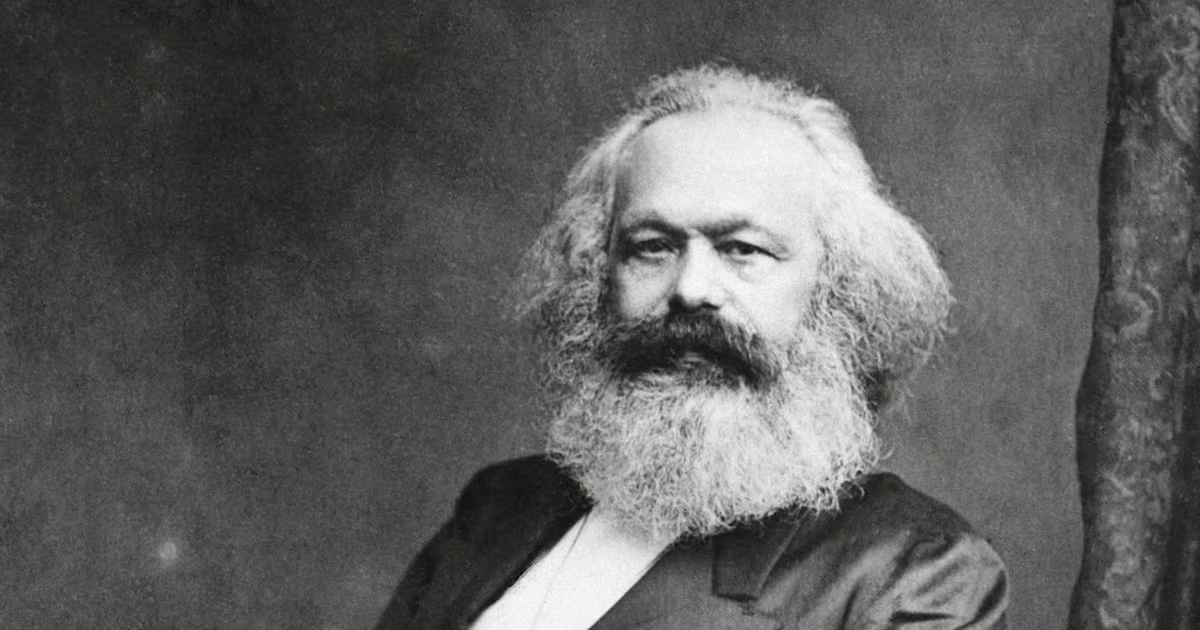
On a somber afternoon of March 14, 1883, the world witnessed the end of an era as Karl Heinrich Marx, the German philosopher whose revolutionary ideas would reshape global politics for generations to come, breathed his last in his modest London home. The man who had penned the immortal words “Workers of the world, unite!” succumbed to bronchitis and pleurisy at the age of 64, leaving behind a legacy that would ignite revolutions and transform nations across the globe.
The Decline of a Revolutionary Mind
The final chapter of Marx’s life was marked by a series of personal tragedies and deteriorating health that gradually weakened the once-formidable intellectual giant. Following the devastating loss of his beloved wife, Jenny von Westphalen Marx, in December 1881, Karl Marx entered a period of profound grief that would hasten his own demise. Jenny’s death struck Marx with such force that he never fully recovered from the emotional blow, describing his existence afterward as nothing short of “wretched.”
The couple had shared a remarkable partnership that spanned four decades, weathering periods of extreme poverty, political exile, and personal hardships together. Jenny had been more than just a wife to Marx; she was his intellectual companion, his emotional anchor, and the mother of his seven children. Her passing left an irreparable void in Marx’s life that compounded his already fragile physical condition.
A Body Ravaged by Years of Struggle
Marx’s health had been deteriorating for years before his wife’s death, a decline that biographers and medical historians have attributed to his punishing work schedule, poor dietary habits, and the chronic stress of financial insecurity. The philosopher suffered from a constellation of ailments that modern medical experts believe stemmed from liver disease, possibly hereditary in nature, which was severely aggravated by his lifestyle choices.
Throughout the 1860s and 1870s, Marx complained frequently of painful boils and carbuncles that made it impossible for him to sit or work in an upright position for extended periods. These skin eruptions, medically known as cutaneous abscesses, were likely manifestations of his underlying liver condition and general physical debility. His biographer Werner Blumenberg noted that Marx’s diet consisted largely of highly seasoned dishes, smoked fish, caviar, and pickled cucumbers – foods particularly harmful to someone suffering from liver ailments.
The philosopher’s nocturnal work habits further exacerbated his condition. Marx was known to work late into the night, often by candlelight, which led to severe eye inflammation and chronic headaches. His excessive consumption of tobacco – usually low-quality cigars due to his financial constraints – and alcohol only worsened his overall health. A serious nervous disorder manifested in 1877, bringing with it protracted insomnia that Marx attempted to combat with narcotics.
The Final Months: A Battle Against Time
After Jenny’s death, Marx developed a persistent catarrh that kept him in poor health throughout the final fifteen months of his life. This respiratory condition gradually evolved into the bronchitis and pleurisy that would ultimately claim his life. Despite his declining health, Marx attempted to continue his intellectual work, though he found himself increasingly incapable of the sustained mental effort that had characterized his earlier years.
During this period, Marx sought treatment at various health resorts across Europe, desperately hoping to regain his strength and complete his life’s work, particularly the remaining volumes of “Das Kapital.” However, these efforts proved largely futile, as his body continued its inexorable decline.
March 14, 1883: The End of an Era
On that fateful March afternoon in 1883, Marx was found peacefully deceased in his armchair at his home on Haverstock Hill in London. His longtime friend and collaborator Friedrich Engels, who had been visiting daily during Marx’s illness, discovered the philosopher’s body. Engels later described the scene with characteristic eloquence, stating that Marx had been “left alone for scarcely two minutes, and when we came back we found him in his armchair, peacefully gone to sleep – but forever.”
The timing of Marx’s death was particularly poignant, occurring at approximately 2:45 in the afternoon on March 14th. Engels, who had witnessed firsthand the toll that years of struggle and recent grief had taken on his friend’s body and spirit, noted that Marx appeared to have simply drifted away quietly, without apparent suffering.
A Modest Farewell for a Revolutionary Giant
The funeral of Karl Marx took place on Saturday, March 17, 1883, at Highgate Cemetery in London’s East section, an area specifically reserved for agnostics and atheists. In a striking contrast to the global impact his ideas would eventually have, Marx’s funeral was attended by a remarkably small gathering of mourners – contemporary accounts suggest between nine and thirty people were present, though most historians agree on approximately thirteen named individuals.
Among those who paid their final respects were Friedrich Engels, Marx’s daughter Eleanor Marx, his sons-in-law Paul Lafargue and Charles Longuet, the family’s longtime housekeeper Helene Demuth, and several prominent figures from the international socialist movement including Wilhelm Liebknecht, who would later become a founder of the German Social Democratic Party.
The modest nature of the funeral was partly due to a communication error that delayed the announcement of Marx’s death by two days, with initial reports incorrectly stating that he had died in Paris. By the time the correction was issued and Marx’s followers learned of his passing, the burial arrangements had already been hastily completed. As one contemporary newspaper noted, “But for this secrecy and haste, a great popular demonstration would undoubtedly have been held over his grave.”
Engels’ Immortal Eulogy
Friedrich Engels delivered the most memorable speech at Marx’s graveside, offering words that would become legendary in the annals of socialist history. Speaking to the small gathering of mourners, Engels proclaimed: “On the 14th of March, at a quarter to three in the afternoon, the greatest living thinker ceased to think.” His eulogy went on to compare Marx’s intellectual contributions to those of Charles Darwin, stating that just as Darwin had discovered the law of development in organic nature, Marx had discovered the law of development in human history.
Engels emphasized that Marx’s legacy lay not merely in his theoretical contributions but in his practical impact on the working-class movement worldwide. He reminded those present that Marx had been, above all, a revolutionary whose primary aim was not simply to interpret the world but to change it – a reference to Marx’s famous eleventh thesis on Feuerbach.
The Stateless Philosopher’s Final Rest
One of the most poignant aspects of Marx’s death was his legal status at the time of his passing. Despite having lived in London for over three decades, Marx died as a stateless person, having been stripped of his Prussian citizenship years earlier due to his political activities. This detail underscores the extent to which Marx had sacrificed personal security and conventional stability in pursuit of his revolutionary ideals.
Marx was initially buried in a simple grave alongside his wife, Jenny, marked only by a modest headstone. It would not be until 1954 that the Communist Party erected the imposing monument that stands today, featuring Marx’s famous words from “The Communist Manifesto”: “Workers of all lands, unite!” This later memorial has become a pilgrimage site for admirers of Marx’s work from around the world.
The Personal Toll of Revolutionary Leadership
The circumstances of Marx’s death illuminate the profound personal cost of his lifelong commitment to revolutionary change. The loss of his wife Jenny, whom he had described as his “most faithful friend,” marked the beginning of his final decline. Their relationship had been tested by decades of poverty, exile, and political persecution, yet it had endured as a source of strength for both partners.
Marx’s family life had been marked by both profound love and heartbreaking loss. Of his seven children with Jenny, only three daughters survived to adulthood: Jenny Caroline, Laura, and Eleanor. The death of his eldest daughter Jenny Caroline in January 1883, just months before his own passing, dealt another devastating blow to the aging philosopher.
A Legacy Born from Struggle
Karl Marx’s death marked the end of a life characterized by intellectual brilliance shadowed by material hardship and political exile. From his birth in Trier, Prussia, on May 5, 1818, to his final breath in London sixty-four years later, Marx had consistently challenged the established order, developing a comprehensive critique of capitalist society that would influence political movements for generations.
His major works, including “The Communist Manifesto” (co-authored with Engels in 1848) and the first volume of “Das Kapital” (published in 1867), were products of years of painstaking research conducted under often dire circumstances. Marx’s dedication to his intellectual mission came at enormous personal cost, including chronic poverty that forced his family to live in squalid conditions and rely on Engels’ financial support.
The Immediate Aftermath and Historical Significance
News of Marx’s death spread slowly through the international socialist networks, reaching different corners of Europe at varying speeds due to the communication limitations of the era. However, among those who understood the significance of his contributions, Marx’s passing was recognized as a pivotal moment in the history of revolutionary thought.
The relatively quiet nature of Marx’s funeral belied the explosive impact his ideas would have in the decades following his death. Within forty years of his passing, the Russian Revolution of 1917 would bring Marxist principles to power in the world’s largest country, while subsequent revolutions in China, Cuba, Vietnam, and other nations would further spread his influence across the globe.
Conclusion: The End of a Beginning
The death of Karl Marx on March 14, 1883, marked not merely the end of a remarkable individual life, but the conclusion of the formative period of modern socialist and communist thought. While Marx himself did not live to see the practical implementation of his theories on a large scale, his death occurred at a moment when the industrial working class he had championed was growing in size and organizational strength across Europe and North America.
The quiet afternoon on Haverstock Hill when Marx drew his final breath represented a transition from the theoretical development of revolutionary ideas to their practical application in the tumultuous century that would follow. Though he died in relative obscurity, attended by only a handful of mourners, Karl Marx had planted intellectual seeds that would grow into movements affecting billions of lives in the generations to come.
The legacy of the German philosopher who died as a stateless exile in London would ultimately transcend national boundaries, inspiring both devoted followers and fierce critics, and ensuring that the name Karl Marx would remain synonymous with revolutionary change long after his mortal frame was laid to rest in the quiet confines of Highgate Cemetery.