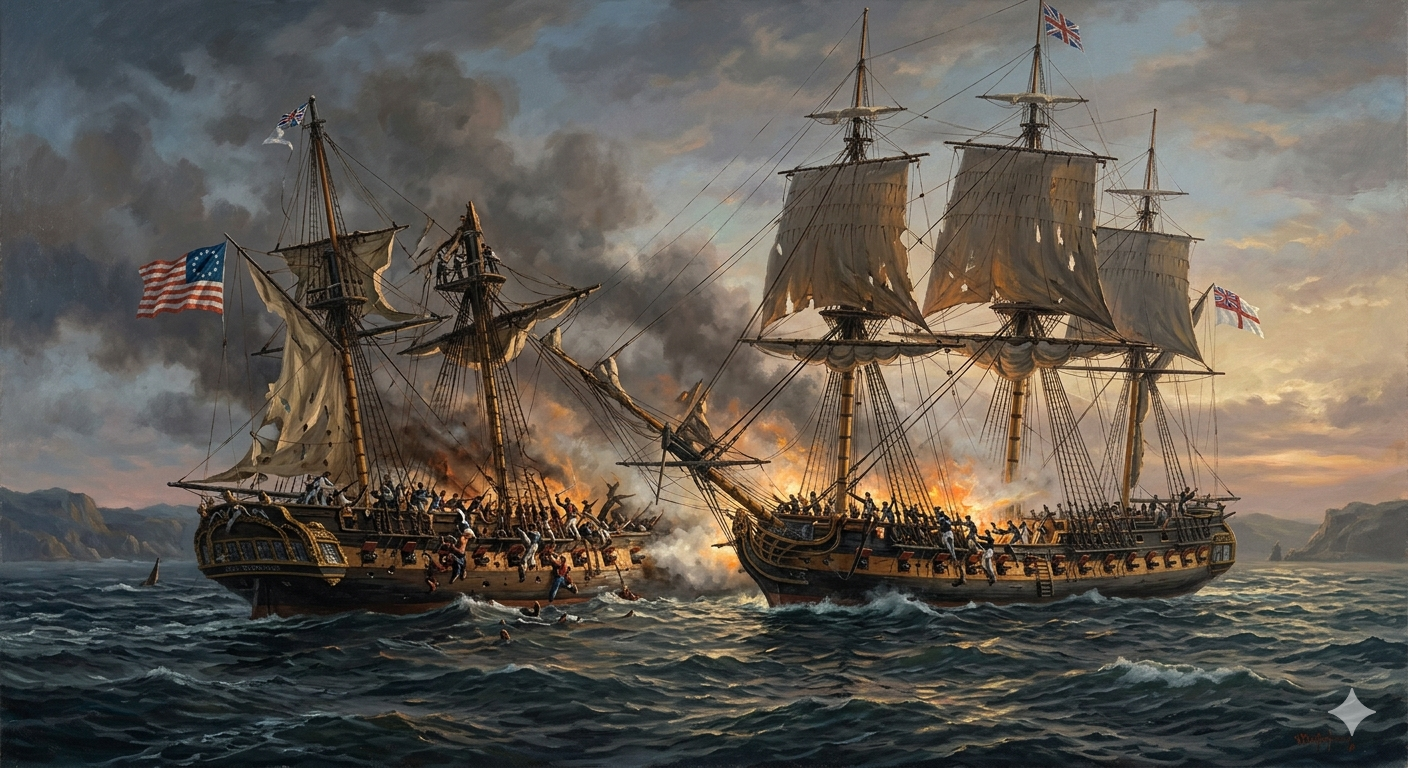
On June 1, 1813, the United States Navy frigate USS Chesapeake sailed out of Boston Harbor to meet the Royal Navy frigate HMS Shannon in single combat. The citizens of Boston lined the hills, climbed onto rooftops, and packed small boats to watch what they fully expected to be another American victory. The local authorities had reserved dock space in anticipation of the captured British warship. A celebratory banquet had been planned for Captain James Lawrence’s triumphant return.
What they witnessed instead was one of the most shocking naval defeats in American history. In less than fifteen minutes, a battle that thousands watched from shore was over. The Chesapeake’s flag had come down. Her commander was mortally wounded. More than a hundred men on both ships were dead or dying. And the words Lawrence uttered as he was carried below deck wounded would echo through American naval history forever: “Don’t give up the ship.”
The War of 1812 at Sea: American Victories and British Humiliation
When the United States declared war on Britain on June 18, 1812, the Royal Navy was the most powerful force on the world’s oceans. Fresh from its triumph at Trafalgar in 1805, the Navy had crushed French sea power and was blockading the ports of Europe. The small American naval force, with just a handful of frigates, seemed almost beneath notice.
The opening months of the war immediately overturned that assumption. American frigates were larger, heavier, and more powerfully armed than their British counterparts. Their main batteries of 24-pounder long guns outranged the 18-pounders that armed British frigates of the same nominal rating. American gunnery crews were well trained and aggressive. In the six major single-ship frigate engagements of 1812 and early 1813, the Americans won every one. USS Constitution defeated HMS Guerriere in August 1812. USS United States captured HMS Macedonian in October 1812. Constitution beat HMS Java in December 1812. The British public was stunned. The Royal Navy’s pride had taken a severe and very public battering.
The pressure on British naval commanders in North American waters to restore that pride was immense. As Captain Philip Bowes Vere Broke of HMS Shannon wrote to his wife before setting out to sea from Halifax: “We must catch one of those great American ships and send her home for a show.” Broke had been working toward exactly that goal for seven years.
Captain Philip Broke: The Gunnery Genius Who Made Shannon Invincible
Philip Bowes Vere Broke (pronounced “Brook”) was born on September 9, 1776, at Broke Hall, Nacton, near Ipswich in Suffolk, England. He had received a formal education at the Royal Naval Academy in Portsmouth, an unusual background for an officer of his generation when most captains learned their trade entirely at sea. He took command of HMS Shannon on August 31, 1806, and would remain her commander for nearly seven years, an unusually long tenure that proved transformative for the ship and decisive for history.
Broke was obsessed with gunnery in an era when most Royal Navy officers regarded detailed gunnery training as unnecessary drudgery. The standard British naval doctrine held that British sailors were inherently superior fighters and that close-range fighting would decide any battle regardless of accuracy. Broke disagreed. He fitted Shannon’s 18-pounder long guns with dispart sights that compensated for the external narrowing of the barrel from breech to muzzle, improving accuracy substantially. He added adjustable tangent sights to give precision at varying ranges. He introduced a system of painted lines on the deck allowing gun captains to align their weapons accurately even without a clear sight line to the target.
Most importantly, he drilled his crew relentlessly. Shannon’s gunners practiced not just loading and firing but aiming. They fired at floating targets, empty beef casks, anything that would let them measure accuracy. Broke burned the prizes he captured rather than detach men from his crew to sail them to Halifax. He was determined that when Shannon met her American opponent, his men would be at full strength and at their peak of readiness.
Before the opening shots of the engagement with Chesapeake, Broke addressed his crew from the quarterdeck: “Throw no shot away. Aim every one. Keep cool. Work steadily. Fire into her quarters, maindeck to maindeck, quarterdeck to quarterdeck. Don’t try to dismast her. Kill the men and the ship is yours.”
By the summer of 1813, HMS Shannon was arguably the most professionally trained and gunnery-capable frigate in the entire Royal Navy. She was waiting off Boston when the opportunity arrived.
Captain James Lawrence and the Unready USS Chesapeake
The USS Chesapeake had a troubled history long before June 1, 1813. She was ordered on March 27, 1794, built by Josiah Fox at the Norfolk Navy Yard, and launched on December 2, 1799. In 1807, she had suffered one of the most humiliating incidents in American naval history when HMS Leopard intercepted and fired upon her, forcing her to surrender and allow the British to remove four crewmen who were claimed as British subjects. The Chesapeake fired only a single gun in resistance. Her commander, Captain James Barron, was court-martialed and suspended from service. The Chesapeake’s reputation had never fully recovered.
Captain James Lawrence was born on October 1, 1781, in Burlington, New Jersey. He had entered the Navy as a midshipman in 1798 at the age of seventeen and built a distinguished career. His most recent command had been USS Hornet, which had defeated and sunk the British brig HMS Peacock in February 1813, a victory that made Lawrence one of the most celebrated naval officers in America and earned him rapid promotion to captain. He was thirty-one years old when he took command of the Chesapeake on May 20, 1813.
The timing could hardly have been worse. The Chesapeake had just returned to Boston from a cruise in April 1813 and was undergoing refit. Many of her experienced officers had been transferred or were ill. A large proportion of her crew had been newly enlisted. The men had barely served together as a unit. There was a dispute over the distribution of prize money that had made some sailors reluctant to re-enlist. Lawrence took on inexperienced recruits to fill out his numbers and prepared to sail.
Adding to the pressure, the British frigates Shannon and Tenedos had been blockading Boston Harbor for weeks. Two other American frigates, President and Congress, had managed to slip away from Boston in April, leaving Chesapeake as the only American warship in the harbor under blockade. Lawrence was under intense public expectation to confront Shannon. He was also aware that Broke had written a formal letter of personal challenge, inviting him to a fair fight one-on-one, with Shannon’s consort Tenedos sent away to equalize the odds. The letter was not delivered before Lawrence sailed, but the knowledge of the challenge had spread throughout Boston.
June 1, 1813: The Battle of Boston Harbor
Chesapeake left Boston Harbor shortly before 1:00 p.m. on June 1, 1813, flying three American ensigns and a large white flag inscribed with the words “Free Trade and Sailors’ Rights,” the rallying slogan of American grievances against British maritime policies that had helped bring about the war. Crowds on shore watched her sail, cheering her on.
Broke, who had been blockading Boston for 56 days, had sent away his consort Tenedos exactly as he had offered in his challenge, to ensure there could be no accusation of unfair odds. He maneuvered Shannon toward Cape Ann, about twelve miles to the northeast, to avoid interference from American gunboats. The two ships were evenly matched in armament: both carried 28 18-pounder long guns as their main batteries, making this the only frigate action of the entire War of 1812 in which neither side had a preponderance of force. Shannon carried approximately 330 officers and men; Chesapeake had 379 in her crew, a numerical advantage that proved meaningless.
The two frigates met at approximately half past five in the afternoon, about 20 nautical miles east of Boston Light, between Cape Ann and Cape Cod. Shannon appeared battered and weather-worn after her long period at sea. Her appearance may have reinforced Lawrence’s confidence. “We have always been an unassuming ship,” Broke remarked dryly when a sailor asked whether Shannon should fly more flags to match Chesapeake’s display.
Both captains declined the opportunity to rake their opponent, a tactical choice that reflected genuine mutual gallantry. Lawrence brought Chesapeake down on Shannon’s starboard side. At approximately 5:50 p.m., at a range of roughly 35 meters, barely more than 100 feet, both ships opened fire simultaneously.
Fifteen Minutes That Changed the War: The Battle Itself
The opening broadsides were catastrophic for the Americans. Shannon’s gun crews, trained to Broke’s exacting standards, fired with methodical precision directly into Chesapeake’s hull and gun deck. The effect was devastating. The Chesapeake’s wheel was shot away immediately, making the ship unsteerable. The fore topsail halyards were cut, preventing sail adjustment. The quarterdeck, where Lawrence and his officers stood directing the battle, was swept with fire. First Lieutenant William Ludlow was mortally wounded within the first minutes. Lawrence himself was struck twice by small arms fire from Shannon’s marksmen in the tops and was carried below deck, mortally wounded.
As he was brought down, Lawrence gave the order that would outlive him: “Don’t give up the ship. Fight her till she sinks.” The phrase, caught in the tumult of battle and reported in various forms, would become one of the most famous last commands in American military history.
Without a functioning wheel, Chesapeake drifted. Her uncontrolled motion brought her stern swinging around toward Shannon’s bow, exposing her to raking fire. Grappling hooks were thrown across and the two ships were lashed together. Captain Broke personally led the boarding party onto Chesapeake’s quarterdeck. He was wearing no saber and carried only his own sword as he vaulted across. The fighting on the Chesapeake’s deck was brutal and close. Of the 150 men stationed on Chesapeake’s quarterdeck during the engagement, approximately 100 were killed or wounded. Broke himself was struck by a cutlass blow to the head that exposed his skull and left him severely wounded. Shannon’s surgeon, Mr. Alexander Jack, made the controversial decision not to perform the routine therapeutic bleeding of the day, a decision that probably saved Broke’s life.
The entire action, from the first broadside to the striking of the American flag, lasted approximately fifteen minutes. It was one of the shortest, bloodiest single-ship frigate actions in the history of naval warfare.
Shannon suffered 24 killed and 59 wounded. Chesapeake lost 56 killed and approximately 85 to 90 wounded. Total casualties across both ships exceeded 200 men in less than a quarter of an hour.
The National Naval Aviation Museum and the U.S. Naval History and Heritage Command have preserved detailed accounts of the battle’s significance, accessible through the U.S. Navy History and Heritage Command’s coverage of the USS Chesapeake and HMS Shannon engagement.
“Don’t Give Up the Ship”: The Last Words That Became a Legend
Captain James Lawrence died on June 4, 1813, three days after the battle, as Shannon escorted the captured Chesapeake toward Halifax. He was 31 years old. He was initially buried with full British naval honors at the Old Burying Ground on Barrington Street in Halifax, with six British naval officers serving as his pallbearers, a tribute to the genuine respect the British held for his courage and gallantry despite his defeat. His body was later repatriated and reinterred at Trinity Churchyard in Manhattan, New York, where thousands attended the public ceremony.
Lawrence’s dying words, “Don’t give up the ship,” were carried back to his friend and fellow naval officer Oliver Hazard Perry, who was then preparing to face the British on Lake Erie. Perry was so moved by the phrase that he ordered a large blue battle flag sewn with the words “DONT GIVE UP THE SHIP” in bold letters. He flew it from his flagship USS Lawrence, named in honor of his fallen friend, at the Battle of Lake Erie in September 1813. Perry won that battle decisively, delivering one of the most complete American naval victories of the war. Lawrence’s dying words, spoken in defeat, thus became the battle cry of America’s greatest naval triumph of the war.
The phrase entered permanent American naval tradition. It has been a rallying call on American ships ever since and is recognized as one of the most enduring expressions of American naval identity.
Broke’s Recovery, Halifax, and the Aftermath of Victory
Lieutenant Provo Wallis of Halifax, the senior surviving officer from Shannon’s original complement, assumed temporary command of Shannon and her prize for the voyage to Halifax. Both ships arrived on June 6, 1813. The streets of Halifax erupted in celebration. Church services were interrupted as congregations poured into the streets to welcome the returning ships. Bostonians, many of whom had watched the battle from shore, wept in the streets.
The 320 American survivors were interned at Melville Island military prison in Halifax Harbor. Some were paroled; others remained confined for the duration of the war. Many of those who died from wounds or disease were buried at Deadman’s Island, near the prison camp. Over the course of the entire War of 1812, more than 8,000 Americans passed through the prisoner of war camp at Melville Island.
Captain Broke recovered at the Commissioner’s residence in the Halifax Naval Yard, against the expectations of his surgeons. The head wound from the cutlass blow had been severe enough that his recovery was considered near-miraculous. He sailed for England in October 1813, arriving at Portsmouth on November 2. In recognition of his victory, Broke was created a Baronet on September 25, 1813. He received the Naval Gold Medal, one of only eight awarded for single-ship actions between 1794 and 1816. The Court of Common Council of London awarded him the Freedom of the City and a sword worth 100 guineas. He was later appointed a Knight Commander of the Order of the Bath on January 3, 1815, and was eventually promoted to Rear Admiral of the Red on July 22, 1830. The severe head wound prevented him from ever returning to active sea command.
Provo Wallis, the young officer who brought both ships safely to Halifax, was later promoted to Commander as a direct result of his role. He ultimately rose to the rank of Admiral of the Fleet. The street running alongside the Naval Dockyard in Halifax is still named Provo Wallis Street in his honor.
The victory transformed British morale in the naval war. As the Nova Scotia government’s heritage resources note, the battle between Shannon and Chesapeake marked a turning point, after which the British gradually gained the upper hand at sea. American frigates were blockaded into their ports. British naval forces based at Halifax blockaded and raided the entire American coastline. The war, which had been going badly for Britain at sea, shifted decisively in their favor in 1813 and 1814.
The U.S. National Park Service has documented the full account of the battle and its consequences at the NPS article on the Capture of USS Chesapeake.
The Fate of USS Chesapeake: From British Service to a Hampshire Mill
Captured USS Chesapeake was repaired and taken into Royal Navy service as HMS Chesapeake. She was used for a period to ferry American prisoners from Melville Island to England’s Dartmoor Prison. She served in the Royal Navy until late 1815, then was laid up and sold in 1819 to a timber merchant at Portsmouth for £500.
The merchant who purchased her, described in historical accounts as a Mr. Holmes, reportedly cleared £1,000 profit from the timber alone. Many of Chesapeake’s planks and beams were in remarkably good condition, made from long-leaf Southern pine rather than the oak one might expect, straight-grained and serviceable for building purposes.
A large portion of the timber was purchased by John Prior, a flour miller from the Hampshire village of Wickham, who used the Chesapeake’s beams and planks to build a new watermill on the River Meon. Construction took place in 1820. The mill, which became known as Chesapeake Mill, operated continuously for over 150 years, not closing until the 1970s. Its massive structural timbers, which supported the floor levels that once held the ship’s guns, can still be seen today. The mill has since been converted to an antiques and gifts center and remains open to visitors in Wickham, Hampshire.
HMS Shannon survived longer than her prize, being eventually broken up in 1859. Shannon’s bell is preserved at the Maritime Museum of the Atlantic in Halifax, along with an officer’s chest and mess kettle from Chesapeake, tangible artifacts from one of the most intense and consequential naval engagements of the 19th century. A cairn with a bronze plaque at Point Pleasant Park in Halifax and a cannon believed to be from Shannon on the north side of Halifax’s Province House mark the victory in the city where it was celebrated.
The Nova Scotia Museum’s resources on the Shannon-Chesapeake battle and its place in the history of the War of 1812 are available at the Nova Scotia Museum’s HMS Shannon and USS Chesapeake page.
The battle of June 1, 1813, lasted fifteen minutes. Its consequences lasted generations. It gave the Royal Navy its pride back at a critical moment, shifted the naval balance of the War of 1812, produced one of the most famous dying commands in military history, and left behind a water mill in the English countryside where the timbers of a defeated American frigate quietly continued their work for another century and a half.