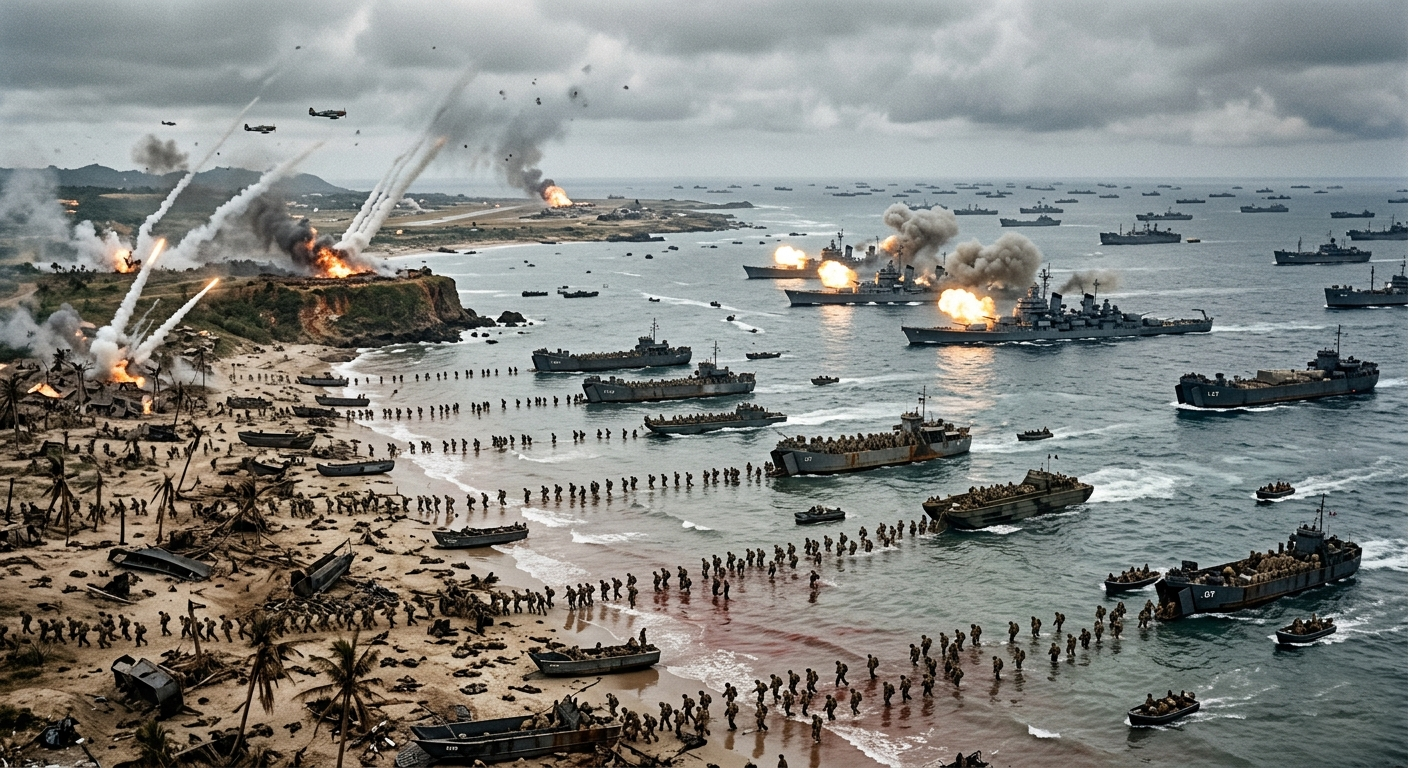
On the morning of April 1, 1945 — which happened to fall on both Easter Sunday and April Fool’s Day — the largest amphibious assault ever launched in the Pacific Theater of World War II began on the shores of a 60-mile-long island in the southwestern Ryukyu chain. More than 180,000 soldiers and Marines of the United States Tenth Army descended upon Okinawa, supported by a naval armada of over 1,600 ships and 350,000 naval personnel, forming the most powerful invasion force ever assembled in the Pacific. The operation was codenamed Operation Iceberg, and it would ultimately last 82 brutal days, producing casualties on all sides that shocked even the most hardened military planners. The battle that followed became known in English as the “typhoon of steel” and in Japanese as tetsu no bōfū — names that speak to the terrifying intensity of the fighting on land, at sea, and in the air.
The Battle of Okinawa, which lasted from April 1, 1945 to June 22, 1945, stands as the bloodiest and costliest engagement of the entire Pacific War. It was the last major island battle before the anticipated Allied invasion of the Japanese home islands, and the lessons learned in the limestone caves and blood-soaked ridges of Okinawa would reverberate far beyond the battlefield — directly shaping President Harry S. Truman’s fateful decision to deploy the atomic bomb and bring the Second World War to its shattering conclusion.
Strategic Importance of Okinawa: Why the United States Had to Take This Island
Okinawa’s strategic value was unmistakable, and both sides understood it perfectly. The island lies just 350 miles (563 kilometers) south of Kyushu, the southernmost of Japan’s home islands, making it the logical final stepping stone before any Allied invasion of the Japanese mainland. As the largest island within the Ryukyu chain, Okinawa possessed qualities that made it indispensable to American military planners. Its relatively flat central plains were ideal for constructing and expanding airfields from which medium-range American bombers and fighters could reach Kyushu and strike at Japan’s industrial heartland with great efficiency. Its numerous coastal indentations and protected anchorages could shelter the enormous naval fleet required to stage and sustain an invasion of Japan, as well as provide space to repair vessels damaged in battle.
After years of island hopping across the Pacific — from Guadalcanal to Tarawa, from Peleliu to Iwo Jima — Allied forces were planning to use Kadena Air Base on Okinawa as a staging point for Operation Downfall, the planned two-phase invasion of the Japanese home islands, which lay just 340 miles (550 km) to the north. Controlling the Ryukyu Islands would also allow the Americans to sever Japan from its southern empire, cutting the supply lines that sustained the Japanese war machine. Okinawa was not merely a battle objective — it was the key that would unlock the door to Japan itself.
The Japanese understood this calculus as well. Japanese military planners recognized that Okinawa was their last viable defensive line outside of the home islands themselves. If Okinawa fell, the Americans would have a launching pad of devastating proximity to Japan, and nothing would stand between Allied airpower and the Japanese mainland. Accordingly, the island was transformed into an extraordinarily powerful fortress in the months and years before the invasion, with an elaborate defensive network designed to inflict maximum casualties and buy time for the home islands to be fortified against the inevitable final assault.
The Strategic Context: Island Hopping, Iwo Jima, and the Road to Okinawa
By the spring of 1945, the Pacific War had ground through years of ferocious island-by-island combat. The United States had adopted a strategy of island hopping — bypassing certain heavily fortified Japanese positions while capturing others that could serve as steppingstones toward Japan — and the result was a steady, grinding advance that brought American forces ever closer to the Japanese homeland. Each island battle had offered its own lessons in the determination of Japanese defenders and the horrific cost of rooting them from fortified positions.
The Battle of Iwo Jima, which began on February 19, 1945, and lasted more than five weeks, had been a sobering preview of what awaited at Okinawa. At Iwo Jima, the Japanese had abandoned the earlier tactic of defending at the water’s edge and instead dug deep into the volcanic rock, creating interconnected tunnels, bunkers, and fighting positions that were extremely difficult to destroy with naval gunfire or aerial bombardment. American forces suffered approximately 26,000 casualties on that small island, while nearly the entire Japanese garrison of about 21,000 men fought to the death, with only a few hundred captured. The pattern of underground defense and maximum resistance was one that Japanese commanders would replicate and amplify at Okinawa.
Even as Iwo Jima was still being secured in March 1945, American commanders were assembling the most powerful invasion fleet ever seen in the Pacific for the next operation. The Fifth Fleet commander, Admiral Raymond A. Spruance, was on his flagship USS Indianapolis (CA-35) steaming toward the Ryukyus in company with Admiral Marc Mitscher’s Task Force 58. The scale of preparation was unprecedented. Theatre commander Admiral Chester W. Nimitz oversaw the overall operation, with Spruance commanding naval forces and Lieutenant General Simon Bolivar Buckner Jr. designated to command U.S. ground troops. The machinery of the largest amphibious operation in Pacific history was moving into position.
Operation Iceberg: Planning the Invasion and Assembling the Assault Force
Operation Iceberg was a logistical undertaking of staggering complexity. The invasion force assembled for Okinawa was not merely large — it was historically unprecedented in the Pacific. More than 1,600 ships and 350,000 naval personnel were assembled to form the largest amphibious assault force of World War II. The armada included 18 battleships, 27 cruisers, 177 destroyers and destroyer escorts, 39 aircraft carriers (comprising 11 fleet carriers, 6 light carriers, and 22 escort carriers), and a vast array of support and troop transport ships. Total aircraft provided by the U.S. Navy, Marine Corps, and Army Air Force exceeded 3,000 over the course of the battle.
The ground force assigned to capture Okinawa was the United States Tenth Army, a unique cross-branch formation that included both U.S. Army and U.S. Marine Corps divisions — eight divisions in total. The Tenth Army’s order of battle included the XXIV Corps, consisting of the veteran 7th and 96th Infantry Divisions (and later reinforced by the 27th and 77th Infantry Divisions), under the command of Major General John R. Hodge. The III Marine Amphibious Corps, consisting of the 1st, 2nd, and 6th Marine Divisions, was commanded by Major General Roy Geiger. The Tenth Army was unique in that it had its own Tactical Air Force — a joint Army-Marine command — and was supported by combined naval and amphibious forces. At the start of the battle, the Tenth Army had 182,821 personnel under its command.
The British Pacific Fleet, designated Task Force 57 under Vice Admiral Bernard Rawlings, also participated, assigned to neutralize the Japanese airfields on the Sakishima Islands, which it did successfully from March 26 to April 10, before shifting its attention to airfields in northern Formosa. The participation of British naval forces underscored the truly Allied nature of the Pacific endgame, even as American forces bore the overwhelming majority of the burden.
Pre-invasion preparations began weeks before the main landings. American air and sea attacks on Okinawa had been ongoing since October 1944, and Allied carrier operations in March 1945 by Carrier Task Force 58, under Rear Admiral Mitscher, carried out extensive strikes against Okinawa and neighboring Japanese positions. American underwater demolition teams and minesweepers worked in the final days of March to clear obstacles from the landing beaches. Every detail was coordinated to support the massive assault that was to come.
The Kerama Islands: The Preliminary Operations That Set the Stage
The main landings on April 1 were preceded by a series of crucial preliminary operations. On March 26, 1945, soldiers of the U.S. Army 77th Infantry Division, commanded by Major General Andrew Bruce, made the first landings of the Okinawa campaign on the Kerama Islands, located about 15 miles (24 km) west of the main island. The capture of the Kerama group provided the Allied fleet with a protected anchorage for refueling, replenishment, and repair operations — a logistical lifeline for the vast armada that would conduct the main assault. In the Kerama Islands, American forces discovered approximately 350 small, high-speed suicide boats that had been assembled by the Japanese to attack the invasion fleet, eliminating that threat before it could be employed. In these preliminary operations, the 77th Infantry Division suffered 27 dead and 81 wounded, while the Japanese dead and captured numbered over 650.
On March 28, 1945, a tragic and disturbing event foreshadowed the human cost that civilians would bear throughout the battle. On Tokashiki island, 394 civilians were forced by Japanese soldiers to kill themselves following the landing of U.S. troops — the first of many instances in which Japanese propaganda and military coercion would drive Okinawan civilians to suicide rather than surrender to the Americans, whom they had been told were barbaric killers. On March 31, Marines of the Amphibious Reconnaissance Battalion landed without opposition on Keise Shima, a collection of coral islets just 8 miles (13 km) west of the Okinawan capital of Naha, where American 155-mm Long Tom artillery batteries were emplaced to provide fire support across most of southern Okinawa. The stage was set for the largest amphibious assault of the Pacific War.
The Japanese Defensive Strategy: Lieutenant General Mitsuru Ushijima and the Thirty-Second Army
Opposing the Allied forces on the ground was Lieutenant General Mitsuru Ushijima, commander of the Japanese Thirty-Second Army. Ushijima was a methodical, experienced commander who had studied the lessons of earlier island battles carefully and developed a defensive strategy specifically designed to maximize American casualties while prolonging resistance as long as possible. He was assisted by his fiery and aggressive Chief of Staff, Lieutenant General Isamu Cho, and by the coolly analytical operations officer, Colonel Hiromichi Yahara, whose cautious approach to strategy would repeatedly clash with Cho’s instinct for aggressive counterattacks.
The Japanese garrison on Okinawa numbered approximately 100,000 men at the onset of the invasion. The Thirty-Second Army consisted of the 9th, 24th, and 62nd Divisions and the 44th Independent Mixed Brigade, though the transfer of the elite 9th Division to Taiwan before the invasion forced significant reshuffling of defensive plans and left the Japanese somewhat undermanned. The garrison also included approximately 9,000 Imperial Japanese Navy troops at Oroku Naval Base — only a few hundred of whom had been trained for ground combat — and approximately 39,000 drafted local Ryukyuan people, including 24,000 hastily drafted rear militia called Boeitai and 15,000 non-uniformed laborers. Among those conscripted were 1,800 middle school boys, incorporated into what was called the “Blood and Iron Corps.” The total strength of opposing forces was formidable, and their positions were ferociously fortified.
Ushijima had abandoned any thought of defending the beaches. The Japanese defensive philosophy at Okinawa was a strategy of defense in depth, centered on the most heavily populated southern portion of the island. Rather than occupy vulnerable positions at the water’s edge — which would be exposed to overwhelming naval gunfire and air bombardment — Ushijima concentrated his forces in a succession of powerful defensive lines built into and through the island’s porous coral and limestone hills and ridges. Tunnels, caves, bunkers, and interconnected underground fighting positions were dug throughout the terrain, creating a fortress that was largely impervious to aerial bombardment and naval gunfire. The Japanese had ample time to prepare and had large numbers of tanks and artillery pieces — more than they had possessed at any previous island battle. They also had the advantage of fighting on terrain that every gunner knew intimately, with ranges and coordinates for potential target areas already well established. The centerpiece of this defensive network was anchored around the historic Shuri Castle, a medieval fortress of the ancient Ryukyuan kings in the island’s south, from which Ushijima would conduct his defense.
Ushijima’s strategic goal was not to win the Battle of Okinawa. He knew the Allies could not be stopped. His objective was to make the price of victory so high that it would deter an invasion of the Japanese home islands, or at least buy sufficient time for Japan to negotiate more favorable terms. He wanted to make the Americans pay for every yard of advance in blood. As the National Museum of the Pacific War has noted, the Japanese were well aware that the lessons of Okinawa would inform the decisions which would bring about the end of the war.
L-Day, April 1, 1945: The Deceptively Calm Beginning of a 82-Day Battle
At 8:30 in the morning on April 1, 1945 — L-Day, as it was designated by the planners — the first waves of U.S. ground forces began moving ashore at Hagushi on the western coast of central Okinawa. It was Easter Sunday. It was also April Fool’s Day. And in a grim irony that was not lost on veterans of previous Pacific landings, the invasion began with almost no resistance. Before the landings commenced, the preinvasion naval bombardment of Okinawa had been described as so heavy that it was itself like a typhoon of steel. Yet despite the enormous firepower unleashed upon the island, the artillery had barely touched Ushijima’s underground fortifications, and the Japanese garrison remained intact in its prepared positions.
The lack of Japanese response to the landings was bewildering to veteran American troops who had prepared themselves for another bloodbath on the beaches. Men who had survived Peleliu and Iwo Jima expected a brutal fight at the water’s edge. Instead, they walked upright across the beaches — something entirely unheard of in the rest of the Pacific War. Admiral Spruance famously messaged theatre commander Admiral Chester Nimitz: “I may be crazy, but it looks like the Japanese have quit the war, at least in this sector,” to which Nimitz dryly responded, “Delete all after ‘crazy.'” By nightfall on April 1, some 60,000 men had come ashore and established a beachhead approximately 5 miles (8 km) long. It was the largest single-day landing in Pacific history.
The reason for the unopposed landings was entirely deliberate on Ushijima’s part. He had ordered his troops not to fire on the American landing force at the beaches. His strategy was to lure the Americans inland, allow them to advance with confidence, and then strike them from prepared positions in the fortified hills and ridges of the south, where American airpower and naval gunfire would be far less effective and where Japanese defenders could fight with maximum advantage. Within hours of coming ashore, both the Kadena and Yomitan Air Bases were captured by American forces — a remarkable early achievement that immediately set in motion the second phase of the operation, providing forward air bases for operations against Japan.
Clearing the North: The III Marine Amphibious Corps and the Push Toward the Motobu Peninsula
With the beachhead secured, the U.S. Tenth Army divided its forces. The Army’s XXIV Corps, consisting of the veteran 7th and 96th Infantry Divisions, cut across the island’s narrow waist and quickly reached the eastern shore, isolating Japanese defenders in the northern half of the island. Meanwhile, the III Marine Amphibious Corps — comprising the 1st and 6th Marine Divisions — drove north to clear the lightly defended northern portion of the island. For the first several days, the Marines’ advance in the north proceeded rapidly through terrain that offered little organized resistance.
The exception was the Motobu Peninsula, in northwestern Okinawa, where Japanese Colonel Takehido Udo had positioned approximately 2,000 soldiers of the Kunigami Detachment in heavily fortified positions centered on Mount Yaetake, a rocky, wooded peak that dominated the peninsula. The 6th Marine Division, commanded by Major General Lemuel Shepherd, assaulted Mount Yaetake beginning on April 8 and fought through some of the first serious combat of the northern campaign before finally clearing the position by April 18. The rugged terrain was a preview of what awaited in the south, though on a far smaller scale.
While the 6th Marine Division battled on the Motobu Peninsula, the 77th Infantry Division assaulted Ie Shima, a small island off the western end of the peninsula, on April 16. The assault on Ie Shima would become famous not only for the fierce fighting — the island was defended stubbornly and the 77th Division encountered kamikaze attacks and even local women armed with spears — but also because it was here, on April 18, 1945, that one of America’s most beloved war correspondents met his end. Ernie Pyle, whose dispatches from the European theater had made him one of the most widely read journalists of the entire war, was killed by Japanese machine-gun fire on Ie Shima while accompanying U.S. troops. Pyle had confided to a colleague just days earlier that he had a “spooky feeling” that he had been spared too many times and that he planned to go home soon. He never got the chance. His death was mourned across America. The northern two-thirds of Okinawa were effectively pacified by April 22.
The Kamikaze Assault at Sea: Operation Kikusui and Japan’s Divine Wind
While American ground forces were consolidating their beachheads and pushing inland, the Japanese unleashed one of the most terrifying and innovative weapons of the entire war against the Allied fleet offshore. The Japanese had employed kamikaze tactics since the Battle of Leyte Gulf in late 1944, but at Okinawa, for the first time, mass suicide attacks became the central and institutionalized pillar of Japanese naval defensive strategy. The word kamikaze means “divine wind,” a reference to the legendary typhoons that supposedly saved Japan from Mongol invasion fleets in the 13th century. At Okinawa, the divine wind took the form of bomb-laden aircraft piloted by young Japanese volunteers and conscripts who were ordered to fly directly into American ships and die in the act of destruction.
Kamikaze attacks began during the preliminary operations, with the first strikes occurring on March 26, 1945. Five days after the initial main landing on April 1, a massive wave of 355 Japanese army and navy kamikaze aircraft struck the armada of Allied ships supporting the invasion. This was the opening salvo of what the Japanese called Operation Kikusui — “Floating Chrysanthemum” — a series of ten major organized kamikaze attacks. Between April 1 and May 25 alone, seven major kamikaze attacks were attempted involving more than 1,500 aircraft. In total, from the beginning of the campaign through its end, Japan launched approximately 1,900 to 2,000 kamikaze sorties against the Allied fleet at Okinawa.
The results were devastating. By the end of the campaign, kamikaze attacks had sunk 29 to 36 ships and damaged 368 more — including 10 battleships, 13 fleet and escort carriers, 5 cruisers, and 67 destroyers. Nearly 5,000 U.S. Navy personnel were killed in the Okinawa campaign, more than U.S. Army deaths (4,582) and Marine deaths (2,792) combined. The U.S. Navy suffered greater casualties at Okinawa than in any previous engagement in either the Atlantic or Pacific theaters. The aircraft carrier USS Bunker Hill was struck by two kamikaze planes within 30 seconds of each other on May 11, 1945, killing 396 men. The carrier USS Franklin suffered over 800 killed and missing earlier in the campaign after being hit by two bombs.
The Navy established Radar Picket Stations — destroyers and smaller vessels stationed in an outer ring around the invasion force — specifically to detect and intercept incoming kamikaze attacks before they could reach the carriers and transports. These stations became among the most dangerous postings of the entire war. Ships on radar picket duty were subjected to concentrated kamikaze attacks, and the sailors who served there endured extraordinary levels of stress and casualties. The determination with which Japanese pilots sought out and attacked these vessels became one of the defining and most terrifying experiences of the Okinawa campaign for the U.S. Navy.
Operation Ten-Go and the Sinking of the Yamato: The Last Gasp of the Imperial Japanese Navy
On April 6 and 7, 1945, the Japanese launched what would be the final major naval operation of the Second World War. Operation Ten-Go — also written as Tengo, meaning “Heavenly Operation” — was a desperate combined assault that sent the world’s largest battleship, the 70,000-ton Yamato, on what amounted to a one-way suicide mission. The Yamato, armed with nine 18-inch main guns of incomparable firepower, was ordered to fight her way through the Allied naval forces surrounding Okinawa, run herself aground on the beaches, and then use her immense artillery to shell American landing positions. The fleet that sailed with Yamato included the light cruiser Yahagi and eight destroyers.
The mission was doomed almost from the moment it began. American submarines spotted the Yamato’s task force shortly after it departed Japanese home waters, and the information was relayed to the fleet. Aircraft from multiple American carriers were dispatched to intercept. Under attack from more than 300 carrier aircraft over a span of approximately two hours, the Yamato took 12 bomb hits and seven torpedo hits. American torpedo bombers had been specifically instructed to aim for only one side of the ship to prevent the crew from engaging effective counter-flooding, and to strike the bow or stern where armor was thinnest. At approximately 2:23 in the afternoon on April 7, 1945, the Yamato blew up and sank, far short of her destination. Of her crew of 2,747, all but 23 officers and 246 enlisted men were lost — approximately 2,475 Japanese sailors perished with the ship. The light cruiser Yahagi was also sunk, losing 446 men. Three accompanying destroyers were so badly damaged they had to be scuttled. The cost to the Americans was just ten aircraft and twelve airmen.
The sinking of the Yamato was a moment of profound symbolic significance. The world’s largest and most powerful battleship, a vessel that represented the pinnacle of Japan’s naval ambition and the spiritual pride of the Imperial Japanese Navy, had been destroyed by aircraft before it could even reach the battlefield. After the Yamato went down, the Imperial Japanese Navy effectively ceased operations for the remainder of the war. The battle had also confirmed, in the starkest possible terms, that the era of the great battleship was over and that naval aviation had become the decisive instrument of maritime warfare.
The Shuri Line: America’s Bloodiest Ground Campaign in the Pacific
While dramatic events unfolded at sea, the most grueling and costly phase of the Okinawa campaign was being fought on the ground, in the rugged, ridge-cut landscape of southern Okinawa. After the initial easy advance of the first few days, American forces moving south from the central beachhead began to encounter the outer defenses of Ushijima’s carefully prepared fortress in the first week of April. The outermost defensive position, known as the Cactus Line, did not offer sustained resistance, but behind it lay the Kakazu Ridge and, behind that, the centerpiece of the Japanese defensive system: the Shuri Line.
The Shuri Line was a masterpiece of defensive engineering, stretching across the full width of the island through the most formidable terrain on Okinawa. It was anchored on the historic Shuri Castle — a 15th-century citadel of the ancient Ryukyuan kings that Ushijima had made his headquarters — and was supported by a system of heavily fortified ridges, hills, and escarpments that offered the Japanese defenders an extraordinary advantage. The Shuri defenses were deeply dug into limestone cliffs and featured mutually supporting positions with interlocking fields of fire, artillery pre-registered on every approach, and an extensive network of underground tunnels through which troops could be repositioned and supplied while protected from American bombardment. The hills and ridges of the Shuri Line were given deceptively mundane names by the Americans who fought and died there: Sugar Loaf Hill, Chocolate Drop, Conical Hill, Strawberry Hill, Horseshoe Ridge, Half Moon Hill, Kakazu Ridge, and the Maeda Escarpment — which became known to the world as Hacksaw Ridge.
The battle for Hacksaw Ridge became one of the most celebrated and harrowing stories of the entire Okinawa campaign. On the 400-foot cliff of the Maeda Escarpment, U.S. Army Private First Class Desmond T. Doss — a Seventh-Day Adventist and conscientious objector who served as an unarmed combat medic — single-handedly carried, lowered, or dragged approximately 75 wounded soldiers to safety from the top of the escarpment while under continuous enemy fire. He refused to leave the ridge until the last wounded man had been evacuated. Doss was later awarded the Medal of Honor for his extraordinary courage, becoming one of seven Americans who received the nation’s highest military decoration for actions during the Battle of Okinawa.
Throughout April, American infantry repeatedly assaulted the Shuri Line’s outer positions with mounting casualties and minimal gain. On April 19, Major General John Hodge launched a new offensive with a barrage from 324 guns — the largest artillery barrage ever fired in the Pacific Ocean Theater — followed by 650 Navy and Marine aircraft attacking Japanese positions with napalm, rockets, bombs, and machine guns. The Japanese defenses were sited on reverse slopes, however, where defenders could wait out the bombardment in relative safety and emerge to engage the Americans as they advanced up the exposed forward slope. A tank assault to achieve a breakthrough by outflanking Kakazu Ridge failed with the loss of 22 tanks. The XXIV Corps suffered 720 casualties in that day’s fighting alone and achieved no breakthrough.
On May 3, the Japanese shifted strategy. Lieutenant General Cho, who had long argued for aggressive counterattacks rather than pure defense, prevailed on Ushijima to launch a major ground offensive coordinated with the largest Japanese artillery bombardment of the entire war and a Kikusui air attack. It was a catastrophic mistake. The attack was a colossal failure — the attacking Japanese troops were cut down in masses by the superior firepower of American infantry and artillery. The loss of several thousand troops, numerous artillery pieces, and irreplaceable ammunition fatally weakened the Shuri Line defenses. From that point on, Ushijima reverted to the defensive approach advocated by Colonel Yahara.
In mid-May, the Okinawan monsoon season arrived, transforming the battlefield. Torrential, unending rains turned roads and hillsides into rivers of mud that bogged down tanks, trucks, and heavy equipment. Troops suffered food and ammunition shortages. The landscape became what one observer described as a sea of mud and corpses. Both sides were suffering, but the Japanese were now losing irreplaceable men and equipment with no prospect of replacement or reinforcement.
The Fall of Shuri Castle and the Japanese Retreat South, May–June 1945
Under relentless American pressure — particularly from the Army’s XXIV Corps pressing from the east and the Marine divisions attacking from the west — the flanks of the Shuri Line began to crumble by mid-May. Ushijima faced a difficult decision: to hold the Shuri Line until annihilated, or to withdraw his remaining forces to a last defensive perimeter at the southern tip of the island. Recognizing that the Shuri position was no longer tenable, he chose withdrawal. On the night of May 23, 1945, the Japanese 32nd Army began a carefully executed retreat southward through the torrential monsoon rain, moving nearly 30,000 personnel — all that remained of the original garrison — to the Kiyan Peninsula at the island’s southern tip, while leaving behind rear-guard elements to slow the American advance.
Shuri Castle fell on May 29, 1945, when Company A, 1st Battalion, 5th Marines, acting on orders from Brigadier General Pedro del Valle, commanding the 1st Marine Division, captured the ancient citadel. In a moment that generated controversy, a Confederate flag was briefly raised over the castle before being removed and replaced by a U.S. flag three days later on the orders of General Buckner — himself the son of a Confederate general, Buckner Sr. The capture of Shuri Castle was both a strategic and psychological milestone, representing the destruction of the main Japanese defensive line after nearly two months of the bloodiest fighting of the Pacific War.
The Japanese withdrawal to the Kiyan Peninsula, while skillfully executed, effectively sealed the fate of Ushijima’s army. The remaining Japanese forces, along with the Okinawan civilians whom Japanese troops had forced to accompany them southward, were now compressed into an ever-shrinking perimeter at the island’s southern tip. The final phase of the battle — the reduction of this last perimeter — would produce some of the worst slaughter of the entire campaign. American forces launched Marine amphibious assaults to cut off Japanese escape routes, with the Marines seizing the airfield at Naha through an amphibious assault commencing June 4. Japanese soldiers too wounded to travel were given lethal injections of morphine by their own side or simply left to die. By the first week of June, American forces had captured only 465 enemy prisoners while claiming 62,548 Japanese killed.
The Deaths of General Buckner and Ernie Pyle: Casualties That Shook the Nation
The Battle of Okinawa claimed not only the lives of thousands of ordinary soldiers, sailors, and Marines, but also two of the most high-profile American figures to die in combat during the entire Second World War. The first was Ernie Pyle, already described above, whose death on Ie Shima on April 18 was a grief-stricken moment for the American public. Pyle’s gift was for writing about the ordinary soldier’s experience with such clarity and compassion that readers at home felt they truly knew the men fighting in their names. His loss was mourned as if a close friend had died.
The second, and even more extraordinary, casualty was Lieutenant General Simon Bolivar Buckner Jr. himself, the commander of the Tenth Army and overall ground commander of the invasion. On June 18, 1945 — just four days before the battle officially ended — Buckner was visiting the front lines to observe an attack by the Second Marine Division when he was struck by Japanese artillery fire. Shell splinters of coral, driven by the blast, penetrated his chest and he died shortly afterward. He was the highest-ranking American officer killed by enemy fire during the entire Second World War, a distinction that speaks volumes about the ferocity and frontline nature of the fighting on Okinawa. The very next day, Brigadier General Claudius Easley was killed by Japanese machine-gun fire, adding another flag officer to the campaign’s grim roster of senior casualties. Command of the Tenth Army passed to Marine General Roy Geiger and then to General Joseph Stilwell after the battle concluded.
The Tragedy of Okinawan Civilians: The Human Cost Beyond the Battlefield
Among all the heartbreaking dimensions of the Battle of Okinawa, the suffering of the indigenous Okinawan civilian population stands apart as perhaps the most devastating. Okinawa was the only Japanese prefecture to experience actual ground combat during the Second World War, and its civilian population — estimated at approximately 500,000 people — was caught between the two armies in a way that produced casualty figures of almost incomprehensible magnitude. The estimates of Okinawan civilian dead range from 100,000 to 150,000, representing roughly one-quarter to one-third of the entire prewar civilian population of the island.
The causes of this catastrophic civilian death toll were multiple and overlapping. Many civilians were killed by the sheer volume of fire — artillery, aerial bombardment, naval gunfire, and small arms — that saturated every corner of the southern part of the island. Others died in mass suicide events that Japanese military authorities and propaganda had actively encouraged. Japanese propaganda had convinced many Okinawans that American soldiers committed atrocities and that capture was worse than death; as a result, groups of civilians killed themselves and each other rather than fall into American hands, particularly as Japanese forces retreated south and forced civilians to accompany them into the shrinking perimeter.
Japanese troops also treated Okinawan civilians with extraordinary brutality. Civilians were used as slave labor, sent by Japanese soldiers to fetch water and supplies under fire — deliberately inducing casualties. Some were used as human shields to draw American fire, allowing Japanese troops to better identify American positions. Japanese soldiers speaking Japanese dialects killed Okinawans who could only speak the local Ryukyuan language, accusing them of being spies. As the final perimeter shrank at the Kiyan Peninsula, Japanese military authorities forced civilians into the killing ground and prohibited their surrender to American forces. More people were killed during the Battle of Okinawa than were lost in the atomic bombings of Hiroshima and Nagasaki combined, and Okinawans bore the heaviest share of this appalling toll.
The End of Organized Resistance: June 1945 and the Death of Ushijima
By the middle of June 1945, organized Japanese resistance was collapsing across the southern Kiyan Peninsula. American forces, attacking from multiple directions and conducting amphibious landings to cut off Japanese escape routes, had reduced Ushijima’s remaining force to a final, desperate pocket. The soldiers who had survived weeks of grueling combat, starvation, wounds, and the constant rain of American firepower were still fighting with extraordinary tenacity, but the outcome was no longer in doubt. Among the Japanese, the incidence of suicide soared during the final days of the battle — soldiers chose death over capture, consistent with the code of bushido that the Imperial military had spent years inculcating.
On June 21, 1945, the last remnants of organized Japanese resistance on Okinawa ended. The following day, June 22, 1945, Lieutenant General Mitsuru Ushijima and his Chief of Staff, Lieutenant General Isamu Cho, committed seppuku — ritual suicide — in their command headquarters on Hill 89 at Mabuni, on the southern coast of the island. They chose death rather than surrender, in accordance with the military traditions of the Imperial Japanese Army. Before the end, Ushijima had refused Colonel Yahara’s request to die alongside them, reportedly saying: “If you die there will be no one left who knows the truth about the battle of Okinawa. Bear the temporary shame but endure it. This is an order from your army commander.” Yahara survived, later authoring a book about the battle, and went on to become the most senior Japanese officer to survive the campaign. On June 22, the Tenth Army held a flag-raising ceremony to mark the end of organized resistance. A mopping-up operation commenced on June 23 and concluded on June 30, 1945.
Of the approximately 110,000-man Japanese garrison on Okinawa, an estimated 107,539 were killed. Approximately 24,000 more were lost after being sealed in caves. Fewer than 8,000 surrendered — an extraordinary testament to the ferocity of Japanese resistance and the cultural imperatives that drove their soldiers to fight to the death. More Japanese prisoners were taken at Okinawa than in any previous Pacific battle, though that figure represents a small fraction of the total force. Among the Japanese dead were virtually the entire military and command structure of the Thirty-Second Army.
American Casualties and the Staggering Human Cost of Victory
The price paid by American forces for the capture of Okinawa was the highest of any campaign against Japan in the Pacific War. American casualties at Okinawa exceeded 49,000, including more than 12,000 killed — figures that surpassed the combined American casualties at both the Guadalcanal Campaign and the Battle of Iwo Jima. The breakdown of those losses reveals the enormous toll exacted by the kamikaze campaign at sea: of the 12,281 Americans reported killed in the Okinawa campaign, 4,907 were U.S. Navy personnel, outstripping Army deaths (4,582) and Marine deaths (2,792). An additional 36,000 Americans were wounded.
The psychological toll was equally devastating. Official Army historians concluded that the Battle of Okinawa produced more and worse neuropsychiatric cases — what today would be called post-traumatic stress disorder — than any other Pacific War battle. Men who had already survived years of combat in earlier campaigns were shattered by the relentless, claustrophobic, no-quarter fighting of Okinawa’s southern ridges. Combat stress took large numbers of men off the line, severely depleting American combat strength at critical moments. Author and Marine veteran E.B. Sledge, who fought at Okinawa with the 1st Marine Division and later wrote about his experience in “With the Old Breed,” described scenes of psychological disintegration that haunted him for decades.
Seven Americans received the Medal of Honor for actions during the Battle of Okinawa, among them the legendary Corporal Desmond T. Doss. The battle also saw the highest naval losses of the entire Pacific War: 36 ships sunk and 368 damaged, with the kamikaze attacks accounting for 26 of the 34 ships sunk. The naval losses at Okinawa surpassed those of any previous engagement in either the Atlantic or Pacific theaters of the war.
President Roosevelt’s Death and Truman’s Fateful Decision
The Battle of Okinawa was fought against a backdrop of momentous political change in the United States. On April 12, 1945 — just eleven days after the main landings began — President Franklin D. Roosevelt, who had served as Commander-in-Chief since the beginning of the war, suffered a cerebral hemorrhage and died at Warm Springs, Georgia. He was replaced by Vice President Harry S. Truman, who had been largely excluded from the inner circle of war planning during his brief time as vice president. Truman learned about the Manhattan Project — the top-secret program to develop an atomic bomb — only after assuming the presidency.
As the Battle of Okinawa ground on through May and June, consuming American and Japanese lives at a rate that appalled even hardened commanders, Truman confronted the most consequential decision of his presidency. American military planners were drawing up detailed estimates of the casualties that could be expected if Allied forces invaded the Japanese home islands — a plan designated Operation Downfall. Based on the experience at Okinawa, conservative planners estimated the United States would suffer 225,000 casualties in such an invasion; more pessimistic assessments pushed that figure to over 1,000,000 American casualties, with Japanese military and civilian deaths potentially reaching into the millions. More than 3 million men were being assembled for Operation Downfall, planned for November 1945.
The ratio of American to Japanese casualties at Okinawa — approximately 1 American injury or death for every 1.2 Japanese — applied to a nation of 71 million people with an estimated 5 million remaining troops was, to American planners, an almost unimaginable nightmare. President Truman, before the Battle of Okinawa had even ended, reportedly came to the conclusion that he had no choice but to use the atomic bomb to avoid what he described as “an Okinawa from one end of Japan to the other.” On August 6, 1945, the atomic bomb was dropped on Hiroshima. On August 9, a second bomb was dropped on Nagasaki. Japan announced its surrender on August 15, 1945. The Battle of Okinawa had not merely been the last major battle of the Pacific War — it had been the decisive experience that made the use of atomic weapons politically and psychologically possible.
The Legacy of Okinawa: US Military Presence, Japanese-American Relations, and Historical Memory
The Battle of Okinawa did not end when the guns fell silent in June 1945. Its consequences continued to reverberate for decades afterward and in many ways continue to shape the geopolitical landscape of the Pacific to this day. Okinawa remained under American administration after the war, not reverting to Japanese sovereignty until 1972. During the postwar decades, the United States built and maintained extensive military bases on the island, many of which remain operational. Kadena Air Base — captured by U.S. forces within hours of the first landings on April 1, 1945 — is today one of the largest and most strategically important American military installations in the entire Pacific, a direct, living legacy of the battle fought there eighty years ago.
The continued American military presence on Okinawa has been a persistent and sometimes bitter point of contention in U.S.-Japan relations. Many Okinawans have resented the presence of American bases on their island, citing noise, environmental damage, crime incidents involving American military personnel, and the historical grievances rooted in the catastrophic civilian losses of the 1945 battle. The fact that Okinawa — which constitutes less than one percent of Japan’s total land area — hosts approximately 70 percent of the American military facilities in Japan has generated ongoing political tensions that remain unresolved.
The civilian suffering of 1945 left a profound and enduring wound on Okinawan culture and identity. Okinawa had been an independent kingdom — the Ryukyu Kingdom — until annexed by Japan in 1879, and many Okinawans had a complex and sometimes ambivalent relationship with Japanese identity even before the battle. The traumatic events of 1945, in which both Japanese military brutality and American bombardment killed an estimated one-quarter to one-third of the civilian population, deepened a distinctive Okinawan sense of identity and a powerful cultural commitment to peace. Every year, on June 23 — designated as the Day of Consolation for the Souls of the War Dead — Okinawa holds memorial ceremonies to honor both the military dead and the hundreds of thousands of civilians who perished in the typhoon of steel.
Historically, the Battle of Okinawa has sometimes been overshadowed in the broader American consciousness by the atomic bombings of Hiroshima and Nagasaki that followed it and brought the war to its end. Yet as the National WWII Museum has observed, the Battle of Okinawa both led directly to the decision to use those weapons and continues to have far-reaching implications for Okinawans, for Japanese-American relations, and for the military posture of the region. Historian George Feifer described Okinawa as the “site of the largest land-sea-air battle in history” and the “last major one before the start of the atomic age.” That framing captures both the battle’s singular scale and its pivotal position at the hinge of modern history.
Conclusion: The Typhoon of Steel and the Price of the Pacific War’s Final Battle
The invasion of Okinawa — Operation Iceberg — was the largest, bloodiest, and most consequential amphibious assault ever launched in the Pacific Theater of the Second World War. In 82 days of combat, from April 1 to June 22, 1945, it consumed the lives of approximately 12,000 Americans killed, nearly 5,000 more American sailors, over 107,000 Japanese soldiers, and between 100,000 and 150,000 Okinawan civilians. It sank and damaged hundreds of Allied ships, produced more psychiatric casualties than any other Pacific battle, and tested the limits of human endurance on both sides of the conflict.
The key figures whose decisions and actions shaped the battle were numerous and unforgettable: Admiral Chester Nimitz, the theatre commander who oversaw the vast Allied operation; Admiral Raymond Spruance, who commanded the Fifth Fleet; Lieutenant General Simon Bolivar Buckner Jr., who gave his life commanding the Tenth Army; Lieutenant General Mitsuru Ushijima, whose brilliant defensive strategy nearly achieved Japan’s goal of making the cost of victory prohibitive; Lieutenant General Isamu Cho, whose aggressive instincts led to the failed May counterattack; Colonel Hiromichi Yahara, who alone among the senior Japanese command survived to tell the story; and the thousands of ordinary soldiers, Marines, sailors, and civilians whose courage, suffering, and sacrifice made the battle what it was.
Okinawa was not simply the last great battle of the Pacific War — it was the battle that ended the Pacific War, by making clear to American leadership that the only alternative to the atom bomb was a mainland invasion that would have cost millions of lives on both sides. In that sense, the 82-day typhoon of steel on a small Ryukyuan island in the spring of 1945 stands as one of the most strategically decisive engagements in the history of modern warfare, and its echoes — in the presence of American bases on Okinawan soil, in the memory of those who lived through it, and in the ongoing questions about the use of nuclear weapons — have never fully faded.