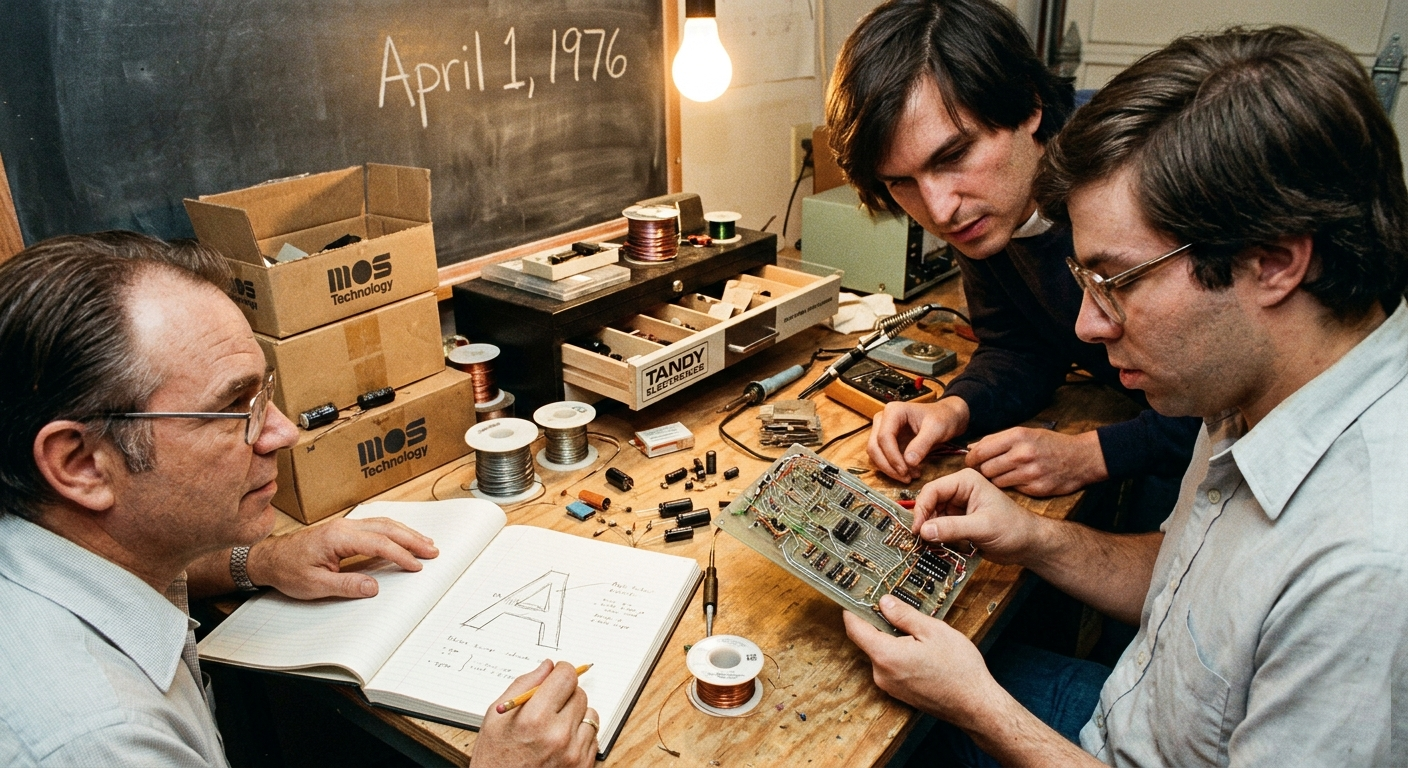
On April 1, 1976 — a date that happened to fall on April Fool’s Day — three men signed a partnership agreement in a modest home on Crist Drive in Los Altos, California, and formally brought into existence a company that would, over the next five decades, transform the way human beings interact with technology, communicate, work, create, and consume information. The company was called Apple Computer Company. The three men were Steve Jobs, a 21-year-old college dropout with a fierce commercial instinct and an almost otherworldly sense of design; Steve Wozniak, a 25-year-old engineering genius who had designed the entire computer the company was being built to sell; and Ronald Wayne, a 41-year-old experienced industry veteran brought in to provide adult supervision and resolve disputes. What began as a casual partnership to sell hand-assembled circuit boards out of a bedroom quickly became one of the most consequential founding moments in modern history.
The story of how Apple Computer was founded is not simply the story of a business. It is the story of the personal computer revolution itself — of how a small group of idealistic engineers and hobbyists in the San Francisco Bay area of California transformed the computer from a room-sized instrument of government and corporate power into a tool that ordinary people could own, use, and love. It is the story of how two young men with barely $1,300 between them, working in a garage, laid the foundation for a company that would eventually become the first in history to be valued at more than four trillion dollars.
The World Before Apple: Personal Computing in the Early 1970s
To understand why the founding of Apple Computer mattered so profoundly, one must first understand the landscape of computing in the years before 1976. In the early 1970s, computers were enormous, expensive, and entirely inaccessible to ordinary people. The mainframe computers operated by universities, government agencies, and major corporations filled entire rooms, required teams of trained operators, and cost hundreds of thousands or even millions of dollars. The idea that a private individual might own a personal computer was, to most people, as fanciful as the idea of owning a private jet.
That began to change in 1975, with the arrival of the Altair 8800, the world’s first commercially successful microcomputer, produced by a company called MITS in Albuquerque, New Mexico. The Altair was built around the Intel 8080 microprocessor and was sold as a kit that enthusiasts had to assemble themselves. It had no keyboard, no screen, and no software in any recognizable sense — users interacted with it by flipping physical switches on the front panel. Nevertheless, it sold thousands of units and ignited a frenzy of excitement among the small but growing community of computer hobbyists across the United States, particularly in the San Francisco Bay area, which was already becoming the capital of a nascent technology industry.
It was in this environment — a world on the verge of a technological revolution, buzzing with possibility but still lacking the key innovations that would make personal computing genuinely useful and accessible — that Steve Wozniak, Steve Jobs, and the Homebrew Computer Club came together to produce something transformative.
The Homebrew Computer Club: The Cradle of the Personal Computer Revolution
In March 1975, a group of electronics enthusiasts gathered in a garage in Menlo Park, California, for the first meeting of an informal organization that would become one of the most influential hobbyist clubs in the history of technology: the Homebrew Computer Club. The club met regularly, initially at Stanford University’s Linear Accelerator Center and later in other locations around the Bay Area, and its members shared a passionate, almost utopian belief that computers could and should be accessible to everyone. They swapped technical schematics, argued about hardware designs, and dreamed about what personal computing might one day become.
Both Steve Wozniak and Steve Jobs became regular attendees at Homebrew Computer Club meetings in 1975. For Wozniak, the club was transformative. Already a gifted self-taught engineer, he was deeply inspired by what he saw and heard at Homebrew meetings, and he threw himself into designing his own personal computer. For Jobs, who had less engineering expertise than Wozniak but an extraordinary eye for commercial potential, the club was equally important — it was the environment in which he first grasped the revolutionary possibility of the machine that Wozniak was building. The Homebrew Computer Club was, in a very real sense, the petri dish in which Apple was conceived.
Steve Wozniak: The Engineering Genius Behind the Apple I
Stephen Gary Wozniak was born on August 11, 1950, in San Jose, California. He was the son of Francis Jacob Wozniak, an electrical engineer for the Lockheed Missiles and Space Company in Sunnyvale — a fact that gave the young Wozniak unusually early access to engineering concepts and electronics equipment. He was a precocious but undisciplined student with a remarkable gift for mathematics and an intense passion for electronics. As a child, he built his first rudimentary computer at the age of 13. He briefly attended the University of Colorado at Boulder in 1968 and 1969 before dropping out, returning to California, attending a local community college, and then enrolling at the University of California, Berkeley, which he also left before completing his degree.
By the early 1970s, Wozniak had developed an extraordinary intuition for circuit design. In 1971, working with a younger friend named Steve Jobs, whom he had met through a mutual acquaintance named Bill Fernandez at Homestead High School, Wozniak designed a device called the “Blue Box” — a piece of electronics that could be used for phone phreaking, or hacking into telephone networks to make long-distance calls without paying for them. The two young men began selling the Blue Box to other students, and while the enterprise was both illegal and short-lived, it established the template for their partnership: Wozniak built things that were technically brilliant, and Jobs figured out how to sell them.
Wozniak eventually landed a job as an engineering intern at Hewlett-Packard, the prestigious Silicon Valley electronics company. While working at HP, he began designing his own personal computer in his spare time, motivated initially by a desire to have a machine he could use personally to access the ARPANET and play games. The key breakthrough came in 1975 when MOS Technology released its 6502 microprocessor chip for just $20 — a fraction of the price of competing chips like the Intel 8080 ($179) or the Motorola 6800 ($170). Wozniak had long preferred the Motorola 6800 design, but both had been far beyond his means. The affordable 6502 gave him his opportunity. He wrote a version of BASIC programming language for the chip and then designed an entire computer to run it. By March 1, 1976, he had completed the basic design of what would become known as the Apple I.
Wozniak’s design was a masterpiece of elegant minimalism. His guiding principle was to achieve maximum functionality with the minimum number of chips, and the result was a machine of extraordinary efficiency. The key differentiator of the Apple I was that it included video display terminal circuitry directly on its circuit board, allowing it to connect to a low-cost composite video monitor or an ordinary television set, rather than requiring an expensive computer terminal like the Teletype Model 33 commonly used with other early computers. This feature alone placed the Apple I far ahead of most contemporary designs in terms of accessibility. Wozniak offered his design to Hewlett-Packard, his employer, but the company rejected it on five separate occasions — a decision that HP would have considerable cause to regret in the years that followed.
Steve Jobs: The Visionary Who Saw a Business Where Others Saw a Hobby
Steven Paul Jobs was born on February 24, 1955, in San Francisco, California. He was the biological son of Joanne Schieble and Abdulfattah Jandali, a Syrian immigrant, but was given up for adoption at birth and raised by Paul and Clara Jobs, a working-class couple in Mountain View and later Los Altos, California. Paul Jobs was a machinist and fix-it enthusiast who taught his adopted son to work with his hands and instilled in him a respect for craftsmanship, precision, and the integrity of design — values that would define Apple’s products for decades.
Jobs attended Homestead High School in Cupertino, which had strong ties to the Silicon Valley technology community. It was there that he was introduced to Steve Wozniak by their mutual friend Bill Fernandez, beginning a friendship and professional partnership that would shape the history of technology. Jobs enrolled at Reed College in Portland, Oregon, in the fall of 1972 but dropped out after one semester, though he continued to hang around the campus for eighteen months, sitting in on classes that interested him — including a calligraphy course that he later credited with shaping Apple’s revolutionary emphasis on beautiful typography. After leaving Reed, Jobs traveled to India in 1974 seeking spiritual enlightenment and later studied Zen Buddhism, experiences that deepened his philosophical disposition and his conviction that beauty, simplicity, and meaning were not separate from but essential to great design.
Jobs began working at Atari, the pioneering video game and computer company, in 1974 — a job that brought him into contact with Ronald Wayne, Atari’s chief product engineer, who would play a crucial role in the founding of Apple. At Atari, Jobs demonstrated the combination of relentlessness, brilliance, and social difficulty that would characterize his entire career. He was demanding, opinionated, and frequently abrasive with colleagues, but his ability to see and articulate the commercial and human potential of technology was recognized by virtually everyone who worked with him. When Jobs saw Wozniak’s completed Apple I design at a Homebrew Computer Club meeting in early 1976, he immediately understood what it was: not just a clever piece of engineering, but the foundation of a business that could change the world.
Where Wozniak saw the Apple I as a personal project to be shared freely with fellow hobbyists — he had originally intended to hand out the design schematics for free — Jobs saw a product. He argued persistently that they should manufacture the computer and sell it, and that even if the venture failed, they could at least tell their grandchildren they had started their own company. Wozniak was initially skeptical but was eventually persuaded by Jobs’s characteristic intensity and conviction. The decision to commercialize the Apple I was Steve Jobs’s most consequential contribution to the founding of Apple — not the engineering, but the transformative act of insisting that engineering could and should become a business.
Ronald Wayne: The Forgotten Third Founder and His 10% Stake
Ronald Gerald Wayne is the least known of the three Apple co-founders, and his brief role in the company’s history is one of the most dramatic cautionary tales in the annals of business. Born in 1934, Wayne was 41 years old at the time of Apple’s founding — more than two decades older than Jobs and nearly fifteen years older than Wozniak. He had worked at Atari as a chief draftsman and chief product engineer, which is where he met Jobs, who became fascinated by Wayne’s entrepreneurial experience. Before joining Atari, Wayne had founded and operated several companies in the slot machine and electronics industries, though none had achieved lasting success. One venture had ended in failure and cost him significant money, an experience that had made him cautious about financial risk.
Jobs brought Wayne in as a co-founder for a very specific and practical reason: he and Wozniak frequently disagreed about business and design matters, and Jobs wanted a trusted third party who could serve as a tiebreaker. In exchange for a 10 percent stake in the company, Wayne was to provide “adult supervision” — bringing his experience and judgment to bear on the energetic but sometimes chaotic partnership of the two Steves. In the early days, Wayne’s contributions were real and practical. He drafted the original partnership agreement that formally established Apple Computer Company. He wrote the first Apple I user manual, drawing on his professional writing and drafting skills. And he designed the very first Apple corporate logo — an elaborate, engraving-style illustration of Sir Isaac Newton sitting beneath an apple tree, framed by a ribbon bearing the legend “Apple Computer Co.” and a line from William Wordsworth: “Newton… A Mind Forever Voyaging Through Strange Seas of Thought… Alone.”
However, Wayne’s early departure from Apple is one of the most consequential and bittersweet decisions in business history. Just twelve days after the company’s founding — on April 12, 1976 — Wayne sold his 10 percent stake back to Jobs and Wozniak for $800. The following year, he accepted an additional $1,500 to formally forfeit any potential future claims against the newly incorporated company, bringing his total compensation to $2,300. His reasoning was rational given the information available to him at the time: Wayne was personally liable for the company’s debts as a partner, he owned physical assets that could be seized if the company failed, and he had already lived through one painful business failure. He made a risk-reward calculation that, with the data he had in 1976, was entirely defensible. As Wayne himself has said in later years, “I would have been the richest man in the cemetery” had he stayed — but he made the best decision he could with the knowledge and circumstances he had at the time. Today, had he retained that original 10 percent stake, it would be worth well over 400 billion dollars.
April 1, 1976: The Founding of Apple Computer Company
The formal founding of Apple Computer Company took place on April 1, 1976, in the Jobs family home on Crist Drive in Los Altos, California. The partnership agreement that Ronald Wayne had drafted established the company’s ownership structure: Steve Jobs held a 45 percent stake, Steve Wozniak held a 45 percent stake, and Ronald Wayne held the remaining 10 percent. The company was registered as a California business partnership. To fund their initial venture with working capital, Jobs sold his Volkswagen Type 2 minibus for approximately $1,500 and Wozniak sold his HP-65 programmable calculator for approximately $500. Neither received the full asking price, but together they raised approximately $1,300 — the entire initial capital of the company that would one day become the most valuable in human history.
The name “Apple” came from Steve Jobs. According to the account Jobs gave his biographer Walter Isaacson, he proposed the name after returning from a stay at Robert Friedland’s All One Farm commune in Oregon, during which he had spent time in the farm’s apple orchard while on one of his fruitarian diets. Jobs told Isaacson that Apple “sounded fun, spirited and not intimidating” — qualities that were entirely intentional. Every existing computer company name at the time suggested technical complexity and corporate formality: names like Hewlett-Packard, Digital Equipment Corporation, Tandy, and MITS. Apple was deliberately different: simple, warm, human. Jobs also noted with characteristic pragmatism that the name would place the company ahead of Atari in the telephone directory. Wozniak agreed, and Apple Computer Company was born.
The operation began in Jobs’s bedroom — one of the most modest and improbable birthplaces for a global technology dynasty imaginable. When space ran out, it moved to the garage. Jobs and Wozniak assembled the first Apple I boards by hand, with help from a small circle of friends. The work was unglamorous and exhausting: soldering components, testing circuits, tracking down faulty connections, and staying up through the night to meet deadlines. But the machine they were building was genuinely extraordinary. And the first major commercial test of its potential was about to arrive.
The Byte Shop Deal: Apple’s First Major Commercial Order and the Road to Market
The first major commercial breakthrough for Apple Computer came through a presentation at the Homebrew Computer Club. After completing his prototype, Wozniak demonstrated the Apple I at a club meeting, and among the audience was Paul Terrell, who was opening a new computer retail shop in Mountain View, California, called the Byte Shop. Terrell was impressed by what he saw and told Jobs that he would place an order for 50 units of the Apple I at $500 each — but only if they arrived fully assembled, as he was not interested in bare printed circuit boards that customers would have to finish themselves. This was a significant shift from Jobs’s original plan to sell bare boards to hobbyists for around $50 each.
Jobs had initially planned to produce bare printed circuit boards and sell them to computer hobbyists. The Byte Shop order, with its requirement for fully assembled units, transformed the nature of the enterprise. Jobs immediately set about securing the components needed. He took Terrell’s purchase order to Cramer Electronics, a national electronic parts distributor, and negotiated a thirty-day net credit arrangement — promising to pay for the parts after he had delivered the completed computers to the Byte Shop and been paid. When the credit manager called Terrell to verify the purchase order, Terrell confirmed that he would pay on delivery, and Jobs secured the parts on credit. He and Wozniak, along with a small crew that included a mutual friend named Daniel Kottke, then worked day and night to assemble the boards and deliver 50 completed units to Terrell on time. Terrell was surprised to receive assembled circuit boards rather than complete systems with cases, monitors, and keyboards, but he honored his word and paid.
The Apple I went on sale in July 1976 at a retail price of $666.66. Wozniak later explained that the price was chosen purely because he liked repeating digits and because it represented a one-third markup on the $500 wholesale price — he was entirely unaware of the number’s associations with the biblical mark of the beast, a fact he has emphasized on many occasions. Approximately 200 units of the Apple I were eventually sold, generating sufficient revenue to fund the development of the machine’s much more ambitious successor. Jobs ensured that the Apple I reached the nation’s first four storefront microcomputer retailers: the Byte Shop in Palo Alto, California; itty bitty machine company in Evanston, Illinois; Data Domain in Bloomington, Indiana; and Computer Mart in New York City. The personal computer was, for the first time, on retail shelves.
Why the Name, the Logo, and the Early Brand Identity Mattered
The deliberate choices Jobs made about the name, brand, and visual identity of Apple Computer Company were not incidental to its success — they were central to it. In an industry where virtually every other company communicated through the language of technical specifications and corporate formality, Apple communicated through the language of humanity, simplicity, and accessibility. The name “Apple” was approachable in a way that no other computer company name was. It was a word that every human being in the world recognized, a word associated not with machinery but with nature, with nourishment, with the story of Newton and the falling apple that gave rise to the theory of gravity.
Ron Wayne’s original Apple logo — the intricate illustration of Newton under the apple tree — was admired but impractical for commercial use. It was too complex to reproduce clearly at small sizes and too heavy with detail for a company that aspired to project simplicity and friendliness. In 1977, Jobs commissioned graphic designer Rob Janoff to create a new logo. Janoff produced the now-iconic rainbow-colored silhouette of an apple with a bite taken out of it — one of the most recognizable corporate symbols in history. The bite in the apple, Janoff has explained, was included for a very practical reason: to ensure that the shape was clearly identifiable as an apple rather than a cherry or some other round fruit. The rainbow colors, used at a time when color computing was one of the Apple II’s most exciting features, projected warmth, creativity, and accessibility. This logo remained in use, with its spectrum of colors, until 1998, when Apple replaced it with a monochromatic version.
From Partnership to Corporation: Mike Markkula, Incorporation, and the Birth of Apple Computer, Inc.
Despite the success of the Apple I, Steve Jobs understood that a company operating out of a garage on a shoestring budget could not compete in the market he envisioned. As early as August 1976, he was pursuing investors. His first approach was to Nolan Bushnell, his former boss at Atari, who admired Jobs but declined to invest. Bushnell instead introduced Jobs to Don Valentine, the founder of Sequoia Capital, one of the most prestigious venture capital firms in Silicon Valley. Valentine also passed, but he in turn introduced Jobs to Armas Clifford Markkula Jr. — known universally as Mike Markkula — a 33-year-old millionaire who had made his fortune as a marketing manager at Fairchild Semiconductor and Intel, retiring early after his Intel stock options made him wealthy.
The meeting between Jobs and Markkula in late 1976 was one of the most consequential encounters in Silicon Valley history. Markkula, who had both the technical background to understand what Wozniak had built and the business experience to see its commercial potential, became convinced almost immediately that Jobs and Wozniak had something extraordinary. He agreed to help them write a business plan, setting a target of $500 million in sales within a decade — an ambition that astonished many who heard it at the time. Markkula invested $92,000 of his own money in Apple and helped secure a $250,000 line of credit from Bank of America, with a total investment package of $250,000 (roughly equivalent to $1.4 million in today’s terms). In return, he received a one-third stake in the company and became Apple’s employee number three.
Markkula’s contribution to Apple’s early success cannot be overstated. Wozniak himself has said that Markkula deserves as much credit for Apple’s success as either he or Jobs. Markkula brought the discipline, experience, and professional infrastructure that transformed a promising garage operation into a real corporation. In February 1977, he recruited Michael Scott from National Semiconductor to serve as Apple’s first president and CEO — the two Steves being, as Markkula judged, too young and too inexperienced to run a growing company on their own. Scott’s annual salary was $26,000. That same month, Wozniak resigned from his job at Hewlett-Packard to work full time at Apple.
On January 3, 1977, Apple Computer, Inc. was officially incorporated in Cupertino, California — without Ronald Wayne, who had already sold his stake. The new corporation formally bought out the original partnership for $5,308.96. Apple Computer Company, the informal business partnership founded on April 1, 1976, had given way to Apple Computer, Inc., a fully formed corporate entity with professional management, institutional funding, and a roadmap for growth. The company had been in existence for barely nine months, and it was already unrecognizable from the bedroom operation where Wozniak had first soldered together the circuit boards of the Apple I.
The Apple I: What Made It Revolutionary and Why Only 200 Were Made
The Apple I was not the first personal computer in any strict technical sense — the Altair 8800 had that distinction — but it was the first to make the case that a personal computer could be genuinely usable by someone who was not a highly trained engineer. The key innovation was the inclusion of video display terminal circuitry directly on the board, meaning that the Apple I could connect to a standard television set or a low-cost composite video monitor. This eliminated the need for a separate and expensive terminal, which had been one of the most significant barriers to entry for individual computer buyers. Combined with the ability to connect to a keyboard, the Apple I offered for the first time a computing experience that resembled — however distantly — the kind of interactive, responsive experience that people would eventually come to take for granted.
The Apple I was sold as a motherboard with a CPU, RAM, and basic video chips. It did not include a keyboard, a monitor, a power supply, or a case — users had to source or build those themselves. The first unit produced was donated to a high school mathematics class and used for instructional purposes; the second was donated to Liza Loop’s public-access computer center. Of the approximately 200 units eventually produced, most were sold through the handful of retail outlets Jobs had cultivated. Today, surviving Apple I units are among the most valuable objects in the history of computing. In 2012, a working Apple I sold at auction for $374,500. Other examples have subsequently sold for even higher prices, reflecting both the rarity and the historical significance of the machine.
Almost from the moment the Apple I reached customers, Wozniak was already working on its replacement. He completed a working prototype of the Apple II as early as August 1976, while the Apple I was still being sold. The two machines were in development simultaneously, a fact that speaks volumes about Wozniak’s extraordinary productivity and about the pace at which the company was moving. The Apple I was discontinued in October 1977, shortly after the Apple II began shipping, and Apple offered Apple I owners discount trade-ins to persuade them to return their boards — which were then destroyed by the company, further contributing to the rarity and value of surviving units.
The Apple II: The Breakthrough Product That Built the Personal Computer Industry
If the Apple I was the founding statement, the Apple II was the revolution. Introduced on April 16 and 17, 1977, at the first West Coast Computer Faire in San Francisco — one of the seminal events in the history of the personal computer industry — the Apple II was a product of an entirely different order of ambition and achievement. Where the Apple I had been a kit for hobbyists, the Apple II was a finished consumer product, with a custom-molded plastic case designed under Jobs’s direction, a built-in keyboard, and support for color graphics. It was designed, in Wozniak’s own words, to be “small, reliable, convenient to use, and inexpensive.”
The Apple II differed critically from its major rivals — the TRS-80 from Tandy/Radio Shack and the Commodore PET — in two key respects: it featured character cell-based color graphics, making it the first personal computer to display color on screen, and it had an open architecture with eight expansion slots, allowing users and third-party developers to customize and extend the machine’s capabilities. These design decisions, particularly the open architecture, would prove enormously consequential. They made the Apple II the preferred platform for a vast ecosystem of hardware add-ons and software applications that fueled its commercial dominance throughout the late 1970s and early 1980s.
The most important of those applications was VisiCalc, the world’s first electronic spreadsheet program, developed by Dan Bricklin and Bob Frankston and released for the Apple II in October 1979. VisiCalc became the first “killer app” of the business computing era — a program so useful and so compelling that businesses bought Apple II computers specifically to run it. This transformed the Apple II from a hobbyist machine into a legitimate business tool and drove Apple’s revenues into the stratosphere. From $773,000 in 1977, Apple’s annual sales grew to $7.86 million in 1978, $47.87 million in 1979, and $117 million in 1980. Some five to six million Apple II units were sold over the following decade, making it one of the most commercially successful personal computers in history.
Apple Goes Public: The 1980 IPO That Created 300 Millionaires in a Single Day
By 1980, Apple Computer Inc. had more than 1,000 employees and was one of the fastest-growing companies in the United States. The company was ready to go public. On December 12, 1980, Apple launched its Initial Public Offering on the NASDAQ stock market under the ticker symbol AAPL, selling 4.6 million shares at $22 per share. The IPO generated over $100 million — more capital than any public offering since Ford Motor Company went public in 1956. By the end of the first day of trading, the share price had risen to $29, giving Apple a market capitalization of $1.778 billion.
The human consequences of the IPO were staggering. Approximately 300 people became millionaires in a single day. Steve Jobs, whose stake in the company had been diluted through successive funding rounds but remained substantial, became worth approximately $256 million on paper. Steve Wozniak, who had generously sold shares to early Apple employees at below-market prices before the IPO — something Jobs refused to do — was also made enormously wealthy. Mike Markkula, whose $250,000 investment in 1977 had bought him a one-third stake, saw his shares worth approximately $203 million on the first day of trading, representing a gain of over 220,000 percent on his original investment in just four years.
The Apple IPO marked the completion of the first chapter of the company’s history and the beginning of a new one. From a partnership agreement signed on April 1, 1976, in a California home with total capital of $1,300, Apple had grown in less than five years into a billion-dollar public company that had fundamentally changed the nature of the technology industry. It was a pace of growth without precedent in American business history.
The Macintosh, the Departure of Jobs, and the Turbulent 1980s
The years following the IPO brought Apple to the greatest creative achievement of its first era, followed by one of the most dramatic corporate crises in Silicon Valley history. In November and December 1979, Steve Jobs led a delegation of Apple engineers to visit the Xerox Corporation’s Palo Alto Research Center (PARC), in exchange for granting Xerox the right to purchase pre-IPO shares in Apple. At PARC, Jobs saw three innovations that changed his understanding of what computers could be: a functional graphical user interface with on-screen windows, icons, and menus; a computer mouse for navigating that interface; and a high-quality display capable of rendering text that looked like it had been professionally typeset. Jobs immediately recognized that these innovations represented the future of computing and set Apple’s engineers to work incorporating them into Apple’s products.
The Apple Lisa, introduced in January 1983, was the first commercial computer to feature a graphical user interface and a mouse. It was a landmark achievement, but its price tag of $9,995 put it out of reach for most consumers, and it was a commercial failure. The lessons learned from Lisa were incorporated into the Macintosh, which Jobs championed as the “people’s computer” — designed for ordinary people with little technical knowledge, at a price that made it accessible to a much wider market. The Macintosh was unveiled on January 24, 1984, in one of the most celebrated product launches in history, accompanied by a landmark television commercial directed by Ridley Scott — broadcast during the Super Bowl — that depicted the Macintosh as a tool of individual liberation against the conformist tyranny of IBM.
However, the internal politics of Apple in the mid-1980s were deeply turbulent. Jobs had recruited John Sculley, then president of Pepsi-Cola, as Apple’s CEO in 1983, famously persuading him with the challenge: “Do you want to sell sugar water for the rest of your life, or do you want to come with me and change the world?” The relationship between Jobs and Sculley deteriorated, however, and in 1985 a power struggle between them came to a head. The Apple board sided with Sculley, stripping Jobs of his operational duties. Rather than submit, Jobs resigned from Apple in September 1985 and took several key Apple employees with him to found a new company, NeXT. Steve Wozniak had already left earlier in 1985 to pursue other interests, having grown disenchanted with the day-to-day management of the company. The two founders of Apple Computer were both gone from the company within a decade of its founding.
Ron Wayne’s $800 Decision: The Most Expensive Exit in Business History
Among the many remarkable aspects of Apple’s founding story, few have captured the public imagination as powerfully as Ron Wayne’s decision to sell his 10 percent stake for $800. By any measure, it was the most financially consequential early exit in the history of business. As Apple’s valuation has grown, the mathematical consequences of Wayne’s decision have become almost incomprehensible. At Apple’s peak valuation of over four trillion dollars, a 10 percent stake would be worth approximately four hundred billion dollars — more than the GDP of many countries.
Wayne, who has given numerous interviews over the years discussing his decision, has consistently maintained that he does not regret what he did, and there is genuine logic to that position. At the time he sold his shares, Apple was a brand-new partnership with no revenues, no proven products, and no certainty of survival. Wayne was personally liable for the company’s debts, and he had already experienced a painful business failure. The risk-reward calculation he made in April 1976 was rational given the information available to him. He has also noted that the relentless pace and energy of Jobs and Wozniak would likely have been incompatible with his own temperament and work style over the long term. Wayne went on to work in the electronics and gaming industries, later selling rare coins and stamps in Pahrump, Nevada. He has been philosophical about his choice, saying he made the best decision he could at the time.
The Return of Steve Jobs: Apple’s Second Founding and the Era of the iMac, iPod, and iPhone
After Jobs’s departure in 1985, Apple entered a difficult decade. Under John Sculley and later Michael Spindler and Gil Amelio, the company struggled to maintain its market share against the growing dominance of IBM-compatible personal computers running Microsoft’s Windows operating system. By 1996, Apple was widely regarded as a company in terminal decline, hemorrhaging market share and barely avoiding bankruptcy. The company’s market share in personal computers had collapsed from its peak of roughly 16 percent to around 4 percent. The company was burning through cash at an alarming rate.
The rescue came from an unexpected direction. In December 1996, Apple announced that it was acquiring Jobs’s company NeXT for $429 million, and Jobs returned to Apple as an advisor. In September 1997, he was named interim CEO — a title he styled “iCEO” — and began the most dramatic corporate turnaround in American business history. Jobs immediately cut over 70 percent of Apple’s products, concentrating the company’s resources on a small number of core projects. He forged an alliance with Microsoft, ending a long-running legal dispute and bringing Microsoft Office to the Mac. He brought in Jony Ive as the lead designer and commissioned the development of a new generation of products that would define Apple’s identity for the next quarter century.
The iMac, introduced in August 1998, was the first product of Jobs’s second era at Apple and immediately signaled that something unprecedented was happening. With its translucent, candy-colored plastic case and its radical “all-in-one” design, the iMac looked unlike anything that had ever been sold as a personal computer. It was designed to project delight, accessibility, and personality. It was, in Apple’s own description, designed for “the rest of us.” The iMac became the best-selling Mac in the company’s history and lifted Apple’s U.S. market share from 2.6 percent to 13.5 percent within a year.
The years that followed produced a succession of products that transformed not just Apple but entire industries. The iPod, introduced in October 2001, revolutionized the portable music player market and created the iTunes ecosystem that would redefine music distribution. The iTunes Music Store, launched in April 2003, established the model of legal digital music purchases at 99 cents per song, fundamentally altering the relationship between technology companies and the music industry. The iPhone, unveiled by Jobs on January 9, 2007 — an announcement he described as “the most extraordinary product Apple had ever made” — created an entirely new category of personal device and transformed the global mobile phone industry. The same year, Apple dropped “Computer” from its official name, becoming Apple Inc. — a recognition that the company Jobs, Wozniak, and Wayne had founded to sell computers had grown into something far broader and more consequential than anyone had imagined when they signed that partnership agreement on April 1, 1976.
The Legacy of Apple’s Founding: What April 1, 1976 Meant for the World
The founding of Apple Computer on April 1, 1976, was not merely a business event. It was one of the pivotal moments of the late twentieth century — a moment when the technological, economic, and cultural currents of an era converged in a California garage to produce something that would change human civilization. The partnership agreement signed by Jobs, Wozniak, and Wayne that day set in motion a chain of events that ultimately placed powerful computing devices in the pockets and hands of billions of people around the world, transformed the way people communicate, create, consume information, and conduct business, and established the template for the kind of technology company — design-obsessed, user-focused, integrated from hardware to software to services — that would dominate the industry for the next half century.
The Library of Congress has recognized Apple Computer Inc.’s founding as one of the most important events in American business history, and the Smithsonian Institution’s National Museum of American History holds Apple I computers in its collections as objects of historical significance. The Computer History Museum in Mountain View, California — just a few miles from the garage where the first Apple computers were assembled — preserves extensive documentation of the company’s early history, including original Apple I circuit boards and founding documents.
Beyond the products and the profits, Apple’s founding established a set of principles and convictions about what technology could and should be that have shaped every major technology company founded since. The conviction that computers should be beautiful as well as functional; that the experience of using a product matters as much as its specifications; that simplicity is a form of sophistication; and that the most powerful technology is technology that empowers ordinary people — these are ideas that Steve Jobs articulated and Steve Wozniak embodied in silicon and solder, and they have become the foundational assumptions of the consumer technology industry.
Conclusion: A Garage, a Dream, and the Company That Changed Everything
On April 1, 1976, three men with a combined starting capital of $1,300, a hand-built circuit board, and a shared conviction that personal computers could change the world signed their names to a partnership agreement and founded Apple Computer Company. Steve Jobs, the 21-year-old visionary with an unshakeable belief in the commercial and human potential of technology; Steve Wozniak, the 25-year-old engineering genius who had designed the most elegant personal computer yet conceived; and Ronald Wayne, the 41-year-old industry veteran who drafted the documents, designed the first logo, and wrote the first manual before making the most consequential business exit in history — these three men, in a bedroom that soon overflowed into a garage, gave birth to a company that would rewrite the rules of virtually every industry it touched.
The story of Apple’s founding is ultimately a story about what becomes possible when extraordinary technical talent combines with extraordinary commercial vision, when the desire to build something beautiful meets the determination to build something that everyone can use. Steve Wozniak built the Apple I because he wanted a personal computer and it didn’t exist. Steve Jobs saw the Apple I and understood that it could be the first product of a company that would put computers in the hands of ordinary people everywhere. Those two complementary impulses — the impulse to create and the impulse to share creation with the world — are the twin engines that drove Apple from a California garage to a four-trillion-dollar company, and they were both present, in nascent form, on the day Apple Computer was born. April 1, 1976 was not a joke. It was the beginning of the future.