On April 2, 1792, the United States Congress passed one of the most consequential pieces of economic legislation in American history. Known as the Coinage Act of 1792 — officially titled “An Act Establishing a Mint, and Regulating the Coins of the United States” — the law did far more than simply authorize a building where coins would be made. It created the United States dollar as the nation’s standard unit of money, established the United States Mint as a permanent federal institution, introduced a revolutionary decimal currency system, set gold and silver as the twin pillars of American monetary value, and codified a bold statement of national sovereignty: the young republic would no longer depend on foreign coins, Spanish silver dollars, or the chaotic patchwork of state-issued currencies that had plagued commerce since independence. It was, in a single stroke of legislation, the financial declaration of independence that completed what the political declaration of 1776 had begun.
The passage of the Coinage Act on April 2, 1792, was not a sudden decision but the culmination of more than a decade of fractious debate, failed proposals, monetary chaos, and competing visions for what kind of financial system the new American republic should have. It brought together the towering intellectual contributions of Alexander Hamilton, Thomas Jefferson, and Robert Morris, the scientific genius of the Mint’s first director David Rittenhouse, the executive authority of President George Washington, and the legislative will of the Second Congress. The building that David Rittenhouse would go on to construct at 7th and Arch Streets in Philadelphia — the first federal building erected under the United States Constitution — became not merely a coin factory but a physical symbol of the nation’s economic maturity and independence.
Colonial America’s Currency Crisis: Why the United States Desperately Needed a National Mint
To understand the full significance of the Coinage Act of 1792, it is essential to understand the monetary chaos that preceded it. During the colonial period, the American colonies had no consistent currency of their own. The British Crown had never permitted the colonies to establish a proper mint or issue their own gold and silver coins as a matter of general policy, viewing that privilege as a sovereign prerogative of the mother country. The notable exception was the Massachusetts Bay Colony, which had daringly established its own mint in Boston in 1652 during a period when England was temporarily without a king following the execution of Charles I. The Massachusetts mint struck silver coins for approximately thirty years, but it employed the clever legal fiction of dating all coins 1652 — regardless of when they were actually made — to convince the British that all those coins predated the establishment of royal authority. Once the monarchy was restored, the Boston Mint’s days were numbered, and it closed in the early 1680s.
Without a functioning domestic mint, colonial Americans conducted commerce using a bewildering and thoroughly inconvenient mixture of currencies. Foreign coins circulated widely, the most common and trusted being the Spanish milled dollar — also known as the “piece of eight” or “real de a ocho” — which was so prevalent that it effectively functioned as the de facto currency of colonial America. British pounds, Dutch guilders, Portuguese coins, and the currencies of numerous other trading nations also circulated alongside these Spanish coins. To make change, it was a common practice to literally cut the Spanish dollar into eight pieces, or “bits” — giving rise to the expression “two bits” for a quarter dollar that persisted in American slang for more than two centuries. Colonial governments sometimes issued their own paper money — called “bills of credit” — but these notes were backed by nothing more substantial than the promises of financially fragile colonial governments and inevitably lost value through inflation.
Livestock and agricultural produce — tobacco, corn, grain, and similar commodities — were routinely used in place of money in rural areas where hard currency was scarce. The economic inefficiency of this situation was enormous. Price-setting was nearly impossible when the same goods might be valued in British shillings in one colony, Spanish reals in another, and Connecticut paper notes in a third, with exchange rates between these various currencies fluctuating unpredictably. The disorder was, as President Washington would later tell Congress, “peculiarly distressing to the poorer classes” who lacked access to larger denominations and were forced to rely on barter for the necessities of daily life.
The Articles of Confederation and the Post-Revolutionary Monetary Disorder, 1776–1788
The American Revolution brought the currency problem into even sharper relief. The Continental Congress, which had no power to levy taxes directly, funded the Revolutionary War largely by issuing paper money — the Continental dollar — in enormous quantities. With no gold or silver backing and no reliable mechanism for redemption, Continental currency depreciated catastrophically. By the end of the war, it had become so nearly worthless that the phrase “not worth a Continental” entered the American language as a permanent expression of worthlessness. The experience of the Continental currency left a deep and lasting impression on the Founding Fathers, particularly Alexander Hamilton, who became the most forceful advocate for a sound, metal-backed national currency as a matter of both economic necessity and national dignity.
The Articles of Confederation, which governed the United States from 1781 until the Constitution took effect in 1789, created a federal government so weak that it could not address the monetary problem effectively. The Articles authorized the states to mint their own coins, leading to a further proliferation of different currencies with different values in different states. The same coin could be worth different amounts depending on which state you were in, creating a nightmare for interstate commerce. In February 1777, a congressional committee had suggested the creation of a national mint, but nothing came of it. In 1782, Superintendent of Finance Robert Morris addressed Congress with a formal proposal to establish a US Mint, suggesting that production costs be paid by those who used the coins. The Continental Congress authorized the establishment of a mint in 1786, but specified — in a decision that reflected its fiscal weakness — that coins should be produced by private contract rather than at public expense. This arrangement failed almost immediately when the contractor, James Jarvis, produced a small quantity of underweight copper cents before abandoning the project and absconding with the government’s copper.
The experience with contracted coinage soured Congress on the private approach and demonstrated with painful clarity that the nation needed a properly funded, government-operated mint under direct federal control. When the Constitution was drafted and ratified between 1787 and 1788, its framers made certain that this lesson was incorporated into the fundamental law of the land. Article I, Section 8, Clause 5 of the Constitution explicitly granted Congress the power “to coin Money, regulate the Value thereof, and of foreign Coin, and fix the Standard of Weights and Measures.” Article I, Section 10 expressly prohibited the individual states from coining money or making anything other than gold and silver coin legal tender for the payment of debts. With these constitutional provisions, the framework for a national monetary system was in place. What remained was the political and intellectual work of determining exactly what that system would look like.
Thomas Jefferson’s Decimal Vision: The Intellectual Origins of American Coinage
The intellectual foundations of the American monetary system that emerged from the Coinage Act of 1792 owed a great debt to Thomas Jefferson, whose thinking about currency predated Hamilton’s famous report by nearly a decade. In 1784, while serving as a member of the Continental Congress, Jefferson had proposed a decimal-based system of currency — one in which every denomination would be a simple multiple or fraction of ten—as the proper basis for American money. This was a radical departure from the cumbersome and irrational British system, which used pounds, shillings, and pence in non-decimal ratios that required considerable mental arithmetic to use and that Jefferson regarded as needlessly complicated. The British system divided a pound into 20 shillings, each shilling into 12 pence, and featured a bewildering variety of denominations — guineas, crowns, half crowns, florins, sixpences, groats, and farthings — whose relationships to one another were anything but intuitive.
Jefferson argued that a decimal system, in which the dollar would be divided into tenths (dimes), hundredths (cents), and thousandths (milles), would be dramatically simpler for ordinary Americans to use and would facilitate commerce by making calculations straightforward. He wrote that the American currency should be “so simple that it would be comprehended by the first elements of arithmetic.” His 1784 proposal was not immediately acted upon, but it established the conceptual template that Hamilton would adopt and refine, and that the Coinage Act of 1792 would enshrine in law. The American decimal currency system that Jefferson first proposed was so far ahead of its time that most of the world would not adopt decim—one for their own currencies until the twentieth century — France moved to decimalization in 1795, and the United Kingdom did not complete decimalization of its currency until 1971.
Jefferson continued to influence the design of the American monetary system in his role as Secretary of State under Washington. In July 1790, responding to a request from the House of Representatives, he wrote a report on weights and measures that included his recommendations for the specifications of silver dollars. In April 1791, after reading a draft of Hamilton’s Report on the Establishment of a Mint, Jefferson responded with what was described as high praise, writing that he had read the report “with a great deal of satisfaction” and that he concurred with Hamilton’s proposal that the monetary unit should stand on both metals — gold and silver — and that the alloy composition should be the same in both. This moment of intellectual alignment between the two men who were already becoming the defining rivals of early American political life was a crucial contribution to the eventual legislation.
Alexander Hamilton’s Report on the Establishment of a Mint: The Blueprint for American Money
The single most important document in the legislative history of the Coinage Act of 1792 was Alexander Hamilton’s “Report on the Establishment of a Mint,” submitted to the House of Representatives on January 28, 1791. Hamilton had been appointed the nation’s first Secretary of the Treasury by President Washington in September 1789, and he immediately set about the enormous task of putting the young republic’s finances on a sound and permanent footing. His Report on the Mint came just one week after the Senate approved his bill to create the Bank of the United States — part of a comprehensive financial program that also included his Report on Public Credit and his Report on Manufactures, together constituting the most ambitious and systematic plan for national economic development ever produced by an American statesman.
The Report on the Mint was, by any measure, an extraordinary document. Hamilton had prepared it with characteristic thoroughness, consulting economic texts including Adam Smith’s The Wealth of Nations, Malachy Postlethwayt’s Universal Dictionary of Trade and Commerce, and Sir James Steuart’s Principles of Political Economy. He researched bank practices and assay reports, including those prepared by the goldsmith for the Bank of New York — an institution Hamilton himself had helped found in 1784 — and consulted records from the Bank of North America and foreign banks. He built upon earlier American proposals, borrowing from Jefferson’s 1784 decimal currency plan and from the earlier proposals of Robert Morris and Gouverneur Morris submitted to the Continental Congress in 1782.
Hamilton’s central proposal was to place the United States on a bimetallic monetary standard — one in which both gold and silver would serve as legal tender and as the basis for the national currency. He proposed the dollar as the primary unit of account, modeled on the widely circulated Spanish milled dollar with which Americans were already familiar, and suggested it should contain 371.25 grains of pure silver. He proposed that gold coins, called eagles, should be worth ten dollars and contain 247.5 grains of pure gold, establishing a silver-to-gold ratio of 15 to 1. He argued forcefully for a decimal currency system, endorsing Jefferson’s framework of dollars, dimes (which the Act called “dismes”), cents, and milles. And he warned Congress — in language that resonated with the painful memory of the Continental currency — that the integrity of the monetary system depended above all on maintaining the actual metal content of coins at the levels prescribed by law, because any debasement of the currency would destroy the public confidence on which the entire financial system rested.
Hamilton also addressed the question of who should bear the cost of coinage. He recommended that the government absorb the cost and provide what was called “free coinage” — meaning that any person could bring gold or silver bullion to the Mint and have it coined into dollars at no charge, or receive an immediate exchange of bullion for coins. This provision was intended to encourage the circulation of coined American money and to make it easy for ordinary citizens and merchants to convert their precious metal into standardized national currency. Congress debated this and related provisions throughout 1791 and into 1792, with Robert Morris chairing the Senate committee responsible for the mint legislation and helping produce sample coins bearing the bust of Washington. The House of Representatives ultimately rejected the idea of placing a portrait of any living or recent president on American coins, arguing that this practice was too reminiscent of the European tradition of depicting monarchs — it was, in the language of the debate, too “monarchical” for a republic. Instead, the Act specified that coins should bear an image “emblematic of liberty.”
April 2, 1792: The Coinage Act Passes and the US Mint Is Born
On April 2, 1792, the Second Congress of the United States passed the Coinage Act, and President George Washington signed it into law. The Act — formally titled An Act Establishing a Mint, and Regulating the Coins of the United States — was a sweeping piece of legislation that ran to twenty-one numbered sections and established virtually every foundational element of the American monetary system in a single document. Its passage marked the culmination of fifteen years of debate, failed proposals, and monetary disorder, and the beginning of a new era in American economic history.
Section 1 of the Act established the Mint and specified its location: it was to be “situated and carried on at the seat of the Government of the United States” — Philadelphia, which was then the national capital while Washington, D.C. was being constructed. Section 1 also identified the five principal officers responsible for operating the Mint: a Director, an Assayer, a Chief Coiner, an Engraver, and a Treasurer. Each of these positions had carefully specified duties. The Director would oversee the entire operation. The Assayer would receive and assay all metals brought to the Mint for coining. The Chief Coiner would cause all metals to be coined according to law. The Engraver would design and prepare the dies for coinage. The Treasurer would receive all coins struck and disburse them to the appropriate persons. The Director was authorized to employ as many clerks, workers, and servants as necessary, subject to the approval of the President — a provision that, as historians have noted, made the US Mint Police one of the oldest federal law enforcement agencies in American history, tracing its origins to 1792.
Section 9 of the Act, perhaps its most practically significant provision, specified the denominations, values, and metallic compositions of all American coins. In gold, the Act authorized three denominations: the Eagle (worth $10, containing 247.5 grains of pure gold), the Half Eagle (worth $5, containing 123.75 grains of pure gold), and the Quarter Eagle (worth $2.50, containing 61.875 grains of pure gold). In silver, it authorized five denominations: the Dollar (containing 371.25 grains of pure silver, equivalent in value to the Spanish milled dollar), the Half Dollar, the Quarter Dollar, the Disme (worth ten cents, the ancestor of today’s dime), and the Half Disme (worth five cents, the ancestor of today’s nickel). In copper, it authorized two denominations: the Cent (one hundredth of a dollar) and the Half Cent. The total system comprised ten coin denominations spanning from the half cent to the ten-dollar eagle — a comprehensive monetary toolkit for a nation of diverse economic needs.
Section 10 specified the design requirements for all coins. On one side of every coin, there was to be “an impression emblematic of liberty, with an inscription of the word Liberty, and the year of the coinage.” On the reverse of each gold and silver coin, there was to be “the figure or representation of an eagle, with this inscription, ‘UNITED STATES OF AMERICA.'” The reverse of copper coins was to express the denomination. These design requirements reflected deliberate republican symbolism: the image of Liberty — drawn as an allegorical female figure rather than any actual person — would represent the founding values of the nation, while the eagle would proclaim its identity. Because no portrait of any real person would appear on American coins until the Lincoln cent of 1909, every American coin for more than a century carried the abstract ideals of the republic rather than the image of any individual ruler or leader. The design philosophy embodied in the Coinage Act of 1792 was, in this sense, a statement of republican political theory as much as a commercial specification.
Section 19 and the Death Penalty: The Iron Guarantee of Monetary Integrity
Among the most striking provisions of the Coinage Act of 1792 was Section 19, which established what remains one of the most severe penalties ever written into American financial law. The section provided that if any officer or employee of the mint debased any gold or silver coins—reducing their precious metal content below the standards required by law—or embezzled any of the metals committed to their charge for coining, that person “shall be deemed guilty of felony and shall suffer death.” The capital penalty for monetary fraud was not a momentary aberration or careless legislative drafting; it was a deliberate and considered choice that reflected the Founders’ understanding of how fragile monetary credibility was and how catastrophically its loss could damage the young republic.
The memory of the Continental currency—which had been issued in such quantities and with so little discipline that it had become nearly worthless, wiping out the savings of countless ordinary Americans and making the phrase “not worth a Continental” a permanent part of the language — was still fresh in 1792. Hamilton had warned explicitly in his reports that any debasement of the currency would undermine the public confidence on which the entire monetary system depended. If Americans could not trust that a dollar coin contained the precise amount of silver the law specified, they would refuse to use American currency, merchants and traders would demand hard coin of verified weight, and the new nation’s monetary system would collapse just as the Continental had. The death penalty for debasement was, from this perspective, less a punitive measure than a structural guarantee — a way of making it clear to every person who would ever handle American money that the government’s commitment to monetary integrity was absolute and non-negotiable.
While Section 19 has been superseded in most of its applications — the penalty for mint employees who debase coinage has since been reduced to fines and up to ten years in prison — some legal scholars have argued that a technical residual application of the death penalty provision may remain in effect with respect to gold and silver coins currently struck by the Mint, such as the American Silver Eagle and American Gold Eagle. Whether or not this technical residual application is legally operative, the provision stands as a remarkable monument to the seriousness with which the founding generation regarded the integrity of the national currency.
David Rittenhouse: The Scientist Who Led the First US Mint
President George Washington’s selection of David Rittenhouse as the first Director of the United States Mint was a choice that said a great deal about the values the administration brought to the institution. Rittenhouse was not primarily a financier or a businessman but a scientist — one of the most celebrated natural philosophers in America, a man who had built the nation’s first astronomical observatory, served as treasurer of Pennsylvania from 1777 to 1789, participated in the American Revolution by supervising the casting of cannon and the improvement of rifles for the Committee of Safety, and been elected a member of the American Academy of Arts and Sciences as well as a fellow of the Royal Society of London. He was, in short, a figure of enormous intellectual prestige and impeccable patriotic credentials.
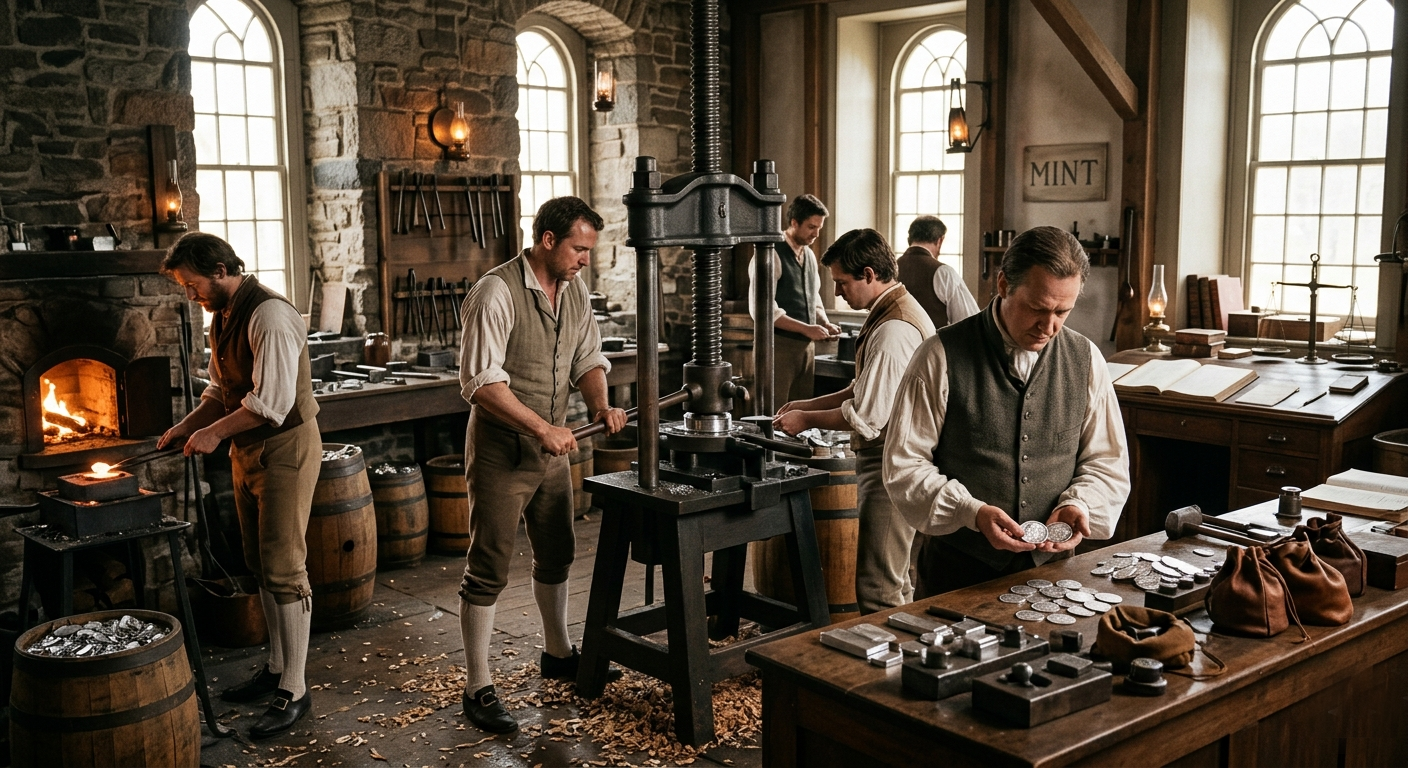
Washington’s nomination of Rittenhouse closely followed Hamilton’s recommendation. After the Act passed on April 2, 1792, Washington nominated Rittenhouse less than two weeks later, and both Hamilton and Jefferson personally urged Rittenhouse to accept the directorship — a measure of how much both men valued his participation. Rittenhouse wasted no time. On July 18, 1792, he paid $4,266.67 to purchase two lots at 7th and Arch Streets in Philadelphia, which would become the site of the Mint building. The very next day he began demolition of an abandoned whiskey distillery that occupied part of the property. Within three months, the first building was ready for the installation of a smelting furnace. The three-story brick structure that Rittenhouse erected — housing gold and silver holdings in basement vaults, weighing rooms and a press room on the first floor — was the first public building constructed by the federal government under the Constitution. At the time of its completion, it was the tallest building in Philadelphia.
David Rittenhouse laid the cornerstone of the Mint building on July 31, 1792, a date that the US Mint itself has described as marking the birth of the Philadelphia Mint. He served as Director from 1792 until 1795, when failing health forced his resignation. During his tenure, the Mint faced formidable challenges: the scarcity of bullion, the difficulty of obtaining skilled workers and proper machinery, the repeated disruptions caused by Philadelphia’s devastating yellow fever epidemics, and the constant pressures of producing sufficient quantities of coinage to satisfy a currency-hungry nation. Despite these obstacles, Rittenhouse oversaw the institution through its critical first years and established it on a foundation that would endure for generations. He died in June 1796, just a year after his resignation, and was mourned across the nation as one of the republic’s most distinguished servants.
The First Coins: From the Half Disme of 1792 to the First Circulating Cents of 1793
The first coins to be struck at the new Philadelphia Mint carry with them a story that has become one of the most charming traditions in American monetary history. According to accounts that have been widely accepted since the nineteenth century, the first coins minted were silver half dismes — the five-cent pieces authorized by the Coinage Act — and the silver used to produce them came from the household silverware of President and Mrs. George Washington. The story holds that, owing to a scarcity of bullion at the Mint in its opening weeks, Washington donated sterling silver teaspoons from the presidential household, which were melted down to produce the first American coins. Washington himself made reference in his annual address to Congress on November 6, 1792, to having witnessed the production of half dismes, and there is a tradition that he distributed some of these early coins as keepsakes to friends and visitors. One report even holds that Washington later contributed “an excellent copper tea-kettle as well as two pair of tongs” to begin the manufacture of cents and half cents.
The two coin presses needed for production had arrived from England on September 21, 1792, reportedly from the Boulton and Watt Mint at Soho near Birmingham, and were put into operation in early October of that year. By the end of 1792, the Mint had produced limited quantities of the half disme and also struck what were called “pattern coins” — experimental samples of proposed coin designs — including a number of impressive silver dollars and half dollars that were distributed to government officials and interested parties but were not placed into general circulation. The chief engraver responsible for preparing the dies for these early coins was Robert Scot, whose “Flowing Hair” design for the silver dollar and half dollar — featuring a stylized female figure representing Liberty, with flowing hair, on the obverse — became the first standard design in American coinage history.
The first coins actually placed into general circulation were copper cents, delivered in March 1793. The records show that in March 1793, the Mint delivered its first circulating coins: 11,178 copper cents. These were the “Chain Cent” design, featuring on the obverse a figure of Liberty and on the reverse a chain of fifteen links representing the fifteen states then in the union — a design that was quickly criticized by some observers as appearing to depict Liberty in chains. The design was almost immediately replaced by the “Wreath Cent,” and then the “Liberty Cap Cent” in the same year. The first silver coins placed into general circulation were the silver half dollar and silver dollar in 1794, both featuring Robert Scot’s Flowing Hair design. The first gold coins entered circulation in 1795 — eagles and half eagles, also designed by Scot. By 1796, quarter eagles had been added to the circulating coinage. Within four years of the Act’s passage, the full range of coin denominations it had authorized was in production.
The Dollar and the Bimetallic Standard: Defining American Money’s Value in Gold and Silver
One of the most consequential decisions embedded in the Coinage Act of 1792 was the choice to base the American monetary system on a bimetallic standard — one in which both gold and silver served simultaneously as the basis for the national currency, with a fixed legal ratio between them. The Act defined the value of gold relative to silver at 15 to 1, meaning that one troy ounce of pure gold was legally equivalent to fifteen troy ounces of pure silver. This ratio was intended to reflect the prevailing market relationship between the two metals, but because market ratios naturally fluctuate over time while the legal ratio remained fixed by law, the bimetallic standard would create complications that monetary policymakers struggled with for the better part of the nineteenth century.
The silver dollar, which Section 9 of the Act specified should contain 371.25 grains of pure silver and 416 grains of total metal (including alloy), was deliberately designed to be equivalent in value to the Spanish milled dollar that was already familiar to Americans as the de facto currency of colonial commerce. This design choice was both practically wise and symbolically significant. By making the new American dollar interchangeable with the Spanish dollar in terms of silver content, the Act ensured continuity and trust — merchants and citizens who were already accustomed to valuing the Spanish dollar would immediately understand and accept the new American coin at the same value. At the same time, the creation of an American dollar bearing American symbols and produced by an American government institution was a powerful assertion of national independence. The dollar would no longer be a Spanish coin borrowed by necessity; it would be an American coin created by sovereign choice.
The bimetallic standard established by the Coinage Act of 1792, while economically significant, also carried within it the seeds of a controversy that would consume American monetary politics for decades. When the market ratio between silver and gold diverged significantly from the legal ratio of 15 to 1 — which occurred almost immediately, as the market price of gold rose relative to silver in the early nineteenth century — gold coins effectively became worth more as metal than as currency, causing them to disappear from circulation as people melted them down for their higher bullion value. The Coinage Act of 1834 addressed this by adjusting the ratio to approximately 16 to 1, but the fundamental tension between market reality and legal fiction built into the bimetallic system continued to simmer until the late nineteenth century’s great battles over the gold standard and free silver, which culminated in William Jennings Bryan’s famous “Cross of Gold” speech of 1896 and were definitively resolved only when the United States formally abandoned the bimetallic standard in 1900.
The Philadelphia Mint as the First Federal Building: Constitutional and Symbolic Significance
The fact that the Mint building erected by David Rittenhouse at 7th and Arch Streets in Philadelphia was the first public building constructed by the federal government under the United States Constitution is a detail that carries more significance than it might initially appear. Prior to the Constitution, the federal government had operated entirely within existing buildings — meeting in rented halls, conducting business in borrowed spaces, lacking the financial and institutional stability to construct its own permanent structures. The Constitution changed that, and the decision to make the Mint — rather than a courthouse, a legislative chamber, or an executive mansion — the first building to be constructed under constitutional authority speaks volumes about the priorities of the Washington administration.
Money, in the Founders’ understanding, was not merely a practical convenience but a foundational institution of republican government. A nation that could not coin its own money was not fully sovereign; a nation whose coins were sound and trustworthy was one whose word could be relied upon in commerce as in diplomacy. The decision to make the Mint’s building the first expression of federal construction was therefore a deliberate statement that the monetary function of government was among its most essential and most primary. This was entirely consistent with Hamilton’s broader vision of the federal government as an active, constructive force in shaping the nation’s economic character — a vision that his political opponents, led by Jefferson and Madison, would contest vigorously but that Hamilton pursued with characteristic relentlessness through every institutional innovation within his power to create.
The three-story brick building that rose at 7th and Arch Streets in Philadelphia was, by the standards of 1792, a substantial structure. The basement held vaults for the secure storage of gold and silver. The ground floor contained weighing rooms, where metals were carefully measured and recorded, and a press room where the coins were actually struck. Upper floors housed administrative functions and the offices of the Mint’s officers. The building was, at the time of its construction, reportedly the tallest in Philadelphia — a symbolic height that was not, in all likelihood, entirely accidental for an institution meant to embody national financial authority and stability.
Women at the US Mint: A Pioneer Institution in Federal Employment
Among the less celebrated but historically significant aspects of the early United States Mint is the role it played in the employment of women in the federal government — a role that predated women’s suffrage by more than a century and that stands as one of the earliest examples of women performing skilled professional work for the American federal government. In 1795, just three years after the Mint’s founding, two women — Sarah Waldrake and Rachael Summers — were hired as adjusters at the Philadelphia Mint. An adjuster was a skilled position requiring precision and care: adjusters were responsible for checking the weight of each coin planchet (the blank metal disc from which coins were struck) to ensure it met the legal standard, filing down coins that were slightly overweight, and removing from the production process planchets that were too underweight to be corrected. The work required both physical dexterity and careful attention, and the hiring of women to perform it was, by the standards of 1795, a remarkably forward-thinking decision.
The US Mint thus became the first federal agency to employ women, a distinction that the modern Mint acknowledges with pride on its official website. By the 1830s, as the Mint expanded its production capacity and installed steam-powered coin presses, many more women were employed operating milling machines and coin presses. In 1877, Elvira Cowen became the first female supervisor at the Mint — still more than four decades before women would gain the right to vote. By 1911, a woman held the second highest administrative position at the institution. This record of relatively early female professional employment, set against the backdrop of a society in which women were barred from most professional occupations and denied the most basic civil rights, is a distinctive and underappreciated part of the Mint’s institutional history.
The Decimal Currency System: America’s Revolutionary Contribution to Global Finance
The decimal currency system established by the Coinage Act of 1792 — in which the dollar was divided into tenths (dimes), hundredths (cents), and thousandths (milles) — was a genuinely revolutionary innovation in the history of money. Section 20 of the Act specified that “the money of account of the United States shall be expressed in dollars or units, dismes or tenths, cents or hundredths, and milles or thousandths, a disme being a tenth part of a dollar, a cent the hundredth part of a dollar, a mille the thousandth part of a dollar.” This clean, logical, entirely base-ten system was the product of Jefferson’s and Hamilton’s determination to free American commerce from the irrational legacy of British monetary complexity.
The significance of this choice was enormous and far-reaching. A decimal currency system is vastly easier to use in everyday commerce than a non-decimal one: adding, subtracting, multiplying, and dividing prices and values requires nothing more complex than ordinary base-ten arithmetic, which anyone with basic numerical literacy can perform. The British system, by contrast — in which 12 pence made a shilling and 20 shillings made a pound, with various other denominations slotted in between — required the constant conversion of values between different units, a process that was slow, error-prone, and inherently exclusionary of people with limited mathematical education. Hamilton had argued that a decimal system would benefit the poor in particular, by making it easier for people with limited education to participate in commercial transactions without being cheated by those with greater facility for complex arithmetic.
The United States was among the very first nations in the world to adopt a decimal currency system, preceded only by Peter the Great’s Russia, which had introduced a decimal ruble in 1704. France moved to decimalization in 1795, three years after the US, as part of the broader metric system reforms of the revolutionary period. Most other European nations followed in the nineteenth century. The United Kingdom, clinging to its traditional system with characteristic tenacity, did not complete the decimalization of the pound until February 15, 1971 — “Decimal Day” — nearly 180 years after the United States had shown that the system worked. Today, virtually every currency in the world uses a decimal system, and the American Coinage Act of 1792 can legitimately claim a share of credit for that global convergence.
The Expansion of the US Mint: Branch Mints, Gold Rushes, and a Growing Nation
The Philadelphia Mint served as the sole coinage facility for the United States for more than four decades after its founding, but the demands of a rapidly expanding nation eventually pushed the original institution beyond its capacity. The first gold rush in American history took place not in California but in the American South: gold was discovered in North Carolina in 1799 and in Georgia in 1829, setting off mining booms that sent streams of gold-bearing ore toward the overwhelmed facilities in Philadelphia. Demand on the Philadelphia Mint grew to the point where the processing of southern gold was significantly delayed, and miners were forced to transport their precious metal hundreds of miles through uncertain terrain to reach the only federal coinage facility in the country.
Congress responded in 1835 by passing legislation to establish three new branch Mints: one in Charlotte, North Carolina, which would specialize in processing the gold of the Piedmont region; one in Dahlonega, Georgia, which would do the same for the gold of the Georgia mountains; and one in New Orleans, Louisiana, which would mint both gold and silver coins to serve the commercial needs of the growing Mississippi Valley and Gulf Coast economy. These three southern mints opened for operation in 1838. Their story took a dark turn in 1861, when the secession of the southern states and the beginning of the Civil War led Confederate forces to seize control of all three facilities. The Confederates briefly produced some Confederate coinage at these mints before converting them to assay offices, and the Union regained control of the facilities in 1862. The Dahlonega Mint never resumed operation after the war. The Charlotte Mint reopened briefly as an assay office in the 1870s. The New Orleans Mint resumed coinage in 1879 and continued producing silver and gold coins until 1909.
The California Gold Rush of 1849 created yet another demand for Mint expansion. The discovery of gold at Sutter’s Mill in January 1848 and the subsequent flood of prospectors to California in 1849 produced vast quantities of gold that needed to be converted into coins. Transporting this gold all the way to Philadelphia was time-consuming, expensive, and risky. Congress authorized a branch Mint in San Francisco in 1852, and it opened in 1854. In its first year of operation alone, the San Francisco Mint produced $4,084,207 in gold coins — a remarkable output that demonstrated the scale of California’s mineral wealth. Gold fever spread to Colorado in 1858, leading to the settlement of Denver, and Congress approved a branch Mint there in 1862. The Denver facility opened initially as an assay office and was converted to full Mint status in 1895, producing its first gold and silver coins in 1906. The Carson City Mint, authorized in 1863 and opened in 1870, served the needs of the vast Comstock Lode silver strike in Nevada. A mint in West Point, New York, was established later and now specializes in producing precious metal bullion coins and commemorative issues.
The Legacy of the Coinage Act of 1792: How April 2, 1792 Shaped America’s Financial Identity
The Coinage Act of April 2, 1792, stands as one of the most foundational pieces of legislation in American history, and its legacy reaches into virtually every aspect of the nation’s economic and institutional life. The dollar that the Act created — defined in terms of precious metal, expressed in decimal units, and embodying the republican values of liberty and national identity — became not merely the currency of the United States but, over the course of the twentieth century, the world’s dominant reserve currency. The global financial system that emerged from the Bretton Woods agreements of 1944 was built around the US dollar, a currency whose origins lay in the decision made by thirty-five delegates in Philadelphia on April 2, 1792, to anchor American money in 371.25 grains of pure silver.
The institutional legacy of the Coinage Act is equally profound. The United States Mint, founded as a single building in Philadelphia, has grown into a federal agency with production facilities in Philadelphia, Denver, San Francisco, and West Point, a bullion depository at Fort Knox, and administrative headquarters in Washington, D.C. It produces billions of coins per year — modern production facilities can strike coins at rates of up to 720 per minute per press — and remains one of the federal government’s oldest continuously operating agencies. The Mint Police force, whose origins trace to the Act’s provision allowing the Director to employ servants and security personnel, is among the oldest federal law enforcement agencies in the country. The principle of free coinage — allowing any person to bring bullion to the Mint and receive it back as legal tender — though subsequently modified, established the democratic accessibility of the national monetary system that Hamilton had championed.
The decimal system that the Coinage Act pioneered has become so universal that it is difficult today to imagine money working any other way. The decimal dollar — with its cents and dimes — has been in continuous use for more than two centuries, making it one of the most stable and enduring currency systems in world history. The coins themselves have changed dramatically: the Flowing Hair silver dollar of 1794 bears little visual resemblance to the Washington quarter of today, and the copper cent has shrunk from an eleven-pennyweight disc to a thin, zinc-filled coin with a copper coating. The metals have changed too, as the gold standard was abandoned during the New Deal and the silver content of coins was reduced and ultimately eliminated in the 1960s. But the basic framework — a decimal system, a national mint under federal authority, coins bearing patriotic symbols, and a commitment to the integrity of the monetary system — is precisely what Congress established on April 2, 1792.
Key Stakeholders of the Coinage Act of 1792: The Founders Who Built American Money
The passage of the Coinage Act of 1792 was the product of many individuals whose contributions deserve explicit recognition. Alexander Hamilton, the first Secretary of the Treasury, was the primary architect of the legislation, producing the exhaustive January 28, 1791 Report on the Establishment of a Mint that served as the intellectual blueprint for the Act. His vision of a sound, metal-backed, nationally administered currency system that would underpin the broader economic development of the republic gave the legislation both its conceptual coherence and its political momentum. Thomas Jefferson, as Secretary of State, contributed the decimal currency framework and provided important intellectual support for Hamilton’s proposals, notwithstanding their broader political rivalry. Robert Morris, the Philadelphia merchant-statesman who served as Superintendent of Finance under the Articles of Confederation and as a Senator from Pennsylvania in the Second Congress, had championed the idea of a national mint since 1782 and chaired the Senate committee that produced the final mint legislation in 1791 and 1792.
President George Washington’s role was crucial in two respects. First, his signature gave the Act the force of law, and his personal commitment to a sound national currency — expressed in his Third State of the Union Address on October 25, 1791, when he described the “disorders in the existing currency” as “peculiarly distressing to the poorer classes” and urged Congress to act immediately — provided the executive impetus that kept the legislation moving. Second, his nomination of David Rittenhouse as the first Mint Director brought to the institution a man of scientific integrity and patriotic dedication who gave the Mint its character in its formative years. David Rittenhouse himself, who served as Director from 1792 to 1795, was the operational builder of the institution, purchasing the land, overseeing construction, hiring staff, procuring equipment, and managing the enormous practical challenges of establishing a working mint from scratch in the Philadelphia of the 1790s.
Other figures who shaped the early history of the Mint include Robert Scot, the Chief Engraver who designed the Flowing Hair coinage of 1794 and 1795 and whose work established the visual tradition of early American numismatics. Benjamin Rush, the famous physician and Founding Father, served as Treasurer of the Mint from 1797 to 1813 and was succeeded briefly by his son James. John and Adam Eckfeldt, members of a family dynasty at the Mint that stretched from the 1780s until 1929, contributed enormously to the technical development of coining machinery and processes. Sarah Waldrake and Rachael Summers, hired as adjusters in 1795, made history as the first women employed by the federal government. These individuals, famous and obscure alike, were the human beings through whose hands the idea of American money became physical reality.
Conclusion: April 2, 1792 — The Day America Defined Its Dollar
The passage of the Coinage Act on April 2, 1792, was a pivotal moment in the history of the United States — a moment when the young republic took a decisive step from political independence toward economic self-sufficiency and institutional permanence. In a single piece of legislation, Congress created the dollar, established the Mint, adopted a decimal currency system, set the monetary standard, specified the design principles for American coins, and proclaimed through the severe terms of Section 19 that the integrity of that monetary system would be defended with the full force of the law. The Act transformed the monetary chaos of the colonial and Confederation periods — the era of cut Spanish dollars, worthless Continental currency, and incompatible state coins — into the foundations of a unified national economy.
The Coinage Act of 1792 was not perfect legislation. The bimetallic standard it established contained inherent tensions that would create monetary controversies for a century. The silver-to-gold ratio it specified would prove unsustainable as market conditions changed. The dream of free coinage would be qualified and eventually abandoned. But the essential framework it created — a national mint under federal authority, a decimal currency system accessible to all Americans, coins bearing the symbols of republican values, and an unwavering commitment to monetary integrity — proved so well-designed that it became the permanent foundation on which all subsequent American monetary institutions were built.
Every dollar bill in an American wallet today, every coin in an American pocket, every digital transaction denominated in dollars and cents traces its lineage back to that April morning in 1792 when the Second Congress of the United States passed an act establishing a mint. The physical building at 7th and Arch Streets in Philadelphia — the first federal building erected under the Constitution — is long gone, replaced by later structures as the institution grew. But the institution that David Rittenhouse built there, the currency that Alexander Hamilton designed, and the decimal system that Thomas Jefferson first imagined remain, more than two centuries later, the living inheritance of April 2, 1792.