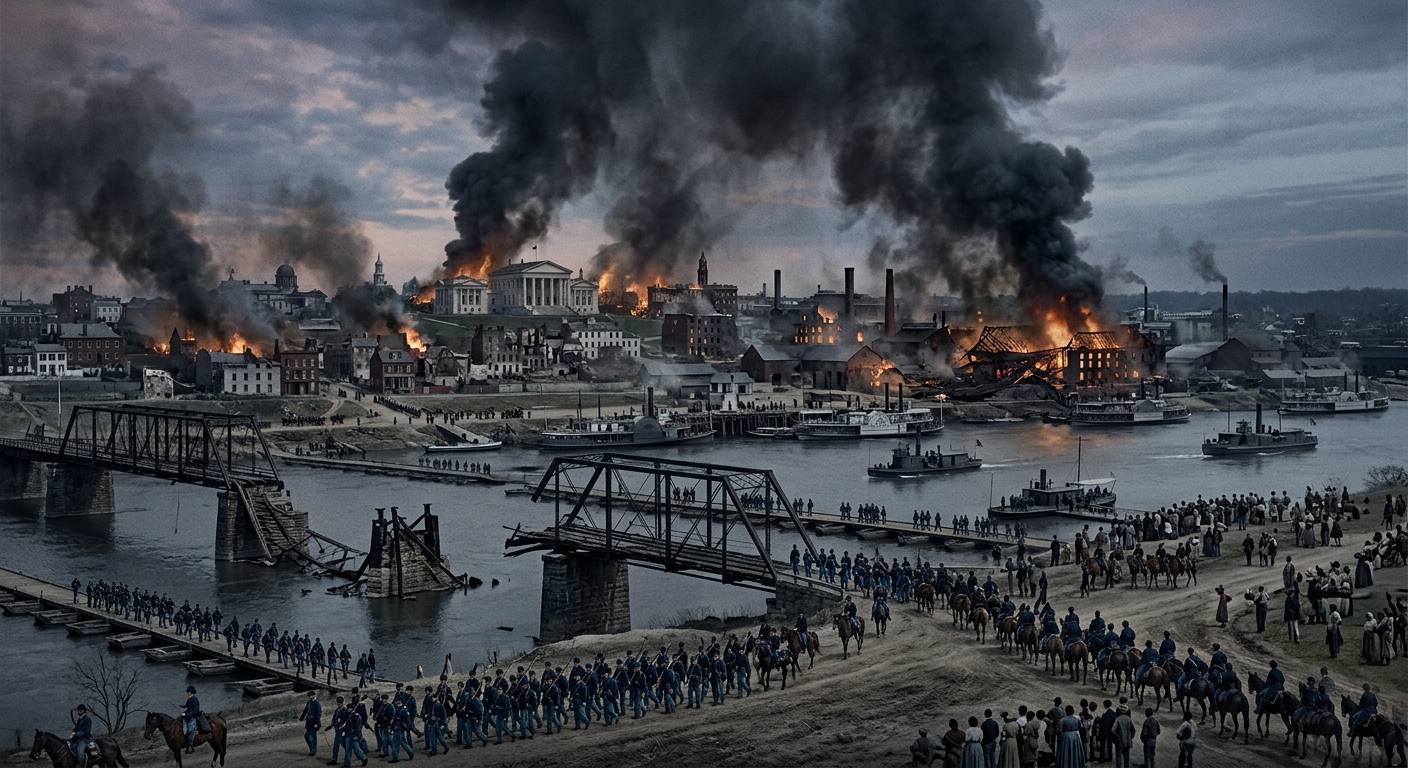
On the morning of April 3, 1865, a Sunday barely twenty-four hours after the Confederate government had fled in the dead of night, Union soldiers marched into the burning ruins of Richmond, Virginia—the capital of the Confederate States of America—and raised the American flag over the Virginia State Capitol building. Smoke still poured from hundreds of structures along the waterfront. Streets that had rung with the martial confidence of a secessionist republic for nearly four years were now thick with the smell of scorched tobacco, spilled whiskey, and the ash of burned government documents. The city’s mayor, Joseph Mayo, had ridden out to meet the Union advance rather than watch his city reduced to rubble. And in one of the most dramatic moments in the history of the American republic, the Confederate capital — the city that had been the heart, the symbol, and the strategic obsession of the entire eastern theater of the Civil War — had fallen without a shot fired in its defense.
The fall of Richmond on April 3, 1865, was far more than a military event. It was the moment that everyone — North and South, soldier and civilian, free and enslaved — had understood from the beginning of the war would mark its essential turning point. The Richmond Examiner itself had written that “the evacuation of Richmond would be the loss of all respect and authority towards the Confederate Government, the disintegration of the army, and the abandonment of the scheme of an independent Southern Confederation. Each contestant in the war has made Richmond the central object of all its plans and all its exertions. It has become the symbol of the Confederacy. Its loss would be material ruin to the cause, and in a moral point of view, absolutely destructive, crushing the heart and extinguishing the last hope of the country.” Six days later, on April 9, 1865, General Robert E. Lee surrendered his Army of Northern Virginia to General Ulysses S. Grant at Appomattox Court House. The Examiner had not been wrong.
Why Richmond Was the Confederate Capital: Strategic, Industrial, and Symbolic Importance
Richmond, Virginia, had not been the original capital of the Confederacy. When the seceding Southern states formed the Confederate States of America in early 1861, they chose Montgomery, Alabama, as their first capital. Richmond’s elevation to Confederate capital status came through a combination of strategic calculation, industrial reality, and political symbolism that proved irresistible to Confederate President Jefferson Davis and his government.
Virginia was the most populous of the Confederate states and the one whose participation was most essential to the rebellion’s credibility and survival. When the Virginia Secession Convention voted to leave the Union on April 17, 1861 — triggered by Lincoln’s call for 75,000 volunteers to “crush the rebellion” following the Confederate bombardment of Fort Sumter — Confederate Vice President Alexander Stephens had already been hinting that Richmond could become the new capital as an inducement for Virginia to join. The Virginia Convention promptly extended an invitation to President Davis and the Confederate government. On May 29, 1861, the Confederate capital moved from Montgomery to Richmond.
The city’s strategic value was enormous. Richmond in 1860 was the 25th largest urban area in the United States, with a population of approximately 37,910, including some 11,700 enslaved people. It sat at the heart of the South’s most industrialized region. The Tredegar Iron Works, sprawling along the James River, was the only facility in the South capable of producing heavy ordnance at the start of the war. Under the management of General Joseph Reid Anderson, Tredegar manufactured approximately 1,100 cannon — representing about half of the entire Confederacy’s domestic artillery production during the war — along with iron plating for naval vessels, railroad equipment, and countless other war materials. Richmond was also a crucial transportation hub, serving as the terminus for five major railroads: the Richmond, Fredericksburg, and Potomac Railroad; the Virginia Central Railroad; the Richmond and York River Railroad; the Richmond and Petersburg Railroad; and the Richmond and Danville Railroad. The James River and Kanawha Canal provided additional access to coastal waters.
Beyond its material importance, Richmond carried immense symbolic weight. Virginia was the home of Washington, Jefferson, Madison, and Monroe — the very architects of the American republic. By making Richmond the Confederate capital, Jefferson Davis’s government was explicitly associating the Southern rebellion with the legacy of the American Revolution, claiming to be the true heirs of the founding generation’s commitment to states’ rights and self-governance. The Virginia State Capitol, designed by Thomas Jefferson himself, stood as the seat of Confederate legislative power — a building whose classical symmetry seemed to lend republican legitimacy to the Confederate project. The Confederate White House, just three blocks from the Capitol, became the residence of President Jefferson Davis from August 1861 until his flight in April 1865. By the time war began in earnest, Richmond’s population had swelled to between 100,000 and 130,000, transforming the prosperous Virginia state capital into what one historian described as “capital, military headquarters, transportation hub, industrial heart, prison, and hospital center of the Confederacy.”
“On to Richmond”: Four Years of Union Attempts to Capture the Confederate Capital
From the very beginning of the Civil War, capturing Richmond was the paramount strategic objective of Union forces in the eastern theater. The cry “On to Richmond” became a rallying slogan for Northern newspapers and politicians who believed that a rapid strike at the Confederate capital could end the rebellion before it had time to consolidate. The two capitals — Washington, D.C., and Richmond — sat barely one hundred miles apart, a proximity that meant the war in the East was, in many respects, a sustained four-year contest between two cities and the armies defending them.
The Union made multiple major attempts to take Richmond. In the Peninsula Campaign of the spring and summer of 1862, Major General George Brinton McClellan advanced the 121,000-man Army of the Potomac up the Virginia Peninsula from Fort Monroe, coming within a few miles of Richmond’s suburbs before being driven back by General Robert E. Lee in the Seven Days Battles. Lee’s brilliant defensive campaign, combined with what many observers regarded as McClellan’s excessive caution, preserved Richmond through one of its most dangerous early moments. Efforts to approach Richmond by water up the James River were blocked by Confederate defenses at Drewry’s Bluff, about eight miles downstream from the city, which also famously repulsed the Union ironclad vessels in May 1862.
In 1864, General Ulysses S. Grant — appointed by President Lincoln as General-in-Chief of the Union Armies in March 1864 — launched the Overland Campaign, a relentless grinding offensive aimed at destroying Lee’s Army of Northern Virginia rather than simply capturing territory. From the Wilderness through Spotsylvania Court House, North Anna, and Cold Harbor, Grant pushed southward with extraordinary determination and at tremendous cost, suffering over 50,000 casualties in six weeks but refusing to retreat after each bloody engagement as his predecessors had done. When Lee entrenched his army in a fortified line protecting both Petersburg and Richmond south of the James River, Grant executed a bold flanking movement and laid siege to Petersburg in June 1864. The siege of Petersburg, which would last nine months and forty-eight days, became the decisive theater of the war’s final phase.
The Petersburg Siege, 1864–1865: The Noose Tightens Around Richmond
The siege of Petersburg, which began on June 9, 1864, was unlike anything the Civil War had produced before it. Grant’s forces constructed an extensive system of trenches, earthworks, and fortifications that gradually extended around the southern and western approaches to Petersburg — and with them, the railroad and supply lines that kept both Petersburg and Richmond alive. Lee’s Confederate forces dug their own parallel line of defenses, creating a trench warfare landscape that eerily presaged the Western Front of the First World War by fifty years. On July 30, 1864, Union engineers detonated a massive mine beneath the Confederate lines, opening a crater that briefly offered the possibility of a breakthrough before collapsing into the catastrophic “Battle of the Crater” in which poor Union planning and execution turned potential victory into disaster.
Through the suffocating summer, fall, and bitter winter of 1864 and into 1865, the Confederate army defending the Richmond-Petersburg line grew steadily weaker. Desertion plagued Lee’s ranks — at points over 100 Confederate soldiers per day were slipping away from the lines to return to their homes and families. Supplies dwindled as Union forces methodically cut off the railroads and roads supplying the Confederate position. By March 1865, Lee had written bluntly to the new Confederate Secretary of War, General John C. Breckinridge, that the Confederacy was “in peril” and that “it seems impossible to maintain our present position. The army cannot be kept together, and our present lines must be abandoned.” The army that had once numbered more than 90,000 men had been reduced to fewer than 60,000, spread thin along a line nearly sixty kilometers long from Richmond to Petersburg.
Inside Richmond, the civilian population was enduring its own hardships. The city’s swollen population far exceeded its capacity to feed and house it. Inflation had become catastrophic — the Confederacy’s paper money was losing value so rapidly that basic necessities became unaffordable for ordinary Richmonders. In April 1863, the desperation had boiled over into the Richmond Bread Riot, in which several hundred women and workers stormed government warehouses, grocery stores, and shops demanding food, shouting “bread or blood” and “bread or peace.” Jefferson Davis himself had ridden to the scene and reportedly threw coins from his pockets into the crowd before ordering troops to disperse the protesters. By early 1865, Richmond residents were writing in their diaries of constant anxiety, mounting fear, and the growing conviction that evacuation was inevitable.
The Battle of Five Forks, April 1, 1865: The Blow That Doomed Richmond
The beginning of the end came at Five Forks, a crossroads approximately twelve miles southwest of Petersburg, on April 1, 1865. General Ulysses S. Grant and his cavalry commander, Major General Philip Henry Sheridan, had been probing and extending the Union left flank westward for weeks, trying to cut Lee’s last remaining supply lines and railroad connections to the south and southwest. Lee had no choice but to extend his already dangerously thin lines to meet these threats, and by late March his army was stretched to the breaking point.
Sheridan’s Union cavalry, supported by infantry under Major General Gouverneur K. Warren, converged on Five Forks where a Confederate force of approximately 10,000 men under Major General George E. Pickett had been ordered by Lee to hold the position “at all hazards.” What unfolded at Five Forks on the afternoon of April 1, 1865, became one of the most decisive and also most controversial engagements of the entire war. Pickett, in a decision that would haunt his reputation for the rest of his life, was absent from the field — enjoying a shad bake behind the lines with cavalry general Fitzhugh Lee and other officers — when the Union assault began. The Confederate force, leaderless at its critical moment, was overwhelmed. Sheridan’s troops routed the Confederates, capturing thousands of prisoners and effectively destroying what remained of Lee’s capacity to protect his right flank and his railroad connections to the south.
The news of Five Forks reached Lee that evening and confirmed what he had long been dreading. His right flank had been destroyed. His railroad escape route to Lynchburg and beyond had been cut. He could no longer hold the thirty-seven-mile line protecting Richmond and Petersburg with the forces available to him. He telegraphed Confederate President Jefferson Davis with stark directness: “I advise that all preparation be made for leaving Richmond tonight.”
Evacuation Sunday, April 2, 1865: Jefferson Davis Flees and the Confederacy Abandons Its Capital
April 2, 1865, fell on a Sunday, and the morning dawned, by several accounts, unusually bright and warm — one of those deceptively pleasant spring days that seemed to mock the catastrophe unfolding beneath it. Richmond’s churches were full. Jefferson Davis was seated in his customary pew at St. Paul’s Episcopal Church on East Grace Street, attending morning services alongside other Confederate officials and convalescent soldiers. The rector, Charles Minnigerode, was conducting the service. Davis, by 1865, had aged visibly under the strains of the presidency he had not sought: wracked by neuralgia, nearly blind in one eye, and carrying the weight of a failing cause that he had never permitted himself to publicly acknowledge as failing.
A messenger entered the church and handed Davis a telegram from General Lee. Davis rose quietly and walked out, his face revealing nothing to the congregation. The telegram told him what he had known must eventually come: Grant had launched a massive assault along the entire Petersburg front that morning at dawn, breaking the Confederate line in multiple places. “I advise that all preparation be made for leaving Richmond tonight.” Davis issued the first orders for the Confederate government’s evacuation. No formal announcement was made to the citizens of Richmond. Government officials began burning sensitive documents in the streets. Word spread from person to person, through rumor and whispered fear, and reaction across the city ranged from stunned incredulity to outright panic.
The evacuation that followed was a scene of desperate improvisation and controlled chaos. Davis and his cabinet boarded trains on the Richmond and Danville Railroad — the only rail line still open — and fled south toward Danville, Virginia, where Davis briefly and delusionally attempted to re-establish the Confederate government. Confederate treasury gold was loaded onto wagons. Banks and government offices were hastily stripped of their valuables. Families desperately sought space on overloaded trains and river boats. Those who could not secure passage scrambled to pack their most essential possessions, knowing that the Union army would arrive in hours.
Meanwhile, Confederate military commanders under General Richard Ewell — Richmond’s military commander — had been ordered by Lee to destroy military supplies and facilities that could not be taken with the retreating army. Confederate soldiers set fire to tobacco warehouses along the waterfront, military storehouses, and bridges over the James River. What was meant to be a controlled destruction of strategic assets quickly became an uncontrolled conflagration. A strong southwesterly wind caught the embers from the burning warehouses and drove them northward into the city’s business district. The fire spread from building to building with terrifying speed. With Confederate soldiers gone and law and order disintegrating, mobs broke into stores, looted freely, and staved in barrels of whiskey in the streets — the gutters of Cary Street reportedly ran with liquor. Armed looters were confronted and in some cases shot by the last remaining soldiers. The powder magazine exploded in the early hours of April 3, blowing out windows two miles away and tearing doors from hinges. Confederate Admiral Raphael Semmes set the Confederacy’s own ironclad warships on fire rather than let them fall into Union hands. By the time dawn broke on April 3, all or part of more than 800 buildings in Richmond had been destroyed or damaged — banks, newspaper offices, businesses, and homes consumed by the fire that the Confederacy itself had started in its final hours.
April 3, 1865: Union Forces Enter Richmond and Raise the American Flag
As the sun rose on the morning of April 3, 1865, the advance elements of the Union Army of the James were moving rapidly toward the abandoned Confederate capital. Mayor Joseph Mayo and members of Richmond’s City Council rode out of town in a carriage to meet the Union vanguard and formally surrender the city, knowing that resistance was futile and that capitulation was the only hope of preserving what remained of the city from further destruction. The Union force they met was the vanguard of the XXV Corps — a formation composed almost entirely of United States Colored Troops, Black soldiers who had been fighting for the Union and for their freedom, and whose presence at the moment of Richmond’s liberation carried a symbolism that was lost on no one.
The 36th United States Colored Troops — led by Brevet Brigade General Alonzo Draper — were reported to be among the first organized regiments to enter Richmond, their drum corps playing “Yankee Doodle” and “Shouting the Battle Cry of Freedom” as they marched through streets still thick with smoke. Black correspondent Thomas Morris Chester, reporting for the Philadelphia Press and one of the few African American journalists covering the war, was present and witnessed the entry. “The colored soldiers of the Army of the James were the first to enter the city of Richmond,” Chester reported emphatically, describing the scene as one for the history books. For the enslaved and recently freed Black population of Richmond — who had watched for years as the Confederate capital enforced and celebrated the system of their bondage — the sight of Black soldiers in Union blue marching through their streets was a moment of transcendent, almost incomprehensible significance.
At 8:15 in the morning on April 3, 1865, Major General Godfrey Weitzel — commander of the XXV Corps and the Union officer responsible for occupying Richmond — officially accepted the city’s surrender at Richmond’s City Hall. Almost immediately, the Union flag was raised over the Virginia State Capitol, the building that Thomas Jefferson had designed and that had housed the Confederate Congress for nearly four years. The sight of the American colors flying over the Capitol of the former Confederacy electrified the Northern public when the news arrived by telegram. Bells rang in cities across the Union. Crowds gathered in the streets of Washington, New York, and Boston in spontaneous celebrations. General Grant, informed of Richmond’s fall, reportedly showed little outward emotion — he was still in the field, pursuing Lee’s retreating army, and victory was not yet complete.
General Weitzel faced an immediate and daunting practical challenge. The fires set by the retreating Confederates were still burning, threatening to consume the entire city. He immediately deployed the city’s two available fire engines, organized bucket brigades, and ordered buildings demolished to create firebreaks. Union soldiers — the same soldiers whose entry into the city had been dreaded by white Richmonders for four years — worked to save Confederate citizens’ homes and businesses from the fire that their own army’s retreat had started. Five hours of intense firefighting effort, aided by the eventual calming of the wind, brought the blaze under control, but not before hundreds of buildings had been destroyed. Weitzel also ordered immediate distribution of rations to the destitute civilian population huddled in Capitol Square, many of whom had lost everything and were in a state of shock and despair.
The Reaction of Black Richmonders: Freedom Comes to the Confederate Capital
The fall of Richmond unleashed an outpouring of joy, grief, and relief among the city’s Black residents that contemporary observers described as unlike anything they had ever witnessed. Richmond had been, for the duration of the war, one of the most active centers of the slave trade in the entire Confederacy. Slave auction houses and holding pens had operated in the city throughout the war, supplying labor to the Confederate war machine and the plantations of the South. The enslaved men and women who had lived under this system in the Confederate capital had observed the progress of the war with desperate, concealed hope, and the arrival of Union forces represented the fulfillment of everything they had prayed and waited for.
As General Weitzel’s forces entered the city, freed slaves surged through the streets in jubilation. Men, women, and children crowded around the Union soldiers, particularly the Black soldiers of the XXV Corps, embracing them, shouting, weeping, and calling out praises to God. Weitzel later wrote of arriving at Capitol Square to find the faces of Richmond’s white residents displaying “perfect pictures of utter despair,” while the city’s Black population expressed boundless and overwhelming joy. Slave pens and prisons were opened. For the first time, thousands of people who had been the property of others woke up to a morning in which no one claimed ownership of them. The 13th Amendment to the Constitution, which would formally abolish slavery throughout the United States, had been passed by Congress on January 31, 1865 — just two months earlier — and was awaiting ratification by the states. Its meaning was already, in the streets of Richmond on April 3, becoming flesh.
President Abraham Lincoln Walks Through Richmond: April 4, 1865
President Abraham Lincoln had been following the campaign’s final developments from the Union command base at City Point, Virginia, on the James River approximately twenty miles below Richmond. He had traveled there to consult with Grant and other senior commanders, and when news arrived that Richmond had fallen, his response was immediate and emotionally overwhelming. “Thank God that I have lived to see this!” he exclaimed, steaming up the James River toward the fallen Confederate capital. “It seems to me that I have been dreaming a horrid dream for four years, and now the nightmare is gone. I want to go to Richmond.”
On April 4, 1865 — which happened also to be the twelfth birthday of his son Thomas “Tad” Lincoln — the President of the United States stepped ashore at Richmond’s Rocketts Landing, accompanied by a small naval escort under Rear Admiral David Dixon Porter, a detachment of just twelve sailors armed with carbines and bayonets, and his young son. Cabinet members and generals had urged against the visit, fearing for Lincoln’s safety in a city that had been the heart of the rebellion and still contained many deeply bitter Confederate citizens. Lincoln dismissed their concerns. He had wanted to see Richmond for four years. He was going to see it now.
The scene that followed has been described as one of the most extraordinary moments of Lincoln’s presidency and of the entire Civil War. Word of Lincoln’s presence spread through the city almost instantly, and thousands of freed Black Richmonders flooded toward him. A dense crowd of jubilant African Americans surrounded the President — men, women, and children pressing close, reaching out to touch him, kneeling before him, calling out blessings and tears of gratitude. One elderly woman reportedly knelt and asked to pray with him. Lincoln was visibly moved, removing his hat in respect. His small naval escort struggled to clear a path through the throng. A detachment of soldiers eventually muscled its way in and formed a protective cordon. As Lincoln and his party walked through the ruined streets toward the Confederate White House and the Virginia Capitol, the crowd followed.
White Confederate Richmonders responded very differently to Lincoln’s presence. Contemporary accounts describe closed shutters, turned backs, and silent, furious hostility from many white residents who watched the procession from behind closed doors or from across the street. Some watched with open contempt. Others, perhaps, with more complex emotions — the terrible realization that the cause for which so many had sacrificed so much was truly, irreversibly over. Lincoln toured Jefferson Davis’s former residence — the Confederate White House — sat in Davis’s chair, and allegedly said simply, “This must have been President Davis’s chair.” He visited the Virginia State Capitol and surveyed the burned district along the waterfront. When General Weitzel later asked him for guidance on how to treat the conquered Confederate citizens, Lincoln replied in a formulation that became one of his most celebrated: “If I were in your place, I’d let ’em up easy — let ’em up easy.”
The Evacuation Fire: Richmond Burns as the Confederacy Destroys Its Own Capital
One of the most important and most frequently misunderstood aspects of the fall of Richmond is the origin and nature of the great fire that burned through the city’s business district in the early hours of April 3, 1865. A persistent myth — one that Confederate partisans spread assiduously in the postwar years — held that Union soldiers had set the fires that destroyed so much of Richmond. The historical record is unambiguous on this point: the fires were set by retreating Confederate forces, acting on orders from their own commanders, and Union soldiers worked to put them out.
The orders to burn came from General Lee and were carried out by Richmond’s military commander, General Richard Ewell. The specific targets were military warehouses, tobacco stored for the Confederate government, bridges over the James River, and the Confederate armory and navy yard. The intention was sound military practice — destroying strategic assets before they could be captured and used by the enemy. But the execution was catastrophic. The warehouse fires along the waterfront were not set until the early morning hours of April 3, when strong southwesterly winds were already blowing through the city. The fires spread almost immediately beyond their intended boundaries, driven by the wind from building to building up through the commercial district. The city’s fire department was overwhelmed and undermanned — many of its members had fled with the retreating army or the evacuating government. With no effective firefighting force and no military authority to impose order, the fire consumed everything in its path.
The Tredegar Iron Works, the greatest industrial asset in the Confederacy and the facility most responsible for sustaining its military capacity throughout the war, survived only through the extraordinary determination of its owner and director, General Joseph Reid Anderson, who organized his workers into the Tredegar Battalion and posted armed men along the perimeter of the facility to defend it against looters and the encroaching flames. Tredegar was the only major Richmond war establishment to escape the torch. When Union forces arrived and began fighting the fires, they were met with the sight of hundreds of buildings already in flames and a city in the grip of apocalyptic chaos. Five hours of concerted firefighting by Union soldiers — working alongside whatever civilian bucket brigades could be organized — eventually brought the blaze under control. By then, more than 800 buildings had been damaged or destroyed, including virtually all of Richmond’s banks, the major newspaper offices, the principal commercial establishments, and countless private homes. The scorched ruins along the riverfront would stand for years as a monument to the Confederacy’s self-destruction.
Key Commanders and Stakeholders of Richmond’s Fall
The fall of Richmond was the product of decisions made by a relatively small number of military and political figures whose choices in the final weeks and days before April 3, 1865, shaped the event’s outcome. On the Confederate side, General Robert E. Lee — commander of the Army of Northern Virginia — had been the central figure defending Richmond for nearly three years. His strategic genius and his army’s sacrificial determination had kept Grant at bay through the devastating campaigns of 1864. But by early 1865, Lee understood with clinical clarity that the cause was lost. He had been telling Jefferson Davis for months that evacuation was inevitable; he had warned that if Grant succeeded in cutting his supply lines, the fall of both Petersburg and Richmond would follow immediately. His telegram to Davis on April 1, 1865, was not the beginning of a decision but the formal notification of one that had been months in the making.
Jefferson Davis, the Confederate President, had led the Confederate government since its formation with a combination of genuine dedication and, many of his contemporaries believed, excessive rigidity and poor political judgment. By April 1865, Davis was a man in denial about the extent of Confederate defeat. After evacuating Richmond, he fled south through Virginia and into the Carolinas, issuing proclamations that the Confederate cause was not lost and that the war would continue. He refused to accept reality long after Lee had done so. Davis was eventually captured by Union forces on May 10, 1865, in Irwinville, Georgia. He was imprisoned for two years at Fort Monroe but never tried for treason; charges were dropped in 1869. He died in 1889 and is buried in Richmond’s Hollywood Cemetery.
On the Union side, General Ulysses S. Grant had been the driving force behind the campaign that finally broke the Confederate lines. His strategy of relentless pressure — refusing to retreat after costly engagements, extending the Union lines until Lee’s army was stretched to the snapping point, cutting supply lines methodically, and finally delivering the decisive blow at Five Forks — was the culmination of his strategic philosophy that the destruction of the enemy’s army, not the capture of geographic objectives, was the key to victory. Major General Philip Sheridan’s aggressive cavalry operations, culminating in the route at Five Forks, directly triggered the chain of events that led to Richmond’s fall. Major General Godfrey Weitzel, commanding the XXV Corps, was the officer who formally accepted Richmond’s surrender, organized the occupation, and worked to suppress the fire and restore order. Major General George E. Pickett, whose absence from the field at Five Forks during a shad bake behind the lines contributed to the Confederate disaster, carried the burden of that absence for the rest of his life.
Richmond’s Mayor Joseph Mayo played a minor but dignified role in the final hours, riding out to formally surrender the city to Union forces and thereby helping to avoid any final bloodshed in its streets. The city council accompanied him, and together they did what they could to preserve order and minimize civilian suffering during the transition. General Richard Ewell, Richmond’s military commander, supervised the burning operations that got out of control and ultimately destroyed much of his own city. Black correspondent Thomas Morris Chester, reporting for the Philadelphia Press, documented the entry of Black Union troops into the city with eyewitness testimony that remains among the most vivid primary sources for the event. General Joseph Reid Anderson, owner of the Tredegar Iron Works, led his Tredegar Battalion in defending the ironworks against the fire and mob violence, preserving the single most important industrial facility in the former Confederacy.
The US Colored Troops and the XXV Corps: Black Soldiers Liberate the Confederate Capital
One of the most historically significant aspects of the fall of Richmond — one that has not always received the prominence it deserves in popular histories of the event — is the fact that the first organized military force to enter the Confederate capital on April 3, 1865, was composed primarily of United States Colored Troops: Black soldiers fighting in the Union Army. The XXV Corps, commanded by Major General Godfrey Weitzel, was the vanguard of the Union occupation force, and it was largely composed of African American soldiers who had enlisted in the Union cause precisely because they understood, with perfect clarity, that a Union victory meant the end of slavery.
The 36th United States Colored Troops, advancing with Brevet Brigade General Alonzo Draper’s brigade at their head, drum corps playing, were among the first units to march into the Confederate capital. Thomas Morris Chester, the Black journalist who witnessed the entry, reported with unmistakable pride and emotion: “You need not feel at all timid in giving the truthfulness of my assertion to the four winds of the heavens, and let the angels re-echo it back to the earth, that the colored soldiers of the Army of the James were the first to enter the city of Richmond.” For the white Confederate citizens who had spent four years fighting to preserve a racial order premised on the permanent subjugation of Black people, the sight of Black soldiers in Union uniform occupying their city carried a meaning that went beyond military defeat. It was the living refutation of everything their rebellion had stood for.
General Weitzel immediately set his troops to work on the practical tasks of occupation: fighting the fires, distributing rations to the destitute population, opening the slave pens and prisons, restoring order, and protecting both the freed Black population and the white civilian population from the mob violence and looting that had erupted in the final hours of Confederate control. The XXV Corps conducted itself with discipline and professionalism that defied the fears — and disappointed the hopes — of those who had expected Union occupation to be marked by brutality or revenge. Weitzel set up his headquarters in the former Confederate White House — Jefferson Davis’s residence — and oversaw the peaceful transfer of authority in what had been, until forty-eight hours before, the nerve center of a rebellion that had cost 620,000 American lives.
From Richmond to Appomattox: The Final Week of the Confederacy
The fall of Richmond did not immediately end the Civil War, but it made the end inevitable within days. Lee’s Army of Northern Virginia, having evacuated Petersburg and Richmond, retreated westward in a desperate attempt to reach Lynchburg and then move south to join General Joseph Johnston’s army in North Carolina. Lee’s plan, if it could be called that, was to unite his forces with Johnston’s, defeat Union General William Tecumseh Sherman’s army advancing northward through the Carolinas, and then turn to face Grant — a strategy that virtually no one on Lee’s staff believed had any realistic chance of success, but which offered at least the theoretical possibility of prolonging Confederate resistance for a few more months.
Grant saw through the plan immediately and moved to prevent it. Sheridan’s cavalry and the infantry of the Army of the Potomac pursued Lee’s exhausted, hungry, and disintegrating army relentlessly. Supply trains that Lee had been counting on at Amelia Court House failed to arrive, wasting a crucial day. At the Battle of Sayler’s Creek on April 6, 1865, Grant’s forces cut off and destroyed approximately a quarter of Lee’s remaining army — nearly 8,000 men — in a single afternoon. “My God! Has the army dissolved?” Lee reportedly exclaimed when he saw streams of defeated Confederate soldiers pouring past him. Grant sent a message to Lee suggesting that further resistance would only cost more lives. Lee replied that he did not think the situation had yet reached the point where surrender was necessary, but the reply had the defensive quality of a man who knew the end was very near.
On April 9, 1865 — six days after the fall of Richmond — General Robert E. Lee met General Ulysses S. Grant at the McLean House in the small village of Appomattox Court House, Virginia. In a meeting that lasted approximately two hours, Lee surrendered his Army of Northern Virginia on terms that Grant had designed to be generous: Confederate officers could keep their sidearms and horses; all soldiers could return to their homes without molestation as long as they obeyed the laws in force where they resided; cavalry and artillery soldiers who owned their own horses could take them home for the spring planting. Grant refused to allow a formal ceremony of surrender or any public humiliation of the Confederate soldiers. Lee signed the surrender document and rode away on his gray horse Traveller. As Confederate soldiers began to comprehend what had happened, many wept openly.
President Lincoln, who was still in the Richmond-Petersburg area when news of Lee’s surrender arrived, returned to Washington on April 8. On April 11, he delivered what would prove to be his final public speech, speaking from the window of the White House to a celebrating crowd and — to the horror of Confederate sympathizer John Wilkes Booth, who was in the audience — expressing support for at least qualified voting rights for Black Americans, particularly those who had served in the Union military. “Now, by God, I’ll put him through,” Booth reportedly said after hearing these words. Three days later, on the evening of April 14, 1865, Lincoln was shot by Booth at Ford’s Theatre in Washington. He died the following morning, April 15, becoming the first American president to be assassinated. The president who had preserved the Union and abolished slavery did not live to see the peace he had worked so hard to secure.
The Historical Significance of Richmond’s Fall: Why April 3, 1865 Changed America
The fall of Richmond on April 3, 1865, occupies a peculiar position in the popular memory of the Civil War — often overshadowed in historical consciousness by the more dramatic and formally conclusive event of Lee’s surrender at Appomattox six days later. But Richmond’s fall was, in many respects, the event that made Appomattox inevitable and that carried the deepest symbolic weight of the war’s conclusion. For four years, Richmond had been the physical embodiment of Confederate nationhood — the city that a rebellious republic had chosen as the expression of its political identity and from which it had directed its military, economic, and administrative apparatus. When Richmond fell, the Confederacy was finished as a political entity regardless of what armies remained in the field.
The Richmond Examiner had understood this truth all along: “Its loss would be material ruin to the cause, and in a moral point of view, absolutely destructive.” Jefferson Davis refused to accept this logic even after the event itself had demonstrated its truth, but every other informed observer in both North and South recognized that the fall of Richmond was the moment the Civil War effectively ended. Grant’s subsequent pursuit of Lee and the surrender at Appomattox were the formal, military confirmation of a political reality that had been established when the Union flag rose over Thomas Jefferson’s Virginia State Capitol on the morning of April 3, 1865.
For the enslaved population of Richmond and the broader African American community of the South, the fall of the Confederate capital had a significance that transcended the immediate military context. It was the physical, visible proof that the institution of slavery — which the Confederacy had been explicitly created to preserve and perpetuate — was finished. The sight of Black Union soldiers marching through Richmond’s streets, the opening of the slave pens, and Lincoln’s subsequent walk through the city surrounded by a throng of jubilant freed people: these were not merely dramatic moments in a military campaign. They were the opening scenes of a new chapter in American history. The 13th Amendment would be ratified in December 1865, completing in law what the fall of Richmond had announced in fact.
The physical destruction that accompanied Richmond’s fall was also historically significant, and not only as a testament to the war’s devastation. The Evacuation Fire — set by the Confederacy, fought by the Union — destroyed more than 800 buildings in the city’s commercial district, eliminating in a single night the infrastructure of a major urban economy. The Tredegar Iron Works survived, saved by its workers’ determination, and would eventually become the site of the American Civil War Museum. Most of the rest of Richmond’s wartime commercial and governmental infrastructure was gone. Reconstruction would take years. The city that rose from the ashes was different in profound ways from the city that had burned — an economic and demographic transformation had been set in motion that would reshape Richmond for generations.
Conclusion: The Day the Confederate Dream Died in Smoke and Ashes
The fall of Richmond on April 3, 1865, brought together in a single moment all the contradictions, tragedies, and transformative possibilities of the American Civil War. A city that had been built, in significant part, on the labor of enslaved people and had served for four years as the capital of a rebellion dedicated to the permanent preservation of slavery, was liberated in part by the enslaved people’s own descendants and fellow sufferers wearing the uniform of the United States Army. A government that had wrapped itself in the language of liberty, self-determination, and the legacy of the American Revolution destroyed its own capital with fire as it fled. A president who had spent four years holding his nation together through the most catastrophic conflict in its history walked through the ruins with his twelve-year-old son, greeted by the tears and prayers of thousands of people who credited him with their freedom.
The key figures whose decisions shaped April 3, 1865 — Grant’s relentless strategy, Sheridan’s devastating blow at Five Forks, Lee’s agonizing but ultimately honorable realism, Davis’s desperate denial, Weitzel’s disciplined occupation, the anonymous Black soldiers of the XXV Corps who marched first into Richmond, Lincoln’s magnanimous presence — together wrote one of the most consequential chapters in the history of a nation that was, at that moment, finally becoming what its founding documents had promised it would be.
The Confederacy outlasted Richmond’s fall by only six days in the east. The institution of slavery — the cause for which the Confederacy had been formed and for which Richmond had been defended — ended with it. The war that had cost more than 620,000 American lives was over. And the task of Reconstruction — of binding up the nation’s wounds, as Lincoln had put it in his Second Inaugural Address — was about to begin under a new president, because the old one would not survive the month. Richmond had fallen. The Civil War was ending. America’s most painful and most transformative chapter was closing, and another was about to begin.