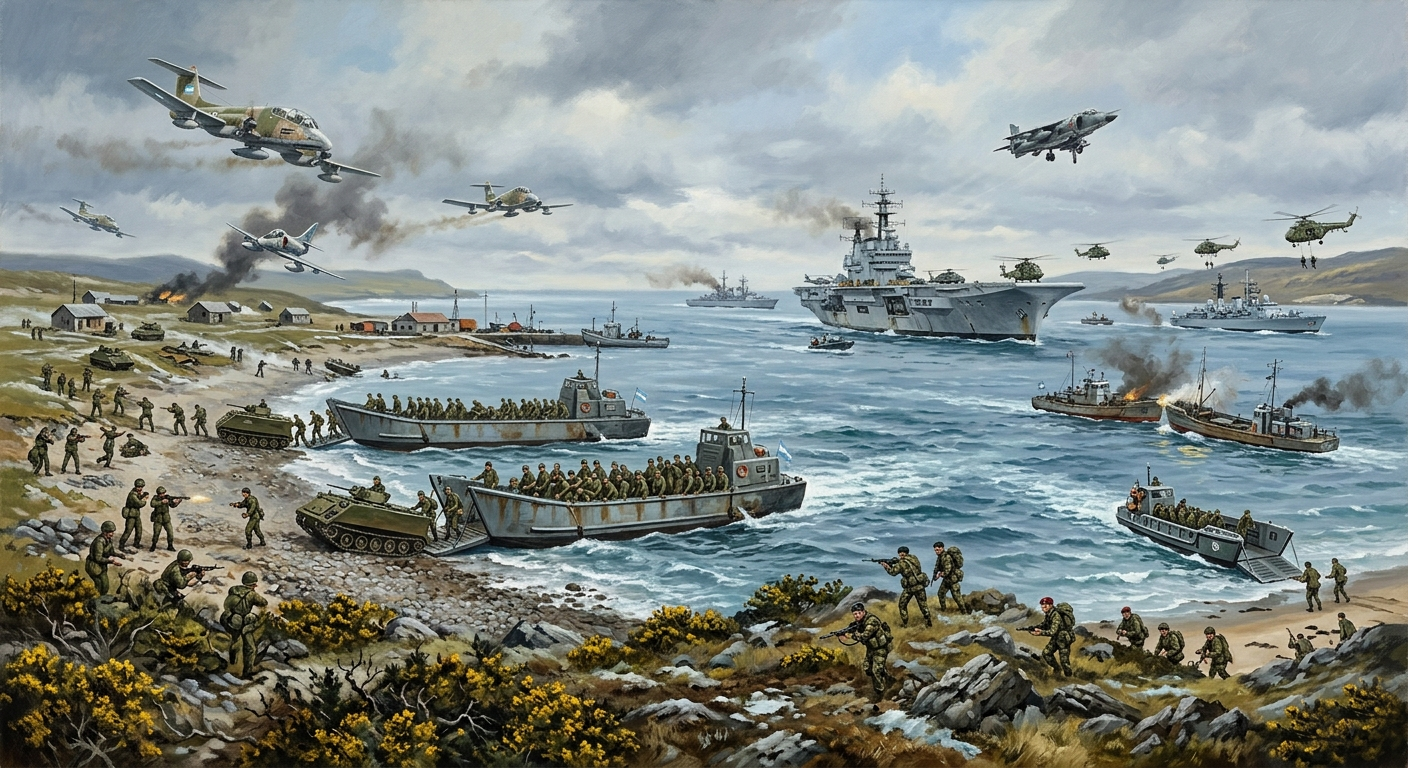
On the morning of April 2, 1982, Argentine amphibious forces launched Operation Rosario, a military assault on the Falkland Islands, a remote British overseas territory sitting in the South Atlantic Ocean roughly 300 miles off the southern tip of Argentina and more than 8,000 miles from the United Kingdom. Within hours, the small garrison of Royal Marines defending the islands — barely 57 men against more than 600 Argentine commandos — was overwhelmed, the Argentine flag was raised over Government House in the capital Stanley, and the islands’ British governor, Sir Rex Hunt, had been arrested and deported. The Falklands War had begun.
What followed was one of the most extraordinary military campaigns of the twentieth century: a 74-day conflict fought at the bottom of the world, in freezing sub-Antarctic conditions, between a South American military junta desperate to survive through nationalist triumph and a British government led by Prime Minister Margaret Thatcher, who responded to the invasion with an iron determination to reverse Argentine aggression and restore British sovereignty. The war cost over 900 lives — 649 Argentine military personnel, 255 British service members, and three Falkland Island civilians — and it changed the political destinies of both nations profoundly and permanently. In Argentina, the defeat brought down the military junta and opened the path to democracy. In Britain, the victory transformed Thatcher’s political fortunes, defined her image as the ‘Iron Lady,’ and reshaped the country’s sense of itself as a military power still capable of projecting force across the globe.
The Falkland Islands: Geography, History, and a Sovereignty Dispute That Began in the Nineteenth Century
The Falkland Islands — known in Argentina as the Islas Malvinas — are an archipelago of two main islands, East Falkland and West Falkland, and approximately 778 smaller islands and islets in the South Atlantic Ocean. Remote, windswept, and sparsely populated, the islands had a civilian population of roughly 1,800 people in 1982, the vast majority of British descent and overwhelmingly committed to remaining under British administration. The islanders were predominantly engaged in sheep farming, and their way of life was simple and settled—quite unlike the remote geopolitical prize they would soon become.
The competing historical claims to sovereignty over the islands stretch back to the eighteenth century and are genuinely complex on both sides. British navigator John Davis is believed to have sighted the islands as early as 1592, and in 1690 British Navy Captain John Strong made the first recorded landing, naming them after Viscount Falkland, who was the first lord of the Admiralty at the time. In 1764, French navigator Louis-Antoine de Bougainville founded the islands’ first permanent human settlement on East Falkland. Spain purchased the French settlement in 1767 and expelled a small British garrison from West Falkland in 1770 — a crisis that nearly led to war between Britain and Spain but was resolved diplomatically. Britain formally withdrew from its remaining West Falkland settlement in 1774, though it never formally relinquished its sovereignty claim.
When Argentina declared independence from Spain in 1816, it asserted that it had inherited Spanish sovereignty over all territories that had fallen within Spain’s colonial jurisdiction in the region, including the Falklands. Argentina established a small presence on the islands in the 1820s. In 1833, however, the Royal Navy arrived and expelled the Argentine garrison, reasserting British possession. Argentina protested this expulsion vigorously and consistently over the following century and a half, but Britain maintained continuous effective administration of the islands from 1833 onward, a period of nearly 150 years by the time of the 1982 invasion. In 1965, United Nations General Assembly Resolution 2065 formally recognized the existence of a sovereignty dispute between Argentina and Britain and invited both parties to negotiate a peaceful resolution — talks that proceeded intermittently over the following seventeen years but reached no conclusion.
Argentina’s Military Junta, the Dirty War, and the Political Crisis That Made the Invasion Seem Necessary
Understanding why Argentina invaded the Falklands in April 1982 requires understanding the desperate political situation of the Argentine military junta that ordered the invasion. Argentina had been governed since 1976 by a succession of military governments following a coup that overthrew the constitutional government. The junta that came to power in that year presided over one of the most brutal periods in Argentine history — the so-called Dirty War (la Guerra Sucia), a campaign of state terrorism against perceived political opponents that resulted in the enforced disappearance, torture, and murder of an estimated 10,000 to 30,000 Argentine citizens between 1976 and 1983. The victims were known as ‘desaparecidos’—’the disappeared.’
By late 1981 and early 1982, the junta led by Lieutenant General Leopoldo Fortunato Galtieri was facing a perfect storm of domestic crises. Argentina’s economy was in severe distress — inflation was catastrophic, foreign debt was enormous, and real wages had collapsed for ordinary Argentines. The human rights abuses of the Dirty War were increasingly well documented internationally and were generating growing domestic protest. The Mothers of the Plaza de Mayo — a group of women who had been staging weekly silent marches in front of the Casa Rosada, the presidential palace, since 1977 to demand information about their disappeared children — had become an international symbol of opposition to the regime. Galtieri’s government was losing what remained of its popular legitimacy with remarkable speed.
The decision to invade the Falklands was conceived fundamentally as a political gamble: that recovering the Malvinas — islands that occupied a deeply emotional place in Argentine national consciousness as stolen territory — would generate a patriotic wave sufficient to unify the country behind the junta, distract attention from the economic catastrophe and human rights horrors of the Dirty War, and restore the government’s shattered legitimacy. Argentine planners also calculated, crucially but wrongly, that Britain would not respond with military force to recover islands so distant, so lightly populated, and so commercially marginal. The calculation seemed reasonable: Britain had been reducing its South Atlantic military presence, had withdrawn the ice patrol vessel HMS Endurance in a budget cut (later reversed), and had showed no recent inclination to expend blood and treasure defending its most remote territories.
The South Georgia Incident, March 19, 1982: The First Shots of a Coming War
The immediate trigger for the full-scale Falklands invasion was an incident on South Georgia, an even more remote British territory approximately 800 miles east of the Falklands. On March 19, 1982, a group of Argentine scrap metal merchants arrived on South Georgia, ostensibly to dismantle an old whaling station at Leith Harbor. What appeared to be a routine commercial operation had, however, been infiltrated by Argentine Marines. The workers raised the Argentine flag and fired shots in celebration — acts that were technically the first offensive actions of what would become the Falklands War.
The British response was to dispatch the Royal Navy ice patrol vessel HMS Endurance from Stanley to South Georgia on March 25, 1982. Argentina interpreted the move as a signal that Britain was alerting to the possibility of military action and accelerated its invasion timetable. The Argentine military junta had originally planned a more gradual escalation — cutting off supplies to the islands, applying diplomatic pressure, potentially taking direct action later in 1982 if UN negotiations failed. The South Georgia incident compressed this timeline dramatically. On the night of April 1-2, Argentine naval forces moved into position, and Operation Rosario was launched.
Operation Rosario, April 2, 1982: The Argentine Invasion of the Falkland Islands
Governor Rex Hunt of the Falkland Islands received warning of the imminent invasion from the British Foreign and Commonwealth Office on the afternoon of April 1, 1982. A telegram from London arrived at 3:30 p.m. stating: ‘We have apparently reliable evidence that an Argentine task force could be assembling off Stanley at dawn tomorrow. You will wish to make your dispositions accordingly.’ Hunt summoned the two senior Royal Marines of Naval Party 8901 — the small standing garrison of approximately 57 marines — to Government House in Stanley to discuss the options for defence. The conclusion was bleak: the garrison was vastly outnumbered by the incoming Argentine force, and meaningful resistance would be almost impossible to sustain.
The first Argentine landings began in the early hours of April 2, 1982. Naval commandos from the Amphibious Commandos Group came ashore from the Type 42 destroyer ARA Santisima Trinidad, navigating inflatable motor boats toward Mullet Creek. The main Argentine force — more than 600 marines and special forces — followed in subsequent waves. Despite the enormous disparity in numbers, the Royal Marines garrison fought with remarkable tenacity. They successfully defended Government House for several hours, inflicting significant casualties on the attackers. Hunt later stated that his defenders fired approximately 6,000 rounds during the fighting, and Major Norman confirmed in 2007 that 6,450 small-arms rounds and 12 rockets were fired by the British defenders. Argentine claims of minimal casualties were disputed — Hunt told Time Magazine that at least five and possibly fifteen Argentine attackers were killed and seventeen wounded.
At 9:15 a.m. on April 2, 1982, Governor Rex Hunt agreed to surrender, recognizing that further resistance would only result in unnecessary British deaths with no prospect of changing the outcome. He was subsequently arrested and, along with Naval Party 8901, deported and repatriated to Britain — against his will, having reportedly told his Argentine captors that they were ‘a bunch of pirates.’ At 4:30 p.m. local time on April 2, the last telex conversation between a Falklands operator and London confirmed that the islands were under Argentine control. Argentine President Galtieri appointed General Mario Benjamin Menendez as Military Governor of the islands and commander of the Argentine forces deployed to defend them. In Buenos Aires, enormous crowds gathered in the Plaza de Mayo to celebrate what was presented as the triumphant recovery of the Malvinas. The celebrations were genuine and massive — Galtieri’s political gamble appeared, momentarily, to be working.
The following day, April 3, 1982, Argentine marines seized South Georgia and the South Sandwich Islands, completing the occupation of all British South Atlantic territories that Argentina claimed. By late April, Argentina had deployed more than 10,000 troops to the Falklands, though the vast majority were poorly trained conscripts who were not adequately equipped with food, clothing, or shelter appropriate for the approaching South Atlantic winter. The logistical and material weaknesses of the Argentine garrison would prove decisive in the weeks ahead.
Prime Minister Margaret Thatcher and Britain’s Immediate Response: Assembling the Task Force
In London, Prime Minister Margaret Thatcher faced an emergency session of the House of Commons on Saturday, April 3, 1982 — only the second time since the Second World War that Parliament had been recalled on a Saturday for a wartime emergency. The atmosphere in the chamber was furious. Thatcher announced to a stunned and angry House that Argentine armed forces had landed on British sovereign territory, had captured the Royal Marines detachment, had raised the Argentine flag at Government House, and had declared the islands and their population to be Argentine. ‘The Falkland Islands and their dependencies remain British territory,’ she declared. ‘No aggression and no invasion can alter that simple fact.’ The message was unambiguous: Britain intended to take the islands back.
The decision to dispatch a military task force was made with remarkable speed. Thatcher’s War Cabinet — including Defence Secretary John Nott, Foreign Secretary Lord Peter Carington (who resigned on April 5, taking personal responsibility for the failure to anticipate the invasion), and later his successor Francis Pym — moved immediately to assemble the largest British naval deployment since the Second World War. On April 5, 1982, the first ships of the task force sailed from Portsmouth naval base, including the two aircraft carriers HMS Hermes and HMS Invincible, to enormous crowds of well-wishers lining the waterfront. The scenes of departure — sailors waving from the decks, families weeping on the quayside — were among the most emotionally charged British public moments of the entire postwar era.
The task force that Britain assembled was extraordinary by any measure. Ultimately comprising 127 ships — including warships, submarines, and requisitioned merchant vessels — it carried approximately 28,000 British military personnel, including Royal Marines of 3 Commando Brigade, the 2nd and 3rd Battalions of the Parachute Regiment, the Welsh and Scots Guards, the Gurkhas, the Special Air Service, and the Special Boat Service. The QE2 — the famous Cunard ocean liner — was requisitioned as a troopship. The Canberra passenger liner, painted white and quickly dubbed ‘the Great White Whale’ by British troops, served a similar function. The journey south to the Falklands, more than 8,000 miles from Portsmouth, would take several weeks, during which time a narrow window remained for diplomatic resolution.
The International Response: The United Nations, the United States, and Global Diplomacy
The international response to Argentina’s invasion was swift and, for Argentina, diplomatically damaging. On April 3, 1982, the United Nations Security Council passed Resolution 502, demanding an immediate cessation of hostilities, demanding the immediate withdrawal of all Argentine forces from the Falkland Islands, and calling on both governments to seek a diplomatic solution. The resolution passed by ten votes to one, with the Soviet Union notably refraining from vetoing the measure despite its general sympathy for non-Western positions. Spain, Panama, the Soviet Union, China, and Poland abstained. The resolution’s passage — secured through the skilled diplomacy of British UN Ambassador Sir Anthony Parsons, who framed the resolution around Argentina’s breach of the UN Charter’s prohibition on the use of force rather than the sovereignty dispute itself — gave Britain the crucial moral high ground internationally.
The position of the United States was more complex and more consequential. The Ronald Reagan administration faced a genuine dilemma: Argentina was regarded by much of Reagan’s foreign policy team as a key anti-communist partner in resisting Soviet influence in Latin America, while Britain was America’s closest and most important NATO ally. Ambassador to the UN Jeane Kirkpatrick did not want to alienate the Argentines and initially favored a more neutral American stance. Secretary of Defense Caspar Weinberger, however, argued strongly for supporting Britain, and Secretary of State Alexander Haig was dispatched on an intensive shuttle diplomacy mission, flying between London and Buenos Aires in an attempt to broker a negotiated settlement before the military confrontation became irreversible.
Haig’s shuttle diplomacy ultimately failed. Thatcher insisted on the complete withdrawal of Argentine forces and the restoration of British administration as the non-negotiable precondition for any settlement. Galtieri, riding the wave of domestic popularity generated by the invasion, refused terms that would amount to publicly backing down from the conquest. When Argentina rejected Haig’s mediation on May 2, the United States formally abandoned its neutrality and sided with Britain, providing crucial military assistance including 200 Sidewinder air-to-air missiles for the Sea Harrier jets, Harpoon anti-ship missiles, Stinger surface-to-air missile systems, mortar ammunition, fuel at Ascension Island, and intelligence support. Peru also attempted mediation in early May, putting forward a peace plan that some historians believe came close to success before being derailed by the sinking of the General Belgrano. UN Secretary-General Javier Perez de Cuellar made a final mediation attempt in mid-May, but it too ultimately failed.
The Total Exclusion Zone and the Naval War: HMS Conqueror, the General Belgrano, and HMS Sheffield
While diplomatic efforts were underway, Britain declared a Total Exclusion Zone (TEZ) of 200 nautical miles around the Falkland Islands, effective April 30, 1982, warning that any ship or aircraft — military or civilian — entering the zone without authorization would be treated as hostile. The zone was designed to deny Argentine supply lines to the islands and to establish the legal and strategic framework for British naval operations. The first significant military action came on April 25, when British forces retook South Georgia in Operation Paraquet. Argentine forces on South Georgia surrendered to Royal Marines and SAS troops, and news of the recapture gave Britain its first concrete military success.
The most controversial single action of the entire Falklands War occurred on May 2, 1982, when the British nuclear submarine HMS Conqueror torpedoed and sank the Argentine cruiser ARA General Belgrano. The attack killed 323 Argentine sailors — the single largest loss of life in any action during the war — and was deeply controversial because the Belgrano, at the time of the attack, was outside the declared Total Exclusion Zone and appeared to be heading away from the British fleet. Thatcher’s government defended the sinking on military grounds, arguing that the Belgrano still represented a genuine threat to the British task force regardless of its precise position relative to the TEZ boundary. The Argentine navy retreated to port following the Belgrano’s sinking and played no further active role in the conflict, which gave the decision considerable military justification. The British tabloid The Sun published its notorious headline ‘Gotcha!’ over the story of the sinking — a response that drew wide condemnation as callous and inappropriate.
Argentina’s response came with devastating swiftness. On May 4, 1982, Argentine Super Etendard aircraft of the 2nd Naval Air Fighter/Attack Squadron fired an AM39 Exocet cruise missile that struck the British Type 42 destroyer HMS Sheffield while it was serving as a radar picket ship. The missile struck amidships, causing a catastrophic fire that killed 20 crew members and severely injured 24 others. The ship was abandoned several hours later and eventually sank while under tow on May 10. The destruction of HMS Sheffield — the first Royal Navy ship to be sunk in combat since the Second World War — had a profound psychological impact on both the British War Cabinet and the British public, making viscerally clear that the conflict was a genuine shooting war in which British servicemen were dying. The Exocet missile, manufactured in France, became the most feared weapon in Argentina’s arsenal, and Argentine Super Etendard pilots would use it to devastating effect throughout the campaign.
The San Carlos Landings, May 21, 1982: Britain Establishes Its Beachhead on East Falkland
After weeks of naval and air exchanges, the critical moment of the war arrived on May 21, 1982, when British forces launched amphibious landings at San Carlos Water on the northwestern coast of East Falkland — a location code-named ‘Bomb Alley’ by the sailors who would endure Argentine air attack there. The landings, part of Operation Sutton, were conducted by 3 Commando Brigade under the command of Brigadier Julian Thompson. Approximately 4,000 British troops came ashore at San Carlos and Ajax Bay, establishing a beachhead that would serve as the springboard for the advance on Stanley. The landings were almost completely unopposed on the ground — the Argentine garrison had not anticipated the specific landing site — but the Royal Navy paid a severe price in the air.
Argentine Air Force and Naval Air Arm pilots flew extraordinarily brave low-level missions against the British fleet in San Carlos Water, braving intense anti-aircraft fire to attack at mast height with bombs and rockets. The A-4 Skyhawk and Dagger (Israeli-modified Mirage) aircraft that attacked the British ships came in at extremely low altitude to avoid radar detection, and their pilots demonstrated remarkable courage throughout the campaign. In the air battles around San Carlos, Argentina sank or severely damaged multiple Royal Navy vessels. HMS Ardent was struck by multiple bombs and sank on May 22. HMS Antelope sank on May 24 after an unexploded Argentine bomb detonated inside her while bomb disposal experts attempted to defuse it. HMS Coventry was sunk on May 25 with the loss of 19 crew members. The container ship SS Atlantic Conveyor — pressed into service as a transport carrying critical Chinook and Wessex helicopters — was struck by an Exocet missile on May 25 and sunk with the loss of twelve men and most of the helicopters, a catastrophic loss that forced British troops to advance toward Stanley largely on foot.
Despite the grievous naval losses, Britain’s Sea Harrier jets — flying from the aircraft carriers HMS Hermes and HMS Invincible positioned east of the Falklands — maintained air superiority above the islands and inflicted heavy losses on Argentine aircraft. The Sea Harriers were equipped with American-supplied AIM-9L Sidewinder missiles and proved highly effective in air-to-air combat, shooting down numerous Argentine aircraft. BBC reporter Brian Hanrahan, constrained by military censorship from revealing specific numbers, delivered one of the most famous lines of the war’s media coverage: ‘I counted them all out, and I counted them all back,’ confirming that all Sea Harriers had returned safely from a mission. The air battles over San Carlos and the surrounding waters were among the most intense aerial combat seen since World War II, and Argentina’s failure to neutralize the British carriers ultimately determined the campaign’s outcome.
The Battle of Goose Green, May 28-29, 1982: The First Land Victory and the Death of Colonel H Jones
With the beachhead at San Carlos established, British forces moved to secure their flanks and demonstrate the offensive capability of the task force. The Battle of Goose Green on May 28 and 29, 1982 became the most celebrated land engagement of the war. The 2nd Battalion, the Parachute Regiment — known as 2 Para — under the command of Lieutenant Colonel Herbert ‘H’ Jones launched a night assault on the Argentine garrison at Darwin and Goose Green on the southern peninsula of East Falkland. The battle pitted approximately 690 British paratroopers against an Argentine force that turned out to be approximately 1,100 strong — nearly double the strength British planners had anticipated.
The fighting lasted approximately 14 hours across featureless, windswept terrain in brutal South Atlantic conditions. The battle came to its pivotal and most famous moment when, at a point where the attack had stalled in the face of intense Argentine fire from a fortified position, Lieutenant Colonel H Jones charged alone at an Argentine trench in a personal act of extraordinary courage. He was killed moments after launching his one-man assault. Jones was posthumously awarded the Victoria Cross — Britain’s highest military honor — for his action. The battalion’s second-in-command, Major Chris Keeble, took command and completed the battle. By the time Argentine forces at Goose Green surrendered, 2 Para had suffered 17 killed and 35 wounded, while capturing approximately 1,400 Argentine prisoners — a result that stunned military planners on both sides and demonstrated dramatically that British infantry, motivated and professionally trained, could overcome numerically superior Argentine defenders.
The March on Stanley: Mount Longdon, Tumbledown, and the Final Battles of June 1982
Following the success at Goose Green, British forces advanced in two parallel axes toward Stanley: 3 Para and 45 Commando Royal Marines marched across northern East Falkland on foot — a physically punishing yomp (Royal Marine slang for a march carrying full kit) of more than 50 miles in difficult terrain and worsening weather — while 2 Para and 42 Commando moved along the southern route. The reinforcement of the task force with 5 Infantry Brigade, which arrived in late May aboard the QE2 and transferred to HMS Canberra off South Georgia, gave British commanders additional combat power for the final phase of the campaign. The brigade included the Scots Guards, the Welsh Guards, and the 1st Battalion, 7th Duke of Edinburgh’s Own Gurkha Rifles.
A devastating blow to the reinforcement effort struck on June 8, when Argentine aircraft attacked the Royal Fleet Auxiliary landing ships Sir Galahad and Sir Tristram in Fitzroy Cove as they were unloading Welsh Guards troops. Sir Galahad was hit by bombs and burned catastrophically, killing 48 men — mostly Welsh Guards — and injuring many more in what became the single most costly British loss of life in any action of the war. The images of survivors, many suffering severe burns, being evacuated from the burning ship were among the most harrowing of the entire conflict. The disaster at Fitzroy caused a delay in the British timetable but did not derail the overall campaign.
The final battles for Stanley took place on the high ground surrounding the capital, where Argentine forces had established fortified defensive positions on a series of rocky ridges. The Battle of Mount Longdon (June 11-12) saw 3 Para attack Argentine positions in brutal close-quarters fighting in darkness and intense cold. Sergeant Ian McKay of 3 Para, who charged an Argentine machine gun position to enable his platoon to advance, was killed in the act and posthumously awarded the Victoria Cross. The Battle of Two Sisters (June 11-12) saw 45 Commando Royal Marines take Argentine positions by night attack with bayonets. The Battle of Mount Tumbledown (June 13-14) saw the 2nd Battalion Scots Guards fight a fierce engagement against Argentine Marine infantry who resisted with considerable determination before finally being forced to withdraw.
The Argentine Surrender, June 14, 1982: The War Ends After 74 Days
By June 14, 1982, British forces had broken through all the Argentine defensive lines and were positioned to enter Stanley. General Mario Menendez, the Argentine Military Governor, faced an impossible situation: his forces were exhausted, out of ammunition in many cases, and clearly incapable of holding the capital against the advancing British brigades. That evening, Menendez contacted Brigadier General Jeremy Moore, the British land forces commander, to discuss terms. At 9 p.m. London time on June 14, 1982, Argentine forces formally surrendered. More than 11,000 Argentine soldiers laid down their arms — a number that far exceeded the total British military force on the islands and underscored how decisively the Argentine garrison had been defeated despite its numerical superiority.
The repatriation of Argentine prisoners of war began immediately. By June 20, 1982, approximately 10,250 Argentine prisoners had been returned to Argentina. British troops began the long journey home, arriving to enormous crowds of celebrating well-wishers at Portsmouth and Southampton. Royal Marines of 40 Commando raised the Union Flag over West Falkland to formally mark the end of the conflict. The Falkland Islands were British again, 74 days after the Argentine invasion had begun.
Key Commanders and Stakeholders of the Falklands War
The Falklands War was shaped by a remarkably small number of key individuals on both sides whose decisions determined its outcome. On the British side, Prime Minister Margaret Thatcher was the central political figure — her immediate, unequivocal commitment to recovering the islands by force if necessary defined the entire British response. Thatcher’s political courage in assembling the task force despite the enormous military risks and the extraordinary logistical challenge of fighting a war 8,000 miles from home has been widely credited as one of the most decisive acts of any British prime minister in the postwar era. Admiral Sir Henry Leach, First Sea Lord, played a crucial role by assuring Thatcher on the night of April 2 that a naval task force was feasible, should she choose to send one — without that assurance, the military option might have been dismissed as impractical before it was properly considered.
Rear Admiral Sandy Woodward commanded the Task Force’s Carrier Battle Group and was responsible for the naval campaign. His decision-making during the critical weeks of naval warfare — including the management of the Total Exclusion Zone and the air defense of the fleet — was central to British success. Brigadier Julian Thompson commanded 3 Commando Brigade and directed the amphibious landings at San Carlos and the initial advance on Stanley. Brigadier General Jeremy Moore, the overall British land forces commander, oversaw the final campaign that resulted in the Argentine surrender. General Sir Lewin, Chief of the Defence Staff, provided critical military advice to Thatcher throughout the conflict.
On the Argentine side, President Leopoldo Galtieri was the political leader whose decision to invade set the entire conflict in motion. His calculation that Britain would not respond militarily was the central strategic error of the campaign. General Osvaldo Garcia commanded Argentine forces during the initial invasion. General Mario Benjamin Menendez served as Military Governor of the occupied islands and commanded the Argentine garrison that ultimately surrendered to British forces on June 14. Argentine Air Force and Naval Air Force pilots, flying with extraordinary courage in obsolete and outclassed aircraft, came closer than most post-war analyses initially acknowledged to defeating the British task force through sustained air attack — their professionalism and bravery were acknowledged even by their British opponents.
The Diplomatic Failure and Why War Could Not Be Avoided
The question of why diplomacy failed to prevent the Falklands War — or to end it short of full military conflict — has occupied historians for decades. Alexander Haig’s shuttle diplomacy came genuinely close to a negotiated formula on at least one occasion, but foundered on the incompatible minimum positions of both governments. For Thatcher, any settlement that did not restore Argentine forces had to restore British administration was unacceptable — to accept anything less would validate aggression and betray the Falkland Islanders’ right to self-determination. For Galtieri, a settlement that required Argentine forces to withdraw without some form of concession on sovereignty would represent a public humiliation that his government could not politically survive. Neither leader had room to maneuver.
The Peruvian peace plan, proposed in the first days of May 1982, has been the subject of persistent controversy. Some analysts argued that the sinking of the General Belgrano on May 2 — which occurred while the Peruvian proposal was being actively considered — effectively ended the best chance for a negotiated settlement, since Argentina interpreted the sinking as evidence of British bad faith in the peace process. The Thatcher government maintained that the Belgrano represented a genuine military threat that had to be neutralized regardless of any diplomatic activity. The truth, as with most contested historical events, probably lies in the recognition that both sides, by the time the Belgrano was sunk, had concluded that war was inevitable and that military advantage was a more reliable path to their objectives than continued negotiation.
The Legacy of the Falklands War: Thatcher, Argentine Democracy, and Britain’s Place in the World
The consequences of the Falklands War for both nations were deep and lasting. In Argentina, the military defeat was catastrophic for the junta’s authority. Three days after the fall of Port Stanley, on June 17, 1982, Galtieri resigned as Argentine president, forced out by the military leadership that had empowered him. The defeat discredited the entire edifice of military rule, exposing the junta’s incompetence, its cynicism in sacrificing poorly equipped conscripts for a political gamble, and the corruption and brutality that had characterized its entire time in power. The Falklands defeat accelerated the collapse of military rule that might otherwise have continued for years. Argentina held free democratic elections in October 1983, bringing Raul Alfonsin and the Radical Civic Union to power. The Dirty War’s architects faced trial. Democracy was restored. The Falklands defeat, paradoxically, gave Argentina a path back to civilian government and accountability that the junta’s crimes had delayed.
For Britain, the victory was transformative. Thatcher’s government, which had been deeply unpopular before the invasion — suffering from recession, high unemployment, and bitter social conflicts — was politically resurrected by the war’s outcome. The 1983 general election, held just over a year after the conflict ended, produced a Conservative landslide victory, with the Falklands factor widely credited as a decisive contributor to Thatcher’s dramatically improved political standing. The victory also restored a sense of British national confidence and military capability that had been eroded by decades of post-imperial retreat and decline. Critics argued, then and since, that the Falklands victory encouraged an inflated sense of British military capacity and contributed to a reluctance to fully reckon with Britain’s reduced role in the world. Supporters argued that the recovery of the islands demonstrated that international law and the rights of self-determining peoples could be defended by force when necessary, and that aggression, if unchecked, would only encourage further aggression.
The military lessons of the Falklands War were extensive and consequential. The conflict demonstrated the extraordinary vulnerability of surface warships to air-launched anti-ship missiles — particularly the Exocet — in ways that reshaped naval doctrine across the world. It demonstrated the continued viability of conventional amphibious warfare even against defended positions. It provided the most extensive test of vertical/short take-off and landing aircraft — the Sea Harrier — in actual combat, with results that confirmed the type’s effectiveness. It underlined the critical importance of Special Forces in modern warfare, with the SAS and SBS playing pivotal roles in the reconnaissance, intelligence, and direct action operations that preceded and accompanied the main campaign. And it provided a model — for better or worse — of how a medium-sized power could project military force over extreme distances against significant opposition, a model that would inform British strategic thinking for decades.
The Falkland Islands After the War: Sovereignty Unresolved and the Islanders’ Right to Choose
The Falklands War did not resolve the underlying sovereignty dispute between Britain and Argentina — it simply determined, through force of arms, who would exercise control of the islands. Argentina never formally renounced its claim to the Malvinas. Diplomatic relations between Britain and Argentina, severed during the war, were eventually restored in 1989 through the Madrid Accords, which established a framework for normalized relations while leaving the sovereignty question unresolved. Argentina’s constitution, rewritten in 1994, explicitly includes the recovery of the Malvinas among the country’s permanent national objectives.
For the Falkland Islanders themselves, the war had a profound and clarifying effect on their identity. The experience of Argentine occupation — with its restrictions on movement, its deportations of some islanders, its imposition of Argentine culture and time zones, and its treatment of the civilian population as subjects rather than people — confirmed for the vast majority that they had no desire whatsoever to live under Argentine sovereignty. A referendum held on the islands in March 2013 produced a result of 1,513 votes in favor of maintaining the current political status (British Overseas Territory) to just 3 against — an outcome of 99.8% in favor that left little ambiguity about the islanders’ wishes. The British government’s position has been consistently that the wishes of the Falkland Islanders are paramount in any consideration of the islands’ future — a position rooted in the principle of self-determination that Argentina contests.
Conclusion: Why the Falklands War Still Matters
The Falklands War of 1982 was, in the literal sense, a conflict over 1,800 people and some sheep on a windswept group of islands at the bottom of the world. But it was also, at every level, a conflict about something much larger: about whether international borders drawn by history and law can be redrawn by military force, about the right of small communities to determine their own political future, about the nature of political authority and the consequences of its abuse, and about the place of military power in a world that had grown accustomed to assuming that great-power conflicts were a thing of the past.
Argentina’s military junta miscalculated because it assumed that Britain — diminished by decades of post-imperial retrenchment, weakened by economic troubles, and distracted by the Cold War calculus of the Reagan years — would not fight for islands so distant and so seemingly inconsequential. It was a reasonable calculation by cold strategic logic. It was completely wrong. Britain fought, and Britain won, and the consequences of that victory and that defeat rippled forward in both countries for decades. The Falklands War cost 907 lives. It ended a military dictatorship. It transformed a prime minister into an icon. It raised profound questions about national honor, democratic legitimacy, and the limits of military power that no clean ending — no neat diplomatic resolution, no final agreed sovereignty settlement — has yet answered. More than four decades after Argentine forces first came ashore at Mullet Creek in the darkness before dawn on April 2, 1982, the Falkland Islands remain British, and the dispute about whether they should be remains very much alive.