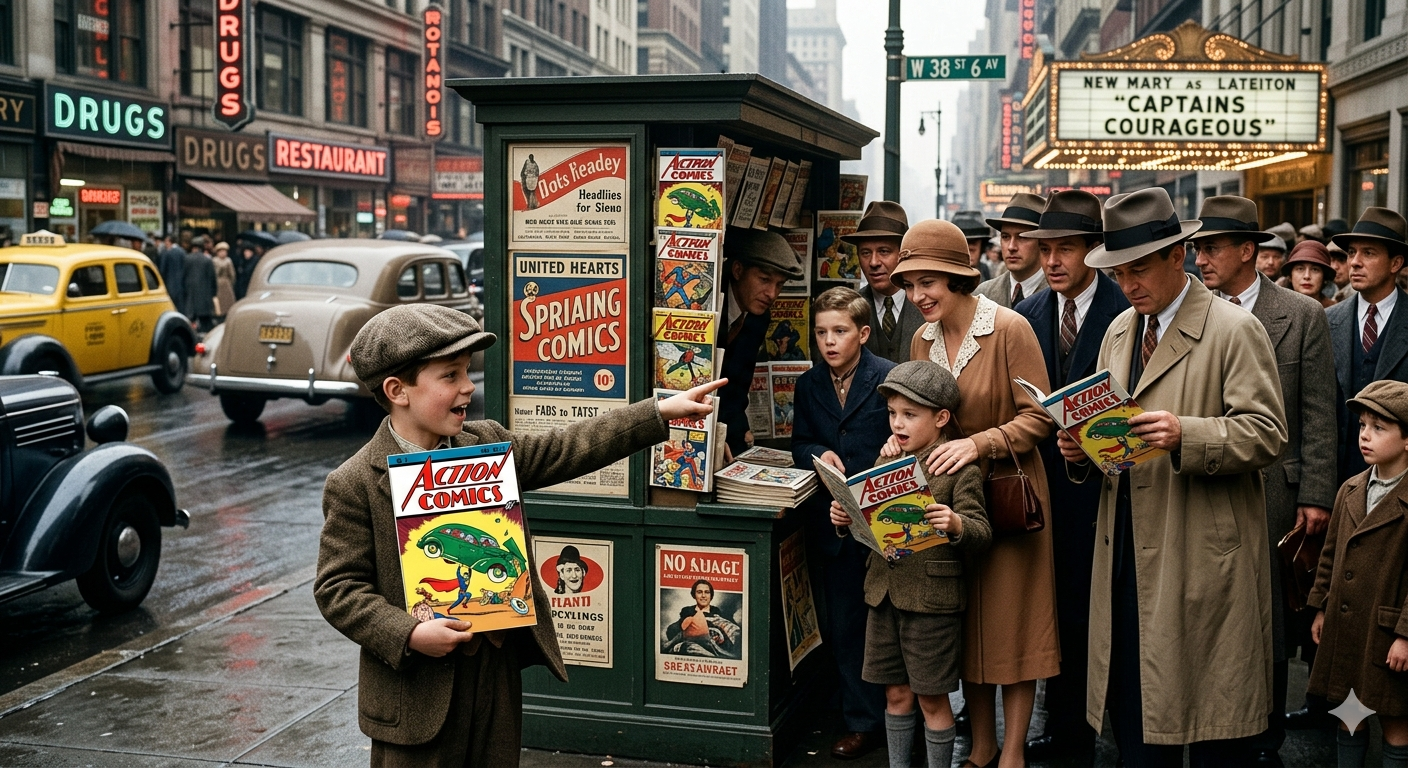
On April 18, 1938, a ten-cent comic book went on sale at newsstands and drugstores across America. Its cover showed a caped figure in a red-and-blue costume lifting a green automobile over his head while terrified men scrambled away from the wreckage. The figure was unlike anything American readers had encountered before. His name was Superman.
That issue, Action Comics Number One, published by National Allied Publications, would go on to become the most valuable comic book in the history of the medium, a single copy eventually selling for more than three million dollars. More importantly, it launched an entirely new genre of storytelling that would define American popular culture for the next century. Every superhero who followed, from Batman to Spider-Man to Wonder Woman, owes their existence to those thirteen cheaply printed pages.
The story of how Superman reached that newsstand, however, begins not in a publisher’s office but in a suburb of Cleveland, Ohio, in the early 1930s, with two shy Jewish teenagers who could not stop dreaming.
Jerry Siegel and Joe Shuster: The Two Teenagers Who Invented the Superhero
Jerry Siegel was born on October 17, 1914, in Cleveland, Ohio, the son of Lithuanian Jewish immigrants. His father, Mitchell Siegel, ran a small clothing store. In 1932, Mitchell Siegel died of a heart attack during a robbery at the store. Jerry was seventeen years old, and the loss was devastating. Later historians would note that the earliest sketches of Superman’s powers show him saving a man at gunpoint, and that the figure being rescued bore a striking resemblance to his father.
Joe Shuster was born on July 10, 1914, in Toronto, Canada, to Dutch and Ukrainian Jewish immigrants, and had moved with his family to Cleveland by the time he was a teenager. He had been a paperboy for the Toronto Star, a connection that would later give Clark Kent’s newspaper its original name, the Daily Star.
The two met at Cleveland’s Glenville High School around 1930 and formed an immediate friendship rooted in shared obsessions: science fiction pulp magazines, newspaper comic strips, and the dream of creating something that would last. They began publishing a small amateur magazine together called Science Fiction, a stapled, mimeographed pamphlet that contained Shuster’s drawings and Siegel’s stories written under various pseudonyms. Only five issues were produced. A copy sold in 2018 for $50,000.
In January 1933, Siegel wrote a short prose story for the magazine titled “The Reign of the Superman,” illustrated by Shuster. The story’s Superman was not a hero. He was a bald villain with telepathic powers, a menacing figure bent on domination, vaguely reminiscent of the villain Ming the Merciless from the Flash Gordon strips the two admired. The story did not sell.
Over the next year, Siegel reconceived the character completely. The villain became a hero. The telepath became a physically powerful champion of the oppressed. The concept was reimagined as a newspaper comic strip about an alien sent to Earth from a more advanced civilization, raised by ordinary Americans, who used his extraordinary abilities to fight injustice. By 1934 or 1935, Siegel and Shuster had the essential Superman most people would recognize today: the costume, the cape, the secret identity as a mild-mannered reporter, the city of Metropolis, and the love interest, Lois Lane.
Six Years of Rejection: The Long Road to Publication
What followed was six years of rejection. Siegel and Shuster submitted their Superman strips to newspaper syndicates and publishers repeatedly, and were turned away each time. Some editors were skeptical of the concept of a superhuman hero. Others worried about lawsuits because of perceived similarities to a character in Philip Wylie’s 1930 science fiction novel Gladiator, which featured a man of extraordinary strength. The strips gathered dust in envelopes and were resubmitted, revised, and resubmitted again.
By 1935, the two had found some work with National Allied Publications, which was then publishing New Fun Comics and other titles under the management of Malcolm Wheeler-Nicholson. They contributed strips including “Henri Duval” and “Doctor Occult,” and also “Slam Bradley” for the new Detective Comics title. Wheeler-Nicholson showed their Superman material to contacts but could not place it. He offered to publish it in one of his own magazines in October 1935, but the deal never materialized.
The decisive moment came in early 1938. Wheeler-Nicholson, the original founder of National Publications, had accumulated enormous debts to his business partners Harry Donenfeld and Jack Liebowitz, who had been financing his operation. In early January 1938, Donenfeld and Liebowitz had Wheeler-Nicholson’s company declared bankrupt and seized it. They now controlled National Publications and its upcoming titles, including a new anthology magazine they had planned to call Action Comics.
Editor Vin Sullivan was tasked with assembling content for the first issue of Action Comics on an extremely tight deadline. He had adventurer stories, a magician feature called Zatara, and various other pieces, but needed a compelling lead feature. He reached out to a former colleague named Sheldon Mayer, who happened to have seen Siegel and Shuster’s Superman strips while working at a syndicate that had recently rejected them. Mayer retrieved the strips and showed them to Sullivan.
Sullivan was interested. He contacted Siegel and Shuster and told them that if they could adapt their newspaper strips into thirteen pages of comic book format, he would buy them. Siegel and Shuster cut, pasted, rewrote, and redrawn the strips into the required format and submitted them in late February 1938. They were paid ten dollars per page, a total of $130 (roughly equivalent to $3,000 in today’s terms). In early March 1938, at Liebowitz’s request, they signed a contract transferring the copyright of Superman to Detective Comics, Inc. This was standard practice in the industry. They did not know what they were giving away.
April 18, 1938: Action Comics Number One Goes on Sale
The first issue of Action Comics was published on April 18, 1938, with a cover date of June 1938, because comic books of the era were routinely dated several months ahead to maximize newsstand time. The print run was approximately 200,000 copies.
The cover, chosen by Liebowitz from available options, was one of the most arresting images that had ever appeared on a newsstand rack. Superman stood with his knees slightly bent, his cape billowing, a green automobile raised above his head as if it weighed nothing. Two men fled in terror. A third lay on the ground, apparently unconscious. Nothing about the image required explanation. The character’s power and the visual dynamism of the scene communicated everything a potential buyer needed to know in a fraction of a second. Liebowitz would later say that his selection of that cover was “pure accident based on deadline pressure” and that he simply wanted something “thrilling.”
The thirteen pages that followed were titled “Superman, Champion of the Oppressed.” The story begins with a condensed origin: a scientist on a distant planet about to be destroyed sends his infant son in a hastily devised space ship to Earth, where a passing motorist discovers the baby and delivers him to an orphanage. The child, who will become Clark Kent, immediately demonstrates superhuman strength by lifting a heavy chair one-handed, astounding the orphanage staff.
When Clark reaches maturity, he discovers he can leap one-eighth of a mile, hurdle twenty-story buildings, raise tremendous weights, outrun a train, and that “nothing less than a bursting shell could penetrate his skin.” He creates the persona of Superman, dons his costume, and begins fighting for justice.
The story that follows is startlingly socially conscious by the standards of mass entertainment in 1938. Superman rescues a woman about to be wrongly executed for murder, ties up the real murderer, and leaves her on the Governor’s lawn with a signed confession. He stops a wife-beater whose knife shatters harmlessly against Superman’s skin. He rescues Lois Lane from gangsters who have abducted her after she rebuffed one of them at a nightclub. He travels to Washington, D.C. to investigate a senator he suspects of corruption, forcing a terrified confession by leaping around high buildings with the man dangling in his arms.
Lois Lane appears in the story as Clark Kent’s colleague at the Daily Star. Clark invites her on a date; a gangster named Butch Matson tries to cut in; Clark, protecting his secret identity, pretends to be a cowardly weakling and lets Lois slap Butch and walk out on him in disgust. This planted the seeds of the love triangle between Clark, Lois, and Superman that would power the mythology for decades.
The issue also featured other characters, including the magician Zatara and a cowboy strip called Chuck Dawson, but as the Action Comics series continued and its sales were analyzed, it became clear that readers were coming back for Superman.
The Publisher’s Surprise: How Superman Took Over Action Comics
Sales of Action Comics Number One were strong, but it took several months for National Publications to realize that the Superman story was the reason. By issue seven, when Superman appeared on the cover for the first time since the debut, sales doubled. Within a year, the series was approaching one million copies sold per month. Liebowitz had a sensation on his hands that would reshape his business entirely.
Superman got his own standalone comic book, simply titled Superman, in the summer of 1939. That same year, a daily newspaper strip began syndication through the McClure Newspaper Syndicate, the very organization that had rejected Superman years earlier. On February 12, 1940, The Adventures of Superman premiered on the Mutual Radio Network, bringing the character to millions of American homes and introducing elements that would become permanent parts of the mythology: the voice of announcer Jackson Beck declaring “Faster than a speeding bullet! More powerful than a locomotive! Able to leap tall buildings in a single bound!”
The Fleischer Studios produced a celebrated series of Superman animated shorts between 1941 and 1943 that remain among the finest examples of the art form. A live-action film serial followed in 1948. The television series Adventures of Superman, starring George Reeves, ran from 1952 to 1958 and cemented the character’s place in American domestic life. In 1978, director Richard Donner’s Superman: The Movie, starring Christopher Reeve as Superman and Margot Kidder as Lois Lane, became a landmark of cinema and proved that superhero stories could sustain serious, large-scale dramatic films.
The Wikipedia entry on Superman provides a comprehensive overview of the character’s history across media, from his 1938 debut to his modern incarnations, available at the Wikipedia entry on Superman.
What Superman Was in 1938: The Depression-Era Champion of the Oppressed
The Superman who appeared in Action Comics Number One in 1938 was a significantly different figure from the nearly omnipotent demigod he would eventually become. He could not fly; he jumped, covering an eighth of a mile in a single leap. He could not shoot laser beams from his eyes or freeze things with his breath. His skin could not be penetrated by ordinary weapons, but it was not yet the near-impenetrable surface it would become. He was powerful, but he was not yet invincible.
More strikingly, he was explicitly political in a way the later Superman rarely was. The story in Action Comics Number One directly confronted corrupt politicians, domestic violence, gangsterism, and the arbitrary exercise of power over ordinary people. Siegel and Shuster had created a figure for the Great Depression, a moment when millions of Americans felt powerless against forces of economic devastation, political corruption, and social injustice that seemed completely beyond individual control. Superman gave readers the fantasy of a champion who could not be bought, could not be stopped, and would not allow the powerful to victimize the helpless.
Siegel and Shuster were children of Jewish immigrants who had watched anti-Semitism spreading across Europe and found expression in nativist movements in America. Their Superman was a figure who championed the persecuted and fought back against bullies at every scale, from the wife-beater in a domestic dispute to the corrupt senator in Washington. The Nazi SS newspaper Das Schwarzes Korps would later denounce Superman as a Jewish propaganda tool. That denunciation, whatever its malign intent, accurately identified the character’s origins in the experiences and values of two young Jewish men from Cleveland.
The Rights Battle: Siegel, Shuster, and the Price of Creation
The $130 that Siegel and Shuster received for Action Comics Number One was not payment for the copyright to Superman. The copyright they gave away for free in the March 1938 contract, as was standard industry practice. They were paid $10 per page for the thirteen pages of story and art they delivered. The copyright transfer was a separate matter, one whose full implications neither they nor their publishers clearly understood at the time.
As Superman became an industry unto itself, generating revenue from comics, newspaper strips, radio, film, and merchandise, Siegel and Shuster’s financial position remained modest. They were under a contract requiring them to work exclusively for the company at $35 per page, with a share of net profits. When their contract ended in 1948, they sued to recover the copyright. They received a settlement of $100,000 but lost the case and their jobs, and were barred from any further involvement with Superman.
Their names were removed from the byline. Joe Shuster, whose eyesight was failing severely, found it almost impossible to find illustration work. Siegel continued writing comics under various names, never recapturing the success of his greatest creation. Both men lived in relative obscurity and economic difficulty through the 1950s and 1960s while the character they had created generated hundreds of millions of dollars for the corporation that owned it.
The situation became a cause célèbre in 1975 when Siegel, Shuster, and other creators publicly campaigned for better treatment through the National Cartoonists Society and the Cartoonists Guild. As the production of the 1978 Superman film generated enormous publicity and as news reports brought the creators’ difficult circumstances to public attention, Warner Communications, which now owned National Periodicals, agreed to terms. In December 1975, the company agreed to pay each man $20,000 per year for the remainder of his life, provide full health benefits, and credit their names on all future Superman productions.
Joe Shuster died on July 30, 1992. Jerry Siegel died on January 28, 1996. Their names now appear on every Superman product, preceded by the line “Superman created by Jerry Siegel and Joe Shuster,” a credit that was eventually amended to add “By special arrangement with the Jerry Siegel family.”
Action Comics Number One Today: The Most Valuable Comic Book in the World
Of the 200,000 copies of Action Comics Number One that were printed in 1938, experts estimate that between 50 and 100 copies survive in any condition. Most have significant wear from being read, shared, rolled up, and discarded by children who had no idea they were holding history in their hands. Only a handful are in high-grade condition.
On August 24, 2014, a copy graded 9.0 out of 10 by the Certified Guaranty Company sold on eBay for $3,207,852, the first comic book to sell for more than three million dollars. That same copy, graded and certified, represents one of the most extraordinary returns on a ten-cent investment in commercial history.
The issue that contained Superman’s debut is accessible in reprint form through DC Comics’ official facsimile editions, and the full history of the character’s publication is documented at the Wikipedia entry on Action Comics Number One.
The Legacy of Superman’s First Appearance: A Genre, a Mythology, and a Cultural Institution
Superman’s debut in Action Comics Number One established every major convention of the superhero genre. The secret identity, the extraordinary powers used in service of justice, the costume that symbolizes the character’s values, the city that serves as the hero’s home, the supporting cast that grounds the fantasy in human relationships: all of these were present in that first thirteen-page story or established within a year.
Every superhero who followed drew on that template. Batman debuted in Detective Comics in 1939, just over a year after Superman. Wonder Woman appeared in 1941. Captain America was created by Jack Kirby and Joe Simon in 1941, partly inspired by the wave of superhero publishing that Superman had triggered. The entire Marvel Comics superhero universe, from Spider-Man to the Avengers, would not exist without the commercial and creative precedent of those thirteen pages in Action Comics Number One.
More than 80 years after that ten-cent comic appeared on newsstands, Superman remains one of the most recognized fictional characters on Earth. His red-and-blue costume, the stylized S shield on his chest, the flowing cape: these are global symbols understood by people who have never read a comic book and never seen a superhero film. The name Clark Kent is understood in dozens of languages as shorthand for hidden greatness beneath an ordinary exterior.
The Ohio History Connection has preserved the story of how Clark and Superman emerged from Cleveland’s Glenville neighborhood, with details available at the Ohio History Connection’s article on the creation of Superman.
Two teenagers in Depression-era Cleveland, dreaming of a character who would stand up to bullies and protect the powerless, created something that would outlast everything they could have imagined. The dime paid for Action Comics Number One on April 18, 1938 bought the world its first superhero and the template for a mythology that shows no signs of ending.