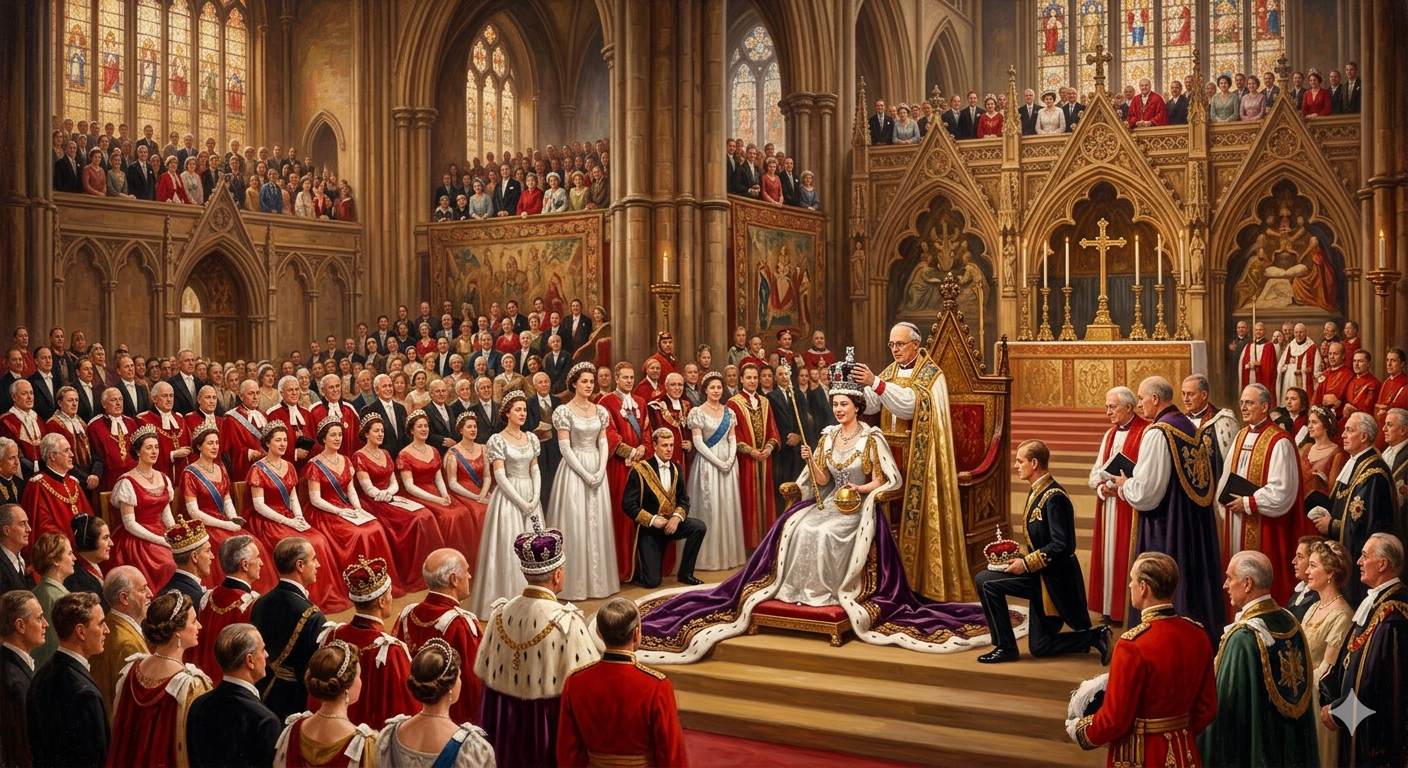
On June 2, 1953, a twenty-seven-year-old woman was driven through the streets of London in a gilded coach drawn by eight grey gelding horses while three million people stood in the rain to catch a glimpse of her passing. At Westminster Abbey, 8,251 invited guests from across the Commonwealth and the world were packed into tiered seating built specifically for the occasion. Another 27 million people across Britain watched on television, many having purchased or rented television sets for the first time in their lives. Tens of millions more watched across North America, Australia, and the rest of the world.
Queen Elizabeth II was crowned the thirty-ninth sovereign and sixth queen to be crowned at Westminster Abbey, in a ceremony rooted in traditions stretching back nearly a thousand years to the coronation of William the Conqueror in 1066. It was the first British coronation ever to be televised. It was also, by any measure, one of the most watched events in human history up to that point. And the Queen herself, overruling the objections of her Prime Minister, had insisted it be televised.
From Princess to Queen: The Accession That Preceded the Crown
Elizabeth Alexandra Mary Windsor was born on April 21, 1926, in London, the first child of Prince Albert, Duke of York, and his wife Lady Elizabeth Bowes-Lyon. She was not born to be queen. At the time of her birth, her grandfather King George V sat on the throne, her uncle David was next in line as Prince of Wales, and her father was the second son, expected to live a quiet royal life outside the direct succession.
Everything changed in 1936. When George V died in January of that year, Elizabeth’s uncle became King Edward VIII. But Edward’s determination to marry Wallis Warfield Simpson, an American divorcee, made his position untenable. On December 10, 1936, Edward VIII abdicated in one of the most extraordinary acts in modern royal history, renouncing the throne voluntarily for the woman he loved. Elizabeth’s father was proclaimed King George VI in his place. Overnight, the ten-year-old Elizabeth became heir presumptive to the British throne.
She watched her father’s coronation in 1937 as an eleven-year-old child, sitting beside her mother in the Abbey, witnessing for the first time the ceremony that would one day be performed for her. She served in the Auxiliary Territorial Service during the Second World War, training as a driver and mechanic, and in 1947 married her distant cousin Lieutenant Philip Mountbatten, a former Prince of Greece and Denmark who renounced his foreign titles and was created Duke of Edinburgh on the eve of the wedding. Their first son, Charles Philip Arthur George, was born on November 14, 1948.
King George VI’s health deteriorated steadily through the early 1950s. In January 1952, too ill to undertake a planned Commonwealth tour himself, he dispatched Princess Elizabeth and Prince Philip in his place. On February 6, 1952, Elizabeth was in Kenya, staying at Treetops Lodge observing wildlife, when word reached her that her father had died in his sleep at Sandringham. She was twenty-five years old. She flew home to Britain as Queen Elizabeth II.
Planning a Coronation: Sixteen Months of Preparation
The period between accession and coronation was deliberately long by tradition: a new sovereign’s coronation could not follow too quickly on the mourning period for the predecessor. June 2, 1953, was chosen as the coronation date, giving planners sixteen months to prepare an event of extraordinary complexity.
The 16th Duke of Norfolk, Bernard Fitzalan-Howard, served as Earl Marshal and was responsible for organizing the entire ceremony. This was a role with deep historical precedent, as the Earl Marshal has presided over coronations for centuries. A Coronation Committee was established, and the preparations were meticulously detailed.
Westminster Abbey itself closed to the public on January 1, 1953, and would not reopen for five months. A workforce of approximately 200 people, working under the Ministry of Works, transformed the interior. They constructed a theatre under the lantern where the throne for the Homage would be placed, built tiered seating for 8,251 guests in the transepts and nave, created a Royal Gallery, added staircases, and built an annexe outside the west entrance to marshal the ceremonial processions. More than two thousand square yards of carpet were laid. Outside, stands for 96,000 spectators were built along the procession route.
Queen Mary, the eighty-five-year-old grandmother of Elizabeth II, died on March 24, 1953, just ten weeks before the coronation. In her will, she had explicitly stated that her death should not be allowed to affect the coronation’s planning or timing. The event went ahead as scheduled.
Elizabeth herself prepared rigorously for the ceremony. She wore the Imperial State Crown around Buckingham Palace during ordinary activities, including at her desk and during tea, so that she could grow accustomed to its considerable weight. She attended two full rehearsals at Westminster Abbey on May 22 and May 29. The Duchess of Norfolk stood in for the Queen at other rehearsals. Maids of Honor practiced handling the long velvet train.
The cost of the coronation was estimated at approximately £1.57 million, equivalent to roughly £53 million in contemporary terms, covering the stands and decorations, state coach repairs, outfits, security, and alterations to the Queen’s regalia.
The Television Debate: Elizabeth’s Decision That Changed Broadcasting
One of the most consequential decisions of the coronation planning was also one of the most unexpected controversies. Prime Minister Winston Churchill, together with much of the Cabinet, strongly opposed the idea of allowing television cameras inside Westminster Abbey. The concerns ranged from the dignity of the ceremony to worries that intimate moments in the service, particularly the anointing, might be treated as entertainment. Churchill argued firmly against televising the coronation.
Elizabeth refused his advice. She insisted that the coronation be broadcast on television, making herself clear on the matter against the combined resistance of her Prime Minister and Cabinet. It was one of the first significant assertions of her independent judgment as a reigning sovereign, and it proved to be a profoundly important decision for both the monarchy and the history of broadcasting.
The BBC had not been permitted inside Westminster Abbey for the previous coronation in 1937. Now, for the first time, television cameras would transmit the ceremony live from inside the Abbey. The number of television licence holders in Britain doubled in the months before the coronation, from approximately one and a half million to three million, as families across the country purchased or rented sets specifically to watch the event. Schools in Britain closed so children could watch. In Canada and the United States, the broadcast was shown in color on some networks, and schools also closed to allow students to see history in real time.
By the time the ceremony ended, an estimated 27 million people in Britain and 85 million in North America had watched the coronation on television. As historian Ariane Chernock of Boston University noted, before 1953 the coronation ceremony had been essentially private, witnessed only by those who could fit inside Westminster Abbey. Elizabeth’s decision to invite the world in through television cameras transformed the institution permanently.
June 2, 1953: The Coronation Service
On the morning of June 2, 1953, London was wet and grey, but nothing could diminish the atmosphere. The crowds that had been gathering for days along the procession route stood packed and expectant in the rain. Westminster Abbey was opened at 6 a.m. to the first of the invited guests.
Elizabeth and Prince Philip left Buckingham Palace in the Gold State Coach at approximately 10:26 a.m. The coach was pulled by eight grey gelding horses named Cunningham, Tovey, Noah, Tedder, Eisenhower, Snow White, Tipperary, and McCreery. On her way to the Abbey, the Queen wore the George IV State Diadem, the diamond circlet she would subsequently wear for the State Opening of Parliament throughout her reign. The Diadem contains 1,333 diamonds and 169 pearls.
The Queen and the Duke arrived at the Royal Entrance to Westminster Abbey at 11 a.m., where they were met by the Earl Marshal, the Great Officers of State, and the Archbishops of Canterbury and York. At 11:15 a.m., Elizabeth joined the procession through the nave and choir to her Chair of Estate near the Altar, accompanied by the choir singing the anthem under the direction of Dr. William McKie, the Abbey’s Organist.
The ceremony was conducted by Dr. Geoffrey Fisher, the Archbishop of Canterbury, and lasted almost three hours. It proceeded through six historic phases. The first was the Recognition, in which the Archbishop presented the Queen to the congregation on all four sides of the theatre, asking if they would do homage to her. The assembly responded with shouts of “God Save Queen Elizabeth.” Second came the Oath, in which the Queen swore to govern her peoples according to their laws and customs, to cause law and justice and mercy to be executed, and to maintain the Church of England.
The third and most sacred element was the Anointing. Elizabeth sat in the ancient St. Edward’s Chair, made for Edward I in 1300 and used at every coronation since. A cloth of gold canopy was held over her by the four Knights of the Garter, shielding this most intimate moment from the television cameras. The Archbishop anointed her palms, breast, and head with holy oil. The oil recipe was secret, but for this coronation it was known to contain essences of orange flowers, roses, jasmine, and cinnamon, prepared at Savory and Moore Ltd.
The fourth phase was the Investiture, in which the Queen received the royal regalia: the Coronation Ring known as the Wedding Ring of England, made for William IV’s coronation in 1831; the golden Spurs; the Sword of State; the Armills, or golden bracelets; the Stole Royal; and the Orb. She was then clothed in the Colobium Sindonis and the Supertunica, the coronation robes.
Then came the crowning itself: the Archbishop took St. Edward’s Crown, a solid gold crown made in 1661, blessed it at the Altar, and placed it on the head of Elizabeth II. The moment the crown settled on her head, the peers and peeresses in the Abbey put on their own coronets and coronets, trumpets sounded, and a 62-gun salute was fired from the Tower of London. Prince Philip, as the first peer to do homage, knelt before his wife and pledged his loyalty.
The sixth phase was the Homage, in which the peers of the realm paid personal tribute to their sovereign.
The ceremony complete, Elizabeth left Westminster Abbey wearing the lighter Imperial State Crown and carrying the Sceptre with the Cross and the Orb, while the assembled guests sang the National Anthem. She left through the choir and nave to the West Door, beginning the return journey to Buckingham Palace.
The Royal Family’s official account of the coronation, covering the ceremony’s traditions and significance, is available at the Royal Family’s official coronation page.
The Coronation Dress and the Norman Hartnell Design
Elizabeth’s Coronation Dress was designed by Sir Norman Hartnell, the leading British fashion designer of the era and the designer of her 1947 wedding dress. The dress was made of white satin and embroidered with the emblems of the Commonwealth nations: the Tudor rose of England, the thistle of Scotland, the shamrock of Ireland, the leek of Wales, the wattle of Australia, the maple leaf of Canada, the fern of New Zealand, the protea of South Africa, the lotus flower of India and Ceylon, and the wheat of Pakistan. The embroidery incorporated hundreds of precious and semi-precious stones. The dress became one of the most celebrated works of British fashion design of the twentieth century.
The Coronation Gown weighed a considerable amount and its 14-foot purple velvet coronation robe was held by six Maids of Honor. The Queen wore the Coronation Necklace, a piece commissioned by Queen Victoria and worn by Queens Alexandra, Mary, and Elizabeth the Queen Mother at their respective coronations, paired with the Coronation Earrings.
The Coronation Day That Carried Extra Magic: Everest and the Celebrations
June 2, 1953, carried an extraordinary coincidence that seemed, to many at the time, almost providential. On the morning of the coronation, news reached London that Edmund Hillary and Tenzing Norgay had successfully reached the summit of Mount Everest on May 29, the first human beings to stand on the highest point on Earth. The announcement was carried by The Times in its coronation morning edition and spread immediately through the waiting crowds. The conquest of Everest and the crowning of a new queen felt, in the atmosphere of the day, like twin announcements of a new Elizabethan age.
The Queen later presented the 14 members of the Everest expedition with special Coronation Medals bearing the additional inscription “Mount Everest Expedition.”
After the ceremony, the return procession wound through a five-mile route through central London. The procession included more than 10,000 soldiers and Commonwealth troops, including the Royal Canadian Mounted Police who received a particular cheer from the rain-soaked crowds. Queen Salote of Tonga became one of the most beloved figures of the day for riding in an open carriage through the rain with cheerful good humor, waving to the crowds and refusing the shelter of a closed carriage.
At Buckingham Palace, the Queen and the Duke of Edinburgh appeared repeatedly on the balcony to vast crowds below. Official photographs were taken inside the palace, with the most celebrated taken by Cecil Beaton, who posed the Queen before a backdrop depicting Henry VII’s Chapel. That evening, on radio, the Queen broadcast to the Commonwealth, pledging her dedication to the service of her peoples.
The Westminster Abbey’s own comprehensive account of the coronation preparations, traditions, and ceremony is available at the Westminster Abbey’s Elizabeth II page.
The Legacy of the 1953 Coronation: A Reign of Record and Meaning
The coronation of June 2, 1953, launched the longest reign in British royal history. Elizabeth II went on to serve as monarch for seventy years, until her death on September 8, 2022, at Balmoral Castle at the age of ninety-six. In 2015, she surpassed Queen Victoria to become the longest-reigning British monarch, and she became the world’s longest-reigning living monarch. She celebrated the Platinum Jubilee of her coronation in 2022, the first British sovereign to reach that milestone.
The coronation itself became the template against which all subsequent coronations would be measured. Its decision to open the ceremony to television transformed the relationship between the monarchy and its subjects, making the rituals of royal succession accessible to millions who had never before been able to witness them. The 1953 broadcast demonstrated that the ancient ceremony of crowning a sovereign need not be diminished by mass viewing; if anything, it was deepened.
The Wikipedia article on the coronation of Elizabeth II provides an exhaustive scholarly and documentary account of the event and its preparations, available at the Wikipedia entry on the Coronation of Elizabeth II.
On September 8, 2022, when Elizabeth II died, the rites of succession that had been set in motion by her own coronation sixty-nine years before were set in motion again for her eldest son. King Charles III was crowned in a ceremony at Westminster Abbey on May 6, 2023, in a building and a ceremony that, like everything else, bore the enduring imprint of what had happened there on June 2, 1953.