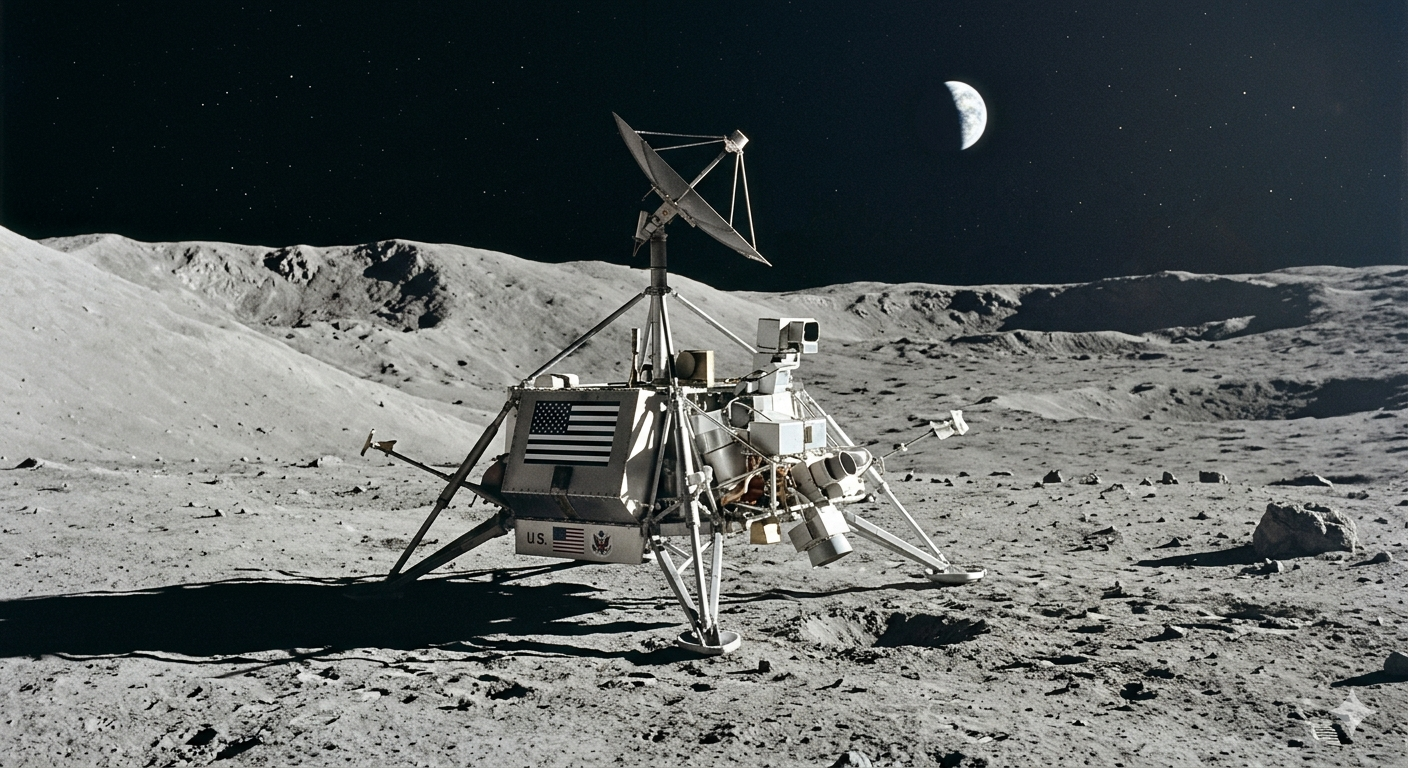
On June 2, 1966, at 06:17:36 Universal Time, a three-legged spacecraft settled gently onto the surface of the Moon in the southwestern region of the Ocean of Storms, touching down just nine miles from its intended target. No human being was on board. The spacecraft had traveled 240,000 miles from Earth in 63 hours and 30 minutes, guided by radar and rocket engines, and had just accomplished something no American machine had ever done before.
Surveyor 1 had made the first successful American soft landing on any extraterrestrial body in the history of the space program. It was the first attempt. It worked perfectly. Thirty-six minutes after landing, it sent its first photograph back to Earth.
The Moon had been reached before, but reaching it gently was an entirely different challenge. Surveyor 1 answered one of the most urgent scientific questions of the Space Race, demonstrated that the Moon’s surface was firm enough to support a crewed spacecraft, and paved the road to Apollo 11 three years later.
Why a Soft Landing Mattered: The Lunar Dust Problem
Before Surveyor 1, one of the most serious concerns among scientists and engineers planning the Apollo Moon landings was a deceptively simple question: what is the surface of the Moon actually like? The answer was not at all obvious in the early 1960s, and the uncertainty was not trivial. Several prominent scientists, including Cornell astronomer Thomas Gold, had proposed that the lunar surface might be covered by a deep layer of fine dust accumulated over billions of years of micrometeorite bombardment. If that dust was deep enough and loose enough, a landing spacecraft or an astronaut stepping onto the surface might simply sink and disappear.
This was not a fringe concern. It was taken seriously enough to shape the entire design philosophy of the American lunar program. Before human beings could safely land on the Moon, engineers needed proof that the surface could bear the weight of a spacecraft. They needed photographs of what the terrain actually looked like at ground level. They needed measurements of soil bearing strength, temperature ranges, and radar reflectivity. Orbital photographs from high above could tell you only so much. What NASA needed was a spacecraft that could land, survive, and send back data from the surface itself.
That need produced the Surveyor program.
The Surveyor Program: Hughes Aircraft, JPL, and the Road to the Moon
In January 1961, NASA selected the Hughes Aircraft Company of Culver City, California, to design and build a series of seven robotic soft-landing spacecraft for the lunar surface. The contract specified vehicles that would weigh approximately 750 pounds at landing, be capable of soft-landing gently on the Moon, perform chemical and physical analyses of the lunar surface, and relay television pictures of lunar features back to Earth.
The technical direction of the entire Surveyor program was assigned to NASA’s Jet Propulsion Laboratory in Pasadena, California. JPL had already demonstrated its capabilities in deep space missions and planetary exploration and was the natural choice to manage the most complex robotic lunar program the United States had yet attempted. The vehicles would be launched by the Atlas-Centaur rocket, a powerful combination that gave the spacecraft enough velocity to fly directly to the Moon without entering a parking orbit around Earth first.
The program was conceived in the same period that NASA was accelerating the Apollo program following President John F. Kennedy’s 1961 commitment to land Americans on the Moon before the end of the decade. Every Surveyor mission was therefore both a technological objective in its own right and a direct preparation for human spaceflight. The landing sites chosen for Surveyor missions, with one exception, were sites being actively considered as Apollo landing targets.
The total cost of the Surveyor program across all seven missions was $469 million. Surveyor 1 was the first mission in the series and was formally designated an engineering test flight, meaning its primary purpose was to prove that the hardware and systems worked as intended, rather than to return maximum scientific data.
The Spacecraft: Engineering Details of Surveyor 1
Surveyor 1 was built around a 60-pound aluminum triangular structure, approximately ten feet tall. Three legs extended from the corners of the triangular frame, each fitted with a footpad designed to absorb the shock of landing and spread the spacecraft’s weight across the lunar soil. Strain gauges on each leg’s shock absorber were designed to measure the peak forces at touchdown, providing direct data on the bearing strength of the surface. Over 100 engineering sensors were distributed throughout the spacecraft, monitoring temperatures, voltages, pressures, and mechanical stresses throughout the flight and surface operations.
The spacecraft carried a single television camera capable of taking both wide-angle and narrow-angle still photographs of the lunar surface. The camera was equipped with a filter wheel containing red, green, and blue filters, which allowed engineers on Earth to reconstruct color images of the lunar surface from three separate exposures through each filter. The camera could resolve details down to one millimeter at a distance of four meters, meaning it could capture the texture of individual grains of lunar soil if they were large enough.
Surveyor 1’s propulsion system used a main solid-propellant retrorocket engine for the primary deceleration from high speed, supplemented by three liquid-fueled vernier engines for final approach guidance and attitude control. The spacecraft was solar-powered, with a solar panel generating electricity to charge batteries. This had an important implication for the mission: during the two-week-long lunar night, when the Moon’s surface faces away from the Sun, Surveyor 1 would have no power source and would have to survive the extreme cold without functioning.
At launch, Surveyor 1 had a mass of 995.2 kilograms, or approximately 2,194 pounds. After consuming propellant during the descent and jettisoning its retrorocket and radar altimeter system at altitude, the spacecraft arrived on the lunar surface weighing approximately 294.3 kilograms, or 649 pounds.
May 30, 1966: Launch from Cape Kennedy
Surveyor 1 lifted off from Complex 36-A of the Eastern Test Range at Cape Kennedy, Florida, at 14:41:00 Universal Time on May 30, 1966, within one second of its planned launch time. The Atlas-Centaur rocket boosted the spacecraft directly onto a lunar intercept trajectory without any intermediate parking orbit around Earth, a trajectory design that required precise calculation but reduced flight time and complexity.
Two-way communication lock with the spacecraft was achieved 28 minutes after liftoff by the Deep Space Network station in Johannesburg, South Africa. Control of the mission transferred from the Eastern Test Range to the Space Flight Operations Facility at JPL in Pasadena, California. A minor anomaly was noted early in the flight when one of the two omnidirectional antennas, Antenna A, could not be confirmed as fully deployed. Commands were transmitted to resolve the issue but telemetry showed no change. The concern was noted but judged not to threaten the mission.
At 06:45 Universal Time on May 31, a midcourse correction maneuver was executed to refine the spacecraft’s trajectory. The original aiming point had been at 3.25 degrees south latitude and 43.83 degrees west longitude in the southwestern Ocean of Storms. After analysis by the Surveyor space science analysis team at JPL, the target was shifted approximately one degree northward to a location considered more likely to offer a smooth and safe landing surface. The revised target coordinates were 2.33 degrees south latitude and 43.83 degrees west longitude.
The NASA JPL news archive documenting the original Surveyor 1 landing and its immediate results is available at the JPL Surveyor 1 landing news page.
June 2, 1966: The Descent and the First American Soft Landing
The terminal descent sequence began when Surveyor 1 was approximately 75.3 kilometers above the lunar surface, traveling at 2,612 meters per second. At that point, the radar altimeter signaled the main retrorocket to ignite. The solid-propellant retrorocket burned for 40 seconds, dramatically reducing the spacecraft’s velocity, and was then jettisoned at an altitude of approximately 11 kilometers. The spacecraft was now traveling at approximately 110 meters per second, still far too fast to land safely.
The three vernier engines then took over, continuing to slow the descent under the guidance of the altimeter and Doppler radar systems. These engines provided the fine control needed to manage the final kilometers of descent while the spacecraft corrected its attitude and reduced speed to a safe landing velocity.
At a height of 3.4 meters above the lunar surface, the vernier engines were commanded off. Surveyor 1 fell the remaining 3.4 meters freely, without any thrust, and made contact with the Moon at approximately 3 meters per second. The spacecraft bounced once, as tracking data later confirmed, and settled onto the surface.
At 06:17:36 Universal Time on June 2, 1966, Surveyor 1 was on the Moon. The landing site was inside the Flamsteed P crater, a broad, relatively flat depression approximately 100 kilometers in diameter in the southwestern Oceanus Procellarum, or Ocean of Storms. The actual touchdown coordinates were 2.474 degrees south latitude and 43.339 degrees west longitude, just nine miles from the modified target point. The landing was described by mission controllers at JPL as a perfect three-point landing.
The concern about Antenna A was immediately resolved. Once on the surface, the signal strength from the antenna rose to normal levels. Whether it had deployed during the retrorocket firing or upon contact with the lunar surface remained unknown, but it was working.
Thirty-six minutes after landing, Surveyor 1 returned its first photograph from the lunar surface. The image showed parts of the spacecraft itself, one of its landing pads, and the dark soil of the Moon immediately surrounding it. The surface was clearly solid. The spacecraft had not sunk. The pad rested on firm ground.
What Surveyor 1 Found: Images, Data, and the Proof Apollo Needed
The data that began flowing back from Surveyor 1 in the hours and days after landing addressed every major question that had been driving the mission’s design.
The television camera began its systematic photographic survey of the surrounding terrain, capturing images across a full range of directions and distances. The panoramic views showed a landscape that was, for the most part, gently undulating, with a scattering of rocks and boulders of varying sizes. The camera resolved boulders more than one meter in size scattered around the crater interior. Crest lines of low mountains were visible on the distant horizon. The images confirmed that the Ocean of Storms was a relatively smooth, open area suitable for landing.
The strain gauges on the spacecraft’s three leg shock absorbers measured the forces at touchdown and provided the first direct measurement of the Moon’s surface bearing strength at a specific location. The data confirmed that the soil was firm enough to support a landing craft of Surveyor’s mass without significant sinking. The dust problem that had worried Thomas Gold and others was not a serious hazard at this site. A crewed spacecraft could land safely.
Surveyor 1 also collected data on the radar reflectivity of the lunar surface and measured temperatures throughout the spacecraft, providing information on the thermal environment that Apollo engineers would need to design spacecraft and spacesuits able to function across the lunar day-night temperature range.
Before the first lunar night began on June 14, 1966, Surveyor 1 had transmitted 10,338 high-resolution photographs. The images included wide-angle and narrow-angle panoramas, photometric surveys, special area studies, celestial photography, and images of the spacecraft’s own footpads resting on the surface, which provided direct visual evidence of how the surface material responded to the weight of the landing.
The NASA Science mission overview for Surveyor 1 provides the complete record of the mission’s technical objectives and scientific results, available at the NASA Science Surveyor 1 mission page.
Surviving the Lunar Night: A Spacecraft Beyond Expectations
When the first lunar night arrived on June 14, 1966, Surveyor 1’s solar panels ceased generating power. The spacecraft entered a dormant state, conserving its stored battery energy. Temperatures on the lunar surface during the night drop to approximately minus 173 degrees Celsius, a brutal cold that tests every electronic component and mechanical system aboard a spacecraft. The engineering team at JPL had designed the spacecraft to survive this environment, but they were not certain it would.
Initial attempts to reestablish contact with Surveyor 1 on June 28 proved unsuccessful, and there was real concern that the spacecraft had not survived the cold. Then, on July 6, the spacecraft responded to commands. It was alive. On July 7, Surveyor 1 resumed photography, transmitting an additional 618 images during its second lunar day of operations between July 7 and July 14.
After the second lunar sunset on July 13, Surveyor 1’s battery voltage dropped dramatically and mission operations effectively came to an end for science purposes. However, engineering interrogations of the spacecraft continued. On January 6, 1967, Surveyor 1 was reactivated for 12 hours and returned data on the motion of the Moon that helped refine measurements of the lunar orbital path and the Earth-Moon distance. Contact with the spacecraft was finally terminated on January 7, 1967.
In total, Surveyor 1 transmitted 11,237 to 11,240 still photographs over the course of its operational lifetime, a number that varied slightly depending on the source of the count. All mission objectives were accomplished. The spacecraft had operated well beyond its design life.
The Soviet Context: Luna 9 and the Space Race
Surveyor 1 was the first American spacecraft to soft-land on any extraterrestrial body, but it was not the first spacecraft from any nation to do so. That distinction belonged to the Soviet Union’s Luna 9 probe, which had made the world’s first successful soft lunar landing on February 3, 1966, approximately four months before Surveyor 1. Luna 9 had also returned photographs of the lunar surface from its landing site on the Ocean of Storms, providing the Soviet Union with the first ground-level photographic evidence of the Moon’s surface properties.
Surveyor 1’s landing came four months after Luna 9, placing the two programs at roughly parallel stages of development in the mid-1960s Space Race. The fact that Surveyor 1 succeeded on its very first attempt was widely noted in the American press and within NASA as a sign that the American lunar program had the technical depth to match the Soviet competition. The success was described at the time as surprising, particularly given the failure record of the earlier Ranger spacecraft program, which had been designed to photograph the Moon during impact approach and had experienced several significant failures before achieving its objectives.
The Surveyor Program’s Full Legacy and the Path to Apollo
Of the seven Surveyor spacecraft launched between 1966 and 1968, five completed successful soft landings: Surveyor 1, Surveyor 3, Surveyor 5, Surveyor 6, and Surveyor 7. Surveyor 2 crashed into the Moon on September 22, 1966, after a midcourse correction failure caused the spacecraft to tumble. Surveyor 4 failed during its terminal descent phase in July 1967 and was lost.
The five successful missions provided landing data from sites spread across the equatorial and mid-latitude regions of the Moon, building a picture of lunar surface conditions across different terrain types. Surveyor 5, which landed in September 1967, carried an alpha particle back-scatter instrument that provided the first direct chemical analysis of lunar soil, identifying it as basaltic in composition. Surveyor 7, the last mission, landed near the crater Tycho in January 1968 and provided data from a highland terrain distinctly different from the mare basalt plains examined by the earlier missions.
The Apollo program used Surveyor data directly in its mission planning. When Apollo 12 landed in November 1969, its landing site in the Ocean of Storms was chosen in part to be close to the Surveyor 3 spacecraft, which had been sitting on the surface since April 1967. Astronauts Charles Conrad and Alan Bean walked to the Surveyor 3 landing site and retrieved the spacecraft’s television camera and several other components, which were returned to Earth for analysis. The camera, now on display at the National Air and Space Museum in Washington, D.C., showed evidence of microorganism contamination, which subsequent investigation attributed to contamination before launch rather than any extraterrestrial biology.
All seven Surveyor spacecraft remain on the Moon where they landed. None of the missions included provisions for returning the vehicles to Earth.
The complete NASA history article on the 55th anniversary of the Surveyor 1 landing, covering the mission’s preparation and its connection to the Apollo program, is available at the NASA History 55 Years Ago: Surveyor 1 Makes a Soft Landing on the Moon.
Surveyor 1 demonstrated that the Moon was reachable, that its surface was stable, that American engineering could deliver a spacecraft to the lunar surface with precision, and that the photographs and data needed to plan a human landing could be returned successfully. Three years and eight days after Surveyor 1 touched down in the Ocean of Storms, Apollo 11 landed in the Sea of Tranquility, and Neil Armstrong stepped onto the lunar surface. The path that led to that moment ran directly through the data that a three-legged robot had gathered for the world on June 2, 1966.