
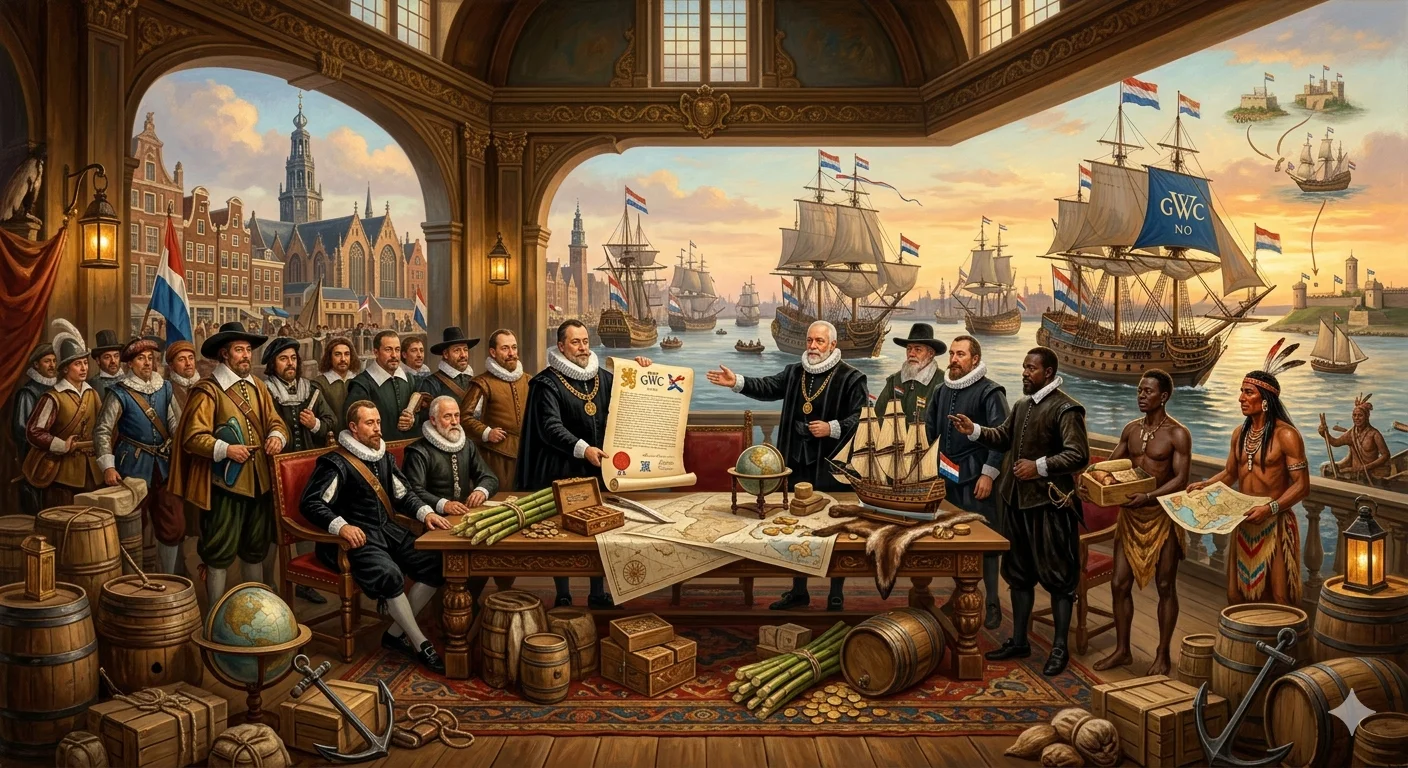
On June 3, 1621, the States-General of the Dutch Republic, the governing parliament of the United Provinces of the Netherlands, issued a charter establishing the Dutch West India Company, known in Dutch as the Geoctrooieerde Westindische Compagnie or GWC. The charter granted the new company a twenty-four-year monopoly on all Dutch trade and navigation in the Atlantic world, encompassing the entire American coastline from Newfoundland to the Straits of Magellan, the Caribbean, and the coast of West Africa between the Tropic of Cancer and the Cape of Good Hope. It was one of the most sweeping grants of commercial and military power in the history of early modern Europe, and it shaped the destinies of millions of people across four continents.
The Dutch West India Company was not simply a trading corporation. The charter empowered it to maintain armed forces, build fortresses, negotiate treaties with foreign rulers, administer justice in the territories it controlled, and appoint and remove governors and officers at its discretion. It was, in effect, a state within a state, armed with the authority to wage commercial war on behalf of the Dutch Republic against the Spanish and Portuguese empires that had previously dominated Atlantic trade.
The Dutch Republic and the Drive for Atlantic Trade in the Early Seventeenth Century
The founding of the Dutch West India Company in 1621 did not occur in a vacuum. It was the product of decades of Dutch commercial ambition, religious and political conflict with Spain, and the particular genius of a small nation that had transformed itself in the sixteenth century into one of the great maritime and commercial powers of the world.
The Dutch Republic, known formally as the Republic of the Seven United Netherlands, had been engaged in the Eighty Years’ War against Spanish Habsburg rule since 1568. This conflict was simultaneously a war of religious independence, as the predominantly Calvinist Dutch provinces resisted Catholic Spanish sovereignty, and a commercial struggle, as Dutch merchants sought access to the trade routes and colonial territories that Spain and Portugal controlled under the Treaty of Tordesillas. The Dutch East India Company, the Vereenigde Oostindische Compagnie or VOC, had been founded in 1602 to prosecute Dutch commercial interests in Asia with considerable success. The logical counterpart, a company to operate in the Atlantic and Americas, took nearly two decades longer to establish.
The primary reason for the delay was diplomacy. From 1609 to 1621, Spain and the Dutch Republic observed the Twelve Years’ Truce, a temporary cessation of hostilities negotiated by the Grand Pensionary Johan van Oldenbarnevelt. As part of the truce terms, Spain demanded that the Dutch withdraw from Caribbean trade. Oldenbarnevelt, prioritizing the truce, took the proposal for a West India Company off the table. Dutch merchants continued to sail to South America and the Caribbean under foreign flags during these years, but a formally chartered company had to wait.
In 1619, Oldenbarnevelt was arrested and subsequently beheaded on charges of treason, with Stadtholder Maurice of Orange taking the dominant political role. When the Twelve Years’ Truce expired in April 1621, the political obstacles to establishing the company were removed, and within weeks the charter was issued.
The Founders and the Charter: Willem Usselincx, Reynier Pauw, and the Heeren XIX
The driving intellectual force behind the Dutch West India Company was Willem Usselincx, a Flemish-born Calvinist merchant who had fled Antwerp to the Dutch Republic after the Spanish reconquest of that city in 1585. From his new home in Amsterdam, Usselincx spent two decades arguing that the Dutch Republic should establish permanent Protestant colonies in the Americas, not merely trading posts or pirate bases. In 1600, he submitted formal proposals to the States-General, the administrations of several Dutch cities, and other influential parties, arguing that permanent settlement would undermine Spanish power more effectively than privateering and would create lasting economic value.
Usselincx envisioned something philosophically more ambitious than most of his commercial contemporaries: colonies settled by families, growing their own food, building genuine communities, and extending Reformed Protestant civilization into the New World. His vision was only partially realized. The company that was eventually chartered in 1621 was ultimately more interested in plunder and monopoly trade than in the systematic colonization he had advocated.
Among the other key founders were Reynier Pauw, a powerful Amsterdam regent and politician who became one of the company’s most influential early directors and who appointed his two sons Pieter and Michiel Reyniersz Pauw as the first managers; Jessé de Forest, a Walloon leader who had organized Calvinist refugees from the Spanish Netherlands and who had ambitions for settlement in the New World; and Samuel Blommaert, a merchant who had been active in West African trade and who provided crucial knowledge of the commercial geography the company would need to exploit.
The charter itself contained forty-five articles covering the company’s organization, powers, and obligations. Article 18 established the governing body as the Heeren XIX, the Lords Nineteen, a board of directors drawn from the company’s five regional chambers located in Amsterdam, Middelburg in Zeeland, Rotterdam and its neighbors (the Maas chamber), Hoorn and Enkhuizen (the Northern Quarter), and Groningen. The Amsterdam chamber held the dominant position, with eight representatives on the Lords Nineteen. Zeeland held four. The Northern Quarter, the Maas chamber, and Groningen each held two. The States-General held one additional seat. This structure deliberately balanced regional interests across the Dutch Republic while ensuring that Amsterdam’s commercial weight was reflected in governance.
The charter granted a twenty-four-year monopoly period during which no Dutch citizen could trade in the company’s territory without its permission, on pain of forfeiture of ships and goods. The company was authorized to pass freely through Dutch waters without paying tolls, to recruit military personnel, and to raise capital from shareholders across the Dutch Republic and from foreign investors on equal terms.
The Wikipedia article on the Dutch West India Company provides a comprehensive scholarly account of the company’s founding, structure, operations, and eventual dissolution.
New Netherland and New Amsterdam: The Company’s North American Colony
The Dutch West India Company’s most enduring legacy in terms of political geography was the establishment of the colony of New Netherland in North America. The foundation for Dutch claims in the region had been laid in 1609, when English navigator Henry Hudson, sailing under contract to the Dutch East India Company in his ship the Half Moon, explored the river that now bears his name as far north as present-day Albany, giving the Dutch Republic its territorial claim to the region.
The company began settling New Netherland in earnest after the charter was issued. In 1624, a group of Walloon settlers, many of them Calvinist refugees from the Spanish Netherlands whom Jessé de Forest had been organizing, were transported to the Hudson River valley, establishing Fort Orange at the site of present-day Albany. In 1625, the company founded a settlement on the southern tip of Manhattan Island, which became the capital of New Netherland and was called New Amsterdam.
The director of the colony who is most associated with its early development was Peter Minuit, who served from 1626 to 1633 and whose name is permanently attached to one of the most famous transactions in American colonial history. In 1626, Minuit purchased Manhattan Island from the Lenape people for trade goods valued at sixty guilders, an exchange that subsequently entered American mythology as one of history’s great bargains. Manhattan became the administrative center of New Netherland, home to Fort New Amsterdam, the governor’s residence, barracks, a church, and a marketplace, while farms called “bouweries” spread out beyond the fort’s walls.
New Netherland as a colony was consistently frustrated by the company’s priorities. The directors in Amsterdam were far more interested in the fur trade and in privateering against Spanish and Portuguese shipping than in the expensive business of supporting agricultural colonization. The settler population grew slowly because Dutch nationals at home had few of the economic or religious pressures that drove English Puritans to Massachusetts or German Protestant refugees to Pennsylvania. The company’s autocratic administration, which gave settlers little voice in their governance compared to the self-governing assemblies in neighboring English colonies, further discouraged loyalty. The colony of New Netherland was eventually surrendered to England in 1664 without significant resistance, and New Amsterdam was renamed New York in honor of the Duke of York.
Piet Hein and the Silver Fleet: The Company’s Greatest Triumph
The single most spectacular success of the Dutch West India Company’s first era came not from trade or colonization but from privateering. In September 1628, Admiral Piet Hein, commanding a fleet of the company’s warships, intercepted the Spanish treasure fleet in the Bay of Matanzas off the northern coast of Cuba. The silver fleet was the annual convoy that carried the extracted wealth of Spain’s American colonies back across the Atlantic to the royal treasury in Seville: silver from the mines of Peru and Mexico, gold, pearls, and other valuables. Hein’s fleet overwhelmed the Spanish escort and captured the entire convoy.
The captured cargo was valued at approximately 11.5 million guilders, an extraordinary sum equivalent to a significant fraction of the Dutch Republic’s annual state revenues. Piet Hein, born in 1577 and one of the most celebrated Dutch naval commanders of his era, became a popular hero throughout the Republic. The windfall allowed the company to pay a dividend of fifty percent to its shareholders, a sensational return that briefly reconciled investors to the company’s otherwise disappointing financial performance. More practically, the silver fleet capture provided the capital that funded the company’s subsequent invasion of Brazil.
Between 1623 and 1636, the company’s fleet captured or destroyed 547 enemy ships. Its role as what contemporaries sometimes called the armed wing of the States-General was arguably more important to the Dutch Republic’s strategic position in its war against Spain than its commercial operations.
Dutch Brazil and the Atlantic Slave Trade
Using the financial foundation provided by Piet Hein’s silver fleet capture, the company launched its most ambitious territorial venture. In 1630, a WIC fleet invaded the northeastern Brazilian province of Pernambuco, then under Portuguese rule, and captured the port cities of Olinda and Recife. This was the beginning of Dutch Brazil, also called New Holland, the company’s attempt to seize control of the world’s largest sugar-producing region.
The colony reached its peak under the administration of Johan Maurits van Nassau-Siegen, a cultured and capable governor who served from 1637 to 1644 and who became known as Johan Maurits “the Brazilian” for his deep engagement with the colony. Under his governance, Dutch merchants financed the sugar plantations, the company seized the Portuguese slave-trading fortress of Elmina on the Gold Coast of West Africa in 1637 and the port of Luanda in Angola in 1641, and the entire supply chain of Atlantic plantation agriculture was brought under Dutch control. The company transported enslaved Africans from its West African posts to the Brazilian plantations, supplying the labor that made the sugar industry function.
The Britannica article on the Dutch West India Company covers the company’s Brazilian enterprise, its role in the Atlantic slave trade, and its eventual decline in authoritative detail.
Portuguese and Brazilian resistance proved too strong for the company to sustain. A prolonged guerrilla war began in 1645, and by 1654 the last Dutch forces had been expelled from Brazil. The loss of Brazil was a decisive blow from which the company never fully recovered financially. Its involvement in the Atlantic slave trade, however, continued and expanded. Between 1658 and 1674 alone, the company transported approximately 53,600 enslaved Africans across the Atlantic, making it one of the largest institutional participants in the trade during that period.
The Lords Nineteen, Bankruptcy, and the Second Company
The company’s governance structure, the Heeren XIX, was a source of persistent internal friction. The five regional chambers competed with one another, directors pursued local interests over company-wide strategy, and shareholders repeatedly complained that they had no meaningful oversight over how their capital was being deployed. The costs of maintaining fortresses in Brazil, West Africa, and the Caribbean, combined with the military expenses of fighting Spanish, Portuguese, and later English forces, chronically exceeded revenues from trade.
The first WIC went bankrupt in 1674, a casualty of the losses sustained during the Third Anglo-Dutch War of 1672 to 1674, which had devastated Dutch commerce and colonies alike. The States-General, recognizing the strategic and commercial importance of the company’s remaining possessions in the Caribbean, Suriname, and West Africa, chose not to simply dissolve the enterprise. On the same day the old company formally ceased to exist, a new charter was issued creating the Second Dutch West India Company, known to historians as the New WIC, governed by a smaller board called the Heeren X.
The second company concentrated on the slave trade and plantation agriculture in Suriname and the Caribbean rather than territorial conquest. It controlled the strategically vital slave market at Willemstad on Curaçao and held the Spanish Asiento contract for periods, giving it the legal right to supply enslaved workers to Spanish American colonies. Suriname, Berbice, Essequibo, Demerara, and various Caribbean islands remained under Dutch governance through the company’s authority.
The New WIC survived until the Fourth Anglo-Dutch War of 1780 to 1784 stripped it of most of its colonial assets. British forces seized Sint Eustatius, Berbice, Essequibo, Demerara, and several forts on the Dutch Gold Coast. The company was left without the resources to function effectively. In 1791, Grand Pensionary Laurens Pieter van de Spiegel advised the States-General not to renew the company’s patent, and they agreed. The Dutch government took direct control of the remaining colonies, and the company was dissolved in 1792. After 171 years, the enterprise that had begun with that June 3, 1621 charter came to its end.
The Library of Congress holds the original 1623 printed edition of the charter document in its collections, available through the Library of Congress charter of the Dutch West India Company collection.
The Dutch West India Company had shaped the map of the Atlantic world in ways that endured long after its dissolution. New York, the city that grew from New Amsterdam, carries Dutch street names and Dutch architectural influence in its oldest neighborhoods to this day. The Caribbean islands of Curaçao, Aruba, Bonaire, Sint Maarten, Sint Eustatius, and Saba remain part of the Kingdom of the Netherlands. The sugar and slave trade infrastructure that the company built connected three continents in a network of exploitation whose consequences shaped the demographics, economies, and politics of the Americas for centuries. The charter of June 3, 1621, was a commercial document of forty-five articles. Its effects measured out across generations.