
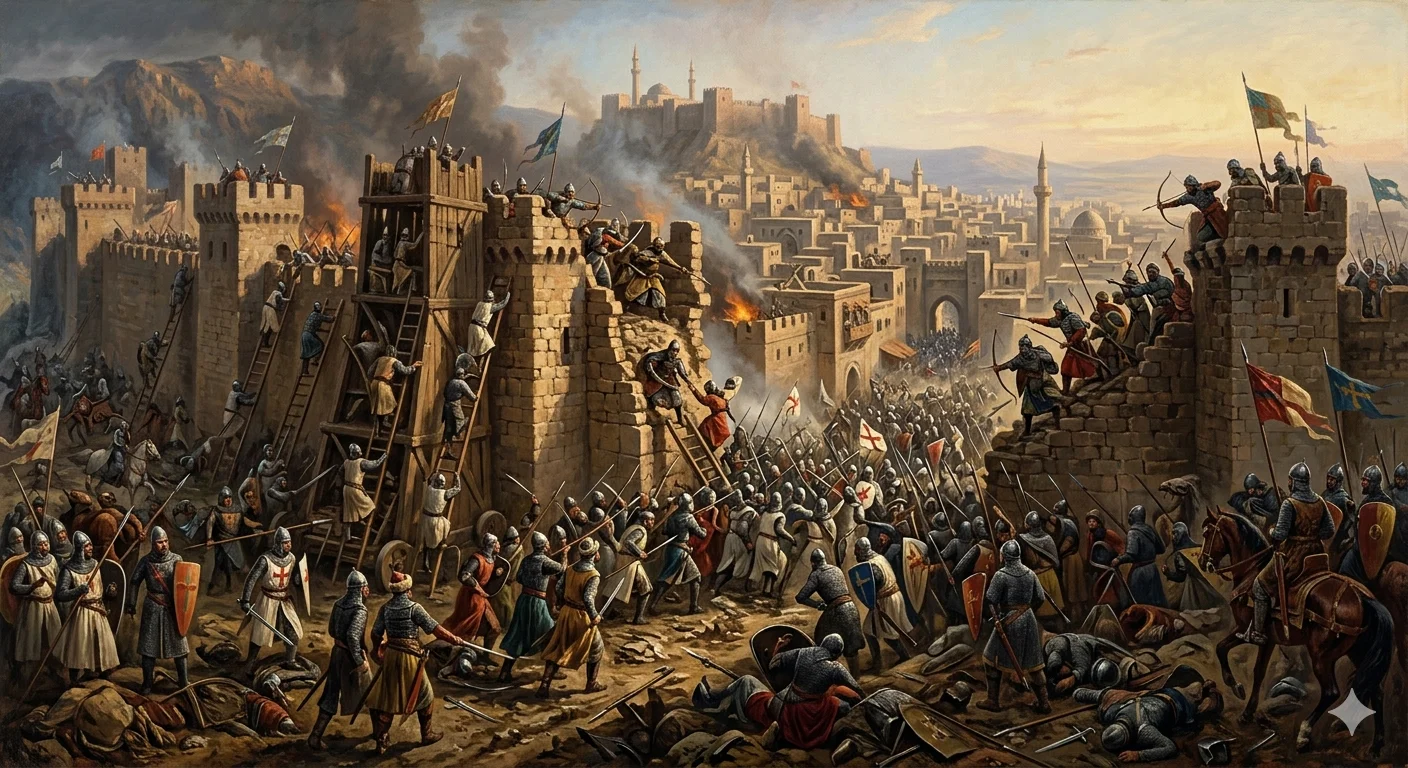
On the night of June 2 to 3, 1098, a small group of Crusader knights scaled the walls of Antioch using ladders lowered from inside by a sympathetic Armenian guard named Firouz. Within hours, the gates of the great Syrian city had been thrown open, the Crusader army had poured inside, and one of the most strategically important cities in the medieval world had fallen after an eight-month siege that had cost thousands of lives and had nearly destroyed the entire First Crusade before it ever reached Jerusalem.
The capture of Antioch was not a clean military triumph. It was a desperate gamble carried out under the shadow of an approaching Muslim relief army, made possible by treachery from within the city walls, and followed almost immediately by another siege in which the Crusaders found themselves trapped inside the very city they had just taken. The story of Antioch is the story of the First Crusade at its most brutal, most desperate, and most astonishing.
The Strategic Importance of Antioch and the Origins of the First Crusade
Antioch, known today as Antakya in southern Turkey, was in 1097 one of the great cities of the medieval world. It had been the third city of the Roman Empire, a major center of early Christianity, and the gateway between the Mediterranean coast and the interior of Syria. Its Byzantine fortifications, originally built under Emperor Justinian I and subsequently strengthened, were among the most formidable in the known world. The walls extended for miles across the surrounding mountains, incorporating natural cliffs and ridges into the defensive system, and were studded with towers at regular intervals.
The First Crusade had been called by Pope Urban II at the Council of Clermont in November 1095, in response to an appeal from Byzantine Emperor Alexios I Komnenos for military assistance against the Seljuk Turks, who had seized large portions of Anatolia from the Byzantine Empire and were threatening Constantinople itself. Urban’s call transformed the request for Byzantine military aid into a holy war to recover Jerusalem and the Christian holy places from Muslim rule.
The armies of the First Crusade assembled in Constantinople in the spring of 1097 and crossed into Anatolia. They won a major engagement at the Battle of Dorylaeum in July 1097 and then marched southward through the brutal summer heat of Anatolia toward Syria. They arrived before the walls of Antioch in October 1097, having already suffered significantly from heat, thirst, disease, and harassment. The city they found waiting for them was held by Yaghi-Siyan, the Seljuk governor who had controlled Antioch since 1088. He was a capable and experienced commander who had been preparing for the Crusader advance for months.
The Crusader Leadership and the Decision to Besiege Antioch
The army that arrived before Antioch was commanded by a group of powerful Western lords who cooperated, argued, competed, and sometimes nearly came apart over the course of the campaign. The principal leaders were Bohemond of Taranto, a Norman prince from southern Italy who was the eldest son of the great adventurer Robert Guiscard and arguably the most experienced military commander in the army; Godfrey of Bouillon, Duke of Lower Lorraine, who had mortgaged his estates to fund his participation; Raymond of Saint-Gilles, Count of Toulouse, the oldest and wealthiest of the princes, who led the largest contingent and had particular rivalry with Bohemond; Robert of Normandy, eldest son of William the Conqueror and Duke of Normandy; Robert of Flanders; Tancred, Bohemond’s nephew; and Hugh of Vermandois, brother of the King of France. Accompanying the army as the representative of Pope Urban II and the formal spiritual leader of the expedition was Adhemar of Le Puy, the Bishop of Le Puy, who served as the papal legate.
Also present as an observer and military adviser, representing Byzantine Emperor Alexios I Komnenos, was Tatikios, a senior Byzantine general who had been with the army since Constantinople and whose role was to ensure that any territories captured by the Crusaders would be returned to Byzantine sovereignty, as the Crusader leaders had sworn to do before leaving Constantinople.
The decision to besiege Antioch rather than bypass it was militarily unavoidable. The city sat astride the Crusaders’ line of march and controlled the passes through the coastal mountains. Any army that left Antioch untaken in its rear would face a permanent threat to its supply lines and any hope of retreat. The Crusaders settled in to besiege a city that their forces were numerically insufficient to fully encircle.
Eight Months of Starvation, Battle, and Desertion: October 1097 to June 1098
The siege began on October 20 or 21, 1097, and from the beginning the Crusaders faced a fundamental problem: they did not have enough men to completely surround Antioch’s massive circuit of walls. Yaghi-Siyan was thus able to send messengers out of the city and receive some supplies, while the garrison launched frequent sorties against the besieging forces.
The Crusaders’ first months were difficult but manageable. Food was available in the surrounding countryside, though it had to be collected in the face of constant harassment from Antioch’s garrison. On December 29, 1097, the garrison launched a major sortie that was repulsed. On December 31, a Crusader force of approximately 20,000 men encountered the first Muslim relief army, sent by Duqaq, the ruler of Damascus, and defeated it in battle. This was encouraging, but the army returned largely empty-handed in terms of supplies, and January 1098 brought severe food shortages. One in seven of the Crusaders died of starvation in that terrible month, and horses died in even greater numbers. Men consumed leather from their belts and shields when food ran out entirely.
The crisis of morale in January 1098 produced the most embarrassing episode of the siege. Peter the Hermit, the charismatic popular preacher who had led an earlier and disastrous unofficial Crusade in 1096 and who was present with the main army, attempted to desert the siege and flee. Tancred pursued him and brought him back to the camp. William the Carpenter, another prominent figure, also deserted. Both were returned and made to swear they would remain. The incident demonstrated how desperate conditions had become even among the leadership.
In February 1098, a second Muslim relief army arrived, this one sent by Ridwan, the emir of Aleppo. The Crusaders, led by Bohemond and Robert of Flanders, marched out to meet it and defeated it on February 9, 1098. The victory was psychologically important but did not immediately solve the food crisis.
Also in February 1098, Tatikios, the Byzantine representative, departed from the Crusader army and returned to Constantinople. The circumstances were disputed then and remain disputed now. Tatikios reported to Emperor Alexios that Bohemond had warned him of a plan among the Crusader leaders to kill him, and he left to avoid assassination. Those close to Bohemond characterized his departure as treachery or cowardice. Whatever the true reason, his departure gave Bohemond a powerful argument: if the Byzantines had abandoned the expedition, the Crusaders were no longer bound by their oaths to return captured cities to Byzantine sovereignty.
In March 1098, an English fleet arrived in the port of Saint Simeon, the harbor serving Antioch, carrying food and building materials. The relief was immediate and significant. The Crusaders began constructing additional fortifications to tighten the blockade of the city’s gates. As the spring progressed, the balance gradually shifted. The Crusader camp began to recover, while Antioch’s defenders found their own food supplies dwindling.
In April 1098, an embassy arrived from the Fatimid rulers of Egypt, the rival Islamic power to the Seljuks. The Fatimids, who had themselves recently lost Jerusalem to the Seljuks, proposed an alliance: they would allow the Crusaders to keep Syria if the Crusaders agreed not to attack Fatimid-controlled Palestine. The Crusaders received the embassy hospitably but could not accept any settlement that did not give them Jerusalem. No agreement was reached.
The Wikipedia article on the Siege of Antioch provides a detailed scholarly account of the military operations, key figures, and political dimensions of the eight-month campaign.
Firouz and the Betrayal of Antioch: The Night of June 2 to 3, 1098
By late May 1098, news reached the Crusader camp that a massive Muslim relief army was approaching under the command of Kerbogha, the atabeg of Mosul, one of the most powerful rulers in the Muslim world. His coalition force, estimated at between 35,000 and 40,000 men, included contingents from Persia, Mesopotamia, Damascus under Duqaq, Aleppo under Ridwan, and various other allies. The Crusaders estimated, correctly, that if Kerbogha arrived before they had taken Antioch, they would be trapped between the garrison and the relief army and annihilated.
Kerbogha had delayed his advance for three weeks by making a detour to besiege the Crusader-held city of Edessa, where Baldwin of Boulogne had established himself as ruler in March 1098. This delay proved fateful. It gave Bohemond just enough time to execute a plan he had been developing for weeks.
Bohemond had made secret contact with a man inside Antioch named Firouz, an Armenian Christian who had converted to Islam and who served as the guard responsible for a section of the northwestern wall known as the Tower of the Two Sisters. Firouz’s motivations remain unclear: some accounts suggest financial reward, others personal grievances against Yaghi-Siyan, others simple sympathy with the Christian army. Whatever his reasons, Firouz had agreed to let Bohemond’s men into the city through the section of wall under his command.
Bohemond brought the proposal before the other Crusade leaders: he would provide access to the city through Firouz, but in exchange he demanded that the other leaders agree in advance to grant him Antioch as his own principality if the city were taken. Raymond of Saint-Gilles objected strongly, both on principle and because he had his own ambitions for Antioch. Most of the other leaders, facing the approaching crisis of Kerbogha’s army, accepted Bohemond’s terms.
On the night of June 2 to 3, 1098, the Crusaders put the plan into action. A small force feigned a march away from the city as though departing to intercept Kerbogha, then returned under cover of darkness to the western wall. Firouz lowered a ladder from the Tower of the Two Sisters. Approximately sixty of Bohemond’s knights climbed the walls and secured the northern towers without resistance. They then moved along the walls, opening gate after gate, allowing the main Crusader army to pour into the city.
Yaghi-Siyan, awakened by the sounds of fighting inside his city, realized the walls had been breached and fled on horseback into the surrounding hills. He was found the following day by Armenian villagers and killed, his head brought to Bohemond. His son Shams remained in command of the city’s citadel, a separate fortification on the hill above the city, which the Crusaders were unable to take with them.
Inside the city, the Crusaders engaged in a massacre of the Turkish garrison and a general slaughter that the chroniclers record without apparent discomfort. The Greek and Armenian Christian population of Antioch, who had survived under Seljuk rule for over a decade, welcomed the Crusaders as liberators.
Kerbogha’s Counter-Siege: June 7 to June 28, 1098
The relief Crusaders felt at having finally taken Antioch lasted only days. On June 7, 1098, the vanguard of Kerbogha’s vast army arrived before Antioch. By June 9, the full force was encamped around the city. The Crusaders, who had besieged Antioch for eight months, were now themselves besieged inside it, with Kerbogha’s army outside and Shams still holding the citadel above them. Their food supplies were again desperately short. Their horses had been reduced from tens of thousands to a few thousand. Some Crusaders lowered themselves from the city walls on ropes and fled by night. Stephen of Blois, who had left the army just before the city fell and who had incorrectly reported to Emperor Alexios that the Crusaders were about to be destroyed, became the symbol of those who abandoned the expedition at its darkest moment.
It was in this crisis of desperation that a visionary intervention transformed the army’s psychology. Peter Bartholomew, a poor French religious mystic traveling with the Provencal contingent, came forward on June 10 with an account of visions in which Saint Andrew had appeared to him multiple times and revealed that the Holy Lance, the spear that had pierced Christ’s side at the Crucifixion, was buried in the floor of the Cathedral of Saint Peter in Antioch. On June 14, after digging in the cathedral floor, a lance-shaped object was found. Whether it was the authentic relic, a planted object, or a genuine discovery interpreted through the lens of faith, the effect on the Crusader army was immediate and dramatic. Morale surged. The princes began planning an offensive breakout.
The decision to sally out and fight Kerbogha’s army directly rather than await starvation or surrender was taken by the Crusade’s collective leadership. On June 28, 1098, the Crusader army marched out through the Bridge Gate in six divisions, the Holy Lance carried at their head. Kerbogha’s commander urged him to attack immediately while the Crusaders were still emerging from the gates, but Kerbogha hesitated, intending to draw the entire force into the open before engaging. This delay was critical. By the time Kerbogha’s army moved to encircle the Crusaders, the Christian forces had formed their battle order.
The battle was decided as much by the collapse of Kerbogha’s coalition as by Crusader military superiority. As the fighting developed and the Crusader charge struck Kerbogha’s lines, the allied emirs who had joined his army for political rather than religious reasons began deserting. Duqaq of Damascus withdrew first. Others followed in rapid succession. Kerbogha’s army dissolved into a rout. The Crusaders pursued the fleeing forces as far as the Iron Bridge, killing many and seizing the entire Muslim encampment with its vast stores of food, weapons, horses, and treasure. Shams, watching from the citadel as the relief army fled, negotiated his surrender and delivered the citadel to Bohemond on June 29, 1098.
The Britannica article on the Siege of Antioch covers the full military and political dimensions of the capture and the Battle of Antioch that followed.
The Aftermath: Principality of Antioch and the March to Jerusalem
The Crusaders remained at Antioch for the rest of 1098, a period marked by epidemic disease, political argument, and the death of Adhemar of Le Puy, the papal legate, on August 1, 1098, from the epidemic that swept the city. The September 1098 letter from the Crusade leaders to Pope Urban II asking him to take personal charge of Antioch was declined. Raymond of Saint-Gilles continued to argue that Antioch should be returned to Byzantine sovereignty, but Bohemond, whose knights had taken the city and who held the citadel, was immovable. He would be the first Prince of Antioch, and the Principality of Antioch, a Crusader state that would survive for nearly two centuries, was his.
Bohemond’s retention of Antioch in breach of the oaths given to Emperor Alexios marked a permanent fracture in the relationship between the Crusaders and Byzantium. Alexios, who had been marching to relieve Antioch but had turned back after being told by refugees that the Crusaders were about to be destroyed, was now accused by Bohemond and others of betrayal and cowardice. The mutual recriminations would complicate Byzantine-Crusader relations for generations.
The World History Encyclopedia article on the Siege of Antioch covers the full context of the First Crusade, the siege’s narrative, and its broader historical consequences in scholarly detail, available at the World History Encyclopedia article on the Siege of Antioch.
In December 1098, leaving Bohemond behind as Prince of Antioch, the remaining Crusade leaders resumed their march toward Jerusalem. After additional campaigns through Syria and along the Palestinian coast, the army reached Jerusalem in June 1099 and captured the holy city on July 15, 1099, completing the stated objective of the First Crusade.
The siege of Antioch, from October 20, 1097, to June 3, 1098, had lasted eight months and had come close to destroying the expedition entirely. It had been resolved not by overwhelming military force but by a single act of betrayal inside the walls, executed at the last possible moment before a relief army would have made it impossible. The capture of the greatest fortified city on the Crusaders’ route to Jerusalem had been achieved through famine, determination, treachery, and the extraordinary leadership of Bohemond of Taranto, who would rule the city he had won for the rest of his life.