On June 2, 2014, at a ceremony held in Hyderabad, Kalvakuntla Chandrashekar Rao took the oath of office as the first Chief Minister of Telangana. In that single moment, decades of marches, hunger strikes, suicides, political negotiations, and parliamentary battles reached their conclusion. Telangana had become the 29th state of India, carved out of the northwestern districts of Andhra Pradesh after one of the longest and most complex statehood movements in the history of independent India.
The journey from a regional aspiration to a constitutionally recognized state took nearly six decades, cost an enormous toll in human suffering, and transformed the political map of southern India permanently. Understanding how Telangana came to exist requires going back to the very beginning of independent India itself.
The Historical Roots of Telangana: Nizams, Hyderabad State, and the 1956 Merger
The region of Telangana occupies the high Deccan Plateau in south-central India. Its history stretches deep into antiquity, shaped by the Maurya Empire, the Satavahana Dynasty, the Kakatiya Dynasty at Warangal, the Bahmani Sultanate, and the Golconda Sultanate, which was famous as the world’s primary source of diamonds until the late nineteenth century. From 1724 onward, the region fell under the rule of the Asaf Jahi dynasty, the Nizams of Hyderabad, whose state became the largest princely state in British India and maintained its own mint, currency, railway, and postal system.
At Indian independence in 1947, Nizam Mir Osman Ali Khan chose not to sign the Instrument of Accession to join India, hoping to retain independence or join Pakistan. This hope ended abruptly in September 1948 when the Indian Army launched Operation Polo, a military action that overthrew the Nizam and annexed Hyderabad State into the Indian Union. After the annexation, Telangana remained part of the reconstituted Hyderabad State until 1956.
The critical turning point came in the mid-1950s when the Indian government undertook a broad reorganization of states along linguistic lines. The States Reorganisation Commission, appointed in December 1953, recommended grouping all Telugu-speaking populations into a single state. The Telangana region of Hyderabad State and the newly formed Andhra State, which had been created from the Madras Presidency in 1953 after the martyrdom of Potti Sriramulu, were proposed for merger.
Potti Sriramulu, born on March 16, 1901, had fasted for 58 days demanding a separate Telugu-speaking state. His death in December 1952 sparked violent protests and compelled the government to create Andhra State. His sacrifice became a powerful symbol for generations of activists who came after him, including those who would fight for Telangana.
On February 20, 1956, an agreement was reached between Telangana leaders and Andhra leaders, known as the Gentlemen’s Agreement, signed by Bezawada Gopala Reddy and Burgula Ramakrishna Rao. The agreement promised to safeguard the interests of Telangana’s people within a merged state, particularly in employment, budget allocation, and education. On November 1, 1956, Telangana was formally merged with Andhra State under the States Reorganisation Act to form the unified state of Andhra Pradesh.
The merger was accepted by Telangana’s leaders on the specific condition that these protections would be honored. Within years, many in Telangana felt the promises had been broken.
The Grievances That Fueled Separation: Jobs, Water, and Identity
The movement for a separate Telangana did not arise from abstract sentiment. It arose from specific, documented grievances about the treatment of the region within the unified Andhra Pradesh.
Telangana’s people argued that the Gentlemen’s Agreement was violated almost immediately in its practical implementation. Andhra employees who migrated to Hyderabad were supposed to remain outside the local job reservation system for a set period under the Mulki Rules. In practice, enforcement was inconsistent and employment opportunities in government and public sector institutions in Hyderabad disproportionately favored people from coastal Andhra and Rayalaseema. Budget allocations for irrigation, infrastructure, and development in the Telangana region were seen as systematically lower than the region’s contribution to state revenues warranted.
The Telangana region contains the headwaters of major rivers including the Krishna and Godavari, but activists argued that the fruits of irrigation projects built using this water flowed primarily to coastal Andhra agriculture rather than to Telangana farmers. The region had its own cultural identity, distinct dialects, festivals including Bathukamma and Bonalu, and traditions rooted in the Nizam-era Hyderabad culture, which many felt were not adequately represented within a state administration centered on coastal Andhra sensibilities.
In 1985, when widespread violations of job reservation protections were documented, then Chief Minister N. T. Rama Rao of the Telugu Desam Party issued Government Order 610, intended to correct the violations and safeguard Telangana employment rights. The order acknowledged that violations had occurred but its implementation remained contested for decades.
1969, 1972, and the First Waves of Agitation
The first major movement demanding a separate state of Telangana erupted in 1969, when social groups, students, and government employees launched widespread protests calling for the region’s separation from Andhra Pradesh. The movement was large, disruptive, and brought significant public attention to Telangana’s grievances, but ultimately ended without achieving statehood. The central government made some concessions to address specific employment concerns but declined to create a separate state.
A second major wave of agitation followed in 1972, again centered on employment grievances and the implementation of the Mulki Rules. This agitation was met with government action and eventually subsided, again without producing the fundamental change the movement demanded.
Through the 1970s, 1980s, and 1990s, the demand for Telangana statehood remained a persistent current in the region’s political life, periodically surfacing in protests and political campaigns but never achieving the sustained national momentum needed to compel the central government to act. The movement needed new leadership and a new organizational form.
The Founding of TRS: KCR and the Political Crystallization of Statehood Demand
The transformation of the Telangana movement into an organized, sustained political force began in earnest in April 2001, when Kalvakuntla Chandrashekar Rao, known universally as KCR, left the Telugu Desam Party and founded the Telangana Rashtra Samithi, or TRS. The party was established with a single-point agenda: the creation of a separate state of Telangana with Hyderabad as its capital.
KCR was born in 1954 in Siddipet, in what is now Telangana. He had been a TDP legislator and minister before concluding that the Telugu Desam Party under N. Chandrababu Naidu was not genuinely committed to Telangana statehood. The founding of TRS gave the statehood movement an explicitly electoral vehicle for the first time, allowing the demand to be pursued through both street politics and parliamentary representation simultaneously.
In the 2004 Lok Sabha and Assembly elections, TRS formed an electoral alliance with the Indian National Congress party, which included a commitment to Telangana statehood in its electoral promises. The alliance was electorally successful, and the Congress party came to power at the center under Prime Minister Manmohan Singh as part of the United Progressive Alliance. TRS won five Lok Sabha seats and 26 Assembly seats, demonstrating strong popular support for the statehood demand and creating political pressure at the national level.
However, the Congress-led central government and the Congress-led Andhra Pradesh state government under Chief Minister Y. S. Rajasekhara Reddy declined to act on the statehood promise. KCR grew frustrated with the Congress party’s inaction and TRS eventually withdrew from its alliance position. The Wikipedia entry on the Telangana movement covers the full political history of this period in comprehensive detail, available at the Wikipedia article on the Telangana movement.
2009: The Hunger Strike That Changed Everything
The year 2009 brought a confluence of events that dramatically accelerated the Telangana movement’s trajectory. In the state elections of 2009, the Congress party won under Y. S. Rajasekhara Reddy. Then, in September 2009, Rajasekhara Reddy died in a helicopter crash, creating a sudden leadership vacuum in the state and weakening Congress’s hold on the Andhra Pradesh administration. The political landscape was suddenly more fluid than it had been in years.
In October 2009, the Supreme Court of India declared Hyderabad a free zone, meaning citizens from across Andhra Pradesh, not just from Telangana, could compete for government jobs in the capital city. This ruling was experienced by Telangana activists as a direct blow to the region’s employment protections and reignited mass protests.
On November 29, 2009, KCR began traveling from Telangana Bhavan in Karimnagar toward Siddipet, his hometown, where he intended to launch an indefinite hunger strike demanding Telangana statehood. Police stopped him at the Alugunur intersection and arrested him. He was taken to Khammam jail, where he immediately began his fast from behind bars. As his health deteriorated, he was transferred to the Nizam’s Institute of Medical Sciences in Hyderabad for medical supervision, where the fast continued.
The slogan that spread across Telangana in those days captured the intensity of the moment: “Telangana vachudo KCR sachudo,” meaning “a separate Telangana or KCR dies.” Student organizations at Osmania University and across the region launched massive protests. Strikes shut down Telangana on December 6 and 7. Several young activists took their own lives in solidarity with the movement. One activist, Srikanth Achari, set himself on fire during the protests.
On the night of December 9, 2009, after 11 days of KCR’s fast and with his health in serious condition, Union Home Minister P. Chidambaram made a formal announcement that the Government of India would initiate the process of forming a separate Telangana state. The announcement was celebrated across Telangana as a historic breakthrough.
The celebrations were short-lived. The announcement immediately triggered violent counter-protests in coastal Andhra and Rayalaseema, where legislators submitted mass resignations and demonstrations erupted against the proposed bifurcation. On December 23, 2009, under enormous pressure from Seemandhra politicians, the central government put the Telangana decision on hold.
The Srikrishna Committee, Years of Agitation, and the Final Parliamentary Battle
In response to the deepening crisis, the Government of India constituted the Srikrishna Committee on February 3, 2010, a five-member body chaired by Justice B. N. Srikrishna, a former judge of the Supreme Court of India and former Chief Justice of the Kerala High Court. The committee was tasked with conducting a comprehensive examination of the demand for Telangana statehood and all related issues.
The committee received over one lakh, or one hundred thousand, petitions and representations from political parties, civil society organizations, and individuals across Andhra Pradesh. It toured all regions of the state extensively and consulted with leaders from TRS, the Telugu Desam Party, the Congress, the Communist parties, and other groups. Its final 461-page report was submitted on December 30, 2010, and publicly released on January 6, 2011.
The committee presented six options, ranging from maintaining a unified Andhra Pradesh to complete bifurcation. Its fifth option was the creation of a separate Telangana with Hyderabad as its capital, alongside a residual Andhra Pradesh state. The committee’s language on the fifth option was cautious rather than decisive, and TRS rejected the report as insufficient, while Seemandhra political leaders welcomed parts of it that supported unity. The movement continued, with mass rallies, the “Million March” on March 10, 2011, the 42-day “Sakala Janula Samme” general strike in September and October 2011, and persistent political agitation maintaining pressure on the central government.
The decisive political shift came in July 2013 when Congress, facing difficult electoral arithmetic ahead of the 2014 national elections, calculated that supporting Telangana statehood would help retain political ground in the region even if it cost the party seats in coastal Andhra. On July 30, 2013, the Congress Working Committee unanimously passed a resolution recommending the formation of a separate Telangana state.
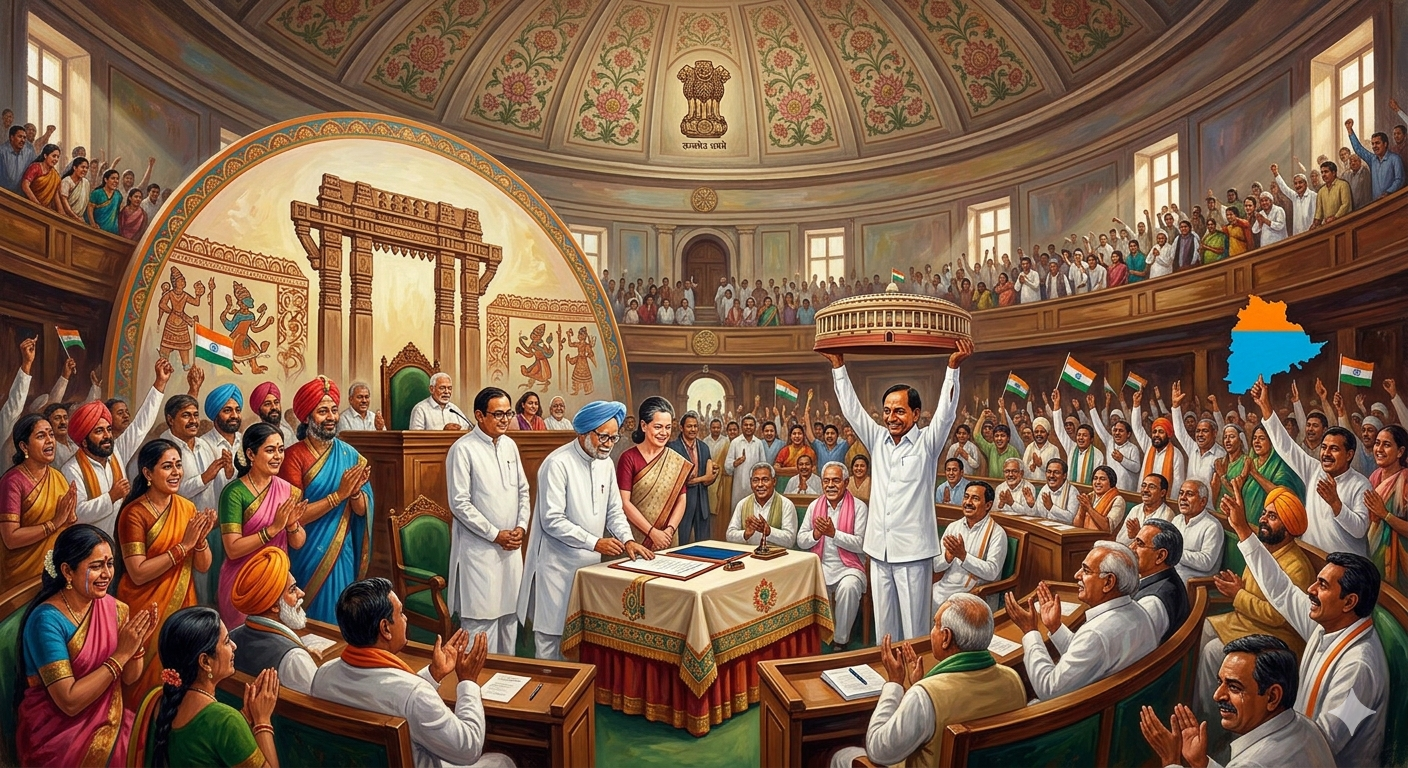
On December 5, 2013, the Union Cabinet approved the Telangana draft bill. The bill was then sent to the President of India and on to the Andhra Pradesh State Assembly for its views. The assembly’s proceedings were chaotic, with Seemandhra legislators disrupting sessions, but the formal process continued. On February 18, 2014, the Lok Sabha passed the Andhra Pradesh Reorganisation Bill with a voice vote. The Rajya Sabha passed it two days later, on February 20. President Pranab Mukherjee gave the bill his assent, and it was published in the official Gazette on March 1, 2014. On March 4, 2014, the Government of India formally declared June 2, 2014, as Telangana Formation Day.
June 2, 2014: A New State Is Born
On June 2, 2014, the state of Telangana officially came into existence as the 29th state of the Indian Union. The occasion was marked with celebrations across the region, with large public gatherings in Hyderabad and other cities.
ESL Narasimhan was sworn in as the Governor of Telangana. Kalvakuntla Chandrashekar Rao, whose founding of TRS in 2001 and hunger strike in 2009 had been central to the movement’s final phase, was sworn in as the first Chief Minister of Telangana. His party, the Telangana Rashtra Samithi, had won a strong majority in the state assembly elections held ahead of formal state formation.
Telangana was constituted from ten districts carved out of northwestern Andhra Pradesh, though subsequent reorganization would eventually expand this to 33 districts. Hyderabad, the historic city and economic capital of the entire former Andhra Pradesh, became the capital of the new Telangana state. Under the terms of the Andhra Pradesh Reorganisation Act, Hyderabad would serve as the joint capital of both Telangana and the residual Andhra Pradesh for a period of up to ten years, allowing the residual state time to develop a new capital city. That ten-year period concluded in 2024, after which Hyderabad became solely the capital of Telangana.
The Wikipedia article on the history of Telangana provides a comprehensive account of the region’s journey from ancient kingdoms through the Nizam era to statehood, available at the Wikipedia article on the History of Telangana.
Telangana After Statehood: Development, Identity, and New Directions
In the years following its formation, Telangana moved rapidly to establish its administrative and developmental identity. The new state invested heavily in its irrigation infrastructure, launching the Kaleshwaram Lift Irrigation Scheme, one of the largest such projects in the world, to address the long-standing water grievances that had been central to the statehood movement. The state also pursued aggressive development of its information technology sector, building on Hyderabad’s established reputation as a major technology hub hosting global companies including Microsoft, Google, Amazon, and dozens of other multinationals.
KCR’s government renamed the Telangana Rashtra Samithi as the Bharat Rashtra Samithi in 2022, signaling ambitions beyond the state’s borders. In the December 2023 state elections, however, the party was defeated by the Indian National Congress under Revanth Reddy, who became the second Chief Minister of Telangana, demonstrating the normalcy of democratic competition in the new state.
The formation of Telangana remains one of the most significant events in post-independence Indian administrative history. It proved that decades of democratic agitation, combined with strategic political organization and the willingness of leaders to sacrifice personally for their cause, could ultimately achieve constitutional recognition for a people’s distinct identity and aspirations. It also renewed debates across India about other proposed states and the principles that should guide the reorganization of a vast and diverse federation.
The Britannica entry on Telangana covers the state’s geography, economy, culture, and modern political history in comprehensive detail, available at the Britannica entry on Telangana.
From the ancient Kakatiya kingdoms to the Golconda diamond trade, from the Nizam’s Hyderabad to the Police Action of 1948, from the Gentlemen’s Agreement of 1956 to KCR’s fast in 2009 and the parliamentary vote of February 2014, Telangana’s path to statehood compressed centuries of history into a single constitutional act. On June 2, 2014, a region found its name on India’s political map as a state in its own right.