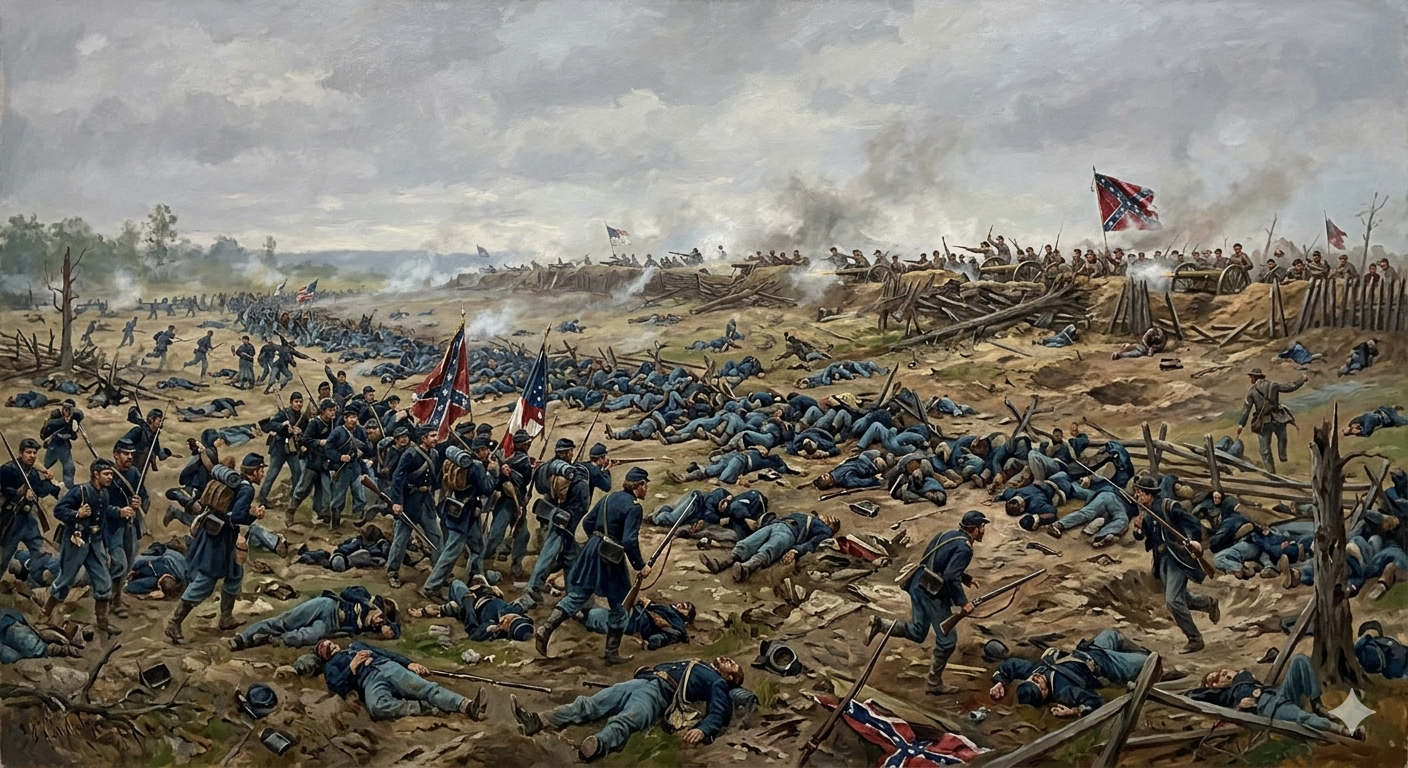
At 4:30 in the morning of June 3, 1864, three Union corps of the Army of the Potomac advanced through thick ground fog and pre-dawn darkness toward Confederate earthworks at Cold Harbor, Virginia, approximately ten miles northeast of the Confederate capital of Richmond. Within thirty minutes, an estimated 7,000 Union soldiers had been killed or wounded. No attack in the entire four years of the American Civil War had broken up as quickly, or killed men as rapidly, as what happened that morning at Cold Harbor.
The Battle of Cold Harbor, fought from May 31 to June 12, 1864, was the final major engagement of Lieutenant General Ulysses S. Grant’s Overland Campaign, the relentless Union offensive that had been grinding southward through Virginia since the opening of the Wilderness on May 4. It became one of the most lopsided military disasters in American history, a cautionary monument to the deadly consequences of frontal assault against prepared field fortifications, and the action Grant himself would later name as his greatest regret of the entire war.
The Overland Campaign and the Road to Cold Harbor
The battle at Cold Harbor cannot be understood without understanding the extraordinary campaign that preceded it. When Grant was appointed general-in-chief of all Union armies in March 1864 and chose to accompany the Army of the Potomac in the field, he brought with him a strategy fundamentally different from anything the Eastern Theater had seen before. His goal was not territory but the destruction of General Robert E. Lee’s Army of Northern Virginia. He would apply continuous pressure, refuse to disengage after setbacks, and use the Union’s superior manpower and resources to grind the Confederate army into defeat.
From May 4, 1864, the two armies had been locked in almost constant combat. The Battle of the Wilderness, fought May 5 to 7, produced brutal fighting in dense Virginia forest where visibility was measured in yards and fire from artillery was nearly impossible. Rather than withdrawing north as previous Union commanders had done after costly engagements, Grant pressed forward. Spotsylvania Court House, May 8 to 21, produced twelve days of savage fighting including the assault on the “Bloody Angle” on May 12, one of the most intense close-quarters combat of the entire war. The North Anna River engagements followed, and then Totopotomoy Creek at the end of May.
By the time the armies reached Cold Harbor, the Union Army of the Potomac had suffered more than 50,000 casualties in approximately four weeks of near-continuous fighting. The Confederate Army of Northern Virginia, far smaller in absolute terms and unable to replace losses at the same rate as the Union, had also been bled severely. Grant believed, or convinced himself, that Lee’s army was nearly broken. The Confederate line was stretching thin. Richmond lay just ten miles away. One more powerful blow, Grant calculated, might end the war.
The Strategic Importance of the Cold Harbor Crossroads
Cold Harbor was not a harbor and was not near any body of water. The name came from a colonial-era tavern, the Cold Harbor Tavern owned by the Isaac Burnett family, which offered travelers shelter but no hot meals. The name “harbor” in this older usage simply meant a place of shelter. Old Cold Harbor stood two miles east of the site of the 1862 Battle of Gaines’s Mill, and New Cold Harbor stood a mile southeast. Both were about ten miles northeast of Richmond.
The strategic importance of the crossroads was simple and critical. Roads radiating from Cold Harbor led directly to Richmond and to the supply lines and reinforcement routes the Union army needed to maintain. Control of Cold Harbor gave Grant a position from which he could either attack Richmond directly or maneuver against Lee’s army while keeping access to the Pamunkey River and the Union supply network. When Grant received reports that Lee was extending his defensive line toward the James River, he determined to seize Cold Harbor, push around Lee’s flank, and drive between the Confederate army and its capital.
The Key Commanders: Grant, Lee, Meade, Hancock, Wright, and Smith
The two commanding generals at Cold Harbor had by June 1864 become each other’s most respected and feared opponent. Lieutenant General Ulysses S. Grant, born April 27, 1822, in Point Pleasant, Ohio, had come east from the Western Theater carrying the prestige of Vicksburg and Chattanooga and the reputation of a general who would fight and keep fighting regardless of the cost. His actual field commander for the Army of the Potomac was Major General George G. Meade, the victor of Gettysburg, though the working relationship between Grant and Meade was often complicated.
The three Union corps commanders who led the June 3 assault were Major General Winfield Scott Hancock, commanding the II Corps, one of the Army of the Potomac’s most capable and experienced combat generals, still suffering from the wound he had received at Gettysburg; Major General Horatio G. Wright, commanding the VI Corps following the wounding of John Sedgwick at Spotsylvania; and Major General William F. “Baldy” Smith, commanding the XVIII Corps, which had recently been brought up from the Army of the James under Major General Benjamin Butler to reinforce Grant’s main force.
Against them stood General Robert E. Lee, born January 19, 1807, in Westmoreland County, Virginia, at the peak of his defensive genius. Throughout the Overland Campaign he had demonstrated an uncanny ability to anticipate Grant’s movements and position his smaller army to maximum defensive advantage. His corps commanders at Cold Harbor included Lieutenant General Ambrose Powell Hill, Lieutenant General Richard H. Anderson, and Major General John C. Breckinridge, the former Vice President of the United States who had run as a presidential candidate in 1860 and who commanded the Confederate forces at the critical left center of the Cold Harbor line.
Major General Fitzhugh Lee, Robert E. Lee’s nephew, commanded Confederate cavalry and played an important early role in contesting Union seizure of the crossroads. Major General Robert Hoke commanded a Confederate infantry division that contested and then began fortifying the Cold Harbor position before the Union infantry arrived in strength.
May 31 to June 2: Seizure of Cold Harbor and the Confederate Fortifications
On May 31, 1864, Union cavalry under Major General Philip Sheridan, one of Grant’s most aggressive commanders, seized the Old Cold Harbor crossroads after a sharp contest with Confederate cavalry under Fitzhugh Lee. Sheridan’s troopers held the position against Confederate counterattacks until Union infantry began arriving, a crucial contribution to the campaign.
The Union assault had originally been scheduled for June 2. Meade ordered an early morning attack, but there were immediate complications. Smith’s XVIII Corps, moving from its separate position near the Chickahominy River, initially refused to cooperate with the timing. Hancock’s II Corps, which had performed a night march to reach Cold Harbor, arrived exhausted and disoriented in the early morning hours of June 2, not reaching its assigned position until approximately 6:30 in the morning. Grant, concerned that Hancock’s men would be too fatigued to attack effectively, advised Meade to postpone the assault until June 3.
This twenty-four-hour delay was catastrophic for the Union cause. Lee used every hour of it. He ordered his engineers and infantry to construct fortifications along a seven-mile front, and the Confederate troops worked through the night of June 2 with the focused intensity of men who understood their survival depended on what they were building. The result was what military historians have described as the most formidable field fortifications of the entire Civil War. Interlocking fields of fire, angled earthworks designed to expose attacking formations to enfilading fire from multiple directions, artillery positioned to sweep the approaches, and rifle pits in front of the main works all combined into a defensive system that would have challenged any army ever assembled.
Union troops who managed to reconnoiter the Confederate position before the assault understood what was waiting for them. Some soldiers quietly sewed their names and home addresses inside their uniforms the night before the attack, so that their bodies could be identified and their families notified of their deaths. It was a gesture of collective premonition that has become one of the most poignant images of the entire war.
The Assault of June 3: Thirty Minutes That Defined a Battle
At 4:30 in the morning of June 3, 1864, Hancock’s II Corps, Wright’s VI Corps, and Smith’s XVIII Corps stepped off into the darkness toward the Confederate lines. The ground between the two armies was cut by ravines, swamps, dense undergrowth, and uneven terrain that immediately broke up the attacking formations and caused units to lose contact with one another.
On the Union left, Hancock’s II Corps achieved the greatest initial success of the day. Elements of his command broke through a portion of the Confederate front line held by Breckinridge’s division, engaging in hand-to-hand fighting and briefly seizing a section of the Confederate works. Several hundred prisoners were taken and four artillery pieces were captured. But the breakthrough was short-lived. Confederate artillery was immediately brought to bear on the captured trenches, turning them into a killing ground. Breckinridge’s reserves counterattacked and drove the Union soldiers back out. The brief Union success collapsed into disaster.
In the center, Wright’s VI Corps advanced into what one observer described as a wall of fire. The Confederate defenders, many of them veterans with years of combat experience, fired as fast as they could load. Double canister shot from Confederate artillery tore through the advancing Union formations at close range, killing men in groups with each discharge. Wright’s corps was stopped before it reached the Confederate main line and forced to dig its own trenches where it had been pinned down.
On the right, Smith’s XVIII Corps was funneled by the terrain into two ravines where the men were exposed to converging fire from Confederate positions on the surrounding higher ground. The Confederates poured fire into the packed formations with devastating effect. Smith’s corps, like Wright’s, was stopped well short of the Confederate works and forced to seek whatever cover the broken terrain could provide.
The Wikipedia article on the Battle of Cold Harbor covers the assault’s tactical details, the order of battle for both armies, and the full casualty figures across the entire two-week engagement.
Across the entire front, approximately 7,000 Union soldiers had been killed or wounded in roughly thirty minutes of fighting, some accounts reducing the timeframe to as little as ten or twenty minutes. The 8th New York Infantry of Hancock’s II Corps, which became known as the “Bloody 8th,” lost approximately one-third of its men in the first half hour alone. The rate of killing at Cold Harbor on the morning of June 3 was without parallel in the American Civil War.
At 12:30 in the afternoon, after riding the Union lines himself and consulting with his corps commanders, Grant suspended the main assault. He later ordered the attack resumed in the afternoon, but the corps commanders refused to advance. Baldy Smith flatly refused the order. He faced no charges or investigation for this act of insubordination, a measure of how clearly everyone understood that the attack had failed beyond any prospect of recovery.
The Nine Days of Trenches: June 4 to June 12
For the nine days following the June 3 assault, the two armies faced each other across trench lines that in some places were only yards apart, locked in a miserable stalemate of sniper fire, artillery exchanges, and the slow death of men caught in the open ground between the lines. Wounded soldiers from the June 3 assault lay in the summer heat between the armies, dying slowly without aid, because neither side could retrieve them without coming under fire.
On June 5, Grant began written negotiations with Lee to arrange a truce to retrieve the wounded. The exchange of letters consumed two days. Lee’s position was that he had no wounded to retrieve, a response that reflected both the military reality and Lee’s awareness of the psychological advantage he held. A brief two-hour truce was finally arranged on June 7, but by then most of those who had lain wounded in the field for four days were dead. Of the thousands who had fallen on June 3, barely a handful were found alive when the truce went into effect.
The Britannica article on the Battle of Cold Harbor describes the political as well as military significance of the battle, including its effect on Northern public opinion and on Robert E. Lee’s strategic situation in the final year of the war.
Grant’s Regret and the Legacy of Cold Harbor
On the night of June 12, 1864, Grant executed one of the most skillfully managed strategic withdrawals of the Civil War. The Army of the Potomac slipped away from its Cold Harbor positions under cover of darkness and, in a feat of logistical precision, crossed the James River on a pontoon bridge over 2,100 feet long. The Confederates were not aware the Union army had gone for hours. Grant’s army arrived before Petersburg on June 15, beginning a nine-month siege that would ultimately deliver the death blow to the Confederacy.
Cold Harbor’s total casualties for the two-week battle were approximately 17,000, with roughly 12,700 for the Union and approximately 4,600 for the Confederacy. The June 3 assault alone accounted for approximately 7,000 Union casualties in its first thirty minutes. Lee’s army, vastly outnumbered, had inflicted almost five times more casualties than it had suffered in the battle’s most intense phase.
Grant spent the rest of his life acknowledging the mistake. In his Personal Memoirs, written while he was dying of throat cancer and published in 1885, he wrote with characteristic directness: “I have always regretted that the last assault at Cold Harbor was ever made. I might say the same thing of the assault of the 22nd of May, 1863, at Vicksburg. At Cold Harbor no advantage whatever was gained to compensate for the heavy loss we sustained.”
The American Battlefield Trust article on Cold Harbor provides detailed maps, primary source accounts, and the full operational narrative of the battle including its context within the Overland Campaign.
Cold Harbor was Robert E. Lee’s last significant offensive victory of the Civil War. It came at a cost, though one he could absorb better than Grant. The Confederate soldiers who had built those seven miles of earthworks in twenty-four hours had bought their army another twelve months of survival. But they could not replace their own losses indefinitely, and the Petersburg siege that followed would slowly drain the Army of Northern Virginia until it collapsed in the spring of 1865. Grant’s Cold Harbor disaster, terrible as it was, was a step on a road that led directly to Appomattox Court House.
Cold Harbor National Cemetery, established in 1866, stands across the road from the Garthright House, which served as a Union field hospital during the battle and where blood dripped through the floorboards into the cellar as surgeons worked around the clock. The cemetery holds the remains of soldiers who died there and were never claimed by their families or their states. About 300 acres of the original battlefield, once encompassing more than 7,500 acres, survive today as part of the Richmond National Battlefield Park.