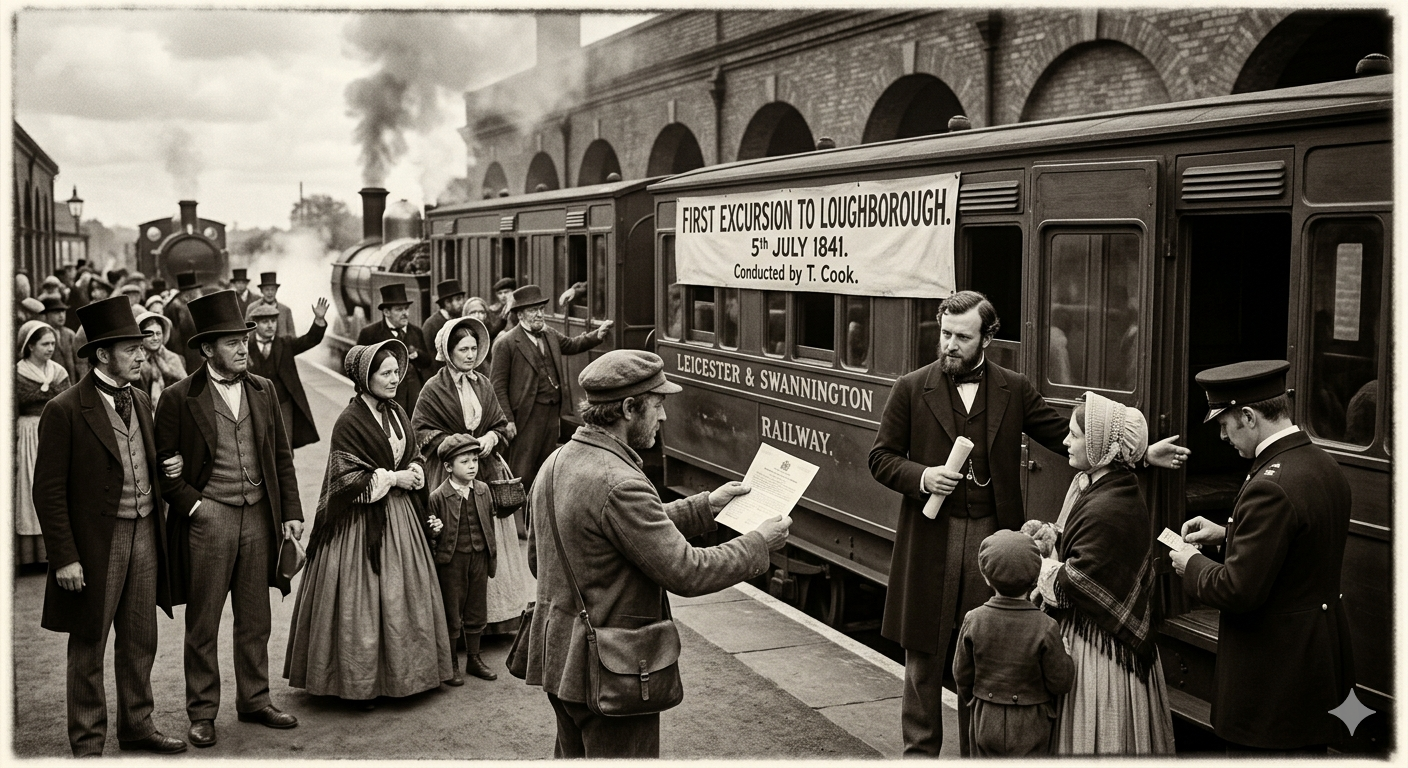
On the morning of July 5, 1841, a brass band struck up at Leicester’s Campbell Street Railway Station, and approximately 485 members of the Leicester Temperance Society climbed into open tub-style railway carriages for a journey that would fundamentally change how human beings thought about travel. Thomas Cook, a thirty-two-year-old Baptist wood-turner and temperance campaigner, had negotiated with the Midland Counties Railway Company to charter a special train to carry these working-class men and women eleven miles along the new railway line to Loughborough, where a temperance rally was being held. The price was one shilling per passenger, which covered the return rail journey and a meal. Cheering crowds and more musicians greeted the party at Loughborough station. The day involved marches, speeches, games, a cricket match, and a tea spread of bread and ham, crumpets and cake, laid out on white tablecloths under the trees in Southfields Park, courtesy of the local dignitary Mr. Paget who had opened his grounds for the occasion. The party returned to Leicester by 10:30 in the evening. History had been made.
The journey from Leicester to Loughborough on July 5, 1841, is generally recognized as the world’s first publicly advertised package tour — the first time a private entrepreneur had negotiated with a transport company to charter a conveyance for a group of paying passengers, organized a comprehensive experience for those passengers that included transportation, food, and entertainment, and advertised the event to the general public. Thomas Cook himself made no profit from this first excursion; the shilling fares covered costs and his compensation was a share of whatever remained. But the concept he demonstrated on that summer day in the English Midlands — that an organizing intermediary could negotiate lower fares from transport providers, create a complete travel experience for ordinary people who could not have arranged it themselves, and in doing so make travel accessible to people who had never previously considered it within their reach — was the founding idea of the modern tourism industry. The biography of Thomas Cook is inseparable from the history of how travel became one of the most significant economic and cultural activities of the modern world.
The Extraordinary Life of Thomas Cook: From a Derbyshire Cottage to the Father of Modern Tourism
Thomas Cook was born on November 22, 1808, in a small cottage at 9 Quick Close in the village of Melbourne, Derbyshire — a village that today markets itself as the birthplace of the man who invented package tourism, as it had previously marketed itself as the origin of the Melbourne hat, the distinctive wide-brimmed style worn by Australian stockmen. His father, John Cook, was a labourer who died when Thomas was only four years old, leaving his mother Elizabeth — the daughter of a New Connexion Baptist preacher — to raise the boy alone before remarrying a man named James Smithard. The family’s financial circumstances were modest at best, and Thomas left school at the age of ten to begin working as a gardener’s boy on Lord Melbourne’s estate, the great Whig politician who would later serve as Queen Victoria’s first Prime Minister. Thomas earned six pence per week and continued his education at the Methodist Sunday School, where religion became the formative influence of his life.
At the age of fourteen, Cook began a five-year apprenticeship as a cabinet-maker and wood-turner under his uncle, John Pegg, who was also a committed Baptist. During this period, he described himself as an earnest, active, devoted young Christian, becoming a Sunday School teacher and eventually its superintendent. At the age of seventeen, he joined the local Temperance Society, committing himself to the cause of abstinence from alcohol that would remain one of the organizing principles of his life for the following six decades. In 1826, at the age of eighteen, he abandoned his cabinet-making apprenticeship to become an itinerant Baptist missionary and preacher, traveling the villages of Derbyshire and Leicestershire on foot, distributing religious tracts, delivering sermons, and establishing Sunday Schools. His biographer, Piers Brendon, recorded that in 1829 alone, Cook covered 2,692 miles — the vast majority of them on foot — in the service of his missionary work. It was this extraordinary walking habit, combined with a constitution hardened by decades of outdoor physical labor and a mind sharpened by self-education and religious conviction, that made him the man who would eventually reimagine how the British public traveled.
In 1832, Cook moved to Market Harborough in Leicestershire, where he worked as a wood-turner to support himself while continuing his Baptist and temperance activities. On New Year’s Day 1833, he took the Temperance Pledge — the formal public commitment to total abstinence from alcohol that was the defining act of membership in the Victorian temperance movement. Two months later, on March 2, 1833, he married Marianne Mason, the daughter of a farmer from Barrowden in Rutland, who shared his religious convictions and who would be his companion and partner for the next fifty years. They had two surviving children: a son, John Mason Cook, born in 1834, who would eventually take over the family business and expand it into a global enterprise; and a daughter, Annie Elizabeth. Cook set up a bookselling and printing business, which gave him skills in promotion and communication that would prove essential to his later career as a travel organizer. He also became an active anti-Corn Law campaigner, a supporter of teetotalism’s economic argument that the money spent on alcohol by the working poor could instead feed families and educate children, and a tireless organizer of temperance meetings, rallies, and events.
The Walk That Changed Everything: The Idea That Sparked the World’s First Package Tour
The moment that directly produced the first package tour came on June 9, 1841, when Thomas Cook set out on foot from Market Harborough to walk fifteen miles to Leicester to attend a meeting of the Temperance Society. The Midland Counties Railway had recently completed a line connecting the two towns, and as Cook walked alongside the new railway tracks, his mind turned to the possibilities that this technology represented. The thought, as he later described it, flashed through his brain: what a glorious thing it would be if the newly developed powers of railways and locomotion could be made subservient to the promotion of temperance. He arrived at the temperance meeting that evening and proposed his idea: instead of individuals making their own way to the quarterly temperance meeting in Loughborough the following month, why not hire a train and carriages from the Midland Counties Railway and transport the entire Leicester Temperance Society membership there together, at a fare low enough that everyone could afford it?
The idea was received with enthusiasm by the temperance meeting, and Cook immediately set about negotiating the practical arrangements. He approached the Midland Counties Railway Company and negotiated the charter of a special train for the excursion, offering the guarantee of enough passengers to make the arrangement commercially viable for the railway. The railway agreed, and Cook set the price at one shilling per passenger — a fare carefully calculated to cover the cost of the rail charter, the return journey, and the provision of food at the destination, with a small residual sum for Cook as compensation for his organizational work. He promoted the excursion through the networks of the temperance movement and the Baptist church, printing leaflets and distributing them through the societies and congregations that formed the core of his social world. Cook’s background as a printer meant that he understood both the technology of mass communication and the power of print promotion in ways that made him a more effective publicist than most organizers of his era.
The significance of what Cook was doing was not merely logistical. The Midland Counties Railway, which had opened only a few years earlier as part of the explosive expansion of the British rail network in the 1830s and 1840s, was still a novelty for most of the working-class population of the English Midlands. The majority of Cook’s 485 passengers on July 5, 1841, had never ridden a railway train before. The technology of steam-powered rail travel was then barely a decade old in Britain: George Stephenson’s Rocket had proven the viability of the steam locomotive at the Rainhill Trials in 1829, and the first public steam railway, the Liverpool and Manchester Railway, had opened only in 1830. Cook was among the first people to recognize that the railway represented not just a faster way to move goods and wealthy passengers between cities but a potential instrument of social democratization — a technology that could, for the first time in human history, make travel affordable for ordinary working people and expand their horizons in ways that had previously been available only to the rich.
July 5, 1841: The First Package Tour in Detail — What Happened on That Historic Day
The excursion of July 5, 1841, departed from Campbell Street Station in Leicester — a station that stood on the site of the modern Leicester railway station — at a time that Cook would later describe with characteristic effusiveness as among the most memorable moments of his life. The 485 passengers, most of them working-class men and women who were members of the Leicester Temperance Society, paid their one shilling each and settled into the open tub-style third-class carriages that the Midland Counties Railway had assigned to the charter. Third-class carriages in 1841 were extremely basic by any standard: open to the elements, made of wood, without seating in many cases, offering no protection from the sparks and smoke emitted by the locomotive. That these passengers were willing to travel in such conditions in order to attend a temperance meeting speaks to both the genuine enthusiasm of the Victorian temperance movement and the appeal of Cook’s organizational vision.
As the train pulled out of Campbell Street Station and moved along the line toward Loughborough, the excursion party was accompanied by a brass band — an element of ceremonial festivity that was entirely Cook’s innovation and that set the tone for the day’s character as something between a religious meeting and a communal celebration. Villagers along the route came out to wave flags and cheer as the train passed; Loughborough station was decorated with banners and bunting to receive the visitors. Mr. Paget, a local dignitary whose estate at Southfields bordered the town, opened the park grounds for the day, providing the space for the temperance rally, the games, and the meal. White tablecloths were spread under the trees, and a spread of bread and ham, later supplemented by crumpets and cake, was provided as the inclusive refreshment that Cook had promised his passengers as part of their one-shilling fare. Minister after minister made rousing speeches on the virtues of temperance. A cricket match was organized. Family games were played. The atmosphere was, by all accounts, one of joyful communal celebration — a Victorian’s day out of a type that had never quite existed before in the organized form that Cook had given it.
The party boarded the return train and arrived back at Leicester station at 10:30 in the evening, tired, satisfied, and — crucially for Cook’s purposes — demonstrably without having consumed any alcohol. Cook’s own account of the day was characteristically exuberant: We carried music with us, and music met us at Loughborough Station… and cheered us all along the line with the heartiest welcome… the whole affair being one which excited extraordinary interest, not only in the county of Leicester but throughout the whole country. He declared that this was the keynote of his excursions, and that the social idea had grown upon him from that moment. Thomas Cook was not a man given to understatement when it came to the things he believed in, and his conviction that he had found a way to serve the dual cause of temperance and social improvement through organized travel was as genuine as it was prescient.
What Made It a Package Tour: The Elements That Defined a New Kind of Travel
The July 5, 1841, excursion satisfied the defining criteria of a package tour in ways that distinguish it from earlier organized railway journeys and make it the acknowledged origin of the modern travel industry. First, it involved a pre-arranged charter of transport infrastructure — Cook had negotiated directly with the Midland Counties Railway Company to provide a dedicated train for the group, obtaining a bulk rate that allowed him to charge each individual passenger less than the standard fare. This negotiation between an organizing intermediary and a transport provider, with the intermediary retaining control of seats or space purchased in bulk and selling them on to individual travelers, is the fundamental commercial mechanism of the package tour business as it has existed from 1841 to the present day.
Second, the excursion was inclusive — the one-shilling fare covered not just the rail journey but also the meal provided at the destination. The integration of transportation and hospitality into a single ticket price, so that the traveler paid one amount in advance and received a complete experience rather than having to negotiate and pay for each component separately, is the element that distinguishes a package tour from simply a discounted rail fare. Cook’s innovation was to take responsibility for the complete experience — to be, in effect, a guarantor of the traveler’s day, ensuring that food would be available, that a venue would be provided, that entertainment would be organized. The traveler’s only concern was to arrive at the station with a shilling and to trust Cook’s organization to deliver the rest.
Third, and crucially, the excursion was publicly advertised to a general audience rather than organized for a private group that had independently decided to travel together. Cook used his printing skills and his networks to promote the excursion through handbills, posters, and word of mouth in advance of the departure date, making it possible for individual members of the public to purchase places on a journey they had not themselves initiated or organized. This distinguishes Cook’s operation from the occasional private charter excursions that railways and other transport operators had arranged for individual wealthy patrons or specific private organizations before 1841. Cook was selling individual places on a public excursion to anyone willing to pay — a genuinely commercial travel service rather than a private accommodation for an existing group.
From Temperance to Commerce: How Cook Built the First Travel Business Between 1841 and 1851
The success of the July 1841 excursion to Loughborough immediately inspired Cook to organize more, and over the following three summers he planned and conducted a series of outings for temperance societies and Sunday-school children throughout the English Midlands. These early excursions were not profit-making ventures for Cook — he organized them as contributions to the temperance cause, volunteering his time and occasionally his own money to ensure their success. He traveled to Derbyshire’s Peak District with a crowd of Leicester teetotallers in the summer of 1843, and organized trips to Derby, Birmingham, and Nottingham that kept the formula of the first Loughborough excursion: transportation arranged in bulk, destination venues organized in advance, and a social and educational programme provided for the participants. Through all of these excursions, Cook was both refining his organizational methods and building a reputation as the man who could be trusted to deliver a good excursion reliably and at reasonable cost.
The transition from temperance activism to commercial business came in 1845, when Cook organized his first profit-making excursion — a tour to Liverpool, Caernarfon, and Mount Snowdon that drew travelers from across the East Midlands, primarily from Derby, Nottingham, and Leicester. For this more ambitious journey, Cook prepared what he called a Handbook for the Trip to Liverpool — a printed guide to the itinerary, the destinations, and the practical arrangements for travelers, which is recognized as one of the first guidebooks produced for a commercially organized group tour and which establishes another of Cook’s innovations: the systematic use of printed travel information as a tool for managing and enhancing the travel experience. The Liverpool excursion was followed in 1846 by a tour to Scotland — taking 350 people from Leicester by steamship and train to Glasgow and Edinburgh — that was Cook’s first genuinely large-scale commercial operation and that demonstrated both his organizational ability and the genuine public demand for affordable organized travel.
By the time Cook organized his Scotland tour in 1846, the railway revolution that had made his business possible was transforming British society at extraordinary speed. Between 1841 and 1846, the total length of Britain’s railway network grew from approximately 1,900 miles to approximately 4,500 miles, making it possible to reach virtually every major British city by rail within a day’s travel. The falling costs of rail travel as the network expanded and competition between railway companies intensified made the affordable mass excursion increasingly practical. Cook had correctly identified the moment at which technology, economics, and social demand were aligned to make organized mass travel a viable commercial proposition — a judgment that his rapidly growing excursion business confirmed year by year.
The Great Exhibition of 1851: When Thomas Cook Moved 165,000 People and Proved His Genius
The event that transformed Thomas Cook from a successful provincial organizer of excursions into a nationally recognized figure in the travel and tourism industry was the Great Exhibition of 1851 — the spectacular display of industrial and cultural achievement organized by Prince Albert and housed in Joseph Paxton’s magnificent Crystal Palace in Hyde Park, London, that ran from May 1 to October 15, 1851. The Great Exhibition was the first truly international exposition, attracting exhibits from across the British Empire and from dozens of foreign nations, and it became one of the most attended public events in Victorian British history, with over six million visits recorded during its five-month run.
Cook’s connection to the Great Exhibition came through a fortuitous encounter in 1850, when he was traveling to Liverpool to negotiate shipping arrangements for a possible American tour and changed trains at Derby. On the platform, he encountered John Ellis, the chairman of the Derby-based Midland Railway Company, who happened to be accompanied by Joseph Paxton — the designer of the Crystal Palace, who was at that point also a director of the Midland Railway. The conversation turned to the upcoming exhibition and to the challenge of bringing the provincial population to London to experience it; Ellis and Paxton decided on the spot that Cook should be engaged to organize transportation for the Midland Railway’s excursions to the exhibition. Cook accepted primarily because he liked the idea of ordinary folk from the provinces being educated in the affairs of the wider world — a motivation entirely consistent with the social vision that had inspired his first temperance excursion a decade earlier — but his seventeen-year-old son John Mason Cook, who had recently joined the business, also recognized the commercial potential of the operation.
During the five months that the Great Exhibition ran, Thomas Cook organized the travel of approximately 165,000 people to London — including large parties from the English Midlands, from Yorkshire, from the North, and from Scotland, many traveling to the capital for the first time in their lives. Cook negotiated group fares with multiple railway companies, organized hotel and boarding house accommodation in London for the thousands of provincial visitors who needed somewhere to stay, and created the logistical infrastructure for moving vast numbers of people to and from the exhibition on a daily basis. The scale of this operation was unprecedented in the history of organized travel: no single individual had previously coordinated the movement of so many people to a single destination over an extended period. Cook’s management of the Great Exhibition transport demonstrated, in a way that even the most skeptical railway companies could not ignore, that organized mass travel was not merely a temperance experiment but a serious commercial enterprise with enormous potential.
Thomas Cook’s Son, John Mason Cook, and the Building of a Global Business
John Mason Cook, born on January 9, 1834, in Horsefair Street, Leicester, was the most important single factor in the transformation of Thomas Cook’s organizational genius into a sustainable and expanding global commercial enterprise. Thomas Cook was a visionary, a tireless promoter, and a skilled negotiator — but he lacked the systematic commercial abilities that building a large business required, and his son provided exactly those qualities. John Mason Cook had worked for his father since his teenage years, demonstrating from early on that he possessed the financial discipline, commercial focus, and organizational efficiency that complemented and amplified his father’s creative instincts. By the time Thomas Cook officially partnered with his son in 1872 — renaming the business Thomas Cook & Son — John Mason was already effectively running the commercial operations while his father continued to personally lead many of the tours, write promotional material, and represent the public face of the enterprise.
The relationship between father and son was not always harmonious. Thomas Cook’s conception of his business was always partly philanthropic — he saw travel as a social good and a moral force, a means of educating and elevating the working classes, broadening their horizons, and providing wholesome alternatives to the alcohol-centered leisure of the Victorian poor. John Mason Cook saw the same business through a commercial lens, focused on efficiency, profitability, and market expansion. The tension between these two perspectives produced a sustained creative friction that drove the company’s growth but also generated considerable personal conflict; Cook eventually retired from the partnership in 1878, after a number of serious quarrels with his son about the direction of the business, returning to Leicester to spend his final years in charitable and religious work. John Mason Cook ran the company with great commercial success until his own death in 1899, when he died of dysentery contracted while escorting the German Kaiser Wilhelm II on a tour of the Holy Land — a death that Thomas Cook himself might have appreciated as combining the company’s two great callings: international travel and service to important people.
The Grand Continental Tour of 1855 and the Opening of International Tourism
The expansion of Cook’s tours from Britain to the European continent represented a qualitative shift in the ambition and scope of what organized travel could mean. In 1855, Cook organized his first European excursion — the grand circular tour of the Continent — taking two groups of travelers from Leicester to Calais and then through Belgium, Germany, the Rhine Valley, and France to Paris, where they visited the Paris International Exposition of 1855. The route was meticulously planned, with pre-arranged transportation on European railway networks and steamship services, accommodation booked in advance at hotels along the route, and a comprehensive printed guide produced for travelers explaining what they would see and how to manage in countries where they did not speak the language. Cook personally escorted the tours, his personal presence serving as both a practical guide and a reassurance for travelers who had never left Britain before.
The success of the 1855 Continental tours opened a decade of rapid expansion into European destinations. In 1863, Cook organized his first Swiss tour, taking a party of intrepid ladies to the glaciers of Switzerland — a journey that required crossing the Alps and staying in mountain hotels at a time when Switzerland was beginning to develop its identity as a destination for British tourists. The Swiss tours were followed by tours to Italy, where Cook’s hotel coupon system — introduced in 1868 — enabled travelers to eat and sleep at a network of pre-approved hotels and restaurants without having to carry large amounts of foreign currency or negotiate prices in an unfamiliar language. The hotel coupon was a simple but transformative invention: a booklet of detachable coupons, each valid for a meal or a night’s accommodation at any hotel on Cook’s approved list, which travelers could obtain in advance from Cook’s offices and use anywhere in the network. It was an early form of what would later be called inclusive tourism, and it established the principle that a well-organized travel company could take responsibility for the traveler’s comfort and security at every stage of the journey.
The Traveller’s Cheque, the Continental Timetable, and Cook’s Revolutionary Travel Innovations
Thomas Cook and his son’s most financially significant contribution to the practical mechanics of travel was the introduction of the circular note in 1874 — the direct predecessor of the traveller’s cheque that became one of the most widely used financial instruments of the twentieth century. The problem that the circular note addressed was an ancient one: how does a traveler carry money safely across international borders without the risk of loss or theft? In 1874, carrying large amounts of cash across Europe was dangerous, and the various national currencies of European countries — before the era of widespread credit cards or electronic transfers — meant that travelers had to calculate exchange rates, find reliable money-changers, and risk being cheated at every transaction. Cook’s circular note was a document issued by the company in denominations of fixed value, payable in local currency at any bank or hotel on Cook’s network in exchange for the note. It was not quite a traveller’s cheque in the modern sense — it required a letter of introduction rather than a signature — but it embodied the same principle: a secure, portable financial instrument that protected the traveler’s funds while making them accessible anywhere in the world.
The other great practical innovation of the Thomas Cook company that transformed the experience of European travel was the publication of Cook’s Continental Timetable, first issued in 1873 as a quarterly compilation of the train and steamship schedules for all major European rail and shipping lines. Proposed by the company employee John Bredall, who recognized that travelers planning European tours had no reliable source of information about the timetables of dozens of different national railway companies, the Continental Timetable was an immediate success and an essential reference for anyone traveling in Europe. It was published monthly from 1883 and is still published today, under the name European Rail Timetable — making it one of the oldest continuously published travel reference publications in the world. The Continental Timetable, along with Cook’s guidebooks, his hotel coupon books, and his circular notes, created a comprehensive information and financial infrastructure for international travel that made it genuinely possible for middle-class travelers to organize independent journeys across Europe with a confidence that would have been impossible before Cook’s company existed.
Around the World in 222 Days: Cook’s 1872 Round-the-World Tour
The apogee of Thomas Cook’s personal engagement with the possibilities of global travel came in September 1872, when he led the world’s first organized round-the-world tour — a 222-day journey covering more than 25,000 miles that circumnavigated the globe using the network of railways, steamships, and other transport infrastructure that the mid-Victorian era had made available. The route took the party — a small group of paying tourists, each of whom paid 200 guineas (approximately £210 in 1872, equivalent to several years’ wages for an ordinary working man) — from London through the United States from New York to San Francisco via Niagara Falls, Salt Lake City, and the newly completed transcontinental railroad; across the Pacific to Japan (Yokohama and Nagasaki) and China (Shanghai and Hong Kong); through the Suez Canal and across Egypt; and back to Britain via the Mediterranean.
Cook himself wrote letters back to The Times in London during the journey, creating a kind of real-time travel narrative for a readership that had never encountered the idea of an ordinary British citizen circumnavigating the globe for pleasure. The round-the-world tour was immediately followed, in 1874, by the advertisement of a permanent annual round-the-world tour at 200 guineas per passenger — making global circumnavigation, for the first time in history, something that could be purchased as a consumer product from a travel agency rather than requiring the resources and connections of an explorer, a diplomat, or a naval officer. Jules Verne’s novel Around the World in Eighty Days, published in 1872 and partly inspired by the real round-the-world tours that Cook was organizing, captured the public imagination about the newly achievable reality of global travel in a way that made Cook’s achievement part of the popular consciousness of the era.
Cook’s Egypt and Holy Land Tours: Bringing the Ancient World to the Victorian Public
Among Thomas Cook’s most personally meaningful achievements was the development of tours to Egypt and the Holy Land — a region of profound religious significance to the Baptist Christian whose faith had been the origin of his travel business. Cook first organized excursions to Egypt in the late 1860s and to Palestine and the Holy Land in 1869, personally leading the first group to Jerusalem and fulfilling a lifelong aspiration to walk the paths of biblical history. The Holy Land tour combined the devotional motivation that had always underpinned Cook’s travel philosophy with the increasingly sophisticated organizational capacity that his business had developed over three decades. Travelers could visit Bethlehem, Nazareth, the Sea of Galilee, and Jerusalem under Cook’s arrangements, with transportation, accommodation, and guides all pre-arranged — making accessible a pilgrimage that had previously required either enormous wealth, extraordinary individual initiative, or both.
The Egypt operations expanded significantly in the 1880s under John Mason Cook’s direction, with the company taking on the organization of tourist traffic on the Nile and eventually securing the contract to supply the British Army during General Gordon’s ill-fated Sudan expedition of 1884-1885. The Nile steamer tours became one of the company’s most prestigious and profitable operations, establishing the model of the luxury river cruise that remains a major component of the international tourism industry to this day. The Thomas Cook presence on the Nile was so dominant and so comprehensive that the company’s name became synonymous in the Victorian mind with Egyptian tourism, and the phrase Cook’s Tour became current English idiom for any organized visit to a series of sights or places — a testimony to the extent to which the company had defined what organized tourism meant for an entire generation of British travelers.
The Legacy of July 5, 1841: How Thomas Cook’s First Tour Created the Modern Tourism Industry
The world tourism industry today is one of the largest economic sectors on earth, generating trillions of dollars in annual revenue, employing hundreds of millions of people, and providing the defining leisure experience for billions of people in every country on the globe. Every package holiday sold by a travel agency, every inclusive resort booking, every group tour organized by any company from a small regional operator to a global hospitality corporation, traces its commercial lineage to the model that Thomas Cook established on July 5, 1841, when he negotiated a bulk fare with the Midland Counties Railway, provided a meal and entertainment for his passengers, and advertised the package to the general public for one shilling. The organizational innovations that Cook developed over the following four decades — the inclusive fare, the printed guidebook, the hotel coupon, the circular note and traveller’s cheque, the Continental timetable, the escorted group tour, and eventually the round-the-world itinerary — became the fundamental toolkit of the travel industry.
Thomas Cook’s contemporary relevance to tourism history extends beyond the specific mechanisms he invented. He was the first person to understand and act on the insight that the combination of the railway, the steamship, and the hotel network had created the physical infrastructure for mass travel, and that what was needed to make mass travel a reality was not better infrastructure but better organization. The railways existed before Cook; the hotels existed before Cook; the desire to travel existed before Cook. What Cook invented was the idea of a trusted intermediary — a company that would take responsibility for the traveler’s entire experience, negotiating with transport operators and hoteliers on the traveler’s behalf, providing information and financial instruments that gave the traveler confidence in unfamiliar situations, and creating in effect a contract of care between the travel organizer and the traveling public. This is the fundamental promise of the package tour, and it remains as relevant today as it was when Cook first made it to 485 temperance campaigners boarding a train at Leicester’s Campbell Street Station on a summer morning in 1841.
Historian of tourism Alan McNee described Cook as perhaps the nineteenth century’s greatest force for popularizing and democratizing travel. The democratization of travel — the extension of the possibility of leaving one’s immediate environment, seeing new places, and experiencing different cultures to people who had previously been excluded from such experiences by poverty, ignorance, or the complexity of arrangement — was a genuine social revolution, and it was Thomas Cook’s revolution. Before Cook, travel for leisure and education was the exclusive province of the wealthy: the Grand Tour of Europe that had been the finishing school of the British aristocracy for two centuries was, by its very nature, available only to those with sufficient money, social connections, and organizational capacity to manage an extended foreign journey. After Cook, a working-class temperance campaigner from the English Midlands could travel to Switzerland, Egypt, or Jerusalem — and eventually around the world — for a prepaid inclusive fare, with every practical detail managed by an organization that guaranteed their safety, comfort, and return.
Thomas Cook’s Final Years and the Company He Left Behind
Thomas Cook retired from active partnership with his son in 1878, returning to Leicester to the house he had built on London Road, which he named Thorncroft, and to the Baptist and temperance activities that had always been the foundation of his life. His later years were personally difficult: his daughter Annie Elizabeth died in 1880, apparently overcome by fumes from a new gas heater, a domestic tragedy that devastated him. His beloved wife Marianne died in 1884, after fifty years of marriage that had been the personal center of his extraordinary public career. Cook’s eyesight deteriorated progressively in his final decade, but he continued to travel — making a final pilgrimage to the Holy Land in 1888 — and to work for the Baptist Church, the temperance movement, and various charitable causes until his health finally failed. He died following a stroke on July 18, 1892, and was buried in Welford Road Cemetery in Leicester. At his death, his estate was valued at £2,731 — a modest sum that reflected his consistent prioritization of social purpose over personal enrichment, in striking contrast to the £622,534 estate left by his more commercially-minded son John Mason Cook when the latter died in 1899.
Thomas Cook’s funeral was attended by an extraordinary assembly that reflected the breadth of his life’s work: the Baptist Union, the Baptist Missionary Society, the National Temperance League, all the great railway companies of Britain, various local bodies, the mayor of Leicester, and upwards of 1,000 mourners. The business he had founded continued under the direction of his son and eventually his three grandsons — Frank Henry, Thomas Albert, and Ernest Edward Cook — who expanded it further in the Edwardian era when travel boomed as never before. In 1928, the grandsons sold the company to the Compagnie Internationale des Wagons-Lits et des Grandes Express Européens, operator of the famous Orient Express, beginning a series of corporate transformations that took the Thomas Cook name through nationalization, privatization, and a succession of corporate owners before the company’s eventual bankruptcy in September 2019 — bringing to an end, after 178 years, what had been the world’s longest-running tour operator. The brand was relaunched as Thomas Cook Tourism in 2020.
Leicester: The Birthplace of Tourism and the Statue That Honors the First Package Tour
The city of Leicester has formally claimed the title Birthplace of Tourism as a consequence of Thomas Cook’s founding excursion, and the city’s historical relationship with the father of the package tour is commemorated in several tangible ways. A statue of Thomas Cook by the sculptor James Butler was unveiled outside Leicester’s railway station in 1994 — on the 150th anniversary of Cook’s organizing of excursions on a commercial basis — by the great-great-grandson of Thomas Cook, who is also named Thomas Cook. The statue stands on London Road outside the station, Cook’s hand raised as if in the act of directing travelers, and serves as one of the most distinctive pieces of public sculpture in the city. The Leicester railway station occupied by the statue is built on the approximate site of Campbell Street Station, from which the first excursion of July 5, 1841, departed — making the station’s forecourt the precise location where modern tourism began.
The city of Loughborough, Cook’s destination on July 5, 1841, also commemorates the excursion, and Southfields Park — where the temperance meeting and the day’s festivities took place — remains a public space in the town, its association with the first package tour a matter of local pride. The Midland Counties Railway that carried the excursion party was incorporated into the Midland Railway in 1844, and its successors eventually became part of the national rail network that continues to carry passengers between Leicester and Loughborough on what is now one of Britain’s most traveled commuter routes. Every passenger who makes that journey today travels, in some sense, in the footsteps of the 485 temperance campaigners who paid their shilling and climbed aboard Thomas Cook’s first organized excursion on a summer morning in 1841.
Conclusion: From One Shilling and One Day to an Industry That Changed the World
The story of Thomas Cook’s first package tour is, at its core, the story of how a simple idea — that an organizing intermediary could make travel accessible to ordinary people by negotiating with transport providers, creating inclusive packages, and guaranteeing the traveler’s experience — grew within a single lifetime into one of the most transformative industries in modern history. Thomas Cook was born into poverty in a Derbyshire cottage in 1808, left school at ten, walked for years across the English Midlands preaching Baptist Christianity and temperance, and had the inspired insight one June morning in 1841 that the newly built railway network could serve as the instrument of his social vision. Eleven years later, he was organizing the travel of 165,000 people to the Great Exhibition in London. Twenty years after that, he was leading the world’s first round-the-world tour. Thirty years after that, his company was selling millions of tickets annually to a traveling public that had come to take organized travel entirely for granted.
The July 5, 1841, excursion from Leicester to Loughborough was a one-shilling, one-day trip of eleven miles in open railway carriages, accompanied by a brass band and ending with bread, ham, crumpets, and cake under the trees in Southfields Park. But the organizing principle it embodied — that travel could be packaged, priced, advertised, and sold as a complete experience rather than assembled piecemeal by individual travelers who lacked the resources or knowledge to arrange it themselves — was genuinely revolutionary. Thomas Cook did not merely invent a business model. He invented a new category of human experience: the holiday, the tour, the excursion — the deliberate removal of ordinary people from their ordinary lives for a period of organized discovery, pleasure, and education. In doing so, he changed not only how people traveled but how they thought about what travel was for, and what a life well-lived might look like beyond the confines of the parish, the town, and the daily routine. The world is still living in the world that Thomas Cook created.