
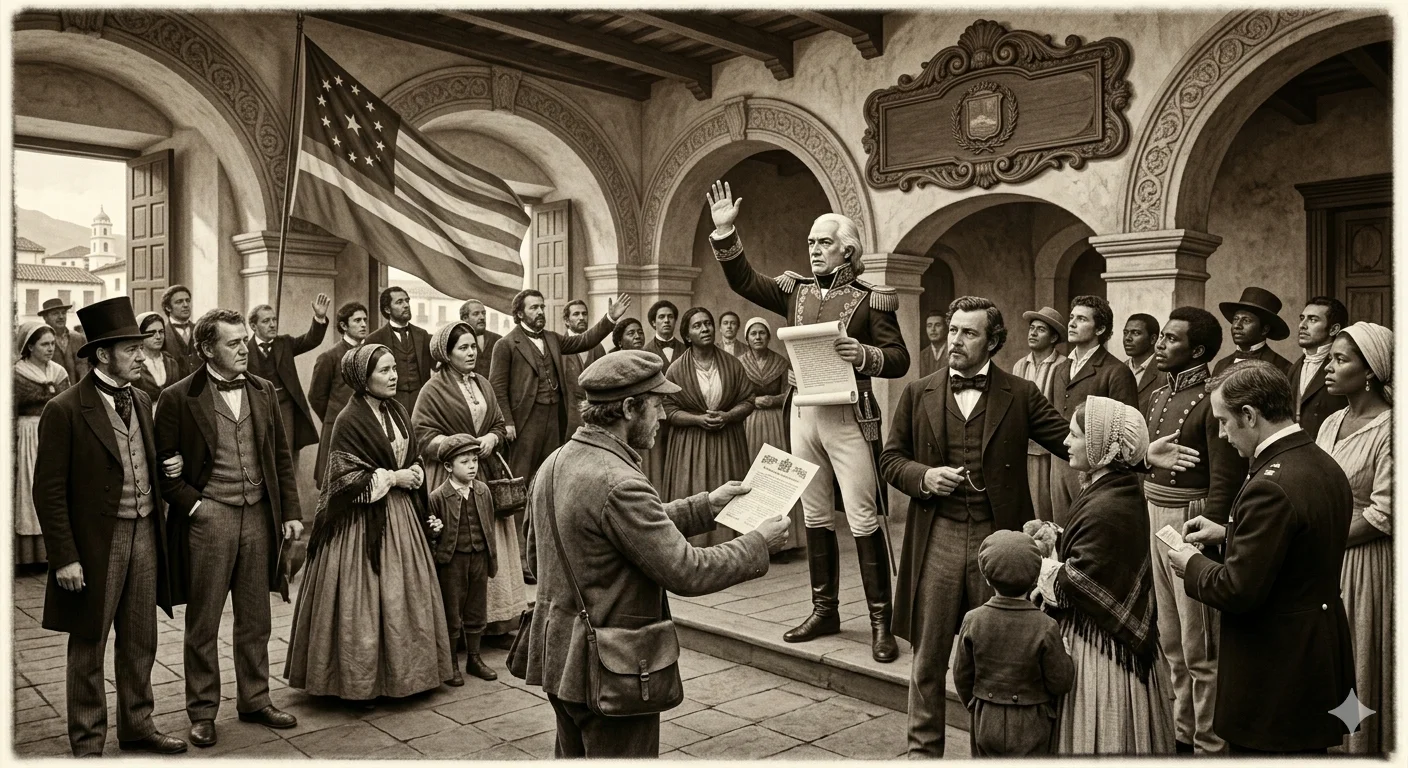
On July 5, 1811, in the grand hall of the newly established National Congress in Caracas, forty delegates of the seven united provinces of Venezuela cast their votes for a document that would change the course of Latin American history forever. The vote was forty in favor and four opposed. The president of the Congress, Congressman Juan Antonio Rodríguez Domínguez, rose and announced that the absolute independence of Venezuela had been solemnly declared. Outside in the streets of Caracas, Francisco de Miranda, the veteran revolutionary who had fought in the American Revolution, the French Revolution, and had spent his life dreaming of Latin American liberation, led crowds of citizens through the plazas acclaiming independence and freedom. A young Creole aristocrat named Simón Bolívar, whose full role in history was still years ahead of him, was among those celebrating in the streets. Venezuela had become the first Spanish colony in South America to formally declare its independence — the first republic born from three centuries of colonial domination.
The Acta de Declaración de Independencia, the document drafted primarily by lawyer Juan Germán Roscio and secretary Francisco Isnardi, was formally read, signed, and ratified by the Congress. It declared that the seven united provinces — Caracas, Cumaná, Barinas, Margarita, Barcelona, Mérida, and Trujillo — forming the American Confederation of Venezuela, were from that day Free, Sovereign, and Independent States, absolved from every submission and dependence on the Throne of Spain. The document’s language deliberately echoed the 1776 American Declaration of Independence, invoking universal rights, the consent of the governed, and the legitimacy of revolution against tyrannical rule. Yet the independence Venezuela had declared on July 5, 1811, would not be won quickly or cheaply. More than a decade of devastating war, catastrophic setbacks, earthquakes, counterrevolutions, and the personal sacrifice of thousands of lives lay between the declaration in Caracas and the military victory at Carabobo in 1821 that finally secured Venezuelan independence as a living reality rather than a written aspiration.
Venezuela Under Spanish Colonial Rule: Three Centuries of the Captaincy General
Christopher Columbus first sighted the Venezuelan coast in August 1498 during his third voyage to the New World, making Venezuela one of the first parts of continental South America seen by European eyes. Spanish exploration of the region began in earnest in 1499 under the navigator Alonso de Ojeda and the cartographer Amerigo Vespucci, who gave his name to the continent. According to tradition, it was Vespucci who gave the land the name Venezuela — Little Venice — after observing indigenous stilt houses built over the waters of Lake Maracaibo, which reminded him of the buildings of Venice. The first permanent Spanish settlement was established at Cumaná in 1521, making it the oldest continuously inhabited European settlement on the South American continent. The city of Caracas, which would become the capital and the center of the independence movement, was founded in 1567 by Diego de Losada.
For nearly three hundred years, Venezuela existed as part of the vast Spanish imperial system, organized administratively as the Captaincy General of Venezuela from 1777, when the Spanish Bourbon reformers reorganized their American territories to improve administrative efficiency and extract more revenue. Before this reorganization, much of Venezuela had been administered as part of the Viceroyalty of New Granada, centered in Bogotá, with the territory divided among multiple administrative units that often overlapped and conflicted. The creation of the Captaincy General brought together the provinces of Caracas, Cumaná, Maracaibo, Guayana, Barinas, Trinidad, and Margarita under a single Captain-General based in Caracas, giving the region something approaching a unified political identity for the first time and inadvertently creating the administrative framework within which a Venezuelan national consciousness would eventually develop.
Venezuela’s colonial economy rested on the cultivation of export crops — primarily cacao, coffee, tobacco, and indigo — grown on large plantations worked by enslaved Africans and indigenous forced labor. The great cacao haciendas of the coastal valleys and the coffee plantations of the Andean foothills produced commodities that connected Venezuela to the Atlantic trading economy and made a small elite of Creole landowners — known as mantuanos, after the mantilla shawls worn by their women — extremely wealthy. Below the mantuanos in the rigid racial hierarchy of colonial Venezuela were the pardos, the free people of mixed African, European, and indigenous descent who made up a large portion of the population and who performed much of the skilled labor and petty commerce of the colony. Below the pardos were the enslaved Africans, and in the interior were the indigenous peoples who had largely been displaced from the coastal regions by Spanish settlement. This racial stratification, codified by law and custom, shaped every aspect of colonial life and would deeply complicate the independence movement by raising questions about who would hold power in the new republic.
The Creole Elite and Their Grievances: Why Venezuela’s Mantuanos Turned Against Spain
The Creole elite of Venezuela — those born in the colony of European descent, as distinct from the peninsulares born in Spain — had many reasons to resent Spanish rule by the late eighteenth century, even as they had long depended on the stability of the colonial system to protect their wealth and social position. The core of their grievance was political: the Spanish imperial system systematically excluded Creoles from the highest offices in colonial administration. The most important positions — the Captain-General, the intendant, the senior judges of the audiencia — were reserved for peninsulares, men born in Spain who were considered more reliably loyal to the Crown. Creoles who had accumulated great fortunes from their plantations and ranches, who had educated their sons in Caracas, in Spain, and increasingly in France and Britain, found themselves excluded from the political power that their economic position would have justified in any other context.
Economic grievances compounded political ones. The Spanish mercantile system restricted Venezuelan trade to commerce with Spain and other Spanish territories, preventing the colony from trading directly with Britain, France, or the newly independent United States — markets that would have paid higher prices for Venezuelan cacao and coffee and offered cheaper manufactured goods in return. The Bourbon reforms of the eighteenth century had brought some liberalization of trade and some improvement in administrative efficiency, but they had also increased taxation and tightened commercial regulation in ways that the Creole elite found burdensome. The Venezuelan cacao growers had particular reason to resent the monopoly of the Caracas Company, established in 1728, which controlled the export of their crop and had been a persistent source of conflict until its abolition in 1784. By the 1790s, Venezuelan Creoles were thoroughly familiar with Enlightenment ideas about natural rights, representative government, and the right of revolution, transmitted through banned books and manuscript copies of prohibited works that circulated widely despite colonial censorship.
The external world provided both inspiring examples and practical opportunities for those contemplating independence. The American Revolution of 1776 demonstrated that a colonial population could successfully break free from European imperial rule and establish a republic based on Enlightenment principles. The French Revolution of 1789 spread the language of liberty, equality, and fraternity throughout the Atlantic world. The Haitian Revolution of 1791-1804 — the successful slave rebellion that overthrew French colonial rule and established the first Black republic in the Western Hemisphere — was both inspiring and terrifying for Venezuelan Creoles: inspiring as a demonstration of colonial resistance to European power, terrifying as a reminder of what could happen to a slave-holding society if the racial hierarchy was disrupted from below. The Haitian precedent haunted the Venezuelan independence movement throughout its history and shaped the Creole elite’s determination to maintain social hierarchies even as they overthrew political ones.
Francisco de Miranda: El Precursor and the Pioneer of Venezuelan Liberation
No figure in the prehistory of Venezuelan independence had a more extraordinary career than Francisco de Miranda, the man whose life became a sustained and improbable campaign to liberate Spanish America from colonial rule, conducted through four decades across two continents before he ever returned to his native Venezuela to attempt the task in person. Miranda was born in Caracas on March 28, 1750, the son of Sebastián de Miranda Ravelo, a Canary Islands merchant who had prospered in Venezuela, and Francisca Antonia Rodríguez de Espinoza, a wealthy Venezuelan woman. He received an excellent education, studied at the Real y Pontificia Universidad de Caracas, purchased a commission in the Spanish army at the age of twenty-two, and began what would become the most globally traveled life in the history of the Latin American independence movement.
Miranda’s military career took him to Cuba, to North Africa, and eventually to North America, where he served during the American Revolutionary War and met many of the leaders of the new United States — George Washington, Alexander Hamilton, Thomas Jefferson, Henry Knox — whose success in creating a republic from colonial rebellion became the model he would spend his life trying to replicate in South America. He then went to Europe, where he spent years in Britain cultivating political connections and lobbying for British support for Latin American independence, and then to France, where he served as a general in the revolutionary armies during the wars that followed the French Revolution of 1789. He fought at Valmy in September 1792, the battle at which the French revolutionary forces halted the Prussian invasion and saved the Revolution — his name appears on the Arc de Triomphe in Paris among those of the republic’s generals. He was arrested during the Terror, imprisoned under suspicion of treason, tried, and acquitted. He returned to London, where he organized the community of Latin American exiles plotting against the Spanish Empire.
In 1806, Miranda mounted his first attempt to liberate Venezuela directly, sailing from New York with a small fleet and approximately two hundred volunteers recruited in the United States. The expedition landed briefly at Coro on the Venezuelan coast in August 1806 but found no popular support — the Venezuelan population was not yet ready to rise, and Miranda was forced to withdraw. It was this failure, and the further years of exile and planning that followed it, that gave Miranda the title by which history remembers him: El Precursor — the Forerunner, the man who prepared the way for others who would complete what he could only begin. When the opportunity he had been preparing for finally arrived in 1810, Miranda was sixty years old, and the young man who would become the Liberator of South America was already gathering in his shadow.
April 19, 1810: The Caracas Junta and the First Step Toward Independence
The immediate trigger for the Venezuelan independence movement was not an internal political development but a crisis in Europe. In 1808, Napoleon Bonaparte’s French armies invaded and occupied Spain, forcing the abdication of both King Charles IV and his son Ferdinand VII at the meeting in Bayonne, and installing Napoleon’s brother Joseph Bonaparte on the Spanish throne. This act destroyed the fundamental legitimacy of colonial authority throughout the Spanish empire: the colonial governments had governed in the name of the King of Spain, but now there was no legitimate King of Spain in a position to exercise authority. In the power vacuum that resulted, juntas began forming throughout the Spanish world — in Spain itself, to resist the French; and in Spanish America, to manage governance in the absence of a functioning metropolitan authority.
In Venezuela, the crisis produced increasing political tension through 1808 and 1809 as the colony’s leaders debated how to respond to the changing situation in Europe. The Spanish Regency, established in Cádiz to govern in Fernando VII’s name, was not recognized by all Venezuelan leaders, and its attempts to maintain authority over the colony were increasingly contested. The decisive moment came on the morning of April 19, 1810 — Maundy Thursday, the Thursday before Easter — when the municipal council (cabildo) of Caracas held an extraordinary open session at which the Spanish Captain-General, Vicente Emparan, was effectively deposed. The sequence of events that day was dramatic: Emparan appeared on the balcony of the Capitol to address the gathered crowd, asked whether the people wanted him to continue governing, and was met with shouts of No. He resigned. The cabildo took control and declared itself the Supreme Conservadora Junta of Caracas, claiming to govern in the name of Fernando VII.
The establishment of the Junta on April 19, 1810, is recognized in Venezuelan history as the beginning of the independence process — the date now celebrated as the Oath of Independence and which gives the name to Venezuela’s nationalist political movement. The Junta was careful at first to maintain the fiction of loyalty to the captive King Fernando VII, declaring itself to be governing on his behalf rather than asserting independence. But in practice it immediately exercised sovereign authority: it lowered taxes, opened Venezuelan ports to free trade, sent missions to Britain and the United States seeking recognition and support, and called for a National Congress of the Venezuelan provinces to determine the colony’s future. The missions abroad included notable young Venezuelans among their members, including Simón Bolívar and the intellectual Andrés Bello, who traveled to London and persuaded Francisco de Miranda to return from his decades of exile and join the movement he had spent his life preparing.
The Sociedad Patriótica, the National Congress, and the Debate Over Independence
The National Congress that the Caracas Junta had called into being began its sessions on March 2, 1811, meeting in the house of the Count of San Javier at what is now called El Conde corner in Caracas. Forty-four deputies represented the seven provinces that had recognized the Junta — Caracas, Cumaná, Barinas, Margarita, Barcelona, Mérida, and Trujillo — while three provinces, Maracaibo, Guayana, and Coro, remained loyal to the Spanish Regency and sent no representatives. The Congress was thus from the beginning a body that represented only part of Venezuela, presiding over a country already divided between those who favored independence and those who maintained allegiance to the Spanish Crown.
Within the Congress, two factions contended over the fundamental question of whether Venezuela should declare outright independence or continue to operate under the legal fiction of loyalty to Fernando VII while exercising effective self-government. The separatists argued that the collapse of Spanish authority had freed Venezuela from any obligation to the Crown and that the moment had come to formally establish a republic. The fidelists maintained that loyalty to Fernando VII remained politically and morally obligatory, that independence was premature and dangerous, and that the provinces should wait for the restoration of legitimate Spanish authority before determining their future course. As the Congress deliberated through the spring of 1811, the separatist position gained momentum — aided significantly by the activities of an organization that was operating outside the Congress itself.
The Sociedad Patriótica — the Patriotic Society — had been founded in August 1810 ostensibly as an agricultural and economic discussion club, but had evolved rapidly into the main engine of the independence movement. Its membership included many of the most radical and energetic advocates of separation, and its sessions became increasingly political in character, functioning as something between a revolutionary club in the tradition of the French Jacobins and a propaganda organization for the independence cause. Among its members were José Félix Ribas, Francisco José Ribas, Antonio Muñoz Tébar, and Vicente Salias. The incorporation of Francisco de Miranda and the young Simón Bolívar gave the society a revolutionary urgency that its earlier membership had lacked. The society published a newspaper, the Patriota Revolucionario, directed by Salias and Muñoz Tébar, and maintained branches in Barcelona, Barinas, Valencia, and Puerto Cabello, giving the independence movement a geographic reach that the Congress alone could not provide.
The pressure from the Sociedad Patriótica on the Congress intensified as the spring of 1811 advanced. Bolívar, then twenty-seven years old, gave a famous speech to the society in which he demanded to know why three hundred years of colonial submission were not enough — asking whether the Congress was deliberating while the moment for action was slipping by. His rhetorical energy and the growing public support for independence in Caracas created a political atmosphere in which the fidelists in Congress found their position increasingly untenable. On July 2, a motion on independence was presented in Congress. On July 3, the formal debate began. On July 5, the vote was taken.
July 5, 1811: The Vote, the Declaration, and the Birth of the First South American Republic
The vote on independence on July 5, 1811, was decisive but not unanimous. Forty of the Congress’s forty-four deputies voted in favor of independence; four voted against. Immediately after the vote, the Congress president, Juan Antonio Rodríguez, announced the result and declared the independence solemnly proclaimed. A committee was formed to draft the formal declaration, consisting of Juan Germán Roscio, Fernando del Toro, and the Congress secretary Francisco Isnardi. Roscio, who had been the most important intellectual voice for independence in the Congress, became the primary author of the document. He was a Venezuelan lawyer of Italian descent, born on May 27, 1763, in San Francisco de Tiznados, who had served as the secretary of foreign affairs for the Junta of Caracas and would go on to become the chief architect of the Venezuelan Constitution of 1811 and one of the founding intellectual figures of the Venezuelan republic. Isnardi, as Congress secretary, provided the administrative framework and precise language that transformed the political decision into a formal legal document.
The Acta de Declaración de Independencia was formally read before the Congress, discussed, and ratified on July 7 with forty-three votes in favor and one opposed. The document was then recorded in the Congress’s Book of Minutes on August 17, 1811. Its language opened by invoking Almighty God, then stated that the representatives of the seven united provinces, forming the American Confederation of Venezuela, assembled in Congress and possessed of the full authority granted by the people they represented, declared that the united provinces were and ought to be from this day, by act and right, Free, Sovereign, and Independent States, absolved from every submission and dependence on the Throne of Spain. The declaration cited as justifications for this action the events at Bayonne — the forced abdications of Charles IV and Fernando VII — which it argued had transferred sovereignty back to the Venezuelan people, since the throne’s claim to govern them rested on a legitimate monarchical succession that Napoleon’s usurpation had destroyed.
The declaration’s authors were clearly familiar with and influenced by the American Declaration of Independence of July 4, 1776, whose logic and rhetoric their document deliberately echoed. Like Jefferson’s document, the Venezuelan declaration made universal claims about rights and sovereignty, not merely arguments about the specific circumstances of the Venezuelan situation. It argued that it was contrary to order, impossible to the Government of Spain, and fatal to the welfare of America that the vast territory and population of Spanish America should depend and be subject to a peninsular corner of the European continent — a geographic and demographic argument that gave the declaration an anti-colonial logic applicable to all of Spanish America, not just Venezuela. This universalism was not coincidental: the founders of the Venezuelan republic understood themselves to be inaugurating a continental movement, and the document they were writing was intended to be a spark for the independence of all of Latin America.
Outside the Congress, the declaration was greeted with celebrations in the streets of Caracas. Francisco de Miranda, who had spent forty years working toward this moment, led crowds through the city’s plazas. The deputies agreed to designate the new republic as the Confederación Americana de Venezuela — the American Confederation of Venezuela — and appointed a commission to design a national flag and draft a constitution. On July 13, 1811, the national flag of Venezuela was approved, based on the design that Miranda had created in 1806 during his first liberation expedition. It was first formally hoisted on July 14, 1811 — the anniversary of the storming of the Bastille, the symbolic date of the French Revolution that had so deeply influenced the Venezuelan independence movement. The flag bore the colors of yellow, blue, and red that remain Venezuela’s national colors to this day: yellow for the wealth of the new land, blue for the ocean separating it from Spain, and red for the blood shed in the struggle for freedom.
Simón Bolívar: The Liberator Whose Long Road to Victory Defined an Era
Simón José Antonio de la Santísima Trinidad Bolívar y Palacios Ponte y Blanco was born on July 24, 1783, in Caracas, into one of the wealthiest and most prominent families of the Venezuelan Creole elite. His parents, Juan Vicente Bolívar y Ponte and María de la Concepción Palacios Blanco, were both from distinguished mantuano families that had accumulated their fortunes through generations of plantation agriculture. Bolívar was orphaned at the age of nine, both parents having died when he was still a child. He was raised by uncles and by his devoted nurse, Hipólita, an enslaved woman whose attachment to him was deep and mutual — Bolívar himself wrote about her later with great warmth, describing her as the author of his childhood happiness and the woman whose milk had nourished him. He was educated at some of Caracas’s best schools, then sent to Madrid in 1799 to complete his education at the Spanish court, where he encountered the decadence of the late Bourbon monarchy and the intellectual ferment of Enlightenment thought that circulated through aristocratic European society.
In Madrid, Bolívar met and married María Teresa de Toro y Alayza, a Venezuelan woman living in Spain, in May 1802. The couple returned to Caracas later that year, but their happiness was brief. María Teresa died of yellow fever on January 22, 1803, after only eight months of married life. Bolívar never remarried, and the loss of his young wife marked him for life. He returned to Europe in 1804, traveling to France and Italy, where he was deeply impressed by Napoleon Bonaparte — then at the height of his power and prestige — and where he took an oath on the Aventine Hill in Rome, in the presence of his tutor Simón Rodríguez, to dedicate himself to the liberation of his homeland from Spanish rule. The oath on Monte Sacro, as it is known in Venezuelan history, was the moment at which the personal decision that would make Bolívar the Liberator was consciously and publicly made.
When Bolívar returned to Venezuela and joined the independence movement in 1810, he was twenty-six years old, extraordinarily energetic, highly educated in both European political theory and military history, and utterly convinced that Spanish America’s independence was not merely desirable but inevitable. He threw himself into the revolutionary cause with a commitment that would not waver for the next twenty years, through exile, defeat, loss, and the relentless demand of military command in conditions of extreme hardship. He was at the Sociedad Patriótica urging independence in the spring of 1811; he was a colonel in the revolutionary army defending the republic in 1812; he was writing his Cartagena Manifesto analyzing the failures of the First Republic from exile in New Granada in December 1812; and he was leading the Admirable Campaign back into Venezuela in 1813, covering 1,200 kilometers in seventy-five days, winning six battles, and arriving in Caracas as El Libertador — the Liberator — proclaimed by the people on August 6, 1813.
The Fall of the First Republic: Earthquake, Royalist Reconquest, and Miranda’s Capitulation
The First Republic of Venezuela, declared in July 1811, lasted barely a year before its collapse in the summer of 1812. The republic’s problems were immediate and severe. Three of the ten provinces — Maracaibo, Guayana, and Coro — had never recognized the Caracas Junta and remained loyal to the Spanish Crown, maintaining a hostile presence on the republic’s periphery. Military expeditions sent to bring these provinces under republican control failed. The loss of the Spanish market for Venezuelan cacao and coffee, disrupted by the political crisis, caused an economic downturn that eroded popular support for the republic, particularly among the lower classes who had not particularly benefited from independence and who now found themselves suffering economically because of it. Royalist forces, operating out of the still-loyal provinces and strengthened by volunteers from the Spanish Caribbean, conducted continuous military pressure against the republic’s borders.
The most dramatic blow to the First Republic came from nature rather than from its human enemies. On March 26, 1812 — which happened to be Maundy Thursday, the second anniversary of the April 19 founding of the Caracas Junta — a catastrophic earthquake struck Venezuela. The earthquake killed thousands of people and caused extensive destruction, and its timing led Catholic clergy loyal to Spain to declare it divine punishment for the rebellion against the Crown. The psychological impact of this religious interpretation on a deeply Catholic population was significant: many ordinary Venezuelans who had been lukewarm about independence or genuinely supportive of it interpreted the earthquake as a sign from Providence, and the Church’s monarchist interpretation of the disaster eroded republican support. Bolívar responded defiantly, famously saying — or being reported to have said — that if Nature itself opposes us, we will fight against Nature and make it obey us. But the damage to the republic’s popular base was real.
By July 1812, the republic’s military position had become desperate. The Spanish royalist commander Domingo de Monteverde, operating out of Coro with a force that grew as provincial royalists joined him, had advanced steadily eastward and was approaching Caracas. Francisco de Miranda, who had been granted dictatorial powers by the republican government in a last attempt to save the situation, struggled to hold the collapsing republic together as outlying provinces defected to the royalists and the republican army disintegrated. On July 25, 1812, Miranda signed an armistice and capitulation with Monteverde at San Mateo, surrendering the republic on terms that he believed would protect the lives of its defenders. Bolívar and other republican officers, furious at what they considered a treasonous surrender, arrested Miranda at La Guaira as he was attempting to board a British vessel and handed him over to Spanish authorities. Miranda spent the remaining four years of his life as a prisoner in Spanish jails, dying in the prison of La Carraca in Cádiz on July 14, 1816. He had given his life to the cause of Latin American independence without living to see it achieved.
The Admirable Campaign and the Second Republic: Bolívar’s Rise to the Liberator
Bolívar fled from Venezuela after the fall of the First Republic and made his way to Cartagena in New Granada, where he published in December 1812 one of the most important documents of the independence era: the Cartagena Manifesto, a brilliant analysis of the failures of the First Republic and an argument for a different approach to achieving and defending independence. The manifesto identified the structural weaknesses of the republican cause — the excessive federalism that had divided authority, the failure to mobilize the pardos and lower classes, the reliance on educated Creoles who lacked military experience — and proposed a more centralized, energetic, and militarily aggressive approach. It was both a political analysis and a personal statement of purpose: Bolívar was not finished, and the failure of the First Republic was a lesson, not an ending.
Joining the republican forces of New Granada, Bolívar received permission in 1813 to lead an invasion of Venezuela. What followed became known as the Admirable Campaign — one of the most remarkable military achievements of the Latin American independence wars. Setting out from Cúcuta with a force of approximately 500 men in May 1813, Bolívar advanced through the Andes into Venezuela, winning a series of engagements in rapid succession and covering enormous distances in a short time. He issued from Trujillo on June 15, 1813, his infamous Decree of War to the Death — a document proclaiming that the war would henceforth be fought without quarter: any Spaniard who did not actively fight for the republic would be considered an enemy and executed; any American who fought for Spain would be shown no mercy. The decree was brutal and controversial, but it served the political purpose of forcing the pardo and mixed-race population to choose sides and of positioning the war as a conflict between Venezuelan Americans and foreign Spanish oppressors.
Bolívar entered Caracas on August 6, 1813, and was proclaimed El Libertador — the Liberator — by acclamation. The Second Republic of Venezuela was established. But it lasted barely a year longer than the First. The most serious challenge it faced was not from Spanish royal armies but from the llaneros — the fierce cattle herders of the Venezuelan plains, the llanos, who had been mobilized against the republic by a royalist commander of extraordinary ability named José Tomás Boves. A mixed-race Spaniard from Asturias, Boves had built a mounted force of llanero cavalry that was among the most effective fighting forces in the hemisphere, and he used them to wage a brutal campaign against the republican forces and the Creole elite that supported them. At the Battle of La Puerta in June 1814, Boves decisively defeated Bolívar’s forces. Boves himself was killed at the Battle of Urica in December 1814, but by then the Second Republic had been extinguished, and Bolívar was once again in exile.
The Long War Continues: Exile, Return, and the Road to Gran Colombia
The years from 1814 to 1819 were the most desperate of the Venezuelan independence struggle. After the fall of the Second Republic, Bolívar spent time in Jamaica and Haiti, writing his famous Jamaica Letter in 1815 — a comprehensive vision of the future of Latin American independence that predicted the emergence of independent republics throughout the continent and argued that geography, culture, and history required forms of government adapted to Latin American conditions rather than simply copied from the United States or Europe. In Haiti, President Alexandre Pétion provided Bolívar with ships, men, arms, and ammunition in return for a promise to abolish slavery in the territories he liberated — a promise that shaped Bolívar’s subsequent policies and that represented the beginning of his engagement with the abolitionist cause that would eventually, in 1816, lead him to declare the freedom of all enslaved people in territories under his control.
In 1816, Bolívar returned to Venezuela from Haiti and began the slow, grinding process of building a base for renewed republican operations. The capture of Angostura (present-day Ciudad Bolívar) on the Orinoco River gave the republicans a secure territorial base from which operations could be conducted and expanded. In 1819, at the Congress of Angostura — a deliberative assembly of republican representatives — Bolívar delivered his famous Angostura Address, one of the great documents of Latin American political thought, in which he outlined his vision for a constitutional republic that would balance democratic principles with the strong executive power he considered necessary for governing the volatile post-colonial societies of Spanish America. The same Congress declared the Republic of Gran Colombia, uniting Venezuela, New Granada, and eventually Ecuador in a single republic with Bolívar as president.
The military breakthrough that the republican cause desperately needed came in 1819 with Bolívar’s audacious crossing of the Andes into New Granada. In June and July 1819, Bolívar led an army of approximately 2,500 men — including a significant contingent of British and Irish volunteers who had joined the republican cause after the end of the Napoleonic Wars in Europe — across the flooded llanos and then over the Andes through the Páramo de Pisba, a high mountain pass where freezing temperatures and altitude sickness killed many men and animals. It was one of the most daring military operations in South American history, comparable to Hannibal’s crossing of the Alps. Arriving in New Granada, Bolívar decisively defeated the royalist forces at the Battle of Boyacá on August 7, 1819, ensuring New Granada’s independence and providing the political base for the declaration of Gran Colombia.
The Battle of Carabobo, June 24, 1821: The Final Victory That Secured Venezuelan Independence
The decisive military victory that ended Spanish control of Venezuela and made the independence declared on July 5, 1811, a permanent reality came on June 24, 1821, at the plains of Carabobo, approximately fifteen kilometers south of Valencia. The Battle of Carabobo was the largest battle of the Venezuelan War of Independence and the engagement that Spanish commanders recognized as decisive — though the last royalist garrison, at Puerto Cabello, did not surrender until October 1823. Bolívar’s republican army of approximately 6,500 men faced the royalist Army of Venezuela under General Miguel de la Torre, who occupied a strong defensive position on the plain.
The battle’s outcome was determined by the performance of the British Legion — the battalion of British and Irish volunteers, commanded by Colonel Thomas Ilderton Ferrier, who had come to South America to fight for independence. Bolívar divided his force and sent a flanking column around the royalist position through rough terrain while attacking frontally in the center. The British Legion, attacking through dense jungle on the flank, forced its way onto higher ground and broke through the royalist line, allowing the cavalry of General José Antonio Páez to exploit the gap. The royalist position collapsed rapidly. General de la Torre managed to escape with a small force to Puerto Cabello, but the bulk of the royalist army was destroyed or captured. Of the approximately 5,000 royalist troops engaged, fewer than 400 reached safety. Venezuela was liberated.
Bolívar entered Caracas on June 29, 1821, just five days after Carabobo. The city received him as El Libertador — the title that had been given to him in 1813 and that the decade of struggle since had made permanent. The Congress of Cúcuta, meeting at the time of Carabobo, ratified the constitution of Gran Colombia and confirmed Bolívar as president. Venezuela, along with present-day Colombia, Panama, and Ecuador, became part of the Gran Colombia that Bolívar had long envisioned as the political framework for post-colonial South America. The formal independence that Venezuela had declared on July 5, 1811, was now a military fact as well as a legal one, though Puerto Cabello would hold out until November 1823 and the last Spanish military presence was not eliminated until the naval battle of Lake Maracaibo in July 1823.
The Federal Constitution of 1811 and the Founding Legal Framework of the Venezuelan Republic
Even before the military struggle for independence was decided, the founders of the Venezuelan republic had begun constructing the legal and constitutional framework of the new state. On December 21, 1811, the National Congress approved the Federal Constitution of the States of Venezuela — the first constitution in Latin American history and one of the earliest republican constitutions in the Western Hemisphere. The document was drafted primarily by Juan Germán Roscio, who drew on the models of the United States Constitution of 1787 and the French Declaration of the Rights of Man and Citizen of 1789, adapting their principles to Venezuelan conditions. The constitution established a federal republic with a bicameral legislature, a weak executive consisting of a triumvirate rather than a single president, and an independent judiciary.
The constitution made several radical departures from the social order of the colonial period. It established the equality of all citizens before the law — a provision that formally ended the racial hierarchy of the colonial caste system, though the reality of racial inequality persisted long after the legal prohibition. It abolished nobiliary titles and the social distinctions that had existed under Spanish rule. It repealed laws that had civilly degraded the pardos — the mixed-race population — and recognized the rights of property and personal security. The Caracas Junta had on August 14, 1810, already prohibited the further introduction of enslaved people into Venezuela, and the constitution ratified this prohibition. However, and crucially, the constitution did not abolish slavery itself — the enslaved people already in Venezuela remained enslaved, and their liberation would not come until 1854 when President José Gregorio Monagas finally abolished the institution. The gap between the republic’s universalist founding ideals and the specific exclusion of the enslaved population from its promises was the founding contradiction of Venezuelan constitutionalism.
Gran Colombia, Separation, and Venezuelan Sovereignty: 1821 to 1830
The Venezuela that emerged from the War of Independence was not immediately a sovereign independent state in the way the July 5, 1811, declaration had envisioned. It was part of Gran Colombia — the great republic that Bolívar had united under a single government in 1819 and that the Congress of Cúcuta had constituted in 1821. Gran Colombia encompassed the territories of modern Venezuela, Colombia, Panama, and Ecuador, governed from Bogotá with Bolívar as president and Francisco de Paula Santander as vice president. The union represented the fulfillment of Bolívar’s most cherished political vision: a powerful, unified Spanish American state that could defend itself against European reimposition of colonial control and take its place among the great nations of the world.
But Gran Colombia was strained from the beginning by the tensions that Bolívar himself had predicted and feared. Regional identities were strong; the geographical barriers between Venezuela, New Granada, and Ecuador made administrative unity difficult; the different social and economic structures of the three regions created conflicting political interests; and the war had produced a generation of military caudillos — regional strongmen — who were loyal to their own power bases more than to the central government in Bogotá. In Venezuela, the dominant military figure was General José Antonio Páez, the llanero cavalry commander whose tactical brilliance at Carabobo had been crucial to the republican victory and whose personal loyalty to Bolívar was genuine but whose political ambitions pointed toward Venezuelan autonomy rather than continental union.
In 1826, Páez led a separatist movement in Venezuela that challenged Gran Colombian authority. Bolívar returned to Venezuela and reconciled with Páez, but the incident revealed the fragility of the union. Bolívar’s later years were marked by increasing despair about the future of the republics he had created: he assumed dictatorial powers in an attempt to hold Gran Colombia together, was the subject of assassination attempts, and watched his political vision crumble as regional separation proved stronger than continental unity. Venezuela formally separated from Gran Colombia on November 22, 1829, when the Congress of Venezuela declared separation, and this separation was confirmed on January 13, 1830. The sovereign Republic of Venezuela, which the declaration of July 5, 1811, had first proclaimed, was finally established as a permanent, independent political reality. Simón Bolívar died on December 17, 1830, in Santa Marta, Colombia, just months after Venezuelan separation, of tuberculosis, having lived to see both the liberation and the dissolution of the continental union he had given his life to build.
Spain’s Recognition and the Long Aftermath: How Venezuelan Independence Was Finally Confirmed
The formal independence that Venezuela had declared in 1811 and won militarily in 1821 was not recognized by Spain until 1845. The Spanish government of Queen Isabella II, under President Carlos Soublette’s Venezuelan government, signed a Treaty of Peace and Friendship on March 30, 1845, by which Spain finally acknowledged Venezuelan sovereignty and ended the legal fiction that Venezuela was still a rebellious province of the Spanish Crown. The twenty-four years between the military victory at Carabobo and the Spanish diplomatic recognition represented the period during which Venezuelan independence existed as a military and practical fact but not as a formally legitimized status in the conventions of international law. The treaty of 1845 completed the legal process that the guns of July 5, 1811, had inaugurated.
The aftermath of independence was difficult in ways that went beyond diplomacy. The Venezuela that emerged from two decades of devastating war was impoverished, demographically depleted, and socially disrupted. The population losses of the independence wars were catastrophic: estimates suggest that Venezuela lost perhaps a quarter of its pre-war population to combat, disease, forced displacement, and famine in the years between 1810 and 1823. The plantation economy that had made the Creole elite wealthy before the war was disrupted; the enslaved population’s legal status remained unchanged (slavery was not fully abolished until 1854); and the political landscape was dominated by military caudillos who had won their authority through the gun and who were not necessarily committed to the constitutional republic that the founders had proclaimed. The history of Venezuela in the nineteenth century after independence was marked by the tension between the republic’s founding ideals and the realities of a society whose structures had been shaken but not transformed by the independence movement.
The Legacy of July 5, 1811: Venezuela’s National Day and Its Enduring Significance
July 5 is celebrated as Venezuela’s national day, the anniversary of the signing of the Acta de Declaración de Independencia and the founding of the first South American republic. The day is marked across Venezuela with military parades, patriotic ceremonies, and civic celebrations that honor the founders of the republic — above all Simón Bolívar, whose image dominates Venezuelan public life to an extent perhaps unmatched by any other historical figure in any other country. Every town and city in Venezuela has its Plaza Bolívar; Bolívar’s face appears on the currency; his full name — Simón Bolívar — was given to the national currency, the Bolívar, and his legacy has been claimed by every political tendency from left to right throughout Venezuelan history.
The significance of July 5, 1811, extends far beyond Venezuela. The Venezuelan declaration was the first formal declaration of independence from Spain in South America, and it served as both inspiration and model for the independence movements that followed throughout the continent. The logic of the Venezuelan declaration — that the Bayonne abdications had dissolved the bond of loyalty between the colonies and the Spanish Crown, releasing the American provinces to determine their own governments — was adopted by independence leaders throughout Latin America. The Venezuelan independence war, and above all the career of Simón Bolívar, provided the military leadership and the political vision for the liberation of much of the continent: Colombia, Ecuador, Peru, and Bolivia all owed their independence in significant part to the campaigns that Bolívar had organized and led from the Venezuelan base.
Francisco de Miranda, whose life had been a precursor to the independence he did not live to see completed, received his posthumous tribute when Venezuela named one of its states in his honor in 1889, and his name was inscribed on the Arc de Triomphe in Paris, the only non-French person among the generals of the French Revolution so honored. The capital of Liberia is named Monrovia in honor of James Monroe, the US President whose support for Latin American independence was expressed in the Monroe Doctrine. The new republic that Venezuela represented was watched by the world and taken as proof that the principles of self-governance and republican liberty were not limited to the Anglo-American tradition but could take root in the soil of the Spanish colonial world as well. Venezuela’s declaration of independence on July 5, 1811, was a moment when a people claimed their sovereignty and dared to believe that three centuries of colonial subjugation could be overcome by the determined assertion of universal rights. History, after a long and costly struggle, proved them correct.