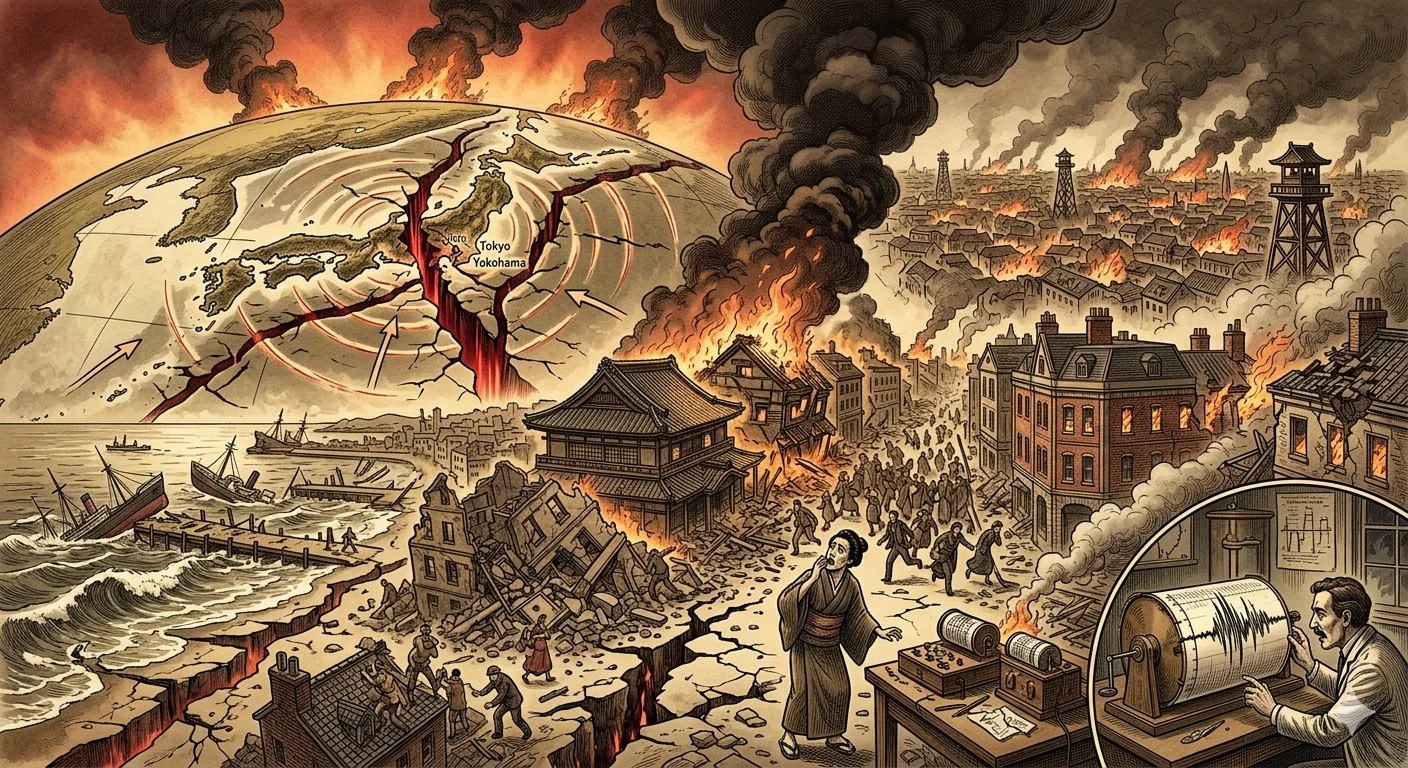
At eleven minutes and fifty-eight seconds past noon on Saturday, September 1, 1923, as millions of families across Tokyo and Yokohama were preparing lunch over cooking fires and charcoal braziers, the ground beneath the Kantō Plain began to shake with a violence that no living person in Japan had ever experienced. The initial jolt lasted approximately fourteen seconds — just fourteen seconds — but by the time it ended, nearly every building in Yokohama had collapsed or was in the process of collapsing, and vast sections of Tokyo’s most densely populated neighborhoods had been reduced to rubble. In those fourteen seconds, the Philippine Sea Plate had lurched sharply beneath the Okhotsk Plate along the Sagami Trough, releasing energy equivalent to approximately four hundred Hiroshima-scale atomic bombs in a megathrust event that registered a magnitude of approximately 8.0 on the moment magnitude scale.
Yet the earthquake itself, devastating as it was, was only the beginning. The cooking fires that the shaking overturned, the charcoal braziers that the collapsed buildings spilled across split and desiccated wooden floors, the fractured gas mains that vented their contents into streets choked with debris, the broken water mains that left the fire departments impotent — these were the true instruments of the Great Kantō Earthquake’s extraordinary death toll. The fires that ignited across Tokyo and Yokohama within minutes of the initial shock burned for two days, swept by the powerful winds of a typhoon that was passing off the Japanese coast at the precise moment of the earthquake, and consumed the wooden cities in firestorms of a ferocity that transformed entire neighborhoods into seas of flame. When the fires finally subsided on September 3, the two cities that had together constituted Japan’s economic, cultural, and governmental heart lay in ruins. The death toll, estimated in contemporary accounts at approximately 140,000 and placed by modern scholarly research at approximately 105,385 confirmed fatalities with a further 13,000 missing, made the Great Kantō Earthquake the most destructive seismic event in recorded Japanese history and one of the deadliest natural disasters in twentieth-century world history.
The Tectonic Setting: Why the Kantō Plain Was Destined for Catastrophe
The Great Kantō Earthquake of 1923 did not come without warning, at least not to those who understood the geological reality underlying Japan’s position on the earth. Japan sits at one of the most tectonically complex locations on the planet, at the meeting point of four major tectonic plates — the Pacific Plate, the Philippine Sea Plate, the Okhotsk Plate, and the Eurasian Plate — whose ongoing collisions and subductions drive the volcanic activity and seismic hazard that define the Japanese archipelago. The Kantō region, encompassing Tokyo and the surrounding prefectures, is positioned directly above the subduction zone where the Philippine Sea Plate dives beneath the Okhotsk Plate along the Sagami Trough, a deep-sea trench that runs roughly east-west beneath Sagami Bay southwest of Yokohama. This configuration made the Kantō region not merely earthquake-prone but specifically vulnerable to megathrust earthquakes — the largest and most destructive category of seismic event, produced by the sudden slip of one tectonic plate beneath another along enormous fault surfaces that extend for hundreds of kilometers.
Japanese historical records documented major earthquakes striking the Kantō region at roughly seventy-year intervals over the preceding centuries, a pattern that had not escaped the notice of scientifically minded observers in the early twentieth century. Seismologist Akitune Imamura of the Imperial University of Tokyo had studied these historical patterns carefully and arrived at a conclusion he published openly in scientific literature in the years before 1923: Tokyo was sitting directly over a seismic gap — a section of a known fault zone that had not released its accumulated stress through recent seismic activity — and would inevitably produce a major earthquake when that stress was finally discharged. Imamura estimated that the resulting disaster would kill over 100,000 people in Tokyo alone. His prediction was publicly criticized and dismissed as irresponsible alarmism by government officials and other scientists who considered it damaging to public confidence and economic stability. The prediction was, however, accurate to a degree that must have haunted Imamura for the rest of his life. It was fulfilled on September 1, 1923, with a completeness that exceeded even his most pessimistic estimates.
The earthquake that struck at 11:58:32 JST was not a single event but a complex sequence. Modern seismological analysis indicates that the initial megathrust rupture, centered in Kanagawa Prefecture approximately 100 kilometers southwest of Tokyo near Odawara, was followed approximately ten seconds later by a second rupture on the other side of Sagami Bay near the Miura Peninsula — a dual rupture on a broad trench-type fault that produced a combined effect far more devastating than either event alone would have been. Three minutes after the initial shock, at approximately 12:01, a magnitude 7.2 aftershock struck beneath northern Tokyo Bay, directly beneath the most densely populated areas of the city. Two minutes after that, at approximately 12:03, a magnitude 7.3 aftershock struck in Yamanashi Prefecture. Survivor accounts consistently describe experiencing three distinct major seismic events within a span of several minutes, separated by brief intervals during which those who had survived the initial collapse struggled to escape from the rubble before the next shock arrived.
Noon on Saturday: The Moment the World Collapsed in Yokohama and Tokyo
The timing of the earthquake — just before noon on a Saturday — was, in the grim arithmetic of disaster, almost perfectly calibrated to maximize casualties. Saturday at noon was a moment when the populations of Tokyo and Yokohama were simultaneously engaged in the single most fire-prone activity of the ordinary Japanese domestic routine: preparing the midday meal. Hundreds of thousands of charcoal cooking braziers, kerosene stoves, and gas burners were in active use across the two cities at the moment of the initial shock. The wooden buildings of the low-lying city areas — the densely packed neighborhoods of the shitamachi, the working-class eastern districts built on the soft alluvial soils near the Sumida River — were the most vulnerable to both the shaking and the fires that followed.
In Yokohama, which was much closer to the earthquake’s epicenter than Tokyo, the destruction from the initial shaking alone was almost total. The port city of approximately 450,000 people, known as the City of Silk for its dominant role in Japan’s silk export trade, was reduced to ruins in approximately fourteen seconds. Survivor accounts consistently describe the same experience: a low, deep rumbling that rapidly intensified, the ground lurching violently in multiple directions simultaneously, and then the sudden, catastrophic collapse of virtually everything built of heavy masonry or traditional construction. The Yokohama Grand Hotel — a Victorian-era establishment that had accommodated American President William Howard Taft, English author Rudyard Kipling, and countless other luminaries of the age of steam travel — collapsed into rubble. The Custom House, the Yokohama Specie Bank, the silk warehouses that formed the economic backbone of the city, the factories and workshops of what had been Japan’s most cosmopolitan and internationally connected port — all fell, or caught fire, or both.
Henry W. Kinney, a Tokyo-based editor of the Trans-Pacific publication who arrived in Yokohama hours after the earthquake, described what he found: Yokohama, the city of almost half a million souls, had become a vast plain of fire, of red, devouring sheets of flame which played and flickered. Here and there a remnant of a building, a few shattered walls, stood up like rocks above the expanse of flame, unrecognizable. It was as if the very Earth were now burning. It presented exactly the aspect of a gigantic Christmas pudding over which the spirits were blazing, devouring nothing. For the city was gone. Within twenty-four hours of the earthquake, Yokohama had ceased to exist as a functioning city. Approximately ninety percent of its buildings were damaged or destroyed. Thousands of residents who had survived the initial collapse were burned alive in the fires that swept through the rubble in the hours that followed. Many who reached the waterfront were drowned when the tsunami generated by the earthquake struck the harbor; the waves at Atami on Sagami Gulf reached a height of approximately 12 meters and destroyed 155 houses, killing 60 people there alone.
Tokyo in Flames: The Firestorm That Turned a City Into Hell
In Tokyo, seventeen miles north of Yokohama, the initial shaking was less severe than in the epicentral region, though still catastrophic by any ordinary standard. The shock waves had weakened during their passage through the Kantō Plain, and many of Tokyo’s more solidly constructed buildings — particularly those built of reinforced concrete or steel frame construction — survived the initial tremors intact or with manageable damage. But the city’s most densely populated neighborhoods, built on the soft, waterlogged alluvial soils of the low-lying areas east of the Sumida River, experienced amplification of the ground motion that made the shaking far more violent than the bedrock areas of the city. In these neighborhoods, where the houses of Tokyo’s working class were packed closely together in timber construction on unstable ground, the collapse was nearly as complete as in Yokohama.
The fires began almost immediately. According to contemporary police reports, fires had broken out in eighty-three separate locations across the city by 12:15 — barely seventeen minutes after the initial shock. Fifteen minutes later, the number had grown to 136. The sources were the overturned cooking fires, the spilled charcoal, the broken gas mains, the industrial furnaces in the factories that lined the Sumida River, and the friction-generated heat in collapsed structures. Under ordinary circumstances, Tokyo’s fire department would have been able to contain multiple simultaneous fires through coordination and rapid response. But the circumstances of September 1, 1923, were not ordinary in any respect: the earthquake had broken the city’s water mains across enormous areas, leaving firefighters without the water pressure they needed; the debris-choked streets prevented fire engines from reaching many blazes; the collapsed bridges over the Sumida River divided the city into sections that could not support each other; and the powerful winds of the typhoon that was passing off the Japanese coast provided a constant and powerful fanning of every flame.
The air temperature in central Tokyo, recorded at the Central Meteorological Observatory near Hitotsubashi, reached 46 degrees Celsius — 115 degrees Fahrenheit — at the height of the firestorms. The combination of typhoon-strength winds, the enormous fuel load represented by the city’s timber construction, and the failure of water supply created conditions in which individual fires merged into city-sized conflagrations that generated their own wind systems, drawing oxygen from the surrounding atmosphere and spreading with a speed and ferocity that outpaced any possibility of organized response. By the evening of September 1, vast sections of eastern Tokyo were a single continuous fire. The Honjo and Fukagawa wards — the most densely populated areas of the shitamachi — were almost entirely consumed. Two-fifths of all the buildings in Tokyo would eventually burn to the ground, leaving approximately half the city’s population homeless.
The Honjo Clothing Depot Tragedy: The Dragon Twist That Killed 38,000 in Minutes
Among the many individual catastrophes that constituted the Great Kantō Earthquake’s overall death toll, none was more concentrated or more terrible than the fate of the tens of thousands of people who sought refuge in the grounds of the Army Clothing Depot in Honjo Ward. As the fires spread through the surrounding neighborhoods on the afternoon of September 1, residents of the low-lying eastern wards fled with whatever possessions they could carry, seeking open ground away from the burning buildings. The Army Clothing Depot offered a large cleared area — approximately 60,000 square meters — that seemed to provide the kind of refuge that open space should offer: distance from buildings, no fuel to burn, room for large numbers of people to gather away from the collapsing structures.
By the afternoon of September 1, approximately 40,000 people had crowded into the Clothing Depot grounds, bringing with them the household goods, furniture, bedding, and other possessions that many had managed to rescue from their homes before the fires reached them. It was these possessions — the combustible material that the refugees had carried with them into what they believed to be a place of safety — that transformed the Clothing Depot from a refuge into a death trap. As the firestorm that was consuming Honjo Ward approached the depot from multiple directions, the accumulated belongings of 40,000 terrified people became an immense additional fuel load, feeding the fire rather than shielding against it.
What happened next has been described in eyewitness accounts with a mixture of scientific fascination and unmitigated horror. The converging fires, superheated by the typhoon winds and the enormous quantity of combustible material, generated a phenomenon that meteorologists now call a fire whirl — popularly known in Japan at the time as a hinotama or dragon twist — an enormous rotating column of fire and superheated gas that was driven by the temperature differential between the burning area and the surrounding air. Contemporary witnesses described a towering pillar of fire, approximately 300 feet tall, that blazed across the Clothing Depot grounds in the late afternoon of September 1. The fire whirl moved faster than human beings could run and burned at temperatures far above what the human body could survive. Of the approximately 40,000 people who had gathered in the Clothing Depot grounds, approximately 38,000 were killed, most of them incinerated within minutes. Only a few hundred survived to describe what they had witnessed. The Honjo Clothing Depot remains the largest single loss of life in any natural disaster event in Japanese history.
The Tsunami, the Landslides, and the Full Spectrum of the Earthquake’s Destruction
The fires that produced the majority of the death toll were the most dramatic element of the Great Kantō Earthquake’s destruction, but the disaster encompassed a full spectrum of hazards that worked simultaneously and in combination to produce casualties and destruction across the entire Kantō region. The megathrust earthquake that caused the event also generated a significant tsunami that struck the coastlines of Sagami Bay and the Bōsō Peninsula within minutes of the initial shock. At Atami, on the southwestern shore of Sagami Bay, the tsunami reached a height of approximately twelve meters and destroyed 155 houses, killing 60 people. At Kamakura, the famous medieval city known for its great bronze Buddha statue and its historic temples, the tsunami killed hundreds of residents who had fled to the beaches to escape the collapsing buildings, only to be struck by the waves.
Landslides triggered by the earthquake’s shaking caused additional casualties and destruction across the hilly terrain of the Kantō region, particularly in the areas southwest of Tokyo where the ground was steep and the shaking most severe. At Nebukawa, near Odawara in Kanagawa Prefecture, a massive landslide buried an entire train and its passengers under meters of debris, killing approximately 100 people in a single incident. Thousands of other landslides, ranging from minor rockfalls to major slope failures, blocked roads, covered villages, and contributed to the general disruption of transport and communications that isolated many communities in the immediate aftermath of the earthquake. The combination of collapsed bridges, debris-blocked roads, damaged railways, severed telegraph and telephone lines, and disrupted shipping made the coordination of relief efforts extremely difficult in the critical first days after the disaster.
The physical damage to the built environment was staggering by any measure. In Yokohama, approximately ninety percent of buildings were damaged or destroyed. In Tokyo, two-fifths of all buildings were burned, and additional structures were destroyed by the initial shaking, leaving approximately sixty percent of the city’s buildings damaged or destroyed. More than half of the brick buildings in the region and approximately one-tenth of the reinforced concrete structures collapsed. Roughly 7,000 factories were destroyed, including major spinning, dyeing, and manufacturing plants. Financial institutions suffered catastrophic damage: 121 of 138 bank head offices and 222 of 310 branch offices in Tokyo were consumed by fire or reduced to rubble. A total of 370,000 houses were either destroyed, burned, washed away, or buried across the Kantō region. The economic damage was estimated at approximately 5.5 to 6.5 billion yen — a figure approximately four times larger than Japan’s entire national budget for 1922.
Frank Lloyd Wright’s Imperial Hotel and the Architecture of Survival
Among the many stories that emerged from the ruins of the Great Kantō Earthquake, few captured international attention more completely than the survival of the Imperial Hotel in Tokyo. The hotel, built to accommodate the diplomatic and commercial visitors who were increasingly coming to Japan’s capital as the country grew in international prominence, had been designed and constructed by the American architect Frank Lloyd Wright, who had been commissioned for the project in 1917 and had completed it in 1922—just one year before the earthquake. Wright had not been trained as a seismic engineer, but he had studied Japanese construction traditions and had observed the way that traditional Japanese timber buildings survived earthquakes through their flexibility, and he had incorporated into the Imperial Hotel’s design a series of features that he believed would protect the structure from earthquake damage.
Wright’s design philosophy for the Imperial Hotel was expressed in several specific structural choices. He built the hotel on a foundation of short pilings driven into the soft upper stratum of Tokyo’s alluvial soil rather than the conventional approach of attempting to reach bedrock, reasoning that the upper layer’s relative softness would act as a shock absorber rather than transmitting ground motion rigidly to the building. He divided the building into relatively small sections connected by flexible joints rather than a single rigid structure, allowing sections to move independently without transmitting stress to adjacent parts. He distributed the building’s load carefully to avoid the concentration of weight that makes structures vulnerable to differential settlement during shaking. And he thickened the building’s walls at the base while tapering them toward the top, creating a profile that was more stable against lateral forces.
When the earthquake struck on September 1, 1923, many of Tokyo’s notables happened to be attending a party in the Imperial Hotel to mark what had effectively been its opening to public events. The building survived while nearly everything around it burned or collapsed. Many of those attending the party survived the earthquake and fire inside what was by then functioning as a refuge as much as a hotel. The survival of the Imperial Hotel became one of the defining stories of the disaster and a powerful demonstration that thoughtful engineering could produce buildings capable of surviving extreme seismic events. Wright himself was not in Japan at the time of the earthquake — he was in the United States — but he received a telegram from the hotel’s managing director, Aisaku Hayashi, informing him that the hotel stood undamaged and that it was now serving as the main refuge for injured and homeless survivors in central Tokyo. Wright displayed this telegram throughout his subsequent career as evidence of his engineering foresight.
The Korean Massacre: The Darkest Chapter of the Earthquake’s Aftermath
Among the many dimensions of the Great Kantō Earthquake’s legacy, none is more morally challenging or more historically contested than what followed in the days after the initial disaster: a systematic wave of violence against Korean residents of the Kantō region that resulted in the deaths of thousands of people who had nothing to do with the earthquake and whose only offense was belonging to a colonial ethnic minority in a moment of social panic. Japan had occupied Korea in 1905, formally annexed it in 1910, and ruled the Korean peninsula with a harsh colonial authority that imposed Japanese language, culture, and governance on a subject population that maintained its own national identity under considerable oppression. In 1923, there was a substantial population of Korean laborers in the Tokyo-Yokohama area, many of them working in the factories, construction sites, and docks that sustained the booming economy of the Kantō region.
The rumors began within hours of the earthquake — possibly on the afternoon of September 1, almost certainly by the evening. Word spread through the ruins and the refugee camps that Korean malcontents were poisoning the wells, setting fires deliberately, looting homes and shelters, and using the breakdown of authority to plot the overthrow of the Japanese government. There was no truth to any of these charges. The wells had not been poisoned; the fires were the product of the earthquake; the looting, where it occurred, was not conducted by Koreans specifically. But the rumors spread with extraordinary speed through a population that was terrified, disoriented, separated from family members, deprived of shelter and food and water, and susceptible to the kind of fear-driven aggression that disasters can unleash against already-marginalized populations. By the evening of September 1 and the day of September 2, organized groups of Japanese civilians, often organized into jishindan (vigilance groups or self-defense corps) armed with bamboo spears, swords, clubs, and agricultural implements, had begun killing Koreans throughout the earthquake zone.
The police and military authorities, rather than suppressing the violence, in many cases facilitated or encouraged it. According to multiple reports from Japanese witnesses, beginning on the night of September 2, police officers in Yokohama, Kanagawa, and Tokyo began informing residents that it was permissible to kill Koreans. The Kanagawa Prefectural Police chief later acknowledged giving his district chiefs a certain mission to deal with the emergency situation — the details of which he refused to describe publicly. Military units that had been deployed ostensibly to maintain order were in some cases complicit in the killings or failed to protect Koreans from vigilante groups. The massacre began on September 1 and continued for approximately three weeks.
Estimates of the number of Koreans killed range from approximately 2,000 to 6,000, with many scholars citing a figure of approximately 6,000. A smaller number of Chinese residents, Japanese socialist activists, and others who were mistaken for Koreans at improvised checkpoints were also killed. Among the Chinese murdered was Ou Kisen, a labor organizer. The Japanese labor activist Hirasawa Keishichi was killed by a vigilante group. The scale of the killings was sufficient that the Japanese government ordered newspapers not to report on them, and for decades afterward, the massacres were minimized or denied in official Japanese accounts of the disaster. The Japanese government ultimately arrested 735 participants in the massacre but gave them notably light sentences. The governor-general of Korea paid approximately 200 yen to 832 families of massacre victims, while the Japanese government officially admitted to only about 250 deaths. The Kantō Massacre remains a deeply contested subject in Japanese and Korean historiography, with modern Japanese politicians sometimes denying or minimizing its scale and Korean civil society continuing to press for official Japanese acknowledgment.
The Political Chaos: Martial Law, Imperial Succession, and the Government’s Response
The Japanese government’s immediate political response to the Great Kantō Earthquake was shaped by the extraordinary coincidence of the disaster with a moment of governmental transition. Prime Minister Tomosaburō Katō had died of illness on August 24, 1923, just one week before the earthquake, leaving Japan effectively without a functioning government at the moment the disaster struck. In the emergency, former Prime Minister Gonnohyōe Yamamoto was asked to form a new government and was invested as Prime Minister on September 2, 1923 — the day after the earthquake. One of Yamamoto’s first acts was to declare martial law over Tokyo, Kanagawa, and the surrounding prefectures, giving the military broad authority to manage the emergency. The declaration of martial law, combined with the general chaos of the disaster and the disruption of communications, created the conditions under which the Korean massacre was able to proceed with minimal official interference.
The emperor himself — at this point the still-young Emperor Hirohito, who was not yet formally emperor but was serving as Regent for his ailing father Emperor Taishō — was at the Imperial Villa at Nikko when the earthquake struck. He returned quickly to Tokyo, where the Imperial Palace and its grounds had survived the earthquake relatively intact and had become one of the major refugee gathering points in the city, with thousands of homeless survivors camped on the palace grounds. The emperor’s return and visible presence in the capital provided an important symbol of continuity and authority in a city that had temporarily ceased to function as a governing center. His planned wedding, scheduled for late 1923, was postponed by one year as a consequence of the disaster.
The political ramifications of the disaster extended well beyond the immediate emergency. Japan in 1923 was in the midst of what historians call the Taishō Democracy era, a period of genuine political liberalization that had produced competitive party politics, press freedom, labor organization, and a degree of civil society development that represented a real, if fragile, departure from the more authoritarian patterns of the Meiji era. The earthquake and its aftermath dealt a significant blow to these liberal tendencies. The declaration of martial law provided cover not only for the suppression of the Korean massacre’s reporting but for the arrest of socialist and labor activists. The social disorientation produced by the disaster strengthened those in Japanese political culture who argued that Western democratic values were incompatible with Japanese traditions, and that the earthquake was in some sense a consequence of moral degeneracy and the corrupting influence of Western modernity. The historian Joshua Hammer has argued that the earthquake accelerated Japan’s drift toward militarism and away from the democratic possibilities of the Taishō era, a drift that would culminate in the militarist government and imperial expansion of the 1930s.
Gotō Shinpei and the Ambitious Plan to Rebuild Tokyo as the World’s Greatest Capital
The most ambitious and consequential political response to the Great Kantō Earthquake came in the form of the reconstruction plan developed by Gotō Shinpei, the former Mayor of Tokyo who was appointed Home Minister in the Yamamoto cabinet and made president of the newly created Imperial Capital Reconstruction Bureau. Gotō was in many respects the most remarkable administrator in Meiji and Taishō Japan — a doctor by training who had become a powerful politician and urban planner, who had built his administrative reputation in the Japanese colonial administration of Taiwan and in the management of the South Manchuria Railway Company, and who had served as Mayor of Tokyo from 1920 to 1923, during which time he had developed ambitious but financially impracticable plans for the modernization of the city. The earthquake, which he famously characterized as a golden opportunity, gave him the political mandate to implement the reconstruction he had previously been unable to finance.
Gotō’s initial reconstruction plan was breathtaking in its ambition and its confidence that the disaster should be seized as an opportunity to build the world’s most modern imperial capital rather than simply to restore what had been lost. He proposed acquiring vast amounts of private land compulsorily, constructing boulevards one hundred meters wide through the ruined city, creating an integrated network of parks and green spaces that would both beautify the city and provide firebreaks against future conflagrations, expanding the port infrastructure, rebuilding the sewage and water supply systems on a new and more comprehensive basis, and reorganizing the entire street network of eastern Tokyo according to rational urban planning principles rather than the organic growth that had characterized the old city. The plan initially requested a budget of between 3 and 4.5 billion yen — a figure that exceeded Japan’s national budget many times over.
American political scientist Charles A. Beard, who had visited Tokyo just months before the earthquake to research his book on the city’s administration and who returned at Gotō’s personal invitation to assess the disaster, captured the spirit of the reconstruction ambition in his revision of the book’s foreword: The earthquake and fire destroyed many of the physical features of Tokyo described in the following pages. The disaster has wiped out as well many of the physical obstacles which have stood in the way of the realization of the plans for city betterment. Beard saw in the earthquake an opportunity for genuine urban transformation of the kind that could normally only be achieved over generations, if at all — the slate-clearing power of catastrophe applied to the problem of urban modernization. Gotō shared and amplified this vision, calling repeatedly for a reconstruction that would not merely restore Tokyo but transform it.
In practice, Gotō’s grand vision was substantially constrained by political and financial realities. Japan in 1923 was in the midst of an economic downturn that had followed the end of the First World War boom, and the earthquake’s economic damage compounded the existing fiscal pressures. The Imperial Capital Reconstruction Council, which reviewed Gotō’s proposals, dramatically scaled back his plan: the initial budget request of 3-4.5 billion yen was reduced to approximately 468 million yen, with further subsequent reductions. The scope of compulsory land acquisition was restricted. The proposed road widths were reduced from the Haussmann-like boulevards Gotō had envisioned to widths that were impressive by Japanese standards but less than the transformative proportions he had demanded. Nevertheless, what was actually implemented represented Japan’s first systematic application of modern urban planning principles to a major Japanese city, and the rebuilt Tokyo that emerged over the following years was significantly more legible, navigable, and fire-resistant than the city it had replaced.
The Reconstruction of Tokyo: Bridges, Parks, and the Modern City That Rose From the Ashes
The physical reconstruction of Tokyo took approximately five years, from 1923 to approximately 1930, though the process of rebuilding private housing and commercial premises extended well beyond the completion of government-funded public infrastructure. The most immediately visible achievements of the reconstruction were the bridges that replaced those destroyed in the earthquake across the Sumida River and its tributaries. Gotō insisted that these bridges be built magnificently, with a quality and ambition that would compete with the finest bridges of Western cities. The rebuilt Sumida River bridges — including the Kiyosu Bridge, Eitai Bridge, and Kototoi Bridge — were designed with aesthetic ambition as well as structural strength, combining reinforced concrete construction with ornamental ironwork in the Art Deco style that was then fashionable in Western architecture, and they remain among Tokyo’s most distinctive historical structures.
The reconstruction also created three new large parks in the areas most devastated by the earthquake: Hamachō Park, Sumida Park, and Kinshi Park, each sited in areas where the firestorms had been most intense and where the creation of open space served both the commemorative purpose of honoring the dead and the practical purpose of providing firebreaks and open gathering areas for future emergencies. The reconstruction moved the city’s central fish market from its traditional location at Nihonbashi to the newly constructed facilities at Tsukiji — a relocation that transformed Tsukiji into what would become one of the most important and famous fish markets in the world, a position it held until its own relocation in 2018. New schools, hospitals, and public buildings were constructed on improved foundations and with attention to fire resistance and earthquake resilience that the pre-earthquake city had largely neglected.
The human geography of the rebuilt Tokyo was also transformed in significant ways. The near-total destruction of the low-lying shitamachi of eastern Tokyo, where the poorer and working-class populations had been most concentrated, displaced hundreds of thousands of residents who did not return to the same neighborhoods. Many moved to the western suburbs of Tokyo, which had been relatively spared from the fires and where rapid suburban development during the reconstruction period created the patterns of residential dispersal that characterize Tokyo’s modern urban geography. Approximately 800,000 people left Tokyo or Yokohama in the immediate aftermath of the earthquake, initially on foot and later by rail, to stay with relatives elsewhere in Japan; approximately 250,000 dispersed to other regions permanently. The demographic transformation of the city that resulted from this dispersal, combined with the physical reconstruction, produced a Tokyo that was visually and functionally quite different from the pre-earthquake city within a decade of the disaster.
International Response and Relief: The World Comes to Japan’s Aid
The international response to the Great Kantō Earthquake was extensive and relatively swift, given the communication and transportation constraints of 1923. News of the disaster reached the outside world slowly and incompletely at first: the telegraph and telephone lines had been severed by the earthquake, and the first full newspaper account did not appear until September 4 — three days after the disaster. A wireless operator in the northern Japanese town of Iwaki functioned as the sole link to the outside world for days, transmitting fragmentary eyewitness accounts to a relay station in Hawaii, which in turn passed them on to San Francisco. But once the scale of the disaster became clear, the response from other nations was rapid.
The United States was among the first and most substantial providers of aid. The American Pacific Fleet, under the command of Admiral Edwin Anderson, was directed toward Japanese waters within days of the earthquake and arrived with relief supplies, medical personnel, and engineers capable of assisting with search and rescue and emergency restoration of infrastructure. The American Red Cross launched one of the largest relief operations in its history to that point, raising millions of dollars and coordinating the shipment of food, medical supplies, blankets, tents, and other essential goods. The British government sent ships and supplies. China, despite its complex and often tense relationship with Japan, provided significant financial assistance. The global response demonstrated the degree to which Japan had become integrated into the international community during the Meiji and Taishō periods and was treated as a valued partner by the major powers of the era.
The Japanese government’s management of international aid was complicated by the parallel effort to suppress information about the Korean massacre, which, if widely known, would have significantly damaged Japan’s international reputation. Some foreign journalists managed to report on the violence against Koreans, and these reports reached audiences in the United States, Britain, and Korea itself, but the Japanese government’s censorship of domestic press coverage and its downplaying of the massacre in communications with foreign governments limited the international response to the killings. The contradiction between Japan’s presentation of itself as a victim nation deserving of international sympathy and the reality of the organized violence occurring in the earthquake’s aftermath created a moral complexity that the international community at the time was not well equipped to address.
Seismologist Akitune Imamura and the Science of Earthquake Prediction Validated
The vindication of Seismologist Akitune Imamura’s prediction was one of the scientific and human stories to emerge from the disaster. Imamura had published his prediction of a major Kantō earthquake in 1905, when he was a professor at the Imperial University of Tokyo, and had maintained his position through the years when it was dismissed and criticized as irresponsible alarmism. His analysis of historical earthquake records, the geological structure of the Kantō Plain, and the accumulation of tectonic stress in the seismic gap beneath the region had led him to conclude not merely that a major earthquake was probable but that it would be extraordinarily destructive, with fire destroying more lives than the earthquake itself and the death toll exceeding 100,000. He had called for construction standards that would reduce the vulnerability of buildings, for water supply systems designed to maintain functionality during earthquakes, and for disaster preparedness plans that acknowledged the specific hazard of fire following earthquake.
None of these recommendations had been implemented. The earthquake occurred, the fires followed, the water system failed, and the death toll exceeded 100,000 in Tokyo alone, just as Imamura had predicted. The event transformed his standing in the Japanese scientific community from dismissed alarmist to vindicated prophet. In the reconstruction period that followed, Imamura’s voice carried far greater weight in debates about building codes, urban planning, and disaster preparedness than it had before September 1, 1923. The establishment of Japan’s modern earthquake early warning systems and building codes can be traced in part to the lessons that the Great Kantō Earthquake forced the scientific and governmental establishment to learn from Imamura’s two decades of dismissed warnings. His career stands as one of the more important examples in the history of science of the social and political obstacles that can delay the translation of accurate scientific knowledge into policy that could save lives.
The Long Shadow: How the Kanto Earthquake Shaped Japanese History and Disaster Prevention
The Great Kantō Earthquake’s influence on Japanese history extends far beyond the physical destruction and immediate loss of life it caused. The disaster occurred at a pivotal moment in Japan’s modern development — a moment when the country was, as historians have noted, poised between the genuine political liberalization of the Taishō Democracy era and the militarist nationalism that would define the 1930s and ultimately lead Japan into the catastrophic adventure of the Second World War. The earthquake’s political consequences, including the declaration of martial law, the suppression of liberal and socialist voices in the chaos of the emergency, the strengthening of nationalist and anti-Western sentiment, and the growth of right-wing patriotic organizations in the disaster’s aftermath, all contributed to the erosion of the democratic tendencies that had characterized Japanese society in the early 1920s.
University of Washington Japan scholar Kenneth Pyle has argued that conservative elites in Japan were already nervous about the democratic forces emerging in society, and that the 1923 earthquake began to reverse some of the liberal tendencies that had appeared right after World War I. The earthquake provided an opportunity for conservative and nationalist voices to argue that Japan’s embrace of Western culture and democratic politics had weakened the moral fabric of the nation, and that the disaster was in some sense a divine reckoning for this cultural betrayal. Philosopher and social critic Fukasaku Yasubumi declared that God had cracked down a great hammer on the Japanese nation. Others saw in the earthquake not divine punishment but a mandate for national renewal on terms that emphasized Japanese tradition, discipline, and imperial values rather than Western liberalism. The measurable increase in right-wing patriotic groups in Japan in the years following 1923 represented, in the view of many historians, the beginning of the organizational infrastructure of Japanese fascism.
The earthquake also contributed to Japan’s economic difficulties. The destruction of financial infrastructure — with 121 of 138 bank head offices in Tokyo destroyed or severely damaged — created a banking crisis that compounded the existing post-World War I economic difficulties. Insurance policies offered little relief because most contained clauses exempting companies from earthquake-related claims. The government was eventually forced to intervene to facilitate partial payouts, but the financial disruption contributed to the series of economic crises that made the 1920s a decade of economic instability in Japan and that helped create the conditions in which militarist solutions to Japan’s geopolitical position would find receptive audiences.
September 1 as Disaster Prevention Day: Japan’s Living Memorial to 1923
The most tangible institutional legacy of the Great Kantō Earthquake in modern Japan is the designation of September 1 as Bōsai no Hi — Disaster Prevention Day — a national commemorative and preparedness observance established in 1960 on the thirty-seventh anniversary of the disaster. Every year on September 1, Japan conducts its most comprehensive national disaster preparedness exercise, with drills held at schools, workplaces, and community centers across the country, government agencies testing their emergency response systems, and public awareness campaigns reminding the population of the earthquake and tsunami hazards that remain ever-present in a nation that sits astride some of the most tectonically active terrain on earth. The exercise is the largest annual disaster preparedness event in the world, involving millions of participants.
The choice of September 1 as Disaster Prevention Day reflects the Japanese government’s determination to ensure that the specific lessons of the Great Kantō Earthquake — the vulnerability of urban populations to combined earthquake and fire hazards, the importance of maintaining water supply systems capable of functioning during disasters, the need for open spaces in dense urban environments, the value of community organization in emergency response — are not forgotten. The disaster demonstrated with appalling clarity how a city could be destroyed not by the earthquake alone but by the combination of seismic damage with the secondary hazards that shaking unleashes: fire, tsunami, landslide, and the social breakdowns that extreme stress can produce. Japan has responded to these lessons by developing some of the most sophisticated earthquake engineering, early warning systems, and disaster preparedness protocols in the world, directly motivated by the scale of what happened on September 1, 1923.
Conclusion: 140,000 Lives and the Disaster That Made Modern Japan
The Great Kantō Earthquake of September 1, 1923, remains the most devastating natural disaster in Japanese history and one of the most destructive in twentieth-century world history. The approximately 140,000 people who died — through the collapse of buildings, the fire whirls and firestorms that consumed entire neighborhoods, the tsunami waves that struck the coastlines of Sagami Bay, the landslides that buried villages and train passengers, and the vigilante violence that killed thousands of Korean and other minority residents — represent a human loss of staggering proportions from a disaster that struck one of the world’s great metropolitan areas at a moment of maximum vulnerability.
The earthquake that Seismologist Akitune Imamura had predicted and been dismissed for predicting, that destroyed the cities that had been built without adequate attention to seismic hazard, that revealed the fragility of urban civilization when natural forces operate at their most extreme, also produced the modern Tokyo that exists today: a city rebuilt with greater regularity, wider streets, more parks, reinforced concrete bridges, and building codes that, imperfect as they were in 1923, represented the beginning of a systematic national commitment to seismic safety. Gotō Shinpei’s vision of Tokyo as a great modern capital, though substantially reduced from his original ambition, gave the rebuilt city its rationalized street grid, its spectacular new bridges, and its redistributed fish market and parks. Frank Lloyd Wright’s Imperial Hotel stood as a monument to the possibility of earthquake-resistant design. And the disaster’s political legacy — however much it contributed to the nationalism and militarism of the 1930s — also planted the seeds of Japan’s modern disaster prevention culture, the annual September 1 national drills, and the determination to be better prepared for the next great earthquake than the population of 1923 had been for the one that struck without adequate warning on that September Saturday at noon.
One hundred years after the Great Kantō Earthquake, Japan commemorated the centenary of the disaster with reflection on how much had changed and how much remained the same. The Tokyo of 2023 is a megacity of over 37 million people in its greater metropolitan area, built on the same alluvial plains and tectonic structures that destroyed the Tokyo of 1923, but equipped with earthquake early warning systems, strict building codes, trained emergency response organizations, and a population educated by decades of annual disaster prevention drills in what to do when the ground begins to shake. Whether this preparation will be adequate for the next great Kantō earthquake — which seismologists predict will eventually occur, as it has occurred before on the roughly seventy-year cycle that Imamura documented in 1905 — remains the most important unanswered question in Japanese public safety. The names of 140,000 dead are the reason Japan asks that question every year on September 1.