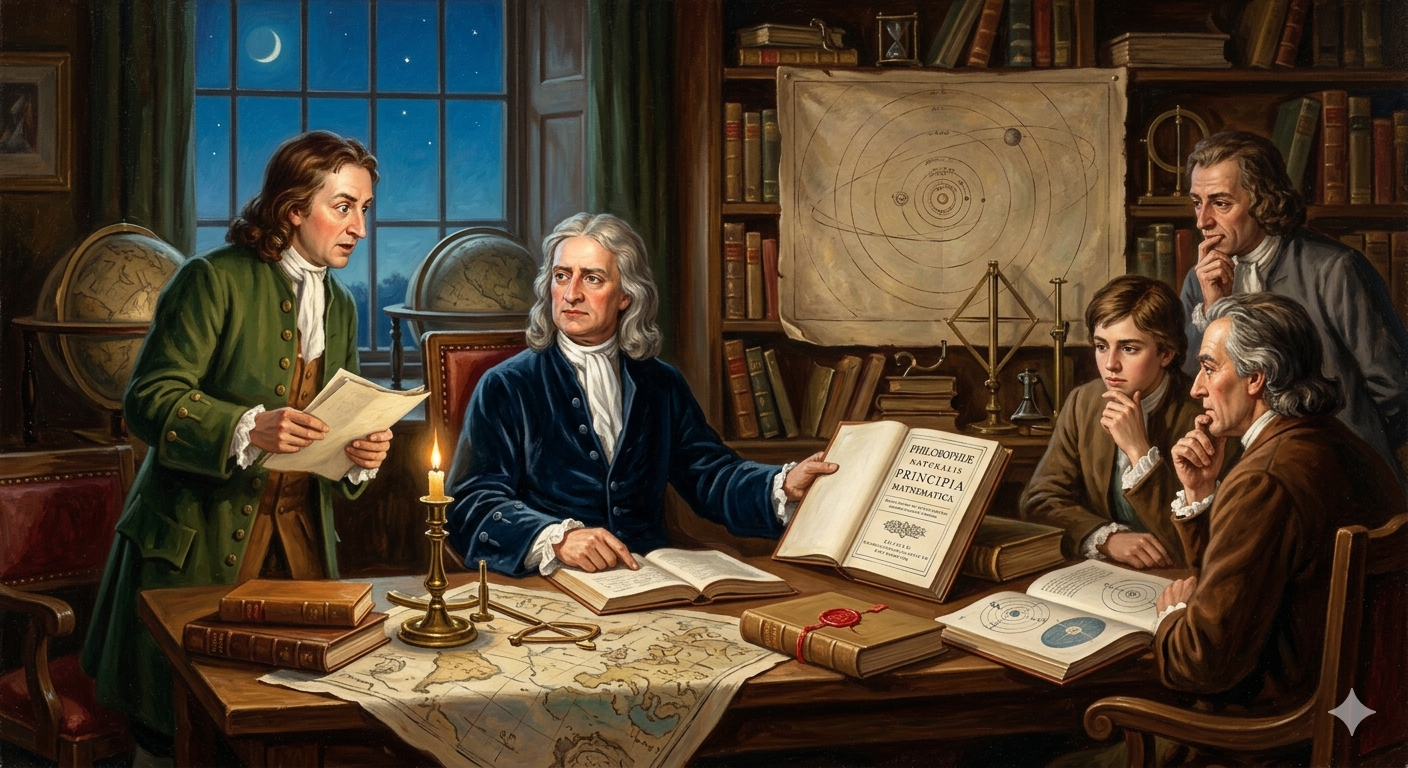
On July 5, 1687, a book appeared in London that changed the world. Its title, in the Latin that all serious natural philosophy was then conducted, was Philosophiae Naturalis Principia Mathematica — the Mathematical Principles of Natural Philosophy. Its author was Isaac Newton, a forty-four-year-old professor of mathematics at Trinity College, Cambridge, who had spent most of the previous eighteen months in a state of total intellectual absorption, forgetting to eat, sleeping only when overcome with exhaustion, working through draft after draft of a work that would eventually run to 547 densely mathematical pages across three books. The man who financed and edited and managed the publication, who had cajoled Newton into writing it in the first place and then prevented him from withdrawing it in a fit of pique during a priority dispute, was Edmond Halley, the brilliant astronomer and polymath who would later lend his name to the most famous comet in history. And the institution under whose formal imprimatur the book appeared — authorized by its president Samuel Pepys on July 5, 1686 — was the Royal Society of London, the premier scientific body in England.
The Principia, as it is universally known, is generally regarded as the single most important scientific work ever published. That judgment, expressed across three and a half centuries by scientists, historians, and philosophers of science, reflects not only what the book contains — the three laws of motion that still govern the design of every bridge, every aircraft, every spacecraft; the law of universal gravitation that explains the orbits of planets and moons and comets and artificial satellites; the mathematical methods that would develop into calculus and modern celestial mechanics — but what it represents: the moment when the universe became, for the first time in human history, explicable in terms of a single coherent mathematical framework that was the same everywhere, in the heavens and on the Earth, for apples falling and planets orbiting. When Alexander Pope wrote his famous couplet for Newton’s tomb — Nature and Nature’s laws lay hid in night; God said, Let Newton be, and all was light — he was expressing a truth that the scientific community recognized immediately and that has only deepened with time. The Principia was not merely a great book. It was the book that began modern science.
The World Before Newton: Galileo, Kepler, Descartes, and the Fragmented Universe That the Principia Would Unite
To understand what the publication of the Principia achieved, it is necessary to understand the state of natural philosophy in the years and decades before 1687 — a state that was, despite the genuine advances of the preceding century, one of fundamental fragmentation and unresolved contradiction. The universe of educated Europeans in 1680 was one in which brilliant men had made important individual discoveries about particular phenomena, but in which no one had yet succeeded in showing that all these phenomena obeyed the same mathematical laws or could be derived from a single coherent set of principles.
Galileo Galilei, the great Italian astronomer and physicist who died in 1642 — the same year Newton was born — had transformed the study of terrestrial motion through decades of brilliant experimentation and mathematical analysis. His work on inclined planes and falling bodies had established precise mathematical relationships between time, distance, acceleration, and velocity for bodies moving under a constant force. He had articulated a principle that would become central to Newton’s work: the principle of inertia, the idea that a body in motion tends to remain in motion and a body at rest tends to remain at rest unless acted upon by an external force. And his astronomical observations — the moons of Jupiter, the phases of Venus, the craters of the Moon, the spots on the Sun — had done devastating damage to the Aristotelian cosmology that had dominated European intellectual life for fifteen centuries, showing that the celestial bodies were not perfect, unchanging spheres but objects subject to change and motion like things on Earth.
Johannes Kepler, the German astronomer who had worked from 1601 until his death in 1630 from the vast observational data collected by his mentor Tycho Brahe, had derived three empirical laws of planetary motion that described the orbits of the planets around the Sun with extraordinary precision. Kepler’s first law stated that planets move in ellipses with the Sun at one focus. His second law stated that the line connecting a planet to the Sun sweeps out equal areas in equal times — a statement about the way planetary speed changes as a planet moves closer to and farther from the Sun. His third law established a precise mathematical relationship between the period of a planet’s orbit and its distance from the Sun. These laws were observationally precise and enormously useful, but Kepler himself had not been able to explain why the planets obeyed them — what force or principle caused the elliptical orbits, the equal-area rule, the period-distance relationship. They were descriptions, not explanations.
René Descartes, the French philosopher and mathematician who died in 1650, had proposed the most ambitious theoretical framework of the pre-Newtonian era in his Principia Philosophiae, published in 1644. Descartes held that space was filled with a swirling vortex of material particles — an invisible fluid medium he called the aether — and that the motions of celestial bodies were carried by these vortices, much as leaves are carried by currents of water. This vortex theory was, in Descartes’ formulation, a mechanistic explanation: it sought to explain astronomical phenomena in terms of direct contact between material particles, avoiding the apparently mysterious notion of forces acting at a distance through empty space. The title of Newton’s own Principia was chosen deliberately to echo Descartes’ — the words Philosophiae and Principia are written in larger text on Newton’s title pages — signaling Newton’s intention to replace Descartes’ framework with a superior one. One of the central purposes of Newton’s Book II would be to destroy the Cartesian vortex theory by showing mathematically that it was inconsistent with the observed motions of the planets.
Isaac Newton: The Making of the Genius — From Lincolnshire to Cambridge’s Annus Mirabilis
Isaac Newton was born on January 4, 1643 (December 25, 1642, in the Old Style calendar then in use in England), at Woolsthorpe Manor in Woolsthorpe-by-Colsterworth, a small hamlet in Lincolnshire, England. His father, also named Isaac Newton, had died three months before his birth, leaving a small farm and modest means to his widow, Hannah Ayscough Newton. When Newton was three years old, his mother remarried a wealthy clergyman named Barnabas Smith and moved away to her new husband’s home, leaving young Isaac in the care of his maternal grandmother for nine years — an abandonment that biographers have connected to Newton’s famously difficult personality, his profound reluctance to publish or share his discoveries, and his volcanic responses to criticism or perceived challenges to his priority. When Barnabas Smith died in 1653, Hannah returned to Woolsthorpe with her three children by Smith, and Newton’s life in his mother’s household resumed.
Newton attended the King’s School in Grantham, where he boarded with a local pharmacist and showed exceptional academic ability, and was admitted to Trinity College, Cambridge, in June 1661 as a subsizar — a student who paid reduced fees in exchange for performing menial service for wealthier students. At Cambridge he encountered the work of Descartes, Galileo, Kepler, and other natural philosophers of the age, and began the mathematical studies that would eventually produce calculus. But the great catalyst for Newton’s scientific development came not from his formal education but from a crisis that interrupted it. In 1665, bubonic plague swept through England, and in the summer of that year Cambridge University closed its gates and sent its students home. Newton, not yet twenty-three years old, returned to Woolsthorpe, where he would spend the better part of two years in intellectual isolation that would prove the most extraordinarily productive in the history of science.
The period of approximately 1665 to 1667, known to science historians as Newton’s annus mirabilis — his wonder years — produced a cascade of fundamental discoveries that would have made the reputation of any other scientist of the age. Working in his mother’s farmhouse in Lincolnshire, Newton developed his method of fluxions (what we call calculus), independently of and earlier than Gottfried Wilhelm Leibniz, who would develop his own version of calculus in the 1670s and ignite one of the most bitter priority disputes in mathematical history. He also conducted his famous experiments with prisms that revealed white light to be composed of all the colors of the spectrum, overthrowing the ancient view that light was simple and pure and that color was an impurity introduced by the medium through which light traveled. And he began thinking, with characteristic mathematical precision, about the nature of gravity and the force that kept the Moon in its orbit — work that would eventually culminate, twenty years later, in the Principia.
The famous story of Newton and the apple — the notion that the sight of an apple falling prompted the insight about universal gravitation — was not merely a legend but was told by Newton himself to several people, including the biographer William Stukeley, who recorded it in his memoir of Newton. The story, whether or not it represents a precise historical event, captures something true about Newton’s method: the recognition that the force pulling the apple toward the earth and the force holding the Moon in its orbit were the same force, governed by the same mathematical law, operating at vastly different distances. Newton apparently worked out the rough numerical relationship during the plague years — comparing the rate at which the Moon was deflected from a straight-line path with the rate at which objects fell at the Earth’s surface — but found his calculation inconclusive, partly because he had an inadequate value for the Earth’s radius. He put the work aside. He would return to it with decisive force nearly two decades later.
Edmond Halley’s Visit of 1684: The Question That Sparked the Greatest Book in Science
In January 1684, three men sat together in London and puzzled over a problem that none of them could solve. The men were Edmond Halley, the astronomer; Christopher Wren, the architect of St Paul’s Cathedral and a Fellow of the Royal Society; and Robert Hooke, the brilliant and contentious polymath who served as Curator of Experiments for the Royal Society. The problem they were discussing was this: Kepler’s third law, which describes the mathematical relationship between a planet’s orbital period and its distance from the Sun, implies that the force holding planets in their orbits must decrease with the square of the distance from the Sun — what is called an inverse square law. Hooke claimed, in his characteristically self-aggrandizing way, that he had already derived all the laws of planetary motion from the inverse square hypothesis and had a proof that the resulting orbits would be ellipses, as Kepler had found. Wren was skeptical, and offered a book worth forty shillings to anyone who could produce the proof. Hooke produced nothing.
Halley, who could derive the inverse square relationship for the simplified case of circular orbits by combining Kepler’s third law with Christiaan Huygens’s formula for centrifugal force, but could not prove the more general case, resolved to ask the one man he thought might have the answer. In August 1684, he traveled to Cambridge and paid a visit to Isaac Newton. The question Halley posed was direct: what orbit would a planet trace if the force attracting it to the Sun followed an inverse square law? Newton’s answer was equally direct: an ellipse. He had already proved it. But he could not find the papers on which the proof had been written. He had mislaid his calculations.
Halley returned to London, and Newton, spurred by the encounter, began working out the proof again. Three months later, in November 1684, Newton sent Halley a short mathematical tract of approximately nine pages titled De motu corporum in gyrum — On the Motion of Bodies in an Orbit. The tract contained the proof of planetary ellipses from the inverse square law, derivations of Kepler’s other laws, and the beginning of what would become the Principia’s framework for relating forces to motion. Halley read it and recognized immediately that he was holding in his hands something of extraordinary importance — not just a proof that Hooke had been unable to provide, but the foundation of an entirely new science of motion. He returned to Cambridge, urged Newton to develop and expand the tract into a full treatise, and volunteered to handle all the arrangements for its publication. Newton, whose reluctance to publish was legendary, agreed.
What followed was one of the most intense periods of sustained intellectual labor in the history of science. From late 1684 through the spring of 1686, Newton worked on almost nothing else. His assistant Humphrey Newton (no relation) later recorded the extraordinary absorption of his employer during this period — how Newton would sometimes forget his food, or forget to sleep, or rush back from a garden walk with some new thought, not even waiting to sit down before beginning to write. Newton’s chemical notebooks, which record a regular program of experiments, have no entries at all for the period from May 1684 to April 1686, showing that he had entirely abandoned his other pursuits to write what would become Principia. The complete work, in the form of three books that Newton had not originally planned when he began, was finished by the spring of 1686 and sent to Halley for transmission to the printer.
Robert Hooke’s Priority Claim and the Almost-Catastrophe That Nearly Killed Book III
The path from Newton’s completed manuscript to the printed Principia was not smooth. When the text of the first book was presented to the Royal Society at the close of April 1686, Robert Hooke immediately and vocally claimed that Newton had stolen from him the crucial idea — the inverse square law of gravitational attraction. Hooke’s claim was that in a correspondence he had conducted with Newton in 1679 and 1680, he had communicated to Newton his hypothesis that gravitational force decreased with the square of the distance from the center, and that Newton had used this communication as the basis for his subsequent work without giving Hooke proper credit.
The claim contained a grain of truth — Newton himself acknowledged to Halley that the correspondence with Hooke in 1679 had reawakened his dormant interest in astronomical matters. But Newton argued, not unreasonably, that Hooke had told him nothing new or original, merely providing what Newton called the diversion he gave me from my other studies to think on these things. Newton further maintained, with considerable justification, that the mathematical demonstration that planetary orbits were ellipses, and the full mathematical theory connecting inverse square force to Keplerian motion, was entirely his own work — work that Hooke had claimed to have done but had never produced in any form approaching mathematical rigor. As Halley himself reported, Hooke had conceded that the demonstration of the curves generated by the inverse square law was wholly Newton’s.
The dispute, however, was enough to send Newton into a rage that endangered the entire publication. Newton threatened to suppress the third book of the Principia altogether — the book titled De mundi systemate, on the System of the World, in which the abstract mathematical machinery of Books I and II was applied to the real solar system, explaining the motions of planets and moons, the tides, the shape of the Earth, and the orbits of comets. Without Book III, the Principia would have been an extraordinary mathematical treatise but without the grand application to the real universe that made it transformative. Halley, exercising what his biographers have described as extraordinary diplomatic skill, wrote long and careful letters to Newton, soothing his anger, praising his work, and tactfully persuading him that suppressing Book III would deprive the world of the most important contribution to natural philosophy in the history of science. Newton withdrew his threat, and Book III went to the printer.
The Publication: Edmond Halley, Samuel Pepys, and the Financial Gamble on a Masterpiece
The practical arrangements for publishing the Principia were complicated by an institutional failure that, had it been handled differently, might have delayed or prevented the book’s appearance. The Royal Society, which was the natural institution to publish so significant a work, had recently spent its entire publication budget on a lavishly illustrated natural history of fish called De Historia Piscium — The History of Fishes. The book, written by Francis Willughby and revised by John Ray, was a fine work of natural history, but it had sold poorly, leaving the Royal Society with neither the money to finance Newton’s Principia nor the institutional credit to borrow against future sales. When the Society formally resolved that the book should be published, it effectively resolved that Halley should undertake the business of looking after it and printing it at his own charge.
Halley accepted this responsibility without hesitation. He personally financed the publication of one of the most important books ever written, paying for paper, printing, and binding from his own modest resources — resources that were additionally strained when the Society, having assigned the publication to him, also informed him that it could no longer afford to pay him the promised annual salary of £50 that had been agreed as compensation for his role as the Society’s paid Clerk. Halley had thus committed himself to funding the book at the precise moment when his own income was reduced. He managed the correspondence with the printer Joseph Streater, read and corrected the proofs himself, and wrote a laudatory poem in Latin — the Ode to Newton — that appeared in the front matter of the first edition, praising Newton’s achievement in language that was both genuine and precise: Newton, who unlocks the hidden secrets of Nature, here displays the forces of the universe.
The book required the formal authorization — the imprimatur — of the President of the Royal Society. In 1686 and 1687, that position was held by Samuel Pepys, famous to later generations as the author of the most celebrated personal diary in the English language, a detailed record of London life in the 1660s that includes vivid accounts of the Great Fire of London and the Great Plague, and in his own time as a highly effective naval administrator who had transformed the professional organization of the Royal Navy. Pepys signed the imprimatur on July 5, 1686, licensing the book for publication. The Principia was printed by Joseph Streater and published in the summer of 1687, with the first edition having a print run estimated at between 300 and 400 copies. The work went out of print quickly: by December 1691, Nicholas Fatio de Duillier noted in a letter to Christiaan Huygens that the book was already difficult to obtain. A 2020 census by scholars Mordechai Feingold and Andrej Svorenčík confirmed the location of 387 surviving copies of the first edition.
The Three Books of the Principia: What Newton Actually Wrote and Why It Was Revolutionary
The Principia opens with a set of Definitions and Axioms, or Laws of Motion, that constitute one of the most condensed and powerful collections of scientific principles ever assembled. Newton’s eight definitions establish the concepts of quantity of matter (what we now call mass), quantity of motion (momentum), inherent force (inertia), impressed force, centripetal force, and the absolute and relative quantities of space, time, and place. These definitions are followed by the three Laws of Motion that have formed the foundation of classical mechanics for three and a half centuries.
Newton’s First Law of Motion — the law of inertia — states that every body continues in its state of rest, or of uniform motion in a straight line, unless it is compelled to change that state by forces impressed upon it. This is a formalization and generalization of Galileo’s principle of inertia, elevated from a statement about observed phenomena to a universal axiom. Newton’s Second Law of Motion states that the change of motion is proportional to the motive force impressed, and is made in the direction of the right line in which that force is impressed — in modern formulation, that the force on a body equals its mass multiplied by its acceleration. This law, which quantifies the concept of force with a precision that had not previously been achieved, became the paradigm of exact quantitative science and has been called the most important equation in physics. Newton’s Third Law of Motion states that to every action there is always opposed an equal reaction: or the mutual actions of two bodies upon each other are always equal, and directed to contrary parts. These three laws, together, constituted a complete framework for analyzing the motion of any object under any force — a framework that remained the foundation of physics for two hundred years and that still governs the design of almost every practical engineering project on Earth.
Book I of the Principia, titled De motu corporum — On the Motion of Bodies — develops the mathematical consequences of the laws of motion for bodies moving under various kinds of central forces, without considering any resisting medium. It opens with a collection of mathematical lemmas on the method of first and last ratios — a geometrical form of infinitesimal analysis that Newton had developed and that would later be recognized as a version of calculus. The book then derives, through a series of propositions and theorems of extraordinary mathematical elegance, the relationship between inverse square forces and elliptical orbits; the equal-areas law as a consequence of any central force; the relationship between forces and orbital shape for various force laws; and the mechanics of bodies attracting each other gravitationally, including the remarkable result that a sphere of uniform density attracts objects outside it exactly as if all its mass were concentrated at its center — a theorem that was essential for applying the theory of gravity to the real Earth.
Book II, titled De motu corporum in mediis resistentibus — On the Motion of Bodies in Resisting Media — addressed the effects of resistance on the motion of bodies through fluids. This book had a specific polemical purpose: to destroy the Cartesian vortex theory. Descartes had proposed that space was filled with a swirling fluid ether and that planetary motions were carried by this fluid, in the way that a cork is carried by a whirlpool. Newton’s Book II demonstrated, through careful mathematical analysis and experimental measurement, that fluid resistance would cause orbiting bodies to decay toward the center of their orbit, not maintain elliptical orbits as Kepler had found. The conclusion was devastating for Descartes: the vortex hypothesis was contradicted by observations, and the planets’ orbits could only be explained if space was, to a high degree of approximation, empty.
Book III — De mundi systemate — On the System of the World — is where Newton brought all the mathematical machinery of the first two books to bear on the real solar system, and it is the book that most directly establishes Newton’s claim to have produced the greatest work in the history of science. Newton opened Book III with what he called his Rules of Reasoning in Philosophy — four methodological principles that would become the foundation of the modern scientific method: that we should admit no more causes of natural things than are both true and sufficient to explain their appearances; that to the same natural effects we must assign the same causes; that qualities of bodies which are found to belong to all bodies within reach of our experiments are to be esteemed as universal qualities; and that propositions collected from observation of phenomena are to be regarded as accurate or very nearly true until contradicted by other phenomena. These rules codified a philosophy of science — empiricism constrained by mathematical precision — that has governed scientific practice ever since.
In the remainder of Book III, Newton used the laws of motion and the inverse square law of gravitation to explain an extraordinary range of phenomena. He showed that the moons of Jupiter obeyed the same inverse square law that governed planetary orbits around the Sun. He connected the orbit of the Moon to the free fall of objects at the Earth’s surface, showing that the force of gravity at the Earth’s surface was the same force — weakened by the inverse square law over the Moon’s much greater distance — that kept the Moon in its orbit. He calculated the masses of the Sun, Jupiter, Saturn, and the Earth relative to each other, producing the first quantitative estimate of solar mass and the first comparative scale of the major bodies of the solar system. He explained the tides as a consequence of the differential gravitational pull of the Moon and Sun on the oceans. He calculated the precession of the equinoxes — the slow wobble of the Earth’s rotational axis over a period of approximately 26,000 years — as a consequence of the Moon’s gravitational pull on the Earth’s equatorial bulge. And he provided, for the first time, a mathematical theory of comet orbits, showing that comets traveled on extremely elongated elliptical or parabolic paths around the Sun and that their motion was governed by the same law of gravitation that controlled the planets.
The Law of Universal Gravitation: One Force, One Law, for Heaven and Earth
At the heart of the Principia’s achievement is the law of universal gravitation, the result that Newton reached through a synthesis of his mathematical analysis, Kepler’s observational laws, and the moon-to-apple insight of the plague years. The law states that every particle of matter in the universe attracts every other particle with a force directly proportional to the product of their masses and inversely proportional to the square of the distance between them. In mathematical terms, F = Gm1m2/r², where F is the force of gravitational attraction, m1 and m2 are the masses of the two objects, r is the distance between them, and G is a universal constant of proportionality.
The word universal in universal gravitation is the key to understanding what Newton had achieved. Before the Principia, the heavens and the Earth were subject to different laws. Aristotle had divided the universe into the sublunary realm — the region below the Moon, where matter was composed of earth, water, fire, and air, and where things naturally moved toward their proper place — and the superlunary realm, where the perfect, unchanging heavenly bodies were composed of a fifth element and moved in perfect circles. Galileo and Kepler had done enormous damage to this division, but no one had replaced it with a positive, mathematically precise framework that explicitly asserted the unity of physical law across all of space. Newton did. The same gravitational force that accelerated an apple falling from a tree in Lincolnshire kept the Moon in its orbit, kept Jupiter’s moons circling Jupiter, kept the planets orbiting the Sun, governed the tides in the Earth’s oceans, and determined the trajectory of comets sweeping through the solar system on their elongated paths. One law, one force, one universe.
Newton’s derivation of this law was a masterpiece of mathematical reasoning that proceeded by comparing three different celestial systems: the moons of Jupiter, the planets around the Sun, and the Moon around the Earth. All three systems obeyed Kepler’s third law — the square of the orbital period is proportional to the cube of the orbital radius — which, when substituted into the formula for centripetal force, yields an inverse square relationship between force and orbital radius. The uniformity of this relationship across three different gravitational systems — three different central bodies, with their satellites orbiting at different distances — provided compelling evidence that the inverse square law was not a special feature of any one system but a universal property of gravitational attraction. Newton’s calculation of the Moon’s orbital acceleration and its comparison with the measured acceleration of gravity at the Earth’s surface — the moon-apple connection of the plague years, now worked out with full mathematical rigor using the improved value for the Earth’s radius provided by the French astronomer Jean Picard in 1669 — provided the direct numerical verification.
The Reception of the Principia: Admiration, Resistance, and the Controversy Over Action at a Distance
The immediate reception of the Principia among the scientific elite of Europe was overwhelmingly one of admiration, though not without reservations. Christiaan Huygens, the Dutch mathematician and astronomer who was probably the most capable natural philosopher in Europe after Newton himself, wrote in his notebook upon receiving his complimentary copy from Newton: The famous M. Newton has brushed aside all the difficulties together with the Cartesian vortices; he has shown that the planets are retained in their orbits by their gravitation toward the Sun. A concise and accurate summary from the most technically qualified reader of the first edition.
The most serious intellectual objection to the Principia came from Huygens himself, and from Leibniz, and concerned what they saw as the fundamentally mysterious and unphysical nature of Newton’s gravitational force. Descartes had insisted that bodies could only act on each other through direct contact — the mechanist principle that all physical causation required a material medium. Newton’s law of universal gravitation asserted that every particle of matter attracted every other particle instantaneously across empty space, without any material medium and without any mechanism that Newton could identify. This was what his critics called an occult quality — a mysterious force operating without any intelligible physical cause, essentially reintroducing into natural philosophy the kind of hidden powers and sympathies that the scientific revolution was supposed to have expelled.
Newton’s response to this criticism was his famous methodological declaration: Hypotheses non fingo — I frame no hypotheses. This phrase appeared in the General Scholium added to the second edition of the Principia in 1713. Newton’s position was that the existence and properties of gravitational force could be inferred from the phenomena — from the observed motions of planets, moons, comets, and falling bodies — and that this inference was sufficient for science, even in the absence of a mechanical explanation of how gravity operated. It was enough that gravity existed and obeyed a precise mathematical law. The cause of gravity was a further question that Newton believed honest science should leave open rather than resolve by a hypothesis that could not be verified. This methodological position — that science should describe phenomena with mathematical precision and not require a causal mechanism beyond what the phenomena themselves revealed — was profoundly influential on the subsequent development of the philosophy of science and on the practice of physics from Newton’s day to the present.
The Second and Third Editions: Roger Cotes, Henry Pemberton, and Newton’s Corrections
Newton published two further editions of the Principia during his lifetime. The second edition, which appeared in 1713 under the editorship of Roger Cotes, a young mathematician at Cambridge, was more than a routine correction of errors. Cotes worked intensively with Newton over a period of more than three years on a thorough revision that corrected errors in the first edition, expanded and clarified the mathematical arguments, and added new material. The most significant addition was the General Scholium — the methodological coda that appears at the end of Book III and contains, among other things, Newton’s Hypotheses non fingo declaration, his discussion of absolute space and time, and his famous statement about God: This most beautiful system of the Sun, planets, and comets could only proceed from the counsel and dominion of an intelligent and powerful Being.
The General Scholium also contained Newton’s discussion of the nature of space and time — one of the most philosophically consequential passages in the entire history of science. Newton distinguished between absolute space, which subsists always similar and immovable without relation to anything external, and relative space, which is measured relative to bodies. The concept of absolute space was contested by Leibniz and others, who argued that space had no meaning except as a relation between bodies, and the Newton-Leibniz debate over absolute versus relational space would be taken up by philosophers and physicists for the next three centuries, eventually reaching its resolution — or rather its transformation into something more subtle and complex — in Einstein’s theories of relativity.
The third edition, published in 1726 and edited by Henry Pemberton, appeared just a year before Newton’s death and incorporated further corrections and refinements. It was this edition from which Andrew Motte’s first English translation was made, published in 1729, two years after Newton’s death in March 1727. The delayed English translation reflected Newton’s deliberate strategy: he had written the Principia in Latin to limit his readership to those with sufficient mathematical and philosophical education to follow the arguments, specifically to avoid being drawn into public debates with poorly qualified critics. The French translation appeared much later still, in 1756, produced by Gabrielle-Émilie Le Tonnelier de Breteuil, the Marquise du Châtelet, the brilliant French natural philosopher and mathematician who also wrote an extensive commentary on Newton’s work with additions by the mathematician Alexis-Claude Clairaut — a translation prefaced by Voltaire.
The Principia and the Scientific Revolution: How Newton Completed Copernicus and Changed the World
The publication of the Principia in 1687 represented not merely an important contribution to an ongoing scientific revolution but the resolution — the definitive, mathematically precise resolution — of the central problem that had occupied natural philosophy since Copernicus had proposed the heliocentric model of the solar system in 1543. For one hundred and forty-four years, the question of planetary motion had been the defining problem of European astronomy: Copernicus had shown that a Sun-centered model fit the observations better than a geocentric one; Tycho Brahe had gathered the observational data from which Kepler derived his laws; Galileo had weakened the traditional case for the immovability of the Earth; and Kepler had described the precise mathematical shapes of planetary orbits. But none of them had explained why the planets moved as they did — what force or mechanism governed their paths. Newton answered this question with a mathematical completeness and a unifying power that made all previous frameworks obsolete.
By deriving Kepler’s three laws from the inverse square law of gravitation and the laws of motion, Newton did something that had never been done before and that established the template for all of theoretical physics: he showed that observational regularities could be derived from a small number of fundamental principles rather than merely being described. Where Kepler had found that planets moved in ellipses and catalogued the fact, Newton showed that planets must move in ellipses — that the elliptical orbit was a mathematical consequence of the inverse square law, not an empirical fact to be memorized. Where Galileo had measured the rate at which bodies fell and described the relationship between time and distance, Newton explained the falling as a consequence of the same force that held the Moon in orbit. The power of this demonstration — derivation from principles rather than mere description of phenomena — set the standard for physical explanation that has not been abandoned since.
The Principia also completed, in a technical but profound sense, the Copernican revolution. The central objection to the moving Earth had always been that it was impossible to explain how objects fell straight down if the Earth was in motion — surely a moving Earth would leave the falling object behind. Galileo’s law of inertia had partially answered this objection, but Newton’s full mechanics, with its precise account of how forces govern motion, provided a complete and unambiguous resolution. The same laws of motion that explained why apples fell straight down also explained the motion of planets, and the moving Earth was not an anomaly in Newton’s system but a straightforward consequence of the same principles that governed everything else. The Principia settled the Copernican controversy not by providing a new argument but by rendering the controversy irrelevant within a framework so comprehensive and mathematically precise that no coherent alternative could compete with it.
Newton’s Legacy: The Principia’s Impact on the Enlightenment, the Industrial Revolution, and Modern Science
The influence of the Principia on European intellectual culture in the century following its publication was enormous and extended far beyond the boundaries of natural philosophy into philosophy, theology, political theory, and the general climate of Enlightenment thought. The success of Newton’s method — the demonstration that the universe obeyed precise mathematical laws that could be discovered through careful observation and mathematical reasoning — inspired thinkers across all fields to apply similar methods to their own domains. Voltaire, who had visited England and absorbed Newton’s ideas, wrote an accessible account of Newtonian science for French audiences that was enormously influential. John Locke, who knew Newton personally, modeled his empiricist philosophy of knowledge on what he understood to be the Newtonian method. The authors of the American Declaration of Independence invoked the self-evident laws of nature and nature’s God in language that echoed the Newtonian conception of a law-governed universe created by a rational God.
In the more technical domain of mathematics and mechanics, the Principia set in motion a program of mathematical physics that occupied some of the greatest minds of the eighteenth century. Leonhard Euler, the most prolific mathematician in history, reformulated Newton’s mechanics in the differential equation language of Leibniz’s calculus, making it far more computationally accessible than Newton’s geometric formulation. Joseph-Louis Lagrange and Pierre-Simon Laplace extended Newton’s gravitational theory to the full complexity of the solar system, showing through decades of laborious calculation that the observed deviations of planets from simple Keplerian orbits were consistent with Newton’s law and could be explained by the mutual gravitational interactions of the planets. William Herschel, using Newtonian mechanics to calculate the expected position of an object perturbing the orbit of Uranus, and Le Verrier and Adams independently predicting the position of Neptune from similar orbital anomalies, provided spectacular confirmations of the theory’s power. The discovery of Neptune in 1846, at the position predicted by pure Newtonian calculation from the perturbation of Uranus’s orbit, was regarded by contemporaries as one of the greatest triumphs of human reason ever achieved.
The Industrial Revolution of the eighteenth and nineteenth centuries was built, in a deep technical sense, on the foundations that Newton had laid. The engineering principles governing the behavior of steam engines, bridges, mills, railways, and ships were all applications of Newton’s laws of motion. The calculation of projectile trajectories, the design of hydraulic machinery, the analysis of stresses in structures — all depended on the mathematical framework that Newton had developed and that Euler, Lagrange, and their successors had elaborated. Newton had not intended the Principia as a practical engineering handbook, but the universe his book described turned out to be the universe in which engineers built machines, and the laws he had derived turned out to be precisely the laws that governed the behavior of those machines.
Newton’s laws were eventually found to be approximate rather than exact — valid for objects moving at speeds well below the speed of light and in gravitational fields that are not extremely strong, but requiring modification by Einstein’s theories of special relativity (1905) and general relativity (1915) at extreme velocities and in strong gravitational fields. Einstein’s general relativity replaced Newton’s instantaneous action-at-a-distance gravitational force with the curvature of four-dimensional spacetime, resolving at last the philosophical objection to action at a distance that Leibniz and Huygens had raised. But Einstein himself acknowledged the magnitude of Newton’s achievement, writing: In order to put his system into mathematical form at all, Newton had to devise the concept of differential quotients and propound the laws of motion in the form of total differential equations — perhaps the greatest advance in thought that a single individual was ever called upon to make.
Conclusion: July 5, 1687 and the Day That Science Became Modern
When the Principia appeared on July 5, 1687, the universe was not the same place it had been the day before. This is not merely a poetic statement. The universe that educated Europeans inhabited before the Principia was a fragmented one, in which terrestrial and celestial phenomena obeyed different laws, in which the causes of planetary motion remained unknown, and in which the most ambitious attempt to unify physical theory — Descartes’ vortex mechanics — had produced a framework that was qualitative and unquantifiable, impressive in its scope but incapable of prediction at the precision that observation demanded. The universe after the Principia was a unified one, governed by mathematical laws that were the same everywhere, that could be applied with quantitative precision to any physical situation, and that had been confirmed by their ability to account simultaneously for the fall of an apple, the orbit of the Moon, the paths of comets, the timing of the tides, and the distribution of Jupiter’s moons.
The Principia was not only the greatest scientific work of the seventeenth century. It was the template for all of theoretical physics that followed — the demonstration that mathematical reasoning from fundamental principles could yield reliable knowledge about the physical universe, that the universe was accessible to human understanding, and that the most complex phenomena of nature could be reduced to simple and beautiful laws. The three editions that appeared during Newton’s lifetime — 1687, 1713, 1726 — each refined and expanded the work, and the work Halley, Cotes, and Pemberton did in preparing them was itself a contribution to the history of scientific publication. The first English translation by Andrew Motte in 1729, the French translation by the Marquise du Châtelet in 1756, and the subsequent translations into every major European language spread Newton’s ideas across the continent and around the world.
Edmond Halley, who financed and managed the Principia’s publication at his own expense, would spend the following decades predicting that a comet observed in 1682 — the comet that would bear his name — would return in 1758. He died in 1742, sixteen years before the comet’s predicted return, and did not live to see his prediction confirmed, just as Robert Brout would not live to see the Higgs boson discovered. But when Halley’s Comet appeared on schedule in December 1758, it was the Principia that had made the prediction possible — the same laws of motion and gravitation that Newton had first set down in those pages, the same mathematics that Halley had used to calculate the comet’s orbit, the same framework that had been verifying itself against observation for seventy years. The greatest scientific book ever written had, in the space of a few decades, produced the greatest predictive triumph in the history of science. And it had all begun with a conversation in London in January 1684, and a question that Edmond Halley decided to take, in August of that year, directly to the one man he believed could answer it.