On the morning of September 1, 1859, a thirty-three-year-old English amateur astronomer named Richard Christopher Carrington climbed to the private observatory attached to his country estate at Redhill in Surrey and prepared for what he expected to be an ordinary session of sunspot observation. The sun was brilliant and clear, the conditions ideal for the kind of meticulous solar sketching that had occupied his mornings for years. He aimed his brass telescope at the solar disc projected onto a white observation screen — he was careful never to look at the sun directly — and began tracing the outline of an enormous cluster of sunspots that had been growing for several days and now occupied an area on the solar surface more than ten times the diameter of the Earth. Then, at approximately 11:18 in the morning, something happened that no human being had ever seen or recorded before.
Two brilliant white patches of intensely bright light suddenly erupted from within the sunspot cluster, blazing against the already dazzlingly bright solar surface with a ferocity that momentarily outshone even the sun itself. Carrington later described them as two patches of intensely bright and white light erupting from the sunspots, with a brilliancy fully equal to that of direct sunlight. He ran from the room to summon a witness, but by the time he returned — within perhaps a minute — the brilliance had already diminished significantly. Within five minutes of their appearance, the blazing patches had vanished entirely. Carrington had just become the first human being to observe and record a solar flare. He had no idea, as he noted down what he had seen and made his carefully measured drawings, that the invisible shockwave now racing toward Earth at approximately 1,500 miles per second would reach the planet in roughly seventeen and a half hours — and would constitute the most powerful geomagnetic storm in recorded human history.
The event that bears Carrington’s name — the Carrington Event of September 1–2, 1859 — remains the most intense geomagnetic storm ever documented, a natural catastrophe of solar origin that paralyzed the Victorian world’s most advanced communications technology, produced auroras visible in the tropics and across both hemispheres simultaneously, caused telegraph operators around the world to be shocked, knocked from their chairs, and set their paper records ablaze, and generated enough surplus electrical current that some lines continued to transmit messages even after being completely disconnected from their power sources. Ice core samples have since confirmed that the Carrington Event was at least twice as large as any other solar storm in the preceding 500 years. Its modern scientific importance extends far beyond the historical record: understanding what happened in September 1859 is essential for assessing what a similar storm would do to the electricity-dependent, satellite-dependent, internet-dependent civilization of the twenty-first century.
Richard Carrington: The Amateur Astronomer Who Discovered Solar Flares
Richard Christopher Carrington was born on May 26, 1826, in Chelsea, London, the second son of Richard Carrington, the proprietor of a large and profitable brewery at Brentford. His father had destined him for the Church of England and arranged for him to study at Trinity College, Cambridge, in 1844 with this clerical future in mind. But Carrington’s encounter at Cambridge with Professor Challis’s lectures on astronomy redirected his ambitions permanently. He abandoned theology and devoted himself to practical astronomical observation, taking a position in 1849 as an observer at the University Observatory at Durham before resigning in 1852 when he concluded that the institution’s instruments were inadequate for the kind of systematic work he wanted to do. With the financial backing of his family’s brewery wealth — a luxury that few serious Victorian scientists enjoyed — he built his own private observatory at Redhill, near Reigate in Surrey, completing it by July 1853 and equipping it with first-rate instruments that he chose and specified himself.
At Redhill, Carrington undertook two of the most significant astronomical observational programs of the Victorian era. The first was a comprehensive survey of circumpolar stars — stars near the north celestial pole that were always visible from England — that resulted in his 1857 publication of A Catalogue of 3,735 Circumpolar Stars, a work of such precision and completeness that it won him the Gold Medal of the Royal Astronomical Society in 1859, the highest honor in British astronomy. The Gold Medal was presented in February 1859, just six months before the solar observation that would make his name permanently famous in a completely different domain. Carrington then turned his systematic attention to the sun, undertaking a detailed eleven-year program of daily sunspot observation and recording that would ultimately reveal one of the fundamental facts of solar physics: the differential rotation of the sun, which rotates faster at its equator than at its poles, producing the characteristic drift of sunspot latitudes through the solar cycle that Carrington’s observations were the first to document definitively.
By the summer of 1859, Carrington was at the height of his observational powers. He had been tracking sunspots for years with the methodical precision that was his scientific signature, recording each spot’s position, area, and movement with measurements that later solar physicists would use to reconstruct the state of the sun’s surface in the mid-nineteenth century. The enormous sunspot group that appeared in late August 1859 was of exceptional size — one of the largest ever recorded — and Carrington had been sketching it carefully for several days when the extraordinary event of September 1 interrupted his routine. His account of what he saw that morning, published in the Monthly Notices of the Royal Astronomical Society later in 1859, is one of the most significant observational reports in the history of astronomy: not merely a description of a curious phenomenon but the founding document of the science of solar flare research.
Richard Hodgson’s Independent Observation: How Chance Doubled the Evidence
Among the remarkable features of the September 1, 1859, solar flare observation was that it was made not by one observer but by two, independently and simultaneously, at two separate observatories in England. Richard Hodgson, another English amateur astronomer who was conducting his own solar observations on the morning of September 1, witnessed the same white-light eruption from his own private observatory at approximately the same time as Carrington. Hodgson described what he saw in the Monthly Notices of the Royal Astronomical Society in language of vivid astonishment: While observing a group of solar spots on the 1st September, I was suddenly surprised at the appearance of a very brilliant star of light, much brighter than the Sun’s surface and most dazzling to the protected eye, illuminating the upper edges of the adjacent spots and streaks, not unlike in effect the edging of the clouds at sunset; the rays extended in all directions. He noted that the phenomenon lasted for some five minutes and disappeared instantly at about 11:25 in the morning.
The fact that both Carrington and Hodgson observed the same event independently, from different locations, using different instruments, was scientifically crucial. It meant that neither observer could be dismissed as having made a private mistake or having been deceived by an instrumental artifact. The two accounts corroborated each other in the essentials — the sudden appearance of bright patches in the sunspot region, the extraordinary whiteness and intensity of the light, the duration of approximately five minutes, the precise time of occurrence — while differing in detail in ways that were consistent with the observers being at slightly different positions and making independent measurements. Carrington and Hodgson compiled their independent reports and these were published side by side in the Monthly Notices of the Royal Astronomical Society, and both men exhibited their drawings of the event at the November 1859 meeting of the Royal Astronomical Society. Their joint publication established the solar flare as a real astronomical phenomenon requiring explanation, not a curiosity to be quietly set aside.
The Kew Observatory Magnetometer and Balfour Stewart: Detecting the Sun–Earth Connection
The key to understanding the Carrington Event’s broader significance was not the naked-eye observation of the flare itself but the simultaneous disturbance recorded by instruments at the Kew Observatory in southwest London. Scottish physicist Balfour Stewart was working at Kew on September 1, 1859, overseeing the observatory’s sensitive magnetometer — an instrument designed to measure small variations in the Earth’s magnetic field by recording the position of a compass needle on continuously moving photographic paper. At the precise moment that Carrington and Hodgson saw the solar flare erupt from the sunspot cluster, the Kew magnetometer recorded a sharp, sudden disturbance that physicists later called a magnetic crochet — a rapid deflection of the Earth’s magnetic field caused by the intense burst of X-rays and extreme ultraviolet radiation from the flare striking the Earth’s upper atmosphere and increasing its electrical conductivity almost instantaneously.
When Carrington learned about the Kew magnetometer disturbance — he visited Kew Observatory in the days after the event specifically to look for corroborating evidence — he was confronted with what appeared to be a remarkable coincidence: the magnetic disturbance at Kew had occurred at exactly the same time as the solar flare he had observed. The implication was electrifying: the sun, 93 million miles away, had somehow reached out and disturbed the Earth’s magnetic field in the time it took light to travel from the sun to Earth — approximately eight minutes. This was the first observational evidence ever assembled for what we now call the solar-terrestrial connection, the scientifically fundamental relationship between events on the sun and physical effects on Earth. Carrington was cautious about claiming the connection definitively, writing in his published paper that one swallow does not make a summer — meaning that a single coincidence, however striking, was not sufficient grounds for a general scientific conclusion. But he noted the coincidence clearly, and its implications were not lost on the scientific community that read his account.
Balfour Stewart published his analysis of the Kew magnetometer records and their relationship to Carrington’s solar flare observation, providing the physical measurement data that complemented the astronomical observation. Stewart’s name is less well known to the general public than Carrington’s, but his contribution to the understanding of the 1859 event was essential: he provided the instrumental evidence that connected the solar observation to the geophysical disturbance, transforming what might have been merely an astronomical curiosity into the founding observation of space weather science. The combined evidence of Carrington’s visual observation, Hodgson’s independent corroboration, Stewart’s magnetometer record, and the enormous geomagnetic storm that struck the following day was overwhelming even for those who might otherwise have been skeptical of a causal connection between solar activity and geomagnetic disturbance.
The Great Aurora of August 28-29, 1859: The Precursor Storm That Cleared the Way
The Carrington Event proper — the geomagnetic storm of September 1-2, 1859 — was actually the second major solar disturbance in less than a week. A powerful coronal mass ejection that preceded the one Carrington observed had already struck Earth on August 28-29, 1859, producing a massive auroral display that astonished observers across the Northern Hemisphere. The aurora borealis on those nights was reported to have been visible as far south as approximately 25 degrees of geomagnetic latitude — deep into the tropics — in both the Northern and Southern hemispheres. Gold miners in the Rocky Mountains who were sleeping in the open air reported being awakened in the early morning hours by a light so bright they initially assumed it was dawn, and began preparing breakfast at one or two o’clock in the morning, only to realize that the glow came not from the sun but from the extraordinary auroral display overhead. Newspapers from New York to San Francisco carried accounts of the August 28-29 auroras, and telegraph operators across North America and Europe noticed unusual magnetic disturbances on their sensitive instruments.
Modern solar physicists believe that this precursor event was not merely a coincidence but physically significant in understanding why the Carrington Event was so extraordinarily powerful. The prevailing scientific explanation for the exceptional speed with which the Carrington coronal mass ejection reached Earth — approximately 17.6 hours, compared to the several days that a typical CME takes to travel the same distance — is that the August 28-29 CME had already swept the region of space between the sun and Earth relatively clear of the ambient solar wind plasma that normally impedes and slows incoming CMEs. By clearing this path, the precursor storm created an almost unobstructed corridor for the Carrington CME that followed, allowing it to maintain far higher velocity than would otherwise have been possible. The Carrington CME arrived at Earth traveling at approximately 2,700 kilometers per second — roughly ten times faster than a typical solar wind speed — and struck the Earth’s magnetosphere with an impact that sent shockwaves through the planet’s magnetic environment for days.
September 1-2, 1859: The Telegraph Networks of the World Catch Fire
The geomagnetic storm that followed the Carrington flare struck the Earth with full force on the night of September 1-2, 1859. For the telegraph systems that constituted the Victorian world’s most advanced communications infrastructure, the effects were both devastating and bizarre. Telegraph networks had been expanding rapidly through the 1840s and 1850s, following Samuel Morse’s first long-distance demonstration in 1844. By 1859, approximately 200,000 kilometers of telegraph lines spanned the United States, Europe, and portions of the rest of the world, connecting cities and continents in a communications network that contemporary writers called the Victorian Internet — the first technology that allowed instantaneous transmission of information across continental distances. The transatlantic telegraph cable, which linked North America and Europe for the first time, had been completed in 1858, just one year before the Carrington Event, though it was already failing and would need to be relaid in 1866.
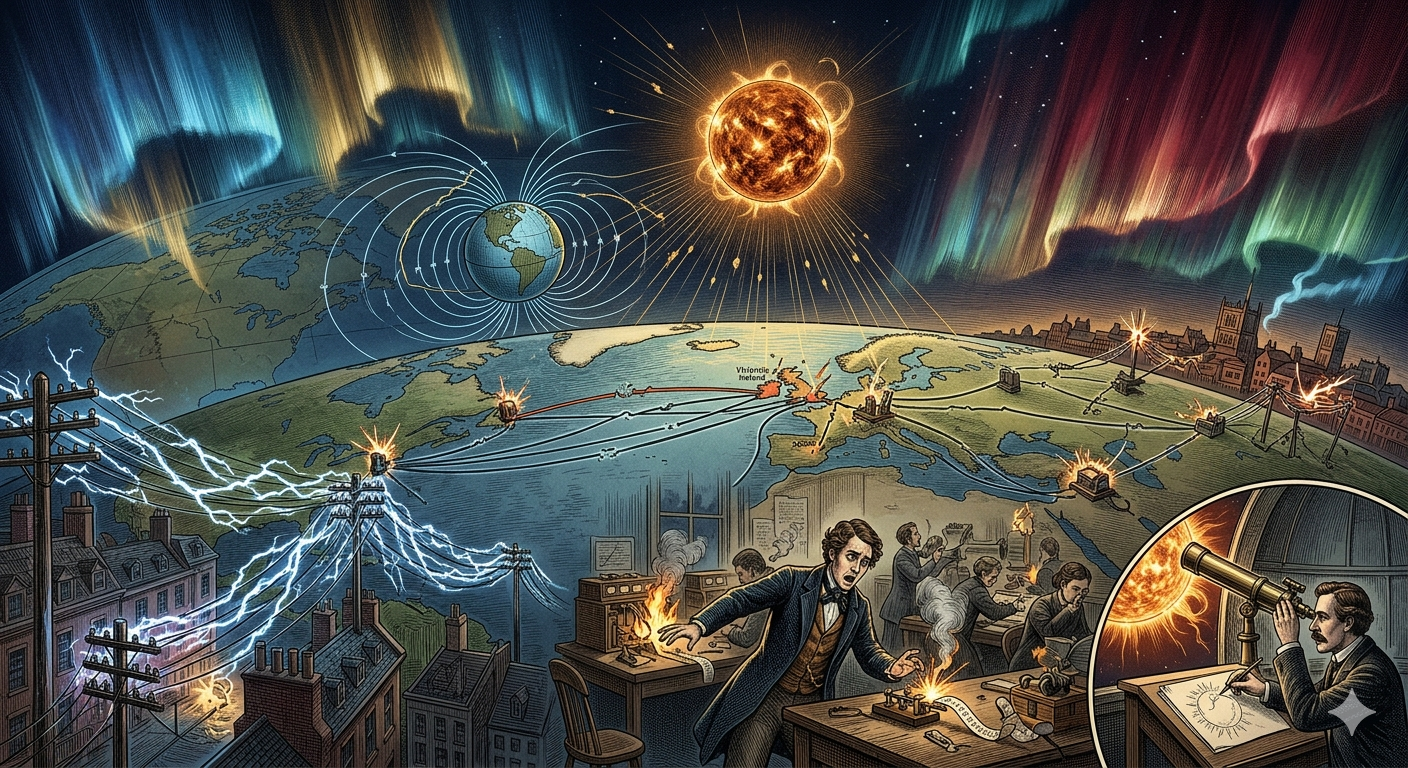
The geomagnetically induced currents produced by the storm interacted catastrophically with this network of wire stretched across the landscape. Telegraph systems all over Europe and North America failed. In some cases, the operators received violent electric shocks that were strong enough to knock them from their chairs. Telegraph pylons threw sparks. The paper on which telegraph printers recorded incoming messages caught fire from sparks leaping from the machines. At some stations, fires broke out in the equipment rooms. The magnetic disturbance was so extreme that the sensitive galvanometers that measured telegraph current swung violently off their scales, becoming useless as indicators of the signal. The New York Times reported on September 2 that the telegraph lines in Boston were all interrupted for several hours, and some of them were so badly injured that they would not be repaired for several days.
Yet the storm produced one of the most remarkable phenomena in the history of communications: the ability to transmit telegraph messages without any connection to a battery or power source whatsoever. The enormous auroral currents induced in the telegraph wires by the geomagnetic storm were so strong that they actually exceeded the normal operating current of the telegraph system, making it possible — at least intermittently — to transmit and receive messages using only the electrical power provided by the storm itself. This phenomenon was documented most memorably in a conversation between operators at the American telegraph line between Boston, Massachusetts, and Portland, Maine, on the night of September 2, 1859, as reported in the Boston Evening Traveler: the Boston operator asked the Portland operator to disconnect his battery entirely for fifteen minutes, then reported that his own battery was disconnected and that they were working with the auroral current. The Portland operator replied that the signal was better than with their batteries on. For a brief, extraordinary period on the night of the worst geomagnetic storm in recorded history, the sky itself was powering the world’s telegraph network.
The September 2, 1859, edition of the New York Times provided one of the most vivid contemporary accounts of the storm’s auroral effects over New York City: the city was visited by one of the most brilliant displays of the aurora borealis that had been witnessed for many years, with the sky clear, the stars shining with unusual brilliancy, and a faint light appearing in the north around nine o’clock that gradually increased in brightness until it reached the zenith. The aurora assumed a variety of forms throughout the night, with the whole heavens at times illuminated with a brilliant light so intense that the stars were entirely obscured. The New York Times also reported the magnetic storm that was affecting all the telegraph lines in the country. The London Times reported separately that the magnetic compasses were so much affected on the nights of September 1-2 that it was impossible to steer by them, and that the aurora borealis was seen in many places where it was rarely seen, with some places so bright that it was possible to read by it.
The Global Aurora: Blood-Red Skies Seen From Cuba to Chile, Hawaii to Hawaii
The auroral displays produced by the Carrington geomagnetic storm were among the most spectacular and geographically widespread in recorded history, and the eyewitness accounts compiled from sources around the world constitute one of the most extensive records of a natural light phenomenon ever assembled. Auroras — normally confined to the polar regions where the Earth’s magnetic field channels charged particles into the upper atmosphere — were observed during the Carrington storm at latitudes that had never before, in living memory, experienced the phenomenon. The aurora borealis was visible as far south as Cuba in the Caribbean, as far south as Honolulu in Hawaii, and reportedly as far south as Venezuela and other parts of South America. The aurora australis in the Southern Hemisphere was simultaneously observed as far north as Santiago, Chile. At latitudes where the aurora had previously been an extremely rare or entirely unknown sight, the displays of September 1-2, 1859, were interpreted by many observers as supernatural events — divine signs, celestial fires, or portents of war and disaster.
The color and intensity of the auroras differed from those seen at higher latitudes in ordinary geomagnetic activity. At normal auroral latitudes, the displays tend to produce the familiar green curtains and ribbons associated with oxygen atoms at high altitudes. But the 1859 storm was so intense that it drove auroral effects to much lower altitudes and produced the characteristic deep crimson-red glow of oxygen at lower atmospheric heights — a color that eyewitnesses described as blood red, fiery red, or a deep crimson that bathed the entire sky. A reporter for the Rocky Mountain News wrote of observations from high in the Rocky Mountains on the night of September 1: On the night of [September 1] we were high up on the Rocky Mountains sleeping in the open air. A little after midnight we were awakened by the auroral light, so bright that one could easily read common print. Some of the party insisted that it was daylight and began the preparation of breakfast. In the northeastern United States, people were reported to be able to read newspaper print by the light of the aurora at midnight — something that had no precedent in the living memory of most Americans.
At sea, the effects were equally dramatic and practically disruptive. The geomagnetic storm distorted compass readings on ships crossing the Atlantic and Pacific oceans, making navigation by compass effectively impossible during the storm’s peak. Ship logs from vessels at sea on September 1-2 recorded sudden, violent oscillations of compass needles that rendered the instruments useless for direction-finding. For navigators in an era before GPS, radio navigation, or any form of electronic position-fixing, reliable compass bearing was an absolute prerequisite for safe passage, and the Carrington storm stripped many ships of their primary means of navigation without warning. The disruption was temporary — compass needles returned to their normal behavior as the storm subsided — but the incident demonstrated that the Carrington Event’s effects were not confined to land-based technology.
Elias Loomis and the Scientific Documentation of the 1859 Storm
The scientific community’s response to the Carrington Event was rapid and comprehensive, and the most systematic contribution to its documentation came from American mathematician Elias Loomis of Yale University, who undertook a massive international effort to collect and analyze first-hand accounts of the storm’s effects from correspondents around the world. Loomis had been interested in the science of auroral phenomena for years and recognized immediately that the September 1859 storm represented an unprecedented opportunity to map the geographic extent and temporal progression of a major geomagnetic disturbance. Between 1859 and 1862, he published nine separate papers in the American Journal of Science presenting the results of his collection and analysis of worldwide reports, compiling data from telegraph operators, ship captains, meteorological observers, and ordinary citizens across North America, Europe, South America, Australia, and other regions.
Loomis’s compilation was invaluable both for establishing the factual record of what had occurred and for providing the scientific community with the evidence needed to assess the relationship between Carrington’s solar observation and the global geomagnetic disturbance. The sheer geographic breadth of the aurora reports he collected — extending to within approximately 23 degrees of the geomagnetic equator in both hemispheres at the storm’s peak on August 28-29 and September 2-3 — confirmed that the 1859 event was genuinely global in its extent, not merely a regional North Atlantic phenomenon exaggerated by sensationalist newspaper reporting. The telegraph disruption reports he gathered documented the economic impact of the storm on the telegraph networks: a significant portion of the world’s 200,000 kilometers of telegraph lines were rendered unusable for eight hours or more at the height of the storm, representing a real economic disruption to the communications infrastructure on which commerce and government had come to depend.
The Science of What Happened: Coronal Mass Ejections, Solar Wind, and Magnetospheric Compression
The Carrington Event of 1859 occurred during Solar Cycle 10, which reached its sunspot maximum in February 1860. The storm thus occurred approximately ten months before the peak of solar activity, demonstrating that extreme geomagnetic events are not strictly confined to the peak of the solar cycle and can occur at any phase when conditions are right. The sunspot group that produced the Carrington flare had been growing visibly since at least late August 1859, reaching an area on the solar surface more than ten times the diameter of the Earth — one of the largest sunspot groups ever recorded. The size and complexity of the sunspot group were consistent with the kind of magnetic field topology that produces the most energetic solar flares and coronal mass ejections.
What Carrington observed on the morning of September 1, 1859, was what modern solar physicists call a white-light flare — an eruption so energetically powerful that it was bright enough to be visible in the full disk of sunlight rather than only in the narrower wavelength ranges typically used for solar observation. White-light flares are among the most energetic events the sun produces, representing an explosion on the solar surface with the energy equivalent to approximately ten billion atomic bombs, releasing intense radiation across the electromagnetic spectrum from radio waves to X-rays and gamma rays. This radiation, traveling at the speed of light, reached Earth approximately eight minutes after the flare — which is why the Kew Observatory magnetometer registered a disturbance (the magnetic crochet observed by Balfour Stewart) almost simultaneously with Carrington’s visual observation of the flare.
The more destructive component of the event was the coronal mass ejection that followed the flare — an enormous bubble of magnetized plasma, billions of tons of charged particles ejected from the sun’s corona and accelerated to extraordinary velocities by the energy of the flare. CMEs typically travel at between 250 and 2,000 kilometers per second through interplanetary space, but the Carrington CME was among the fastest ever measured, traveling at approximately 2,700 kilometers per second and covering the 150 million kilometer distance from the sun to Earth in just 17.6 hours — dramatically faster than the typical journey of two to four days. When this wall of magnetized plasma collided with Earth’s magnetosphere — the protective magnetic bubble that surrounds our planet — it compressed the sunward face of the magnetosphere from its normal position at approximately 65,000 kilometers altitude to well within the orbit of geostationary satellites, while simultaneously stretching the nightside magnetosphere out in a long tail that shed enormous pulses of electrical energy into the upper atmosphere through the polar regions and far beyond.
The geomagnetically induced currents (GICs) that disrupted the telegraph network were the ground-level expression of the enormous electrical currents flowing in the ionosphere above, driven by the energy deposited by the storm into Earth’s upper atmosphere. When a rapidly changing magnetic field sweeps over a conductor — such as the thousands of kilometers of telegraph wire stretched across the landscape — it induces an electrical current in that conductor by exactly the same physical principle as an electrical generator. The more rapidly the magnetic field changes, and the more conductive the material and the longer the conductor, the stronger the induced current. The Carrington storm’s magnetic field varied with extreme rapidity and enormous amplitude, inducing currents in telegraph wires that overwhelmed the normal operating voltages and either disrupted the systems entirely or produced the surpluses of electrical energy that allowed some lines to operate without batteries.
The First Proof of the Solar-Terrestrial Connection: What 1859 Taught Science
The Carrington Event was not merely a spectacular natural phenomenon. It was the event that proved, for the first time in the history of science, that the sun could directly and physically affect conditions on Earth beyond simply providing heat and light. Before 1859, the scientific understanding of the sun’s influence on Earth was essentially limited to Newton’s proof of gravitational attraction between the sun and the planets, and the obvious fact that solar light and heat determined the planet’s climate. The idea that the sun could reach across 93 million miles of space and disturb Earth’s magnetic field, induce electrical currents in wires, and produce auroras visible in the tropics was, before September 1859, a speculation without observational foundation. The Carrington Event provided that foundation, and its implications for what we now call space weather — the study of how solar and geomagnetic activity affect near-Earth space and human technology — cannot be overestimated.
The Scientific American of October 15, 1859, stated that a connection between the northern lights and the forces of electricity and magnetism was now fully established — a remarkably confident scientific conclusion drawn just six weeks after the event. The paper noted that the magnetic instruments at Kew had been simultaneously disturbed and that the connection had been confirmed by multiple independent observations. For the astronomy and physics communities of 1859, this was a fundamental revision of the understood relationship between the sun and Earth: from a purely gravitational and radiative relationship to one that included electromagnetic phenomena of potentially enormous practical significance.
Carrington himself, in the careful language of the cautious empiricist, had pointed toward this conclusion while declining to assert it definitively. His observation that one swallow does not make a summer was not a denial of the connection but a proper scientific acknowledgment that a single case, however compelling, was not sufficient for a general conclusion. The subsequent accumulation of evidence from Stewart’s magnetometer, Hodgson’s corroboration, Loomis’s global documentation, and decades of subsequent solar observation ultimately confirmed what Carrington had seen but hesitated to claim: that solar activity and terrestrial magnetic and electrical phenomena are intimately and causally connected, and that the sun’s behavior poses a direct and significant hazard to human technology in ways that no one had previously imagined.
Subsequent Major Solar Storms: From 1872 to the Near-Miss of 2012
The Carrington Event stands alone in the historical record for its intensity, but it has not been without successors, and the history of solar storms since 1859 provides essential context for understanding the Carrington Event’s place in the spectrum of solar activity. A very strong solar storm in February 1872 produced widespread auroral and telegraphic disturbances across Europe, Asia, and North America, being described by some contemporary observers as approaching the intensity of the 1859 event, though modern analysis suggests it was significantly less severe. A major storm in May 1921 — the New York Railroad Storm, so called because it disrupted railway signal systems in the northeastern United States and caused fires in telegraph and telephone exchanges — was by some measures comparable to the Carrington Event in its magnetic intensity, though it occurred in an era of more limited electrical infrastructure and thus caused less documented damage than a similar storm would cause today.
In March 1989, a severe geomagnetic storm — classified as a G5, the highest category on the NOAA space weather scale — knocked out power across large sections of the Canadian province of Quebec, leaving approximately six million people without electricity for up to nine hours and causing hundreds of millions of dollars in damage to power transmission infrastructure. The Quebec blackout demonstrated vividly that geomagnetic storms remained a serious technological threat even in the modern era, despite the decades that had elapsed since 1859 and the significant advances in electrical engineering that had occurred in the meantime. The 1989 storm was, by most measurements, significantly less intense than the Carrington Event — perhaps a third to a half as powerful — yet it produced a major regional power failure with significant economic consequences.
Perhaps the most sobering demonstration of continuing Carrington-scale risk came on July 23, 2012, when a coronal mass ejection of truly extraordinary size and velocity erupted from the sun. Measurements made by NASA’s STEREO-A spacecraft, which was positioned to observe the event from a different angle than Earth, indicated that this CME was traveling at approximately 2,500 kilometers per second — nearly as fast as the Carrington CME — and that its magnetic field strength was comparable to the 1859 event. Had Earth been in the path of this CME, modern researchers believe it would have caused catastrophic damage to the global electrical infrastructure on a scale that would have dwarfed the 1989 Quebec blackout by orders of magnitude. The CME missed Earth by approximately nine days in Earth’s orbital position around the sun — a narrow margin that physicists noted with considerable relief and a degree of alarm about how close civilization had come to an unplanned encounter with a Carrington-class event.
Richard Carrington’s Later Life and Legacy: Triumph and Tragedy
The Carrington Event of September 1859 was the peak of Richard Carrington’s scientific life. The recognition that followed — his election as a Fellow of the Royal Society on June 7, 1860; the continued praise for his sunspot observations; the eventual publication in 1863 of his comprehensive Observations of the Spots on the Sun, which documented the differential rotation of the solar surface that now bears his name as the Carrington Rotation — consolidated his standing as one of the most important solar observers of the Victorian era. The Carrington Rotation, the approximately 27-day period used by solar physicists as the standard reference frame for tracking solar features, is named in his honor and continues to be used in contemporary solar research.
But Carrington’s personal life was marked by misfortune that contrasted sharply with his scientific success. In 1865 his health began to fail, and he largely ceased his active observational work from that year onward. The brewery business that had funded his astronomical career faced difficulties, and financial pressures compounded his health problems. He sold his Redhill observatory in 1865, the same year his health deteriorated. His wife, whom he had married in 1869, died under suspicious circumstances — a death that generated contemporary speculation and legal inquiry. Carrington himself died on November 27, 1875, at the age of forty-nine, having been largely inactive in science for the last decade of his life. The man who had made the most important observational discovery in Victorian solar physics — and who had been the first human being to see a solar flare, the first to observe the differential rotation of the sun, and one of the first to suggest the solar-terrestrial connection — died in relative obscurity, his greatest achievement named not after the flare that he observed but after the geomagnetic storm that it caused, which came to be known by later generations as the Carrington Event.
What a Carrington Event Would Do to the Modern World: A 21st-Century Assessment
The scientific and policy significance of the Carrington Event in the twenty-first century is not historical but urgently practical. The civilization of 2024 is orders of magnitude more dependent on electrical technology than the Victorian civilization of 1859, and the potential consequences of a Carrington-scale geomagnetic storm striking Earth today are proportionally more severe. A comprehensive assessment published by the National Academy of Sciences in 2008 estimated that a Carrington-class storm striking the modern United States could cause between one and two trillion dollars in economic damage — approximately four to eight times the annual GDP of Argentina — and that recovery from the damage to the electrical power infrastructure could take four to ten years.
The specific vulnerabilities of the modern power grid to geomagnetically induced currents differ in important respects from the vulnerabilities of the 1859 telegraph network. Modern power grids operate at much higher voltages and over much longer distances than Victorian telegraph networks, making them even more susceptible to damage from GICs. The most critical vulnerability lies in high-voltage power transformers — the enormous and expensive devices that step electricity up to the very high voltages used for long-distance power transmission and then step it back down for distribution to homes and businesses. These transformers are custom-built to order, typically take one to three years to manufacture and deliver, and are not stockpiled in significant quantities anywhere in the world. A severe geomagnetic storm could destroy hundreds or thousands of such transformers simultaneously, creating a power grid restoration problem of unprecedented scope and duration.
Beyond the power grid, the modern world’s dependence on satellite technology creates a category of vulnerability that simply did not exist in 1859. A Carrington-scale geomagnetic storm would expose satellites in Earth orbit to intense radiation and could disrupt or destroy spacecraft electronics, degrade or eliminate GPS navigation, interrupt satellite communications, and disable the weather monitoring satellites that modern society depends on for everything from aviation safety to agricultural planning. The Global Positioning System, whose signals underlie not only navigation but also the precise timing signals that synchronize financial transactions, telecommunications networks, and power grid operations, would be severely disrupted. The combination of power grid damage, satellite disruption, and communication system failure could produce cascading infrastructure failures far more severe than any single element of the damage alone would suggest.
The Legacy of 1859: Space Weather Science, Monitoring Systems, and Preparing for the Next Carrington Event
The scientific legacy of the Carrington Event runs through the entire history of space weather research, a field that barely existed before 1859 and that now constitutes one of the most practically important domains of applied science. The fundamental conceptual breakthrough that the 1859 event forced upon the scientific community — that the sun can directly cause physical effects on Earth beyond gravity and light — created the intellectual framework within which all subsequent solar-terrestrial research has been conducted. The mechanisms that Carrington and his contemporaries could only speculate about — what we now understand as coronal mass ejections, solar wind, magnetospheric dynamics, ionospheric physics, and geomagnetically induced currents — have been elaborated through 165 years of subsequent observation and theory into a comprehensive scientific discipline with both fundamental and applied dimensions.
Today, the primary early warning system for Carrington-class solar events is the network of space weather monitoring satellites operated by agencies including NOAA, NASA, and the European Space Agency. The Deep Space Climate Observatory (DSCOVR), positioned at the L1 Lagrange point approximately 1.5 million kilometers sunward of Earth, continuously monitors the solar wind and CME arrival, providing approximately 15 to 60 minutes of advance warning before a major CME strikes Earth’s magnetosphere. While 15 to 60 minutes is not enough time to implement extensive protective measures — the preparation of the electrical grid and satellite operators for a major space weather event requires hours to days of advance warning, which can sometimes be provided by solar observatories that detect CMEs departing the sun — it is enough time to alert astronauts on the International Space Station, warn satellite operators to put their spacecraft in safe mode, and enable some emergency protective steps for the most vulnerable grid components.
Conclusion: September 1, 1859 and the Discovery That Changed Our Understanding of the Sun
On the morning of September 1, 1859, Richard Carrington had no idea that what he was about to see would become the founding observation of a new scientific discipline, give its name to the most powerful solar storm in recorded history, and remain, 165 years later, the most important benchmark against which all solar storm hazards are measured. He was simply doing what he had been doing every clear morning for years: pointing his telescope at the sun, making careful drawings of sunspots, and recording everything he observed with the meticulous precision of a first-rate Victorian scientific mind. The two patches of intensely bright and white light that erupted before his eyes at 11:18 that morning lasted five minutes — five minutes in which the entire subsequent history of solar physics was, in a sense, inaugurated.
The Carrington Event of September 1-2, 1859, remains the most powerful geomagnetic storm in the documented human record. Its telegraph disruptions, its global auroras visible in the tropics of both hemispheres, its sparks and shocks and fires in the offices of the Victorian Internet, and its remarkable demonstration that the sun’s wire could reach across 93 million miles of empty space to disturb the compasses of ships at sea and the sensitive instruments of physicists on land — all of these effects made it one of the most extraordinary natural events in modern history. The fact that it occurred in an era when the only vulnerable technology was the telegraph network, rather than in an era of global power grids, satellite networks, and internet infrastructure, is what separates the Carrington Event of history from the Carrington-scale catastrophe of a possible future.
The solar flare that Richard Carrington witnessed for five minutes on a clear September morning in Surrey was the first chapter of a story that humanity is still living. We have built a civilization that is more dependent on electrical technology than any civilization in history, and we have built it on a planet whose protective magnetic field is periodically shaken by the same kind of solar violence that Carrington observed. The question of when the next Carrington-class storm will arrive — and whether our technology and our preparedness will be adequate to survive it — is one of the most important practical questions in the science of our time. What happened in September 1859 was not merely history. It was a warning.