On August 2, 1939, Albert Einstein signed a letter addressed to President Franklin D. Roosevelt from his summer cottage at Nassau Point in Peconic, Long Island. The letter was relatively short, running to less than two pages, and written in measured, cautious language that only gradually disclosed the magnitude of what was being described. By its third paragraph, however, the letter had arrived at a sentence that would change the world: “This new phenomenon would also lead to the construction of bombs, and it is conceivable, though much less certain, that extremely powerful bombs of a new type may thus be constructed. A single bomb of this type, carried by boat and exploded in a port, might very well destroy the whole port together with some of the surrounding territory.”
The letter did not reach Roosevelt until mid-October 1939, delayed by the outbreak of war in Europe when Germany invaded Poland on September 1. When Roosevelt finally read it, he replied with a brief note and authorized the creation of the Advisory Committee on Uranium, the modest governmental body that represented the first formal step of the United States government toward what would eventually become the Manhattan Project. The letter Einstein signed that summer afternoon is widely regarded as one of the most consequential pieces of correspondence in modern history, and the story of how it came to be written reveals as much about the men who conceived it and the crisis they feared as about the physics that made the atomic age possible.
Nuclear Fission, Leo Szilard, and the Recognition of a Danger
The Einstein-Roosevelt letter of August 2, 1939, was not primarily Einstein’s idea. The driving force behind it was Leo Szilard, a Hungarian-born physicist who had been thinking about the possibility of nuclear chain reactions and their implications for weapons development since the early 1930s.
Szilard was born in Budapest in 1898 and had been educated in Germany, where he had known and worked alongside Einstein before both men fled the country after Hitler’s rise to power in 1933. Szilard moved to London, where in 1933, inspired by Ernest Rutherford’s dismissive remark that generating usable power from atomic fission was “moonshine,” he conceived and patented the idea of a nuclear chain reaction. He understood in a way that many of his contemporaries did not that if fission of heavy atoms could release neutrons that in turn triggered further fissions, the resulting exponential release of energy could be either a profound source of power or an equally profound weapon of destruction.
The scientific breakthrough that made the letter urgent came in December 1938, when German physicists Otto Hahn and Fritz Strassmann, working in Berlin, achieved uranium fission. Their colleague Lise Meitner, a Jewish Austrian physicist who had recently fled Germany to Sweden, and her nephew Otto Frisch provided the theoretical explanation: the uranium nucleus had split, releasing enormous energy. Danish physicist Niels Bohr brought this news to the United States in January 1939, and the Fifth Washington Conference on Theoretical Physics opened with Enrico Fermi on January 26, where the results were quickly confirmed experimentally by Fermi and John R. Dunning at Columbia University.
Szilard immediately grasped what German physicists having achieved fission meant for the world. Germany, which had invaded and occupied Czechoslovakia in March 1939, now controlled the Joachimsthal uranium mines in Czech Bohemia, the most significant uranium deposits in Europe outside the Belgian Congo. Szilard knew that German physicists, among the most talented in the world, were now working under a government that had demonstrated both genocidal intentions toward Jews and aggressive territorial ambitions against its neighbors. If Germany developed nuclear weapons before the Allies, the consequences could be catastrophic.
Szilard was not alone in his alarm. His fellow Hungarian refugee physicists Eugene Wigner and Edward Teller shared his concerns. All three had grown up in a Hungary that had experienced fascist and communist revolutions, and all three had fled Nazi Germany. They had no illusions about what the regime was capable of. Szilard and Wigner drove to Einstein’s Long Island cottage on July 12, 1939, to discuss the situation.
Einstein’s Reaction and the Decision to Write
When Szilard and Wigner found Einstein on July 12 and explained the possibility that fission could be used to construct weapons of enormous destructive power, Einstein’s reported reaction was striking in its honesty: “Daran habe ich gar nicht gedacht,” he said in German. “I did not even think about that.”
Einstein’s famous mass-energy equivalence equation, E=mc², which he had published in 1905, mathematically described the relationship between mass and energy that made nuclear weapons theoretically possible. But Einstein had not pursued the practical implications of his own theory into the realm of weapons design. He was a theorist of exceptional brilliance but not an experimental physicist, and the path from the mass-energy equation to a working nuclear weapon required decades of subsequent experimental work by dozens of other scientists.
The meeting on July 12 produced a preliminary letter, which Einstein signed in German to be sent to the Belgian government warning it about the uranium deposits in the Belgian Congo. Wigner transcribed it. But Szilard and his colleagues recognized that the American government was the critical audience. They needed someone with access to Roosevelt and sufficient credibility to be taken seriously. Einstein’s name was essential: he was the most famous scientist in the world, a Nobel Prize winner recognized everywhere, and a man whose authority on questions of physics was unquestioned.
On August 2, Szilard returned to Long Island, this time with Edward Teller as his driver since Wigner was unavailable. Sachs and Szilard had drafted a new letter in English, and Einstein dictated a version in German. Szilard then dictated the English version to a young departmental stenographer named Janet Coatesworth at Columbia University, who later recalled that when Szilard mentioned the possibility of extremely powerful bombs, she was “sure she was working for a nut.” Einstein signed the English letter on August 2, 1939, the document now known as the Einstein-Szilard letter.
The letter was signed from Peconic, Long Island, addressed formally to “F.D. Roosevelt, President of the United States, White House, Washington, D.C.” It began with a cautious, measured description of recent work by Enrico Fermi and Leo Szilard on nuclear chain reactions, identified the possibility of new and powerful explosives, noted that Germany had stopped exporting uranium from the Czech mines it now controlled, mentioned that Germany was currently pursuing its own research into uranium, and recommended that the United States maintain contact with physicists working on chain reactions, secure uranium supplies, and perhaps fund experimental research.
The Wikipedia article on the Einstein-Szilard letter provides a comprehensive account of the scientific and political context in which the letter was written, the roles of each physicist involved, and the governmental response it triggered.
Alexander Sachs and the Long Road to Roosevelt’s Desk
Having Einstein’s signature on the letter was only half the challenge. Getting it to Roosevelt was another matter entirely. Szilard’s first instinct was to approach Charles Lindbergh, the famous aviator and a man of great prestige in America. Lindbergh was contacted but never responded, and it later became clear that his sympathies toward Nazi Germany made him a deeply inappropriate choice.
The actual conduit to Roosevelt was Alexander Sachs, an economist at Lehman Brothers who also served as an unofficial adviser to the president and was one of the few people outside government with reliable personal access to Roosevelt. Sachs agreed to deliver the letter personally, a promise that turned out to be easier to make than to keep. Roosevelt’s staff, aware that Sachs had a reputation as a voluble talker, kept him at arm’s length for weeks to protect the president’s time.
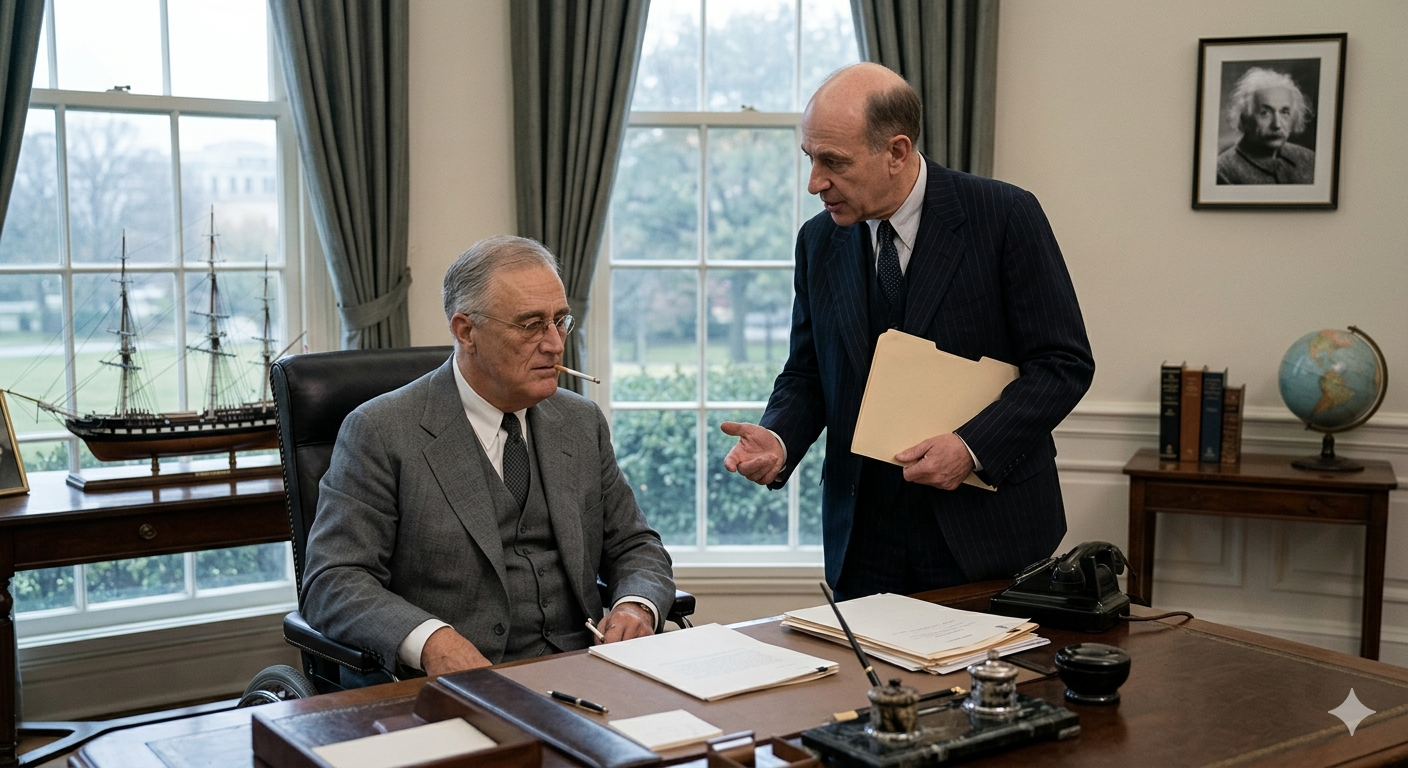
The letter was dated August 2, 1939. Germany invaded Poland on September 1. Britain and France declared war on Germany two days later. The war that Szilard and his colleagues had been trying to prevent, or at least to prepare for, had begun while the letter sat in Sachs’s possession awaiting delivery. It was not until October 11, 1939, more than two months after Einstein had signed it, that Sachs finally secured an appointment with Roosevelt and delivered it in person.
Sachs later recalled that he read the letter aloud to Roosevelt and then used an analogy from military history, comparing the opportunity to Napoleon Bonaparte’s failure to appreciate Robert Fulton’s offer to build him a steam-powered navy, to drive home the significance of what was being proposed. Roosevelt understood immediately. His response, according to Sachs, was to call in his aide General Edwin “Pa” Watson and say: “Pa, this requires action.”
Roosevelt’s Response: The Advisory Committee on Uranium
Roosevelt replied to Einstein briefly on October 19, 1939, thanking him for the letter and informing him that he had created a special committee to investigate the questions raised. This was the Advisory Committee on Uranium, chaired by Lyman James Briggs, the director of the National Bureau of Standards. The other original members were Army representative Colonel Keith Adamson and Navy representative Commander Gilbert Hoover. Szilard, Teller, and Wigner attended the committee’s first meeting on October 21 as the physicists who had initiated the whole process.
The Advisory Committee on Uranium was a modest beginning. Colonel Adamson was openly skeptical about the possibility of building an atomic bomb and was willing to authorize only $6,000, equivalent to approximately $100,000 in current terms, for the purchase of uranium and graphite for Szilard and Fermi’s experiments. This was a cautious, incremental government response to a warning that described weapons capable of destroying entire ports.
The committee’s early work was slow and did not have the urgency that the physicist-advocates had hoped for. Over the following two years, it evolved through several organizational iterations. In June 1940, it was reconstituted as the National Defense Research Committee. In 1941, the Office of Scientific Research and Development was established under Vannevar Bush to coordinate American wartime science. The pace accelerated dramatically after the British MAUD Committee issued its report in July 1941, concluding with considerably more confidence than American researchers had yet mustered that an atomic bomb was genuinely achievable within a few years using enriched uranium. In October 1941, Roosevelt authorized a full-scale development program. After the Japanese attack on Pearl Harbor on December 7, 1941, brought the United States into the war, the program received the additional resources and urgency it needed. The Manhattan Project, the massive American-British-Canadian effort to build nuclear weapons, was formally established in August 1942.
The National Archives Einstein-Szilard letter resource at the Atomic Heritage Foundation provides access to the original text of the letter along with historical context about the scientific work that prompted it.
Einstein’s Role and His Lifelong Regret
The story of Einstein’s role in the events that led to the atomic bomb is deeply complicated by the gap between the man who signed the letter and the men who built what it set in motion. Einstein was not part of the Manhattan Project. His political views, including his lifelong pacifism and his socialist sympathies, caused the US Army intelligence service to deny him the security clearance he would have needed to participate. The FBI’s file on Einstein, maintained by J. Edgar Hoover, ran to thousands of pages. The man whose signature had initiated the chain of events that led to the Manhattan Project was excluded from the project itself.
Einstein also had no direct role in the scientific work of the bomb’s development. The experimental physics that produced the first controlled nuclear chain reaction at the University of Chicago on December 2, 1942, under Enrico Fermi’s direction, and the engineering that built the Trinity test device and the weapons dropped on Hiroshima and Nagasaki, were the work of hundreds of scientists and engineers whose names are far less famous than Einstein’s.
Einstein wrote three more letters to Roosevelt after August 2, 1939, all of them drafted by Szilard and signed by Einstein. The fourth and final letter, dated March 25, 1945, urged Roosevelt to meet with scientists to discuss the policy implications of atomic weapons and their possible international control. Roosevelt died on April 12, 1945, before reading it. The letter was found on his desk, unread, after his death. It was left to his successor, Harry S. Truman, who had not been told about the Manhattan Project until he became president, to make the decision to use the weapons that Roosevelt’s response to Einstein’s letter had set in motion.
Einstein’s own reckoning with what the letter had helped to produce was unambiguous. In 1947, when Newsweek published an article about him under the headline “The Man Who Started It All,” he was quoted saying: “Had I known that the Germans would not succeed in producing an atomic bomb, I would never have lifted a finger.” The fear of German nuclear weapons had been the entire motivation. That fear proved partially unfounded. Germany’s nuclear weapons program, led principally by Werner Heisenberg, never achieved the breakthroughs that Allied scientists feared, partly due to scientific errors and partly due to the Allied bombing campaign and commando operations that disrupted it.
The History.com account of Einstein’s letter to Roosevelt covers the chain of events from the letter’s drafting through Roosevelt’s response and the creation of the Advisory Committee on Uranium.
Einstein spent his final years advocating for nuclear disarmament and international control of atomic weapons. He co-signed the Russell-Einstein Manifesto in April 1955, a document drafted by Bertrand Russell and co-signed by nine other prominent scientists calling for peaceful resolution of global conflict in the nuclear age. Einstein died on April 18, 1955, before the Manifesto was publicly released. He had begun his life as a German-born physicist who believed that science transcended national borders and politics, and who had spent the last twenty years of his life grappling with the consequences of a single document signed on a summer afternoon on Long Island.
The letter Einstein signed on August 2, 1939, was fewer than two pages long. Its language was careful and restrained. The word “bomb” appeared once. But those two pages set in motion a program that employed over 125,000 people, cost approximately two billion dollars, and produced the weapons that killed more than 100,000 people in Hiroshima and Nagasaki in August 1945 and defined the security landscape of the world for the remainder of the twentieth century and beyond. It was, Einstein reportedly called it, “the greatest mistake” of his life, and also one of the most consequential acts of scientific conscience in history.